
ZHIYUN CINEPEER Weebill 3E
4.4Editor score
3 kg tested payload
1.05 kg gimbal weight
Native vertical shooting
Bluetooth shutter control
This guide compares the best gimbal for Sony A7III options by payload, stabilization, tracking, controls, portability, and accessory support.
A gimbal designed for the Sony A7 III should do more than smooth walking shots. It should balance the camera comfortably, control its essential functions, accommodate a suitable lens, and remain dependable across vertical clips, low-angle footage, and longer production days. The right model depends on payload, handling, tracking, and workflow.
This roundup compares ten camera and smartphone stabilizers using their stated specifications, included features, compatibility details, and customer ratings. The list includes compact DJI models, a lighter ZHIYUN option, two FeiyuTech stabilizers, a bundled audio kit, and one phone-focused alternative for creators using different equipment.
Each review identifies the pick's strongest benefits, practical limitations, and most suitable user. The top selections cover a lightweight Sony setup, a premium full-size system, and a capable mid-size model, while the remaining entries show important differences in payload, controls, app support, and included accessories. Current listings can change.
4.4Editor score

4.5Editor score
4.3Editor score
The table below compares each stabilizer by its intended equipment class, weight, load capacity, control features, and most relevant workflow benefit. Two entries are phone-specific and should not be considered direct camera mounts for a Sony A7 III.


The DJI RS 3 Mini is a compact three-axis stabilizer with a 4.3 customer rating. Its defining combination of a stated 795 g weight, 2 kg payload capacity, and 1.4-inch full-color touchscreen makes it one of the more practical choices for travel and everyday Sony A7 III production. It is designed to accept Sony cameras and combines compact handling with recognizable DJI controls.
We may earn a commission when you buy through this link, at no additional cost to you.
The RS 3 Mini uses high-torque motors and DJI's third-generation RS stabilization algorithm. It supports low-angle shooting and flashlight mode, while native vertical shooting is achieved by moving the quick-release plate to the vertical arm rather than rotating the entire camera awkwardly. Bluetooth shutter control can start or stop recording and trigger a photo after initial pairing. These details make the gimbal particularly useful for creators who move between cinematic, social, and vertical formats.
The central compromise is software access. DJI states that the Ronin app has been removed from Google Play and must be downloaded from DJI's official website, which may be inconvenient for buyers accustomed to normal app-store installation. It also does not include the Intelligent Tracking Module listed for the RS 4 Mini. For a Sony A7 III paired with a reasonably compact lens, however, its stated capacity leaves useful room above the camera-and-lens weight.
This is a strong recommendation for travelers, solo filmmakers, and hybrid creators who value portability over maximum payload. Those using a larger zoom lens, heavy accessories, or extensive follow-focus setup should calculate their complete load first. For a typical A7 III body with an everyday prime or compact standard zoom, the RS 3 Mini offers the most straightforward blend of size, control, and stabilization features in the roundup.
At 795 g, the RS 3 Mini is easier to carry throughout a travel day than the larger DJI RS 4 and RS 5. Its touchscreen, Bluetooth shutter control, and native vertical mount preserve the essential controls expected in a modern shooting rig without adding a large control handle.
The stated 2 kg payload can accommodate the A7 III with many standard lens combinations, although the exact camera, lens, battery, and accessory weight should be checked. Proper balancing matters more than approaching the maximum rating.
We may earn a commission when you buy through this link, at no additional cost to you.
The DJI RS 4 Mini is the strongest all-around recommendation for a Sony A7 III, combining a 4.5 customer rating with a compact form and a 2 kg payload. It supports mirrorless cameras, vlogging cameras, and phones, and its starter kit includes the gimbal, tripod, and essential accessories. The package therefore offers a practical foundation for a creator who wants more than basic stabilization.
We may earn a commission when you buy through this link, at no additional cost to you.
Automatic axis locks are one of its most useful workflow features. Instead of manually locking and releasing each axis, the user can move from storage to a shooting configuration in about a second. Teflon-enhanced balancing reduces friction and allows more precise adjustments, while Responsive Follow Mode reacts quickly to hand movement. The Intelligent Tracking Module helps frame a moving person or other subject during orbit shots and solo filming.
The tracking system is not described as an integrated module, so buyers should verify what is included for their intended configuration. DJI also notes that platform compatibility prevents the Ronin app from being found on Google Play, requiring a direct download from the official website. These points add setup friction, but they do not reduce the gimbal's core appeal: fast operation, effective tracking, and a compact body suited to the A7 III.
Choose the RS 4 Mini when you want a capable everyday gimbal without moving to a full-size professional setup. It is particularly attractive for solo creators who want automated locks, responsive following, and tracking support in a travel-friendly package. Confirm the tracking-module package contents and download the app before the shoot, and check your complete A7 III and lens weight before ordering.
Automatic axis locks remove several repetitive setup steps, helping the operator go from packed to ready more quickly. That convenience is especially valuable when moving between locations or switching from conventional footage to short vertical clips.
With the Intelligent Tracking Module, a creator can maintain subject framing during dynamic movement or orbit shots. The module's presence in the package should be confirmed carefully because tracking hardware is central to this recommendation.
We may earn a commission when you buy through this link, at no additional cost to you.
This renewed DJI RS 3 Mini carries a 4.7 customer rating, the highest among the listed products. It retains the core design of the standard RS 3 Mini: a 795 g body, a tested 2 kg payload, Bluetooth shutter control, native vertical shooting, and DJI's third-generation stabilization algorithm. For a knowledgeable buyer, renewed condition can make an otherwise capable A7 III stabilizer more attainable.
We may earn a commission when you buy through this link, at no additional cost to you.
Its feature set covers the essentials for compact mirrorless production. The motors are rated to support camera-and-lens combinations up to the stated tested payload, and native vertical shooting is achieved through the quick-release plate. Bluetooth control allows photo and recording functions to be triggered from the handle, reducing the need to return to the camera during a take.
Renewed status introduces the most important caveat. Cosmetic wear, packaging differences, accessory completeness, and warranty terms can differ from a new unit, so the listing and seller's condition details deserve close attention. The supplied summary also does not mention the Ronin app installation note included with other DJI listings, but the underlying model generally expects compatible app-based operation. Buyers should not assume that every standard accessory is present.
This renewed RS 3 Mini makes the most sense for a buyer who understands the model, prioritizes portability, and wants a capable A7 III setup without paying for the newer RS 4 Mini's automated locks and tracking ecosystem. Inspect the condition description and included components carefully. For a first gimbal purchase where clarity and support are more important, the new RS 3 Mini or RS 4 Mini may be the safer choice.
A renewed unit provides the core RS 3 Mini experience: a light frame, a capable 2 kg tested payload, and practical vertical shooting. Those features remain well aligned with a Sony A7 III and a compact lens.
Condition and accessory details matter more than with a new unit. Review the listing, warranty information, and included items before purchase rather than assuming the package is identical to the standard RS 3 Mini bundle.
We may earn a commission when you buy through this link, at no additional cost to you.
The ZHIYUN CINEPEER Weebill 3E offers one of the most useful combinations of capacity and portability in this guide. Its 4.4 customer rating, 3 kg tested payload, and 1.05 kg body make it well suited to a Sony A7 III, particularly for creators who may use a heavier zoom than the compact DJI Mini models comfortably accommodate.
We may earn a commission when you buy through this link, at no additional cost to you.
Native vertical shooting works by mounting the quick-release plate to the vertical arm, which is convenient for reels, shorts, and livestream-style content. Bluetooth shutter control can start and stop recording or trigger photos after initial connection. The listed battery life reaches 16 hours, with a stated two-hour-and-46-minute charging time when using 14W PD fast charging. Its wide-axis arm is also listed as compatible with major mirrorless cameras and DSLRs, including several 24-70 mm combinations.
The important accessory limitation is explicit: the package includes the Panasonic control cable LN-UCUC-A02, while Sony and other camera brands require an additional compatible control cable. Without that cable, basic stabilization can still be used, but remote shutter or recording control through the stated wired connection is unavailable. The optional sling grip and wrist rest are also sold separately, so Sling Mode 2.5 is not automatically part of the package.
The Weebill 3E is our best-value choice for an A7 III creator who prioritizes payload, battery endurance, and low weight. Buy the appropriate Sony control cable if remote operation is important, and treat the sling grip as an optional comfort accessory rather than an included feature. For most balanced mirrorless configurations, its stated capacity offers generous headroom.
A 3 kg tested payload gives the A7 III more room for larger zoom lenses or a modest accessory arrangement than 2 kg Mini models. It is a meaningful advantage for creators who change lenses frequently.
The stated maximum battery life of 16 hours reduces the likelihood of an all-day shoot being interrupted by a depleted internal battery. Actual runtime depends on the payload, movement, and enabled functions.
We may earn a commission when you buy through this link, at no additional cost to you.
The DJI RS 3 Mini Mic Kit bundles the compact RS 3 Mini with two Mic Mini transmitters, one receiver, and a charging case. With a 4.3 customer rating, it is aimed at creators who want a ready-to-use video and audio package rather than a gimbal alone. The stabilization side retains the RS 3 Mini's 795 g weight and 2 kg payload capacity.
We may earn a commission when you buy through this link, at no additional cost to you.
Its audio component supports 48 kHz recording, a transmission range of up to 400 meters, and two levels of noise cancellation. The transmitters are listed at 10 g each, and the charging case supports up to 48 hours of battery life. Automatic limiting is included to reduce the risk of audio clipping. Together with the gimbal's 1.4-inch color touchscreen and Bluetooth shutter control, the package supports a streamlined solo-production setup.
This bundle does not solve every production requirement by itself. The wireless microphone system captures sound, but it does not add a headphone monitoring solution to the listed features, and the package does not mention a tracking module for the gimbal. Users who already own reliable wireless audio may gain little from the microphones and still have to carry the extra components. It is also a separate ASIN from the standard RS 3 Mini, so package contents should be compared carefully.
Choose this kit for a new creator building a travel vlog, interview kit, or social-video package around a Sony A7 III. The combination reduces the need to source a gimbal, two transmitters, a receiver, and a charging case separately. For established creators who already own a microphone system or need advanced tracking, the standard gimbal options may offer a more focused and less cluttered setup.
Two transmitters allow more than one participant to be captured in many production situations, while the included receiver and charging case complete the basic wireless workflow. This makes the bundle practical for interviews and collaborative travel content.
Automatic limiting is designed to reduce accidental clipping, while two-level noise cancellation can improve recordings in imperfect acoustic conditions. These features do not replace careful microphone placement or a controlled recording environment.
We may earn a commission when you buy through this link, at no additional cost to you.
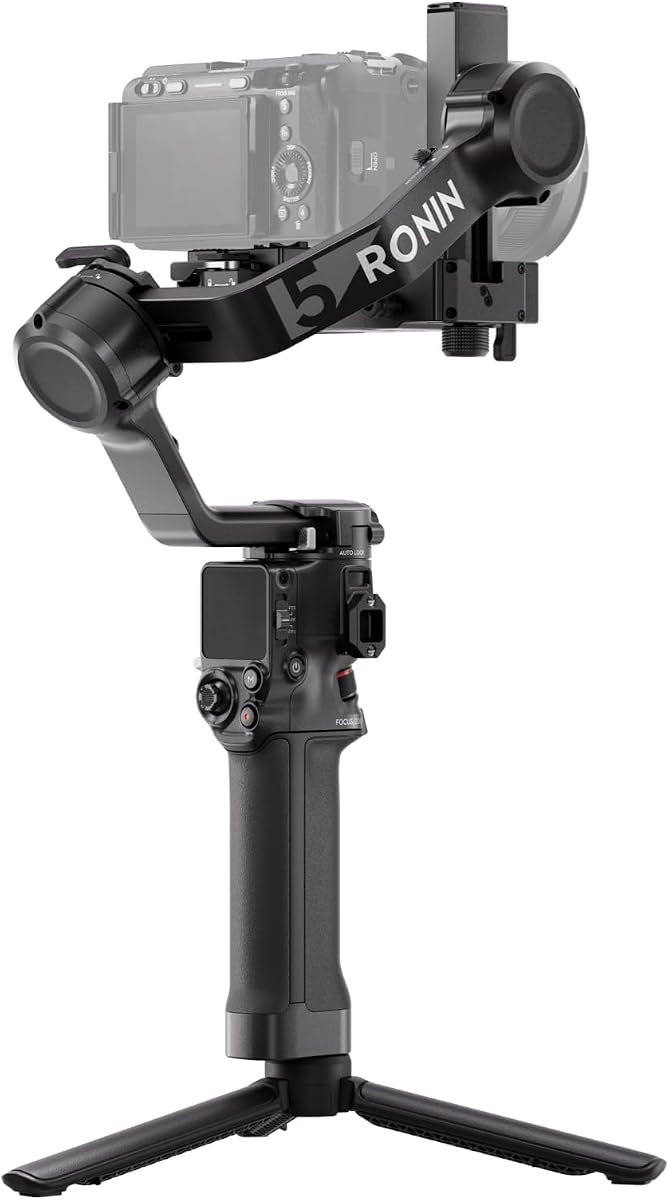
The DJI RS 5 is the premium recommendation for creators who want a highly refined control system around a Sony A7 III. It carries a 4.3 customer rating and differentiates itself with fine-tuning knobs on each axis arm, automated axis locks, a Z-axis indicator, an electronic briefcase handle, and enhanced subject tracking. The package includes a quick-open tripod, BG33 battery grip, and other accessories.
We may earn a commission when you buy through this link, at no additional cost to you.
Its balancing system is particularly relevant to the A7 III because a mirrorless body with a heavier zoom can become difficult to fine-tune on a simpler gimbal. Teflon interlayers and dedicated adjustment knobs support a smoother setup, while the Z-axis indicator provides visual feedback to help the operator reduce vertical imbalance. Second-generation automated axis locks streamline storage and deployment, which is valuable during fast location changes.
Tracking is described through an Enhanced Intelligent Tracking Module capable of framing and following a person, vehicle, or pet from the touchscreen. The electronic briefcase handle offers single-handed operation through a joystick and buttons, reducing fatigue when working around a larger rig. The stated one-hour full charge, up to 14 hours of standby time, 60% faster charging, and 15% longer runtime also support a professional production schedule.
DJI notes that the Ronin app must be obtained from the official website because of platform compatibility. Users should also confirm which controls and accessories are included, especially because premium ecosystems often depend on optional modules and proprietary connections. Even so, the RS 5 is the most advanced option here for users who prioritize precise balancing, responsive physical controls, premium tracking, and long-term workflow refinement over the lowest possible carry weight.
Per-axis fine-tuning knobs and Teflon interlayers make the balancing process more deliberate and repeatable. The Z-axis indicator gives immediate visual guidance, which is helpful when mounting an A7 III with a larger lens.
The electronic briefcase handle puts a joystick and camera controls beneath the user's hand. That arrangement supports single-handed operation and can reduce fatigue during extended follow shots.
We may earn a commission when you buy through this link, at no additional cost to you.
The DJI RS 4 is a full-size stabilizer for creators who need more payload and accessory flexibility than the Mini models offer. Its 4.5 customer rating, 3 kg capacity, and extended tilt axis make it a natural fit for a Sony A7 III paired with a substantial zoom or a more involved accessory arrangement. It includes a gimbal, BG21 battery grip, quick-release plate, and extended grip/tripod.
We may earn a commission when you buy through this link, at no additional cost to you.
The second-generation native vertical shooting design uses a horizontal plate that can be released and repositioned for vertical content. Mode controls cover PF, PTF, and FPV, with the ability to select 3D Roll 360 or Custom operation in FPV. Teflon-coated axis arms reduce friction for more precise balancing, and the 8.5 mm extension of the tilt axis creates additional balancing space for mirrorless configurations.
The RSA communication port expands the control ecosystem, allowing compatible tethered handles and third-party control or remote-control rings. A BG70 high-capacity battery grip can extend runtime from 12 to 29.5 hours and provide camera and accessory power, but that grip is sold separately. The RS 4 is consequently less of a simple all-in-one purchase and more of a platform for users who intend to expand their equipment.
This is an excellent choice for professional or advanced hybrid creators who regularly use heavier lenses, need multiple gimbal modes, or want a tethered control ecosystem. It is less compelling for someone whose priority is the lightest possible travel package. For the A7 III, it provides ample stated capacity and excellent vertical support, but buyers should account for its larger size and the potential extra cost of accessories.
The 3 kg payload and extended tilt axis offer more room than compact 2 kg gimbals. This is valuable when the A7 III carries a larger zoom, battery grip, or additional production hardware.
The RSA port and optional high-capacity grip make the RS 4 suited to creators who want to expand control and power options over time. The modular approach is a strength for established workflows but may be unnecessary for simple solo recordings.
We may earn a commission when you buy through this link, at no additional cost to you.
The hohem iSteady X3 is a phone-oriented three-axis stabilizer with a 4.2 customer rating. It is not a conventional mount for the Sony A7 III, so it does not compete directly with the camera gimbals in this list. It is included because many Sony A7 III creators also produce vertical social content on a phone and may prefer a compact, self-contained mobile setup.
We may earn a commission when you buy through this link, at no additional cost to you.
Its features emphasize solo shooting and portability. A detachable controller supports operation from up to 32.8 feet away, while upgraded iSteady 8.0 stabilization is designed for movement with iPhone and Android devices. The unit folds into a pocket-size form, weighs a listed 0.93 lb, and converts between handheld, tripod, extension-rod, and low-angle configurations.
AI tracking and gesture control are available through the Hohem Joy app, allowing the phone gimbal to follow movement or respond to commands. A magnetic fill light provides adjustable brightness and multiple tones for indoor scenes, night content, and streaming. The trade-offs are inherent to the phone format: it cannot stabilize the A7 III, and several advanced functions depend on app behavior and phone compatibility.
Choose the iSteady X3 as a companion tool rather than a Sony A7 III gimbal. It is well suited to creators who want remote phone operation, compact travel storage, and rapid movement between landscape and portrait capture. If the Sony A7 III itself is the required camera, use one of the camera-specific stabilizers instead and consider this model only for supplementary mobile content.
The removable controller lets the operator start a phone recording and step away from the device. That makes the gimbal useful for dance demonstrations, product views, fitness clips, and other shots that are difficult to frame alone.
Portrait and landscape switching, a foldable design, extension rod, tripod mode, and magnetic light provide several useful functions in one package. It complements a camera workflow without trying to replace a mirrorless-camera stabilizer.
We may earn a commission when you buy through this link, at no additional cost to you.
The FeiyuTech SCORP 2 is a 4.4-rated mirrorless and DSLR stabilizer with a 2.5 kg payload. Its integrated AI tracking sensor distinguishes it from gimbals that require a separate tracking module. The feature set makes it a relevant option for a Sony A7 III creator who wants subject tracking in a compact three-axis design without adding another attachment.
We may earn a commission when you buy through this link, at no additional cost to you.
An OK gesture can begin tracking, while other gestures control photography and video. The upgraded quick-installation system uses L-shaped mounting plates and an anti-off quick-release slider, which can be installed directly on the vertical arm for fast vertical shooting. A 1.3-inch touchscreen displays filming status and parameters, and a multi-function knob controls individual axis rotation or electronic zoom.
Camera control can be wired or performed over Bluetooth, including shutter triggering and focus activation. FeiyuTech's app adds parameter adjustment and somatosensory remote control, allowing a phone's gravity sensor to direct the lens remotely. This expands useful functions but also introduces a software dependency. The SCORP 2's 2.5 kg capacity is below the DJI RS 4 and RS 5 but should give an A7 III with a moderate lens some useful headroom.
The SCORP 2 is a compelling option for a creator who prioritizes integrated tracking and gesture control over maximum payload or a large professional handle. It works particularly well for solo demonstrations, walking videos, and controlled social productions. Check the specific Sony camera-control cable requirements and the app's current compatibility before relying on remote focus, zoom, or recording functions.
The integrated AI sensor removes the need to attach a dedicated tracking module. Gesture activation can simplify solo operation, although stable subject recognition still depends on framing, lighting, and movement.
The combination of touchscreen, multifunction knob, wired control, and Bluetooth control gives the operator several ways to manage recording and zoom. That flexibility is useful across different camera setups and shooting styles.
We may earn a commission when you buy through this link, at no additional cost to you.
The FeiyuTech SCORP 3 KIT is the most feature-heavy package in the roundup, with a 4.2 customer rating and a maximum payload of 3.5 kg. That capacity comfortably accommodates a Sony A7 III with a larger lens and several accessories, while the extended axis arms and repositionable slider provide room to refine camera placement.
We may earn a commission when you buy through this link, at no additional cost to you.
Its standout feature is a detachable underslung handle that doubles as a wireless remote. Creators can monitor framing, change modes, and adjust camera settings from up to 39 feet away. The built-in AI tracking module is described as hardware-level and requires no app download or Bluetooth pairing for tracking, which reduces setup friction. The modular camera and slider can also rotate 90 degrees for a one-second vertical switch without extra tools.
The kit includes a carrying box, carbon fiber extension pole, weight-reducing shoulder strap, articulating arm, and fill light. This is a generous creator package, but it is also more equipment to carry and configure. For a compact mobile workflow, those accessories may be unnecessary. The touchscreen handle is particularly useful for remote operation, while the extension pole and shoulder strap support alternative ways of supporting the rig.
Choose the SCORP 3 KIT when you want a high-capacity Sony A7 III stabilizer with integrated tracking, remote screen control, and a broad collection of accessories. It is particularly suitable for solo creators who often work alone and value remote framing over minimalism. For users who already own extension poles, straps, or a fill light, compare the package contents carefully, since those extras may not improve an established kit.
The detachable touchscreen handle lets the operator monitor and adjust the camera from a distance of up to 39 feet. It can make unattended demonstrations, interviews, and performance clips more practical without adding a second camera assistant.
A 3.5 kg maximum load and extended arms provide substantial capacity, while the rotating slider enables quick native vertical repositioning. These features suit an A7 III setup that carries a larger lens or modest production accessories.
We may earn a commission when you buy through this link, at no additional cost to you.
The right gimbal depends on the complete camera-and-lens weight, the kind of movement you need to smooth, the controls you use during a shoot, and how much equipment you are willing to carry. These factors matter more than headline specifications alone.
Begin with the total weight of the Sony A7 III body, mounted lens, battery, quick-release hardware, and every accessory supported by the gimbal. The stated payload is the maximum tested load, not a recommendation to load the gimbal to its limit. A comfortable margin gives the motors room to correct larger movements and reduces the effort required to balance the rig.
A 2 kg model can work well with the A7 III and a compact prime or moderate zoom, but lens choice changes the equation quickly. A 3 to 3.5 kg model provides more flexibility for larger zooms and accessory-heavy arrangements. Calculate the complete load before deciding, and confirm that the camera can be mounted securely in the intended orientation.
A gimbal must be held as well as it moves the camera. Mini models weighing around 795 g to 1.05 kg are easier to carry and less tiring during long handheld sessions. Full-size stabilizers can offer larger controls, stronger accessory support, and more precise adjustment, but they take up more storage space and can become tiring when used without a support system.
Choose the lightest model that comfortably handles your usual lens and accessories. If your work includes long shooting days, weight should be weighed alongside battery life, handle design, and the possibility of using a tripod, extension, or support accessory.
Good stabilization starts with correct balance. Look for Teflon-coated or otherwise low-friction axis surfaces, useful locking mechanisms, and ideally per-axis adjustment controls. Automatic axis locks can save time, but they do not replace careful camera placement or fine balance adjustment.
For an A7 III with a zoom lens, a gimbal with extended tilt-axis space and visible balance guidance may be easier to tune. The RS 5's Z-axis indicator and fine-tuning knobs, for example, provide more direct feedback than a basic model with only manual adjustments.
Tracking is valuable for solo operators who need to keep a moving subject framed. Some systems use an integrated sensor, while others rely on a separately installed module. Integrated tracking can reduce setup and keep the rig visually cleaner, but verify the exact package contents before purchase.
DJI models such as the RS 4 Mini and RS 5 emphasize Intelligent Tracking modules, while the FeiyuTech SCORP 2 and SCORP 3 list built-in AI tracking. Compare recognition behavior, gesture support, and app requirements rather than assuming all tracking systems behave identically.
A physical joystick, control knob, shutter button, and touchscreen can make a gimbal easier to operate without constantly opening an app. The best interface for you is the one you can find and adjust quickly while watching the camera or subject. Screen size, button layout, and axis-control access all affect speed.
Also review app availability before buying. DJI notes that the Ronin app must be downloaded from its official website because of platform compatibility. FeiyuTech's SCORP 2 also uses its app for expanded settings and gravity-sensor remote control. Confirm that the required software is accessible on your phone before the shoot.
Vertical content is now a routine requirement for many creators. Native vertical support means the camera can be repositioned without dismantling the gimbal or tilting the camera in a compromised orientation. A fast rotation mechanism, additional mounting plate, or extended arm makes switching more repeatable.
Low-angle shots place different demands on balance, and FPV-style operation requires suitable modes. The DJI RS 4 offers PF, PTF, and FPV modes, including 3D Roll 360 and Custom options. If you need these working styles regularly, choose a gimbal whose controls and balancing system support them rather than relying on a simple portrait switch alone.
Bluetooth shutter control can provide basic recording and photo commands, while a wired camera-control cable may be needed for more extensive functions such as focus, zoom, or start-and-stop operation. Compatibility is camera-specific, and some packages include cables for one brand while requiring a separate purchase for another.
The ZHIYUN Weebill 3E, for example, includes a Panasonic cable but requires an additional compatible cable for Sony. The FeiyuTech SCORP 2 supports wired or wireless control. Check the supported Sony model list and the functions you actually need before ordering any control cable.
Battery life determines how long the stabilizer can operate away from a power source. The ZHIYUN Weebill 3E lists up to 16 hours, while the DJI RS 5 lists up to 14 hours of standby time and a one-hour full charge. Runtime in practice varies with payload and motor activity, so treat these as category-specific maximum figures rather than guarantees.
Accessories can improve comfort or extend functionality, but they also add weight and cost. A tripod, extension pole, fill light, remote handle, shoulder strap, and battery grip are useful only when they match your workflow. Review the package list before buying a large kit to avoid paying for gear you already own.
Begin with a fully charged gimbal and camera, a fresh battery in the A7 III, and the correct control cable if you intend to use wired functions. Before mounting the camera, confirm that the gimbal's stated payload exceeds the complete rig weight. Install the battery and lens with the camera powered down, then attach the camera to the quick-release plate and tighten every locking mechanism.
Balance the rig on all three axes before operating the motors. Slide the camera forward or backward until the tilt axis remains level, then move it side to side and adjust the roll and pan positions. Power the gimbal only after the camera is secure and the balance is stable. Use automatic locks if the model offers them, and recheck the balance whenever you change the lens or camera position.
Walk slowly when learning a new gimbal, using smaller movements before attempting fast pans or low-angle passes. For vertical footage, use the native vertical design rather than rotating the camera body into an awkward orientation. Update the required app, record a short test with the intended Sony control method, and confirm shutter, recording, focus, and zoom functions before an important shoot. Store the unit with its axes locked, keep the camera disconnected when not in use, and avoid exposing the gimbal or camera to moisture, excessive heat, or impacts.
It can, but the complete body-and-lens weight determines the answer. The A7 III body plus a compact prime may leave comfortable room under a 2 kg rating, while a larger zoom can bring the total close to the limit. Include the battery, plate, and accessories in the calculation and leave additional headroom for comfortable balancing.
The DJI RS 3 Mini and the renewed RS 3 Mini share the lightest listed weight at 795 g. The RS 4 Mini adds automatic axis locks and tracking-module support, making it more workflow-focused for solo creators. The best choice depends on whether compactness alone or faster setup and subject tracking matters more.
It depends on the gimbal and the controls you want. Bluetooth shutter control may handle basic recording or photo functions, while focus, zoom, and some start-and-stop commands may require a compatible wired cable. The ZHIYUN Weebill 3E, for example, includes a Panasonic cable but not a Sony cable.
Native vertical shooting is generally cleaner because the camera remains properly oriented relative to the gimbal axes. It also reduces the chance of an awkward balance and makes switching more repeatable. Models such as the DJI RS 4 Mini, RS 4, and SCORP 3 offer dedicated vertical mechanisms for this reason.
Integrated tracking generally produces a cleaner setup and fewer accessory steps. A separate module can still work well when it is part of the manufacturer's intended ecosystem and is included in the package. Verify the package contents carefully, because similar product names can refer to different configurations.
It matters because battery limitations can interrupt a take during a long production day. The Weebill 3E lists up to 16 hours, while other models emphasize fast charging or standby endurance. Actual runtime depends on camera weight, motor activity, display use, and wireless functions, so carry a charged spare battery or plan charging breaks when possible.
No. The iSteady X3 is designed for compatible iPhone and Android devices rather than a mirrorless camera. It can be useful as a companion for mobile vertical content, but an A7 III owner needs a camera-specific gimbal with an appropriate payload and mounting system.
Confirm that the complete rig is within the tested payload, the quick-release plate is fully secured, and the lens and camera are positioned as close as practical to the gimbal's rotational axes. Power on only after the rig cannot shift, then fine-tune each axis while the gimbal remains level.
The best overall match is the DJI RS 4 Mini because it combines a compact format, automatic axis locks, responsive follow modes, tracking-module support, and a 2 kg payload suitable for many A7 III configurations. The ZHIYUN CINEPEER Weebill 3E is the best-value alternative when payload, battery life, and long shooting days matter more than the newest DJI workflow features.
For creators who want the most refined handling and control, the DJI RS 5 offers precise balance knobs, automated locking, a Z-axis indicator, premium physical controls, and enhanced tracking. The FeiyuTech SCORP 3 KIT is also compelling for high-capacity solo work because its detachable touchscreen can operate remotely. Prioritize total rig weight, payload, balancing controls, tracking hardware, and required camera connections before choosing.
Check the current product listing, package contents, supported Sony control functions, and app availability before purchasing. Listings and bundles can change, and compatible accessories may not be included. Once confirmed, balance the Sony A7 III carefully, test every control, and choose the gimbal that matches the lenses and kind of footage you are most likely to create.