
Baofeng UV-5RM
4.8Editor score
999 programmable memory channels
Rechargeable 2500mAh battery
NOAA weather alert receiver
Wide receive frequency coverage
CHIRP and frequency cloning
Our Ham Radio for Backpacking guide compares 10 leading radios for range, battery life, portability, weather alerts, navigation features, and reliable field
Ham radio for backpacking is more than another piece of emergency equipment. It gives hikers, campers, hunters, and trail crews a way to communicate beyond cellular coverage, coordinate groups, check weather alerts, and respond to emergencies without depending on towers, satellites, or internet access.
The best radio for a trip must balance range, battery life, controls, antenna performance, weight, and durability rather than maximizing one specification alone. We compared the featured handhelds and QRP transceiver using the supplied information, focusing on practical features for backcountry travel and different levels of operator experience.
Each selection reveals a different path into portable radio communication, from a straightforward dual-band handheld to a GPS-equipped model, a digital-radio platform, and a lightweight home-built transceiver. Ratings and availability can change, and current prices vary, so compare the specifications and permissions required before purchasing.
4.8Editor score

4.4Editor score

4.5Editor score
The table below places all ten radios side by side, emphasizing the capabilities that matter most in the backcountry: supported bands, power, navigation, charging, memory capacity, and weather information.


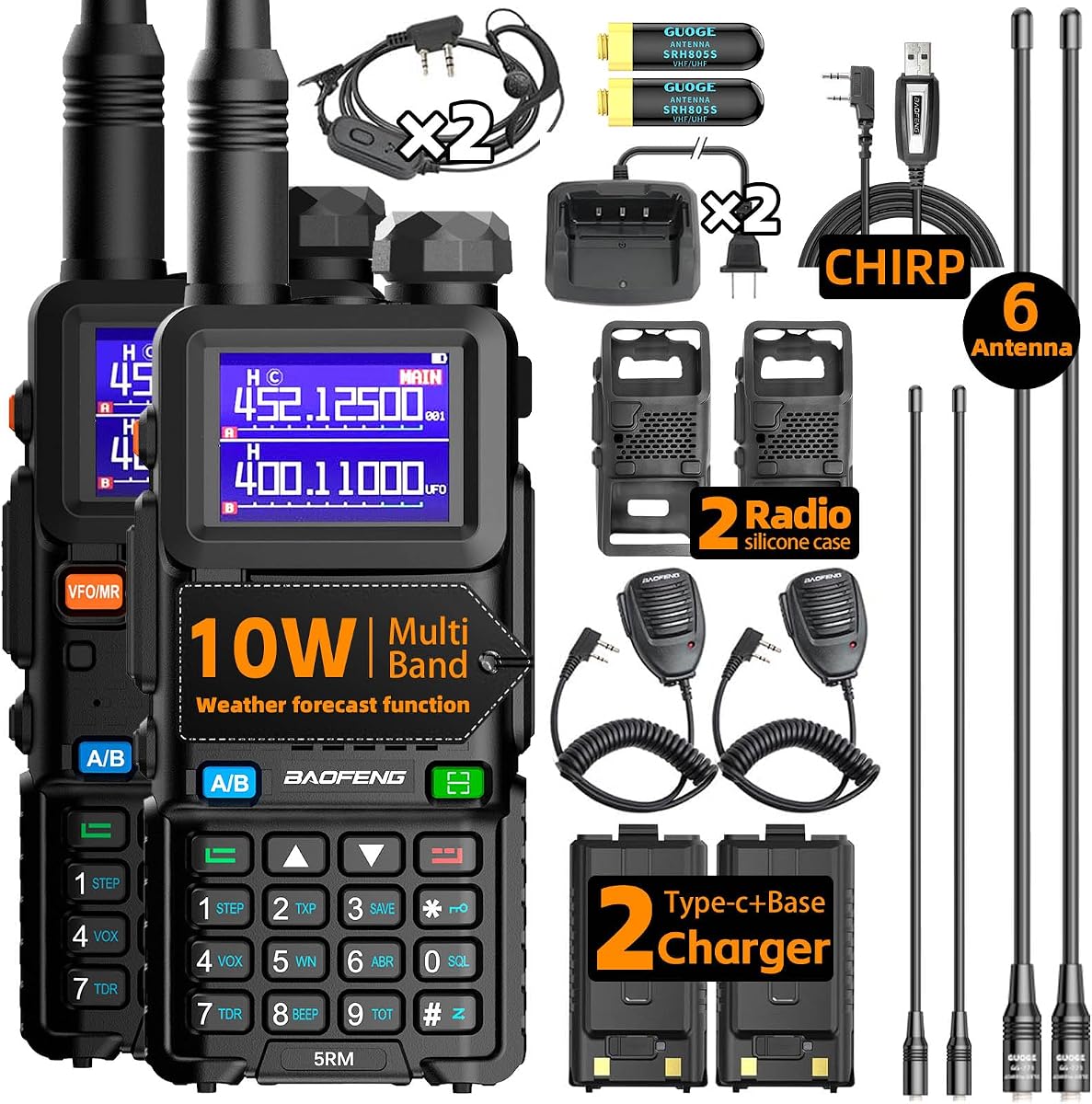

The Baofeng AR-5RM two-pack earns a 4.8 rating and stands out as the most balanced option in this guide. It combines dual-band amateur transmission, 999 programmable channels, a 1.77-inch color screen, a 2500mAh battery, NOAA reception, and two-way frequency copying. Those features give a backpacker more flexibility than a basic handheld without moving into the complexity of a full-featured digital or QRP platform.
We may earn a commission when you buy through this link, at no additional cost to you.
Its receiving coverage extends from 108 to 520MHz across the listed ranges, while transmission is confined to 144–148MHz and 420–450MHz. That distinction matters because a radio may listen to aviation, broadcast, or other bands without authorizing transmission there. The radio supports CHIRP programming, direct frequency copying, CTCSS and DCS tones, a flashlight, VOX, alarms, and a time-out timer. USB and desktop charging make it practical to replenish from a power bank between camps.
The trade-offs are the usual ones associated with a feature-dense handheld. Its menu is more involved than that of a simple radio, and a first-time operator should invest time in programming channels before entering the trail. Transmit power also increases battery consumption, so choosing a lower setting when the group is close can preserve runtime. Users must remain responsible for transmitting only on frequencies and power levels permitted by their license.
This is the strongest general recommendation for hikers, campers, hunters, and families seeking a ready-to-go pair. It is particularly useful when one radio remains at camp while another travels with a group member. For operators who value USB-C charging, weather alerts, broad reception, and straightforward cloning more than GPS or digital messaging, the AR-5RM two-pack offers the most convincing combination of capability and value.
The listed dual-band transmission and 10-watt output make this a capable choice for trailheads, camps, and open backcountry. Actual range varies with terrain, antenna height, obstruction, battery level, and the other station, so maximum output should not be treated as a guaranteed distance.
USB charging accepts power from many portable sources, while the desktop base provides a convenient option at camp. Keeping a charged radio sealed against moisture remains more important than any particular charging method.
We may earn a commission when you buy through this link, at no additional cost to you.
This Baofeng AR-5RM two-pack receives a 4.5 rating and is a strong choice for users who want a complete, matching radio set rather than assembling equipment piecemeal. Its two radios each include a 2500mAh battery, USB-C cable, desktop charger, belt, hand strap, earpiece, antenna, and speaker microphone, while a programming cable supports computer-based frequency management.
We may earn a commission when you buy through this link, at no additional cost to you.
The radios provide 999 memory channels, a 1.77-inch color screen, NOAA emergency alerts, frequency copying, CTCSS and DCS codes, and 10-watt dual-band transmission. Their listed receive range extends from 108 through 520MHz in several blocks, while transmit ranges are 144–148MHz and 420–450MHz. The included speaker microphones are particularly useful for groups traveling in vehicles or working around noisy campsites.
This package is not as minimal as a single-radio purchase. Carrying two full-size handhelds, spare batteries, charging bases, earpieces, and microphones can consume meaningful pack space. The two-meter and seventy-centimeter bands remain the most practical amateur choices for many backpackers, but a group should agree on channels and CTCSS or DCS settings before separating from base camp.
Choose this two-pack when every member needs an identical radio and hands-free operation is valuable. It is less suitable for a solo hiker who only needs one compact unit or for a group committed to digital voice networks. For conventional analog communication and a generous accessory package, it is among the most complete options listed.
Identical radios make channel changes and troubleshooting easier because everyone is using the same control layout and feature set. A programming cable also allows one prepared channel list to be copied to the second unit.
The external speaker microphones allow a user to keep the radio in a pocket or pack while transmitting hands-free. That is useful around roads, camp tasks, or other noisy environments where grabbing the handset is inconvenient.
We may earn a commission when you buy through this link, at no additional cost to you.
The Baofeng UV-32 two-pack has a 4.4 rating and is our Editor's Choice for hikers who want more than basic handheld communication. It upgrades the 5RM platform with built-in GPS, 10-watt output, high, medium, and low power switching, an 18.89-inch high-gain antenna, frequency duplication, AM reception, FM reception, a flashlight, alarms, and a stopwatch.
We may earn a commission when you buy through this link, at no additional cost to you.
Its navigation capability is the defining feature. GPS can provide a useful position reference to a team during travel or an incident, although it is not the same as a dedicated GPS communicator with messaging, maps, tracking service, or guaranteed emergency dispatch. NOAA reception supplies weather forecasts and emergency alerts, while a 2500mAh lithium-ion battery supports longer field use.
The long antenna may improve signal reception but is less convenient than a shorter whip when packing or moving through dense vegetation. Turning GPS on and using maximum transmit power will consume the battery faster, so operators should activate features according to need. The radio is also programmed either through side-key controls, frequency copying, or an application workflow, each of which deserves review before the trip.
The UV-32 is a good match for experienced amateur operators, hunters, search-and-rescue volunteers, and groups that value coordinates alongside voice communication. It is less compelling for casual users who need only simple local talkaround. Even so, the combination of GPS, weather alerts, a flashlight, selectable power, and flexible charging makes it one of the strongest expedition-oriented handhelds here.
Built-in GPS can help a hiker confirm position or relay a reference point to another equipped radio. It should complement, rather than replace, a paper map, compass, and the navigation discipline appropriate to the terrain.
High, medium, and low transmit settings let users balance range against runtime. Lower output and selective use of GPS can conserve energy when the group is nearby or stationary at camp.
We may earn a commission when you buy through this link, at no additional cost to you.
The Malahit trusdx has a 4.5 rating and is the premium specialist in this roundup. Unlike the full-size handhelds, it is a compact, low-power transceiver designed around the usdx platform, offering five HF bands and multimode operation in an already assembled 3D-printed enclosure. The olive-green case and QRP concept make it appealing for backpackers who prefer minimal equipment over feature-dense handset controls.
We may earn a commission when you buy through this link, at no additional cost to you.
Its listed bands cover 80, 60, 40, 30, and 20 meters. This opens access to long-distance HF communication rather than only local VHF and UHF paths, although HF performance depends heavily on antenna design, propagation, operator skill, and time of day. The mainboard already has its bootloader and firmware installed, and the package includes a serial-number label inside the box.
This is not a turnkey substitute for a familiar handheld. Call-sign programming requires reading the included instructions, and the beta firmware adds a spectrum display while reducing some main-menu functions. The serial number does not appear on the OLED because the bootloader is already installed, but it can be recovered from the labeled bag or found through the documented all-zero method if the label is lost.
The radio is a compelling premium choice for experienced shortwave listeners, portable HF operators, and builders who understand antenna and power requirements. The battery case is not included, so prospective owners must account for a power solution separately. For that specialized user, the trusdx offers a more refined and compact expedition platform than a conventional waterproof dual-band handheld.
Access to five HF amateur bands changes the type of communication possible, opening long-distance paths that ordinary VHF and UHF radios cannot provide. Operators still need a suitable antenna and realistic knowledge of propagation.
The completed case, installed bootloader, and programmed firmware remove several early build hurdles. Users still need to configure their call sign and choose a power source, so the product is easier to start than an unassembled kit.
We may earn a commission when you buy through this link, at no additional cost to you.
The BTECH BF-F8HP PRO has a 4.3 rating and distinguishes itself with an unusually organized interface. Its clear English menus, full keypad, 1,000 memory locations, and ten named zones make it attractive for operators who manage many repeaters, local channels, travel destinations, club frequencies, and event channels.
We may earn a commission when you buy through this link, at no additional cost to you.
Zone-based scanning is the central advantage. Users can select which named zones participate in a scan and temporarily skip a busy channel without rewriting the saved list. A two-channel view can show names and frequencies, Dual Watch alternates between two displayed channels, and Single Watch provides a full-screen view of one channel. Approximate dBm readings add useful signal context.
The radio is conventional analog rather than a DMR or trunked scanner, and its scanning behavior should not be mistaken for decoding those systems. Computer programming requires the separately sold PC03 cable, while firmware work requires BTECH CPS, that cable, and model-specific instructions. These requirements are reasonable for experienced users but add cost and planning for beginners.
Direct radio-to-radio location sharing can send a position to another compatible BF-F8HP PRO on the same channel. It does not provide repeater passage, APRS, mapping, continuous tracking, or emergency-location services. For a backpacker who values structured memory management, readable controls, and tri-band flexibility, the BF-F8HP PRO is more approachable than a dense programming-driven handheld.
Separating home, travel, club, event, simplex, and receive channels reduces menu clutter. A user can scan only the relevant group instead of cycling through an undifferentiated list of frequencies.
The keypad handles routine changes, while BTECH CPS or supported CHIRP-next with a PC03 cable supports larger programming jobs. The separate cable requirement should be considered when budgeting for a complete setup.
We may earn a commission when you buy through this link, at no additional cost to you.
The Baofeng UV-5R earns a 4.5 rating and remains a practical choice for backpackers who value simplicity over an expansive menu. It transmits on 144–148MHz and 420–450MHz, includes 128 channels, supports dual-frequency display and dual standby, and provides selectable high and low transmit power. The physical layout is established and widely recognized.
We may earn a commission when you buy through this link, at no additional cost to you.
A large LCD, keypad lock, VOX, selectable display colors, CTCSS and DCS tones, and an LED flashlight cover the needs of most ordinary hiking and camping communication. It can be programmed manually or through a computer, with CHIRP support providing a convenient software option. These characteristics make it a sensible first radio for someone who does not need GPS, hundreds of extra channels, or digital voice.
Compared with the newer 5RM, K5PLUS, and UV-32 models, its 128-channel memory is less flexible, and the supplied feature list does not mention NOAA reception, USB-C charging, or a high-gain antenna. The basic flashlight is useful, but a dedicated headlamp will normally provide better illumination for trail tasks. A spare battery or conservative power setting is also wise on long trips.
The UV-5R is best for a pair of campers on a local trail, a family checking in around base camp, or a licensed operator who already understands programming and channel management. It is not the most advanced choice, but its uncomplicated feature set can be a virtue in the field, where fewer settings often mean fewer distractions.
The dual display and straightforward keypad make it easy to monitor a primary and secondary channel. Busy-channel lockout, dual standby, and tone controls cover common local operating needs.
The UV-5R provides a manageable way to learn basic programming and simplex operation. Its established design is supported by widely available CHIRP programming, although computer preparation is still recommended.
We may earn a commission when you buy through this link, at no additional cost to you.
The Baofeng K5PLUS has a 4.5 rating and combines a 10-watt handheld platform with a flexible 15.35-inch high-gain antenna. It is an attractive middle ground for a backpacker who wants more output and memory than the basic UV-5R without paying for the UV-32's GPS-equipped feature set.
We may earn a commission when you buy through this link, at no additional cost to you.
One-touch frequency copying is the most useful field convenience. Pressing the band button can duplicate settings from a compatible radio, reducing the need for complex computer programming when creating a group channel plan. The radio also supports 999 channels, NOAA emergency reception, CTCSS and DCS tones, airband and FM reception, a flashlight, a stopwatch, VOX, alarms, and a time-out timer.
Charging works through a USB-C cable or desktop charger, giving users the option of recharging from a wall outlet, vehicle, laptop, or power bank. The long curved antenna may improve signal reception, but it also adds bulk and can be more awkward than a shorter antenna. Users who prioritize a compact daily carry may prefer to change antennas for different operating situations.
The K5PLUS is well suited to hunters, campers, and hiking partners who want a high-power analog radio with straightforward cloning. It lacks a stated built-in GPS, so it is less suited than the UV-32 to sharing coordinates. For conventional voice contact, weather awareness, and flexible charging, it offers an effective and approachable package.
Frequency copying lets one radio serve as the source for a matching channel and tone configuration. Confirming settings on both devices before departure is still essential, since cloning does not replace a briefing.
USB-C charging is especially convenient when a trail trip relies on a shared power bank. A desktop charger remains useful at base camp, while the rechargeable battery reduces the need to carry disposable cells.
We may earn a commission when you buy through this link, at no additional cost to you.
The Baofeng DM-32UV carries a 4.3 rating and is the most technically advanced radio in the list. It supports DMR digital mode and traditional analog FM, giving backpackers a way to communicate across both conventional amateur channels and compatible digital systems. It is the only single-unit listing here with a stated APRS function and a full keypad for manual entry.
We may earn a commission when you buy through this link, at no additional cost to you.
GPS, APRS, FM and AM reception, NOAA alerts, an emergency alarm, and digital text messaging broaden its use beyond ordinary voice contacts. The radio supports up to 4,000 channels, TDMA dual-time-slot operation, and encryption choices listed as ARC4, AES128, and AES256. A 2.0-inch screen and customizable side keys are designed for quick access on the move.
A single Type-C connection handles charging, frequency writing, and firmware updates. Voice recording, remote monitoring, and manual programming are additional tools, but they also make the radio less approachable than a conventional handheld. Digital conversations only work when both stations are on compatible channels, color codes, and talk groups. A solo traveler may therefore receive more benefit from the analog functions than from the advanced digital platform.
The DM-32UV is a strong recommendation for licensed users who coordinate with digital repeaters, need APRS, or want text-capable communications with compatible stations. It is less suitable for someone seeking a simple emergency radio with minimal menus. Backpackers should test their planned talk groups, verify digital coverage, and understand the local network before relying on it away from populated areas.
Dual-mode operation lets a user retain access to traditional FM while also using DMR networks. This flexibility is useful when a group mixes analog and digital equipment or moves between local systems.
GPS and APRS can add location information to a communications plan, while text messages offer a non-voice option where supported. These features require compatible equipment, correct setup, and a clear understanding of how location data is transmitted.
We may earn a commission when you buy through this link, at no additional cost to you.
This Baofeng UV-5RM has a 4.6 rating and is a well-rounded single-radio option for backcountry communication. It transmits at up to 10 watts on the listed amateur bands, stores 999 channels, and uses a 1.77-inch color display. CHIRP programming support and a one-touch frequency copy function simplify configuration for a group.
We may earn a commission when you buy through this link, at no additional cost to you.
The radio receives NOAA alerts for hurricanes, tornadoes, storms, and other severe-weather events, making it useful when cellular service is unavailable. Its 2500mAh rechargeable battery can be charged through USB-C or a desktop base using wall outlets, power banks, laptops, vehicle adapters, or other USB sources. A high-quality speaker microphone provides hands-free communication in noisy conditions.
Its receive coverage is broad, spanning 108–136MHz, 136–174MHz, 220–260MHz, 350–390MHz, and 400–520MHz, but transmission is limited to 144–148MHz and 420–450MHz. Broad reception is useful for monitoring, but it should not be confused with permission to transmit outside the licensed amateur bands. Users must also follow regional power and equipment rules.
This model is a strong all-around choice for a licensed hiker, hunter, or camper who wants NOAA reception, flexible charging, and a capable antenna connection in a single unit. It is less convenient than the two-pack options when every group member needs hardware, but it is a better fit for a solo user carrying only one radio. Its frequency cloning and CHIRP support keep setup manageable.
The built-in NOAA receiver provides a useful source of forecasts and emergency weather alerts beyond cellular coverage. It does not replace route planning, but it adds a useful layer of information during changing mountain conditions.
The included speaker microphone allows a user to keep the radio accessible without holding it during a transmission. It is useful around camp, on a road, or during activities where both hands may be occupied.
We may earn a commission when you buy through this link, at no additional cost to you.
The BTECH BF-F8HP has a 4.5 rating and is a strong all-in-one kit for a backpacker who wants substantial output and a broad selection of included accessories. It offers 8-, 4-, and 1-watt power settings, a 2100mAh battery, a V-85 antenna, desktop charger, wall adapter, earpiece, wrist strap, belt clip, and a detailed user guide.
We may earn a commission when you buy through this link, at no additional cost to you.
The radio covers 136–174MHz and 400–520MHz for both reception and transmission, with broad and narrow bandwidth selection. This wider coverage differentiates it from radios restricted to specific amateur segments, but operators must follow the regulations that apply to their location and the frequencies they use. The high-gain antenna and adjustable output make it useful for varied terrain and group sizes.
Computer programming is possible with a recommended PC03 FTDI cable, which is not listed among the included accessories. New owners should therefore plan for a compatible programming cable if they want repeatable channel lists. The model itself is simpler than the BF-F8HP PRO and DM-32UV, but it offers a mature feature set without the burden of digital voice networks or extensive zone management.
Choose the BF-F8HP for a licensed hiker who wants a complete package and the option to reduce transmit power on short local hops. It is a sensible first serious handheld for many campers, and its included guide helps explain customization. For travelers needing GPS, APRS, or direct location sharing, one of the more specialized models will serve better.
The 8-, 4-, and 1-watt settings provide a practical way to manage battery life and unnecessary interference. Low power is often enough within camp, while higher settings may be justified on wide-open routes.
The battery, antenna, charger, earpiece, strap, and clip cover the basics needed for use. The separate PC03 programming cable remains an important addition for anyone creating a detailed memory list on a computer.
We may earn a commission when you buy through this link, at no additional cost to you.
A backpacking radio should be selected for the trip, terrain, group, and operator's experience rather than for a single headline specification. Licensing, legal frequency use, battery strategy, antenna needs, and navigation tools deserve equal attention.
In the United States, transmitting on amateur frequencies generally requires a valid amateur radio license and an authorized call sign. The specific bands available to a novice, general-class, or advanced operator can differ, and equipment rules may also vary by country. A radio capable of receiving many frequencies does not authorize the operator to transmit on all of them. Before buying, identify the bands permitted by your license and the channels your group expects to use.
VHF and UHF handhelds are effective for local trail and camp communication, while HF opens long-distance paths but demands more knowledge and a suitable antenna. Terrain matters greatly: narrow valleys, dense forest, and rocky ridges can block or distort signals. If the group will spread out beyond line-of-sight range, consider whether repeaters are practical, whether digital infrastructure is available, and what emergency communication plan can work when infrastructure fails.
Battery capacity alone does not determine runtime. Transmit power, GPS, display brightness, scanning, and external accessories all affect consumption. A 2500mAh battery may last an entire day for light local use but be consumed quickly by repeated high-power transmissions. Carry a charging plan, use lower power when possible, limit screen time, and keep a power bank or solar charger accessible. For cold-weather trips, keep spare batteries near body heat because cold reduces battery performance.
A radio that performs well at base camp may be awkward during a long hike. Full-size handhelds, long high-gain antennas, desktop chargers, and multiple accessories can consume substantial pack space. Compact QRP equipment can reduce weight but usually needs a separate power solution and more careful antenna setup. Choose the smallest complete setup that supports the intended operating mode, and consider whether a removable antenna allows a practical compromise between pack space and reception.
NOAA reception provides weather forecasts and alerts, an LED flashlight can serve as a backup light, and an emergency alarm can help draw attention. None replaces sound trip planning. Weather alerts depend on the broadcast area and receiver performance, while a flashlight is rarely a substitute for a dedicated headlamp. Consider which features you will genuinely use and test them before leaving, especially if the radio is part of an emergency plan.
GPS can help confirm a position, and APRS can transmit location information through an amateur network. Direct radio-to-radio location sharing is useful between compatible models but may not work through repeaters or provide continuous tracking. These features differ greatly from a satellite communicator with maps, messaging, and monitored emergency response. A backpacker should also carry a paper map, compass, and redundant navigation knowledge, particularly in terrain where the radio display or GPS signal may be unavailable.
Frequency cloning is convenient, but computer programming provides the best control over channel lists, names, tones, and zones. Confirm whether a programming cable is included, whether the radio supports CHIRP or the manufacturer's software, and whether updates require separate hardware. DMR radios are only useful when nearby stations and repeaters use compatible standards, color codes, and talk groups. A digital feature does not automatically produce broader real-world coverage.
Outdoor radios encounter rain, dust, sweat, falls, and temperature changes. A sealed dry bag, protective radio pouch, or dedicated case can protect controls and charging ports. Use a lanyard or secure attachment so the unit does not disappear into brush or a creek, and use a belt clip that releases under strain rather than a rigid fixed mount. Verify manufacturer ingress ratings when available, but treat them as one layer of protection rather than permission to submerge the radio.
Before the trip, program all required channels, tone codes, transmit-power restrictions, and emergency frequencies. A computer and the correct cable usually provide the most reliable method, while frequency cloning works well for a simple matching group channel. Test every radio in the field, verify that both A and B sides or zone settings are correct, and write down backup channels. If using GPS, APRS, or digital talk groups, confirm that the relevant equipment and networks are compatible.
On the trail, keep the radio accessible but protected from rain and impact. Use a belt clip, lanyard, or pouch appropriate to the activity, and keep the antenna extended when receiving or transmitting. Choose low power for nearby teammates and higher power only when terrain or distance justify the extra battery draw. Maintain a regular calling schedule, identify yourself clearly, keep transmissions brief, and use a prepared emergency procedure rather than relying on improvised contact.
Care for the radio by charging it according to the supplied guidance, avoiding unattended charging on flammable surfaces, and allowing heat to dissipate after heavy use. Protect charging ports from dirt and moisture, clean the connector only with an appropriate dry method, and do not open a sealed housing unless the manufacturer provides instructions. Store the radio and battery separately from extreme heat, direct sun, and moisture. After the trip, check the antenna and belt clip for damage, record battery condition, and update the channel list before the next outing.
The best ham radio for backpacking depends on whether you need local VHF/UHF communication, long-distance HF, digital messaging, or GPS. A dual-band handheld such as the Baofeng AR-5RM is a versatile general choice, while the UV-32 adds GPS and the DM-32UV supports digital voice and APRS. Weight, battery strategy, and operator experience should be considered alongside range.
You generally need an appropriate amateur radio license before transmitting on amateur frequencies. The exact privileges and equipment rules depend on your country and license class, so verify the allowed bands and power levels. A radio may receive frequencies beyond the bands you are permitted to transmit on, but reception permission does not grant transmission permission.
A handheld can work well in mountains, but terrain has a major effect on range. Ridges and open valleys may provide excellent paths between peaks, while narrow canyons and dense forests can block signals. Raising the radio, using a clear line of sight, choosing a suitable antenna, and agreeing on alternate channels can improve reliability.
No. Higher transmit power can improve the chance of reaching a distant station, but it consumes more battery and may be unnecessary for teammates nearby. Many radios also offer low, medium, and high settings, making it sensible to use the lowest practical power and reserve higher output for emergencies or wide-open terrain.
The two tools serve different purposes. A ham radio supports local and long-range voice communication but generally requires licensed operators and compatible infrastructure. A satellite communicator can provide messaging, maps, tracking, and emergency services when cellular coverage is absent. For remote or high-consequence trips, carrying both can provide valuable redundancy.
It depends on the model and how you intend to operate it. A simple group may use frequency cloning, but a cable makes it easier to create, rename, and replicate complete channel lists. Some listings include a programming cable, while others specify a separately sold PC03 or manufacturer-approved alternative. Check the package before buying.
Keep the radio in a waterproof pouch or dry bag when rain, splash, dust, or mud is likely, while keeping the controls and speaker accessible. Extend the antenna when needed, inspect seals and connectors, and never charge a wet radio. Even rugged enclosures should be protected because water can enter through ports and damaged seals.
Use the lowest transmit power that provides reliable communication, limit scanning and display use, and switch off GPS or other features that are not needed. Carry a charged power bank and keep spare batteries warm in cold conditions. The radio's actual runtime will vary with transmission, weather, temperature, and accessory use.
The Baofeng AR-5RM two-pack is the best balanced recommendation because it combines 10-watt dual-band transmission, 999 channels, NOAA alerts, frequency cloning, USB-C charging, and two complete radios. The Baofeng UV-32 is the stronger feature-rich choice for hikers who value GPS, selectable power, a flashlight, and a long high-gain antenna, while the Malahit trusdx serves specialized users who want a compact five-band HF platform.
Prioritize the communication mode you will actually use, the range your terrain demands, and a battery plan you can sustain. A simpler analog handheld can be more dependable for a local family camping trip, while a digital radio adds value only when compatible networks exist. GPS, APRS, frequency copying, and high power are useful tools, but none replaces redundant navigation, weather planning, appropriate equipment, and operator training.
Ratings, product configurations, availability, and current prices can change, so review the seller's latest specifications before ordering. Confirm the included accessories, required programming cable, battery configuration, and applicable transmission rules. Most importantly, test the radios with your actual group before the trip and agree on primary, secondary, and emergency communication procedures.
