
Audio-Technica ATH-M20x
4.6Editor score
Tuned low-frequency performance
Studio tracking and mixing
Circumaural sound isolation
Explore the best headphones with detachable cable for studio monitoring, DJing, podcasting, and critical listening, compared for sound, comfort, and connectivit
Headphones with a detachable cable offer a practical upgrade path: a damaged wire can be replaced without replacing the entire headset. They also make it easier to switch between studio, gaming, and everyday connections, provided the replacement cable uses a compatible connector and delivers the right signal for your equipment.
This guide compares ten wired headphone models with removable or interchangeable cables, focusing on the features that matter in real use. We consider driver design, closed-back or open-back construction, monitoring capability, connection options, comfort, isolation, and whether each model suits tracking, mixing, DJ work, podcasting, or immersive listening.
Each review highlights the product's strongest qualities and meaningful limitations, helping you identify the right balance for your setup. Product ratings and specifications come from the supplied product information, while prices and availability can change, so compare current listings before purchasing.
4.6Editor score

4.7Editor score

4.5Editor score
The comparison below organizes all ten models by acoustic design, monitoring features, cable arrangements, and major use cases, making it easier to identify the right headset for recording, mixing, DJ performance, podcast production, or critical listening.



The Audio-Technica ATH-M40x earns a 4.6 rating and stands out as a dependable professional studio monitor with detachable cables included. Its combination of 40 millimeter drivers, a circumaural closed-back shape, and 90-degree swiveling earcups gives it a clear purpose: accurate monitoring in environments where distractions and headphone bleed need to be controlled.
We may earn a commission when you buy through this link, at no additional cost to you.
The headphone's rare-earth magnets and copper-clad aluminum wire voice coils support its reputation as a serious monitoring tool. Its robust construction, professional-grade earpads, and reinforced headband materials are particularly relevant to users who move between tracking sessions, rehearsal rooms, and editing desks. The detachable-cable arrangement also makes it easier to change between equipment or replace a damaged lead.
The principal trade-off is that the ATH-M40x is designed for professional monitoring rather than fashionable lifestyle use. Its circumaural construction and pro-grade padding can feel substantial during long sessions, and the closed-back design is less suitable for listeners who want to hear their natural surroundings. For a recording session, however, those traits are advantages rather than drawbacks.
Choose the ATH-M40x if you need a flexible studio headphone for recording, mixing, or practice and value one-ear monitoring, isolation, and serviceable cables. It is a particularly strong option for musicians who want a dependable monitoring tool without moving to an open-back reference model. Confirm that your equipment and preferred replacement cables match the included connection system.
The swiveling earcups make it possible to rotate one side upward, which is valuable when tracking vocals, positioning a microphone, or checking cues with one ear open. This flexibility is one of the strongest reasons the ATH-M40x appeals to working musicians.
Including detachable cables improves serviceability and gives the listener more ways to connect to different sources. A damaged cable no longer has to end the useful life of an otherwise functional pair of headphones.
We may earn a commission when you buy through this link, at no additional cost to you.
The Audio-Technica ATH-M20x carries a 4.6 rating and serves as a straightforward studio headphone built for tracking and mixing. It combines 40 millimeter drivers, rare-earth magnets, copper-clad aluminum wire voice coils, and a circumaural design, delivering the fundamentals without the elaborate feature set found in more specialized models.
We may earn a commission when you buy through this link, at no additional cost to you.
Its tuning places particular emphasis on enhanced low-frequency performance, which can make kick drums, bass lines, and other low-register elements easier to evaluate. The closed-back structure helps isolate the mix from the surrounding room, while the single-side cable exit keeps the front of the headphone visually and physically uncluttered.
The trade-off is that the ATH-M20x does not provide the same 90-degree one-ear monitoring convenience highlighted by the ATH-M40x. It is also a more specialized headphone than a conventional wireless headset, and its circumaural fit may feel substantial to users accustomed to lighter on-ear designs. The detachable-cable proposition is best considered alongside the included connection arrangement and any replacement cable you may need.
This is a compelling choice for musicians, producers, and home-studio users who want a dependable monitoring headphone with a strong emphasis on bass and isolation. It works particularly well for mixing and tracking at a workstation where a quiet, closed-back design matters. If one-ear monitoring is essential, the ATH-M40x may offer a more natural fit for your workflow.
The enhanced low-frequency tuning gives the ATH-M20x a distinct studio character. It can help creators hear foundational elements clearly, although engineers should still judge low-frequency balance in context across the full frequency spectrum.
The circumaural, closed-back design helps block distracting environmental sound. That makes the headphone well suited to focused mixing sessions and practice in a busy room.
We may earn a commission when you buy through this link, at no additional cost to you.
The beyerdynamic DT 770 Pro X has a 4.5 rating and targets listeners who want high-resolution studio monitoring with a particularly practical cable system. Its 48-ohm impedance allows direct connection to a laptop, interface, phone, or console without requiring a separate headphone amplifier, making it more flexible across different setups.
We may earn a commission when you buy through this link, at no additional cost to you.
The STELLAR.45 driver is the centerpiece of the design, supplying precise, high-resolution sound for tracking and mixing. At the same time, the closed-back housing provides isolation that helps keep headphone sound out of microphones during recording. The detachable mini-XLR cable can be swapped in seconds, and the replaceable velour ear pads support long-term maintenance.
The main compromises involve size and acoustic openness. This is a substantial over-ear studio headphone, so buyers should consider desk space, storage, and long-session comfort. Its closed-back design may also feel less spacious than an open-back reference headphone, although that isolation is exactly what many recording workflows need.
Choose the DT 770 Pro X when you want a serious closed-back monitoring headphone, direct source compatibility, and a connector designed for straightforward cable replacement. It is well suited to recording, mixing, and critical listening, particularly for users who want high-resolution monitoring without carrying a separate amplifier. Its replaceable pads and detachable cable also make it a serviceable long-term purchase.
The 48-ohm design is important because it is intended to work with common sources, from a phone to a recording interface. That makes the DT 770 Pro X a practical choice for creators who move between locations or connect to different pieces of equipment.
The detachable mini-XLR cable and replaceable velour pads address two components that commonly experience wear. Both features make it easier to maintain performance and adapt the connection to a changing setup.
We may earn a commission when you buy through this link, at no additional cost to you.
The Audio-Technica ATH-M50X holds the highest supplied rating in this roundup at 4.7. It is a well-rounded closed-back studio headphone that combines 45 millimeter large-aperture drivers, rare-earth magnets, copper-clad aluminum wire voice coils, and a circumaural housing designed to provide strong isolation in loud environments.
We may earn a commission when you buy through this link, at no additional cost to you.
Sound is described as exceptionally clear across an extended frequency range, with deep and accurate bass response. For working musicians, the 90-degree swiveling earcups are equally important because they allow one-ear monitoring without removing the entire headphone. Professional-grade earpad and headband materials support durability and comfort during extended use.
The main limitation is its specialist design. The ATH-M50X is a wired monitoring headset, not a wireless lifestyle model, and some listeners may prefer a lighter or more casually styled over-ear product. The closed-back enclosure also prioritizes isolation rather than the unrestricted airflow associated with open-back reference headphones.
This model is a strong all-purpose recommendation for recording, mixing, editing, and critical listening. Its rating, flexible monitoring controls, durable materials, and balanced reputation make it appealing to both professionals and serious home-studio users. Consider it when you need a dependable headphone that can handle demanding sessions without relying on wireless convenience.
The 45 millimeter drivers and extended-range clarity make the ATH-M50X a practical option when details matter. The advertised deep, accurate bass response is especially useful for evaluating low-frequency material without exaggerating it.
Professional-grade earpads and headband materials are designed to withstand regular use while maintaining comfort. Combined with the rotating earcups, this makes the headphone adaptable to focused studio work.
We may earn a commission when you buy through this link, at no additional cost to you.
The OneOdio Pro-10 has a 4.4 rating and is designed for DJing, mixing, instrument practice, and everyday wired listening. Its large 50 millimeter drivers and neodymium magnets support powerful bass, clear vocals, and crisp highs, producing a balanced stereo presentation described as suitable for both entertainment and monitoring.
We may earn a commission when you buy through this link, at no additional cost to you.
The 90-degree swiveling earcups enable single-ear monitoring, while the adjustable, stretchable headband is designed to distribute weight comfortably. Compatibility extends across smartphones, laptops, tablets, desktop computers, interfaces, DJ mixers, and amplifiers through 3.5 millimeter and 6.35 millimeter connections. A shared audio port also allows a second pair of headphones to be connected for music or video.
Its limitations are relatively straightforward: it operates exclusively in wired mode, and users should verify the plug sizes and cable arrangement needed for their equipment. The shared port also requires a compatible second connection rather than providing a universal solution for every device. As with any over-ear monitor, a sealed fit can become warm during extended sessions.
The Pro-10 is a good fit for a beginner building a home-studio setup, a musician who needs both 3.5 millimeter and 6.35 millimeter connectivity, or a DJ who values one-ear cueing. Its removable-cable compatibility should be checked against the supplied connection details and desired replacement lead before purchase.
The rotating earcups support quick transitions between full listening and one-ear cueing. That makes the Pro-10 relevant for DJ practice, live cue monitoring, and instrument work where awareness of nearby sounds matters.
The shared audio port is a distinctive convenience for collaborative listening. It can let two headphone users hear the same music or video without relying on a separate splitter, subject to compatible connections.
We may earn a commission when you buy through this link, at no additional cost to you.
The OneOdio A70 carries a 4.4 rating and is the most flexible choice for listeners who want wireless listening alongside a wired connection. It can provide up to 72 hours of stated playback in wireless mode, while the included 3.5 millimeter-to-6.35 millimeter and 3.5 millimeter-to-3.5 millimeter cables allow operation without battery power.
We may earn a commission when you buy through this link, at no additional cost to you.
Custom-made aluminum fascia and 40 millimeter neodymium drivers are intended to deliver dynamic stereo sound with powerful bass. The rotatable, foldable structure adds portability, while soft memory cotton and skin-friendly protein leather are included for comfort and isolation. A built-in microphone with noise reduction supports hands-free calls.
The A70 is not positioned as a specialist critical-listening headphone, and its shared-listening feature requires the appropriate wired connections rather than functioning as a universal wireless transmitter. Wireless operation also means it does not offer the same purely wired signal path as a dedicated studio monitor. Buyers focused on recording accuracy may prefer a model explicitly tuned for monitoring.
Choose the A70 if you want one headphone for wireless music, calls, DJ-style wired use, and travel. It is particularly suitable for students, mobile listeners, and casual studio users who value the ability to switch modes. Verify that the included cables and jack-lock design suit your source before ordering.
Bluetooth handles everyday convenience, while wired operation remains available for DJ controllers, mixers, and other compatible equipment. The two included cables make it possible to choose the appropriate connection for the source.
The rotatable earcups and foldable headband reduce the space required for storage and travel. That portability is a meaningful advantage over bulkier studio monitors that are designed to remain at a workstation.
We may earn a commission when you buy through this link, at no additional cost to you.
The MAONO MH601 has a 4.5 rating and is tailored to podcast recording, streaming, DJ mixing, and general studio monitoring. It uses 50 millimeter large-aperture drivers and a closed-back design intended to provide clarity, deeper bass response, and some reduction of background noise.
We may earn a commission when you buy through this link, at no additional cost to you.
Its standout practical feature is the included 9.8-foot spring-loaded 3.5 millimeter-to-6.35 millimeter detachable cable. An interchangeable 6.35 millimeter jack supports shared listening, while broad compatibility covers smartphones, computers, mixers, music-production equipment, guitar amplifiers, keyboards, and specified MAONO podcast equipment. The cable system is especially relevant to users who move between mobile and production setups.
The headphone has no built-in microphone, so it will not handle voice calls or spoken commentary on its own. It is also a passive device: it needs an appropriate audio source and does not contain an internal battery. While the included earpads are described as blocking 85 percent of ambient noise, that figure should be understood as a supplied specification rather than a universal real-world result.
The MH601 is a compelling option for creators who prioritize a direct wired connection and a clearly detachable cable. It is well suited to podcast editing, instrumental tracking, stream monitoring, and DJ practice. Choose it over a headset with an integrated microphone when your existing recording setup already provides voice capture.
The spring-loaded cable is designed to survive movement and repeated handling while remaining removable. Its length and 3.5 millimeter-to-6.35 millimeter configuration also make it useful across a range of studio devices.
The rotating earcups allow single-ear monitoring during vocal tracking or mix adjustments. Because the MH601 has no built-in microphone, it works best as a dedicated playback and monitoring tool within a larger recording setup.
We may earn a commission when you buy through this link, at no additional cost to you.
The Audio-Technica ATH-R50X earns a 4.5 rating and is designed for professional open-back reference listening. Its fully open-back construction permits unrestricted airflow, helping eliminate internal resonance and produce an extremely quick transient response. The result is intended for mixing, mastering, and demanding audio production.
We may earn a commission when you buy through this link, at no additional cost to you.
The supplied information highlights extended bass, an accurate midrange, and a wide, realistic soundstage. Its 207-gram weight and redesigned headband are intended to support long sessions without excessive bulk. Cable flexibility is excellent: the package includes 3.0 meter and 1.2 meter detachable cables with 2.5 millimeter twist-lock connectors and gold-plated 3.5 millimeter stereo plugs.
The defining limitation is isolation. Because the headphone is fully open-back, it lets environmental sound in and sound out. That makes it unsuitable for recording situations where a microphone could capture the music, and less useful in noisy environments. The two different cable lengths can help adapt the setup, but they do not change the acoustic behavior.
Choose the ATH-R50X for critical listening, mastering, and detailed mix work in a controlled room. The quick transient response and wide soundstage are major strengths for professionals who want to evaluate spatial relationships and fine detail. Pair it with good room treatment and use a closed-back alternative when recording.
The open-back architecture creates a wide and realistic soundstage, allowing listeners to judge the placement of instruments more naturally. That makes the ATH-R50X most useful in a quiet, controlled environment rather than a bustling shared workspace.
The 3.0 meter cable suits a stationary listening position, while the shorter 1.2 meter option can be convenient at a desk. Twist-lock connectors help keep the chosen cable secure during use.
We may earn a commission when you buy through this link, at no additional cost to you.
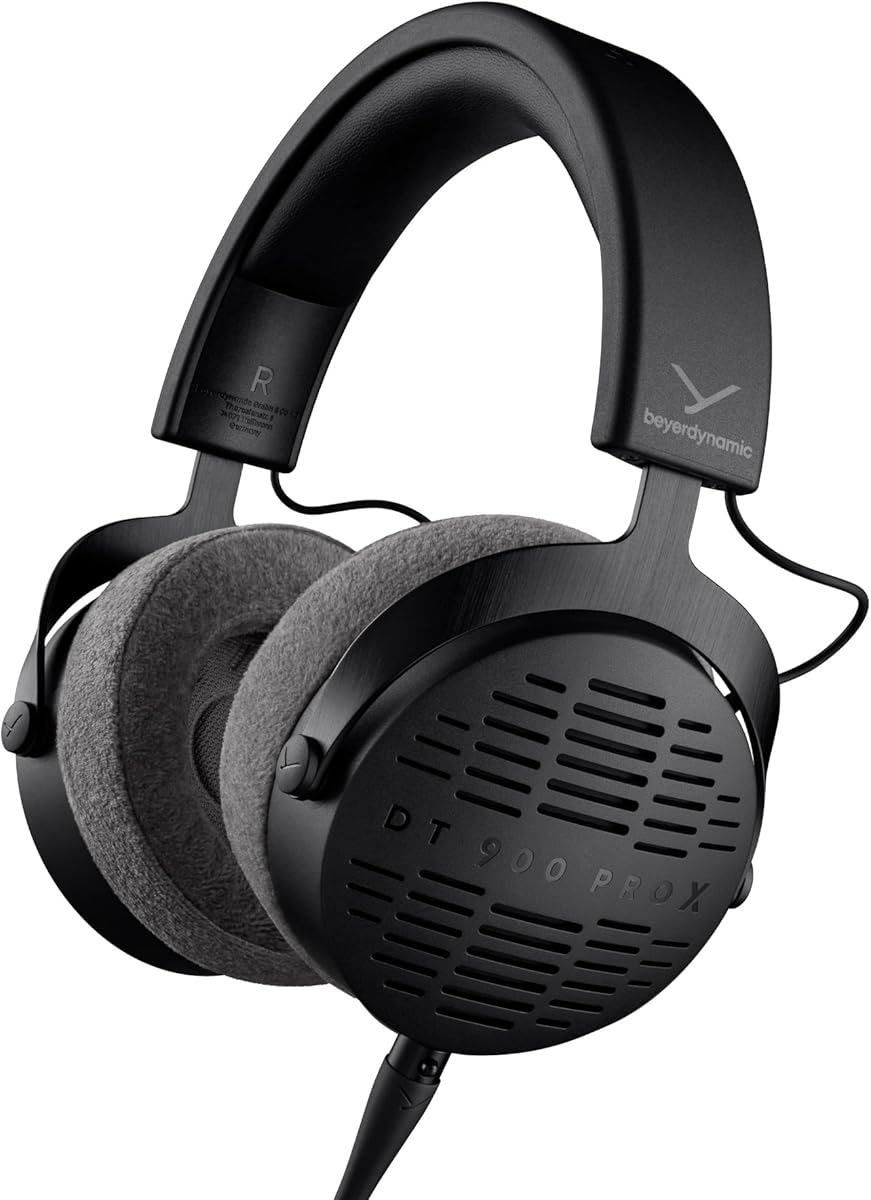
The beyerdynamic DT 900 PRO X has a 4.5 rating and is aimed at mixing, mastering, and critical listening. Its open-back reference presentation is built around wide, natural imaging, giving the listener a clear view of where instruments sit within the stereo field.
We may earn a commission when you buy through this link, at no additional cost to you.
The STELLAR.45 driver provides high-resolution sound with low distortion at any stated level. A 48-ohm impedance allows full-volume operation from common sources such as a laptop, interface, or phone without a dedicated headphone amplifier. The package includes a detachable mini-XLR cable and a 1/4-inch adapter, so it can fit both studio and more general listening arrangements.
The open-back construction is the central trade-off. It excels at natural spatial imaging and fast, open headphone presentation, but it provides little environmental isolation and can leak sound into a recording space. The DT 900 PRO X should therefore be used for mix decisions in a controlled room, not as a monitoring headphone while tracking vocals with nearby microphones.
Choose the DT 900 PRO X when your priority is a wide, natural soundstage and confident final-mix evaluation. It is particularly compelling for producers and engineers who appreciate straightforward source compatibility and a detachable professional connector. Pair it with a closed-back model for tracking if your workflow requires both recording and critical listening.
The wide, natural soundstage makes the DT 900 PRO X useful for judging stereo width and instrument placement. Its open design provides an uncluttered sense of space that closed-back monitors do not attempt to reproduce.
The 48-ohm drive and included 1/4-inch adapter remove unnecessary barriers between the headphone and common playback equipment. The detachable mini-XLR cable also keeps the connection serviceable.
We may earn a commission when you buy through this link, at no additional cost to you.
The Audio-Technica ATH-R70XA carries a 4.6 rating and represents the most specialized open-back reference model in the group. It is intended for engineers, producers, and musicians who want a balanced mix of accuracy, transparency, and comfort during long working sessions.
We may earn a commission when you buy through this link, at no additional cost to you.
Its fully open-back design allows unrestricted airflow to reduce internal resonance and deliver extremely quick transient response. At 199 grams, it is the lightest listed model, while a streamlined, metal-reinforced frame and reimagined headband are designed to minimize fatigue. Replaceable velour earpads add another layer of long-term serviceability.
The unique dual-sided 3.0 meter cable provides separate left and right signal paths and uses locking connections, helping maintain proper stereo orientation. The tradeoff is that the open-back format offers essentially no passive isolation and can allow sound to escape into a recording area. Those limitations are acceptable only when the headphone is used for listening rather than live tracking.
Choose the ATH-R70XA for professional reference listening, detailed mix review, and extended sessions where low weight is a priority. Its construction, cable design, and replaceable pads make it a thoughtful long-term option for critical listeners. It is less suitable for commuting, shared offices, or any environment where outside sound would be disruptive.
The 199-gram design is a meaningful advantage during long sessions. Lightweight construction can reduce the sense of burden on the head without changing the fully open-back acoustic approach.
Independent left and right detachable cable routing provides a clear stereo path, while locking connectors help resist accidental movement. The replaceable velour pads support ongoing maintenance.
We may earn a commission when you buy through this link, at no additional cost to you.
The best headphones with detachable cable depend on where you will use them, what you need to connect, and whether isolation or open sound matters more. Use the following factors to narrow the field before comparing comfort, drivers, and accessories.
Closed-back headphones use a sealed or substantially enclosed design that reduces environmental sound and limits how much audio escapes. That makes them the more practical choice for recording, DJ cueing, podcasting, and use in noisy rooms. The ATH-M40x, ATH-M20x, ATH-M50X, DT 770 Pro X, Pro-10, and MH601 all use closed-back approaches. Open-back models such as the ATH-R50X, DT 900 PRO X, and ATH-R70XA prioritize natural airflow, wide soundstage, and quick transient response, but they leak sound and offer little isolation.
A detachable cable is only useful if its connector matches the headphone and the intended source. Some models use mini-XLR, while others use 2.5 millimeter twist-lock connectors or a spring-loaded 3.5 millimeter cable. Source-side plugs also vary among 3.5 millimeter and 6.35 millimeter, with adapters sometimes included. Check the supplied connector details, especially if you plan to move between a laptop, interface, phone, DJ controller, or mixer.
Driver size alone does not determine sound quality, but it helps identify the headphone's design emphasis. The ATH-M40x, ATH-M20x, and ATH-M50X use 40 or 45 millimeter drivers tuned for professional monitoring. The OneOdio Pro-10 and MAONO MH601 use 50 millimeter drivers with an emphasis on powerful bass, while the ATH-R50X focuses on extended bass and accurate midrange. For critical work, prioritize a clear, controlled response and appropriate monitoring intent rather than choosing on diameter alone.
Ninety-degree swiveling earcups are especially important for musicians and DJs because they can rotate one side upward to keep an ear open to nearby cues. The ATH-M40x, ATH-M50X, Pro-10, and MAONO MH601 offer this feature. One-ear monitoring can help when tracking a performer, listening to a mix, or following cues in a live setting. If your work requires that flexibility, treat it as a higher priority than cosmetic design or wireless convenience.
Impedance affects how easily a headphone can be driven by a laptop, interface, phone, or console. The DT 770 Pro X and DT 900 PRO X use a 48-ohm design intended to work directly with common sources without requiring a separate headphone amplifier. Other models may include connections for 3.5毫米 and 6.35毫米 equipment. While passive operation is convenient, users should still verify output strength, plug format, and channel compatibility before making a final choice.
Comfort is determined by more than weight. Earpad softness, headband pressure, clamping force, heat buildup, and the fit of the earcups all influence long sessions. The ATH-R50X weighs 207 grams and the ATH-R70XA weighs 199 grams, making them especially light among the open-back choices. The ATH-M40x and ATH-M50X emphasize professional-grade earpads and headband materials, while the A70 uses memory cotton and protein leather. Choose a shape and weight that suit your head and the duration of your work.
A detachable cable protects against one common source of waste, but long-term ownership also depends on other wear-prone parts. The DT 770 Pro X includes replaceable velour pads, while the ATH-R70XA uses replaceable velour earpads. Check whether a replacement pad or cable is available in the correct connection format. Models with wired-only operation also avoid battery aging, whereas the A70 adds a rechargeable battery as another long-term component to consider.
Most models in this guide are dedicated wired headphones, but the OneOdio A70 also supports Bluetooth and includes a built-in microphone for hands-free calls. The Pro-10 and MH601 offer shared-listening connections, and the A70 supports a wired sharing arrangement. These conveniences are useful for lessons, gaming, collaborative listening, or mobile use, but they do not replace the low-latency, direct connection of a specialist wired monitor. Match the extras to your routine rather than assuming every feature is needed.
Before the first connection, identify the headphone-side socket and the correct source-side plug. Turn the device volume down, attach the cable firmly without twisting it, and confirm that the left and right channels are correct. For open-back models, begin at a moderate level in a controlled room; for closed-back monitoring, make sure your recording microphone is positioned as needed to prevent bleed.
Treat detachable connectors and cables gently. Pull the plug straight from the socket rather than rocking it, and avoid sharp bends close to the termination. If your model uses a locking connector, engage or release it according to its design. Replace a cable as soon as you notice intermittent audio, visible damage, or a loose connection, because continued strain can damage the socket.
Remove the headphones when they are no longer in use, especially in hot or humid conditions. Keep the earpads clean and dry, store the headphones in a protective pouch or case, and avoid wrapping the cable tightly around the earcups. Replace worn earpads on models that support them, and check connector compatibility before ordering any replacement cable or accessory.
Detachable-cable headphones are usually easier to maintain because a damaged cable can be replaced without replacing the entire headset. They can also make it easier to change between source types or use different cable lengths. The actual audio performance still depends on the headphone design, driver, fit, and intended use, not on the presence of a detachable connector alone.
No, you should match the connector on the headphone side as well as the plug needed by your audio source. Mini-XLR, 2.5 millimeter twist-lock, and standard 3.5 millimeter connections are not interchangeable. Check the product documentation and choose a cable with the correct headphone-side connector, appropriate length, and source-side plug.
Open-back headphones are not universally better. They often provide a wide, natural soundstage and quick transient response, which can benefit critical listening in a quiet room. Closed-back headphones provide greater isolation and prevent sound leakage, making them more suitable for recording, DJing, podcasting, and noisy environments. The best choice depends on your room and workflow.
Many studio headphones can work for gaming because they provide accurate sound and useful wired connections. However, models without a microphone, including the MAONO MH601, require a separate microphone for voice communication. A model with a built-in microphone, such as the OneOdio A70, offers a more integrated option for calls and wireless use.
A 48-ohm headphone is designed to be relatively easy to drive, which can make it convenient with a laptop, phone, interface, or console. It does not guarantee identical volume or sound on every device, but it reduces the need for a separate headphone amplifier in many common setups. Source quality and volume control still influence the final result.
They allow one earcup to rotate upward, making it easier to monitor with one ear while keeping the other open to nearby sounds. This is valuable for vocalists tracking a performance, musicians rehearsing with an instrument, and DJs checking cues. The ATH-M40x, ATH-M50X, Pro-10, and MAONO MH601 all feature this monitoring-oriented design.
No. A detachable cable refers to a replaceable physical connection, while wireless describes audio transmission without a cable. A model can support both, as the OneOdio A70 does with Bluetooth and included wired cables. Other models, such as the MAONO MH601, are passive wired devices with no internal battery.
Replace a cable when you notice damaged insulation, a loose plug, intermittent sound, buzzing, or a connection that no longer seats securely. Earpads should be replaced when the surface becomes cracked, hardened, misshapen, or no longer seals comfortably. Using compatible parts helps preserve fit, isolation, and reliable connectivity.
The Audio-Technica ATH-M50X is the strongest all-around recommendation for balanced monitoring, flexible one-ear use, and strong isolation. The ATH-M20x provides a more economical route into studio-focused listening, while the beyerdynamic DT 770 Pro X stands out for high-resolution closed-back monitoring, 48-ohm source compatibility, and a detachable mini-XLR connection.
Your workflow should determine the acoustic design. Choose a closed-back model for recording, DJ cueing, podcasts, and noisy rooms; choose an open-back model for wide, natural imaging and critical listening in a controlled space. Prioritize the correct connector, cable length, source plug, comfort, and required monitoring features before making a final choice.
Finally, check the current product listing, included accessories, and availability before purchasing. Ratings, specifications, and prices can change over time, and compatibility details matter when selecting a replacement cable. Taking a few minutes to confirm the connection system can prevent frustration and help you choose a detachable-cable headphone that fits your setup.