
Griddy Wideband Grid Parabolic Kit
4.0Editor score
600–6500 MHz coverage
Up to 26 dBi gain
MIMO-ready configurations
Explore the best parabolic WiFi antenna options, comparing gain, frequency bands, connectors, MIMO support, mounting kits, and outdoor performance.
A parabolic WiFi antenna concentrates radio energy toward a remote access point, making it useful for weak outdoor signals, point-to-point links, and long-range directional coverage. The best model balances high gain, correct frequency support, suitable connectors, manageable cable loss, and an installation that provides clear line of sight.
We compared the ten listed products by examining their stated operating bands, gain, polarization, impedance, connectors, included accessories, directional characteristics, and intended applications. The list includes conventional 2.4 GHz grid dishes, wideband cellular antennas, and several products designed for satellite or Yagi use rather than ordinary WiFi.
Each review explains where a product fits and where it does not, helping you distinguish a true outdoor WiFi dish from a high-gain panel, Yagi, or satellite mesh antenna. Product availability, included accessories, and prices can change, so confirm the current listing before buying.
4.0Editor score

5.0Editor score

4.3Editor score
This side-by-side overview highlights the major differences in radio coverage, antenna architecture, gain, connector type, and intended use. It also makes clear that several highly rated listings are panel, Yagi, or satellite antennas included for comparison with genuine grid-parabolic options.


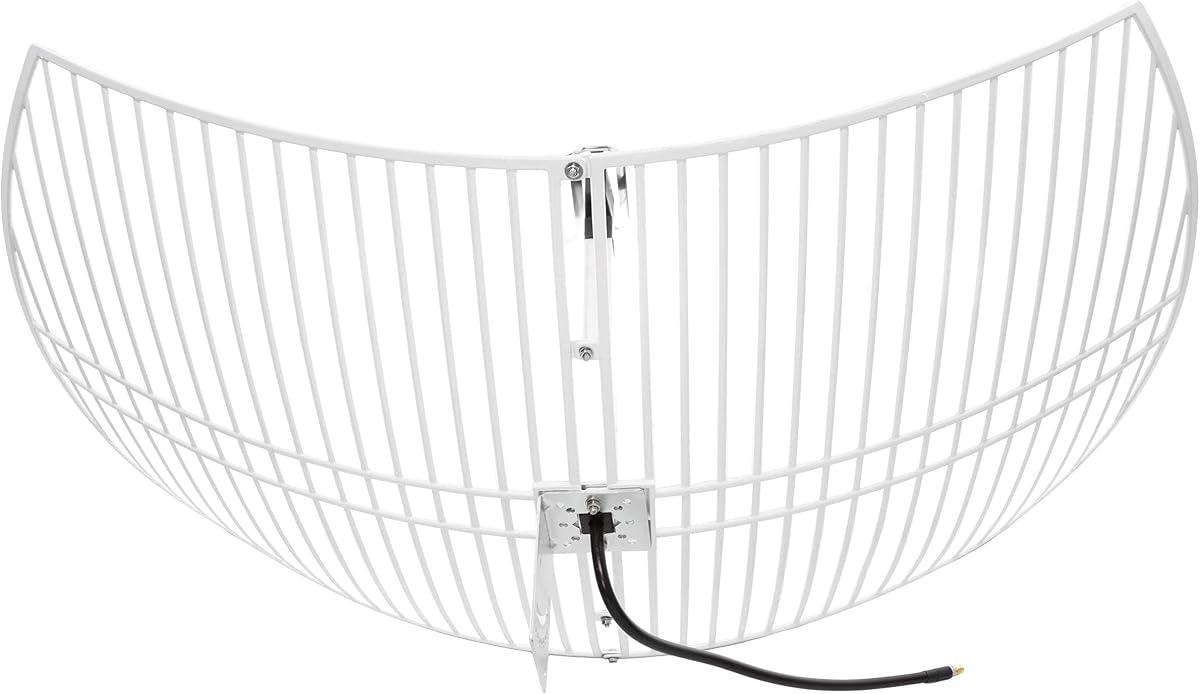


The antenna-only Griddy is a wideband grid-parabolic option rated 4.2, with the strongest appeal for installers who already know their radio equipment and connector requirements. It covers 600–6500 MHz and is specified at 12–17 dBi from 600–960 MHz, 20–23 dBi from 1700–2700 MHz, and 23–26 dBi from 3000–6500 MHz.
We may earn a commission when you buy through this link, at no additional cost to you.
Its most valuable feature is flexibility across cellular and WiFi applications. The antenna can serve a hotspot, router, WiFi access point, LTE router, or booster, provided the receiving device has a compatible antenna port. A 50-ohm N-Type connector provides a conventional interface, while separate Griddy units can support MIMO equipment that exposes multiple antenna connections.
The significant trade-off is that narrow-beam, high-gain antennas are unforgiving of poor placement. The product information explicitly calls for line of sight, and warns that reflections or dispersion from trees and buildings can reduce effectiveness. This version also lacks the TS9 and SMA adapters included with the complete kit, so compatibility checks are especially important.
It is a strong candidate for a technically confident buyer who wants one antenna platform for several outdoor radio tasks. Buyers seeking a simple WiFi plug-and-play package, or those unable to position the antenna facing the transmitter, should consider the complete Griddy kit or a broader-coverage alternative instead.
Covering 600–6500 MHz allows one antenna to address multiple cellular and WiFi bands, but the actual gain changes considerably across that spectrum. Confirm that the access point operates within the range where the advertised gain is meaningful.
The concentrated beam can produce a substantial improvement when the target is visible. Use a phone signal meter or WiFi survey from the intended mounting position before drilling, since a slightly different aim can materially change results.
We may earn a commission when you buy through this link, at no additional cost to you.
The complete Griddy kit earns a 4.0 rating and packages the wideband grid antenna with 50-ohm N-Type connectors plus TS9 and SMA adapters. That broader connector package makes it more practical for a homeowner or installer than the antenna-only version, especially when the target router, booster, or modem uses a less common terminal.
We may earn a commission when you buy through this link, at no additional cost to you.
Like the antenna-only Griddy, it provides stated gain of 12–17 dBi from 600–960 MHz, 20–23 dBi from 1700–2700 MHz, and 23–26 dBi from 3000–6500 MHz. The same antenna can be directed toward a cellular tower or WiFi access point, making it appealing for rural homes, outdoor hotspots, and fixed cellular installations.
Its limitations are practical rather than fundamental. A directional grid antenna offers little advantage if trees, terrain, or buildings interrupt the direct path. The included adapters improve convenience but cannot compensate for an incompatible connector or poor aiming. Users also need to understand that one antenna does not automatically provide MIMO; matching units are required when the equipment expects separate spatial streams.
This is the more complete version of the Griddy platform and a sensible recommendation for users connecting the antenna to cellular or WiFi equipment immediately. It is best for buyers willing to perform careful placement and want a broad 600–6500 MHz solution without choosing a narrow single-band dish.
Including TS9 and SMA adapters reduces the chance that a compatible device will require an extra purchase. Still verify the connector type and adapter length needed for the specific router, modem, or booster.
The wide operating range allows the same directional antenna to serve 4G LTE, 5G NR, and WiFi applications. Its practical value is greatest when the target equipment and required connector configuration are known in advance.
We may earn a commission when you buy through this link, at no additional cost to you.
Nooelec's GOES antenna is a 21 dBi parabolic mesh designed specifically for near-real-time weather satellite images. Its 1.7 GHz center frequency and more than 200 MHz of bandwidth target satellites operating around 1.6–1.8 GHz, including GOES, NOAA HRPT, Meteor M2 HRPT, Metop, and FengYun systems.
We may earn a commission when you buy through this link, at no additional cost to you.
A major strength is its ability to handle both linearly and circularly polarized signals, covering RHCP and LHCP reception. The LMR400 feed cable and male SMA termination suit a broad range of software-defined radio systems, while the supplied mounting hardware and two-year warranty improve the package's practicality for satellite enthusiasts.
This is not a conventional 2.4 or 5 GHz WiFi dish, and treating it as one would be a serious compatibility mistake. Decoding also requires appropriate SDR, filter, and low-noise amplifier hardware, plus decoding software such as SatDump or a supported alternative. The antenna alone does not create a ready-to-use WiFi link.
The product is an excellent choice for weather monitoring, remote sensing, and satellite experimentation, but ordinary home WiFi users should skip it. It earns its place in this comparison as a specialized parabolic mesh antenna, not as a universal WiFi solution.
The fine mesh and parabolic form concentrate the satellite downlink while remaining well suited to a stationary installation. Alignment toward a specific satellite is critical, so a broad-positioning plan is preferable to trial-and-error aiming.
Support for both RHCP and LHCP makes the antenna relevant to several transmitting weather satellites. This versatility is more important in satellite work than in conventional WiFi, where polarization handling is usually built into the access point and client.
We may earn a commission when you buy through this link, at no additional cost to you.
This 2.4 GHz grid-parabolic set has a 5.0 rating and is the most conventional option in the list for outdoor WiFi reception. It operates from 2400–2500 MHz with 20 dBi gain, vertical polarization, 50-ohm impedance, maximum input power of 100 watts, and a stated VSWR of 1.5 or lower.
We may earn a commission when you buy through this link, at no additional cost to you.
The package is notably complete for a basic installation. It includes the grid antenna, a right-angle mounting bracket, a 9.8-foot RF400 cable, an SMA male adapter, and two U-bolt clamps. The low-loss cable is especially useful because external runs can otherwise undermine the benefit of a high-gain dish.
The key limitation is its 2.4 GHz-only design. It will not receive a 5 GHz or 5.8 GHz network, and its narrow frequency range offers no cellular-band flexibility. The stated 60 m/s wind-resistance figure and corrosion-resistant materials support outdoor use, although proper sealing, grounding where appropriate, and secure mounting remain important.
Choose this antenna when a fixed 2.4 GHz access point, router, camera, or remote link is visible from the mounting location and an SMA-equipped device needs a stronger signal. Among straightforward single-band WiFi dishes, its accessory package and stated performance make it a leading option.
The included cable, adapter, bracket, and clamps cover the main mechanical and connection requirements. The RF400 cable also limits the high-frequency loss that can reduce the effective benefit of the dish.
The directional pattern is suited to backhaul, point-to-point communication, and reception from a distant access point. It is less attractive where users need broad coverage around a building or a target that moves frequently.
We may earn a commission when you buy through this link, at no additional cost to you.
This wideband antenna is built around a 2×2 MIMO arrangement and a stated gain of 34 dBi. It covers 600–6000 MHz, allowing use with 5G, 4G LTE, and WiFi devices, while the supplied dual cable, adapter, and mounting package targets outdoor fixed cellular installations.
We may earn a commission when you buy through this link, at no additional cost to you.
Its main advantage is system integration. Two separate 49-foot cables and TS9 and N male adapters give the installer more options when connecting MIMO-compatible home internet equipment. A pole mount is included, and the broad operating range can simplify selection when cellular bands vary by carrier or location.
The 3.0 rating is lower than every other rated product in the comparison, so buyer confidence should be tempered. The headline 34 dBi figure is exceptionally high for a consumer directional antenna and should be understood as a stated peak rather than an expectation of 34 dBi improvement in every real-world condition. Connector configuration, polar alignment, and unobstructed placement remain decisive.
The product makes the most sense for a buyer explicitly seeking a dual-feed cellular MIMO setup and able to confirm the modem or router interface in advance. It is less attractive for a basic 2.4 GHz WiFi project or for anyone who values a simple, single-cable installation.
The two-feed design is intended for 2×2 MIMO equipment, allowing separate signal paths rather than relying on a single antenna connection. Compatibility must include matching the cable and adapter arrangement to the device's antenna ports.
The included 49-foot runs can place the antenna farther from interference and closer to a clear view of the tower. Longer placement options are useful, but every additional connector and length of cable introduces avoidable signal loss.
We may earn a commission when you buy through this link, at no additional cost to you.
The Eifagur antenna is not a parabolic grid dish, but it is one of the most approachable directional WiFi options. It has a 4.3 rating, a 15 dBi gain figure, and dual-band coverage from 2400–2485 MHz and 5150–5850 MHz, including the commonly labeled 5 and 5.8 GHz ranges.
We may earn a commission when you buy through this link, at no additional cost to you.
Its rectangular panel format is practical for rooftop or exterior wall mounting. A directional design concentrates the radio pattern toward the intended router or access point, while a 10-foot RG58 cable and RP-SMA male connector allow connection to many routers, access points, security cameras, adapters, and surveillance systems.
The trade-off is that a panel antenna does not offer the same narrow concentration as a high-gain dish, and RG58 is not the lowest-loss cable available for 5 GHz. A buyer expecting a long-range dish should understand this difference. The product also makes broad claims about reducing network drops that depend on environment, equipment, and link conditions.
This antenna is a good budget option for directional WiFi, especially when both 2.4 and 5 GHz networks must be reached or a full parabolic dish is unnecessary. It is best suited to a visible access point, a security camera installation, or a moderately distant fixed router.
Dual-band operation is more useful for general WiFi than for a satellite antenna because many client devices can select either 2.4 or 5 GHz. This makes the panel attractive for flexible outdoor router and camera installations.
The panel is generally easier to position and less visually imposing than a grid dish. It also avoids the need for exact aiming demanded by a very narrow high-gain beam, making it a sensible moderate-range solution.
We may earn a commission when you buy through this link, at no additional cost to you.
The second Nooelec entry is a 20 dBi mesh parabola optimized for L-band signals, including Inmarsat, Iridium, and hydrogen-line applications. It has a 1.4 GHz center frequency and more than 300 MHz of bandwidth, giving it a broad low-frequency microwave range for specialized satellite communications.
We may earn a commission when you buy through this link, at no additional cost to you.
A sub-reflector supports the stated performance, while the attached LMR400 cable and SMA termination make integration with existing radio equipment straightforward. The arm, attached coaxial cable, and mounting kit form a practical installation bundle. Its lightweight, durable construction is well suited to a stationary outdoor installation, remote sensing, or weather tracking.
Despite its parabolic construction, it should not be purchased as a conventional 2.4 or 5 GHz WiFi antenna. The 1.4 GHz operating region does not align with standard WiFi access points, and the product is optimized for L-band links rather than consumer networking. Equipment compatibility and directional aiming remain essential.
It is a strong specialist choice for satellite communication enthusiasts and professionals, combining a 4.4 rating with broad L-band support and a complete mounting setup. Ordinary households seeking stronger home or outdoor WiFi should choose one of the 2.4 GHz dishes, a dual-band panel, or a wideband cellular antenna instead.
The 300 MHz-plus bandwidth covers numerous L-band services within its designed range. This makes the antenna more adaptable than a narrowly tuned satellite dish, provided the target transmission falls within the stated spectrum.
Because the antenna concentrates gain toward a defined target, fixed alignment provides its best results. A secure mount and stable aim reduce the need for repeated adjustment compared with a more mobile use case.
We may earn a commission when you buy through this link, at no additional cost to you.
The 25 dBi Yagi is a compact directional alternative for 2.4 GHz networking. It has a 4.5 rating, operates from 2400–2483 MHz, uses 50-ohm impedance, and measures 50 centimeters with a 1.5-meter cable and gold-plated RP-SMA connector.
We may earn a commission when you buy through this link, at no additional cost to you.
Its straightforward installation is a major benefit. Unscrewing a compatible antenna and replacing it with the Yagi can improve reception for a router, access point, USB adapter, desktop wireless card, or IP security camera. The aluminum-alloy construction is described as waterproof and durable, while the directional element is easy to align toward a router or tower.
The headline 25 dBi figure should be treated as a maximum specification, and real performance depends heavily on aim, distance, interference, and the connected device. It is also strictly a 2.4 GHz product, not a 5.8 GHz antenna. The included wall-mount bracket adds placement flexibility, but the relatively short feed cable limits how far the element can be moved from the equipment.
Choose it for a compact, high-gain 2.4 GHz link, particularly for cameras or fixed routers that need a stronger signal in one direction. It is less appropriate for users needing 5 GHz, broad omni coverage, or the very narrow beam of a precision dish.
The RP-SMA connector makes setup quick for compatible equipment, and the short cable keeps signal loss limited. Users should confirm whether their device uses RP-SMA, SMA, or another connector before installation.
The 50-centimeter Yagi is easier to mount in confined spaces than a large dish. Its longer elements concentrate 2.4 GHz energy, but accurate alignment remains important for maintaining a stable link.
We may earn a commission when you buy through this link, at no additional cost to you.
This 16 dBi Yagi antenna operates at 2400–2500 MHz and is positioned as a practical directional option for longer links. It has a 3.9 rating, uses vertical orientation, and is supplied with RP-SMA and SMA connectors along with a two-meter extension cable and mounting accessories.
We may earn a commission when you buy through this link, at no additional cost to you.
The product description highlights wireless routers, hotspots, modems, USB adapters, desktop cards, drone controls, cameras, surveillance systems, vehicles, industrial routers, IoT gateways, and video transmission equipment. A longer cable gives users more freedom to place the antenna near a window, roof edge, or other location with a better view of the transmitter.
Its 16 dBi gain is lower than the 20 to 25 dBi figures associated with several other 2.4 GHz options, but it may be a more balanced choice when a very narrow beam is unnecessary. The rating is modest, and real performance will vary with orientation and interference. It also remains a 2.4 GHz-only product, so it cannot service a 5 GHz network.
This antenna is worth considering for mobile or specialized deployments where a longer lead and included choice of connectors are valuable. For a stationary building-to-building link with maximum gain, a dedicated grid dish may be more appropriate; for a drone or vehicle setup, the more compact Yagi format can be easier to accommodate.
Supplying both RP-SMA and SMA connectors reduces adapter uncertainty across common WiFi equipment. Check the device's connector before purchase and avoid adding unnecessary adapters or extensions in a sensitive link.
The two-meter extension permits better placement for mobile and temporary installations. A clear view toward the access point still matters more than simply attaching the antenna to the nearest convenient surface.
We may earn a commission when you buy through this link, at no additional cost to you.
This 17 dBi grid-parabolic antenna is a straightforward 2.4 GHz outdoor dish with a N-Type female connector. It operates from 2400–2500 MHz, uses vertical polarization and 50-ohm impedance, has a maximum input power of 100 watts, and is specified at VSWR of 1.5 or lower.
We may earn a commission when you buy through this link, at no additional cost to you.
The included hardware consists of the antenna, a right-angle mounting bracket, and two U-bolt clamps. Its stated weather-resistant grid dish and corrosion-resistant materials are intended for fixed outdoor installations, and the 60 m/s wind-resistance figure suggests attention to external durability.
The listing provides no numerical customer rating, so there is no visible customer-score history to help gauge owner experience. It also does not include a coaxial cable or an SMA adapter, so users must supply a suitable low-loss run and any required connector. Like other narrow dishes, it depends on accurate aiming and an unobstructed path.
It is best for installers who want a simple 2.4 GHz dish, already know how to select and terminate the feed cable, and have a clear line of sight. Those wanting a more complete package should favor the 20 dBi set, while users who need 5 GHz or cellular compatibility should choose a broader-band antenna.
The grid dish concentrates energy into a forward lobe, making it appropriate for receiving from one remote access point. It can also be paired with another directional unit for a point-to-point backhaul link.
Because no RF cable is included, select a low-loss 50-ohm cable that reaches the mounting position without unnecessary slack. A suitable N-Type-to-device adapter or pigtail will also be needed.
We may earn a commission when you buy through this link, at no additional cost to you.
The right antenna depends on frequency, target equipment, coverage pattern, connector layout, and installation conditions. Gain alone does not guarantee a better link, so the following factors should be considered together before making a purchase.
Begin by confirming the exact radio band used by your access point, router, hotspot, or cellular modem. Standard WiFi equipment may operate at 2.4 GHz, 5 GHz, or both, while cellular antennas must cover the bands assigned by the carrier and region. The two 2.4 GHz grid dishes in this list operate at 2400–2500 MHz, whereas the Griddy options cover a much broader 600–6500 MHz range.
A wideband antenna offers installation flexibility but should not be assumed to deliver identical gain at every frequency. The Nooelec products occupy specialized satellite bands and are not substitutes for WiFi antennas. Match the antenna's stated frequency range to the actual transmission before considering gain, connector type, or mounting size.
Gain measures how tightly an antenna concentrates energy rather than how much power it creates. A dish with 20 or 25 dBi of stated gain can produce a strong link over distance, but its narrow pattern makes exact placement and clear line of sight increasingly important. A 15 dBi panel may deliver a more forgiving result when the target location is not perfectly fixed.
Treat published gain as a maximum under specified test conditions. Real performance also depends on polarization, feed loss, nearby interference, terrain, and the radio's sensitivity. The 34 dBi claim on the wideband MIMO antenna deserves particular caution because real links rarely deliver the headline figure as a simple end-to-end improvement.
A parabolic dish or mesh concentrates energy into a narrow forward beam, making it excellent for a visible transmitter and point-to-point links. A panel antenna generally offers a broader vertical pattern, while a Yagi uses multiple elements to create directionality with a compact structure. Omnidirectional antennas are usually better when the transmitter position varies.
Choose based on geometry rather than appearance. A dish is appropriate when both ends can be fixed and aimed. A Yagi may work better for a camera, drone, vehicle, or temporary link where a large dish is inconvenient. If the access point may move or sit at an unknown angle, additional gain cannot compensate for a beam that misses the target.
The antenna connector must physically and electrically match the receiving equipment, directly or through a suitable adapter. N-Type, SMA, RP-SMA, and TS9 are not interchangeable in every context, and a gender mismatch does not determine compatibility by itself. Check the device specification for connector type, impedance, and antenna port function.
Cable matters almost as much as the antenna. RF400 and LMR400 are presented on several selected products and are generally better suited to high-frequency, longer runs than RG58. Keep runs short when practical, minimize adapters, and use quality 50-ohm coax. A supplied low-loss cable is helpful, but an adapter still cannot correct a wrong connector or poor polarization alignment.
Modern cellular routers and some WiFi access points can use multiple antennas for spatial diversity or multiple-input multiple-output operation. A single directional antenna may improve one link, but true MIMO performance often requires separate, appropriately positioned antennas and matching cables. The Griddy information specifically recommends using two or four units when the equipment supports multiple external antenna connections.
The wideband 2×2 MIMO product includes a dual-feed arrangement and long cables for that type of system. Before buying multiple antennas, verify how the device assigns its ports, whether the two spatial streams require distinct aiming or only separate feed paths, and what the manufacturer recommends for outdoor operation.
An outdoor antenna needs a stable mount, weather-resistant materials, and cable entry that prevents moisture from reaching connectors. Several grid dishes in the list include brackets and U-bolt clamps, while the Nooelec satellite bundles provide dedicated mounting hardware. A bracket is only useful if the selected pole or wall structure can carry the antenna without shifting.
Consider wind exposure, roof vibration, corrosion, and access for future alignment. The listed dishes state wind resistance up to 60 m/s, but no rating guarantees that a poorly selected mast or bracket will perform safely. Secure the pole, protect cable connections, leave room to adjust aim, and inspect outdoor fittings periodically.
Vertical polarization is common for WiFi access points, and the 2.4 GHz dishes in this comparison specify it. Polarization mismatch can reduce a link even when frequency and gain are correct, particularly over long distances. The Nooelec GOES antenna supports both linear and circular polarization because weather satellites use different signal types.
For ordinary WiFi, use the manufacturer's antenna guidance whenever available. Do not infer compatibility from a generic SMA label alone; antenna ports can have different impedance, band, and power characteristics. For cellular and satellite systems, the radio's supported bands and recommended antenna interface are more reliable than visual connector matching.
A complete kit is valuable when it includes the feed cable, required adapters, mounting bracket, and clamps. The 20 dBi 2.4 GHz set has one of the most complete WiFi packages, while the 17 dBi dish omits a cable. The Griddy complete kit includes TS9 and SMA adapters, whereas the antenna-only version requires separate planning for device connections.
Also distinguish specialized applications before comparing packages. The Nooelec antennas are engineered for satellite reception and require suitable radio equipment and decoding systems. A bundle can be excellent for its intended purpose while being entirely wrong for conventional WiFi. Choose based on the complete signal chain, not simply the number of included pieces.
First, identify the exact antenna ports, supported bands, connector type, and polarity of the router, access point, camera, booster, or modem. Plan the mounting location before connecting the cable, looking for the shortest practical route with a clear view toward the transmitter. A nearby window or roof edge is often more useful than a convenient indoor wall position.
Next, assemble the mount, secure the antenna, and aim it gradually toward the target. While the system is connected and operating, compare signal strength, throughput, and stability from several positions and angles. Fine adjustments can matter more than a large physical change, especially with a narrow dish or Yagi beam.
For care, inspect mounting hardware, cable insulation, connector seals, and corrosion periodically, especially after severe weather. Keep the dish clear of leaves and debris, avoid pointing unused feed cables toward moisture, and check for connector changes. Do not transmit unless the connected equipment and antenna power rating are appropriate, and avoid modifying the feed system without accounting for impedance and connector compatibility.
A parabolic WiFi antenna concentrates radio energy toward a specific transmitter or receiver. It is most useful for outdoor reception from a distant router, point-to-point backhaul, rural hotspots, cameras, and fixed cellular equipment. Its narrow beam makes line of sight and accurate alignment essential.
It can, but only if the antenna supports the relevant 5 GHz band and the connected equipment uses a compatible connector. Most 2.4 GHz grid dishes in this comparison cannot receive 5 GHz. The Eifagur panel and the wideband Griddy products list 5 GHz support, while the Nooelec satellite antennas target different radio services.
No. Higher gain usually means a narrower beam, so a highly directional antenna demands more accurate placement and a clearer path. A lower-gain panel or Yagi may produce a more reliable result if the target location is close, obstructed, or likely to move.
A single antenna can work with some MIMO systems, but full spatial-diversity performance may require multiple antennas and matching feed paths. Check the router or modem manual for the required antenna configuration. Products such as the Griddy and the 2×2 MIMO model are better suited to evaluating multi-antenna arrangements.
Match the connector specified by the router or access point, including gender, impedance, and supported frequency. SMA, RP-SMA, TS9, and N-Type are common in this category, but appearance alone is not enough. Adapters can help when the antenna and device use different connectors.
It can, but walls, furniture, and people reduce the benefit of a narrow directional pattern. A window-mounted or outdoor position is usually better when the target lies outside the building. For indoor coverage around a room or hallway, an omnidirectional access point may be more suitable.
The Nooelec models are not ordinary WiFi antennas. One is centered around 1.7 GHz for weather satellite reception, while the other is centered at 1.4 GHz for L-band satellite and hydrogen-line applications. They require compatible radio equipment and should not be selected for standard 2.4 or 5 GHz networks.
Use enough cable to place the antenna where it has the clearest view, but avoid unnecessary length because every foot can contribute loss. RF400 or LMR400 is preferable for many high-frequency installations, and minimizing adapters helps maintain signal quality. Secure and weather-protect all connections.
The 2.4 GHz Grid Parabolic Set is the clearest all-around WiFi choice in this list because it combines a 5.0 rating, 20 dBi stated gain, low-loss RF400 cable, mounting hardware, and an SMA adapter. The Griddy complete kit is the stronger premium option for users who need broad cellular and WiFi coverage, while the Eifagur panel is the most approachable budget directional solution.
Prioritize compatibility before gain. Confirm the target frequency, connector, polarization, MIMO needs, and distance from the transmitter. Then choose a coverage pattern that suits the installation: a narrow dish for a fixed visible target, a panel for easier placement, or a Yagi for compact and mobile applications.
Finally, confirm the current listing, included accessories, and price before ordering. Product bundles and technical details can change, and using a low-loss cable with the correct adapter is essential. With the right target, connector, and line of sight, a directional parabolic antenna can provide a meaningful improvement over a weak internal or stock antenna.