Samsung Galaxy A16 4G LTE
4.2Editor score
Broad international 4G support
Dual-SIM travel convenience
Super AMOLED 90Hz display
Choosing a smartphone for international travel is more complicated than picking a fast screen or a capable camera. Network bands, regional SIM support, eSIM availability, voltage requirements, and carrier compatibility can determine whether a phone works smoothly after landing. The right travel device balances worldwide connectivity, dependable battery life, useful cameras, and manageable size.
This guide compares ten phones and one essential travel accessory using their supplied specifications, compatibility details, ratings, and feature lists. It covers global 4G and 5G models, dual-SIM configurations, supported bands, storage, displays, cameras, batteries, charging, and practical features such as headphone jacks or expandable storage. It also highlights important regional limitations that should be checked before ordering.
Each review identifies the product's strongest travel advantages and its most meaningful compromises, so the ranking can serve different itineraries rather than one generic ideal. The flagship-style models lead for advanced cameras, displays, and connectivity, while more affordable options can suit light travelers. Prices and carrier offerings change over time, so readers should verify current details and activation requirements before purchasing.
4.2Editor score

4.6Editor score

4.7Editor score
As an Amazon Associate we earn from qualifying purchases.
The table below compares all ten selections across the details travelers should verify most carefully: cellular technology, SIM support, display size, and battery capacity. Carrier limitations remain just as important as hardware, so the notes distinguish broadly global models from devices designed around specific networks.


The international Samsung Galaxy A16 combines a familiar Samsung interface with broad 4G LTE band support and a dual-SIM design, making it a practical choice for travelers who need dependable cellular service without moving to a premium handset. Its 128GB storage, 90Hz Super AMOLED display, and 50MP autofocus camera cover the core needs of navigation, messaging, photography, and entertainment.
We may earn a commission when you buy through this link, at no additional cost to you.
This model's strongest travel advantage is its list of supported 4G bands, including B1, B3, B5, B7, B8, B20, B28, B38, B40, and B41. That gives it broad compatibility with GSM networks outside the United States. Dual physical SIM slots also let travelers keep a local line and a home-country line active, although the device does not support eSIM.
There are important compromises. It is a 4G model rather than a 5G device, its listed 4GB RAM may constrain demanding multitasking, and no power adapter is included. In the United States, the supplied information says compatibility is limited to T-Mobile and its MVNOs, Metro and Standup, so travelers should not assume it will activate on every American carrier.
The Galaxy A16 is best for cost-conscious travelers who value a large, smooth display, expandable everyday functionality, and international GSM compatibility. Choose it when avoiding eSIM limitations, checking your destination's supported bands, and bringing your own charger are acceptable. For those requirements, it is a well-balanced travel phone rather than a bleeding-edge multimedia device.
The unusually broad 4G band list gives this phone a strong starting point for international use. Check the supported bands against your destination and intended carrier before departure, particularly when visiting regions where 4G coverage varies.
The 6.7-inch Super AMOLED display makes maps, trip confirmations, and streaming easy to read, while the 90Hz refresh rate keeps routine scrolling smooth. A physical case is included in the listed bundle, which adds some protection for a frequently handled travel device.
We may earn a commission when you buy through this link, at no additional cost to you.
This black international Galaxy A16 is a straightforward Android travel phone with a 6.7-inch display, 128GB of storage, and a 50MP triple-camera arrangement. It is especially relevant to international visitors who want a familiar Samsung experience, two physical SIM slots, and support for GSM networks across a broad range of overseas regions.
We may earn a commission when you buy through this link, at no additional cost to you.
The 50MP autofocus wide camera is suitable for street scenes, landmarks, receipts, and travel documentation, while the additional 2MP macro camera provides a dedicated close-up option. Its 5000mAh non-removable battery should provide a sensible foundation for map use, translation apps, and long days of photography, with the usual need to recharge each evening.
Its limitations are significant for anyone who values modern connectivity. The phone is limited to 4G LTE, has no eSIM, and does not work with CDMA carriers. In the United States, the supplied compatibility information points to T-Mobile, Metro, and Standup only, excluding carriers such as Verizon, AT&T, Cricket, Visible, Xfinity Mobile, and US Mobile.
This version is most suitable for travelers who already understand its network restrictions or who will use it primarily outside the United States. It is less suitable for frequent domestic carrier switching, travelers who depend on eSIM activation, or users who need the highest-end camera and charging performance. Within that focused category, it remains a capable and approachable travel companion.
Two physical SIM slots are useful when arriving with one line and purchasing another locally. Keep both trays accessible while traveling, and note that a dual-SIM device may require manual network selection when two nearby networks compete for service.
The 50MP autofocus main camera handles most travel photographs, while the 2MP macro sensor can capture close-up textures and details. A separate 50MP sensor is also listed within the camera configuration, but the supplied information does not clearly define its distinct role.
We may earn a commission when you buy through this link, at no additional cost to you.
The Motorola Moto G15 pairs a generous 256GB storage allocation with a 6.72-inch display, Android 15, and a 5200mAh battery. Its international GSM configuration makes it relevant for travelers who want ample room for offline maps, downloaded entertainment, travel documents, and a large collection of photographs.
We may earn a commission when you buy through this link, at no additional cost to you.
A MediaTek Helio G81 Extreme octa-core processor provides everyday performance, while dual SIM support allows separate numbers for local and home services. The 50MP autofocus main camera and 5MP ultrawide camera cover common travel needs, and the 3.5mm headphone jack, Bluetooth 5.0, and FM radio add useful options when a traveler wants to limit data use or avoid draining the battery with streaming.
The main drawback is network scope. This is a 4G LTE international model, and the listed United States compatibility centers on T-Mobile, Metro PCS, Mint Mobile, Tello, and other services that use T-Mobile towers. Verizon, Sprint, Boost, Cricket, Xfinity, and AT&T are specifically excluded because the model does not support CDMA networks.
Travelers who photograph heavily, download content before departure, or want a headphone jack will find the 256GB capacity particularly useful. It is less attractive for buyers who need 5G, an eSIM, or broad carrier flexibility in the United States. For overseas travelers who understand the GSM limitation, it is a storage-focused and thoughtfully equipped budget device.
The 256GB internal capacity is the defining feature, offering space for downloaded maps, playlists, podcasts, photographs, and local media. It reduces the need to carry a separate drive or continually remove offline content during a long trip.
Wi-Fi, Bluetooth 5.0, GPS, a 3.5mm jack, and an FM radio support the practical needs of a long journey. These extras are particularly valuable when cellular service is costly or weak and travelers want entertainment that does not depend on streaming.
We may earn a commission when you buy through this link, at no additional cost to you.
The XIAOMI 17T PRO Ai 5G is the most comprehensively equipped phone in this guide for a traveler who prioritizes global connectivity, premium imaging, a high-refresh display, and modern charging. It supports both physical nano-SIMs and an eSIM, includes NFC, and lists extensive 4G and 5G bands across international markets.
We may earn a commission when you buy through this link, at no additional cost to you.
Its Leica-branded camera system combines a 50MP main camera with optical stabilization, a 50MP periscope telephoto camera, and a 12MP ultrawide camera. The feature list also includes 8K recording, 4K at 120fps, log recording, and extensive slow-motion options. On the front, a 32MP in-display selfie camera supports 4K HDR video, making the phone well suited to travel diaries and high-resolution destination content.
The 6.83-inch 1.5K AMOLED display refreshes at up to 144Hz and includes HDR10+, Dolby Vision, and high brightness specifications. Its 7000mAh silicon-carbon battery is paired with 100W wired charging, 50W wireless charging, and reverse charging. These are meaningful advantages for a phone that may be used for photography, navigation, and entertainment throughout a demanding day.
The trade-offs are warranty and carrier restrictions. The supplied information states that there is no United States warranty and that the model does not work with Verizon, Sprint, Boost, Metro PCS, AT&T, or Cricket. It also has no microSD support. Travelers with compatible networks and a desire for eSIM flexibility will find this the most technically complete selection.
The extensive 4G and 5G band lists make this a strong candidate for multi-country itineraries. Dual nano-SIM and eSIM support let travelers separate work and personal lines, but carriers and bands still need to be checked for each country before departure.
The triple Leica system covers wide, ultrawide, and periscope perspectives, with optical stabilization on the main and telephoto cameras. These focal lengths are useful for architecture, distant subjects, group photographs, and compact travel kits that benefit from more than one lens.
We may earn a commission when you buy through this link, at no additional cost to you.
The Bolt One is designed for travelers who want a small, uncomplicated phone that can handle essential communication without becoming a large device in a carry-on. Its 5-inch screen, compact body, and Android 14 Go software make it especially approachable for short trips, backup-phone duty, or travel days when light weight matters more than advanced imaging.
We may earn a commission when you buy through this link, at no additional cost to you.
Despite its small size, the phone includes a removable 2000mAh battery, 32GB of internal storage, and support for an additional 512GB through a microSD card. Bluetooth 4.2, Wi-Fi, GPS, and USB Type-C cover the core connectivity functions, while a 5MP rear camera and 2MP front camera handle basic snapshots and video calls.
Performance is the main limitation. The 1.3GHz quad-core processor and 2GB of RAM are modest, and the device is restricted to 4G LTE without band 71 or 5G. Although it is unlocked and lists compatibility with T-Mobile, Metro, Boost, Mint, Ultra, Ting, and Consumer Cellular, it does not work with AT&T, Cricket, Verizon, or Tracfone, and no SIM card is included.
The Bolt One works best as a lightweight travel phone for compatible networks, basic communication, offline music, and occasional photography. Its removable battery and expandable storage add real longevity for certain users. Buyers expecting quick app loading, sophisticated cameras, or unrestricted carrier support should look elsewhere.
A 5-inch display keeps the phone comfortable in one hand and easy to place in a jacket pocket, secure pouch, or day bag. It is a sensible choice for travelers who find larger modern smartphones cumbersome during long walks and airport transfers.
A removable battery can be especially useful on extended journeys, while microSD expansion provides additional room for offline files. The 2000mAh capacity is modest compared with larger models, so battery size should be considered against expected screen time.
We may earn a commission when you buy through this link, at no additional cost to you.
The I25 Ultra 5G combines a large 6.99-inch HD+ display, 12GB of RAM, 512GB of storage, and a 7000mAh battery. Its integrated stylus and generous endurance make it a strong choice for travelers who use their phones for long flights, note-taking, navigation, entertainment, and document review.
We may earn a commission when you buy through this link, at no additional cost to you.
The included stylus allows direct writing, sketching, and editing on the display without adding a separate accessory. Storage can also be expanded through a TF card, while the high-performance 5G processor is described as optimized for Android 14. Fingerprint unlock and face recognition provide two convenient ways to access the device during busy travel days.
The supplied compatibility notice says the phone works with GSM carriers such as T-Mobile, MetroPCS, and Mint Mobile, but it is not compatible with CDMA carriers such as Verizon, AT&T, or Cricket. Although the product is described as globally connected and dual-SIM, the listing does not provide the detailed band list found for several other selections. Buyers must therefore confirm their exact carrier and destination before ordering.
This phone is ideal for media-heavy travelers, frequent note-takers, and users who want a large screen without giving up a substantial battery. It may be less attractive for buyers who prioritize a specific camera sensor, a 3.5mm headphone jack, or the most transparent international band support. Its strengths, however, are substantial and clearly travel-oriented.
The 7000mAh battery is one of the largest capacities in this guide and is well suited to full days of mapping, photography, and video. Fast charging helps travelers recharge quickly between hotel stops, although an appropriate charger may need to be arranged.
The integrated pen makes the large display useful for handwritten itineraries, annotations, sketches, and quick notes. It is a practical alternative to carrying a separate stylus that could be lost or left behind.
We may earn a commission when you buy through this link, at no additional cost to you.
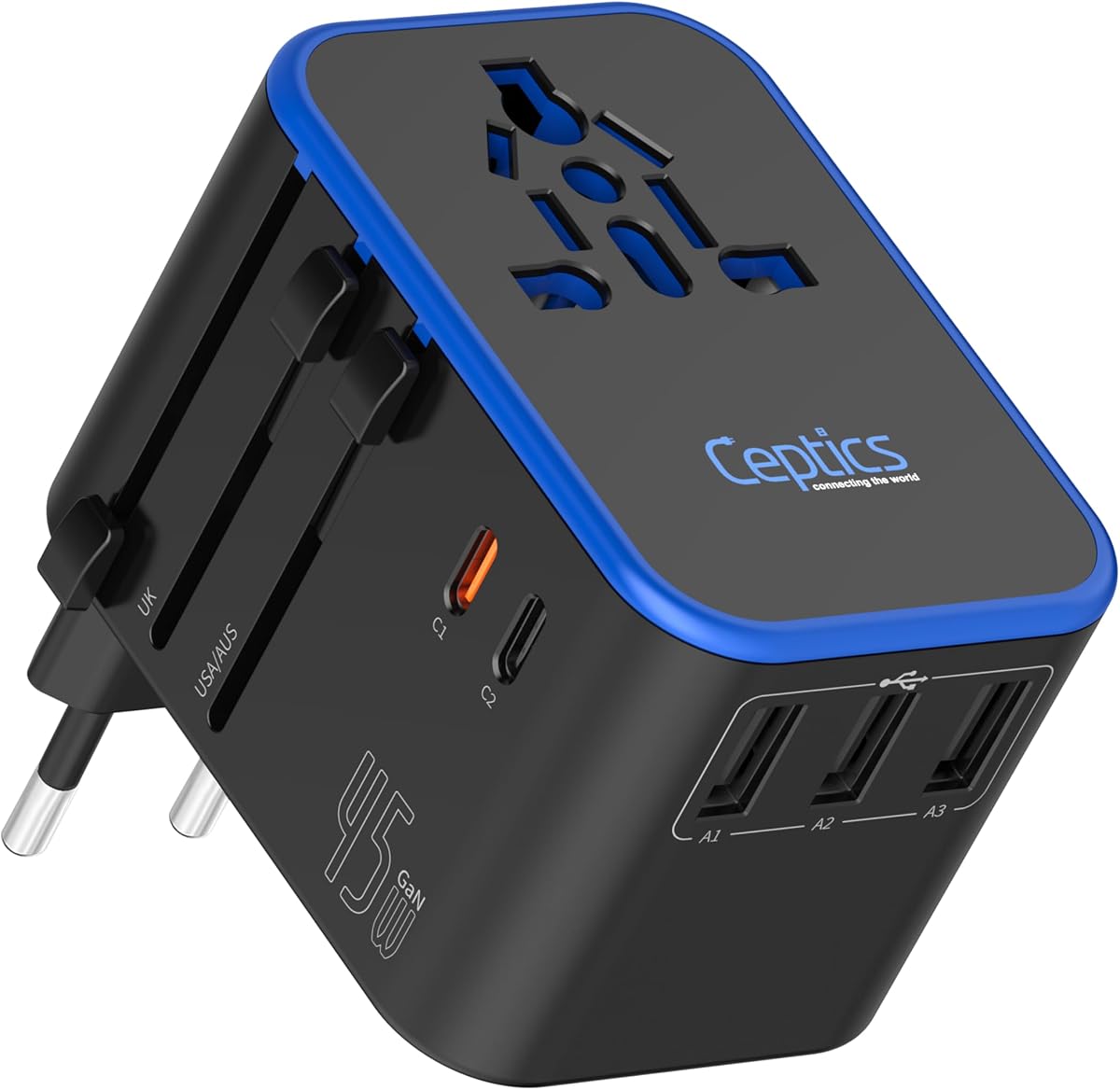
The Ceptics 45W universal travel adapter is an essential companion for any international smartphone journey. It combines a universal wall input with three USB-A ports and two USB-C ports, allowing a traveler to charge a phone, tablet, laptop, or several smaller devices from a single outlet.
We may earn a commission when you buy through this link, at no additional cost to you.
Its plug configuration covers Type A, Type I, Type C, and Type G outlets, covering regions including the United States, Japan, China, Australia, New Zealand, Europe, South America, the United Kingdom, Ireland, Singapore, and Hong Kong. One USB-C port supports Power Delivery and Quick Charge 3.0, while the adapter includes an 8A fuse, plug lock, safety shutters, and stated FCC, CE, and RoHS certifications.
The crucial limitation is that this is not a voltage converter. Compatible devices must support worldwide 100-240V power, which most modern phone chargers do. It cannot operate hair dryers, curling irons, straighteners, or other 110V-only appliances, regardless of whether their plug shape fits.
This is not a smartphone itself, but it completes the travel-phone kit more effectively than a single compact charger. It is especially helpful for families, business travelers, and anyone carrying multiple devices. Travelers should still keep a backup cable and confirm that their phone or laptop requires the supplied 45W total allocation when several devices are connected.
Five USB ports reduce clutter and make it easier to recharge a phone overnight while also topping up a watch, e-reader, power bank, or second phone. The shared 45W rating is most effective when the connected devices are not all demanding maximum output at once.
The universal input recognizes several major plug types, reducing the need to carry country-specific wall blocks. It still does not replace a voltage transformer, and the included safety protections do not make it suitable for every appliance.
We may earn a commission when you buy through this link, at no additional cost to you.
The Alcatel 1 is a basic international phone built around a 5-inch FullView display, dual-SIM GSM connectivity, and a removable battery. Its 4G band list is broad for a simple device, making it useful for travelers who need an inexpensive primary or backup phone and want a manageable screen size.
We may earn a commission when you buy through this link, at no additional cost to you.
The phone includes 16GB of internal storage, 1GB of RAM, a quad-core MediaTek MT6739 processor, and Android 8.1 Oreo Go. A 5MP rear camera and 2MP front camera cover basic photography and video calling, while Bluetooth 4.2, Wi-Fi, hotspot support, and an FM radio add useful offline and local-network functions.
Its performance and software are dated by current standards. The small amount of RAM and older operating system may feel slow in modern apps, and the FWVGA+ resolution is lower than most current smartphones. The international version also has no United States warranty, though the supplied compatibility notes say it works with most GSM carriers, including T-Mobile and AT&T, but not CDMA carriers such as Verizon, Sprint, or Boost.
The Alcatel 1 is best for light travel use, emergency backup, simple calls, messaging, and travelers who value a removable battery more than modern performance. It is a sensible secondary device to keep in a carry-on because it is compact and serviceable, but it is not the strongest choice for navigation-heavy or app-dependent itineraries.
Support for LTE bands 1, 2, 3, 4, 5, 7, 8, 12, 13, 17, and 28 gives the Alcatel 1 wider international reach than many similarly simple phones. Destination and carrier checks are still essential because local 2G, 3G, or 4G availability can vary.
The removable 2000mAh battery can be replaced when needed, which reduces dependence on finding a charger during an extended journey. Its small display and light feature set also make it easy to preserve as a backup phone.
We may earn a commission when you buy through this link, at no additional cost to you.
The Samsung Galaxy A07 combines global 4G LTE support, a 6.7-inch display, dual physical SIM slots, and microSD expansion. Its 64GB internal storage may be modest by current standards, but support for cards up to 1TB makes it a practical option for travelers who want to carry substantial offline media or navigation content.
We may earn a commission when you buy through this link, at no additional cost to you.
The device supports a broad selection of FDD and TDD LTE bands, along with 3G and 2G networks, and the supplied information describes it as unlocked for worldwide GSM use. It also includes Wi-Fi, GPS, Bluetooth-related features, a 3.5mm headphone jack, a fingerprint sensor, and a 5000mAh battery. The rear camera system includes a 50MP autofocus main camera, a 2MP depth camera, and an 8MP wide camera with optical stabilization.
The product is a Latin American international model, so warranty coverage depends on the exact model number and region. The listing has no United States warranty and notes that charger placement is not included. Although the title mentions compatibility with major networks, the detailed information says some carriers, including Metro and Mint, may require IMEI activation.
The Galaxy A07 is well suited to travelers who want Samsung software, dual-SIM flexibility, expandable storage, and broad 4G support without moving to a 5G flagship. Its HD+ PLS LCD is less sharp than some alternatives, and travelers should verify regional warranty and activation details before making a purchase.
Unlike many phones that remove one SIM slot to fit storage, this configuration lists two SIM slots alongside a separate microSD position. That arrangement is valuable when travelers need two active numbers and substantial expandable storage.
International versions often carry different warranty and carrier-activation rules from domestic models. Verify the SM-A075 model designation, regional coverage, and whether the intended prepaid carrier requires IMEI activation before traveling.
We may earn a commission when you buy through this link, at no additional cost to you.
The MIRO Ultra-Light weighs 192g and combines a 6.75-inch HD+ display with a 4900mAh battery, offering a relatively large viewing area without the weight associated with many premium models. Dual-SIM support makes it a straightforward option for travelers who want separate work and personal lines.
We may earn a commission when you buy through this link, at no additional cost to you.
The supplied information says the global 4G phone is compatible with major United States carriers, including AT&T, T-Mobile, and Mint Mobile, and can be used for postpaid or prepaid plans. It includes 64GB of internal storage with an advertised 1TB expansion capability, a 13MP AI dual-camera system, a 5MP front camera, and a 3.5mm headphone jack.
The camera is adequate for everyday travel documentation but lacks the resolution and optical specifications emphasized by the premium selections. This is also a 4G-only device, and the listing does not provide a detailed band list for specific destinations. As a result, its global compatibility claim should be confirmed against the exact carrier and country before departure.
The MIRO Ultra-Light is a comfortable choice for travelers who value screen size, low weight, wired headphones, and generous expandable storage. It is less compelling for photographers or buyers seeking 5G, but it covers common travel needs at a more modest feature level. It works especially well for media consumption, calls, messaging, and casual photography.
At 192g, the device offers a large display without adding the substantial weight of many flagship phones. The balance can be useful during long sightseeing days, airport walks, and extended periods of video viewing.
A 3.5mm jack supports wired headphones without an adapter, and the large expandable storage claim is helpful for offline entertainment. The supplied information does not list the card format, so buyers should confirm microSD support and its limits before relying on expansion.
We may earn a commission when you buy through this link, at no additional cost to you.
A useful travel smartphone begins with cellular compatibility, not screen size or camera resolution. After confirming that a device can operate on the networks and bands you need, compare battery life, SIM design, storage, charging, screen size, and regional warranty coverage.
Choose a model with explicit support for your destination and carrier. Treat unsupported carrier lists as firm boundaries unless the seller confirms otherwise.
Prioritize dual-SIM when frequent calls and messages matter. Verify eSIM support separately rather than assuming it comes with an unlocked model.
Match battery capacity to itinerary intensity. For heavy navigation and photography, prioritize endurance and reliable charging over a smaller, lighter body.
Choose a display that balances readability and carry weight. The most capable screen is not automatically the most comfortable choice on a long walking trip.
Prioritize autofocus, optical stabilization, and useful focal lengths. Pick a larger sensor or more advanced lens system only when photography is central to the trip.
Estimate how many photos, videos, and offline files you will create, then add breathing room. Check whether the second SIM and storage can operate together.
Verify the exact regional model and warranty before purchasing. A lower price may be offset by reduced local support or no domestic service.
Add only travel-relevant extras that improve convenience. Every additional accessory takes space and increases the number of things to pack or protect.
Before leaving, install the intended local carrier app, complete any required IMEI activation, and place the travel data plan into both physical SIM slots or provision the eSIM. Download offline maps and the relevant airline, rail, hotel, and transit apps. Set the phone's time zone automatically, enable location services while limiting background access where practical, and save booking details as screenshots or downloadable files in case mobile service is unavailable.
Protect the device with a sturdy case and screen protector, then use a small waterproof pouch for passports, cards, and chargers. Keep a backup of the phone's IMEI, account credentials, and travel documents in a separate secure location. At public charging points, use a trusted outlet or a charging adapter with protection, and avoid unknown USB ports. A compact power bank can provide reserve energy, but it should be carried in the cabin rather than checked luggage.
On arrival, confirm that the phone has selected a permitted network, test calls and mobile data, and enable airplane mode while switching between roaming and local service. Use data-saving controls for maps, video, and background synchronization, particularly if activation charges apply. Before returning home, back up photographs, remove the local SIM or disable the eSIM if appropriate, and restore any carrier settings needed for your usual networks.
An unlocked international smartphone is generally not tied to one carrier, allowing compatible SIM cards to be used with supported networks. Unlocking does not guarantee activation everywhere because each model has its own cellular bands, and some international versions exclude particular CDMA carriers or regional frequencies. Check the supported band list and carrier exceptions for every destination on the itinerary.
A 4G phone is often sufficient because 4G LTE remains the practical foundation of mobile service in many countries, while models such as the Galaxy A16, Moto G15, Alcatel 1, Galaxy A07, and MIRO Ultra-Light can be simpler and less demanding. A 5G model provides more future flexibility where local 5G coverage and compatible plans are available, but it may also carry tighter carrier exclusions. The best choice depends on where you will travel and which networks operate there.
Yes, particularly when you want to keep a local number for calls and data while preserving a home-country number for account verification. Physical dual-SIM devices require carrying two cards, while eSIM models allow remote activation and management. Check whether the second SIM shares bandwidth with the first and whether the phone has a dedicated microSD slot.
No. The Ceptics 45W travel adapter is designed for devices that accept worldwide 100-240V input, which includes most modern phone chargers. It does not transform 220-240V into 110V, so it should not be used with 110V-only hair dryers, curling irons, straighteners, or similar appliances. Always check the voltage label on the device being plugged in.
Start with reliable autofocus, optical image stabilization, and a lens arrangement that matches your subjects. A main camera handles everyday scenes, an ultrawide helps with landmarks and group photos, and a telephoto is useful for distant subjects. Video capabilities, the front camera, and storage also matter, particularly for travelers who record daily vlogs or keep large collections of destination images.
No. Many global models work on GSM-based services but exclude major CDMA networks, while the supplied listings also contain model-specific restrictions. For example, several devices name T-Mobile-related carriers as compatible but exclude AT&T, Verizon, Cricket, Boost, or other networks. Enter your intended carrier and check the exact model before purchasing or activating the phone.
At least 64GB is practical for offline maps, tickets, applications, and a moderate number of photographs. Heavy users of high-resolution video should consider 128GB or more, or a model with microSD expansion. If the phone uses a hybrid SIM tray, verify that a second SIM and storage card can be active at the same time.
Not always. Several products in this guide explicitly state that they have no United States warranty, while the Galaxy A07 is described as a Latin American model with regional coverage. Warranty service may also depend on the exact model suffix. Purchase from an authorized seller, retain the receipt, and check the manufacturer's support coverage for the precise regional model.
The XIAOMI 17T PRO Ai 5G stands out for travelers who want the broadest combination of international 5G bands, eSIM support, premium cameras, a 144Hz display, and fast charging. The Samsung Galaxy A16 is a more restrained choice for overseas GSM use, offering dual physical SIM slots, a 90Hz AMOLED display, and 5000mAh battery at a lower tier. The I25 Ultra 5G appeals to travelers who prioritize a very large display, built-in stylus, and substantial battery capacity.
Prioritize compatibility before every other specification. Identify your destination countries, local carriers, and required SIM configuration, then confirm the exact band list and any exclusions. After that decision, choose based on battery endurance, display size, camera flexibility, storage, charging needs, and regional warranty support. A slightly less powerful phone with correct bands is more useful abroad than a flagship that cannot activate on the intended network.
Prices, prepaid plans, carrier policies, and product availability can change at any time. Before purchasing, compare the current listing with the carrier's supported-device list, review activation requirements, and confirm what accessories or chargers are included. Those final checks can prevent the most common international travel problems before the phone ever leaves the house.