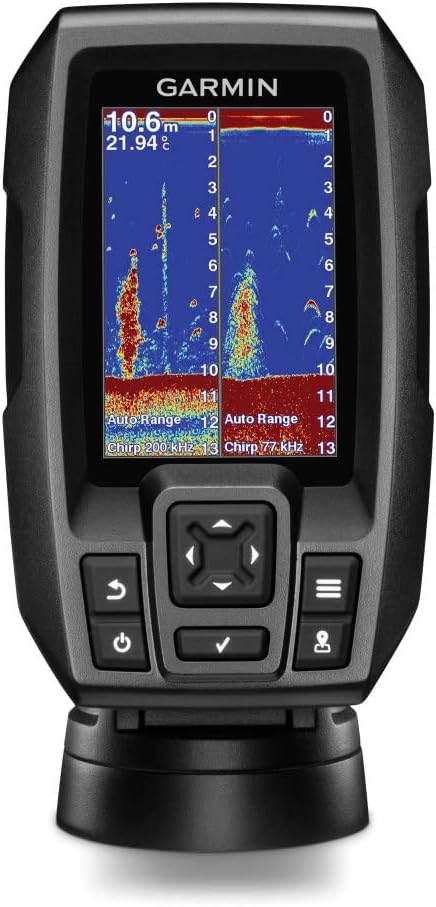
Garmin Striker 4
4.6Editor score
Compact 3.5-inch display
CHIRP sonar technology
Clear Vu scanning sonar
Maximum 1,600-foot depth
Waypoint navigation supported
Fish finders for small boats help anglers see submerged structure, identify fish, measure depth, and navigate favorite waters with greater confidence. The right unit should fit the available console space, match your usual fishing conditions, and provide sonar information that is easy to interpret without overwhelming a limited dashboard.
This guide compares ten fish finders based on the supplied display, sonar, GPS, mapping, transducer, mounting, and wireless details. It covers compact fixed-mount units for modest boats, portable systems for kayaks and canoes, and larger screens for anglers who want more detail while still operating from a small craft.
Each review explains the most useful strengths, practical limitations, and ideal boating setup for every model. Ratings reflect the supplied customer feedback, while product features and availability can change over time. Always compare current listing details, installation requirements, and current pricing before purchasing.
4.6Editor score

4.7Editor score
4.5Editor score
As an Amazon Associate we earn from qualifying purchases.
The comparison below highlights the major differences in screen size, sonar design, navigation, mapping, and installation. These distinctions help determine which fish finder is most practical for a compact boat, kayak, pontoon, or other small watercraft.


The Garmin Striker 4 combines a very compact 3.5-inch display with features that are more capable than many anglers expect from a small fish finder. Its supplied rating is 4.6, reflecting strong general satisfaction, and its standout combination is CHIRP sonar, Clear Vu scanning, GPS navigation, and a bundled transducer in one relatively straightforward package.
We may earn a commission when you buy through this link, at no additional cost to you.
Clear Vu scanning sonar is designed to show objects and structure in greater detail, while CHIRP uses a continuous sweep of frequencies to create clearer fish arches and improve target separation. For a small boat, that combination can make a major difference when the display is limited and anglers need to identify a productive drop-off, brush pile, or group of fish quickly. The device also includes a waypoint map for marking and navigating to locations such as docks, stumps, and submerged structure.
The main limitation is the screen itself. A 3.5-inch diagonal display is easy to fit into a compact console, but it offers less room for separating targets and reading menus than a four-, five-, or seven-inch screen. This model also uses a keyed interface rather than the touch control found on the Striker Plus 4. Nevertheless, the simple buttons can be advantageous in wet, sunny, or moving-boat conditions because there is no touchscreen to tap imprecisely.
This is a particularly strong choice for anglers who want serious sonar and navigation in a restricted dashboard. It reaches a listed maximum depth of 1,600 feet in freshwater and 750 feet in saltwater, while its IPX7 rating supports use in wet environments. Choose the Striker 4 when space is the first priority, a transducer is needed out of the box, and simple physical controls are preferable to advanced wireless features.
The combination of CHIRP and Clear Vu scanning sonar gives this compact unit an advantage over basic depth-only displays. It can present fish arches and underwater structure in more detail, helping anglers decide where to concentrate when a small boat leaves little room for screen splitting or extensive manual interpretation.
Its 3.5-inch diagonal face is the defining advantage for compact boats. The keyed interface is also straightforward to use with wet hands, although anglers who prefer larger displays and touch navigation will find better matches among the other Garmin models in this guide.
We may earn a commission when you buy through this link, at no additional cost to you.
The Humminbird PiranhaMAX 4 is a compact, traditional fixed-mount fish finder built around an uncomplicated premise: give an angler clear sonar and a straightforward installation. Its supplied rating is 4.6, placing it among the strongest customer-rated choices in the guide, and the included transducer and tilt-and-swivel bracket make it a practical all-in-one option.
We may earn a commission when you buy through this link, at no additional cost to you.
Dual Beam sonar allows users to select between a narrow beam for detailed scanning and a wide beam for broader coverage. That flexibility is useful on small lakes, rivers, and coastal waters because the best viewing setting depends on the structure being searched. A tight beam can help separate nearby targets, while a wider beam can reveal more fish and contours around the boat.
The tilt-and-swivel mount allows quick adjustment of the viewing angle, which is helpful when an angler changes position or the console is exposed to glare. The package includes the PiranhaMAX 4 unit, the mounting bracket, and an XNT 9 28 T transom-mount transducer, reducing the need to select mounting hardware separately.
Its trade-off is that the feature set remains basic compared with units offering GPS waypoints, contour mapping, wireless connectivity, or specialized imaging. That simplicity is not necessarily a drawback; many small-boat anglers want a reliable sonar display without navigating complicated menus. Consider the PiranhaMAX 4 when straightforward operation, selectable beam coverage, and an included transom transducer matter most.
Dual Beam technology lets the operator move between focused detail and wider coverage without changing hardware. This adaptability makes the PiranhaMAX 4 useful for anglers who move between shallow structure, channels, drop-offs, and open water during a single outing.
The supplied XNT 9 28 T transom-mount transducer and adjustable bracket cover the essential installation pieces. Buyers should still verify transducer compatibility with their hull and confirm whether a different mounting approach is needed for their particular boat.
We may earn a commission when you buy through this link, at no additional cost to you.
The Humminbird Helix 5 Chirp GPS G3 is the feature-rich middle ground in this collection. Its supplied rating is 4.4, and it combines a five-inch display, Dual Spectrum CHIRP sonar, enhanced GPS navigation, and real-time mapping capabilities. Those features make it a natural upgrade for small-boat anglers who want more than basic depth readings without moving to the largest screen in the guide.
We may earn a commission when you buy through this link, at no additional cost to you.
Dual Spectrum CHIRP sonar offers two search approaches. Wide Mode is intended to maximize coverage beneath the boat, while Narrow Mode provides more detailed scanning and precise two-dimensional target separation. The Low-Q transducer supports the sonar system, giving anglers a way to distinguish fish arches from timber, rocks, vegetation, and other structure.
Navigation is another major strength. The included Humminbird Basemap provides coverage for more than 10,000 lakes and the continental U.S. coastlines, while compatibility with LakeMaster, CoastMaster, and Navionics charts creates upgrade options. AutoChart Live can develop maps with depth contours, bottom hardness, and vegetation information while recording. Compatible AutoChart Zero Line SD cards expand that mapping capacity.
The trade-off is complexity and dashboard size. A five-inch display needs more mounting room than the smallest models, and premium chart subscriptions can add further cost if used. The keypad remains practical in weather because it does not depend on touch input. This Helix model suits anglers who value sonar detail, charting, and future mapping options more than the absolute smallest footprint.
Switching between Wide and Narrow modes helps balance coverage and detail as fishing conditions change. This is particularly valuable on a small boat, where finding a productive area quickly can matter as much as examining a single target closely.
The built-in basemap and support for recognized premium chart systems make the unit more versatile than basic sonar displays. AutoChart Live adds another layer by recording information about contours, bottom hardness, and vegetation during future trips.
We may earn a commission when you buy through this link, at no additional cost to you.
The Garmin STRIKER Vivid 4cv earns an Editor's Choice designation because it balances several important features in a still-compact four-inch format. Its supplied rating of 4.7 is the highest among the listed products, and the unit combines color sonar, CHIRP traditional scanning, CHIRP ClearVü scanning, GPS, and Quickdraw Contours mapping.
We may earn a commission when you buy through this link, at no additional cost to you.
Vivid scanning sonar color palettes help distinguish fish from structure by making submerged features easier to compare visually. The included GT20 transducer supports both traditional CHIRP and ClearVü scanning sonar, giving anglers two ways to interpret the water below the boat. Traditional sonar is useful for broader interpretation, while scanning sonar can provide more defined views of fish and objects.
High-sensitivity GPS allows anglers to mark waypoints, create routes, and view boat speed. Built-in Quickdraw Contours mapping expands the unit beyond a pure fish finder, enabling users to record contour information while traveling over useful water. A tilt-and-swivel bail-mount bracket is included, which gives the installation some flexibility on a compact console.
The four-inch screen still cannot offer the visual workspace of the five- or seven-inch models, and the supplied information does not list Wi-Fi connectivity. However, for many small boats, four inches is a more balanced fit than five inches while still providing a meaningful improvement over the 3.5-inch Garmin Striker 4. It is a strong all-around recommendation for anglers who want color, scanning sonar, GPS, and mapping in one accessible unit.
The four-inch display offers a noticeable step up in visible detail without taking on the physical footprint of a five- or seven-inch unit. That makes this model well suited to center consoles and compact dashboards where every inch of space matters.
The GT20 transducer, high-sensitivity GPS, and Quickdraw Contours provide the core tools needed for both finding fish and revisiting productive areas. Its feature balance makes it one of the easiest recommendations for anglers who do not want to choose between navigation and sonar.
We may earn a commission when you buy through this link, at no additional cost to you.
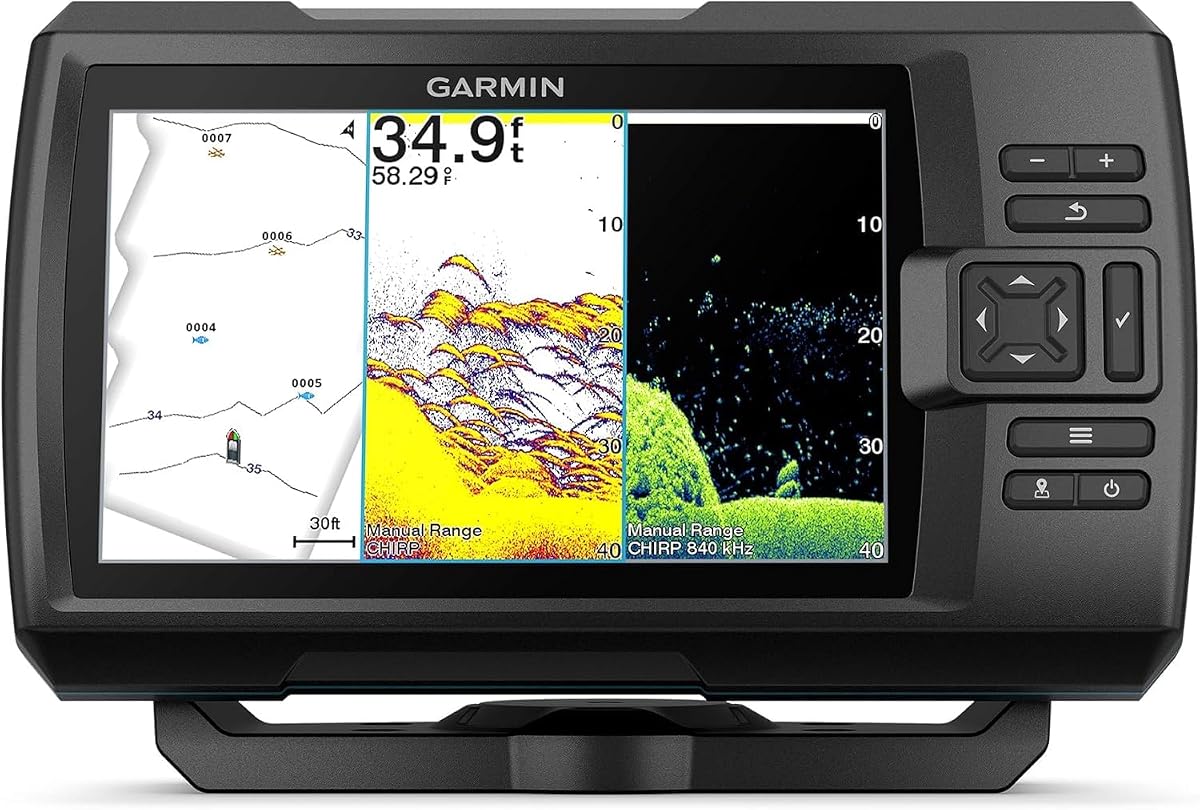
The Garmin Striker Vivid 7cv is the premium choice in this guide, offering the largest screen and the most advanced connectivity specification among the Garmin models featured. Its supplied rating is 4.5, and it combines a seven-inch color display, CHIRP sonar, ClearVü scanning sonar, GPS, Quickdraw Contours, and Wi-Fi access to the ActiveCaptain mobile app.
We may earn a commission when you buy through this link, at no additional cost to you.
The large display is the primary attraction. More screen area can make it easier to read multiple sonar readings, follow navigation details, and distinguish subtle changes in the color palettes. The included GT20-TM transducer supports traditional CHIRP and ClearVü scanning, giving users flexibility in how they view fish and submerged structure.
Wi-Fi connectivity adds practical value beyond the sonar image. With a compatible smartphone, anglers can transfer waypoints, receive smart notifications and software update notices, and access the Garmin Quickdraw Community. High-sensitivity GPS supports waypoint marking, route creation, and boat-speed display, while Quickdraw Contours provides built-in mapping support.
Premium does not mean universally suitable. A seven-inch display can dominate a very small console and may be less comfortable on a compact skiff or fishing kayak. Some anglers may also prefer a simpler unit without wireless features. The Striker Vivid 7cv is best for a small boat with sufficient console area who wants the clearest display and convenient phone integration.
The seven-inch display provides the most spacious view in the guide, reducing the need to switch between compact pages. It is especially useful for anglers comparing sonar returns, reviewing navigation information, and using the vivid color palettes to distinguish fish from structure.
ActiveCaptain Wi-Fi support can simplify waypoint transfer, software updates, and community mapping access. The feature is most valuable when the boat has a protected location for a compatible phone and the angler already uses Garmin's broader navigation ecosystem.
We may earn a commission when you buy through this link, at no additional cost to you.
The Lowrance Eagle Fish Finder stands out for its modern portrait display and choice of screen sizes, offering configurations from four to nine inches. Its supplied rating is 4.3, the lowest in this comparison, but the product targets a broad range of small-boat needs with a bright IPS screen, auto-tuning sonar, and a wide-coverage included transducer.
We may earn a commission when you buy through this link, at no additional cost to you.
The portrait IPS screen is designed to remain clear in bright sunlight, from wide viewing angles, and through polarized sunglasses. Those visibility characteristics are meaningful on open water, where glare and changing boat positions can make conventional displays harder to read. The 4-inch configuration may appeal to anglers with tight console space, while larger versions provide more room for detail.
Auto-Tuning Sonar reduces setup by automatically optimizing settings, allowing users to spend more time interpreting the display. The included 200 kHz Bullet Skimmer produces a broad 44-degree beam, which is particularly useful for kayaks and small boats that need coverage near the hull. Fish icons with depth and zoom help simplify target identification without requiring an audible fish alarm.
Fast installation is another strength. A twist-lock connector simplifies attaching and removing the display, while the compact portrait shape suits areas where a traditional wide landscape screen may be awkward. The main uncertainty comes from the multiple size and C-MAP configurations: buyers need to confirm the exact display size, transducer bundle, chart options, and mounting accessories included with the listing they select.
The IPS panel and wide viewing angles support easier reading in bright conditions. For anglers moving between covered and open areas, a display that remains legible at multiple angles can reduce the need to shade or reposition the unit.
Auto-tuning and the twist-lock connection reduce both operating and installation friction. The compact portrait format is particularly practical for limited dashboards, although buyers should verify the dimensions and included components for the selected configuration.
We may earn a commission when you buy through this link, at no additional cost to you.
The LUCKY MT-202 is the most genuinely portable fish finder in the guide, built for anglers who move between shore, kayak, canoe, boat, pontoon, and ice without installing a console or mounting a permanent transducer. Its supplied rating is 4.5, and its defining features are a handheld 3.5-inch LCD, a floating wireless sensor, and a stated operating distance of 853 feet.
We may earn a commission when you buy through this link, at no additional cost to you.
The wireless sensor can be cast like a bobber or attached with its safety tether. This allows anglers to place the sonar in productive areas such as weed beds, deep channels, brush, and other structure that may be difficult to reach from the boat. The sensor and display are also described as light enough to remain highly portable, making the system appealing for travel-oriented fishing.
The wide 90-degree sonar beam covers a 3-to-147-foot depth range. The display presents fish icons with exact depth markings and scrolls from right to left to preserve a history of targets and structure passing beneath the sensor. That scrolling view can help an angler track movement or understand whether a reading is associated with a larger feature.
The trade-offs are clear. A 3.5-inch horizontal display is modest, and the supplied specification does not describe built-in GPS navigation or contour mapping. It also depends on wireless communication and battery use rather than a standard transom installation. Choose the MT-202 when portability, flexible sensor placement, and minimal setup are more important than a permanent navigation station.
Casting the floating sensor allows the sonar to search areas beyond immediate reach. That flexibility can be especially useful around shoreline cover, deep channels, or structure that a fixed hull-mounted transducer cannot scan from the boat's current position.
The handheld and floating-sensor arrangement avoids permanent installation, making it convenient for shared boats and changing fishing locations. It is also better suited to spontaneous outings than permanently mounted units that require cable routing and transducer placement.
We may earn a commission when you buy through this link, at no additional cost to you.
The Garmin Striker Plus 4 fills the space between the entry-level Striker 4 and the larger STRIKER Vivid models. Its supplied rating is 4.6, and it offers a sunlight-readable 4.3-inch display, touchscreen controls, dual-beam CHIRP sonar, built-in GPS, and Garmin Quickdraw Contours mapping.
We may earn a commission when you buy through this link, at no additional cost to you.
The dual-beam transducer supports Garmin CHIRP traditional sonar and is intended to provide clear images and strong target separation. Supported frequencies include 50, 77, 83, and 200 kHz, with a listed transmit power of 200 watts RMS. The slightly larger 4.3-inch screen gives users more visible information than the 3.5-inch Striker 4 without approaching the footprint of a five-inch unit.
Touch operation provides a modern, intuitive way to navigate menus, while built-in GPS lets anglers mark waypoints, create routes, and monitor boat speed. Quickdraw Contours can create and store maps using one-foot contours for as much as two million acres. That is meaningful capacity for an angler who records personal maps across multiple lakes.
The tradeoff is that a touchscreen may be less convenient than physical buttons when the display is wet, dirty, or being used in rough conditions. The supplied information also does not list Wi-Fi connectivity, so this unit is less integrated with phones than the Garmin Striker Vivid 7cv. It remains an excellent middle option for boaters who want touch controls and mapping without the largest screen.
The 4.3-inch display is a practical middle ground between compact three-and-a-half-inch units and larger five-inch screens. It can improve readability while remaining manageable on a modest center console or fishing dashboard.
Touch controls make menu access direct, and Quickdraw Contours adds durable value for anglers who repeatedly visit local waters. Bluetooth is identified as a special feature, but the supplied specifications do not detail broader wireless phone connectivity.
We may earn a commission when you buy through this link, at no additional cost to you.
The Humminbird PiranhaMAX 4 DI adds Down Imaging to the familiar PiranhaMAX formula, making it a strong choice for anglers who need to see structure in detail. Its supplied rating is 4.6, and the package combines a 4.3-inch color LCD, Down Imaging, Dual Beam sonar, Fish ID+, alarms, zoom, a tilt-and-swivel mount, and an XNT 9 DI T transom transducer.
We may earn a commission when you buy through this link, at no additional cost to you.
Down Imaging is designed to show timber, brush, bridge pilings, rocks, and other structure below the boat with sharp detail. That makes it particularly useful for locating productive habitat rather than relying only on individual fish arches. Dual Beam sonar provides an additional way to choose between detailed scanning and broad coverage, giving the angler more control over the view.
Fish ID+ can help identify targets automatically, while fish alarms, depth alarms, and zoom add tools for monitoring the display. The 4.3-inch color screen offers a practical balance between visibility and size, and the redesigned interface is described as easier to use.
The main limitation is that the supplied specifications do not mention built-in GPS navigation, contour mapping, or advanced chart compatibility. Those omissions make it less attractive as a complete navigation system. However, for an angler whose priority is recognizing structure and fish on a relatively compact display, the PiranhaMAX 4 DI provides a specialized imaging advantage over a basic depth finder.
Down Imaging can reveal familiar forms such as timber, brush, rocks, and pilings with greater definition. Recognizing that structure helps anglers interpret why fish are present and can make a productive area easier to relocate on another trip.
Fish ID+, zoom, and alarm functions can reduce the effort required to monitor individual targets. They are particularly convenient for anglers who prefer the unit to help distinguish returns instead of relying only on manual sonar interpretation.
We may earn a commission when you buy through this link, at no additional cost to you.
The Garmin STRIKER 5CV offers a balanced five-inch option for small-boat anglers who want more visible detail than a compact display but do not need the seven-inch premium model. Its supplied rating is 4.5, and it includes a transducer, CHIRP traditional sonar, CHIRP ClearVü scanning sonar, built-in GPS, and Quickdraw Contours mapping software.
We may earn a commission when you buy through this link, at no additional cost to you.
Traditional CHIRP and ClearVü scanning sonar give users two complementary views of the water. Traditional sonar supports a general interpretation of fish and structure, while ClearVü can create more defined imagery of individual targets and underwater features. The five-inch color screen is better suited than smaller units to separating those returns and reading more information at a glance.
Built-in GPS allows anglers to mark waypoints, create routes, and view boat speed. Quickdraw Contours lets users create and store maps with one-foot contours for up to two million acres, which can be valuable for preserving depth information around productive structure. The included transducer helps make the package ready for a standard installation.
The five-inch screen takes up more room than the smaller Garmin units, so console measurements are essential. The supplied information also does not list Wi-Fi connectivity, leaving phone integration less prominent than on the Striker Vivid 7cv. This model is a practical middle-to-large choice for a small boat with a sufficiently broad mounting area and a preference for dependable physical controls.
The five-inch display provides more room for reading targets and comparing sonar returns. It is a meaningful upgrade for anglers who regularly fish structure-heavy water or want to use both CHIRP traditional and ClearVü scanning modes.
GPS waypoints, routes, speed information, and Quickdraw Contours make the unit useful beyond locating fish in the moment. These functions help anglers preserve and revisit information about areas that produced consistent results.
We may earn a commission when you buy through this link, at no additional cost to you.
The best fish finder for a small boat is not simply the model with the largest screen or longest feature list. Display fit, sonar style, transducer placement, navigation requirements, power availability, and the types of water you fish should guide the decision.
Begin by measuring the usable area of the console rather than comparing screen sizes alone. A four-inch or 4.3-inch unit can suit a compact center console, while a five-inch display may be comfortable on a slightly larger dash. The seven-inch model is most appropriate when the boat has a broad protected mounting surface and the angler values a large viewing area. Also consider the bracket, cable route, sun cover, and clearance required to tilt or swivel the display.
Choose based on total footprint, not screen diagonal alone. A slightly smaller unit can be easier to operate from a seated position, particularly on a skiff or fishing kayak.
Traditional CHIRP sends a continuous sweep of frequencies and can create clear fish arches with strong target separation. CHIRP ClearVü scanning sonar presents a more photographic-style image of fish and structure. Dual Beam and Dual Spectrum systems offer selectable narrow and wide modes, allowing anglers to trade detail for coverage. Down Imaging focuses on the shape of submerged structure, which can help locate brush, rock, timber, and other habitat.
Match the sonar system to your fishing style. If you mainly need contours and fish arches, traditional or Dual Beam may be sufficient. If recognizing fine structure is important, prioritize ClearVü or Down Imaging.
A fish finder is only as useful as its transducer placement, and the supplied hardware may not suit every hull. Transom-mounted units are convenient on many small boats, while portable sensors avoid permanent installation. Confirm the transducer type, mounting location, cable length, compatibility with the display, and whether the hull material or shape could interfere with a conventional mount.
Match the installation method to how the boat is used. Shared or rental boats generally benefit from portable equipment, while a privately owned boat may justify a permanently mounted sonar system.
Basic fish finders primarily show depth, contours, and fish arches. GPS-equipped models can mark waypoints, create routes, and show boat speed. Chartplotter-style units add detailed basemaps, premium chart compatibility, and personal mapping options. AutoChart Live can record contours, bottom hardness, and vegetation, while Quickdraw Contours focuses on user-generated depth contours.
If you repeatedly return to the same productive areas, waypoints and mapping add meaningful value. If your main goal is immediate sonar information, those advanced features may be less important than screen readability and transducer performance.
Color, screen brightness, viewing angle, and display size all affect how quickly an angler can interpret a sonar image. The Lowrance Eagle uses an IPS portrait display designed for bright sunlight and wide viewing angles, while the Garmin units use sunlight-readable color screens. A portrait format can fit narrow dashboards, but it is not automatically better than a landscape display for every mounting arrangement.
Choose a screen that remains legible from the position in which you actually fish. Readability on a calm lake at midday may differ substantially from usability in glare, rain, or a heaving small boat.
Wireless features can make waypoint transfer, notifications, software updates, and community mapping easier, but they also introduce app compatibility and phone-management considerations. The Garmin Striker Vivid 7cv specifically supports ActiveCaptain connectivity. Other models may list Bluetooth or offer different ecosystem features without providing the same phone integration.
Treat connectivity as a convenience rather than the deciding factor unless your established workflow already depends on it. Sonar quality, mounting fit, and navigation usefulness should remain more important than adding an app.
Portable fish finders such as the LUCKY MT-202 are attractive for anglers who fish from shore, kayak, canoe, or changing locations. Their wireless sensor avoids permanent wiring, and their stated depth and operating ranges can suit a variety of environments. Fixed-mount units generally provide a more permanent connection to the boat and may be better for navigation-centered setups.
Compare battery requirements, charging routines, weather exposure, and storage space. A portable setup is not automatically better; it simply solves a different need. Decide whether freedom of placement is worth more than a permanent dashboard installation.
Write down your most important needs: readable fish arches, detailed structure, GPS navigation, contour recording, portability, or a compact display. This prevents a long specification list from obscuring the decision. A simple four-inch model may be perfect for a small console, while a five-inch unit may be worth it if detailed sonar interpretation is central to your fishing.
Prioritize two or three essential features, then verify installation fit and transducer compatibility. Let those requirements direct the comparison rather than choosing the model with the most elaborate feature list.
Start with a clean, dry mounting area and follow the included instructions for power, transducer placement, and bracket assembly. Confirm that every cable is secured away from sharp edges, propellers, hinges, and moving controls. For a transom-mounted transducer, pay attention to the listed transom angle and the transducer's consistent contact with the water. Portable sonar should be fully charged before leaving shore, with the sensor and display stored together in a protective case.
Once installed, learn the basic sonar and navigation controls before reaching unfamiliar water. Compare the display with familiar features such as a known drop-off, channel edge, or boat ramp. Set brightness and sensitivity for the current conditions, use narrow beams for detail and wide beams for coverage when supported, and save useful waypoints as soon as you locate productive structure. Avoid repeatedly changing settings while actively searching for fish, as consistent sonar settings make returns easier to interpret.
After each outing, remove the portable components from exposed moisture and inspect fixed connectors for dirt or corrosion. Clean the display with a soft, damp cloth rather than abrasive cleaners, and protect the unit from excessive direct heat when stored. Check the transducer cable and mount for loosening, especially after rough water. Periodically review software updates, mapping recordings, storage capacity, and any current compatibility notices for accessories or mobile applications.
The most convenient installation depends on the boat and whether portability matters more than a permanent dashboard system. Transom-mounted models such as the Humminbird PiranhaMAX 4 are designed for a relatively straightforward external transducer setup, while the LUCKY MT-202 avoids fixed wiring entirely. Before installation, measure the console, identify the power source, and check the complete list of included mounting hardware.
A smaller display can be advantageous in a kayak because it uses less space and is easier to mount near the angler's seated position. The Lowrance Eagle offers a compact four-inch portrait configuration, while the LUCKY MT-202 removes the need for a permanent mount. The best choice still depends on visibility, controls, battery needs, and whether you want GPS navigation.
In most cases, yes, because the transducer is the component that sends sonar signals into the water and receives the returning signals. Several products in this guide include a compatible transducer, but buyers should verify the exact model and mounting style. A unit advertised without a transducer may require a separate purchase to detect fish and underwater structure.
CHIRP uses a continuous sweep of sonar frequencies and is well suited to showing fish arches and separating targets. Down Imaging focuses on producing a detailed view of submerged structure such as brush, rock, timber, and pilings. Many anglers use different sonar modes for different tasks, so a unit offering both can be especially versatile.
GPS itself does not detect fish, but it can help you mark productive water, record routes, view boat speed, and return to specific locations. Features such as Quickdraw Contours and AutoChart Live add information about depth contours, bottom hardness, and vegetation. These navigation tools are most useful for anglers who repeatedly fish the same lakes, channels, or coastal areas.
A portable model offers flexibility, quick setup, and no permanent hull modification, making it ideal for shore, kayak, canoe, and changing-location fishing. A fixed system is usually better suited to a permanent console, continuous boat speed display, structured GPS navigation, and dedicated transducer placement. The better option depends on how and where the boat is used.
A 3.5- to 4.3-inch display may be sufficient for a tightly spaced console, while a five-inch screen provides more room for interpreting sonar and navigation details. A seven-inch display offers the largest viewing area but requires a much broader mounting surface. Measure the entire dash and consider viewing angle, bracket clearance, sun protection, and operator position before deciding.
Basic sonar is enough if your priority is seeing depth, fish arches, and nearby structure during each trip. Advanced mapping becomes more valuable when you want to save productive areas, navigate reliably, record contours, or revisit deeper water. Consider your normal routine rather than choosing advanced features you are unlikely to use, and check any ongoing chart or accessory requirements.
The Garmin STRIKER Vivid 4cv is the strongest all-around recommendation because it combines a compact four-inch color screen, CHIRP and ClearVü sonar, GPS, Quickdraw Contours, and an included GT20 transducer. The Garmin Striker 4 provides the more compact and budget-conscious route, while the Garmin Striker Vivid 7cv serves boaters with adequate mounting space who want a large display and phone connectivity.
Your priorities should determine which feature comes first. Match the display to the available console, select sonar modes that suit the fish and structure you target, and confirm that the transducer and mounting hardware fit the hull. Portable anglers should consider the LUCKY MT-202, while anglers focused on navigation and detailed structure can examine the Humminbird Helix 5 Chirp GPS G3 and PiranhaMAX 4 DI.
Ratings and product configurations can change, and current prices should always be checked before purchasing. Review the latest listing, included accessories, installation requirements, chart options, and compatibility details to ensure that the selected fish finder fits the boat and the intended fishing style.