
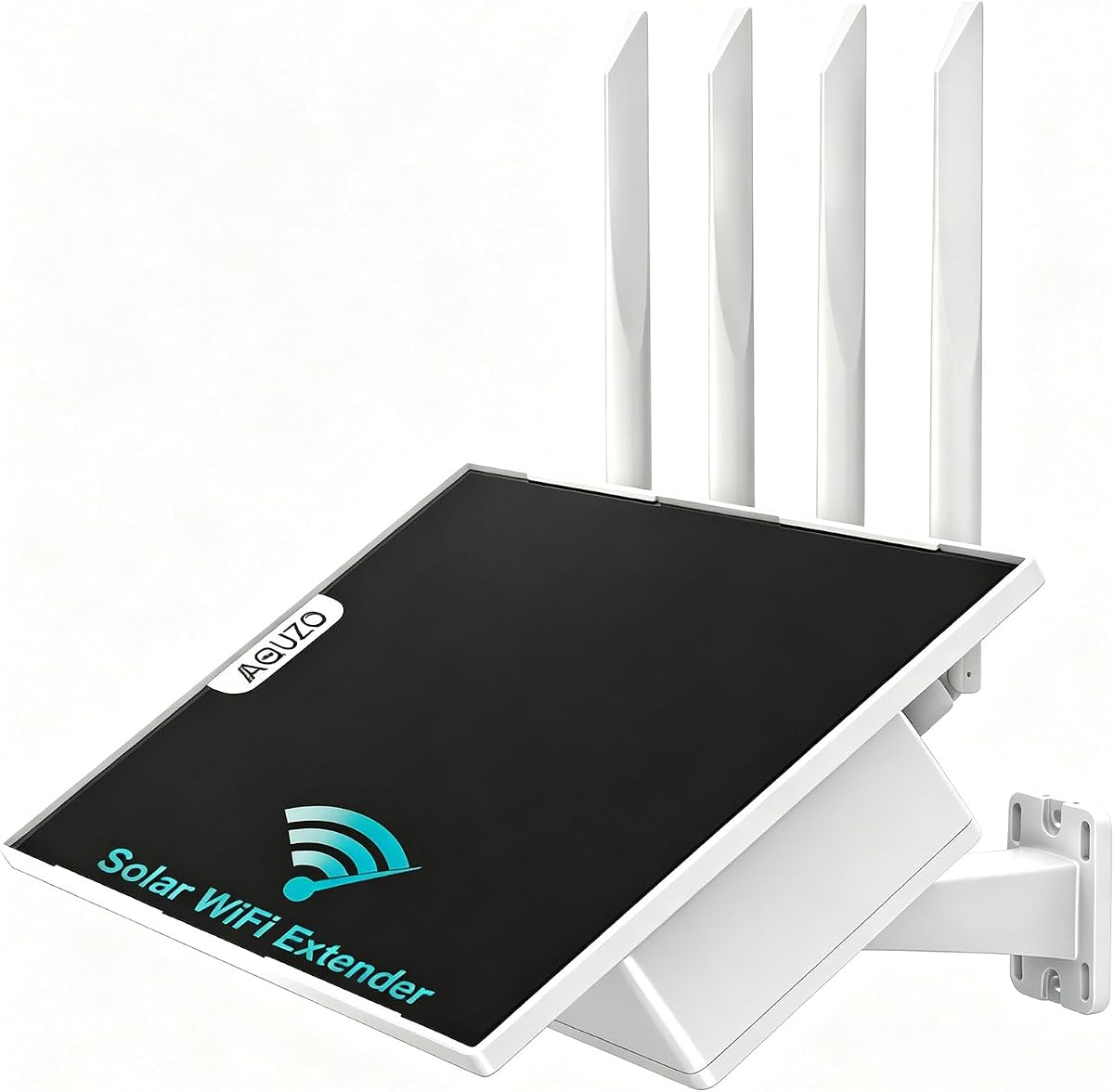
Outdoor WiFi Extender Solar Powered E9
Dual-band up to 1200Mbps
Four 8dBi antennas
Dual 15W solar panels
36,000mAh battery backup
Our Solar WiFi Extenders guide compares coverage, solar power, battery capacity, weatherproofing, speed, setup, and use cases for every outdoor need.
Solar WiFi Extenders bring dependable network access to gardens, farms, campsites, barns, garages, and other outdoor spaces where a conventional router signal fades. A good unit balances useful range, consistent 2.4GHz performance, dependable solar charging, adequate battery reserves, and weather-resistant construction. Installation should also be simple enough for users without advanced networking experience.
We compared all ten products using their stated specifications, including claimed coverage, radio bands, maximum speeds, antenna configurations, solar-panel output, battery capacities, weather ratings, operating temperatures, mounting options, and router compatibility. The guide covers both single-unit 2.4GHz repeaters and a higher-capacity dual-band model, while noting where published range remains dependent on placement and obstructions.
Each review identifies the most suitable setting for that extender, from budget-conscious coverage to premium dual-band performance. The comparison also highlights meaningful differences in IP ratings, antenna design, relay support, and backup power. Product listings and specifications can change, and prices fluctuate frequently, so readers should verify current details and compatibility before purchasing.
4.5Editor score

4.3Editor score
This side-by-side comparison shows how the ten solar WiFi extenders differ in radio support, stated range, energy storage, outdoor protection, and installation features. The figures come from the supplied product descriptions, and actual reach will vary with router signal, interference, walls, terrain, weather, and antenna placement.


The WiFi Extender Outdoor Solar Powered E8 combines a claimed 120-meter radius with four 5dBi antennas, making it one of the most comprehensively specified options in this guide. Its 4.5 rating also places it among the stronger customer-rated products. The combination of 2.4GHz performance, a 27,000mAh battery, and an IP66 enclosure makes it particularly convincing for properties where a dependable repeater must operate without a nearby outlet.
We may earn a commission when you buy through this link, at no additional cost to you.
Its 15W solar panel and large internal battery form a sensible outdoor power system. According to the product description, the battery can support operation through cloudy or rainy stretches, while intelligent charging and power management are intended to maintain continuity. The enclosure is also described as resistant to dust, rain, heat, and ultraviolet exposure, which makes the unit suitable for fences, barns, garages, patios, farms, and exposed garden locations.
The main limitation is that it operates only on the 2.4GHz band. That band is useful for extending a network over distance and for supporting compatible cameras and smart devices, but it is not the right choice for users who want modern 5GHz speed or a dedicated high-bandwidth WiFi 6 network. The stated 300Mbps ceiling and 120-meter radius should also be treated as maximum or ideal figures rather than guaranteed performance in every yard.
This is the strongest all-around recommendation for buyers who want proven outdoor protection, substantial battery capacity, and a capable antenna arrangement. Place it where the existing router still has a usable signal, mount it in direct sunlight, and orient the antennas toward the intended coverage area. It is particularly well suited to outdoor cameras, garden equipment, and users extending WiFi across a sizeable property.
The 15W panel, 27,000mAh battery, and IP66 enclosure create a practical package for year-round outdoor deployment. Positioning the unit where it receives unobstructed sunlight helps the panel replenish power while the battery carries the load through adverse weather.
Four 5dBi antennas and a claimed 120-meter radius distinguish this model from simpler two-antenna designs. Its 2.4GHz connection is especially relevant to outdoor cameras and many smart-home devices that only use the 2.4GHz band.
We may earn a commission when you buy through this link, at no additional cost to you.
This Solar WiFi Extender Outdoor earns a 4.6 rating, matching the highest numerical rating among the ten listed products. It is built around a 26,000mAh rechargeable battery, a 15W solar panel, and an IP65 weather-resistant enclosure. The product description gives it a broad operating range of -30°C to 70°C, making it a credible option for farms, gardens, courtyards, garages, and other exposed spaces.
We may earn a commission when you buy through this link, at no additional cost to you.
Two external high-gain antennas provide 360-degree signal reception and transmission, while the stated coverage extends to 300 feet. Setup occurs through a browser interface at the address 192.168.16.1, with support stated for Windows, Android, and iOS platforms. A 360-degree adjustable mounting bracket lets installers refine antenna position after checking the available router signal.
Its main trade-off is the IP65 rating, which is one step below the IP66 protection offered by several alternatives. IP65 is still intended for dusty and wet outdoor environments, but buyers choosing between units should understand that the exact rating should guide installation decisions. Like other repeaters in this category, the model repeats a standard 2.4GHz network and does not add 5GHz support.
This product suits users who want a high-rated, readily adjustable unit without moving to the premium dual-band category. It works particularly well for network cameras, smartphones, tablets, smart televisions, laptops, and other standard 2.4GHz WiFi devices. Install it on an exterior wall or bracket with direct sun exposure and enough existing router signal to give the repeater a strong starting connection.
A stated operating range of -30°C to 70°C supports use in hot, cold, and variable rural environments. The enclosure is listed as IP65 weather resistant, so sheltered mounting remains sensible when conditions are severe.
The external antennas and rotating bracket allow installers to aim reception toward the router and transmission toward the target area. This flexibility is useful when walls, sheds, or landscaping block a fixed placement.
We may earn a commission when you buy through this link, at no additional cost to you.
The Outdoor WiFi Extender Solar Powered offers a substantial 27,000mAh battery, IP66 enclosure, and dual MIMO antennas for extending a 2.4GHz network through open outdoor areas. Its 3.7 rating is lower than the leaders, but the underlying specification set remains competitive. The product targets backyards, estates, farms, RV parks, and other locations where power outlets and Ethernet wiring are inconvenient.
We may earn a commission when you buy through this link, at no additional cost to you.
Its 12W solar panel is smaller than the 15W panels used by several rivals, but the large battery provides meaningful backup. The description states that it can operate continuously for seven days during cloudy or rainy weather, with intelligent power management supporting longer-term use. Two USB-C solar inputs also allow a second panel to be connected when additional charging is desired.
The trade-offs include a more modest customer rating and a stated 200-to-300-foot open-air range, which is subject to obstructions. Like the other 2.4GHz products here, it is not designed to create a new 5GHz network. Users must also place it where the source router still registers approximately three bars, because the repeater needs a usable incoming connection to rebroadcast.
It is a good fit for buyers who prioritize battery storage, IP66 protection, and the option to add another panel. It can support outdoor cameras, robotic mowers, smart speakers, plugs, tablets, and phones when those devices use a compatible 2.4GHz network. For most users, the stated 200-to-300-foot open-air range is the more realistic figure to use when planning a placement.
The stated seven-day cloudy-weather runtime is supported by a 27,000mAh internal battery. Actual runtime varies with traffic, signal strength, temperature, and solar exposure, so the claim is best viewed as a laboratory-style maximum.
Two USB-C solar inputs offer a practical upgrade path. Adding another compatible panel can improve recharge headroom in shaded or cloudy installations where the standard 12W panel is insufficient.
We may earn a commission when you buy through this link, at no additional cost to you.
The Solar WiFi Extender 500ft is notable for including a LAN port and claiming coverage of up to 500 feet. Its 3.4 rating is the lowest in the group, so buyers should not rely on the maximum-range claim without considering their environment. Nevertheless, the listed 300Mbps speed, 15W panel, 25,000mAh battery, and IP66 enclosure make it technically relevant for outdoor networking.
We may earn a commission when you buy through this link, at no additional cost to you.
Wireless extension is the main function, but the LAN port offers an additional way to connect a compatible device. The description states that the battery can provide up to seven days of operation on rainy days, and the shell is described as IP66 weather resistant across a -20°C to 60°C working range. A two-year warranty and online manual support are also listed.
The 500-foot figure is an ideal open-area claim, and actual performance will depend on clear line of sight, source signal strength, and interference. With a 3.4 rating, it may be less reassuring for buyers who prioritize a well-established customer response. The product is also restricted to 2.4GHz compatibility, which excludes consumers seeking a modern dual-band network.
This model is worth considering when a wired option at the outdoor endpoint is valuable, when the installation area is open, or when its warranty is important. It may suit users connecting a camera, access point, or other network device near a barn or garage. Clear the area around the solar panel, secure the enclosure, and confirm the router's 2.4GHz signal reaches the intended mount point.
The included LAN port differentiates this repeater from purely wireless competitors. It can provide a more stable wired connection for a nearby compatible network device when outdoor cable routing is manageable.
The stated 500-foot reach is most appropriate for open spaces with minimal obstruction. A strong source signal, elevated mounting, and clear antenna orientation matter more than the headline number in a heavily built environment.
We may earn a commission when you buy through this link, at no additional cost to you.
The Solar-Powered Outdoor WiFi Extender combines a 4.6 rating with a useful relay feature, making it one of the most attractive choices for large properties. It supports 2.4GHz speeds up to 300Mbps, uses dual high-gain external antennas, and has a stated maximum open-air reach of 492 feet. A more conservative working range of 280 to 300 feet is also listed.
We may earn a commission when you buy through this link, at no additional cost to you.
Its solar panel is described as 24% efficient and protected by tempered glass. The 20,000mAh lithium battery is smaller than the 25,000mAh to 27,000mAh batteries used by many competitors, but the listing states that it supports more than 500 charge and recharge cycles. The product can operate on cloudy days and is designed for continuous year-round use.
One notable distinction is support for up to seven connected devices, along with daisy-chaining in relay mode. That makes it practical for extending coverage in stages across a farm, ranch, RV park, or yard. The trade-off is the IP65 enclosure and smaller battery, both of which make the 15W charging system and careful placement especially important.
This is a strong recommendation for a buyer who expects multiple outdoor devices and may want to link more than one unit. It is especially relevant for cameras, HD streaming, browsing, and compatible smart devices. Install the first repeater where the source signal is reliable, use a high-quality shielded connector on any outdoor Ethernet run, and check the setup interface for the correct router and security settings.
Relay mode lets multiple units extend a network in stages. It can cover long properties more effectively than relying on one unit to bridge every wall, field, or building between the router and target.
Support for as many as seven connected devices is useful for outdoor camera and smart-device networks. Users should still account for the practical throughput limits of a 2.4GHz repeater and the quality of the incoming signal.
We may earn a commission when you buy through this link, at no additional cost to you.
The Outdoor WiFi Extender Solar Powered E9 is the clear premium model in this roundup because it supports both 2.4GHz and 5.8GHz bands, reaches a stated 1200Mbps, and uses four 8dBi external antennas. Its claimed 150-meter radius also exceeds the stated reach of most competitors. The supplied listing does not include a numerical customer rating, but the specification set is distinct from every other product here.
We may earn a commission when you buy through this link, at no additional cost to you.
Power is a major strength. Two 15W solar panels use a dual-path, dual-IC charging design, and one panel is attached by a 2-meter cable so it can be positioned in a sunnier location. The 36,000mAh battery reportedly charges in about five hours of strong sunlight and can run for five to six days on cloudy days according to the product description.
The higher capacity comes with a larger and more involved installation. The E9 needs sufficient sunlight for two panels, a secure outdoor mounting point, and room to orient four antennas. It also repeats a network rather than functioning as a full independent router, and exact compatibility depends on the source network and setup. The absence of a supplied numerical rating means buyers should investigate current customer feedback and warranty details.
The E9 is the right choice for buyers who need more than basic 2.4GHz extension, especially those moving high-volume data between a main building and a barn, garden, or larger outdoor area. It also provides the strongest backup-power specification in the list. Choose it when dual-band performance and the four-antenna array justify the larger system rather than solely for a small camera installation.
Support for 2.4GHz and 5.8GHz is the E9's defining advantage. The faster band can handle higher-bandwidth devices, while 2.4GHz remains useful for distance and compatible outdoor smart equipment.
Two 15W panels provide greater charging capacity than a single-panel design, while the extended cable allows one panel to seek better sun. This flexibility is especially helpful around trees, buildings, or partially shaded fences.
We may earn a commission when you buy through this link, at no additional cost to you.
The LCLCTEK WiFi Extender Signal Booster has a 4.3 rating and a 26,000mAh solar-powered design intended to cover gardens, garages, bedrooms, bathrooms, and other weakly served areas. It operates on 2.4GHz at up to 300Mbps and uses two high-gain external antennas. The stated reach is up to 300 feet, while the listing also describes coverage across an area of up to 30,000 square meters.
We may earn a commission when you buy through this link, at no additional cost to you.
Its IP66 housing and stated -30°C to 70°C operating range provide useful outdoor resilience. The device supports 802.11b/g/n/a/ac 2.4GHz routers, and setup can be completed through a web browser at 192.168.16.1 from Windows, Android, or iOS platforms. A 180-day return or replacement quality guarantee and technical support are also advertised.
Area and distance claims are not interchangeable. A 30,000-square-meter figure is most relevant to open ground, while walls, vehicles, vegetation, and building materials can reduce usable coverage dramatically. The product does not add 5GHz support, so it should be judged as a 2.4GHz range extender rather than a full dual-band upgrade.
This model is a sound choice for a standard home router that needs a 2.4GHz signal carried into an outdoor workspace or garden. It is also useful for compatible cameras and general smart-home devices. Position the unit near the boundary where the original signal remains usable, then use the adjustable external antennas to point the extended network toward the intended area.
The stated area and 300-foot reach are useful for farms, gardens, and open yards. A clear mounting line and strong source signal remain necessary to approach the published figures.
Browser-based configuration from common desktop and mobile systems makes the unit approachable. Changing the default network credentials and confirming security settings is an essential early installation step.
We may earn a commission when you buy through this link, at no additional cost to you.
The Solar WiFi Extender 500 Feet is built to push a 2.4GHz connection across gardens, farms, ranches, and other open environments. It provides a claimed 500-foot range, a 15W solar panel, a 26,000mAh rechargeable battery, and an IP66 enclosure. Its 3.4 rating is among the lowest here, making it important to evaluate the product against less expensive alternatives with stronger customer feedback.
We may earn a commission when you buy through this link, at no additional cost to you.
The 500-foot figure is attractive for large properties, and the adjustable antenna and 360-degree bracket allow installers to aim the unit. The product is also described as a solution for streaming, gaming, and outdoor security cameras, although it repeats a 2.4GHz signal rather than offering the higher throughput of a dual-band system.
Its most important limitation is that maximum range depends heavily on an unobstructed path and a strong router signal at the extender. Solid barn walls, terrain, dense trees, and nearby interference can all reduce real-world performance. As with the other repeaters, adding an extender cannot create a usable link if the incoming signal is already absent at the mounting location.
This product is best suited to buyers with an open layout and a straightforward need to extend 2.4GHz service to a distant camera, garden, or outbuilding. It may be less compelling where nearby 5GHz networks are available or where customer ratings carry greater weight. Verify the current listing, warranty, and instructions before installation.
The stated 500-foot range targets open outdoor areas such as large gardens and ranches. Elevated installation and direct sight toward the router offer a better chance of approaching that figure.
A 26,000mAh battery and 15W panel provide a useful balance for continuous operation. The IP66 enclosure adds resistance to rain, snow, dust, and intense sunlight, although sheltered placement can still extend service life.
We may earn a commission when you buy through this link, at no additional cost to you.
The Solar WiFi Extender Outdoor 26000mAh is a straightforward 2.4GHz repeater for farms, gardens, ranches, and remote areas. It combines a 15W solar panel, 26,000mAh rechargeable battery, and IP65 weather-resistant housing. The supplied information does not include a numerical customer rating, so buyers should examine current feedback before deciding.
We may earn a commission when you buy through this link, at no additional cost to you.
Its selling point is simple deployment. Once mounted in a sunny location, the unit pairs with an existing home router and rebroadcasts the network without complex configuration. It is described as compatible with routers, wireless network cameras, smartphones, smart televisions, laptops, tablets, and other wireless devices, which makes it relevant to mixed outdoor ecosystems.
Its 2.4GHz-only design and IP65 rating are the main limitations. Users seeking a 5GHz connection or the highest ingress-protection class will need to look elsewhere. Because the listing does not provide a numerical maximum range, the product is best judged by its power system, compatibility, and ease of installation rather than an unverified distance figure.
The model makes sense for users who want basic 2.4GHz extension without running electricity or network cables to the installation point. Mount it where sunlight reaches the panel, keep the antenna clear of metal and vegetation, and use a strong password on the extended network. It is a practical candidate for cameras, tablets, and garden devices in small-to-medium outdoor areas.
Solar charging and a rechargeable internal battery remove the need for a nearby outlet or a long outdoor power cable. This makes the unit practical for fences, gates, fields, and remote outbuildings.
The listed support for cameras, phones, televisions, laptops, and tablets covers common household device categories. Buyers should still verify that every target device can use the extended 2.4GHz network.
We may earn a commission when you buy through this link, at no additional cost to you.
The LASTCOW Solar WiFi Repeater delivers a useful set of outdoor features at a value-focused tier. It has a 4.3 rating, a 15W solar panel, a 26,000mAh battery, a stated 200-meter range, and an IP66 enclosure. It is designed to extend 2.4GHz service across gardens, ranches, farms, and other large outdoor spaces.
We may earn a commission when you buy through this link, at no additional cost to you.
The 360-degree bracket and adjustable outdoor antenna make it easier to optimize a two-way signal path. The unit is intended for gaming, streaming, and outdoor security cameras, and its battery allows operation without a power cable. It also claims continuous day-and-night use, with the battery supporting the repeater whenever the panel is not actively charging.
The main limitation is its single-band design. It can repeat a compatible 2.4GHz network, but it cannot provide a 5GHz connection. Its 200-meter range is also a maximum claim rather than a guarantee, and walls, terrain, and poorly positioned antennas can reduce it. Buyers seeking a higher-throughput or dual-band solution should move up to the premium E9.
This is a sensible budget recommendation for a garden, camera, or rural outbuilding that only needs reliable 2.4GHz extension. The large battery and IP66 housing provide more resilience than a basic indoor repeater. Choose a high mount with direct sun, a clear view toward the router, and enough separation from metal objects to maximize the available gain.
A 26,000mAh battery, 15W panel, and IP66 housing form a capable outdoor package without adding a second radio band. The result suits users who mainly need cameras, smart devices, and general 2.4GHz access in a moderately sized area.
A 360-degree bracket and adjustable antenna allow the installer to optimize reception and transmission after mounting. This is valuable on properties where the best signal path is not directly beneath the unit.
We may earn a commission when you buy through this link, at no additional cost to you.
Selecting a solar WiFi extender requires balancing radio capability, antenna design, energy independence, weather resistance, and placement. The most important step is identifying which devices need coverage and where the existing router signal remains strong enough to relay.
Most products in this guide operate on the 2.4GHz band, which provides good propagation and broad compatibility with cameras, smart-home equipment, and older wireless clients. The E9 stands apart with 2.4GHz and 5.8GHz support and a stated maximum of 1200Mbps. Choose dual-band equipment when modern phones, laptops, high-resolution camera feeds, or busy shared networks require additional throughput. A single-band repeater can still be entirely appropriate when the target devices use 2.4GHz exclusively.
Prioritize dual-band support for mixed modern networks, but choose 2.4GHz for compatible cameras and long-distance extension.
Published ranges of 200, 300, 492, or 500 feet describe ideal conditions rather than guaranteed results. A repeater must receive a usable signal from the source router before it can rebroadcast one, while walls, sheds, terrain, trees, vehicles, and radio interference reduce the useful result. A four-antenna model may provide more flexibility, but antenna quantity cannot overcome a weak incoming signal. The E8 and E9 lead the group in stated radius, while several competitors advertise longer linear range.
Plan placement around signal strength and obstructions, not headline distance. Use the claimed range only as an open-air benchmark.
Most units use a 15W solar panel, while the E8 uses 15W, the 2.4GHz model with 27,000mAh uses 12W, and the E9 includes two 15W panels. A larger panel can recover energy more quickly and tolerate shade better, but panel wattage alone does not reveal real charging performance. Panel angle, seasonal sunlight, surface cleanliness, shading, and conversion efficiency all influence results. A unit with a secondary solar input can be especially useful where the primary mounting point receives only partial sun.
Favor 15W or dual-panel charging for shaded locations, and prioritize unobstructed direct sunlight over raw panel size.
Battery capacities in the group range from 20,000mAh to 36,000mAh, with most clustered between 25,000mAh and 27,000mAh. A larger battery provides greater resilience during cloudy weather and periods of low solar exposure. Runtime is affected by signal strength, traffic, relay mode, temperature, battery age, and the amount of energy the radio consumes, so published cloudy-day claims should be treated as maximum conditions. The E9's 36,000mAh capacity is the largest, while the 20,000mAh model in fifth place offers less backup.
Choose a large battery for year-round exposure, remote sites, or frequent cloud cover, while recognizing that actual runtime depends on use and weather.
An IP65 enclosure is designed to resist dust and water jets, while IP66 adds protection against powerful water jets and is generally the more demanding outdoor rating. Either can suit a garden, farm, garage, or patio, but the enclosure does not make exposed installation risk-free. Sealed cable entries, correctly secured antenna mounts, and protection from prolonged direct sun remain important. If a unit will sit beside a splash-prone camera, pool area, or exposed gate, favor IP66 when possible.
Prefer IP66 for exposed installations, maintain all seals, and use sheltered placement when practical even with a weather-resistant enclosure.
Two high-gain antennas are standard across most products, while the E8 has four 5dBi antennas and the E9 has four 8dBi antennas. External antennas allow reception and transmission to be aimed separately, and adjustable 360-degree brackets help optimize a placement. The mounting surface must remain rigid enough to prevent the antennas from shifting. Trees and wet foliage can also move in wind, so alignment should be checked after severe weather.
Use adjustable external antennas and a rigid bracket, then fine-tune orientation for a clear link between the router, extender, and target area.
Most products support 2.4GHz 802.11b/g/n routers, with several explicitly mentioning 802.11a/ac compatibility, Starlink routers, cameras, phones, tablets, laptops, and smart televisions. Compatibility still depends on the source router, its security settings, and whether the device can use 2.4GHz. A wired LAN port on the fourth-ranked product may be helpful for a fixed endpoint, but it does not make that unit a general dual-band system. Check the current manual before changing advanced network settings.
Verify router standards, target-device bands, browser setup requirements, and any wired-port needs before ordering.
The fifth-ranked product supports daisy-chaining in relay mode, allowing multiple units to extend coverage in stages. Other products focus on one-hop extension, although a chain can sometimes be created with compatible repeaters. Setup is generally described as browser-based and beginner-friendly, with instructions included. No unit is completely installation-free: choosing a sunny location, securing the bracket, connecting to the source network, and confirming that the extended signal appears all require attention.
Choose relay support for large properties, and budget time for careful mounting, pairing, signal checks, and security configuration.
Begin by testing the existing router signal at the intended mounting point. A strong connection at the extender is essential because the device relays a received signal rather than obtaining internet service independently. Place the unit where the router still registers a dependable signal, then determine which direction contains the greatest number of walls, trees, and structures. That direction should receive more focused antenna placement.
Mount the enclosure securely on an exterior wall, fence, shed, pole, or other stable structure. Orient the solar panel toward unobstructed sunlight, and avoid locations where roof runoff, irrigation, or dense foliage will collect on the panel. Connect the device to the 2.4GHz network using the supplied instructions, connect a phone or computer to its access point, and open the browser-based management interface. Pair it with the source router, select the appropriate network, and set a strong password for the extended connection.
After pairing, move the antennas gradually and test the target area with the device you use most. Confirm that outdoor cameras remain connected, video playback is stable, and the repeater maintains a strong incoming signal. Clean the panel periodically, inspect brackets and seals after storms, and remove accumulated leaves or bird debris. Recheck alignment if performance changes because vegetation grows, snow accumulates, or a structure is added near the installation.
They generally do because the internal battery supplies power when the solar panel cannot generate enough energy. Several products in this guide claim multi-day cloudy-weather operation, although actual runtime depends on battery capacity, signal quality, traffic, temperature, and prior charging. A unit placed in direct sunlight with a clean 15W panel will usually recover more energy than one in shade.
Published figures such as 200, 300, 492, or 500 feet are best treated as open-air maximums. Walls, buildings, trees, terrain, antenna alignment, radio interference, and the strength of the source signal can reduce the useful range considerably. The extender must also be placed where it can receive a strong WiFi signal from the router before it can rebroadcast one.
These products are generally repeaters or range extenders, so they rebroadcast an existing 2.4GHz network. They do not automatically provide cellular service or a new internet connection. A router, modem, or suitable gateway must already supply the network that the extender receives and shares.
A dual-band model is better when clients need 5.8GHz performance or when a larger household places heavy traffic on the network. The E9 in this guide is the only listed dual-band product and also has a larger battery and dual solar panels. For compatible outdoor cameras and basic smart devices, a less complex 2.4GHz extender may be sufficient.
Most of the listed products are specifically described as compatible with network cameras. The camera and extender must use a compatible 2.4GHz network, and the installation must provide a strong enough signal to the repeater. Test video stability and notification delivery before relying on the unit for critical monitoring.
Both ratings indicate resistance to dust and water, with IP66 offering stronger protection against powerful water jets. Neither rating makes an extender immune to all weather or physical damage. Correct sealing, stable mounting, and reasonable placement remain important, especially in areas exposed to irrigation, wind-driven rain, or prolonged direct sunlight.
Yes. Solar charging and the built-in battery are the main reasons these products suit remote outdoor locations. The unit still needs a usable router or gateway signal, and the solar panel must be mounted where it receives adequate sunlight. If the panel is shaded, adding another supported panel or using a wired-power alternative may be more reliable.
A repeater can reduce effective throughput because the client and extender may share airtime and the extended link still depends on the source connection. Performance varies with radio support, interference, antenna placement, and the number of simultaneous users. The E9's dual-band capability is advantageous for users who need more throughput, while 2.4GHz models remain practical for less intensive camera and smart-device use.
The E8 is the best overall choice because it combines four 5dBi antennas, a claimed 120-meter radius, a 27,000mAh battery, and IP66 protection in a well-rounded outdoor package. The E9 is the premium selection for buyers who require dual-band performance, four 8dBi antennas, dual solar panels, and the largest battery, while the LASTCOW repeater represents the budget-focused option with 26,000mAh capacity and IP66 protection.
For most outdoor camera and smart-device installations, a solid 2.4GHz model is sufficient. Prioritize the strength of the signal at the mounting point, direct solar exposure, an IP65 or IP66 enclosure, and antenna adjustability before relying on maximum-distance claims. Properties needing higher throughput, multiple bands, or long chains of coverage should look toward the E9 or a system designed specifically for relay mode.
Finally, check the current listing, manual, warranty, and compatibility details when purchasing. Prices, ratings, and product information can change over time, and the current cost of each model may affect which option offers the best value. Confirm the router band, target-device requirements, and installation conditions before making a final choice.
