
Motovera Self Leveling Laser Level
4.2Editor score
Green cross-line projection
Self and manual modes
Adjustable tripod included
Discover the best digital laser levels for precision layout, angle measurement, and alignment, with expert comparisons of accuracy, features, and range.
Digital laser levels combine projected reference lines with electronic angle or distance measurement, helping installers mark level, square, and angled positions with greater confidence. The right model depends on whether you need compact magnetic angle finding, a full cross-line projection tool, or a distance-measuring device for rooms and building layouts.
This guide compares ten digital laser products across measurement accuracy, display readability, projection capability, magnetic attachment, power options, environmental protection, and included accessories. It covers compact digital angle finders with dual lasers, self-leveling cross-line tools, a pipe-friendly digital level, and a laser distance meter with integrated bubble levels.
Each review identifies the most useful application and the compromises to consider, while the comparison table makes the key specifications easy to scan. Ratings and product details reflect the supplied listings, but availability, promotions, accessories, and prices can change, so shoppers should confirm current details before purchasing.
4.2Editor score

4.5Editor score

4.5Editor score
The comparison below highlights each product's core measurement method, projection system, practical attachment options, and intended working range, helping distinguish compact angle tools from cross-line levels and distance meters.




This digital angle finder and dual-laser inclinometer stands out as the most balanced option in the collection, combining a 4×90-degree measurement range with a clearly readable electronic display and a 4.5 rating. Its compact proportions make it easier to carry than a full cross-line laser, while the projecting lines add useful reference capability for layout and installation work.
We may earn a commission when you buy through this link, at no additional cost to you.
The strongest feature is the magnetic housing, which provides attachment on all four sides and helps the tool remain stable against pipe, steel, saw blades, and other suitable metal surfaces. Accuracy is stated at ±0.2 degrees, resolution is 0.05 degrees, and repeatability is 0.1 degree. Those specifications make it suitable for checking woodworking joints, positioning fixtures, confirming cabinet angles, and repeating angled layouts.
The laser operates as a Class II device with output below 5mW, and the dual projection can help establish horizontal or symmetrical reference lines. A bright red backlight improves readability in garages and direct sunlight. The internal 340mAh rechargeable battery, included USB-C cable, and automatic inversion of the display reinforce its suitability for mobile work, while the stated IP67 protection offers stronger environmental resistance than the other angle finders in the list.
This is the most balanced recommendation for users who want a digital angle gauge and laser in one compact tool without carrying a larger projecting laser kit. It is especially attractive to woodworkers, builders, metalworkers, and renovators who work around ferrous surfaces. Those needing a full-room cross-line, receiver compatibility, or long-distance pulse operation should instead consider one of the dedicated projection levels.
The digital inclinometer provides a 4×90-degree range with a stated ±0.2-degree accuracy and 0.05-degree resolution. Magnets on all four sides allow mounting in multiple orientations, which is especially useful around pipes, steel frames, machine tables, and saw blades.
The rechargeable 340mAh battery, included USB-C cable, pocket-sized body, and stated IP67 protection make the tool convenient to carry between jobs. The backlit display and inverted reading support quick use in garages, workshops, and overhead positions.
We may earn a commission when you buy through this link, at no additional cost to you.
The Coobeast Digital Angle Finder combines a digital level, angle finder, and dual laser line tool in a compact package. Its 4.4 rating and stated ±0.2-degree accuracy place it among the stronger angle-finder options, while a 0.05-degree resolution supports more precise readings. It is a practical choice for installers who want one instrument to handle several common layout checks.
We may earn a commission when you buy through this link, at no additional cost to you.
Four-side magnetic attachment is the defining convenience. Once placed on a suitable metal surface, the tool can remain hands-free while its red laser lines provide a visual reference. The three-button control scheme includes holding a measurement, switching units, and zeroing for relative comparison. The digital value adjusts automatically as the instrument changes orientation and flips when mounted upside down.
Its backlight improves display visibility, and the 400mAh rechargeable battery supports convenient extended work. A belt-loop storage bag is included for portability. The stated IP54 rating provides basic protection against dust and water, though buyers needing stronger sealing for wash-down or exposed outdoor conditions should look for the higher-rated option at number one.
Choose the Coobeast when you need an affordable, feature-rich angle gauge for cabinetry, metal fabrication, shelving, and general home repair. It is less appropriate when the laser must cover large rooms, serve as a receiver-compatible beam, or function as a dedicated self-leveling cross-line. For those needs, a purpose-built projecting laser is the clearer solution.
Rather than offering only a numeric angle, this model combines an electronic level, 360-degree angle measurement, and twin laser lines. The result is a compact instrument for checking level, transferring an angle, and establishing horizontal or symmetrical guides.
Data hold is useful in confined spaces where the display may be difficult to view, while the zero function supports relative measurements against a reference angle. Automatic display inversion maintains readability in overhead and inverted positions.
We may earn a commission when you buy through this link, at no additional cost to you.
The Proster Digital Angle Finder is a compact four-side magnetic gauge with dual lasers and a stated 4×90-degree measurement range. Its 4.3 rating reflects a generally capable design, while the 0.05-degree resolution and ±0.1-to-0.2-degree stated error range make it appropriate for carpentry, construction, and detailed DIY measurements.
We may earn a commission when you buy through this link, at no additional cost to you.
The tool offers zeroing for absolute or relative work, data hold, unit switching between degrees and percent, a low-battery indicator, and automatic shutoff after three minutes. Its LCD reverses when the tool is turned over, improving visibility from several working positions. The supplied storage bag adds convenience for contractors carrying the unit between work areas.
Dual side lasers are stated to remain clearly visible up to three meters each, or about six meters combined, with possible extension under low-light conditions. This is a reference-line feature rather than a long-range room laser. The supplied information also notes that temperature, humidity, and exposure to extreme conditions may affect internal materials and reduce accuracy.
The Proster is best suited to close-range angle checks where the priority is a magnetic, rechargeable, dual-purpose tool rather than expansive projection. Choose it for furniture assembly, machine setup, small installation brackets, and workshop tasks. For full-room cross-lines, longer reach, or a bundled tripod, the dedicated green-beam levels offer a better fit.
Dual lasers provide reference lines on two sides, making the gauge useful for short layout spans. The electronic inclinometer simultaneously supplies a numeric angle, so the operator can transfer or verify a position without relying on a conventional bubble vial alone.
A dedicated calibration mode is accessed through the zero and power controls, and the manufacturer describes a specific sequence. Users should also allow the tool to acclimate to changing temperatures and keep it away from moisture or extreme conditions when precision matters.
We may earn a commission when you buy through this link, at no additional cost to you.
The Motovera Self Leveling Laser Level is the most complete starter kit among the projecting options, with a 100-foot stated indoor range, an adjustable tripod, two AA batteries, a manual, and a carry bag. Its 4.2 rating is the lowest here, but that figure should be considered alongside the breadth of features included for new users.
We may earn a commission when you buy through this link, at no additional cost to you.
The green cross-line beam is described as four times brighter than a standard red laser and is stated to remain visible indoors up to 100 feet. Accuracy is listed at ±1/9 inch at 33 feet, equivalent to approximately ±3 millimeters at 10 meters. A 110-degree projection angle helps cover walls, floors, and work surfaces.
The pendulum lock provides two distinct operating modes. Self-leveling mode establishes level references within ±4 degrees and flashes when the tool exceeds that range. Manual mode locks the lines at a chosen angle for staircases, decorative layouts, and other non-level work. Four brightness modes and a pulse function give users flexibility in changing ambient light.
This package is the most approachable for DIY decorators, tilers, and builders who want a dedicated cross-line tool and tripod without assembling a kit. The trade-offs are its lower stated accuracy relative to the BOSCH, its reliance on AA batteries, and the absence of a numeric angle display. It is best for layout and general alignment rather than metrology-grade angle work.
The green beam offers strong visibility in well-lit rooms, while four brightness settings and pulse mode provide additional control. Buyers should note that an indoor 100-foot figure describes beam visibility, not guaranteed precision at every distance or under every lighting condition.
Self-leveling mode is appropriate for shelves, cabinets, tile grids, and pictures. Manual mode holds a selected angle for staircases, patterned walls, or angled installation guides, with a flashing reminder indicating that the pendulum is locked.
We may earn a commission when you buy through this link, at no additional cost to you.
The XUNTOP USB Charging Digital Angle Finder offers a balanced combination of electronic angle measurement, dual laser projection, and magnetic mounting. Its 4.5 rating reflects a favorable customer history, and the stated ±0.2-degree accuracy, 0.1-degree repeatability, and 4×90-degree range align with the needs of general professional and serious DIY users.
We may earn a commission when you buy through this link, at no additional cost to you.
Magnets on all four sides help keep the unit stable against metal objects and machinery. The aluminum body measures approximately 2.4 by 2.4 by 1.2 inches, making it genuinely pocketable. Its USB-C charging cable and internal rechargeable battery eliminate routine disposable-battery changes during mobile work.
The laser is listed as Class 2 with output below 1mW. This provides dual reference lines for horizontal and symmetrical installation, but it is not intended to project across an entire room. A bright backlight improves readability in sunny garages, while automatic display inversion allows the reading to remain visible when the gauge is upside down.
This model is a sound choice for woodworkers, cabinet installers, and renovators who value compactness and stable magnetic attachment. It is less attractive for users who need a long beam, room-wide coverage, area calculations, or a bundled stand. Those requirements call for one of the dedicated cross-line or distance-measuring options.
At roughly 2.4 inches square, the tool can be carried in a pocket or belt bag and positioned in confined spaces. Four-side magnetic attachment adds stability without requiring a separate bracket, provided the working surface is suitable for magnetic attachment.
The dual lasers add a visible transfer line, while the inclinometer provides the corresponding numeric angle. Zeroing at any angle supports relative comparison, which is useful when matching an existing sloped or angled component.
We may earn a commission when you buy through this link, at no additional cost to you.
The Klein Tools 935DAG is a digital electronic level and angle gauge with a 4.8 rating, the highest among these ten products. It does not include a laser, but it targets a specialized need exceptionally well: measuring level, relative angle, and pipe or conduit angles where a stable, aligned base matters more than beam projection.
We may earn a commission when you buy through this link, at no additional cost to you.
Its magnetic base attaches to ferrous surfaces such as conduit, electrical raceways, miter-saw blades, ducts, and vents. V-groove edges provide more reliable seating on cylindrical objects. These features make it particularly relevant to electricians, HVAC technicians, metalworkers, and installers who routinely need to measure round or narrow workpieces.
The measurement range extends from 0 to 90 degrees or 0 to 180 degrees, which is valuable when accounting for springback during conduit bending. A zero calibration feature establishes a reference for relative angles, while the high-visibility reverse-contrast display is easier to read in dim conditions and automatically rotates when the tool is inverted.
Choose the Klein Tools model when pipe alignment, conduit bending, or hands-free angle checks are central to the job. It is the strongest specialist pick in this guide, even though it lacks the dual lasers offered by several angle finders. For projecting straight lines across a wall, select a green cross-line level instead.
The V-groove edges sit securely on conduit and pipe, reducing the rocking or inconsistent seating that can distort an angle reading. Combined with the magnetic base, this design supports stable measurements on narrow and vertical workpieces.
The 0–180-degree capability extends beyond the four-quadrant ranges common among compact digital angle boxes. This makes the tool useful when a full semicircle or opposite-angle relationship must be measured.
We may earn a commission when you buy through this link, at no additional cost to you.
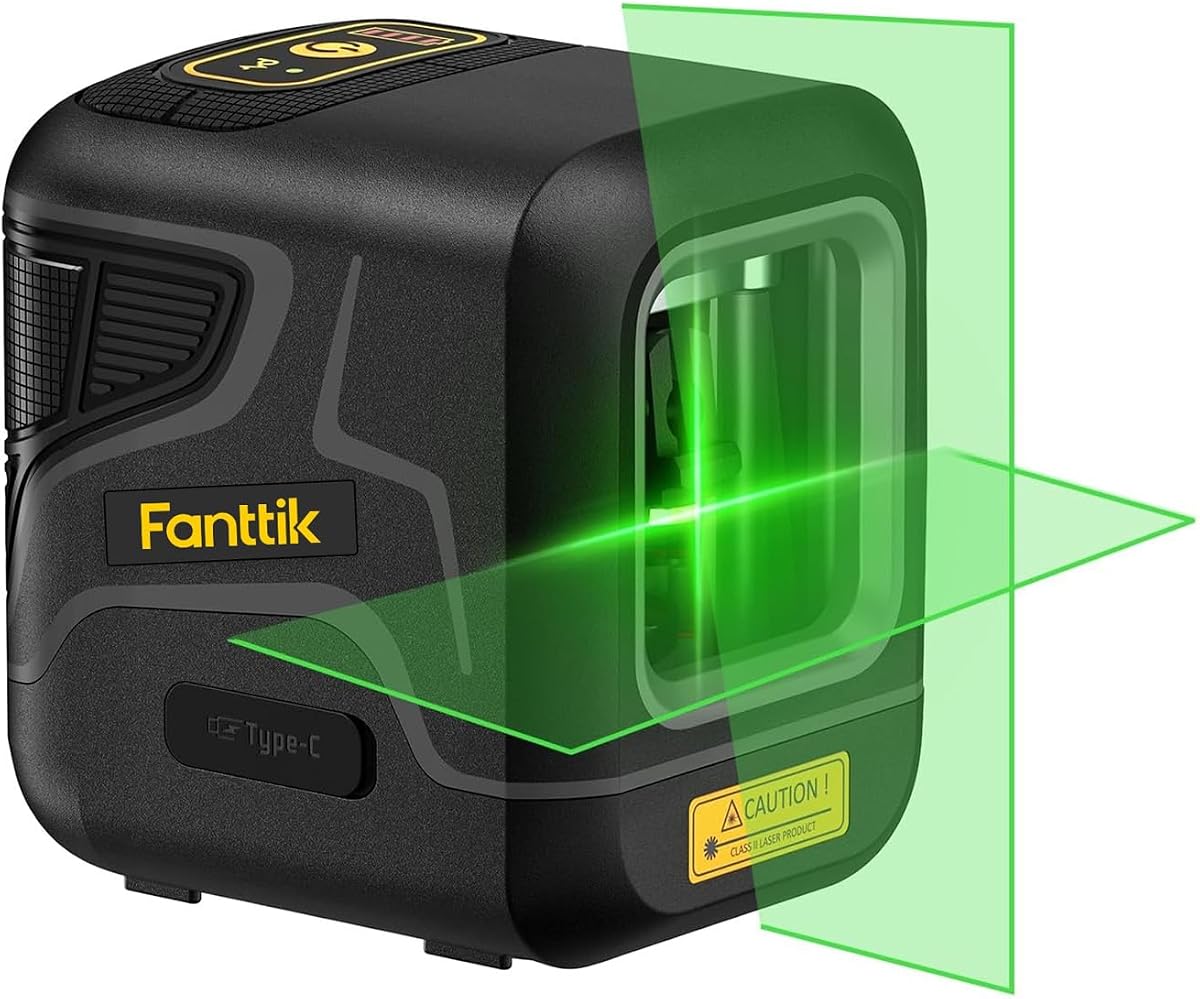
The Fanttik D2 is a pocket-oriented green laser level aimed at picture hanging, shelving, and home DIY. Its 4.5 rating and stated 1/8-inch accuracy at 30 feet make it a credible choice for household layout where a small, rechargeable tool is more convenient than a full professional laser kit.
We may earn a commission when you buy through this link, at no additional cost to you.
The integrated 2200mAh battery is rated for up to ten hours of continuous use and can be recharged more than 500 times. A magnetic bracket supports 360-degree rotation, allowing the green cross-line to be positioned in multiple directions. At only 0.56 pounds, the unit is easy to move around a room or carry to different projects.
Self-leveling operation establishes a level reference when the pendulum is unlocked. If the tool is tilted beyond four degrees, the beam flashes to signal that automatic leveling is unavailable. Manual mode fixes the line at a chosen angle for non-level layouts, with a periodic flash serving as a status reminder.
The stated 164-foot pulse-mode range requires a compatible receiver, which is not included. That distinction matters for outdoor work or large commercial spaces. For indoor picture placement and general home projects, however, the D2's compactness, long runtime, and green visibility make it especially convenient.
The large rechargeable battery is one of the D2's main advantages over compact AA-powered laser levels. It supports extended placement without frequent battery changes, while USB-C charging keeps the charging setup familiar.
The supplied magnetic bracket rotates through 360 degrees and attaches to suitable metal surfaces. This is useful for positioning a reference line around furniture, shelving, doors, and wall-mounted items without occupying both hands.
We may earn a commission when you buy through this link, at no additional cost to you.
The eSynic IP54 Digital Angle Finder is a compact level box with an unusually detailed set of operating specifications. Its 4.5 rating, stated ±0.1-degree accuracy at 0 and 90 degrees, ±0.2-degree accuracy elsewhere, and 0.05-degree resolution make it a serious option for woodworking, construction, and installation work.
We may earn a commission when you buy through this link, at no additional cost to you.
Strong neodymium magnets are located on all four sides. This permits secure positioning against saw blades, machine tables, steel beams, and other ferrous surfaces. The electronic inclinometer measures 4×90 degrees, while a reverse black-and-white LCD remains legible in dim workshops and direct sunlight.
Two Class II lasers project visible lines from opposite sides for alignment tasks. The 340mAh rechargeable battery charges through USB-C in about 2.5 hours and provides seven or more hours of stated continuous use. A carry bag and Type-C cable are included, along with zero, hold, unit-selection, flip, and automatic shutoff functions.
This model is well suited to checking saw or jointer angles, cabinet alignment, tile slopes, window frames, workbench setup, and other close-range jobs. The display shows an error when tilted beyond approximately 30 degrees, so it is best used within its intended orientation range. It does not replace a long-range cross-line laser for spanning a room.
The listed ±0.1-degree performance at the horizontal and vertical positions gives users a more useful understanding than a single headline accuracy figure. At other points in the four-quadrant range, the stated tolerance is ±0.2 degrees.
The USB-C rechargeable design supports roughly 2.5-hour charging and more than seven hours of stated use. Four-side magnetic attachment allows the operator to set the angle, release both hands, and return to the measured task.
We may earn a commission when you buy through this link, at no additional cost to you.
The RockSeed Digital Laser Distance Meter is different from most tools in this guide: it measures distance rather than projecting a leveling line or displaying an inclinometer angle. With a 4.4 rating, 165-foot stated range, and ±1/16-inch accuracy, it is the appropriate option for room dimensions, floor areas, and material quantities.
We may earn a commission when you buy through this link, at no additional cost to you.
Two bubble levels help maintain horizontal and vertical orientation, reducing the chance of measuring at an unintended slant. The large backlit LCD is easy to read in dim areas, and a mute setting suppresses the audible measurement beep in quiet environments such as libraries and classrooms.
Measurement functions include distance, length, continuous measurement, area, volume, three-point Pythagorean calculation, addition, and subtraction. The device can retain 20 groups of data, allows manual deletion, provides a low-battery indicator, and shuts down after 150 seconds of inactivity to conserve power.
The RockSeed includes a 1.5V AAA battery, user manual, hand strap, and package box. Its IP54 rating protects against dust and splashes. It is ideal for real estate, remodeling, and interior layout, but it cannot replace a self-leveling cross-line, magnetic angle finder, or pipe gauge when visual alignment is the task.
Area and volume modes streamline estimating room dimensions and material quantities, while the three-point Pythagorean function handles indirect measurements. Continuous measurement and basic arithmetic further reduce the need for separate manual calculations.
The twin bubble levels make it easier to hold the meter square, while the backlit display improves readability in dark spaces. A selectable beep lets users work quietly without losing the visual confirmation of a measurement.
We may earn a commission when you buy through this link, at no additional cost to you.
The BOSCH GLL50-20G is a premium self-leveling green cross-line laser for users who value a established professional tool format, compact construction, and dependable jobsite protection. Its 4.5 rating and stated 50-foot range make it well suited to framing, cabinet installation, tile, and general construction layout.
We may earn a commission when you buy through this link, at no additional cost to you.
The green lines are described as up to four times brighter than standard red beams, improving visibility in rooms with substantial ambient light. Accuracy is stated at 5/16 inch at 30 feet. The ergonomic, lightweight body is easy to store and reposition, while the integrated magnetic mount provides hands-free placement on suitable metal surfaces.
The Smart Pendulum System self-levels and blinks to indicate when the tool is out of level. Locking it when switched off helps protect the pendulum during transport. The enclosure has an IP55 rating for resistance to rain and dust, a useful advantage for contractors who cannot keep every tool indoors.
Two AA batteries are included, and the tool also accepts a BOSCH 3.7-volt lithium-ion battery sold separately. That flexibility supports quick work with standard cells or longer operation with the optional battery. It is the premium pick here, although the Motovera offers greater stated range and a bundled tripod.
The thin green cross lines remain easier to follow than many red-beam alternatives in bright work areas. The stated 50-foot range provides ample coverage for standard rooms, workbenches, cabinets, and installation zones.
The IP55 enclosure is designed to withstand dust and rain exposure. Users can start with the included AA batteries or add the compatible rechargeable lithium-ion battery when extended runtime and fewer disposable cells are priorities.
We may earn a commission when you buy through this link, at no additional cost to you.
Choosing a digital laser level means matching the instrument to the measurement task, working environment, and required accuracy. A compact magnetic angle finder, a cross-line projector, and a distance meter may all use digital technology, but they solve different problems.
First decide whether you need a numeric angle, a projected reference line, or a distance measurement. Digital angle finders and inclinometers display slope in degrees or percent and often include magnets or laser lines. Self-leveling cross-line lasers project horizontal and vertical references but usually do not provide a numeric angle readout. Distance meters calculate length, area, and volume rather than alignment lines.
Accuracy describes the maximum permitted deviation from the true measurement, while resolution indicates how finely the display can present a value. These are not interchangeable. A tool with 0.05-degree resolution may still have an accuracy of ±0.2 degrees, so both figures matter when transferring an angle or marking a layout.
Green beams are generally easier to see than red beams in brightly lit rooms. Compact angle-finder lasers often project only a short reference line, whereas dedicated cross-line lasers cover larger areas. Pulse mode can extend practical outdoor use when used with a compatible receiver, but the receiver must be included or purchased separately.
Self-leveling mode uses an internal pendulum to establish horizontal or vertical references automatically. Manual mode locks the beam at a fixed angle for stairs, decorative patterns, and other sloped work. Most tools indicate an out-of-level condition through blinking, which prevents users from mistaking a warning for a fault.
Magnetic bases are especially useful for angle gauges because they permit hands-free positioning on ferrous pipes, steel frames, saw blades, and machine tables. V-groove edges improve stability on round objects. Dedicated cross-line tools often include a separate magnetic bracket or integrated mount, which may rotate through 360 degrees for flexible placement.
A backlit display is valuable in garages and outdoor shade, while automatic inversion allows the reading to remain visible when a tool is mounted upside down. Data hold freezes a reading in confined spaces. Zeroing establishes a reference for relative measurements, and unit switching between degrees and percent can simplify slope calculations.
Rechargeable tools are convenient for frequent mobile use, while AA batteries offer immediate flexibility and easy replacement. Pay attention to stated runtime, charging time, low-battery indication, and automatic shutoff. Optional lithium-ion packs can reduce disposable-battery consumption, but compatibility must be checked before purchase.
IP54 and IP55 ratings indicate improved resistance to dust and water compared with an unprotected tool, though neither rating means the device can be submerged. Also consider whether you need a tripod, carry bag, charging cable, batteries, receiver, or storage case. Complete kits can be convenient, but accessories should not obscure the core measurements you require.
Before use, inspect the housing, display, battery, and laser window for damage, and confirm that the tool is charged or fitted with fresh batteries. Read the display straight on, allow the instrument to acclimate to the ambient temperature, and test the reading on a known level surface. For angle gauges, calibrate or zero against that reference before transferring measurements.
Set up the tool on a stable, appropriate surface. Magnetic models should be placed only on surfaces that can hold the tool securely, while dedicated laser levels should be mounted on a tripod, wall bracket, or included stand. Observe any blinking out-of-level warning, lock the pendulum only when a fixed angle is intentionally needed, and never direct the beam toward eyes or reflective surfaces.
After the job, switch the tool off and store it in a dry case or supplied pouch. Clean the laser window gently, remove moisture and dust, and avoid immersing the unit even if it has an IP rating. Charge rechargeable models before long storage, inspect cables for damage, and have a technician address calibration drift, persistent errors, or readings that no longer match a known reference.
No. A digital laser level projects reference lines, while a laser distance meter calculates the distance to a target. Some digital angle finders combine an electronic inclinometer with short projected lines, but they still serve a different purpose from a full cross-line projector or a dedicated distance-measuring tool.
For furniture assembly, cabinet installation, and general carpentry, a stated accuracy around ±0.1 to ±0.2 degrees is usually sufficient for an angle gauge. For laser line layout, compare the tolerance at the distance you will actually work, because accuracy figures often apply at a specific range such as 30 or 33 feet.
Green lines are generally more visible to many users, especially in brightly lit indoor workspaces. They do not automatically make a tool more accurate or capable of reaching farther. Beam color, range, self-leveling performance, and mounting flexibility should all be considered when choosing between models.
You can measure its angle without relying on magnets, but the stability of the placement may be lower. Magnetic versions are best suited to steel, iron, and other ferrous surfaces. On wood, use a firm support, hold the tool steady, and verify the zero reference before relying on the reading.
Zeroing establishes the current orientation as a reference point. It is useful for measuring a difference from an existing angle rather than measuring relative to true horizontal. Make sure the tool is stable and the desired reference is correct before pressing zero.
A flashing beam commonly indicates that the pendulum is locked or that the tool is tilted beyond its automatic leveling range. The behavior is generally a status warning rather than a defect. Check the operating mode and reposition the tool if the line is not producing the intended level reference.
No. These ratings indicate resistance to dust and water splashes, providing useful jobsite protection. They do not authorize submersion or prolonged exposure to heavy rain, and the charging port should still be kept dry during storage and use.
A receiver is helpful when sunlight makes a pulse-mode beam difficult to see. Several products can extend their working range with a compatible receiver, but some receivers are not included. Confirm the accessory requirement and compatibility before relying on a long outdoor distance.
The Digital Angle Finder & Gauge is the strongest all-around recommendation because it combines a digital inclinometer, dual lasers, four-side magnetic attachment, and strong environmental protection in a pocketable body. The Motovera is the most complete value-oriented kit, while the BOSCH GLL50-20G stands out as the premium projection option.
Prioritize the measurement type first, then assess accuracy at your working distance, display visibility, mounting method, power, and environmental protection. Compact angle finders suit woodworking and installation, dedicated cross-lines suit room-wide alignment, and distance meters suit dimensions, area, and volume. Specialized tools such as the Klein Tools model are particularly valuable for pipe and conduit work.
Ratings, accessories, and availability can change, and current prices should be checked before buying. Compare the latest product listing, included components, warranty information, and manufacturer guidance against the job you need to complete rather than choosing solely from the headline rating.