
WVL 7400mWh Emergency Weather Radio
4.6Editor score
Compact 231g housing
AM, FM, and NOAA
Phone charging capability
Our cheap crank radio guide compares 10 emergency radios for power options, NOAA reception, lighting, portability, charging, and preparedness value.
A cheap crank radio becomes far more useful when it can do more than receive broadcasts. The best models combine hand-powered charging, solar recharging, NOAA weather access, bright lighting, and enough battery capacity to support phones or other essential devices during outages.
We compared these ten radios using the information supplied for each model, focusing on battery capacity, charging methods, radio bands, weather-alert behavior, lighting, portability, water resistance, and emergency features. The list includes compact units for backpacks and larger models designed for home, travel, and vehicle kits.
Each pick highlights a different balance of capabilities, from budget-friendly portability to higher-capacity charging and clearer signal processing. Ratings and product details reflect the supplied listings, while availability and prices change, so readers should confirm current specifications before purchasing.
4.6Editor score

4.8Editor score
4.7Editor score
The table below compares the ten emergency radios by power capacity, charging flexibility, radio coverage, and useful emergency features. These distinctions help show which models fit small kits, home preparedness, camping, vehicle storage, or higher-capacity charging needs.


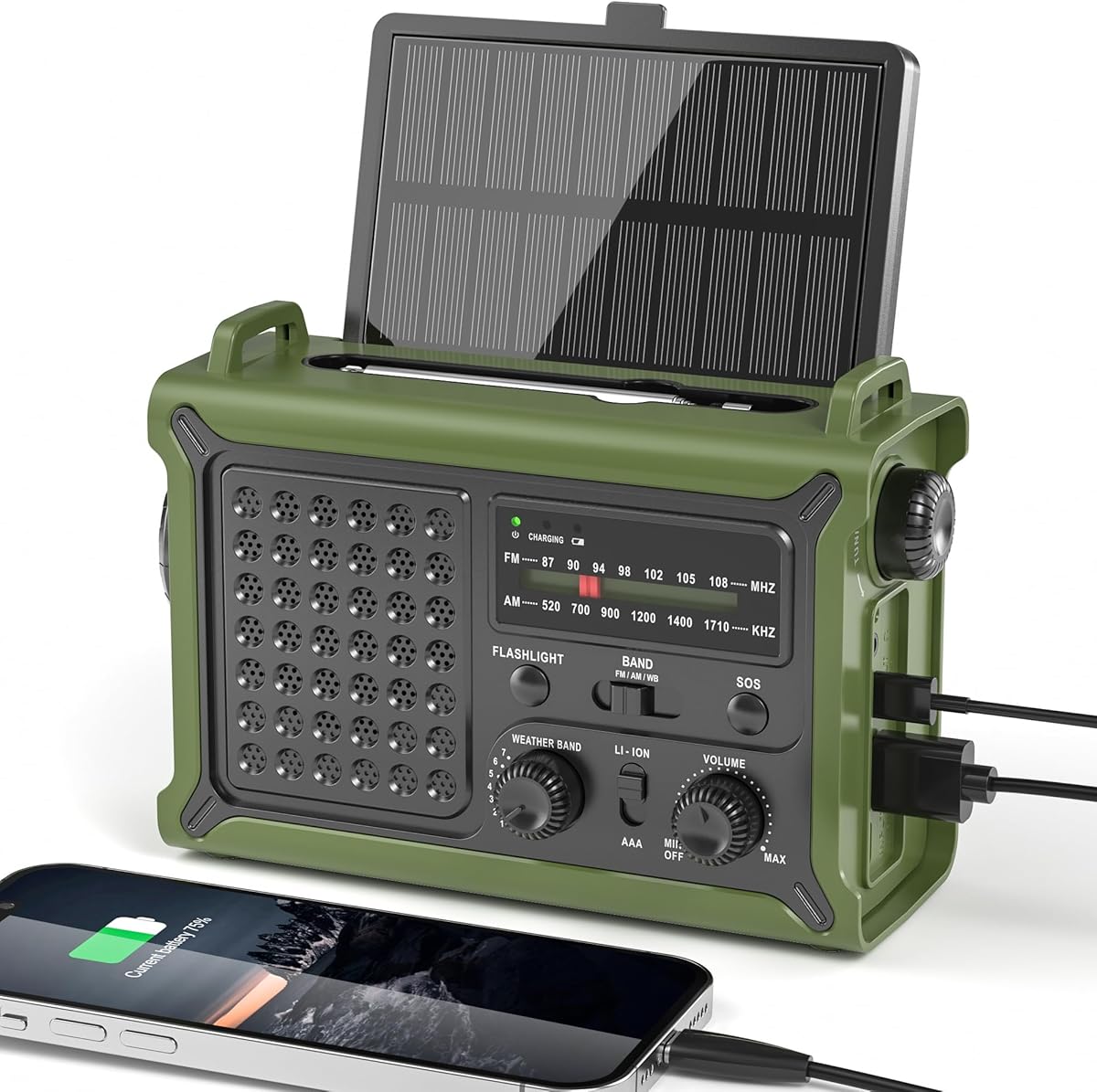
This 12000mAh emergency radio combines NOAA, FM, and AM reception with a large solar panel, a hand-crank generator, phone charging, and two kinds of lighting. Its 4.7 rating reflects a strong overall feature set, particularly for buyers who want more reserve capacity than a pocket radio can provide.
We may earn a commission when you buy through this link, at no additional cost to you.
The standout feature is the 8500mm² monocrystalline solar panel, which the supplied listing describes as substantially larger than common decorative panels. An upgraded generator, reinforced magnet, and extended crank arm are also intended to improve charging effort. The radio can support a phone, while the flashlight reaches up to 260 feet and the frosted reading lamp provides softer illumination.
Its controls, large tuning knob, responsive buttons, and nonslip shape are practical advantages for households and older users. A high-sensitivity signal chip and noise-reduction circuitry are intended to improve clarity across the supported radio bands. The tradeoffs are its larger 6.8 by 2.9 by 4.7-inch body and the need to fully charge the battery before first use.
This is a compelling choice for home emergency kits, bug-out bags, and outdoor trips where battery reserve matters. It may be excessive for someone wanting the smallest possible radio, but households seeking a broad combination of solar charging, manual power, weather reception, illumination, and device backup should find it especially versatile.
A 12000mAh internal battery gives this radio more headroom for listening, lighting, and emergency phone charging than the 2000mAh and 5000mAh alternatives in the list. The listing specifically presents the capacity as a practical reserve for keeping essential functions available for extended periods.
The large solar panel and upgraded hand-crank system offer two paths for restoring power when ordinary electricity is unavailable. The extended crank arm is also intended to make repeated manual charging less tiring during a household emergency.
We may earn a commission when you buy through this link, at no additional cost to you.
The Leaton combines a 10000mAh battery, NOAA and AM/FM reception, solar charging, a hand crank, USB-C input, phone output, lighting, and a compass. Its 4.5 rating and broad feature set make it a strong general-purpose choice for families, campers, travelers, and homeowners building an emergency kit.
We may earn a commission when you buy through this link, at no additional cost to you.
It is designed with clearly stated limitations. NOAA reception requires users to extend the antenna, select the weather mode, and tune manually; it does not provide SAME alerts, automatic warnings, or location-based notifications. The 5V/1A USB output supports emergency phone charging, though the listing estimates approximately one to one-and-a-half charges for an iPhone 14 because conversion losses affect actual delivery.
The three-mode flashlight includes high, low, and SOS settings, while a separate 1.3W reading lamp handles maps and supplies. The radio measures about 6.3 by 3.5 by 3.1 inches, weighs roughly 1.1 pounds, and carries an IPX6 rating for spray and splash protection rather than immersion.
Buyers who value capacity, simple controls, and multiple ways to restore power will find this model accommodating. It is less suitable for anyone who prioritizes automatic NOAA alerts or private headphone listening, but for a general household or travel radio, those compromises are reasonable.
Manual NOAA tuning means users must locate and monitor a local station themselves. That is an important distinction from radios that automatically scan for official warnings, so this model suits buyers willing to make alert monitoring part of their routine.
Large controls and a straightforward layout make the radio approachable for families and seniors. The built-in compass also adds useful orientation support for outdoor trips without turning the device into a dedicated navigation tool.
We may earn a commission when you buy through this link, at no additional cost to you.
The Emgykit is one of the smallest products in the guide, measuring 5.1 by 2.1 by 2.4 inches and weighing 0.51 pounds. It combines AM, FM, and NOAA reception with a 2000mAh battery, hand-crank charging, solar charging, Type-C charging, a three-LED flashlight, and an SOS alarm.
We may earn a commission when you buy through this link, at no additional cost to you.
Its 4.6 rating makes it a notable compact option, especially when every ounce matters. The upgraded 3W three-LED flashlight produces 140 lumens, while holding the SOS control for three seconds activates a siren louder than 80 decibels. Those features add practical value for roadside, storm, and nighttime emergencies.
The main limitation is the relatively modest battery, which offers much less reserve than the 10000mAh and 12000mAh models. Phone charging is possible, but the radio is not presented as a high-output charging station. The supplied information also does not list a water-resistance rating or automatic weather alerts.
This model is best for backpacks, small survival kits, and travelers who prioritize size and weight over extended battery runtime. It remains a capable budget radio for weather broadcasts and basic emergency lighting, especially when paired with a separate power bank for more demanding phone use.
The radio's low weight and short dimensions make it easy to carry during hiking, camping, or evacuation. It occupies considerably less space than higher-capacity models, allowing users to include it without dedicating a large portion of a pack to emergency equipment.
The 140-lumen flashlight and high-volume SOS siren give the user two ways to signal for attention. These are particularly useful when darkness makes a visual distress signal difficult or when noise helps attract nearby assistance.
We may earn a commission when you buy through this link, at no additional cost to you.
The WVL combines a 7400mWh battery, AM/FM and preset NOAA weather channels, solar charging, hand-crank power, phone charging, an LED flashlight, a motion-sensor reading lamp, and an SOS alarm. Its 4.6 rating makes it a well-rounded budget selection for emergency kits.
We may earn a commission when you buy through this link, at no additional cost to you.
The radio weighs 231 grams and measures 130 by 50 by 60 millimeters, giving it a practical balance of portability and capacity. The motion-sensor reading lamp is a distinctive convenience, while the 1.5W flashlight provides direct illumination for a dark room, campsite, or roadside.
The supplied listing uses 2000mAh when discussing the phone-charging function and 7400mWh in the product title, so buyers should examine the current product details closely. NOAA channels are preset, but the radio uses analog tuning. It also lacks the automatic warning behavior found in some competing models.
This is a good pick for buyers who want many emergency functions without moving to the largest battery capacity in the list. Its compact construction, charging flexibility, and useful lighting make it especially suitable for a go-bag, vehicle kit, or inexpensive secondary household radio.
At 231 grams, the WVL is easy to carry while still offering a substantial battery and several integrated tools. The combination of radio, lamp, charger, siren, and alternate power inputs reduces the number of separate items needed in a basic kit.
The motion-sensitive lamp can provide convenient short-duration illumination without requiring constant button operation. It is most useful at a campsite, beside a bed during an outage, or while working with maps and supplies.
We may earn a commission when you buy through this link, at no additional cost to you.
The Midland ER310 is a red-and-black emergency crank radio built around NOAA weather and AM/FM reception. Its 4.6 rating and established product listing make it a familiar option, particularly for buyers who value a straightforward emergency device associated with a recognized radio brand.
We may earn a commission when you buy through this link, at no additional cost to you.
Because the supplied product data contains only the brand name and identifies the ER310 as an emergency crank weather radio, it is not possible to confirm additional details from this source. The model should be judged by its stated core function: providing weather and broadcast reception with hand-crank power during outages.
One limitation of this review is the absence of confirmed battery capacity, charging options, lighting functions, water resistance, and alert behavior. Those details matter because emergency radios differ significantly in how much support they can provide when a phone battery is also depleted.
The ER310 is worth shortlisting for shoppers who recognize the Midland name or want a dedicated weather radio without a broad collection of entertainment bands. Before buying, compare the current listing with the higher-capacity models here, particularly if phone charging, automatic NOAA alerts, or a built-in flashlight are priorities.
The supplied information points to a focused weather-radio role rather than a multifunction entertainment device. That simplicity can be attractive for buyers who want NOAA and standard broadcast access without navigating extra controls or bands.
Because the source lists no battery, charging, or lighting specifications, checking the latest manufacturer details is essential. Those details determine whether the ER310 is adequate for a go-bag, home backup, or vehicle-only kit.
We may earn a commission when you buy through this link, at no additional cost to you.
This 7400mWh radio distinguishes itself with three built-in charging cables for Lightning, USB-C, and Micro USB devices. It also supports USB-C charging, hand cranking, solar charging, and AAA batteries, while offering NOAA, AM/FM, a three-mode flashlight, six reading LEDs, and an SOS alarm.
We may earn a commission when you buy through this link, at no additional cost to you.
Its 4.6 rating reflects a useful combination of preparedness functions. The integrated cable approach solves a common practical problem: finding the correct charger for a phone when normal supplies are scattered or lost. Multiple brightness levels and separate reading lights offer more control than many similarly compact alternatives.
The radio is not designed to charge multiple devices simultaneously, and the included cable formats may not suit every current phone. AAA batteries are presented as an additional backup rather than the primary power source. A water-resistance rating is not included in the supplied details, so wet-weather suitability should not be assumed.
This model is a strong choice for mixed-device households or anyone who wants charging leads stored directly in the emergency radio. Its varied power options, substantial capacity, and dedicated lighting functions make it more versatile than a basic weather-only receiver.
Keeping three device cables inside the unit reduces dependency on separate accessories during a power emergency. It is a practical advantage for families using phones with different connector standards, although newer devices may still require their own cable.
USB-C, hand-crank, solar, and disposable AAA options provide unusually broad flexibility. The backup compartment adds another layer of resilience for situations where the internal battery is depleted and sunlight or manual effort is limited.
We may earn a commission when you buy through this link, at no additional cost to you.
This 12000mAh emergency radio is the strongest overall match in the guide, combining the highest listed rating with generous battery capacity, a large solar panel, seven NOAA channels, AM/FM reception, a 5W flashlight, a 12-LED reading lamp, and a 120dB SOS alarm.
We may earn a commission when you buy through this link, at no additional cost to you.
DSP signal processing is intended to reduce noise and improve AM/FM and weather-band reception, while a 57mm speaker provides fuller sound than many compact units. The radio can be charged by hand, sunlight, or Type-C input, and its battery can also supply emergency charging to phones and small USB devices.
The IPX6 construction is designed to handle splashes and rain exposure, and the 5W flashlight is well suited to rooms, campsites, garages, and roadside use. NOAA reception is manual, so the radio must remain powered on and tuned to a weather station. It does not claim automatic warning or location-based alert functions.
This is the ideal all-around choice for households that want substantial reserve power, flexible charging, useful lighting, and broad radio access in one device. It suits a bedside backup, garage, RV, emergency go-bag, and outdoor kit, while its high rating makes it the leading pick in this comparison.
DSP processing is intended to make broadcasts clearer when reception is imperfect. The 57mm speaker also supports comfortable listening for weather updates, news, and music when the radio is used beyond emergencies.
The 5W flashlight, separate 12-LED reading lamp, and 120dB SOS alarm provide visible, readable, and audible emergency support. Together they reduce the need to carry several separate light and signaling devices.
We may earn a commission when you buy through this link, at no additional cost to you.
The RunningSnail is a compact 2000mAh radio with AM, FM, and NOAA reception, a retractable antenna, USB device charging, and a one-watt LED flashlight. Its 4.5 rating and 0.5-pound weight make it appealing for travel and outdoor kits where portability matters.
We may earn a commission when you buy through this link, at no additional cost to you.
The radio offers hand-crank, solar, and internal-battery power options, helping it remain useful when conventional charging is unavailable. The retractable antenna is designed to support reception in remote or weak-signal areas, while the flashlight provides basic illumination during outages and nighttime travel.
Its small 5 by 1.8 by 2.4-inch size is the main advantage and its 2000mAh battery is the main constraint. The unit has fewer lighting and navigation functions than several higher-ranked options, and the supplied data does not identify a water-resistance rating or automatic alert system.
Choose the RunningSnail when a lightweight radio that still supports weather broadcasts, standard radio, charging, and a flashlight is enough. It is a sensible secondary radio for hiking, camping, and vehicle kits, though people expecting extended phone backup should select a larger model.
The 0.5-pound radio can be carried without creating much excess weight. Its narrow footprint also makes it easy to organize in a small backpack, glove compartment, or go-bag alongside water, food, and first-aid supplies.
AM, FM, and NOAA access cover local broadcasts and official weather information. The retractable antenna adds flexibility when the radio is moved between indoor and outdoor locations or used in areas with variable reception.
We may earn a commission when you buy through this link, at no additional cost to you.
The NOAA Weather Radio Hand Crank stands out for automatic severe-weather alerts, including a nine-second SOS alarm and flashing red light. It also receives NOAA, AM, FM, and shortwave broadcasts and includes a 5000mAh internal battery, making it a feature-rich choice for overnight warning coverage.
We may earn a commission when you buy through this link, at no additional cost to you.
Its five power sources include the internal rechargeable battery, solar panel, hand crank, a 5V/2A plug connection, and an included USB cord. A compartment accepts three AAA batteries for additional backup, although those batteries are not included. The radio is stated to last up to 13 hours when fully charged and playing FM.
Shortwave covers 7 to 19MHz, supporting international and overseas broadcasts, though this should not be confused with receiving every shortwave station. The 3.5mm headphone jack permits private late-night listening, and a 116dB SOS button provides another strong attention signal.
This is a good choice for households wanting automatic warning behavior without giving up conventional radio reception. It is particularly useful beside a bed, where the flashing red light and loud alarm can alert sleepers, but the flashlight and reading lamp should still be checked regularly during outages.
Automatic monitoring means users do not have to remain actively tuned to every weather channel. The alarm and flashing red light are designed to make official warnings noticeable during the night when a phone might be charging or out of range.
Shortwave reception and five charging or backup options distinguish this model from basic AM/FM emergency radios. The combination is useful for travelers and listeners who want more than local news and weather programming.
We may earn a commission when you buy through this link, at no additional cost to you.
The Raynic combines a 5000mAh battery with automatic NOAA alert scanning, a large HD LCD, digital tuning, AM/FM/shortwave reception, a phone charger, a headphone jack, a 3W flashlight, a 2.5W reading lamp, and an SOS siren. Its 4.5 rating reflects a well-rounded feature set.
We may earn a commission when you buy through this link, at no additional cost to you.
Automatic scanning checks for emergency and weather warnings when the radio is switched on or left in standby. The display shows the battery level and tuned frequency, while tune controls scan for stations. Long-pressing the dimmer turns off the backlight and enters power-saving mode, which helps preserve battery life.
It weighs 1.2 pounds and measures 6.8 by 3.7 by 2.9 inches. The IPX3 rating protects against light splashes but does not indicate resistance to heavy rain or immersion. A 3.5mm headphone jack allows private listening, and the built-in USB connector supports communication-device charging.
The Raynic is ideal for buyers who want an easy-to-read display and automatic alerts alongside manual radio tuning. Its 5000mAh capacity is smaller than the top models but sufficient for a multi-function emergency radio, particularly when used with the backlight managed carefully.
The radio combines automatic alert scanning with digital frequency selection, giving users both background warning coverage and precise manual control. The large screen is particularly helpful for older users or anyone tuning under stress in poor light.
The headphone jack prevents broadcasts from disturbing nearby travelers during quiet hours. USB device charging adds a communication backup, although the 5000mAh capacity should be managed according to the number of devices and how urgently the radio itself is needed.
We may earn a commission when you buy through this link, at no additional cost to you.
The most useful cheap crank radio is not simply the one with the longest feature list. Battery needs, alert behavior, portability, listening comfort, and the availability of replacement power should determine which model fits your household and emergency plans.
Battery capacity is one of the clearest ways to separate emergency radios in this guide. The list ranges from 2000mAh models suited to radios, lights, and limited charging to 10000mAh and 12000mAh units better positioned for extended listening, lighting, and phone support. Actual runtime depends on feature use, battery condition, conversion losses, and cranking speed, so the headline capacity should not be treated as a promise of uninterrupted phone power.
Choose a larger battery for a home radio that must remain available, serve several family members, or charge communication devices. A compact 2000mAh radio is more appropriate when low weight matters and a separate power bank is already included.
Hand cranking is valuable because it requires no grid power, sunshine, disposable batteries, or working cable. Solar charging provides a passive maintenance option, while USB-C or Type-C input offers the most efficient routine recharge when electricity is available. Some models add AAA battery compartments, creating another useful fallback when the internal battery is depleted.
Look for at least two independent restoration methods. A radio with hand crank, solar, and wired input is easier to keep ready, while a built-in cable set can be particularly valuable when chargers have been lost or damaged.
Not all NOAA radios work in the same way. Several models require users to tune manually to one of seven weather channels, while the NOAA Weather Radio Hand Crank and Raynic advertise automatic alert scanning. Manual tuning can work well for prepared users, but automatic warning behavior offers a major advantage when the radio is intended to remain on overnight.
Determine whether you need passive alerts, location-based warnings, or simply access to broadcasts. SAME technology and automatic location alerts are specifically absent from some models, so check the exact listing rather than assuming every NOAA-capable radio offers identical warnings.
AM, FM, and NOAA coverage covers most emergency information and familiar local broadcasting. Shortwave adds international and overseas programs for travelers, although the usable range varies. Models with DSP signal processing, noise reduction, and extended or retractable antennas are intended to improve clarity where reception is weak.
Consider where the radio will be used. A long antenna and signal-processing features may matter for a remote cabin, while a straightforward NOAA and AM/FM model may be enough for a bedroom or vehicle close to broadcast towers.
A flashlight is essential during outages, and a separate reading lamp can make maps, supplies, and repair tasks easier. Brightness levels are useful because a focused beam is appropriate for navigation while softer light is better for close work. Motion-sensor lighting, SOS sirens, and flashing red lights add more specialized warning options.
Match the lighting to the situation. A high-output flashlight helps in garages and campsites, a reading lamp supports prolonged indoor use, and an audible or visual siren can attract attention. Models offering several brightness modes offer better control across different tasks.
A radio carried in a backpack should prioritize compact dimensions and low weight, while a home or vehicle model can favor larger controls and a bigger battery. The guide includes units weighing approximately 0.5 pounds as well as heavier models around 1.1 or 1.2 pounds. Water-resistance ratings range from IPX3 to IPX6, and none should be treated as waterproof.
Choose a small, light model for hiking and evacuation. Select a larger unit if it will remain on a shelf, workbench, or vehicle console. For outdoor exposure, IPX6 provides stronger splash protection than IPX3, but neither rating makes immersion safe.
An emergency radio may need to be operated by someone tired, frightened, or in a dark room. Large buttons, a prominent tuning knob, clear labels, and a nonslip grip improve confidence and reduce mistakes. Digital displays can show the selected frequency and battery state, while analog tuning keeps some models simpler.
Think about the people who will actually use it. Large controls and an easy-to-read display are especially helpful for families and older users. A model with a compass, headphone jack, or automatic alerts may be more valuable than extra entertainment features.
Phone charging is a major benefit because communication may be more important than entertainment during a prolonged outage. Output strength matters: the Leaton specifies 5V/1A, and the 10000mAh and 12000mAh radios provide more nominal capacity than smaller units. Conversion losses mean capacity does not translate directly into a full phone charge.
Check connector type, output rate, and whether the radio can operate while charging. Built-in Lightning, USB-C, and Micro USB cables are convenient, but they will not cover every modern device. Include a separate power bank if phone backup is the radio's primary role.
Before relying on a new radio, read its instructions, confirm the battery level, and fully charge it according to the manufacturer guidance. Charge it through the wired input, test every band, extend the antenna, and locate your local NOAA station. If the model scans automatically, enable the relevant alert and standby settings so warnings can be received.
Keep the unit where it is easy to reach but not exposed to excessive heat, moisture, or direct damage. For a long-term emergency kit, test the radio, flashlight, reading lamp, SOS siren, and phone output at regular intervals. Many manufacturers recommend topping up the battery every few months, and the Leaton specifically recommends recharging every three to six months.
During an outage, operate the radio efficiently and preserve battery capacity for essential alerts. Adjust the volume only as high as needed, use the dimmer or lighting controls to limit consumption, and avoid leaving a bright display on continuously. If wired charging is available, use it whenever practical while keeping the hand crank and solar functions ready for later emergencies.
The most important feature depends on how the radio will be used. NOAA access is essential for weather information, while battery capacity and charging options matter more for extended outages. A phone-charging function is valuable when communication is a priority, and a flashlight becomes crucial when the power goes out. Consider the full emergency situation rather than judging one specification in isolation.
Several models in this guide can provide emergency power to phones or other USB devices. Actual charging time and the number of charges depend on battery capacity, output, phone requirements, and conversion losses. A 2000mAh radio is best treated as a limited backup, while 10000mAh and 12000mAh models offer more potential, although no capacity guarantees a specific number of full charges.
The required time varies by model, cranking speed, battery condition, and what the radio is powering. The Leaton listing states that one minute of steady cranking provides roughly 15 to 20 minutes of radio listening. Other products do not provide a comparable standardized estimate, so users should test their own unit after fully charging it and become familiar with the required effort.
No. Some radios must be manually tuned to a local NOAA channel and left on to hear broadcasts. Others, including the NOAA Weather Radio Hand Crank and Raynic models in this guide, advertise automatic scanning for alerts. SAME and location-based warnings are also not universal, so buyers should verify the exact alert behavior in the current product listing.
Solar charging is best treated as a maintenance and backup method rather than the only way to restore a full battery. Weak or intermittent sunlight can limit charging speed, while indoor lighting is generally insufficient for a rapid recharge. A radio with both solar and wired input is more flexible because it can be charged normally whenever household power is available.
Not necessarily. A water-resistance rating such as IPX3 or IPX6 indicates protection against specified levels of moisture exposure, not permission to submerge the radio. Even the IPX6 models in this guide are described as suitable for splashes or rain exposure rather than immersion. Keeping the radio covered during severe weather is the safest approach.
Keeping the internal battery in a healthy state is important, and the supplied Leaton guidance recommends fully charging the unit before first use. Long-term storage should also include periodic top-ups, as mentioned in that product's maintenance advice. The radio should be kept in a moderate, dry environment and tested occasionally to ensure its controls and battery remain functional.
Backpackers should prioritize low weight and compact dimensions. The Emgykit and RunningSnail models weigh approximately 0.5 pounds, while the WVL is listed at 231 grams. Their smaller batteries provide less charging capacity than the higher-ranked models, so campers should carry a dedicated power bank if keeping a phone powered is a major requirement.
The Emergency Radio with Hand Crank & Solar is the strongest all-around option, offering a 12000mAh battery, seven NOAA channels, a large solar panel, useful lighting, and the highest listed rating. The Leaton is a balanced alternative with a 10000mAh battery and clear manual NOAA tuning, while the Solar Radio Emergency Hand Crank stands out for its particularly large panel and extensive power options.
For buyers focused on value and portability, the WVL offers a capable feature mix without the largest battery or housing. Smaller models such as the Emgykit and RunningSnail are easier to carry, while the NOAA Weather Radio Hand Crank and Raynic are worth considering when automatic warnings are a priority. Choose the balance of battery, alert behavior, portability, and lighting that matches your actual emergency plan.
Finally, confirm the current listing details before purchasing, especially for battery output, weather-alert behavior, included cables, and water resistance. Product availability, ratings, and prices can change over time, so a recent listing is the best source for final specifications and the current purchase decision.