
Rodweil RO05
5.0Editor score
Fully analog processing design
Near-zero latency operation
Balanced signal architecture
Includes XLR-to-TRS cable
Rackmount noise gate guide comparing ten dynamics processors, channel strips, and compact noise suppressors for studio, live, podcast, and instrument setups.
A rackmount noise gate can make recordings and live mixes cleaner by reducing hiss, hum, room noise, and signal bleed. The best model for your setup depends on signal type, threshold behavior, release timing, connectivity, and whether you need compression or other processing alongside gating. A well-chosen gate should improve clarity without chopping off natural vocal or instrument endings.
This guide compares ten noise-reduction and dynamics options spanning rackmount processors, single-space channel strips, analog gates, and instrument pedals. We evaluated each product using its documented features, connection methods, monitoring, operating format, and suitability for recording, broadcasting, stage work, or amplified instruments. The list includes dedicated gates as well as broader processors that include gating functions.
Each review explains the standout strengths, practical limitations, and most suitable applications. The top selections represent the strongest combinations of useful features, clarity, and value within this diverse group, while every product receives a complete entry. Product prices and availability can change, so check the current listing and confirm signal compatibility before ordering.
5.0Editor score

4.7Editor score
4.7Editor score
The comparison below covers ten noise-control products designed for different audio environments. Some are true rack-oriented dynamics processors, others are channel strips, and the remaining models target guitar, bass, or effects-loop noise; each uses a different format, so the most important distinction is how and where you intend to use it.






This dual-channel 1U dynamic processor combines compression, an integrated noise gate, and a sidechain insert in a rack-oriented format. Its 4.5 rating reflects a versatile package for studio, live, and streaming applications. The two-channel layout is especially attractive when a project needs consistent vocal treatment or simultaneous level control across multiple sources.
We may earn a commission when you buy through this link, at no additional cost to you.
Overeasy compression and automatic attack and release settings provide a straightforward starting point, while independent controls allow more deliberate shaping. XLR and quarter-inch TRS inputs and outputs make the unit suitable for common studio, live sound, and interface arrangements. A dedicated sidechain insert supports frequency-based ducking for bass, kick drum, and other low-end control.
The trade-off is that this is a broad dynamics processor rather than a gate-only device. Its numerous functions can take more time to understand than the controls on a dedicated pedal or simple analog gate. The product is also specifically tied to line-level rack workflows, so users focused solely on amplified instruments may prefer a pedal designed for the guitar signal path.
This is a strong choice for a mobile studio, small live rig, streaming desk, or broadcast room that wants noise reduction and compression without occupying multiple rack spaces. It works particularly well when a project already uses XLR and TRS connections and needs LED feedback for gain reduction, compression, and gate thresholds.
The dual-channel architecture provides a practical way to treat two related sources consistently, such as vocals and an instrument bus. A one-rack-unit design also keeps the signal chain compact, which is valuable in touring cases and project rooms with limited space.
Having both functions in one processor can shorten the path from a raw source to a controlled output. The gate suppresses unwanted low-level material, while the compressor manages the remaining dynamic variation without requiring two separate devices.
We may earn a commission when you buy through this link, at no additional cost to you.
This second dual-channel rackmount option combines a compressor or limiter, a noise gate, and a sidechain insert. It carries a 4.1 rating and is designed for studio recording, live sound, streaming, podcasting, broadcast, and stage use. Its strength lies in providing a familiar rack interface for controlling several kinds of program material.
We may earn a commission when you buy through this link, at no additional cost to you.
Overeasy compression is designed to create a more natural transition into gain reduction, and the adjustable attack and release controls provide greater control over how the unit responds. A classic VCA-based signal path is included to support vocal clarity, warmth, and presence. The gate is paired with LED indicators for gain reduction, compression level, and gate threshold.
Its main limitation is that the 4.1 rating is lower than those of several dedicated suppressors and established dynamics processors in this guide. Users who only need noiseless instrumental control may find the compressor and limiter features unnecessary. Users should also verify their exact routing and operating expectations before committing the unit to a critical production path.
The product makes the most sense for a small studio or live setup that wants one box to cover vocal presence, noise control, and frequency ducking. It may be especially helpful for singers, streamers, and engineers who value flexible XLR and TRS connectivity and a clear visual reference while adjusting dynamics.
The VCA circuit is intended to improve clarity and presence in vocal sources. That focus makes the processor relevant to podcasting, broadcast, streaming, and live singing applications where intelligibility is a priority.
The sidechain input can create targeted ducking when another signal is routed into it. It offers a useful option for low-end control, although the exact setup should be tested with the source material and release timing.
We may earn a commission when you buy through this link, at no additional cost to you.
The Rodweil RO05 is a dedicated analog noise gate and expander designed to reduce ambient noise, preamp hum, and inherent noise floor problems. It has a 5.0 rating and is aimed particularly at home studio users, podcasters, and stage performers looking for a hardware alternative to recurring software noise-reduction subscriptions.
We may earn a commission when you buy through this link, at no additional cost to you.
Unlike digital gates that convert analog signals for algorithmic processing, the RO05 uses a fully analog circuit with four high-performance audio chips. According to the product information, that approach avoids conversion-related latency and signal loss while continuously analyzing and processing the incoming audio. Its balanced circuit design is also intended to produce smoother transitions than a basic threshold cutoff.
Proper placement is essential. The RO05 should follow a microphone preamp or sit within a line-level signal chain; it should not receive a raw microphone signal directly. Its higher power consumption may produce a slight internal circuit echo during shutdown, which the manufacturer describes as normal component voltage release rather than a defect.
This is an appealing choice for creators who want responsive noise control without converting their analog signal to digital and back. It suits home studios, podcast chains, and stage systems where low latency and straightforward line-level integration matter. Users should confirm that their preamp supplies a strong enough signal before installing the gate.
Keeping the processing chain analog avoids digital conversion and the latency commonly associated with software noise reduction. This can be helpful when monitoring a live vocal, streaming performance, or recording that must remain responsive.
The most important installation step is feeding the RO05 from a preamp or line-level source. Connecting a microphone directly can leave the signal too weak for the unit to analyze and process as intended.
We may earn a commission when you buy through this link, at no additional cost to you.
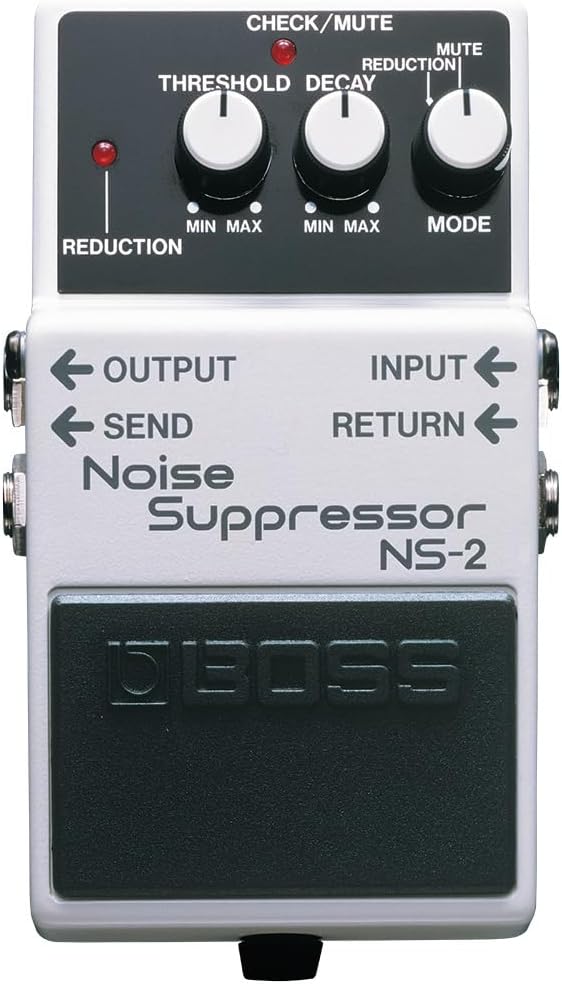
The BOSS NS-2 is a compact noise suppressor and gate built specifically for guitar and bass effects chains. Its 4.6 rating reflects a straightforward and popular approach to reducing amplifier hiss and pedal-generated noise. Although it is not a rackmount unit, it remains relevant to anyone searching for the best rackmount noise gate because instrument pedals solve a closely related signal-cleaning problem.
We may earn a commission when you buy through this link, at no additional cost to you.
A unique noise detection circuit is designed to preserve the natural attack and envelope of the instrument rather than simply chopping every signal below a threshold. Threshold and Decay controls shape how aggressively the pedal identifies noise and how long it takes to return to normal operation. This makes it suitable for clean guitar, bass, and amplified effects applications.
The obvious limitation is that it does not belong in a studio rack. It has no XLR, TRS, or rack-level input section, and its controls are purpose-built for musical instrument noise rather than speech, microphones, or stereo program buses. Pedalboard space is another practical consideration for users who already carry several effects.
The NS-2 is a good fit for a guitarist or bassist with noticeable amplifier hiss or unwanted noise from distortion and other pedals. It is especially attractive for players who want a simple suppression control without a dense feature set. It should be placed where it can respond naturally to the instrument's decay and pick dynamics.
The detection circuit is designed to retain the natural attack and envelope of the source. That goal is important for guitar because overly aggressive gating can make clean passages sound abrupt or thin.
Two primary controls make the NS-2 approachable. Threshold establishes where the pedal begins suppressing noise, while Decay shapes how quickly the signal returns after the noise drops below that level.
We may earn a commission when you buy through this link, at no additional cost to you.
The dbx 266xs is a single-space rackmount compressor and gate designed for portable, touring, and studio use. Its 4.7 rating and broad program support make it one of the most complete and credible entries in this guide. The unit can smooth uneven levels, add control to guitars and drums, and tighten mixes through its dynamic processing.
We may earn a commission when you buy through this link, at no additional cost to you.
Program-adaptive expander and gate behavior is a central feature, supported by new gate timing algorithms designed for smooth release characteristics. Separate LED displays show gain reduction, compression threshold, and gate threshold, allowing faster setup and more accurate adjustment. The result is a processor that presents useful information without requiring a computer or menu-driven screen.
Although it occupies only one rack space, the 266xs processes one channel rather than two. That makes it less convenient for a stereo pair, but it is highly useful when every rack position matters. The sidechain insert also broadens its usefulness, and the simple front-panel layout suits live environments where fast changes may be required.
This is a strong general-purpose choice for an engineer who wants a proven compressor and gate in a single rack unit. It works well for isolated vocals, instruments, drum buses, and live sources. For users who need the specific combination of efficient rack space, smooth gating, and immediate LED feedback, the 266xs is particularly difficult to overlook.
The program-adaptive expander is designed to accommodate changing source material rather than relying on one fixed behavior. This makes the gate easier to use across voices, instruments, and production conditions.
Dedicated displays for compression and gate thresholds reduce guesswork during setup. Seeing both functions at once helps users balance sustained processing without allowing the gate to become unnecessarily aggressive.
We may earn a commission when you buy through this link, at no additional cost to you.
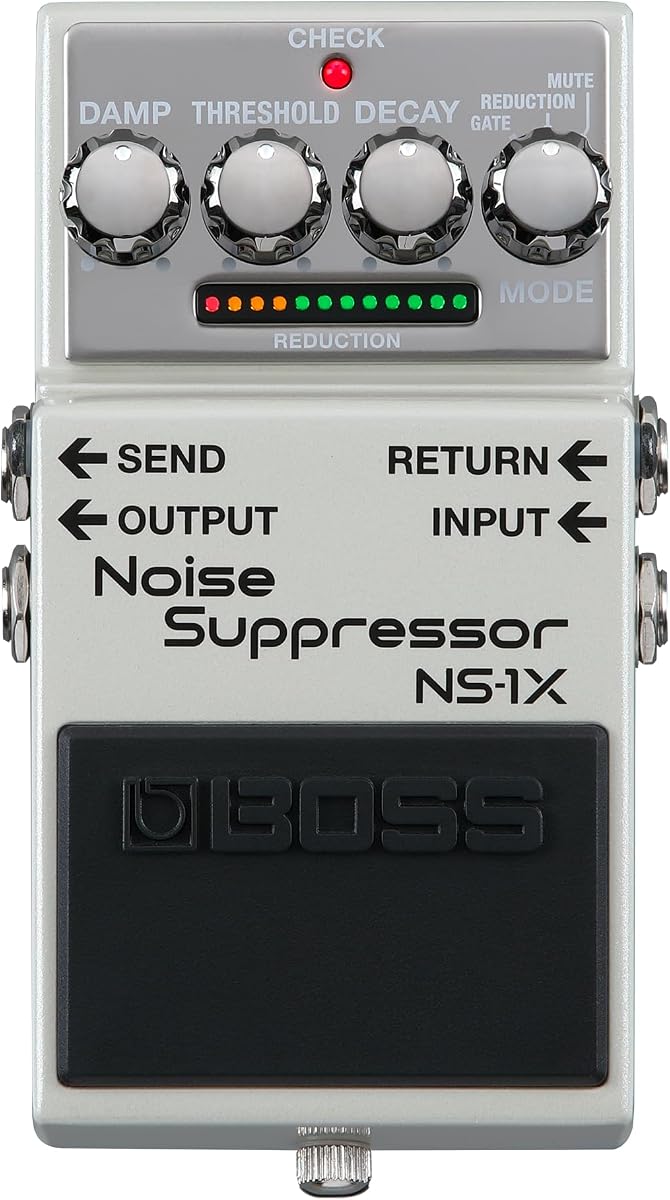
The BOSS NS-1X is an advanced noise reducer and ultra-fast gate for guitar, bass, and other instruments. Its 4.7 rating reflects a feature-rich pedal built around BOSS MDP technology, with two operating approaches: Reduction mode for general noise control and Gate mode for fast, precise handling of high-gain material.
We may earn a commission when you buy through this link, at no additional cost to you.
Reduction mode is intended to keep a pedalboard quiet in everyday playing, while Gate mode reacts quickly enough to maintain distinct, sharp riffs. Threshold, Decay, and Damp controls provide direct control over suppression behavior, and a dynamic indicator shows the current noise-reduction status. A mute mode can silence the instrument signal while the pedal switch is engaged.
The send and return loop is a notable premium feature. It allows noise-producing effects such as distortion and overdrive to be placed within a controlled loop, helping the suppressor address noise generated by the chain rather than only the final output. A DC Out is also available for power distribution when used with the required optional adaptor and cable.
The NS-1X is best suited to serious pedal players who need detailed noise management and advanced routing. It is not a rackmount processor, and users must provide suitable power and plan its position within the signal chain. For high-gain rigs, bass systems, and effects-heavy boards where a standard suppressor feels too basic, its processing depth offers a clear upgrade path.
Reduction mode favors a quiet general playing environment, while Gate mode provides rapid response for tightly articulated high-gain passages. Having both options allows the user to select a suppression behavior suited to the performance style.
The send and return loop broadens the pedal's role beyond basic output noise reduction. It can be used to process a noise-producing effects section as a defined loop, which is valuable in complex pedal arrangements.
We may earn a commission when you buy through this link, at no additional cost to you.
The dbx 286s is a one-rack-space channel strip that combines microphone and instrument preamplification with compression, a de-esser, an enhancer, and an expander or gate. Its 4.5 rating reflects the value of putting several common signal-processing tasks into one compact unit. It is especially relevant to small studios that need a straightforward alternative to a chain of separate devices.
We may earn a commission when you buy through this link, at no additional cost to you.
The floating balanced XLR microphone input accepts balanced or unbalanced sources, while two quarter-inch TRS line inputs accommodate instruments or prerecorded tracks. An insert connection allows the user to loop out between the preamp and processing sections for additional gear. The expander and gate provide the noise-control component, while compression brings vocals forward and the de-esser targets harsh high frequencies.
The limitation is that this single-channel design is less convenient than a dual-channel unit when both sides of a stereo pair need identical treatment. It also offers many functions in a small faceplate, so users must balance their setup carefully. Its fixed operating voltage options may matter for permanent international installations.
The 286s is best for a singer, voice artist, podcast producer, or small project studio that wants a preamp, gate, compressor, and de-esser without filling an entire rack. It also works well for individual instruments that benefit from channel-strip treatment. The included rack screws and washers make installation straightforward in a standard one-space enclosure.
Combining a preamp, gate, compressor, de-esser, and enhancer can simplify a small studio or live rack. It also reduces the number of signal connections needed for a basic vocal or instrument channel.
The insert and loop-out functions let users borrow external processors without surrendering the channel strip's other functions. That flexibility is useful for adding specialized equipment while keeping the signal path organized.
We may earn a commission when you buy through this link, at no additional cost to you.
The Rowin LEF-319 is a compact guitar noise gate designed to reduce unwanted signal noise while preserving the original character of the source. Its 4.3 rating makes it a credible option for players who need a simple pedal rather than a complex rack processor. It is especially relevant to beginners building a first pedalboard and to musicians dealing with amplifier hiss or noise from basic effects.
We may earn a commission when you buy through this link, at no additional cost to you.
A reduction control provides an adjustment range of negative seventy to positive ten decibels, allowing the user to influence how strongly noise is suppressed. Hard mode offers a more decisive effect, while soft mode is intended for gentler reduction. The zinc alloy construction and mini format help conserve pedalboard space, and the LED indicates when the unit is operating.
True bypass is another useful attribute because it lets players preserve their signal path when the effect is not engaged. The major practical drawback is that the pedal cannot run from batteries; it requires a center-negative nine-volt power supply, which is sold separately. Its control set is also simpler than the BOSS options, offering less opportunity for fine-grained shaping.
The LEF-319 is best for guitarists and bassists who need a compact, uncomplicated suppressor with a choice of hard or soft behavior. It is less appropriate for anyone requiring an effects loop, external power distribution, or fine control over fast response. Users should include the cost and availability of a suitable power supply in their overall setup plan.
The two operating modes make it easier to match the pedal to different playing styles. Soft mode offers a gentler approach, while hard mode provides more obvious reduction when the signal chain produces substantial noise.
The compact enclosure is valuable on crowded pedalboards, and true bypass leaves the instrument signal unprocessed when the pedal is switched off. External nine-volt power is required for normal operation.
We may earn a commission when you buy through this link, at no additional cost to you.
The 31-band graphic equalizer is included to provide a useful contrast with dedicated noise-control products. It uses DSP processing and a combination of digital and analog signal handling, with thirty-one frequency bands for detailed tonal adjustment. The product information does not identify a noise gate, and no customer rating was supplied, so it should not be treated as a direct gate alternative.
We may earn a commission when you buy through this link, at no additional cost to you.
The equalizer is intended for radio stations, conference rooms, recording studios, entertainment halls, live-event systems, home theaters, and other installed audio environments. Its compact design can fit into a bookshelf or audiovisual cabinet, while the dense frequency control offers more tonal refinement than a simple low-cut filter.
Because the supplied specifications do not mention transient control, threshold detection, or a gating function, it cannot address room noise and bleed in the same way as a noise gate. It may improve perceived clarity through frequency shaping, but tonal adjustment is not equivalent to suppressing unwanted signal energy. The lack of a supplied rating also makes direct customer-satisfaction comparison impossible.
This product is most relevant to someone who wants a permanent equalization system rather than a rackmount noise gate. It may complement a larger audio installation in which frequency control is needed, but it should not be selected as the primary solution for periodic background noise, speech bleed, or noisy instrument decay. A dedicated gate or dynamics processor is the better choice for those requirements.
Thirty-one bands provide fine control over the tonal balance of a fixed sound system. This is useful for compensating room or speaker characteristics, although it is a different function from dynamic noise suppression.
The listed applications emphasize radio, conference, hospitality, home theater, and event environments. Its strength lies in system-wide tonal shaping rather than per-channel dynamics control.
We may earn a commission when you buy through this link, at no additional cost to you.
The Electro-Harmonix Silencer is a versatile noise gate and effects-loop pedal rated 4.5 by customers. It can be used inline with an instrument or arranged to gate an entire effects loop, giving it broader utility than many simple suppressor pedals. It is a strong choice for guitarists and bassists whose noise is generated by multiple effects in a shared chain.
We may earn a commission when you buy through this link, at no additional cost to you.
The unit can deliver up to negative seventy decibels of noise reduction, making it suitable for controlling substantial amplifier hiss or effect noise. Its release time ranges from eight milliseconds to four seconds, allowing the response to be adjusted for either rapid recovery or long, smooth decay. Buffered bypass keeps the signal path consistent when the pedal is switched out.
This is still a pedal rather than a rack unit, so it cannot directly replace a single-space dynamics processor in a studio or stage rack. It also does not provide compression, limiting, or broad channel-strip processing. The very wide release range demands careful adjustment because a long setting can make the gate feel delayed after each phrase or note.
The Silencer is best for pedalboard users who need either conventional inline gating or full-loop control. It is especially useful when distortion, modulation, or other effects create noise that cannot be handled adequately by a gate placed only at the end of the chain. A nine-volt battery is included, making it straightforward to add to a mobile or pedalboard setup.
The pedal can function as a conventional inline noise gate or gate an entire effects loop. Full-loop placement is valuable when several pedals collectively generate noise that appears only when the complete chain is active.
The adjustment from eight milliseconds to four seconds covers very fast suppression through long, smooth tails. Slower release settings may preserve musical decay, while faster settings can prevent one note from extending into the next.
We may earn a commission when you buy through this link, at no additional cost to you.
The right noise gate depends on the source, signal level, rack architecture, and level of control you need. Start by separating true rack processors from channel strips and instrument pedals, then compare threshold behavior, release timing, connectivity, monitoring, and the other processing functions you actually expect to use.
A true rackmount noise gate should fit a standard equipment enclosure and be designed to remain connected to a larger signal path. The dbx 266xs, dbx 286s, and the two unnamed dual-channel processors occupy one rack space, but they differ in channel count. Dual-channel units can process a stereo pair or two independent channels at once, while a single-channel device may be a better choice when only one source needs gating and every rack position is valuable.
Choose by counting the channels that require independent control, not simply the total inputs visible on the equipment. Also verify rack height, included mounting hardware, ventilation needs, and whether the project already has separate preamplifiers or dynamics processors.
A noise gate needs a signal strong and consistent enough for its detector to distinguish program material from background noise. The Rodweil RO05 must be placed after a microphone preamp or in a line-level path; it is not designed to accept a raw microphone directly. Rack processors with XLR and TRS connections are better suited to professional consoles, interfaces, mixers, and live systems, while instrument pedals are meant for guitar-level signals.
Check connector type, balanced or unbalanced operation, insertion point, and whether your existing equipment supplies enough gain. A mismatched signal level may lead to a gate that never opens, closes too quickly, or alters the character of the source.
The threshold determines where the gate stops passing signal and begins treating it as unwanted noise. The release determines how quickly the gate returns to normal after a quiet passage. A gentle, slow release can preserve vocal and instrument tails, while a fast release prevents the gate from extending between notes but may create abrupt transitions. Products such as the Electro-Harmonix Silencer offer a particularly wide release range, whereas the BOSS NS-2 uses a simple Decay control.
Prioritize predictable behavior and an appropriate adjustment range rather than the number of knobs. Listen for natural decay, listen between phrases, and avoid setting the threshold so high that quiet parts of the performance are mistaken for noise.
A device that combines gating with compression can reduce rack clutter and simplify the signal path. The dbx 266xs, the two dual-channel rack processors, and the dbx 286s include broader dynamics functions, while the Rodweil RO05 and the BOSS pedals are more focused on suppression. Additional processing may include limiting, de-essing, enhancement, or sidechain control.
Choose a multifunction unit when it replaces other equipment that you genuinely need. Be cautious about adding processing simply because a control is available, since compression, enhancement, and gating can interact and make a basic setup harder to diagnose.
LED meters and threshold displays make setup more precise and reveal whether a gate is opening as intended. The dbx 266xs uses separate indicators for gain reduction, compression threshold, and gate threshold. The dual-channel processors also provide independent LEDs, and the BOSS NS-1X includes a dynamic reduction indicator. These visual references are especially valuable in dim live environments or during fast setup.
Favor a device that makes important states easy to see, but also remember that a display does not replace good listening. Metering helps set the processor; it does not guarantee that the chosen threshold sounds natural.
A sidechain insert lets a second signal influence the compressor or gate behavior. This can create ducking in response to bass or kick drum content, helping a vocal or other source remain prominent. The two dual-channel rack processors and the dbx 266xs provide this capability, while the dbx 286s uses its insert for external processing rather than describing a conventional sidechain function.
Sidechain control is valuable for active mixes but adds routing and setup complexity. Make sure the processor's documentation and controls match the type of external triggering you intend to use, and listen carefully for excessive pumping.
Latency can be important for live performers, streamers, and electronic musicians who need immediate response. The Rodweil RO05 is specifically described as a fully analog hardware gate that avoids analog-to-digital and digital-to-analog conversion, resulting in nearly zero latency. Digital plugins and digitally controlled devices can have different response characteristics, particularly when a gate changes state.
For studio tracking, conventional latency may be manageable, but it still needs to be considered. For live use, favor a predictable path and test the full chain with the performer rather than judging the isolated device.
Guitar and bass players usually need the noise gate directly in the instrument path, where a pedal is more practical than a rack device. The BOSS NS-2, BOSS NS-1X, Rowin LEF-319, and Electro-Harmonix Silencer are designed for that environment. Their features reflect different needs, from simple hard-and-soft suppression to advanced noise detection and effects-loop control. Studio engineers and live sound technicians are more likely to need XLR, TRS, rack mounting, and multi-stage processing.
Do not force a pedal into a rack guide or a rack processor onto a pedalboard. Match the physical format to the source and signal path first, then compare the control features that matter within that format.
Start by placing the unit in the correct part of the signal chain. For a microphone, the normal order is microphone, preamplifier, gate or channel strip, recording or mix bus, and then any external processing required by the project. The Rodweil RO05 must receive a preamped or line-level signal. A rack gate connected directly to a raw microphone may not have enough level to operate properly.
Set the threshold with the intended source playing at normal level, then adjust it downward until the unwanted background noise is suppressed. Use the release setting to balance continuity against choppiness. Listen for quiet consonants, reverb tails, and instrument decay because these are often the first parts of a performance to disappear when the gate is too aggressive.
Introduce compression, sidechain routing, or other advanced functions only after the gate is operating cleanly. Use the meters and LEDs to confirm the behavior, change one control at a time, and record a short test before committing to a full session. Keep the unit ventilated, secure all rack connections, and follow the specified power requirements. For pedal-based units, use the correct adapter, preserve the stated power polarity, and replace the included nine-volt battery when necessary.
A noise gate reduces or closes signal below a chosen threshold, mainly controlling unwanted silence, hiss, hum, or bleed. A compressor reduces the difference between louder and quieter parts of an ongoing signal. Many rack processors include both, allowing the gate to clean the background while the compressor controls the performance's level movement. Their release and threshold controls interact, so both functions should be adjusted carefully.
Yes, if the source, preamp, and level are connected correctly. A gate can reduce steady room noise, air conditioning hum, and leakage after a speaker stops talking, but it cannot reliably reconstruct words that were already damaged by clipping or excessive gain. Place the gate after a suitable preamp, set the threshold with the voice at a normal level, and check that quiet syllables remain intact.
Use a rack gate for studio, PA, podcast, and line-level systems where XLR or TRS routing and rack installation are important. Use a pedal for guitar, bass, and amplified instrument chains where the device must sit directly in the effects path. A pedal may also be better when controlling noise generated by distortion or other effects because it can be placed in or around the loop.
The threshold may be too high, the release may be too short, or the gate may be opening more slowly than the natural decay of the source. Lower the threshold slightly and lengthen the release while listening to quiet consonants and reverb tails. If the gate still chops endings, compare the preamp output level and make sure the source is reaching the detector with a consistent signal.
No. A gate is most effective against relatively steady background noise that falls below the signal threshold. Irregular sounds such as a passing car, mouth clicks, keyboard movement, or a nearby conversation can trigger the gate or remain audible. Better microphones, placement, acoustic treatment, gain staging, and noise-reduction editing may be needed alongside gating.
No. The list includes true one-rack-space processors, a compact analog gate intended for a downstream line-level position, a full channel strip, several instrument pedals, and one equalizer without a documented gate function. Product format should be checked carefully before purchasing. The recommendations explain which devices are directly suitable for rack use and which address related noise-control needs in pedalboards or fixed installations.
Only with a model that provides a compatible sidechain or insert connection. The two dual-channel rack processors and the dbx 266xs list sidechain functionality, allowing another signal to influence their behavior. Proper routing and trigger selection are essential, and too much ducking can produce obvious pumping. Start with modest settings and increase only as the arrangement requires.
Lower the threshold, increase the release time, and make sure the source is reaching the unit at an appropriate level. Listen to the quietest part of the performance and watch the threshold indicator or meter while adjusting. If the source level varies widely, additional compression or a channel-strip preamp may create a more consistent signal before the gate.
The dbx 266xs stands out as the most convincing all-purpose rack choice because it combines a proven compressor, adaptive gate, smooth release behavior, sidechain access, and clear threshold displays in a single rack space. The Rodweil RO05 is a compelling budget-oriented option for creators who prioritize an analog, near-zero-latency path, provided the signal reaches it through a proper preamplifier. The BOSS NS-1X leads the instrument-pedal group with sophisticated detection, multiple operating modes, and effects-loop routing.
Prioritize signal compatibility before features. A technically impressive gate cannot work correctly at the wrong level or in the wrong place in the chain. Choose a dual-channel processor for stereo or paired sources, a dedicated one-space unit for focused dynamics control, a channel strip when a preamp and other processing are also needed, and a pedal when the signal path is an instrument rig.
Before ordering, verify the current price, availability, connector types, power requirements, and the manufacturer's connection guidance. Product pricing and configurations can change, and the supplied information may not cover every regional variant. A short test with your actual microphone, interface, instrument, and room will provide the most reliable way to choose a noise gate that cleans the signal without diminishing the performance.