
Bluetooth NOAA Pocket Radio
4.3Editor score
Four-band digital reception
Bluetooth and TF playback
Rechargeable 1250mAh battery
Portable Beach Radio guide comparing reception, sound, battery life, water resistance, connectivity, portability, and emergency features for beach trips.
A portable beach radio should be easy to carry, comfortable to operate, and capable of delivering enjoyable sound where outlets and cellular service are unreliable. The best models also consider reception, battery flexibility, water exposure, connectivity, and the different ways people listen at the shore.
We compared ten products across conventional transistor radios, rechargeable portable radios, emergency weather radios, and Bluetooth speakers with built-in FM tuners. Features examined include supported bands, speaker output, antenna design, power options, water-resistance ratings, phone connectivity, lighting, and practical outdoor controls.
Each numbered review identifies the strongest use case and important compromises, while the comparison table makes the differences easier to scan. Ratings reflect published customer feedback, and specifications are based on the supplied product information. Availability, features, and prices can change, so verify current listings before purchasing.
4.3Editor score
4.8Editor score

4.4Editor score
The table below compares all ten options by radio bands, output, power, connectivity, and outdoor suitability. Conventional transistor radios emphasize simple tuning, while rechargeable and emergency models add features such as Bluetooth, solar charging, NOAA alerts, and built-in lights.




This Portable AM/FM Transistor Radio with Loud Speaker, Battery or USB Powered combines conventional AM/FM listening with shortwave reception, giving it more range than a basic two-band radio. Its 4.2 rating reflects generally favorable customer feedback, while the 5W speaker and large controls make it especially approachable for shared beach outings.
We may earn a commission when you buy through this link, at no additional cost to you.
The radio supports FM from 88 to 108 MHz, AM from 530 to 1710 kHz, and shortwave from 2.8 to 22 MHz. A DSP anti-jamming chip is included to improve sensitivity, while the telescopic antenna provides a practical way to optimize reception. Clear music, talk radio, sports coverage, traffic reports, and news can all fill a day at the shore without relying on mobile data.
Its controls are deliberately uncomplicated. An AM/FM/SW selector, a large channel tuner, and separate volume buttons reduce the need to navigate complex menus. Power can come from the built-in rechargeable battery or a DC 5V USB connection, making it useful both in areas without outlets and in bedrooms, offices, or kitchens. The lack of documented water resistance means it should be kept away from splashes and spray.
This is a strong general recommendation for anyone who wants a traditional radio with a little more tuning flexibility than the simplest models provide. It works well for beach picnics, camping, emergency kits, and rooms where a straightforward radio is preferable to a connected speaker. The shortwave capability adds interest for travelers, but Bluetooth playback would require a separate device.
AM, FM, and shortwave support gives you access to local broadcasts, talk programming, and international or long-distance shortwave stations. The wide-band ranges and DSP chip can be useful when reception conditions vary around the coast.
Large tuning and volume controls are valuable when a radio is passed around a group or operated in bright outdoor conditions. The 5W speaker also provides enough volume for many casual beach listening situations.
We may earn a commission when you buy through this link, at no additional cost to you.
The JEUJUG Portable AM FM Radio is a strong hybrid for travelers who want conventional broadcast reception and phone-based music in one device. It carries a 4.4 customer rating and stands apart with a 5W speaker, Bluetooth 5.0, and an unusually flexible set of power options for a portable radio.
We may earn a commission when you buy through this link, at no additional cost to you.
The built-in rechargeable battery is advertised to deliver more than ten hours of AM/FM playback. For longer outings, a compartment accepts four D-size batteries, and an included AC cord can recharge the internal battery while keeping the radio operating indoors. That flexibility makes it practical for beach weekends, travel, offices, and emergency preparation without requiring a single charging method.
Signal reception is supported by an 18-inch telescopic antenna and an enhanced magnetic rod antenna. A large, clear dial helps with station selection, and Bluetooth 5.0 allows fast, stable pairing with a phone. The radio can automatically reconnect to the last Bluetooth device and then return to AM/FM mode when the listener wants broadcast content.
This is a good choice for someone who does not want to carry separate speakers and radios. Its tradeoff is size: the unit is 6 inches high, 4.8 inches wide, and weighs 1.45 pounds without added batteries. The handle helps with portability, but the product is not as pocketable as the Goodes radio. It also lacks a documented water-resistance rating, so beach use should focus on dry, shaded areas.
The radio is useful when public stations are preferred but also offers phone playback for playlists, podcasts, or other connected audio. Switching modes allows a group to move between live broadcasts and stored content without carrying two separate devices.
The internal rechargeable battery covers ordinary outings, while D-cell backup and AC charging extend the options. This is especially helpful for camping or locations where charging access is inconsistent.
We may earn a commission when you buy through this link, at no additional cost to you.
The Goodes Portable Radio AM FM, Transistor Radio with Best Reception is a compact, uncomplicated choice for listeners who want simple AM/FM service without paying for connectivity or emergency equipment. It has a 4.4 rating and is built around a six-section, 16.5-inch antenna that rotates through 360 degrees for easier signal tuning.
We may earn a commission when you buy through this link, at no additional cost to you.
A DSP anti-jamming chip is included, and the radio covers FM from 87 to 108 MHz and AM from 520 to 1710 kHz. Its large speaker can deliver clear music, talk programming, and sports coverage. A 3.5mm headphone jack allows private listening, which is useful when one person wants to follow a broadcast without disturbing the rest of a group.
The radio is powered by two AA batteries, although batteries are not included. Its compact, rugged-inspired body, one-hand format, and included lanyard make it easy to carry to a beach, park, festival, walking route, or emergency bag. The large AM/FM toggle, channel tuner, and volume knob reduce the learning curve for seniors as well as younger listeners.
This is the value-focused selection when radio reception and portability matter more than Bluetooth, solar charging, or weather alerts. Its main inconvenience is the need to carry spare batteries and the absence of USB charging. Even so, the combination of a long antenna, straightforward controls, and a low customer rating of 4.4 makes it one of the most approachable radios in this roundup.
The Goodes model focuses on radio reception rather than connected audio. Its one-hand body and lanyard make it particularly easy to carry from a beach bag to a walking route or picnic blanket.
The long rotatable antenna helps locate stations, while the headphone jack provides a simple alternative to group listening. Together, they offer more control than the smallest basic transistor radios.
We may earn a commission when you buy through this link, at no additional cost to you.
This second Portable AM/FM Transistor Radio with Loud Speaker, Battery or USB Powered closely matches the practical strengths of the first model in this list, with a 4.3 customer rating. It supports AM, FM, and shortwave, combines a telescopic antenna with a DSP anti-jamming chip, and provides a clear 5W speaker for outdoor programs.
We may earn a commission when you buy through this link, at no additional cost to you.
Its tuning range includes FM at 88 to 108 MHz, AM at 530 to 1710 kHz, and shortwave at 2.8 to 22 MHz. Those bands allow access to music, news, traffic information, and shortwave programming. The radio is designed for easy operation, with dedicated band selection, a large channel tuner, and separate volume controls.
Power comes from either a built-in rechargeable battery or DC 5V USB. That makes it possible to recharge at home or office before a trip and then use the internal battery away from an outlet. The rechargeable design also makes the radio practical as a component of an emergency or camping kit, although weather resistance is not documented.
Choose this model if three-band reception and a loud speaker are priorities and you do not need Bluetooth. Compared with the Goodes radio, it offers broader band support and USB charging, but it lacks the included lanyard, headphone connection, and readily replaceable AA-battery arrangement. It is a versatile choice for users who want traditional radio functionality in a modern rechargeable format.
The combination of AM, FM, and shortwave provides access to local stations and broader programming. USB power and an internal rechargeable battery reduce the need to carry disposable batteries on routine outings.
A 5W speaker gives the radio enough output for music, talk shows, sports, and news around a picnic area. The uncomplicated controls also make it easy to share with people who are less familiar with digital devices.
We may earn a commission when you buy through this link, at no additional cost to you.
The Retekess TR604 AM FM Radio is a traditional analogue radio designed to be immediately understandable. Its 4.6 rating is the highest among the dedicated radios in this comparison, and its large knob, analog readout, and straightforward frequency and volume adjustment make it attractive to older listeners or anyone who prefers physical controls.
We may earn a commission when you buy through this link, at no additional cost to you.
The radio uses a 2W large-volume speaker with a loud horn that can provide clear sound outdoors, including at a beach or campsite. A long, rotatable 23.62-inch antenna supports reception and reduces the need to reposition the entire unit while searching for a stronger signal.
Power flexibility is another strength. It can operate with D-size batteries for emergencies, outages, camping, and beach use, while the AC 110V power supply supports continuous listening indoors. D-size batteries are noted as offering longer operating time than comparable AA-powered units, which can reduce battery replacement frequency.
This is a strong pick for people who want a radio that does one job exceptionally well. It lacks Bluetooth, USB audio, and shortwave, and it has no documented waterproofing, so it is better suited to a shaded table or dry beach setup than exposed conditions. Its simplicity, easy operation, and strong customer feedback make it an enduring alternative to feature-packed models.
The large tuning knob and analog display minimize the need for digital menus or touchscreen precision. This makes the TR604 a comfortable choice for seniors and for groups with mixed levels of technical comfort.
D-cell battery operation is useful where outlets are unavailable, while AC power offers uninterrupted indoor listening. The radio can remain useful as both a portable beach set and a household backup.
We may earn a commission when you buy through this link, at no additional cost to you.
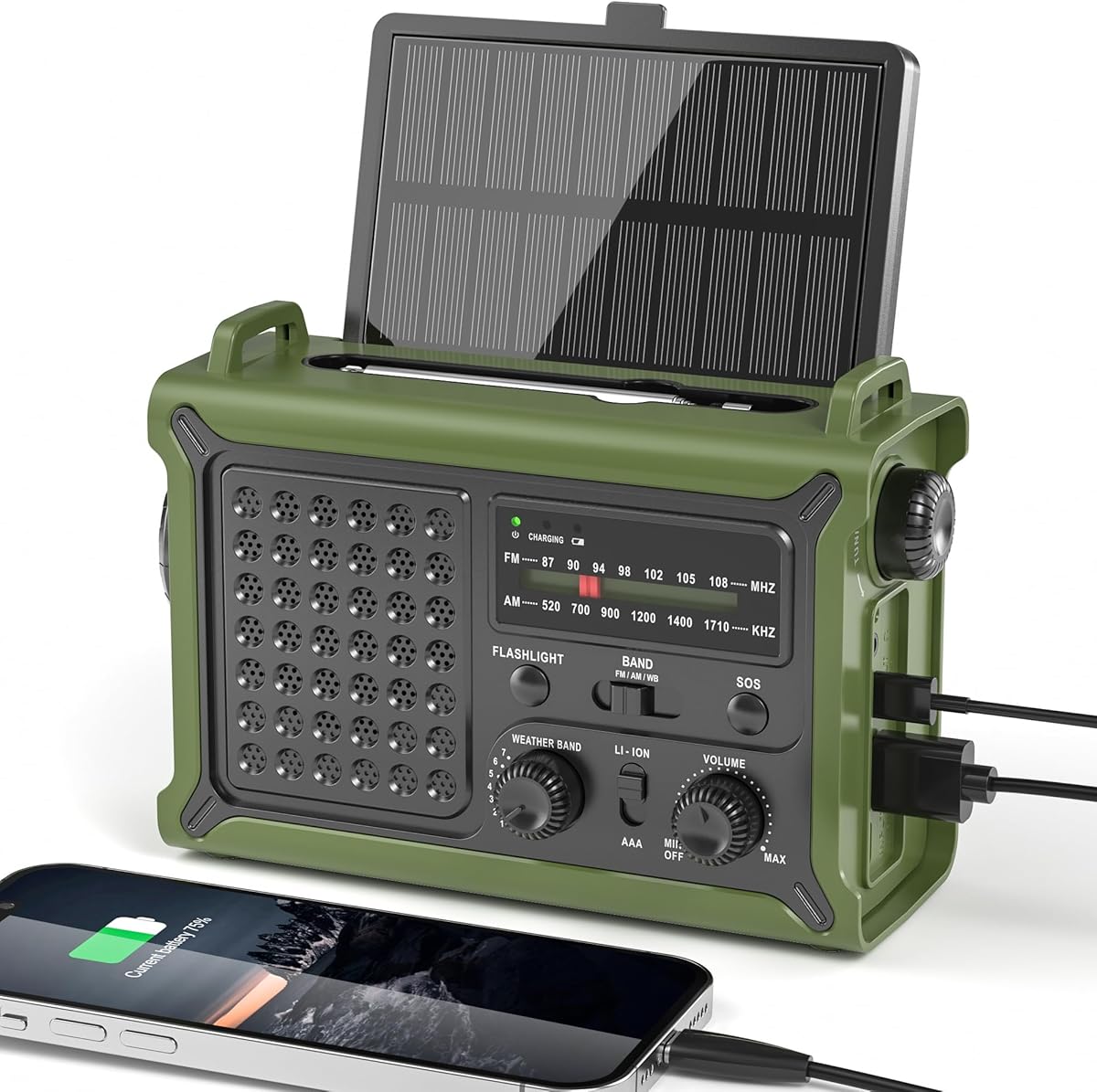
The Solar Radio Emergency Hand Crank 12000mAh with Clear Signal is the most comprehensively prepared option for beach trips where a storm, power loss, or isolated campsite could matter. It has a 4.8 customer rating, the highest in the group, and combines NOAA, AM, and FM reception with several independent ways to obtain power.
We may earn a commission when you buy through this link, at no additional cost to you.
Its high-sensitivity signal chip, noise-reduction circuitry, and extended antenna are intended to provide clear NOAA FM and AM broadcasts. A large 8500mm-square-millimeter monocrystalline solar panel is substantially larger than typical decorative panels and is designed to charge faster, including in relatively low light. The upgraded hand-crank generator provides another option when neither sunlight nor an outlet is available.
The 12000mAh lithium battery can power the radio, lights, and phone-charging functions. Lighting includes a focused flashlight with a stated beam distance of up to 260 feet and a softer reading lamp, both offering two brightness levels. These additions make the radio useful after sunset, during a power outage, or around a campsite.
This is the top recommendation for campers, hikers, families concerned about coastal weather, and anyone who wants a radio with meaningful emergency capability. The 6.8 by 2.9 by 4.7-inch body and non-slip grip are manageable, but it is larger than a basic transistor radio. Solar charging still depends on available sunlight, and the battery level should be checked and fully charged before first use.
Solar charging, a hand-crank generator, a large battery, phone charging, and two lights make this more than a basic receiver. It is designed for situations where access to conventional power may disappear.
NOAA reception can provide weather broadcasts and alerts, while the flashlight and reading lamp improve nighttime visibility. The controls are also large, clearly labeled, and easy to operate in the dark.
We may earn a commission when you buy through this link, at no additional cost to you.
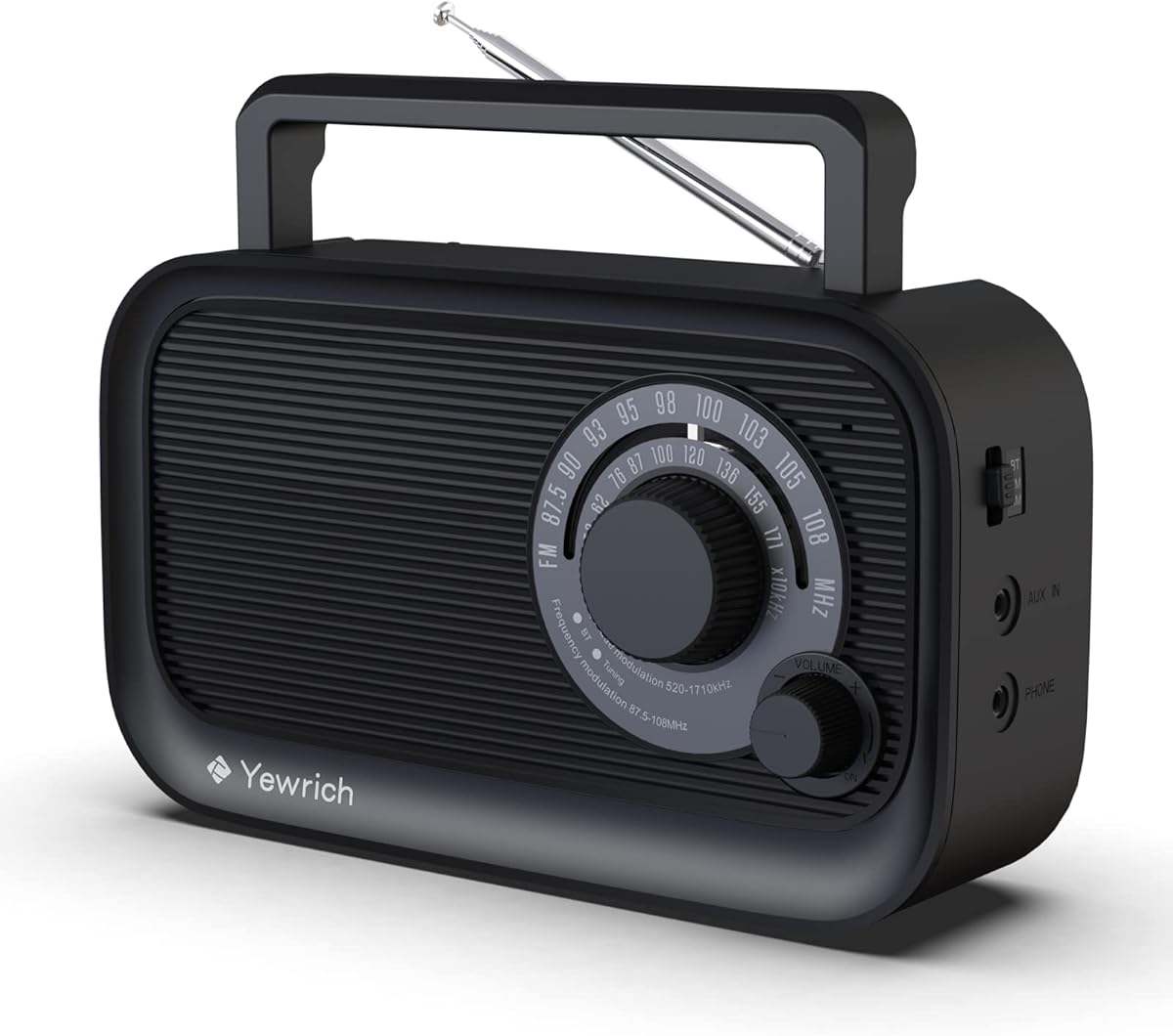
The Yewrich AM FM Radio with Bluetooth AC/DC Power with 3.5mm Headphone Jack offers a balanced blend of radio reception, phone playback, and straightforward operation. It carries a 4.3 rating, a DSP chip for stable signal quality, and a retractable antenna tuned for AM and FM listening.
We may earn a commission when you buy through this link, at no additional cost to you.
Its Bluetooth speaker function can connect with a phone in less than a second, allowing favorite music to be played through the built-in precision speaker. The radio covers FM from 87.5 to 108 MHz and AM from 520 to 1710 kHz, so it remains useful when live local content is preferred over a connected playlist.
Power can come from an included charging cable connected to AC 110V power, or from four AA batteries when the radio is outdoors. A 3.5mm headphone jack supports private listening. The large dial, integrated handle, and premium ABS construction make it particularly suitable for older users and for carrying between a patio, park, beach picnic, or indoor room.
The Yewrich is a good middle ground for someone who wants Bluetooth without buying a dedicated portable speaker. Compared with the JEUJUG, it has a smaller stated speaker and only two broadcast bands, but it also has a 3.5mm headphone connection. The lack of shortwave, Bluetooth version details, and documented water resistance should be considered before a storm-prone trip.
Bluetooth gives the radio a second role as a compact speaker for playlists, talk audio, and other phone content. AM/FM remains available for local news, music, and live programming.
The large tuning dial, handle, and clear radio layout are helpful for everyday use. Headphone support also allows quieter listening when the radio needs to be close to one member of a group.
We may earn a commission when you buy through this link, at no additional cost to you.
The Musibaby M68 Portable Wireless Speaker, 24H Playtime, Blue is a wireless speaker with FM reception rather than a traditional transistor radio. Its 4.4 rating, 12W driver, Bluetooth 5.3, and advertised battery life of up to 24 hours make it a compelling choice for listeners who mainly want phone audio but still value an FM option.
We may earn a commission when you buy through this link, at no additional cost to you.
Besides Bluetooth, the M68 supports FM radio, USB flash-drive playback, and AUX input. The USB port is specifically for a flash drive rather than a direct phone charging cable. Two M68 units can be paired for wider left-and-right stereo, making the speaker useful in a bedroom, dorm, patio, or small beach gathering.
Water resistance is rated IPX5, which supports exposure to everyday splashes and light rain. That makes it suitable near a poolside table or beach towel under ordinary conditions, but it is not designed for submersion, boat spray, or direct shower water. Clear sound, balanced mids, and fuller bass are provided by the compact 12W speaker.
Choose the M68 when portable phone music, long playback, and moderate splash exposure matter more than AM reception, NOAA alerts, or emergency functions. Actual playtime depends on volume, audio source, and operating conditions. It is not intended to power a large beach party, but it is well suited to personal listening and small gatherings.
Bluetooth 5.3 supports straightforward wireless playback, while FM, USB, and AUX provide alternatives when a phone is unavailable. This makes the speaker more versatile than a single-purpose Bluetooth model.
The IPX5 rating is appropriate for common splashes and light rain around everyday outdoor use. Keeping the speaker away from direct surf and pool immersion helps preserve its intended level of protection.
We may earn a commission when you buy through this link, at no additional cost to you.
The IPX7 Waterproof Shower Speaker with LED Display, FM Radio, Suction Cup, Light Show, and Built-in Mic is built for wet environments and social gatherings. Its 4.2 rating and IPX7 protection distinguish it from radios designed only to tolerate splashes, making it a strong option near pools, beaches, bathrooms, and outdoor events.
We may earn a commission when you buy through this link, at no additional cost to you.
IPX7 protection allows the speaker to be submerged in up to three feet of water for as long as 30 minutes. A removable suction cup lets it attach to smooth bathroom walls, mirrors, pool decks, or kitchen counters, and the speaker can float on the water. This mounting flexibility is unusual among portable FM radios and helps keep the device in convenient listening positions.
The multifunction LED display shows the time and battery level in Bluetooth mode, while FM mode provides station and volume controls. A beat-driven halo displays seven colors that can scroll or remain locked to one color. Two units support true wireless stereo, and a built-in microphone allows the speaker to handle calls when connected.
This is the pick for listeners who prioritize water protection, a lively appearance, and phone connectivity more than traditional broadcast reception. FM radio is included, but AM and emergency weather bands are not. The illuminated effects are more entertaining at a party than during quiet listening, so buyers seeking a restrained radio or long-form speaker may prefer a different model.
The IPX7 rating supports temporary submersion in up to three feet of water for 30 minutes. It is therefore more appropriate around active pools and wet beach areas than basic splash-resistant speakers.
The LED display, selectable light effects, suction cup, and true wireless stereo pairing give this model a party-oriented character. FM reception remains available, while Bluetooth 5.0 handles phone playback and calls.
We may earn a commission when you buy through this link, at no additional cost to you.
The Bluetooth AM FM Shortwave Radio with NOAA Weather Alert is the most feature-rich dedicated radio in this guide. Its 4.3 rating reflects a balanced blend of broadcast reception, digital controls, connected playback, and emergency-oriented functions in a portable body suited to beaches, campsites, parks, and picnics.
We may earn a commission when you buy through this link, at no additional cost to you.
A DSP chip supports reception across four bands: FM from 87 to 108 MHz, AM from 520 to 1710 kHz, shortwave from 4.75 to 21.85 MHz, and NOAA weather broadcasts from 162.400 to 162.550 MHz. The NOAA function can deliver real-time weather alerts and updates, while the 5W speaker is designed to provide clear, loud program audio.
The built-in 1250mAh rechargeable battery is advertised to provide approximately 10 to 12 hours of music and news on a full charge, with USB-C charging. Bluetooth 5.4 can play audio from a phone, tablet, or laptop, while the TF card slot supports personal MP3 playlists. A 3.5mm headphone jack, six EQ settings, flashlight, bright digital display, back clip, and wrist strap add further flexibility.
This is the premium selection for a listener who wants much more than AM and FM. It combines NOAA awareness, shortwave exploration, local broadcasts, phone audio, offline files, and private listening in one device. The trade-off is complexity compared with an analogue radio, along with a smaller battery than the solar emergency model. Even so, it offers the broadest mix of entertainment and preparedness features here.
AM, FM, shortwave, and NOAA reception make the radio useful for local information, broader broadcasts, and weather updates. The digital tuner and bright display help users navigate those bands with more precision than a traditional analog dial.
Bluetooth 5.4 and TF card playback extend the radio beyond live broadcasting, while the 3.5mm headphone jack provides a quiet option. The back clip and wrist strap also make it easier to keep close during active outings.
We may earn a commission when you buy through this link, at no additional cost to you.
The right beach radio depends on how you listen, where you use it, and how much protection you need. Compare radio bands, output, power, connectivity, water resistance, portability, and emergency functions before choosing a model.
AM and FM are the most familiar choices for local music, talk radio, sports, news, traffic updates, and emergency information. Shortwave adds access to distant and international broadcasts, while NOAA bands are especially relevant for weather updates in the United States. Reception quality also depends on the signal chip, antenna length, antenna rotation, and whether you can reposition the unit near a window, opening, or clearer signal area.
A larger speaker and higher stated wattage can make broadcasts easier to hear over wind, surf, and conversation. The products in this guide range from a 2W horn-style speaker to 5W models designed for louder output. For personal headphone listening, speaker power matters less. For a shared blanket, patio, or campsite, prioritize clarity, volume, and whether a model can pair two units for a wider stereo field.
Rechargeable batteries are convenient for repeated beach trips because they can be topped up before departure, while disposable batteries provide a useful backup when recharging is impossible. Pay attention to the stated playback duration, battery capacity, charging connector, and required battery size. Products accepting both internal rechargeable cells and standard batteries offer the broadest recovery options, while AC-powered radios are more suitable for permanent indoor listening than a day at the beach.
A beach radio is exposed to damp sand, splashes, drinks, and occasional spray, but water-resistance levels are not interchangeable. IPX5 is intended for splashes and light rain rather than submersion, while IPX7 supports temporary immersion under specified conditions. No resistance rating should be assumed simply because a product resembles an outdoor speaker. Keep every radio covered during fog, protect openings from wet sand, and never leave a device in direct surf unless its documentation clearly permits it.
Bluetooth lets a radio become a portable speaker for playlists, podcasts, phone calls, or locally stored audio. AUX input and USB flash-drive playback can provide alternatives when a phone is not available, while TF card support is convenient for offline music. A dedicated radio remains valuable for live local coverage and emergencies, so a hybrid design can be more useful than a Bluetooth-only model if you want both forms of listening.
A radio that sounds capable may still be awkward to carry across soft sand. Consider dimensions, weight, handle or strap design, and whether the controls can be operated with one hand. Pocket models suit walking and small blankets, while larger speakers work better for stationary picnics. A lanyard, back clip, or wrist strap helps prevent drops, and a non-slip grip becomes especially valuable if the device is handled with wet hands.
Emergency features can be useful beyond a radio's entertainment role. NOAA reception, weather alerts, hand-crank charging, solar panels, phone charging, flashlights, and reading lights are valuable when a storm, outage, or late return disrupts normal plans. Check whether the emergency functions are relevant locally, and verify battery levels before travel. A high-capacity battery or independent charging method is more dependable than a small cell that may already be depleted.
Large analog knobs are easy to use and remain effective in bright sunlight or when the device is wet. Digital displays can show precise frequencies, time, battery status, and menu options, but they add complexity and may be harder to read in glare. Some users prefer the immediacy of a large tuner, while others value a backlit screen and preset-like navigation. Headphone support, independent volume controls, and clearly labeled band selectors can improve shared use.
Before the first outing, install any required batteries, connect the charging cable, and check the battery level. Fully charge rechargeable models and test AM, FM, shortwave, Bluetooth, NOAA, flashlight, and other functions in advance. Read the included instructions, identify charging and power inputs, and keep a note of the controls that are easiest to use in poor light.
At the beach, begin by extending the antenna and choosing the correct band. Rotate or reposition the antenna slowly if a station fades, and move the radio closer to an open area if reception remains poor. For Bluetooth, pair the radio with the phone before leaving and verify that the selected source is correct. Keep the device on a stable, dry surface, away from direct waves, wet sand, and prolonged sun exposure.
After use, switch the unit off, disconnect charging cables, and wipe salt, sand, and moisture from the exterior with a soft, slightly damp cloth. Do not immerse a model unless its stated rating permits it, and avoid charging a wet device. Store the radio in a dry bag with adequate ventilation, and remove disposable batteries during long periods of non-use if the manufacturer recommends it.
Reliability depends on the environment and how you plan to listen. A radio with a long telescopic antenna, DSP reception chip, and both rechargeable and disposable battery options is versatile for many trips. A radio with NOAA reception, solar charging, or a hand crank provides greater resilience in severe weather or off-grid settings. Reception can also vary by location, so checking local station coverage before leaving is helpful.
It depends on the product's stated water-resistance rating. A model with IPX5 protection is intended to handle splashes and light rain but not submersion. An IPX7 model can tolerate temporary immersion under the manufacturer's specified conditions, usually up to three feet for 30 minutes. Radios without a documented rating should be protected with a waterproof cover and kept away from direct spray and surf.
Bluetooth is useful when you want to play your own playlists, podcasts, or downloaded content through the radio's speaker. It also helps when local broadcast coverage is poor. Radio remains valuable for live local programming and emergency information, so a hybrid model is often more useful than either a radio-only device or a Bluetooth-only speaker. Check the Bluetooth version and confirm that the radio functions as both a receiver and speaker.
A NOAA radio is particularly useful in coastal regions because it can provide weather information and alerts when phone service or normal power is unavailable. It is not required for every casual visit, but it adds meaningful preparedness for camping, remote beaches, and severe-weather conditions. A model with a flashlight, hand crank, or solar charging can remain operational under more difficult conditions.
Higher output can help broadcasts remain audible over wind, waves, and conversation, but it does not guarantee better reception or battery life. A 5W radio or speaker is useful for a group, while a smaller unit with headphones may be better for one person. Consider placement, audio clarity, controls, and water exposure along with wattage when making a choice.
Extend the antenna fully and rotate it slowly while listening for a clear signal. Moving the radio away from buildings, vehicles, umbrellas, and other obstructions can also help. Longer adjustable antennas provide more positioning flexibility than fixed ones. If a station remains weak, try a different frequency band or location rather than assuming the speaker is defective.
Most radio models are not appropriate for swimming, and only products with explicit IPX7 protection are designed for limited submersion. Boat spray and direct ocean waves can overwhelm even splash-resistant equipment. For marine use, choose a product specifically documented for that environment and secure it so it cannot fall overboard. For swimming, use a dedicated waterproof speaker with clearly stated immersion protection.
Pack the radio, any required charging cable, and a way to keep it dry, such as a protected compartment in a beach bag. If the radio uses disposable batteries, carry spares because the listed accessories may not include them. For extended visits, bring a power bank for models with USB charging and keep the device out of direct sun when possible. A dry pouch is particularly useful for long or rainy outings.
The Solar Emergency Hand Crank Radio is the strongest all-purpose choice for listeners who value weather reception, independent charging, lighting, and emergency resilience. The Bluetooth NOAA Pocket Radio offers the richest entertainment and connectivity mix, while the Goodes Portable AM FM Radio delivers a straightforward, compact, budget-conscious experience. Each serves a distinct need rather than competing for exactly the same use case.
Prioritize the features your outing truly requires. Choose Bluetooth when personal playlists are central, NOAA when weather awareness matters, and a long antenna when reliable AM/FM reception is the goal. For group listening, look for a 5W-class speaker; for solo use, a headphone jack may be more valuable. Water resistance should always match the actual setting rather than serving as a casual assumption.
Before ordering, verify the current listing, included accessories, battery requirements, and available channels. Ratings and product configurations can change over time, and prices also vary between sellers. Checking the latest details ensures that the selected portable beach radio still fits the intended trip, group size, and level of preparedness.