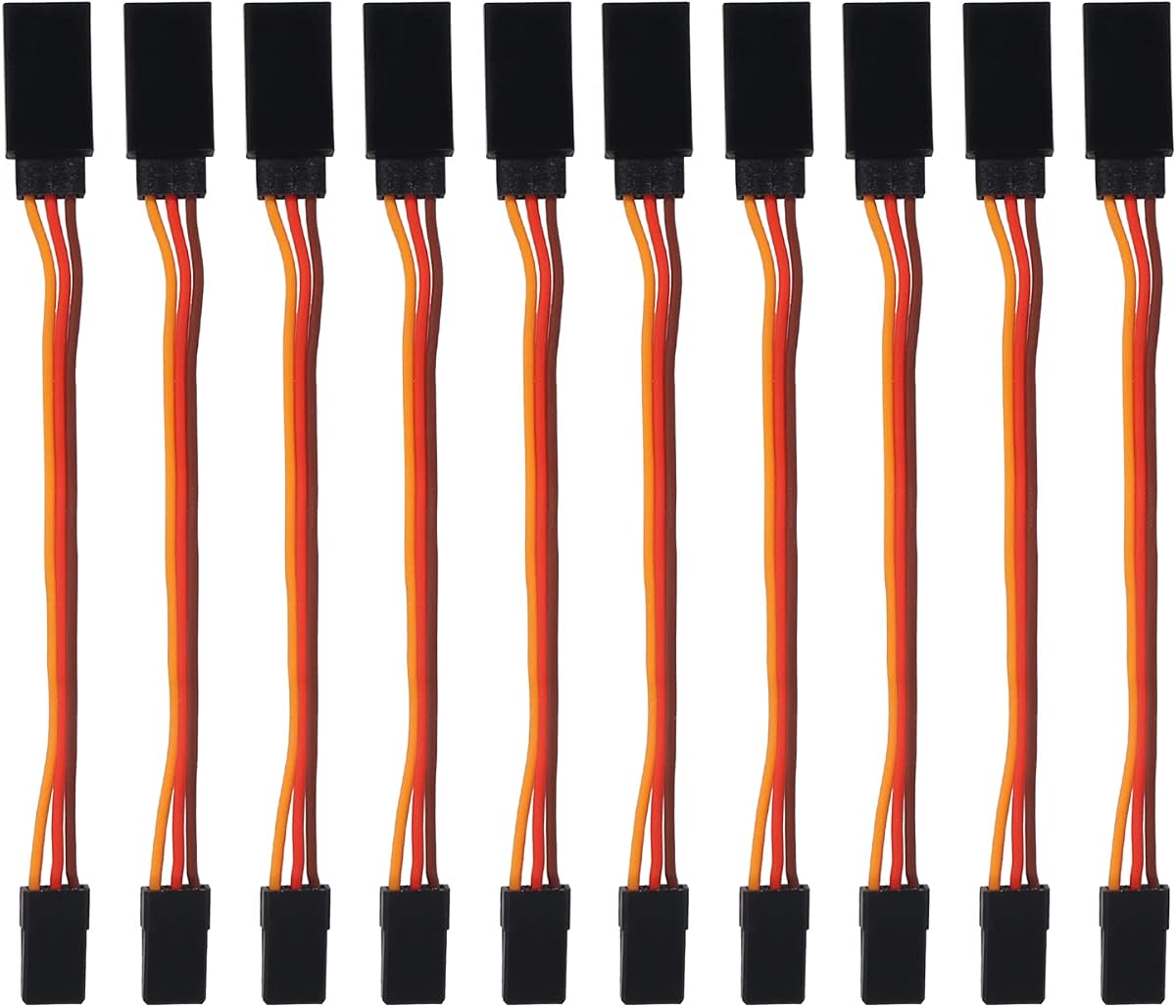
22pcs 3Pin Servo Extension Cable
4.8Editor score
Five length options included
Angled three-pin connector design
Receiver and servo connection support
Discover the best Servo Extension Cable options for RC cars, planes, helicopters, and drones, compared by length, connector type, wire design, and pack size.
A servo extension cable adds reach between an RC receiver, control board, or servo without requiring a major wiring redesign. A useful cable should provide a secure connection, flexible conductors, accurate signal transmission, and enough length for tidy routing. The right choice depends on connector style, wire gauge, application, and the space available in your model.
This guide compares ten servo extension cable products using their stated specifications, compatibility information, pack contents, connector arrangements, and customer ratings. It covers general-purpose 3-pin leads, multi-length assortments, Y-harness splitters, and heavier-duty cables for RC vehicles, aircraft, helicopters, drones, and other remote-controlled projects.
Each review highlights the product's most useful qualities, along with limitations that may matter to a particular builder. The top selections represent three distinct priorities: broad length flexibility, a convenient multi-length pack, and more specialized construction. Product availability and prices can change, so check the current listing before purchasing.
4.8Editor score
4.8Editor score

4.7Editor score
The table below compares all ten options by their most important practical characteristics, including lead length, connector format, wire construction, and intended RC applications.


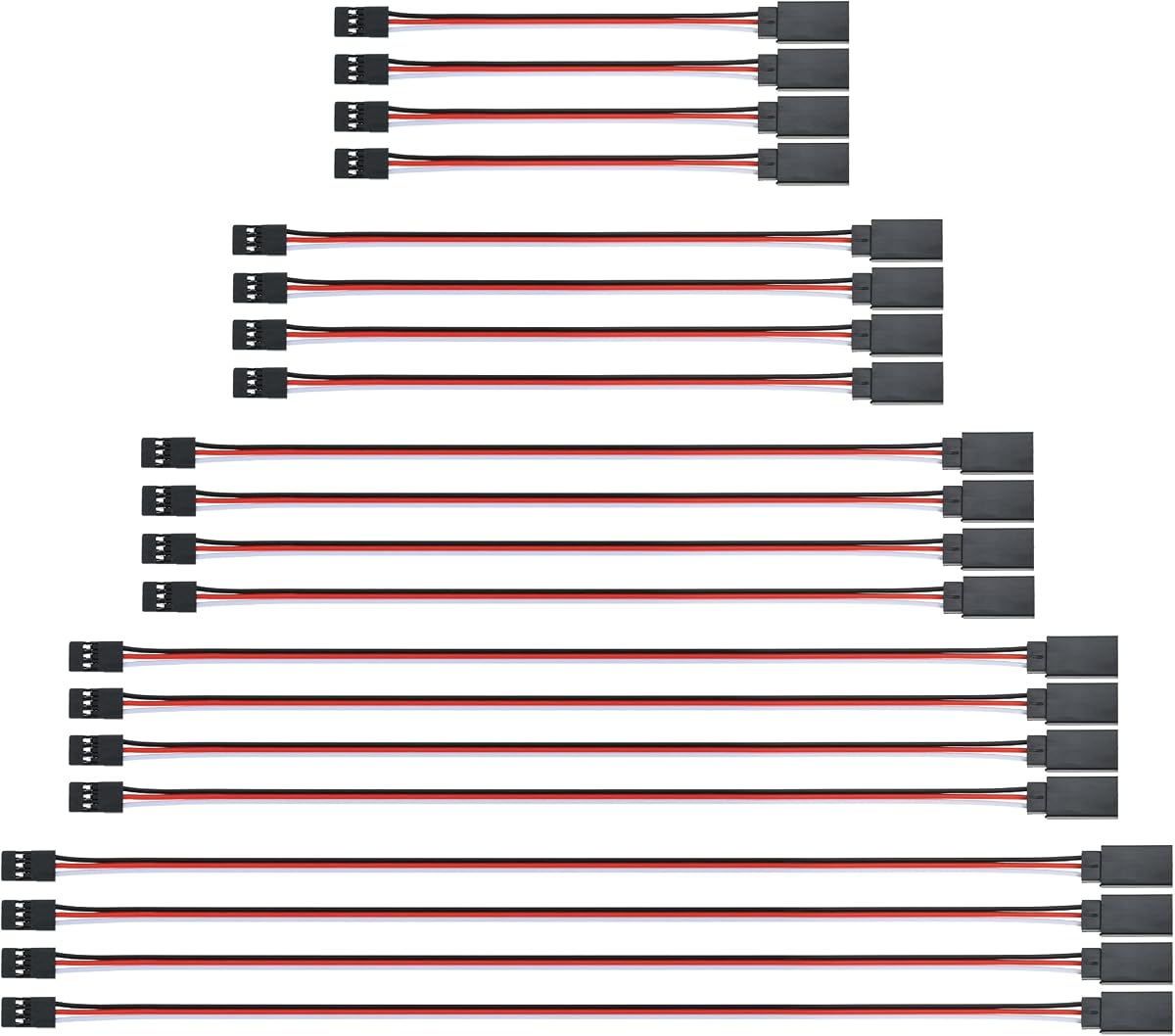

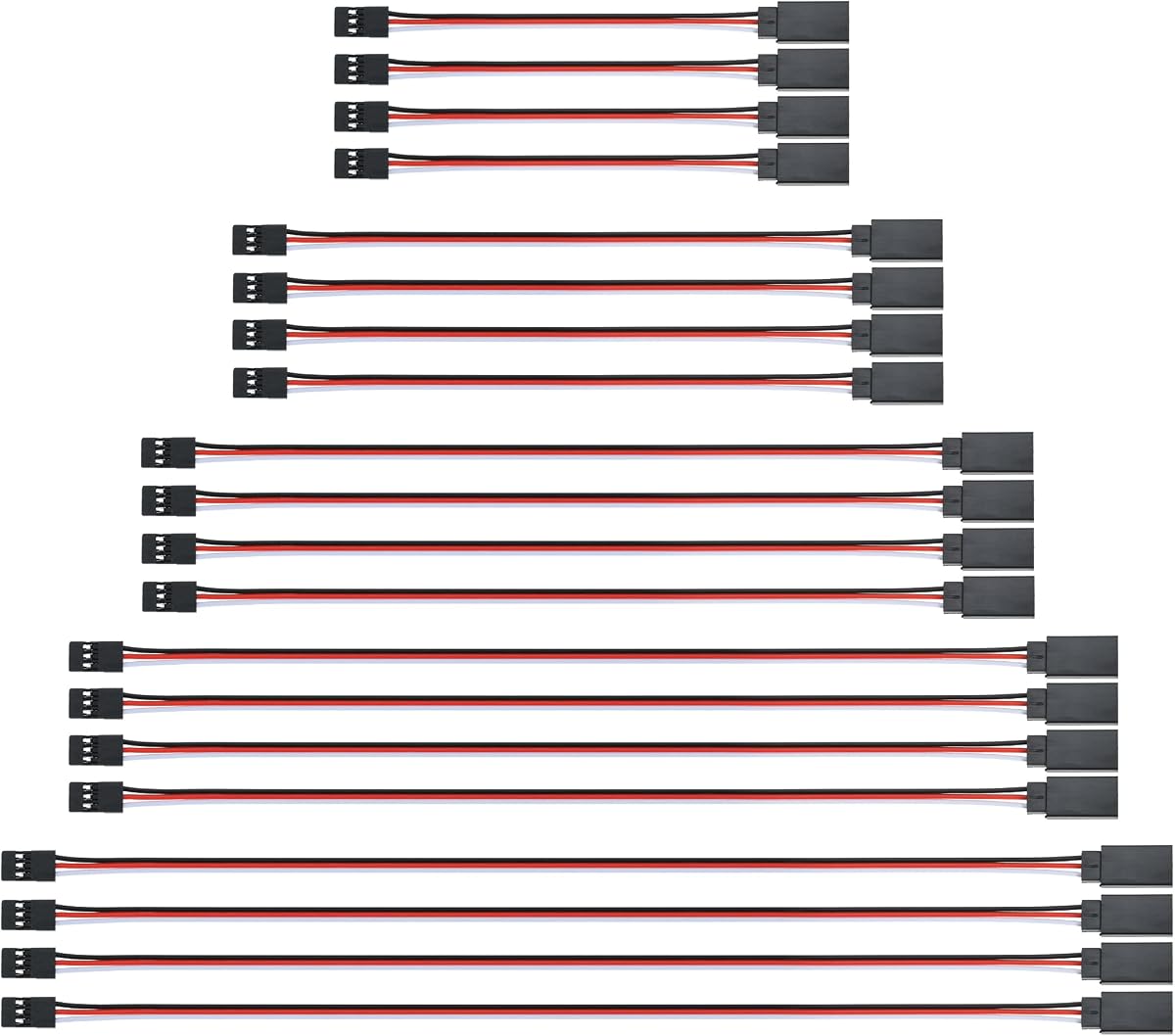
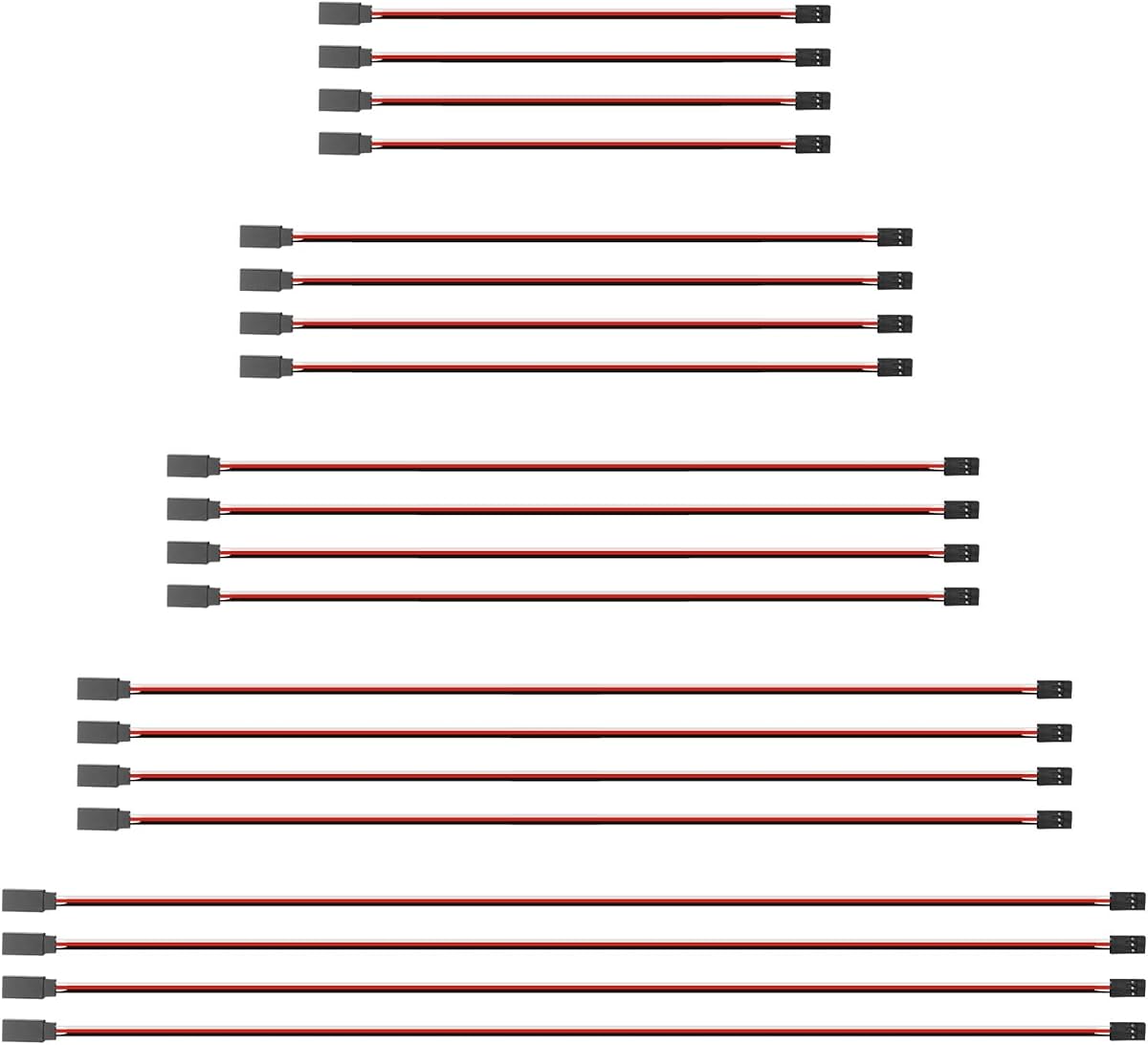
This 20-piece servo extension cable set receives a 4.8 rating and stands out for its unusually versatile assortment of lengths. It includes 12.4, 17.5, 22.3, 33, and 52.5 cm leads, with four cables in each size. That range makes it easy to select a short lead for a compact receiver bay or a longer one when routing around obstacles.
We may earn a commission when you buy through this link, at no additional cost to you.
Each lead uses a three-pin female-to-male configuration intended for connections between receivers, control boards, and servos. The angled connectors and keyed shape help make installation more intuitive, while the stated compatibility with Futaba and JR systems covers several common RC formats. The assortment is particularly useful for builders who would otherwise need to purchase several separate lengths.
The principal limitation is that the pack offers no extra construction features beyond the basic extension format. Buyers seeking higher wire gauges, locking clips, or a Y-harness will need a more specialized product. The set also does not provide different wire lengths within a single cable, but that is not a problem for installations that can be planned around a fixed size.
This is a strong general-purpose choice for RC cars, helicopters, airplanes, and compact electronics projects. It is particularly appealing to hobbyists who want a ready assortment for repairs and custom layouts. The combination of useful length choices, broad compatibility claims, and a high customer rating makes it an especially practical pick for the top of the list.
Having five sizes in one pack reduces the need for repeated purchases during a build. Short leads can minimize excess wire in crowded compartments, while longer options help reach servos mounted beyond the receiver's immediate reach.
The listed JR and Futaba compatibility makes this assortment relevant to many standard servo configurations. Builders should still verify their receiver and servo connector style before installation.
We may earn a commission when you buy through this link, at no additional cost to you.
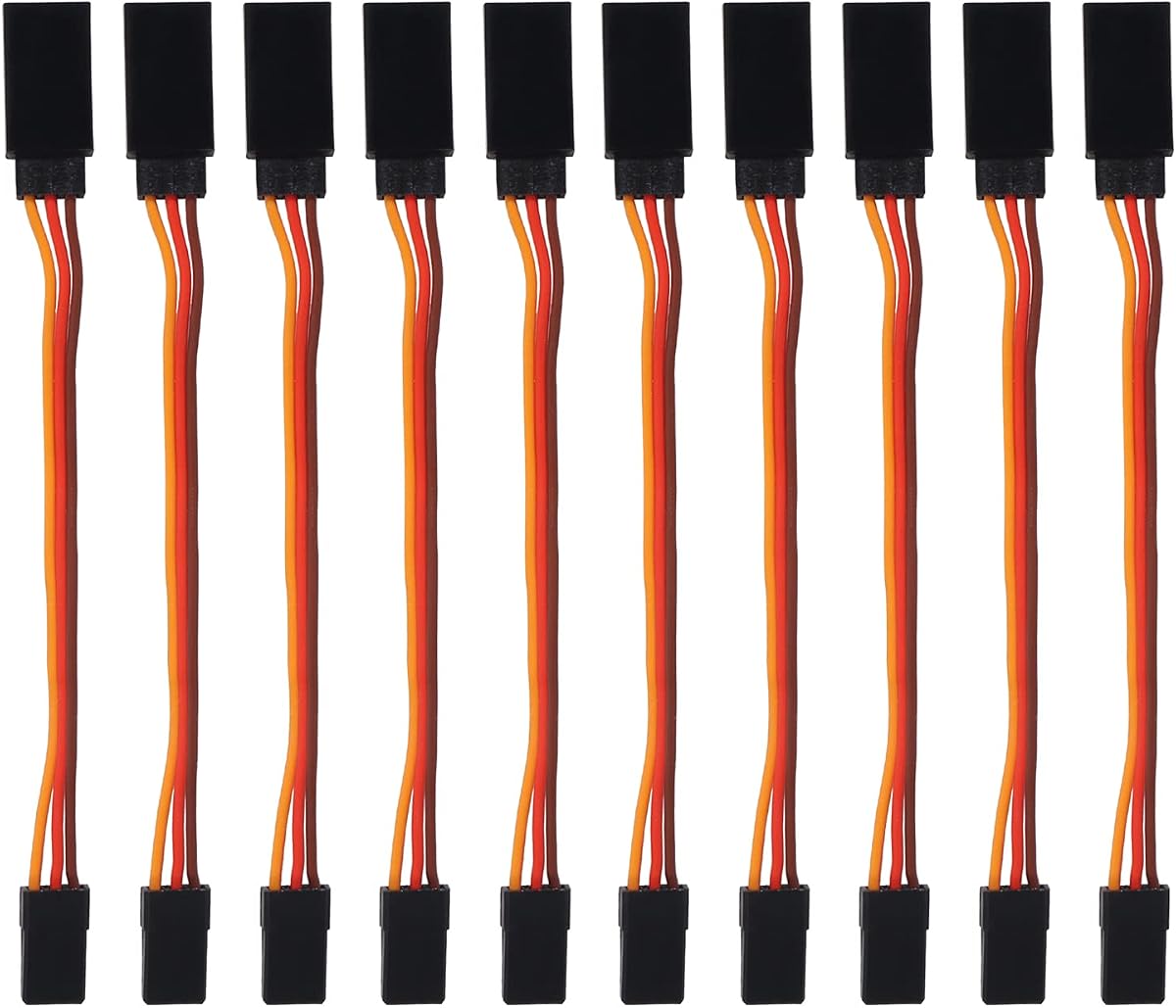
This 22-piece assortment carries a 4.8 rating and is built around five cable lengths: 6, 15, 30, 50, and 100 cm. The inclusion of a 100 cm option gives it more routing range than many compact sets, while shorter cables help control wire clutter around receivers and control boards.
We may earn a commission when you buy through this link, at no additional cost to you.
The listed use cases include Futaba and JR servos, airplanes, helicopters, remote-control cars, and receiver connections. Angled three-pin ends support straightforward installation, and the product description says they can be connected to a receiving set or steering engine. It is a simple solution for adding reach without changing the installed servo lead.
Its most noticeable drawback is the uneven pack composition: the product information specifies five cables each at 6, 15, 30, and 50 cm, plus two 100 cm cables. That makes sense for preserving the longer options, but buyers wanting equal quantities at every size may prefer another assortment. It also lacks integrated locks or premium conductor details.
This pack is well suited to hobbyists who work on several RC platforms and need both short and long extensions. It works especially well for quick repairs, receiver repositioning, and general wiring experiments. For buyers seeking a simple, broadly useful selection without specialized hardware, it delivers a balanced assortment and strong customer feedback.
The six-centimeter lead is useful for minor repositioning, whereas the 100-centimeter lead can reach around larger frames or bulky equipment. Keeping both extremes in the pack supports a wide range of installation tasks.
Twenty-two leads provide several spare options for replacing a worn cable or testing a different routing path. This makes the set more than a one-project accessory.
We may earn a commission when you buy through this link, at no additional cost to you.
This 16-piece servo wiring kit has a 4.7 rating and combines standard extension cables with Y-harness splitters. That makes it more versatile than a pack made entirely of simple leads. The set includes three 2.76-inch 30-core Y-harnesses, three 5.9-inch 60-core Y-harnesses, five 3.54-inch extensions, and five 5.9-inch extensions.
We may earn a commission when you buy through this link, at no additional cost to you.
Its strongest feature is the ability to create multi-servo connections as well as extend individual leads. Thirty-core and sixty-core wire options offer different levels of flexibility and routing convenience. The stated compatibility with JR, Futaba, and Spektrum equipment broadens its relevance to RC cars, airplanes, and drones, including specialized model layouts.
The pack is not optimized for long-distance routing because its listed extension lengths are measured in inches. Builders needing several feet of reach may need additional cable. Some users may also find that the Y-harnesses and extensions overlap with their needs, although those extra pieces can remain useful for future projects or repairs.
This kit is a good fit for builders setting up a more complex RC electrical system rather than solving one isolated connection. It is especially attractive when multiple servos need organized branching or when a project requires both extension leads and splitters. The combination of compatible hardware and two wire-core constructions sets it apart from basic extension assortments.
A Y-harness lets one receiver lead feed two servo connections, while ordinary extensions address reach and placement. Keeping both formats together simplifies projects involving several controls.
The 30-core and 60-core options provide choices for compact routing and more flexible conductors. This variety is useful when signal integrity and manageable bends are priorities.
We may earn a commission when you buy through this link, at no additional cost to you.
The Tecunite 20-piece set has a 4.8 rating and focuses on giving builders a range of extension lengths for cleaner installations. Its stated sizes are 10, 15, 30, 50, and 60 cm, covering short receiver-bay links through longer routes across an RC model.
We may earn a commission when you buy through this link, at no additional cost to you.
Flexible 26 AWG wire is used throughout the set, which should be easier to bend and route than heavier solid-core alternatives. The connectors have a polarization key intended to prevent incorrect insertion, adding a useful layer of protection during installation. Standard three-pin compatibility also makes the cables suitable for common RC cars, airplanes, helicopters, and receiver connections.
One minor concern is inconsistency in the product description: it refers to six specific lengths but then lists five. The title and advertised assortment clearly indicate five sizes, so buyers should use the listed measurements when planning a build. The connectors also lack a mechanical locking clip, meaning secure retention depends on normal plug fit and routing.
This set is a good general recommendation for anyone who wants to improve wire management without purchasing individual lengths. It is particularly useful for model builders, repairers, and RC hobbyists who regularly reposition receivers or servos. The strong rating, keyed ends, and flexible wire make it a dependable, versatile choice.
Matching a lead more closely to the required distance reduces excess wire inside the model. Less looping can make the receiver bay easier to inspect, service, and protect from vibration.
A polarized connector is helpful because servo leads carry power, ground, and signal. The stated keying design helps guide the plug into its proper orientation.
We may earn a commission when you buy through this link, at no additional cost to you.
The Frienda 15-piece set has a 4.8 rating and offers a simple solution for builders who consistently work with 300 mm, or 11.8-inch, servo leads. Every cable in the pack has the same length, making it convenient for multi-servo installations that require an identical extension.
We may earn a commission when you buy through this link, at no additional cost to you.
The black-and-red three-pin leads use male-to-female ends and are listed for Futaba and JR servos, receiver connections, aircraft, helicopters, and RC cars. They can also be used to jump from one board to another or connect a control panel. Fifteen identical pieces are useful for completing an entire installation or keeping several replacements nearby.
Because only one size is offered, the pack lacks the flexibility of a mixed-length assortment. It will not solve a short-distance problem without leaving extra wire, and it cannot accommodate a long route requiring substantially more reach. There is also no mechanical locking feature to resist separation during rough operation.
This product is best for RC builders who know their wiring standard and prefer standardized lengths over broad assortments. It is a practical choice for repeated receiver connections, control-board links, and replacement stock. The high rating and generous quantity make it appealing when consistency matters more than length variety.
A uniform 300 mm lead can simplify a build involving several servos at similar distances from the receiver. Builders can plan a consistent wiring pattern without searching through different cable sizes.
Having fifteen matching leads makes it easy to replace a damaged cable without redesigning the route. Spare stock is particularly useful for vehicles that see frequent impacts or vibration.
We may earn a commission when you buy through this link, at no additional cost to you.
The BackBayRC 45 cm set carries a 4.7 rating and offers the most specialized construction in this roundup. It uses twisted 20 AWG, 100-strand conductors, gold-plated pins, and silicone insulation, creating an extension cable aimed at durability, clean signal transmission, and repeated movement.
We may earn a commission when you buy through this link, at no additional cost to you.
The integrated safety clip is the most distinctive feature. Physically locking the male and female plugs together helps prevent accidental disconnection during fast runs, rough landings, or bumpy trails. Twisted wiring is also intended to reduce electrical interference, while the high-strand design allows repeated flexing without quickly working the cable into a permanent kink.
This premium specification is overkill for a stationary control panel or a simple repair, and the set includes only five cables at one length. Users who need a very short lead or extensive assortment may find a mixed-length pack more convenient. Connector compatibility should also be checked because the plugs are described as JR-style rather than universal across every system.
It is most appropriate for RC vehicles, drones, planes, and e-bikes where vibration, movement, or tight routing makes connection security important. For a build exposed to repeated crashes or continual flexing, the extra construction has a clear purpose. This is the premium selection for users who prioritize dependable retention and flexible routing over having a large assortment of basic leads.
The twisted layout is intended to reduce interference between the conductors carrying power, ground, and control signal. That can be useful in compact builds where wiring runs close to other electronics.
The safety clip provides a mechanical reason for the plugs to remain joined. That is especially useful where ordinary friction alone may not withstand high-speed vibration or repeated impacts.
We may earn a commission when you buy through this link, at no additional cost to you.
This 15-piece set has a 4.7 rating and emphasizes conductor flexibility through a 60-core construction. Each of the three wires in a cable contains 60 strands, while the overall gauge is stated as 22 AWG. The result is designed to bend repeatedly without sacrificing the tidy routing expected from a quality servo lead.
We may earn a commission when you buy through this link, at no additional cost to you.
The product information notes tinned copper conductors and tinned plugs, with the stated purpose of improving oxidation resistance and interference characteristics. Twisted-pair wiring is also included to help reduce electromagnetic interference. Angled male and female connectors are compatible with JR and Futaba types and are designed to discourage incorrect installation.
The package contains matching 300 mm cables, so it does not offer the placement flexibility of an assortment. Although the construction is described as easy to crimp and secure at both ends, buyers who require a specific unlisted gauge or length may need another option. The product listing also contains a typographical reference to 300 cm, while the primary specification and title correctly identify 300 mm.
This extension is a good choice for a builder who values flexible, multi-strand wire and clean signal routing more than having several lengths. It works well for common RC servo connections, control boards, and model electronics. The fifteen-piece quantity provides ample stock for multi-servo installations and future repairs.
Sixty fine strands can move more freely than a single solid conductor, which helps when routing a lead around a frame or fitting it into a confined battery compartment.
Twisted conductors and tinned contact surfaces are intended to support stable electrical performance. These characteristics are useful in models with several closely packed electronic components.
We may earn a commission when you buy through this link, at no additional cost to you.
The ACEIRMC 10-piece set has a 4.6 rating and centers on a compact 10 cm extension length. This makes it most appropriate for minor reach adjustments, crowded receiver bays, and simple servo connections where a full-size lead would create unnecessary excess.
We may earn a commission when you buy through this link, at no additional cost to you.
Every lead has angled three-pin connectors, with the product information describing female-to-male ends for use with receivers, control boards, and servos. Compatibility is listed for Futaba and JR systems, along with RC cars, airplanes, and helicopters. The angled housing also provides a visual cue that can help the user orient the plug correctly.
The 10 cm length is both the main advantage and the main constraint. It is useful for small corrections but cannot reach around large obstacles or span a substantial distance in a model. The listing also provides little detail about conductor gauge or shielding, so buyers who require a specified electrical construction may need to investigate further.
This pack is best for close-range wiring in compact models or for a small repair requiring the same standard lead. Ten matching cables make it convenient for a project with several nearby servos. Its straightforward design and broad stated application support make it a practical option when a short extension is all that is needed.
A short extension can provide just enough separation to move a servo or route a plug around another component. It also avoids the clutter that can result from folding a much longer cable into a small compartment.
The angled connector design can make the connection easier to see and handle in a confined space. It also helps guide the plug into a consistent orientation during installation.
We may earn a commission when you buy through this link, at no additional cost to you.
This 20-piece extension set receives a 4.8 rating and provides four cables in each of five lengths: 10, 15, 20, 30, and 50 cm. The evenly distributed quantities are useful for builders who need several leads of each size rather than one or two very long options.
We may earn a commission when you buy through this link, at no additional cost to you.
Each cable has a female and male connector and uses the familiar three-wire arrangement for positive voltage, ground, and pulse-width modulation. Listed applications include Futaba and JR servos, RC cars, airplanes, helicopters, FPV quads, AR wings, and FPV wings. That broad range makes the set useful across fixed-wing, multirotor, and ground-based projects.
The product does not specify a heavier wire gauge, connector locking system, or special shielding, so its advantage rests on variety and straightforward compatibility. The warning against reversing the connection is important because a servo and power source can be damaged if a lead is installed incorrectly. Users should confirm orientation before energizing the system.
This is a strong general-purpose assortment for hobbyists working across multiple RC categories. The five graduated lengths help balance short, tidy connections against moderate reach requirements. Its consistent four-piece quantity per size also makes it easier to plan symmetrical installations or keep a balanced spare stock.
The five sizes progress in small enough increments that builders can match lead length more closely to the actual installation. This reduces excess wire and makes cable management more predictable.
The stated range from cars and helicopters to FPV wings and aircraft reflects a standard three-pin approach. It makes the set practical for hobbyists who switch between different types of models.
We may earn a commission when you buy through this link, at no additional cost to you.
This 28-piece set has a 4.1 rating, lower than the other products in the roundup, but it offers the broadest stated size selection. The assortment includes 6, 10, 15, 20, 30, 50, and 100 cm leads, with four examples of every length.
We may earn a commission when you buy through this link, at no additional cost to you.
The graduated range covers very short links as well as 100 cm leads for extended routing. Every cable has a three-pin female-to-male arrangement intended for receiver and servo connections. The listed applications include JR servos, RC cars, airplanes, and helicopters, covering the basic needs of many common model types.
The lower rating suggests that some buyers may have found aspects of the product less satisfactory, although the available data does not identify a specific defect. The product description also gives limited information about conductor gauge, insulation, or contact materials. Buyers with demanding electrical specifications may want a more clearly documented premium cable.
Despite those limitations, the assortment is attractive for a hobbyist who wants many replacement leads and a suitable length for nearly any compact installation. The balanced four-cable quantities make it easy to build several projects without running short. It is a functional general-purpose choice, though one of the higher-rated sets may offer more confidence for demanding builds.
Seven sizes give the set an advantage when a project may require anything from a tiny 6 cm link to a 100 cm extension. This is useful for a workshop containing several differently sized models.
Four matching cables per length make it easy to complete multi-servo installations and keep a reserve of identical leads. The large total count is especially useful for repair-focused hobbyists.
We may earn a commission when you buy through this link, at no additional cost to you.
The right servo extension cable depends on connector compatibility, required reach, conductor construction, and the demands of the model. These factors help separate a simple repair lead from a cable intended for frequent movement or complex wiring.
Start by confirming that the connector arrangement matches the equipment being connected. Most products in this guide use three-pin JR or Futaba-style connections, with a female end intended to connect to a servo and a male end to connect to a receiver or control board. Spektrum, Hitec, and other proprietary systems may use different physical arrangements, so visual similarity alone is not enough. Check the receiver, servo, and control-board documentation before buying, particularly if the model uses a compact or nonstandard connector.
Measure the actual route instead of estimating from the model's overall size. Include the distance needed to bend the cable around a frame, pass a servo horn, and leave enough service slack. Short leads are useful for crowded receiver compartments, while 50 to 100 cm options suit larger aircraft, cars, and complex installations. A multi-size pack is often more economical than buying several individual lengths, although it may include more cables than a single project requires.
Wire gauge influences conductor thickness, flexibility, and resistance. The roundup includes 20 AWG, 22 AWG, and 26 AWG examples, as well as 30-core and 60-core stranded constructions. Finer strands tend to bend more easily in confined spaces, while heavier gauges may suit higher-current or more demanding installations. Stranded wire is generally easier to route than solid wire, especially around moving parts and repeated vibration.
Servo cables carry power, ground, and a control signal, so electrical noise can affect performance. Twisted conductors, as offered by the BackBayRC set, are designed to reduce interference between wires. The lkelyonewy set also emphasizes multi-strand and twisted construction. For basic bench work or low-complexity models, ordinary three-pin leads may be sufficient, but builders running cables near motors, ESCs, or other noisy electronics should pay closer attention to conductor layout and routing.
A snug connector is important in every RC model, but requirements rise in vehicles that see high vibration, repeated impacts, or fast movement. Keyed and angled ends help prevent incorrect installation, while an integrated safety clip adds positive mechanical retention. The BackBayRC cables are the only option in this list explicitly equipped with such clips. Other cables may work very well in stable installations, but builders should avoid leaving unsupported plugs where they can swing or snag.
A larger pack is helpful when several servos need extensions, when a model will be rebuilt frequently, or when damaged leads need quick replacement. Multi-length sets with equal quantities per size are particularly convenient for workshops. A smaller pack may be sufficient for a single repair, but the added stock can prevent a project from being delayed later. Consider whether the included pieces match the connector and length required by the current build.
A standard extension cable serves one servo from one receiver lead. A Y-harness allows a single receiver channel to control two servos, which may be useful for ailerons, elevator surfaces, steering, or other paired mechanisms. The 16-piece extension-and-splitter kit is the most convenient combined option here. If a project requires only one extra servo connection, a simple extension is more direct and avoids adding unnecessary branching.
Cable material and routing should match the environment. Silicone-insulated wire remains flexible in tight builds and under repeated movement, while multi-strand copper is easier to bend around frames and battery trays. Flexible insulation also reduces stress at the connector. In all cases, the cable should be routed so it cannot rub against sharp edges, pinch under suspension components, or become trapped between moving parts.
Before installation, disconnect the receiver battery or remove all electrical power from the system. Compare the female and male connector shapes, locate the corresponding receiver or servo port, and verify that the pin arrangement is correct. Do not force a connector that resists insertion. If the plug does not seat smoothly, inspect the housing and confirm that the cable is oriented properly.
Route the extension along the frame or through an appropriate cable channel. Keep the lead away from sharp edges, hinges, drive shafts, hot motors, and components that move independently. Avoid creating a tight bend right at the connector, but do not leave excessive slack that can swing, snag, or become pinched. Secure the cable at suitable intervals without crushing the insulation.
Test the installation with the servo disconnected from the mechanism where possible, then reconnect the mechanical load and check for smooth movement, consistent control, and a secure plug fit. Periodically inspect the cable for exposed conductors, damaged insulation, loose connectors, and unusual heating. Replace a cable if its housing is cracked, its conductors are visible, or its connection has become unreliable.
A servo extension cable adds distance between a receiver or control board and a servo. It is useful when a servo cannot be mounted directly at the desired location or when the original lead is too short. The cable carries power, ground, and the pulse-width modulation control signal to the servo.
No. Although many RC servos use similar three-pin connectors, the physical housing, locking style, and pin arrangement can differ between brands and systems. Most products here are listed for JR and Futaba-style connections, while one also mentions Spektrum compatibility. Confirm the connector format and pin layout before connecting the cable.
Twisted wiring can be beneficial when servo leads run near motors, electronic speed controllers, or other components that may create electrical interference. It is a sensible upgrade for complex models or installations with long signal runs. In a simple, well-routed system, a standard stranded extension may be adequate.
Choose a lead that reaches the servo with a small amount of service slack after routing around the frame. Measure the actual path rather than using the model's exterior length as a guide. Mixed-length packs are convenient when several servos are mounted at different distances from the receiver.
The connector and wire must be suitable for the servo's electrical requirements, and the extension should not introduce excessive resistance or an unsafe voltage drop. Heavier wire, such as 20 AWG, may be more appropriate for demanding high-current setups. The receiver, battery, and servo specifications should be considered together before installation.
Route the cable where it cannot swing, snag, or experience hard impacts, and provide support close to the connector without creating a sharp bend. A cable with an integrated locking safety clip offers additional mechanical retention. Check connector fit and secure the wire at regular intervals, especially in off-road cars, aircraft, and moving platforms.
A male-to-female extension can normally connect to a matching servo lead or another extension, provided the connectors and pin order are correct. Joining several cables can add resistance, clutter, and additional failure points, so it is better to select a suitable length when possible. Power should be disconnected before making or checking connections.
A standard three-wire servo connection uses one conductor for positive voltage, one for ground, and one for the pulse-width modulation control signal. The PWM wire carries commands from the receiver to the servo. Correct pin order is essential because reversing the connection can damage the servo or power source.
The 20-piece five-length set is the most balanced all-around option because it provides useful size variety, a strong customer rating, and broad stated compatibility. The 22-piece pack is also compelling for builders who want both short and long leads, while the BackBayRC set stands apart for twisted heavy-duty wire, gold-plated contacts, silicone insulation, and integrated safety clips.
Prioritize confirmed connector compatibility first, then select the shortest practical length for the installation. Consider wire construction and locking features most seriously for vibration-heavy models, complex electronic layouts, or projects where a loose connection would be disruptive. For simpler wiring tasks, a well-stocked multi-length pack may provide better overall utility than a single premium cable.
Ratings and product availability can change, and current prices should always be checked on the linked listings before making a final purchase. Review the receiver and servo connector documentation, calculate the required routing distance, and confirm that the chosen cable's electrical construction suits the model before installation.