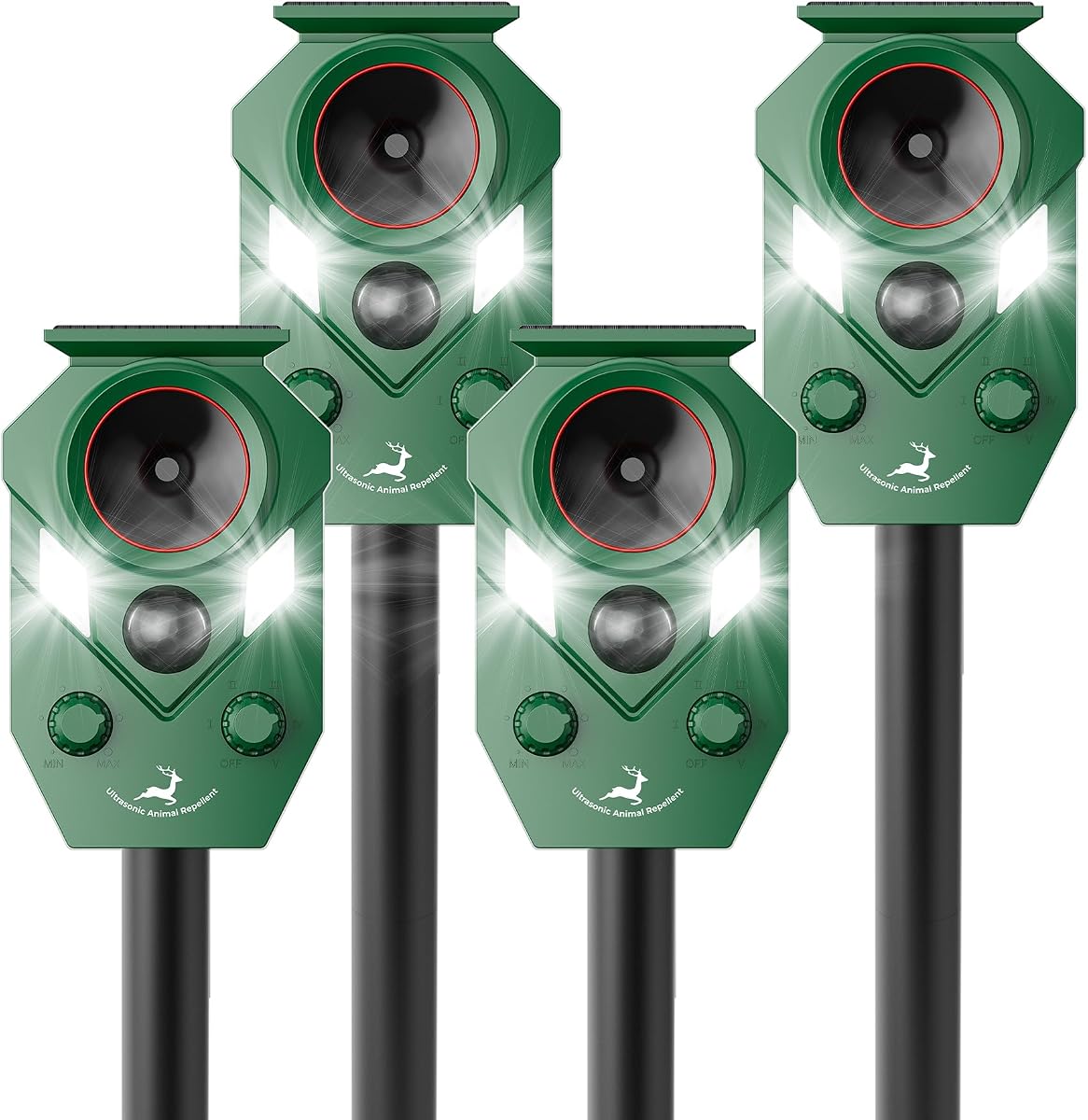
4 Packs Solar-Powered Ultrasonic Animal Repellent
5.0Editor score
Ultrasonic and strobe combination
Five selectable operating modes
USB-C backup charging
Four-unit perimeter coverage
Explore the best Coyote Deterrent options, comparing solar lights, scent deterrents, alarms, repellents, and training tools for yards, farms, and homes.
Coyote deterrents range from solar predator-eye lights and motion-activated alarms to predator urine, pepper-based repellents, and portable air horns. The most useful choice depends on whether your priority is protecting chickens, guarding a garden, deterring nighttime visitors, or maintaining safety while hiking.
This guide compares ten relevant options across deterrence method, coverage, power source, portability, weather resistance, ease of installation, and suitability for different settings. It covers permanent solar devices, temporary scent barriers, audio alarms, motion sensors, and human-carried tools without making unsupported performance claims.
Each review explains the product's strongest features, limitations, and ideal setting so you can match the device to your property and routine. Ratings and availability can change over time, and current prices should always be checked on the linked retailer listing before making a purchase.
5.0Editor score
5.0Editor score

4.5Editor score
The table below compares all ten deterrents by core method, power source, coverage approach, and best-fit location, making it easier to distinguish permanent property protection from portable and scent-based alternatives.



The Solar Nocturnal Animal Repeller Outdoor is a fixed-property deterrent that uses flashing red LED lights to imitate the eyes of a large nocturnal predator. It has a 5.0 rating and stands out for its straightforward, chemical-free approach. Rather than trapping or poisoning wildlife, it creates a visual barrier intended to frighten coyotes and other nocturnal visitors away from an occupied area.
We may earn a commission when you buy through this link, at no additional cost to you.
Its strongest feature is the combination of solar charging and an IP65-rated housing. The high-efficiency panel charges during daylight, while the weather-resistant construction is designed for rain, snow, heat, and cold. Installation requires pressing the power button and mounting the unit on a post, fence, or wall at a height of one to eight feet. Its red-light approach can be aimed toward vulnerable approaches rather than into neighboring homes.
A single light may not protect an expansive property by itself, and effective placement depends on identifying where animals enter. The unit also needs a sunny location to maintain its charge, which can be difficult under dense tree cover or beside heavily shaded structures. These limitations make multiple-unit coverage more practical for large yards, farms, chicken coops, and orchards.
This is the strongest general-purpose choice for someone who wants a maintainable deterrent that operates quietly at night. It is particularly suitable for small farms, backyard chicken enclosures, rural homes, and gardens bordering wildlife habitat. Choose it when a solar, humane, visual deterrent is preferred over a manual spray or portable alarm.
Solar charging removes the need to run wiring to an outlet, making the unit practical for remote coops, garden gates, and other areas without reliable electrical access. Mount it where daylight can reach the panel and where its flashing direction faces likely approaches.
The red LED imitation of a large predator's eyes offers a passive way to discourage coyotes, raccoons, foxes, deer, and skunks. Its outdoor housing is specified for year-round use, although regular cleaning and secure mounting remain important.
We may earn a commission when you buy through this link, at no additional cost to you.
PredatorPee Original Wolf Urine uses scent to communicate the presence of a dominant predator. It has a 3.9 rating and is designed to trigger an instinctive response in animals such as coyotes, foxes, moose, bears, elk, weasels, beavers, and mule deer. The idea is simple: a familiar predator marker can make an area feel unsafe to animals that might otherwise investigate it.
We may earn a commission when you buy through this link, at no additional cost to you.
The spray bottle makes this product flexible for chicken runs, garden boundaries, gates, campsites, and other isolated points where you can reapply the scent manually. It requires no batteries, wiring, or permanent mounting, and the included ScentTags offer a way to associate marked locations with the deterrent. This makes it useful as a supplemental layer rather than the only safeguard around vulnerable property.
Scent-based deterrents depend heavily on freshness, temperature, wind, rain, and the animal's familiarity with wolf urine. The product data also claims that a genetic fear response may cause pests to leave and avoid returning, but individual results can vary. You should avoid placing the substance where pets may contact or consume it and follow the labeling provided with the product.
This option suits property owners who want a portable, non-electrical barrier and are willing to monitor and refresh it. It is less suitable for someone who needs uninterrupted overnight protection without frequent attention. For broader coverage, it can complement a solar predator light or motion alarm rather than serve as the sole deterrent.
Wolf urine can mark vulnerable areas with a scent that may prompt wary animals to turn elsewhere. Apply it according to the product label and place markers around likely approaches rather than relying on a single central spot.
Because wind and weather can disperse or conceal the scent, pairing it with a visual light or audible alarm creates a more resilient defense. This combination is especially useful around chicken coops, garden plots, and campsites.
We may earn a commission when you buy through this link, at no additional cost to you.
The Dog Horn XL is a manual air horn designed to create a sudden, loud sound in the presence of dogs, coyotes, bears, and other wild animals. It carries a 4.5 rating and differs from fixed property devices because you control when it is used. That makes it especially effective for hikers, campers, boaters, dog walkers, and anyone who wants an immediate audible response.
We may earn a commission when you buy through this link, at no additional cost to you.
Its key advantage is readiness. There is no setup, charging, motion calibration, or mounting requirement, and the included belt clip helps keep the horn within reach. The product description states that it can be heard up to a mile away and recommends keeping it at arm's reach. It can also be used to break up unwanted dog confrontations, stop pulling, and discourage animals during training.
Because the sound is produced on demand, it cannot watch a chicken coop or guard a garden continuously. It may also be inappropriate in quiet neighborhoods, near livestock that could be startled, or in situations where a sudden blast could create noise complaints. Its effectiveness depends on carrying it in places where a coyote encounter is plausible.
This is the best pick for travelers, pet owners, and campers who need a small, dependable safety tool rather than unattended coverage. It is also a sensible emergency backup for someone who already has a solar deterrent. Keep it accessible, check the operating instructions, and avoid relying on it as a substitute for secure fencing and property awareness.
A loud, unexpected sound can interrupt an animal's approach and create distance in situations where immediate action matters. Keep the horn easy to reach and use it as a deterrent rather than an aggressive response.
The same tool can support hiking, biking, camping, boating, dog walking, and training. Its lack of fixed placement makes it a flexible complement to property-mounted coyote controls.
We may earn a commission when you buy through this link, at no additional cost to you.
This four-pack combines ultrasonic waves, bright flashing lights, and motion activation to discourage a range of animals, including coyotes, raccoons, deer, and cats. It has a 5.0 rating and is the most feature-rich option in this guide. The combination of several operating modes, dual charging options, and four separate units makes it suitable for creating a layered perimeter rather than relying on one isolated device.
We may earn a commission when you buy through this link, at no additional cost to you.
Its five modes allow you to select strong strobe activity for daytime disturbances, quieter night settings, or smart frequency changes. The product description states that ultrasonic waves operate from 18 to 45 kilohertz and that the lights reach 1,300 lux. It also claims 92 percent effectiveness in laboratory testing, although consumer results can depend on animal habits, placement, and local conditions.
Each unit has an 1,800 milliamp-hour battery and a solar panel that can provide a month of protection according to the listing, with USB-C backup charging taking about three hours. The IP65 housing is designed for difficult weather. These are useful features, but the four-pack requires careful positioning because poorly aimed units may leave gaps or create overlapping sound and light.
This is the most comprehensive option for a homeowner or small farm willing to distribute units around a yard, coop, orchard, or pond. It is particularly attractive for people who want selectable modes rather than a single light pattern. Choose it when a multi-unit, hybrid deterrent is worth the additional setup and when you are prepared to test different modes as animal activity changes.
The ability to move between daytime strobes, quieter nighttime operation, and adaptive frequency settings is the standout feature. Test modes during different periods and adjust placement based on where animals actually approach.
A four-unit set can cover separate entrances, corners, and vulnerable structures more effectively than a single light. Position each unit to face an approach route and keep the solar panels exposed to useful daylight.
We may earn a commission when you buy through this link, at no additional cost to you.
The four-pack Nocturnal Animal Repeller uses an amber, campfire-like flashing pattern intended to resemble a larger nocturnal hunter. It has a 4.4 rating and is designed for chicken coops, yards, gardens, orchards, and other outdoor areas affected by coyotes, raccoons, foxes, deer, skunks, and hawks. The visual simulation gives it a distinct identity among the products reviewed here.
We may earn a commission when you buy through this link, at no additional cost to you.
Dual charging provides more flexibility than a strictly solar design. Six hours of sunlight can provide a full night's charge, while the USB backup can fully charge the device in approximately two hours. A transparent power indicator helps users determine operating status. Installation is straightforward: press the power button, then mount the compact unit on a fence, post, or wall at eye level for the target animal.
The listing describes a weatherproof design intended for heavy rain, snow, and intense sun. It does not provide a formal ingress-protection number, however, so exact exposure limits are less clearly documented than for devices with an IP rating. Its effect also depends on whether the light is visible from the animal's expected route; a fence-mounted unit aimed inward may be less useful than one facing a perimeter opening.
This set is a good fit for owners seeking a nonchemical, visually distinctive deterrent for nighttime wildlife. It works especially well where a red predator-eye appearance is undesirable or where a warm amber light better blends into the setting. The four units allow broader coverage, but users should still combine them with secure fencing and attentive nighttime livestock practices.
The USB option gives owners a way to restore power when sunlight is limited. Check the indicator before a long stretch of unsettled weather and keep charging ports protected when the unit is exposed outdoors.
The amber flame effect offers an alternative to conspicuous red predator eyes. Because visibility from the approach route matters, aim the light toward paths, gates, and livestock enclosures rather than simply mounting it at eye level without considering direction.
We may earn a commission when you buy through this link, at no additional cost to you.
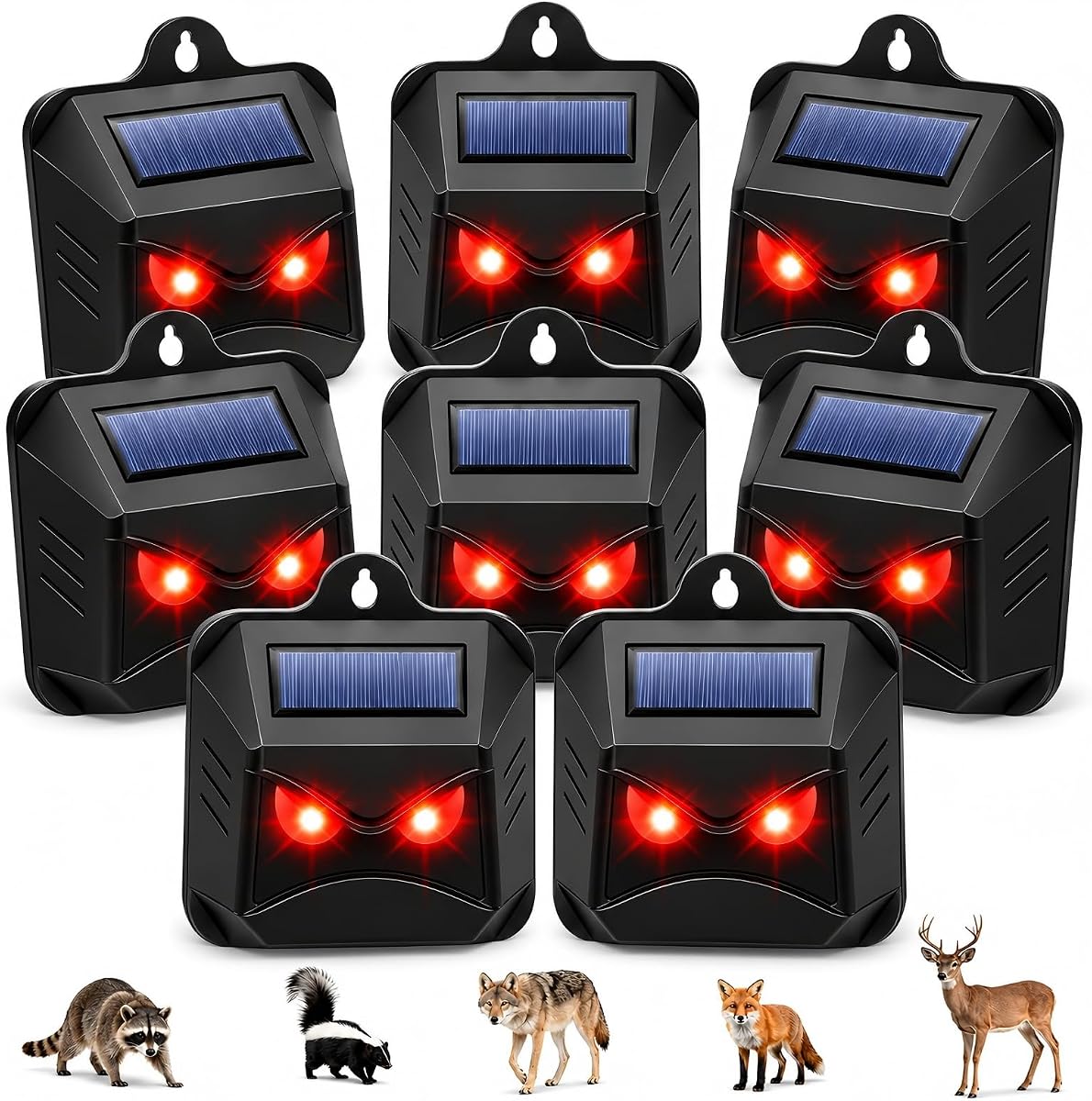
The 2026 Solar Predator Eyes four-pack uses red dual-strobe lights to simulate predator eyes and fire after dark. It has a 4.5 rating and targets coyotes, raccoons, deer, foxes, skunks, wolves, owls, and other nocturnal animals. Automatic dusk activation makes it convenient for owners who do not want to switch the system on manually each evening.
We may earn a commission when you buy through this link, at no additional cost to you.
A high-efficiency monocrystalline silicon panel supplies the charging, and the units can be mounted on trees, fences, or walls at heights from one to eight feet. The product description suggests combining multiple units for 360-degree coverage, which makes the four-pack useful for yards, farms, chicken areas, and gardens with several access points. IP44 weather resistance provides outdoor suitability in rain and snow.
The manufacturer advises that complete results may take three to four weeks and that pest activity could initially increase as animals adjust. That expectation is important: no visual deterrent should be evaluated after only a single evening. IP44 also indicates less water ingress protection than an IP65-rated housing, so sheltered mounting may be prudent in areas exposed to heavy spray or sustained downpours.
This four-pack is a balanced choice for homeowners who want more coverage than a single solar light but do not need ultrasonic functions or multiple mode settings. It is well suited to a rural property with several corners, coops, or garden entrances. Use the lights as part of a broader plan that also includes secure fencing, prompt removal of food sources, and nighttime animal-care practices.
Automatic activation removes the need to remember a nightly switch. Confirm that each panel is positioned where it receives sufficient daylight, especially before relying on the lights through a prolonged cloudy period.
Distributing four units around a property can reduce blind spots near gates, coop corners, and garden boundaries. Map the major approach routes first, then face each unit toward the area it is intended to protect.
We may earn a commission when you buy through this link, at no additional cost to you.
HASSEN Coyote Urine is a scent-based territorial marker intended to make an area seem occupied by a coyote. It has a 3.8 rating, the lowest among the ten products, and offers a different approach from predator-eye lights or sound alarms. The listing describes 16 ounces of authentic predator urine enhanced with coyote gland essence, with no synthetics or dilution claimed.
We may earn a commission when you buy through this link, at no additional cost to you.
The squeeze bottle and flip-top cap make application direct and relatively controlled. You can place scent along gates, coop entrances, feeding areas, and other points where unwanted visitors may be establishing themselves. Unlike a mounted electronic deterrent, it can be carried to different locations as the season and animal behavior change. The product is also presented as gentle on soil, grass, plants, and pet areas when used as directed.
Its effectiveness is likely to vary because scent markers are temporary. Rain, heat, wind, snow, and repeated animal traffic can reduce the marker before it has the desired effect. The lower rating may also reflect varying experiences with predator urine, individual animal behavior, or improper placement. Because the product is designed to communicate with animals, it should be kept away from food, water, and any area where children or pets might contact it.
This is most appropriate for property owners seeking a targeted coyote scent rather than a general predator signal. It can be used near den-like structures, livestock transition areas, and recurring travel routes. Treat it as a temporary layer and reapply according to the label, using a physical light or alarm when reliable unattended coverage matters.
Coyote urine is intended to suggest that another coyote has already claimed the space. Applying it at recurring entry points may make a garden or livestock area feel less available to roaming animals.
The flip-top bottle is convenient for targeted touch-ups, but scent-based deterrence depends on freshness. Combine it with a durable physical barrier and monitor whether wildlife continues to test the same route.
We may earn a commission when you buy through this link, at no additional cost to you.
The Cayenne Pepper Powder is a five-pound bulk container of all-natural ground red pepper with a listed heat level of 50,000 Scoville Heat Units. It has a 4.6 rating and is not exclusively a coyote device, but the product information identifies outdoor animal deterrence as an additional use for gardens, yards, and plants.
We may earn a commission when you buy through this link, at no additional cost to you.
Its practical advantage is manual control. You can sprinkle a line around vegetable plots, fruit trees, or vulnerable structures and adjust the amount to the area. The perforated lid supports controlled pouring, while the large container is practical for users who want to treat several boundaries. It is also a normal culinary spice, adding value for households that already use cayenne in cooking.
The product's stated outdoor targets include skunks, deer, squirrels, birds, cats, mice, snakes, rats, raccoons, and insects; coyotes are not specifically named in the supplied description. It should therefore be viewed as a broad garden deterrent rather than a proven stand-alone coyote control. Rain, snow, wind, and disturbed soil can move the powder, so reapplication is likely necessary. Avoid placing it where children, pets, or food production may lead to accidental ingestion, and follow the product's safety directions.
This is a good option for gardeners who want a simple, natural material alongside more specialized equipment. It can supplement fencing, netting, motion lights, and scent deterrents, particularly around low-growing crops. However, a homeowner facing repeated coyote visits should prioritize a purpose-built visual or audible system and use physical protection around livestock.
The powder can be placed in narrow lines or broader bands depending on the plants and animals involved. Test a small area first and keep the pepper away from surfaces where it might contaminate food or waterways.
Because it is designed around multiple nuisance animals rather than coyotes alone, cayenne works best as one layer in a broader garden defense. Pair it with fencing, netting, motion-activated lighting, and prompt cleanup of fallen fruit.
We may earn a commission when you buy through this link, at no additional cost to you.
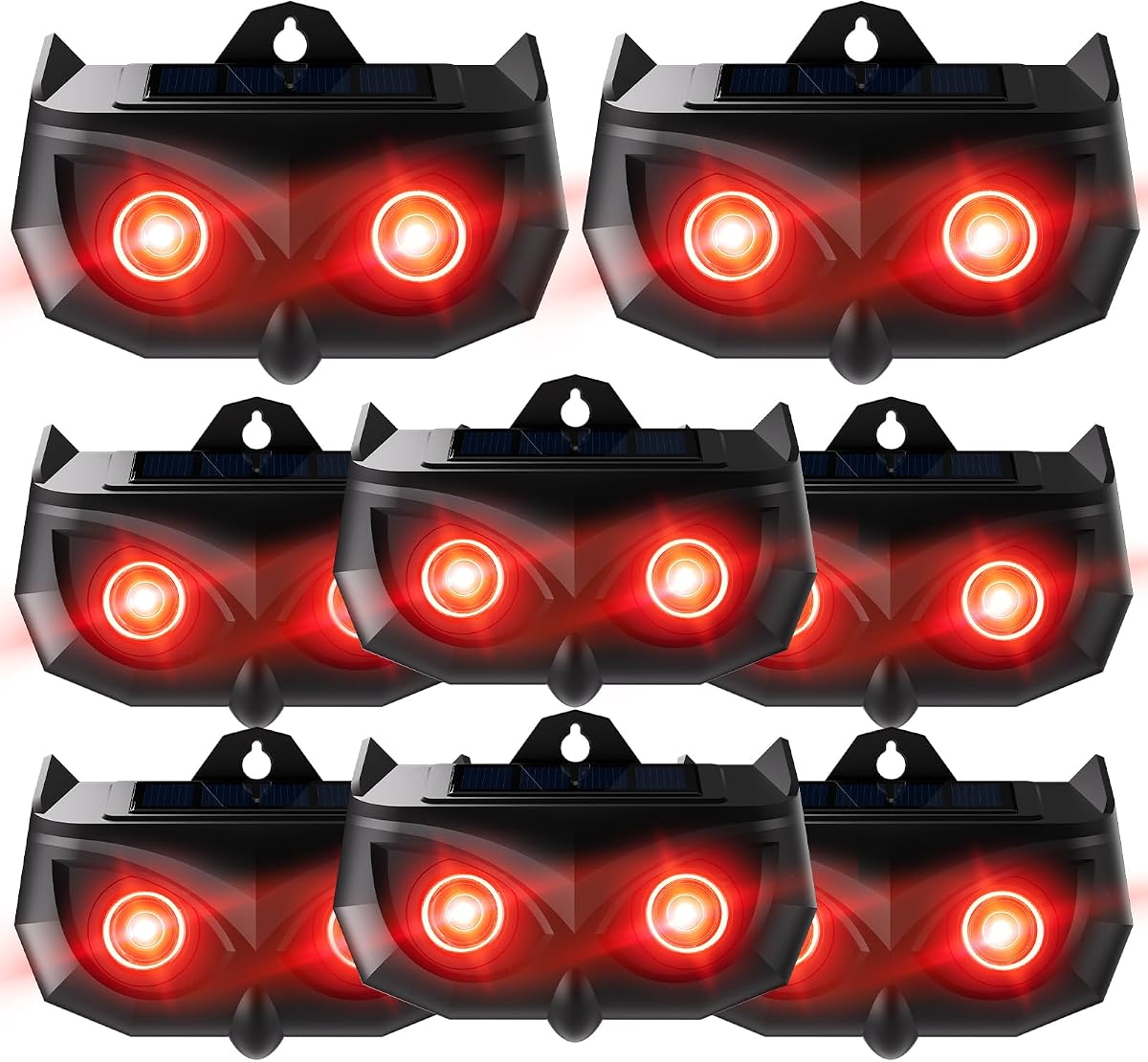
The eight-pack version of the 2026 Solar Predator Eyes is designed for properties that need broad, distributed coverage. It has a 4.5 rating and uses the same red dual-strobe light concept as the four-pack: red flashes imitate predator eyes and fire to frighten nocturnal animals. Targets include coyotes, raccoons, foxes, deer, skunks, wolves, and owls.
We may earn a commission when you buy through this link, at no additional cost to you.
With eight units, owners can cover a large yard, farm perimeter, chicken property, or orchard more thoroughly. Each unit has a monocrystalline silicon solar panel and activates automatically at dusk. Mounting height can be adjusted from one to eight feet, allowing the lights to be positioned for different species and structures. This flexibility makes the set appealing for properties with many access points or separated vulnerable areas.
The IP44 rating is suitable for ordinary outdoor exposure, but because it is below IP65, the units may be better installed under partial shelter or away from direct water spray. The product description also says complete results can take three to four weeks and that initial activity may rise while animals adjust. Owners should avoid interpreting the first few nights as a definitive test.
This is the best pick for a larger property owner who wants systematic nighttime coverage without operating a network of wired devices. It is less convenient for a small urban yard where one or two lights would be sufficient. Map your perimeter, distribute the units intelligently, and check the solar panels regularly to maintain dependable nighttime operation.
Eight independently mounted units let you address separate gates, coops, tree lines, and garden corners. Begin with the routes used most often by wildlife rather than spacing every unit evenly without regard to behavior.
Automatic dusk activation and solar charging reduce daily intervention. A routine check of panel exposure, light direction, and physical security can help ensure each unit remains effective through changing seasons.
We may earn a commission when you buy through this link, at no additional cost to you.
The Solar Motion Sensor Alarm combines movement detection, red flashing lights, and audible warnings to discourage wildlife. It has a 3.9 rating and explicitly lists coyotes among the larger animals it is intended to deter. The system is also suitable for raccoons, deer, skunks, bears, wild boars, rabbits, and groundhogs around gardens, orchards, ponds, yards, and farms.
We may earn a commission when you buy through this link, at no additional cost to you.
Its sound system includes preset barking-dog and loud-impact sounds, three volume levels, and support for custom voice recordings of up to 20 seconds. Output can reach 130 decibels, making it useful where a visual light alone may not be enough. Three operating modes provide 24-hour monitoring, darkness-only activation, or a night-cycle setting that plays the preset sounds every five minutes.
A 1,200 milliamp-hour rechargeable lithium battery provides more than 12 hours of continuous use according to the description, while the solar panel takes about ten hours to recharge it. The package includes a remote, USB charging cable, screws, expansion plugs, and a manual. Possible drawbacks include neighborhood disturbance, limited coverage from the sensor's field of view, and dependence on adequate solar exposure for routine recharging.
This alarm is best for owners who want a visible and audible response triggered by approaching animals. Position it where it can detect a main access route, and use night mode if constant sound would be disruptive. It should complement secure fencing, covered feed storage, and other deterrents rather than replace fundamental wildlife-exclusion practices.
Preset dog barking, impact sounds, flashing red LEDs, and optional custom recordings provide several ways to discourage an approaching animal. Select a sound that is effective without creating an ongoing nuisance for nearby residents or livestock.
Choose continuous operation for high-risk areas, night-only activation for lower disturbance, or periodic night-cycle sounds. The correct mode depends on local wildlife activity and the amount of noise your surroundings can tolerate.
We may earn a commission when you buy through this link, at no additional cost to you.
Choosing a coyote deterrent means balancing the behavior you need to interrupt with the size of the area, available power, weather exposure, nearby people and animals, and how much maintenance you are willing to perform. A layered plan is usually more reliable than depending on a single method.
Visual devices imitate predator eyes or fire, ultrasonic repellents combine high-frequency sound with lights, and motion alarms respond with audible warnings. Predator urine and coyote urine use scent, cayenne creates a temporary taste-and-smell barrier, and a portable air horn provides a direct human-controlled response. Match the method to the animal's likely behavior: visual deterrents work best where animals can see them, sound alarms depend on detection range, and scent products need frequent refreshing.
Choose the method that addresses the actual route animals use. A coyote entering through a damaged fence will not be deterred by a light aimed at the wrong opening. Observe movement, tracks, feeding damage, and nighttime activity before installing equipment.
Single units are practical for one chicken coop entrance, a small garden corner, or a narrow approach route. Larger properties benefit from several devices placed to cover corners, gates, tree lines, and vulnerable structures. Ultrasonic and visual systems generally require more precise aiming than a scent barrier, while multiple predator lights can create overlapping coverage around a coop or yard.
Map the property before buying a multi-pack. Prioritize entry points and the areas where animals feel safe, then place devices so each faces a likely approach without glaring constantly into nearby windows.
Solar power is convenient for remote coops, farms, and gardens because it avoids wiring and reduces dependence on electrical outlets. However, a solar panel still needs useful sunlight, and shaded or frequently overcast locations may require USB backup charging. Rechargeable-battery alarms and hybrid repellents offer flexibility but need periodic charge management. Scent products and manual horns require no charging at all.
Choose a device whose charging method suits the installation site. If a unit will sit beneath dense vegetation or next to a north-facing structure, verify that it has an alternative charging method before relying on it through poor weather.
Outdoor deterrents must tolerate rain, snow, heat, cold, dust, and direct sunlight. An IP65 product offers a higher stated water-ingress protection level than an IP44 model, while products without an ingress rating require closer attention to sheltered placement. Metal housings, sealed controls, and secure cable management can further improve durability, but no rating eliminates the need for routine inspection.
For exposed installations, prioritize a clearly stated weather rating and elevate the unit where runoff may collect. Check seals, fasteners, and panel surfaces after storms, and replace or relocate any unit that remains wet or corroded.
Light, sound, scent, and physical barriers generally allow owners to discourage animals without poison or lethal traps. Nevertheless, no deterrent is harmless in every situation. Bright alarms can disturb neighbors, predator urine can affect pets, and pepper can irritate or contaminate areas where animals or children may encounter it. Review the product directions and select methods appropriate for children, livestock, pets, and nearby waterways.
Humane deterrence should be combined with exclusion and habitat management. Secure coops, repair fencing, remove attractants, and use the device as one layer of protection rather than relying on it to solve every wildlife conflict.
Some deterrents are ready in seconds, while solar lights and alarms require mounting, activation, and directional adjustment. Portable products suit people who move between home, camp, and trail, but they cannot watch a property continuously. Electronic devices also need attention to batteries, solar panels, sensor positions, and accidental movement. Scent barriers need replenishment, and pepper barriers can be displaced by weather.
Estimate the maintenance you can realistically sustain. A sophisticated device that is poorly aimed or left without charge provides little value, while a simple horn that remains in your pocket may be more useful during an actual encounter.
Wildlife deterrents do not create an invulnerable perimeter, and individual responses can vary. Animals may be accustomed to lights or sounds, may approach from an uncovered direction, or may return when the deterrent is weak or depleted. The four-pack listing notes that visual repellents may require three to four weeks to show complete results, while another product describes a possible initial increase in activity as animals adjust.
Give a new setup a fair evaluation period, but change placement or method if there is no improvement. Track repeat visits and consider using two approaches with different sensory cues, such as predator eyes plus an alarm or wolf scent plus secure fencing.
A manual air horn is ideal when you need an immediate response on a hike or campsite, while mounted devices work best for fixed livestock areas. Audible alarms should be considered carefully in close neighborhoods, and frequent manual spraying is impractical for large properties. Portable devices are also easier to take along during travel but offer no unattended protection at home.
Think about where the sound, light, or scent will be experienced. A deterrent that creates repeated complaints may be unsuitable even if it discourages wildlife, and a scent marker near a public walkway may be unpleasant to people as well as animals.
Begin by identifying how coyotes enter and move through the area. Inspect fences, gates, coop doors, garden boundaries, and livestock routes at different times, especially near dawn and dusk. Remove food attractants, secure trash and feed, and decide which locations need active deterrence. A physical fix such as repairing a fence opening or installing predator-resistant coop hardware should come before adding electronic equipment.
Install the chosen deterrent according to its directions. For solar lights, face the beams toward likely approaches, select a mounting height between one and eight feet when required, and ensure the panel receives sunlight. For motion alarms, position the sensor across the approach path rather than directly beside it. For scent or pepper, apply only to labeled surfaces and away from food, pets, children, drainage areas, and livestock feed.
Test and monitor the setup for several weeks. Adjust the direction, mode, volume, or height as animal behavior changes, and clean solar panels, light lenses, and sensor windows as dirt accumulates. Replace depleted scent or displaced pepper promptly, recharge batteries when the alternative charging path is available, and check that mounts remain secure. If visits continue from the same unprotected direction, add another layer or reposition the device rather than simply increasing its intensity.
The most effective setup usually combines secure construction with more than one deterrent. Predator-eye lights can discourage nighttime approaches, while a motion alarm or scent marker adds another cue. Make the coop itself resistant to entry, remove exposed feed, and position the deterrent where the animal must encounter it.
They can, provided the solar panel receives enough daylight and the unit is rated for the local temperature and weather. Snow cover, shade, and prolonged cloudy periods may reduce charging, so models with USB backup are useful in those locations. Inspect the panel and operating status throughout the season.
Light, sound, and scent deterrents are designed to discourage animals without trapping or poisoning them. They are not completely risk-free because startling sounds can affect nearby animals and poorly positioned lights may create glare. Use labeled products responsibly and consider the presence of livestock, pets, and neighboring residents.
The number depends on the property's size, the number of approach routes, and the direction in which each light faces. One unit may be enough for a single coop entrance, while larger properties often need four or more units positioned at corners, gates, and exposed boundaries. Map the routes before choosing a pack size.
Coyote urine is intended to mark territory and may discourage a roaming coyote from investigating an area. Its effectiveness varies with freshness, weather, placement, and the animal's prior experiences. It should be refreshed as directed and paired with fencing or an electronic deterrent when dependable unattended protection is required.
They can be installed outdoors, but you should consider whether high-frequency sounds or bright strobes could disturb people, pets, or nearby animals. Directional placement and selectable modes may help. Check the manufacturer's guidance and avoid pointing strong lights or alarms toward neighboring homes.
A layered approach is generally more useful than relying on one cue. A visual predator light can cover an active approach route, a motion alarm can respond when movement is detected, and predator scent can reinforce selected boundaries. Secure animal housing and attractant management remain essential regardless of the deterrent chosen.
Results vary by product, animal, placement, and exposure level. Some solar visual repellents describe a three-to-four-week adjustment period, and wildlife may initially increase activity while learning the new deterrent. If there is no improvement after a fair evaluation, change the placement or add a complementary method.
The Solar Nocturnal Animal Repeller Outdoor is the most balanced overall choice for a fixed property, combining red predator-eye lighting, solar charging, and an IP65-rated housing. The four-pack ultrasonic repeller is the feature-rich option for owners who want multiple modes, hybrid sound and light, USB-C backup, and broader perimeter placement. Dog Horn XL is the practical portable option for trails, camps, dog walks, and emergency personal safety.
Prioritize the problem you are trying to solve rather than simply choosing the most complex device. A poultry owner needs reliable coverage near the coop, a gardener may need several low-impact barriers, and someone on a trail may value an immediate audible tool more than unattended solar coverage. In every case, combine deterrence with secure fencing, protected feed, clean waste practices, and regular observation.
Ratings, product availability, features, and prices can change, so check the current retailer listing before buying. Compare the device's power source, coverage, weather rating, and intended targets with the conditions at your property, and select a solution that you can position correctly and maintain over time.