
WiFi Sprinkler Timer for Garden Hose Irrigation
4.4Editor score
984-foot gateway signal range
Multiple smart watering modes
App and voice control
Our Programmable WiFi Water Timer guide compares app control, zone capacity, range, scheduling, rain delay, and durability to help you choose confidently.
A programmable WiFi water timer turns a standard outdoor faucet into a remotely managed irrigation system. The best models combine flexible schedules, weather-aware controls, clear smartphone apps, voice-assistant support, and enough range or zone capacity for the layout of your garden.
We compared the 10 products in this guide across connectivity, programmable zones, watering modes, range, rain delay, materials, and outdoor suitability. The list includes gateway-based systems, direct WiFi models, multi-zone controllers, and one non-WiFi alternative for shoppers who do not need app control.
Each review highlights the product's most useful capabilities and practical trade-offs, while the comparison table makes the differences easier to scan. Product details and availability can change, so readers should verify current specifications, compatibility, and pricing before making a purchase.
4.4Editor score

4.4Editor score
4.1Editor score
The comparison below covers all 10 products, including the garden-hose controllers, multi-zone irrigation timers, gateway systems, Orbit B-hyve models, and the non-WiFi MOES timer that offers programmable sequential watering without an app.
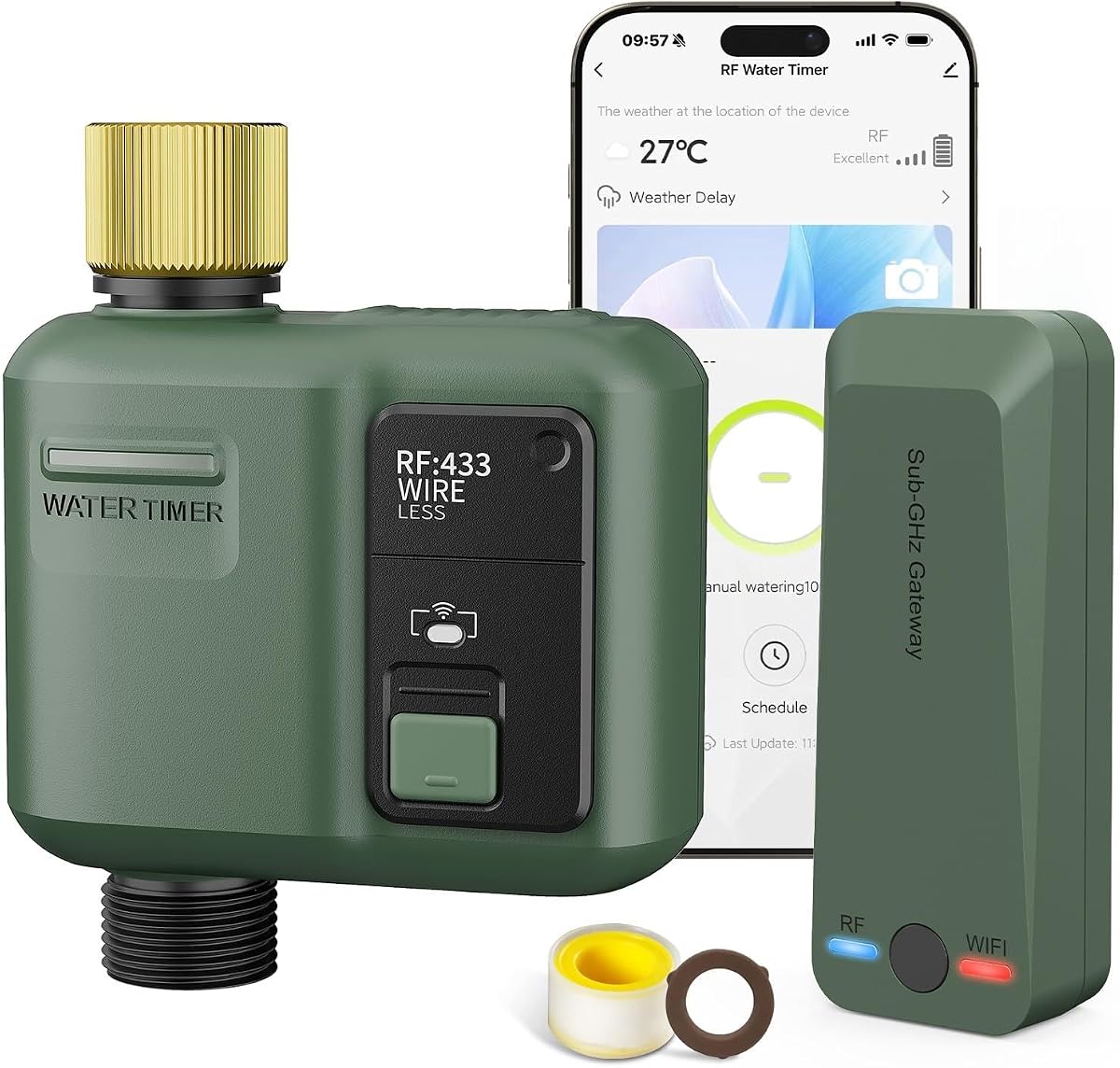


The Xinfuture WiFi Sprinkler Timer combines a 4.4 rating with extensive control features at a value-oriented position. Its standout feature is the included RFID gateway system transmitter, which is described as maintaining a connection up to 984 feet. That makes it especially interesting for gardens, yards, or irrigation setups where a standard short-range signal may struggle.
We may earn a commission when you buy through this link, at no additional cost to you.
Scheduling is highly flexible. The controller offers multiple schedules, watering durations from one minute to 24 hours, frequency controls, and separate programming for its three-zone design. Single irrigation and recirculating modes cover routine watering and misting-style applications, while Smart Life or Tuya Smart apps provide remote operation and voice-control support.
The trade-offs are worth considering. It must operate over a 2.4GHz WiFi network, and Bluetooth is only available for initial setup rather than standalone control. A gateway also makes installation more involved than a direct-WiFi hose timer, and the mixed description of the three-zone layout and dual-zone functionality may require buyers to confirm the exact number of independently controlled outlets in the final package.
This is a strong recommendation for households that want long-range smart control, several watering programs, and useful records without moving to a more complex irrigation controller. It is especially suitable for a large garden, multiple planted areas, or a property where reliable signal coverage matters more than having the smallest possible control box.
The gateway-based connection is the timer's defining advantage. Its stated 984-foot range can offer more placement flexibility than a timer limited to a conventional WiFi or Bluetooth link, particularly when the timer is separated from the home network by exterior walls.
Independent timing, repeated cycles, misting, and manual operation make the controller practical for lawns, flower beds, vegetable patches, and drip lines. Users can also review each session's start, duration, and end time.
We may earn a commission when you buy through this link, at no additional cost to you.
This WiFi Water Timer for Garden Hose earns a 4.3 rating and offers a balanced combination of long-range control, flexible programming, and durable outdoor components. Its dedicated gateway is listed as reaching 984 feet, a useful characteristic for larger properties or gardens where the timer must operate beyond the router's immediate reach.
We may earn a commission when you buy through this link, at no additional cost to you.
The schedule system allows users to set start times in AM or PM, choose watering durations from one minute to 24 hours, and establish weekly frequencies. Timed watering, weekly cycles, mist mode, rain delay, and manual mode cover several common irrigation situations. Smart Life or Tuya Smart app support allows remote changes, while Alexa and Google Assistant provide hands-free control.
Its physical design is a meaningful part of the appeal. A brass inlet, built-in filter, and IP55 water-resistant housing are intended to withstand everyday outdoor use and help reduce problems associated with debris or moisture. However, the product still needs a compatible 2.4GHz WiFi network and a gateway, so buyers wanting the simplest possible setup may find it less convenient.
The timer is well suited to lawns, planted beds, and drip irrigation systems where both scheduling flexibility and dependable fittings matter. It is a compelling option for shoppers who want more rugged materials than a basic plastic hose controller without moving to a large in-home irrigation panel.
The brass inlet and integrated filter address two practical outdoor concerns: fitting durability and debris entering the mechanism. Together with the IP55 housing, these details make the controller a sensible fit for year-round garden use.
Weekly cycles, misting, rain delay, and manual irrigation cover everything from measured sprinkler runs to quick hands-on watering. Voice control adds convenience for starting or stopping a cycle without opening the app.
We may earn a commission when you buy through this link, at no additional cost to you.
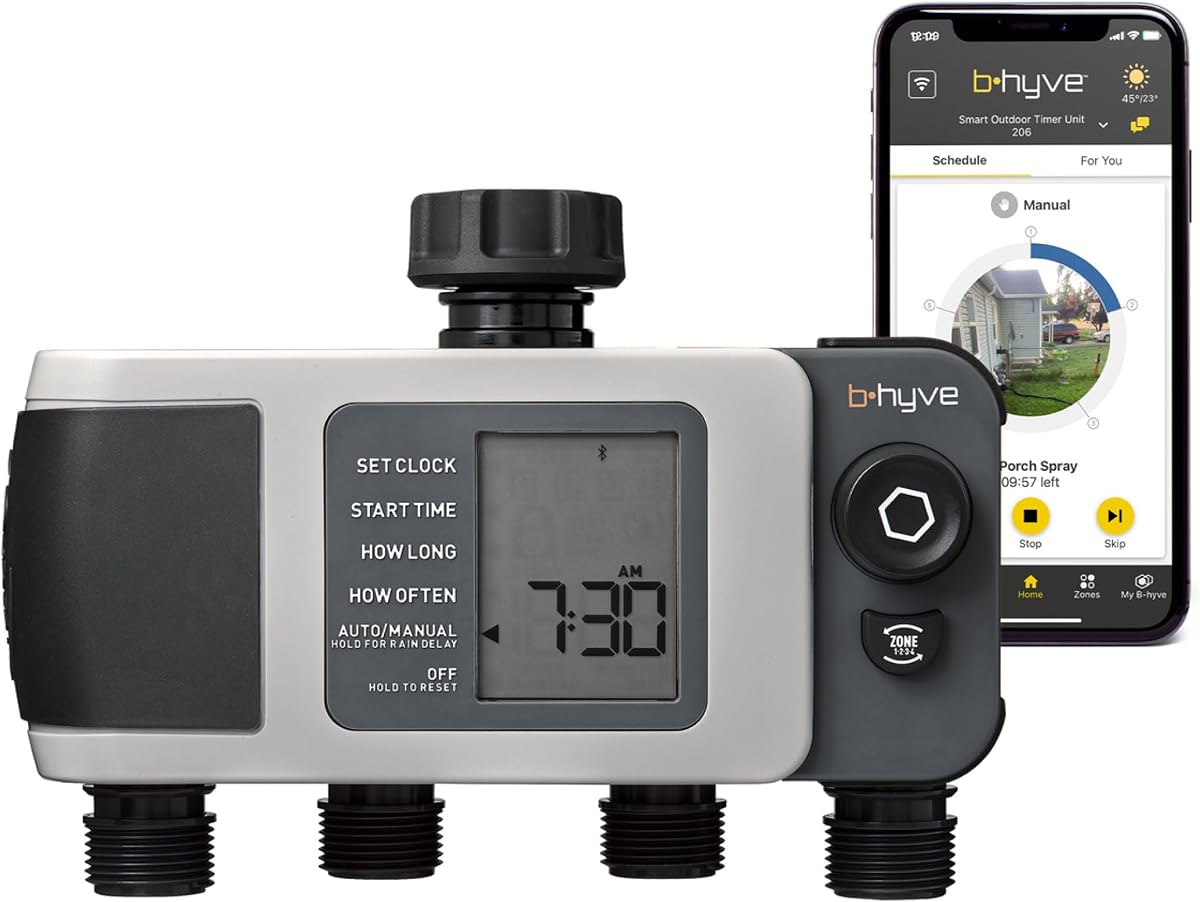
The Orbit B-hyve XD 4-Port Smart Hose Watering Timer has a 4.0 rating and focuses on a clear advantage: four outlets for multiple garden areas. It is intended for lawns, flower beds, and other zones that need separate watering schedules, making it more versatile than a standard one-outlet hose timer.
We may earn a commission when you buy through this link, at no additional cost to you.
Wireless programming through the Orbit system allows schedules to be managed from a phone. The timer also uses weather and drought information to adjust irrigation, helping preserve plant health when conditions change. A two-year limited warranty is included for private-use purchases, providing more reassurance than the one-year coverage listed for several competing products.
The primary drawback is complexity. A four-port configuration needs enough connected hoses or irrigation equipment, and buyers should understand how the system's watering and weather features work before installation. Its 4.0 rating is also lower than the ratings assigned to the leading options in this list, so prospective buyers should review current customer feedback for the exact model.
This model is a strong fit for larger gardens with several distinct planting areas that cannot share the same schedule. Choose it when four independently managed zones will solve a real irrigation problem; if only one hose needs automation, a simpler one-port controller may be easier to maintain.
The four-outlet design allows users to assign different watering plans to separate beds, lawns, or drip systems. That eliminates the need to force plants with different needs onto one shared program.
Orbit's smart weather and drought monitoring can modify irrigation as conditions change. This reduces the likelihood of leaving a zone on a fixed schedule when local conditions call for less water.
We may earn a commission when you buy through this link, at no additional cost to you.
The Gateway WiFi Water Timer holds a 4.4 rating and stands out as a balanced, scalable choice for smart irrigation. Its sub-GHz gateway is listed as reaching 984 feet, allowing the timer to communicate across larger properties and through walls without relying on the home's WiFi signal at the outdoor faucet.
We may earn a commission when you buy through this link, at no additional cost to you.
Battery life is another major strength. Two AA batteries are stated to power the wireless controller for up to eight months, and the system does not require wiring or a nearby outlet. It also supports independent zones, allowing different schedules for lawns, drip systems, and garden beds. Daily, interval, and odd-or-even watering modes give users several ways to structure irrigation.
The main compromise is that a gateway and two-battery installation introduce setup steps and maintenance. Although the product description says the weather-delay function can automatically skip watering during rain, buyers should still confirm how that behavior is configured in the app. AES-128 encryption and over-the-air updates help address security and software longevity.
This is our Editor's Choice because it balances range, battery life, zone control, and scalability without requiring a full irrigation panel. It works particularly well for households that may eventually add more timers, as one gateway can support up to 64 devices.
An eight-month stated battery life removes the need for a charging cable or outlet at the outdoor tap. Replacing two AA batteries at a predictable interval is simpler for many gardens than maintaining hardwired irrigation equipment.
Independent zones make the timer useful for mixed plantings, while 64-device gateway support allows expansion. A homeowner can begin with one water timer and add more without changing the underlying gateway concept.
We may earn a commission when you buy through this link, at no additional cost to you.
The WiFi Solar Sprinkler Timer has the highest listed rating in the group at 5.0, and its dual-power design is its most distinctive feature. Solar charging and a Type-C USB connection offer two ways to keep the timer powered, reducing the recurring inconvenience of replacing standard batteries.
We may earn a commission when you buy through this link, at no additional cost to you.
It has two outlets, each with up to 10 independent watering plans. Normal Schedule Mode handles set-time watering, while Cycle and Soak Mode repeats watering within a defined period. Users can select daily, every-other-day, or every-two-day frequencies and customize start times and run lengths for different parts of the garden.
Its upgraded connection operates directly over a smartphone-compatible 2.4GHz WiFi network without an extra hub. Rain delay, manual watering, Alexa and Google Assistant support, an IPX6 rating, a metal filter, and brass female-thread connectors add useful outdoor conveniences. Solar charging may nevertheless vary with sunlight, and the USB port is still needed when solar input is insufficient.
The timer is a strong recommendation for gardeners who want low-maintenance power and a high degree of schedule flexibility without adding a gateway. It is particularly compelling for two separately planted zones that need distinct cycles, such as a drip-irrigated bed beside a lawn.
Solar energy can sustain regular operation, while USB charging provides a dependable backup for cloudy periods. The included Teflon tape can improve thread sealing when installation requires it.
Ten plans per outlet provide a high level of control for lawns, patios, and beds. Cycle and Soak is especially useful for soils that need repeated watering intervals rather than one uninterrupted run.
We may earn a commission when you buy through this link, at no additional cost to you.
The Smart WiFi Sprinkler Timer 3 Zone carries a 4.2 rating and offers a capable mix of range, scheduling, and manual controls. Like the leading Xinfuture model, it uses a WiFi controller and RFID gateway transmitter listed as reaching 984 feet, helping maintain a stable connection across substantial outdoor spaces.
We may earn a commission when you buy through this link, at no additional cost to you.
Its three-zone design is intended to give lawns, flower beds, and vegetable patches separate start times, durations, and frequencies. Single irrigation mode can run from one second to 11 hours, 59 minutes, and 59 seconds, while recirculating mode supports scheduled weekday cycles. Five schedules, misting, and a one-to-seven-day rain delay add further control.
Detailed irrigation records show the start, duration, and end of each session, which can help users refine their schedules. A physical manual button is useful for immediate tasks such as pool refilling or car washing without changing saved programs. The compromises are the need for a 2.4GHz network and a gateway, plus inconsistent zone wording in the supplied description, which alternates between dual-zone functionality and a three-zone design.
This product is a good fit for a garden with several distinct planting areas and a need for both misting and conventional irrigation. Buyers should confirm the physical outlet configuration and included components before installation, especially because the product title and detailed description use the zone term differently.
The exceptionally broad single-mode timing range supports both brief misting and long irrigation periods. Recirculating schedules then add flexibility for repeating a watering pattern across selected days.
Session records make it easier to see how long each zone actually ran. The manual button provides a quick physical option for temporary watering without altering the programmed routine.
We may earn a commission when you buy through this link, at no additional cost to you.
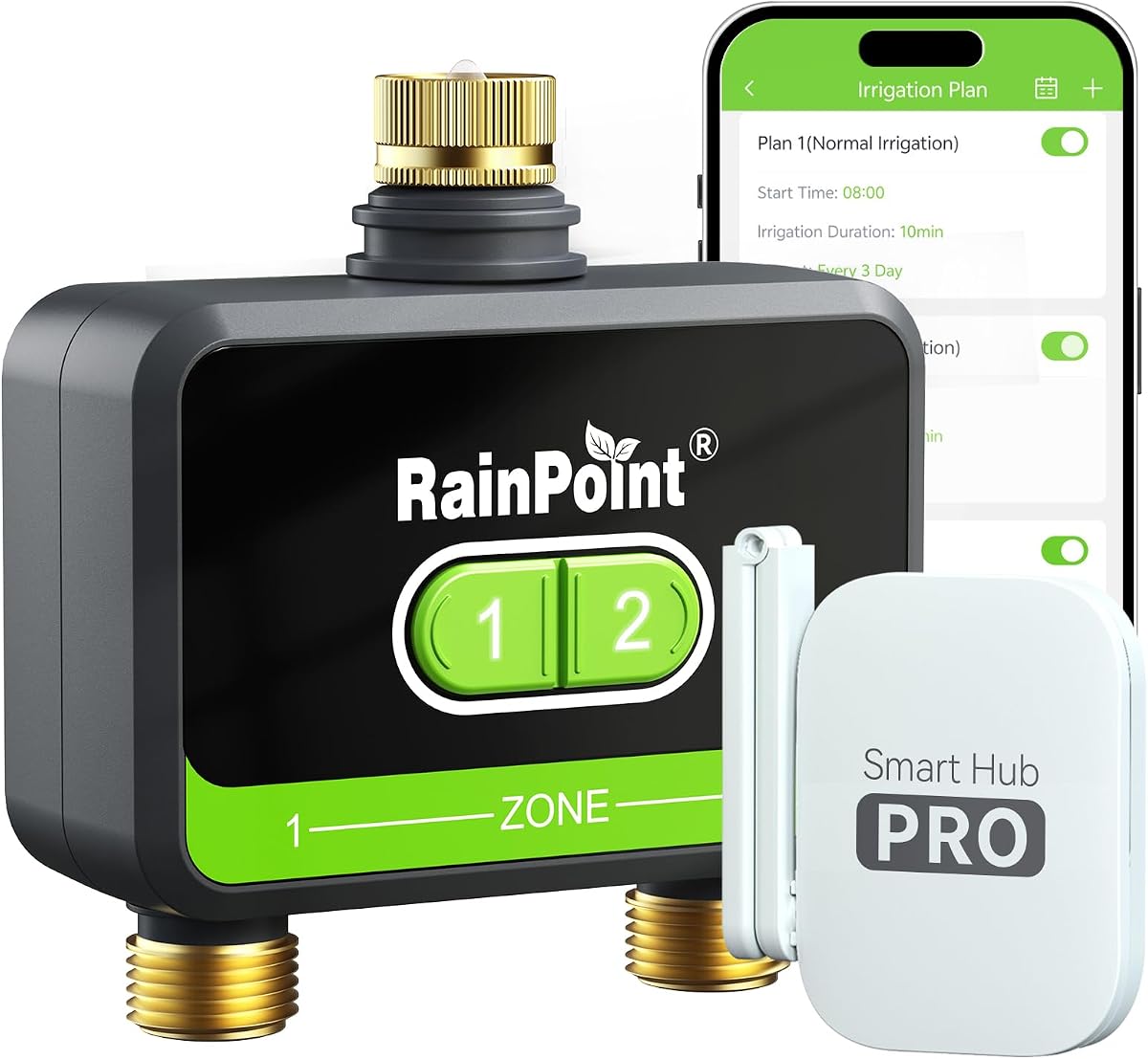
The RainPoint 2-Zone WiFi Water Timer combines a 4.1 rating with a feature set aimed at gardeners who want more assistance than basic on-and-off scheduling. It supports two independent zones, each with up to six customizable schedules, and uses solid brass inlet and outlet ports for durability.
We may earn a commission when you buy through this link, at no additional cost to you.
The app's plant-specific recommendations use information supplied about the garden to help create watering plans. Smart Scenes can adjust schedules according to weather and synchronize with other RainPoint devices, while Seasonal Adjust automatically changes monthly run time by a stated 10% to 200%. These automation features distinguish it from simpler programmable hose timers.
Normal Irrigation, Misting Irrigation, and Cycle and Soak cover common watering patterns. Frequencies include EveryDay, Odd Dates, Even Dates, Weekly, and intervals from every 2 to 30 days. Alexa and Google Assistant support provide voice operation. The trade-offs are the premium position and dependence on the RainPoint ecosystem, which may offer less flexibility for users committed to another smart-home platform.
This model is best for buyers who value guided scheduling, seasonal automation, and independent brass-equipped zones. It is a thoughtful choice for mixed gardens where plant needs differ and a fixed calendar program would require frequent manual editing.
Seasonal Adjust changes each month's watering duration by a selected percentage, reducing the need to revisit every program as temperatures and seasonal water needs change.
Plant-specific recommendations and beginner-friendly smart suggestions help users build initial schedules. Smart Scene automation can then refine those schedules using weather information and compatible RainPoint devices.
We may earn a commission when you buy through this link, at no additional cost to you.
The Orbit B-hyve XD 1-Port Smart Hose Watering Timer is a straightforward choice for one automated faucet. It has a 4.0 rating and centers on precise local weather data, remote access, and automatic adjustment when drought conditions develop.
We may earn a commission when you buy through this link, at no additional cost to you.
Programming can be performed wirelessly over WiFi or locally through Bluetooth, giving users more than one setup path. The timer adjusts to local drought levels, supports customizable watering restrictions, and works with the broader B-hyve smart irrigation approach. Its IPX-5 certification protects it against low-pressure water streams from different directions during outdoor operation.
The limitation is capacity: only one outlet is available, so separate zones require additional equipment. The supplied information also notes that EPA WaterSense certification applies when the timer is combined with a WiFi hub. Buyers should therefore review the complete system requirements rather than assuming every hub and accessory is included.
This is a good recommendation for a homeowner with a single hose-connected planting area who prioritizes weather responsiveness and a familiar smart irrigation platform. It is less appropriate for a garden that needs independently scheduled lawn, bed, and drip zones from one controller.
Local weather data and drought-level awareness allow the timer to adjust operation rather than following a completely rigid calendar. This can be useful during dry periods when supplemental watering is needed.
Bluetooth offers a local programming option, while WiFi supports remote control. That combination is useful both during initial setup and when managing the timer while away from home.
We may earn a commission when you buy through this link, at no additional cost to you.
The RAINPOINT 2027 New Version WiFi Water Timer has a 4.1 rating and is distinguished by its built-in water-flow meter. It records consumption with a stated accuracy error of plus or minus 5%, giving users a way to design schedules around actual water use rather than relying only on time.
We may earn a commission when you buy through this link, at no additional cost to you.
The HWG023 antenna gateway is rated to transmit up to 250 meters and penetrate three to four walls, offering dependable reach without a dedicated external hub. Up to six schedules, three watering modes, and five frequency settings allow fine control, while the app can delay watering from one to 30 days during rainy weather and adjust frequency during dry spells.
Brass inlet and outlet connections are designed for durability and leak resistance, with the assembly stated to handle up to 116 PSI. The trade-offs include a shorter stated gateway range than the 300-meter models in this guide and the inherent uncertainty of flow readings, even when a manufacturer's stated accuracy is strong.
The timer is a compelling recommendation for gardeners who want consumption data alongside automation. It is especially relevant for drip irrigation, water-conscious planting plans, and users who want to compare actual volume use before adjusting run times.
The integrated flow meter adds a practical measurement layer missing from many hose timers. Actual use can help reveal whether a schedule is delivering more or less water than a plant zone requires.
Brass fittings and a stated 116 PSI capacity support a robust outdoor installation. Careful thread alignment and gasket placement remain important for preventing leaks.
We may earn a commission when you buy through this link, at no additional cost to you.
The MOES 3 Zone Water Timer has a 4.5 rating and serves as the guide's programmable but non-WiFi alternative. It manages three garden areas from one outdoor faucet with independent programming, providing useful automation without an app, hub, Bluetooth connection, or smart-home integration.
We may earn a commission when you buy through this link, at no additional cost to you.
Its defining technical feature is sequential watering. When multiple zones share the same start time, the timer runs them one after another rather than opening all outlets together. This can reduce pressure conflicts when connected hoses and sprinklers share a source. The 3/4-inch brass inlet and outlet are also designed for durable outdoor use.
Watering duration can be set from one minute to 23 hours and 59 minutes, and frequency ranges from one hour to 30 days. Rain delay can pause the schedule for one to 15 days, manual watering provides immediate access, and low-battery protection closes the valve. The obvious limitation is that it cannot be controlled remotely or through voice assistants.
This timer is a strong recommendation for gardeners who primarily want reliable automated schedules and multiple outlets but do not need remote access. It may also appeal as a simpler backup controller for an area where WiFi coverage is poor, provided the user is comfortable making changes directly on the device.
Running same-time zones in sequence avoids opening all three outlets at once. That design can ease pressure strain and make a shared-faucet layout easier to manage.
The controller removes network setup and app dependence from the equation. Local programming, manual watering, and a 15-day rain delay cover the essential outdoor timer functions.
We may earn a commission when you buy through this link, at no additional cost to you.
The right programmable WiFi water timer depends on how many areas you need to water, where the faucet sits, how you want to control the schedule, and which smart-home ecosystem you already use.
Start by counting the areas that genuinely need different schedules. A single outlet is sufficient for one drip bed or one connected sprinkler run, while two or three outlets allow lawns, flower beds, and vegetable patches to operate independently. Four-port models suit larger properties with several distinct zones. Independent programming is more useful than raw outlet count because plants may require different start times, run durations, and watering frequencies.
Choose a zone count that matches your garden rather than paying for unused capacity or accepting a complicated splitter setup.
Many smart hose timers communicate directly with a 2.4GHz WiFi network, while others use a separate gateway and sub-GHz radio connection. Gateway systems are attractive when the outdoor faucet is far from the router or separated by walls. Products in this guide state ranges from 250 meters to 300 meters, with some claiming the ability to penetrate several walls. Actual performance varies with buildings, obstacles, placement, and surrounding electrical interference.
Check where the gateway can be installed and keep it unobstructed. For direct-WiFi models, confirm that the timer is within reliable 2.4GHz coverage.
A good app should make schedules understandable, show active watering status, and allow manual changes without excessive menus. Several products use the Smart Life or Tuya Smart ecosystem, while RainPoint devices use the RainPoint Home app and Orbit products use the B-hyve platform. Voice control through Alexa or Google Assistant is widely available, but it normally depends on a compatible app, account, and connected speaker.
Prefer an ecosystem you already use and confirm whether Bluetooth is supported for setup, for everyday control, or only for initial configuration.
Basic start times and daily cycles cover simple gardens, but wider scheduling options make a controller more adaptable. Look for weekly programs, intervals, odd-or-even days, misting, recirculation, and Cycle and Soak. Long-duration settings can support drip systems, while brief settings are useful for misting or hand watering. Multiple independent programs per outlet are valuable when seasonal plant needs require changes without replacing the entire schedule.
Prioritize the modes that match your watering method rather than assuming the largest number of settings will be regularly used.
Rain delay prevents a scheduled watering session from running during or after wet weather, while automatic rain detection may skip sessions without manual intervention. Weather-responsive adjustment can also shorten or extend run times during drought conditions. These features vary considerably: some models provide a simple one-to-seven-day delay, while others support longer delays, local forecasts, seasonal adjustments, or Smart Scenes.
Check whether weather data is automatic or depends on the app's location settings. Manual delays are useful, but automatic behavior is more convenient during travel.
Outdoor controllers are exposed to moisture, mineral deposits, and debris. Brass inlet and outlet fittings are generally more durable than lightweight plastic connections, while a built-in filter can help protect internal parts. Water-resistance ratings such as IP55 and IPX6 indicate protection levels for different exposure conditions. A 3/4-inch thread size must also match the outdoor faucet and the hose or equipment being connected.
Install with the correct washers and seals, align threads straight, and avoid over-tightening. A quality gasket setup matters more than a high rating if the connection leaks.
Most hose timers use replaceable AA batteries, and a stated eight-month battery life can reduce routine maintenance. Solar and USB dual-power systems eliminate routine battery replacement but require suitable sunlight and a backup charging method. Low-battery protection is a useful safety feature because it can close the valve before depleted cells cause an interrupted cycle. Remote status visibility can also help prevent a timer from being left unattended with weak batteries.
Choose the power system that matches your location and willingness to maintain it rather than focusing only on the longest stated run time.
Session histories showing start time, duration, and end time help identify schedules that run too long or too often. A built-in flow meter goes further by recording actual water consumption. These insights are valuable for refining drip irrigation, reducing waste, and checking whether multiple zones are delivering their expected amounts. The data does not replace calibration, but it provides a useful baseline for making adjustments.
Prioritize usage data if conserving water is a central goal. It is less essential for a simple single-zone setup with a fixed schedule.
Begin by identifying the faucet's thread size, checking the included fittings, and cleaning the connection area. Install the timer with the specified washers or gasket correctly seated. Where a manual recommends thread tape, apply it only to the appropriate threaded connection and avoid excess that could interfere with the seal. Connect the hose or irrigation equipment only after the controller is firmly attached, then briefly run the system to check for leaks before creating final schedules.
Connect the timer to its app, create the appropriate user account, and complete gateway pairing if the model requires one. For direct-WiFi products, connect to a 2.4GHz network rather than a 5GHz-only network. Grant requested permissions, name each zone according to the area it serves, and set realistic start times and run durations. Begin with a short manual test for every outlet, then enable rain delay and weather-related settings before leaving the system on a weekly schedule.
Inspect the filter, fittings, and connections periodically, especially after severe weather or long periods of disuse. Replace batteries before the low-battery indicator appears, or recharge a solar-and-USB model as needed. Keep the gateway dry, unobstructed, and within its recommended operating environment. Review irrigation records, adjust seasonal run times, and confirm that the app still communicates with every timer whenever the home network or smart-home setup changes.
Most true WiFi timers need internet access for remote control because their schedules, status information, and weather features are managed through a cloud-connected app. Some products may retain previously programmed local schedules if connectivity is interrupted, but this varies by model. The MOES 3 Zone Water Timer is the clear exception in this guide because it does not use WiFi, an app, Bluetooth, or a hub.
Many of the products listed specifically require a 2.4GHz WiFi network. A 2.4GHz-only router is therefore the safest choice, and many dual-band routers can host both bands on separate network names. A gateway-based timer may still communicate with the home network through its own setup process, so users should follow the manufacturer's exact pairing instructions rather than assuming either frequency will work.
Choose one zone for a single drip line or sprinkler run, two zones for two independently managed areas, and three or more for larger gardens. More outlets are useful only when each area needs a different schedule or watering method. The MOES timer can also run matching schedules sequentially, which helps reduce pressure conflicts when several outlets would otherwise open together.
Yes, several models explicitly support drip systems or offer long watering durations suitable for slow irrigation. Use the timer to regulate the overall watering window, then adjust individual drippers or tubing to suit each plant. A flow meter, session history, or water-usage records can help determine whether the system is delivering more water than the zone needs.
A direct-WiFi timer connects to the home's 2.4GHz network and is often simpler to set up. A gateway system uses a separate hub or transmitter to create a dedicated radio link between the gateway and outdoor timer. The gateway approach can provide longer range and better wall penetration, but it requires additional placement and pairing.
Rain delay temporarily suspends scheduled watering so a timer does not irrigate during or immediately after wet weather. The available range varies from one to seven days on some products, while others offer delays as long as 30 days. Models with weather monitoring may also adjust automatically, but buyers should confirm which behavior requires app permissions or location settings.
Confirm that the faucet and hose threads match, place the gasket correctly, and align the straight threads before tightening. Avoid overtightening, and check the connection after the first watering cycle because fittings can settle slightly over time. Models with brass connections and built-in filters may offer better durability, but proper installation remains essential.
Most of the connected models in this guide support Alexa or Google Assistant, allowing users to start or stop watering through a linked smart-home setup. Voice control generally depends on the manufacturer's app, account, and compatible speaker. The non-WiFi MOES model does not support voice control because it has no app or smart-home connection.
The Xinfuture WiFi Sprinkler Timer offers the strongest budget-oriented package, combining a long gateway range, flexible schedules, misting, rain delay, manual operation, and detailed session records. The Gateway WiFi Water Timer is the most balanced overall recommendation, adding long battery life, independent multi-zone control, and support for as many as 64 devices. For a higher-end smart system, the RainPoint 2-Zone WiFi Timer provides guided plant recommendations, Smart Scenes, and automatic seasonal adjustment.
Prioritize the features your garden will actually use: independent zones for different plant needs, reliable range for the location of the outdoor faucet, and rain or weather functions that suit your climate. A gateway is valuable for large properties, while a direct-WiFi model can be simpler for a nearby faucet. Manual-only scheduling is appropriate only if remote control is not important to you.
Before ordering, verify the included gateway, hub, fittings, thread size, app requirements, and exact zone configuration. Product specifications, customer feedback, availability, and prices can change over time, so checking the current listing ensures that the timer you choose still matches your watering setup.