
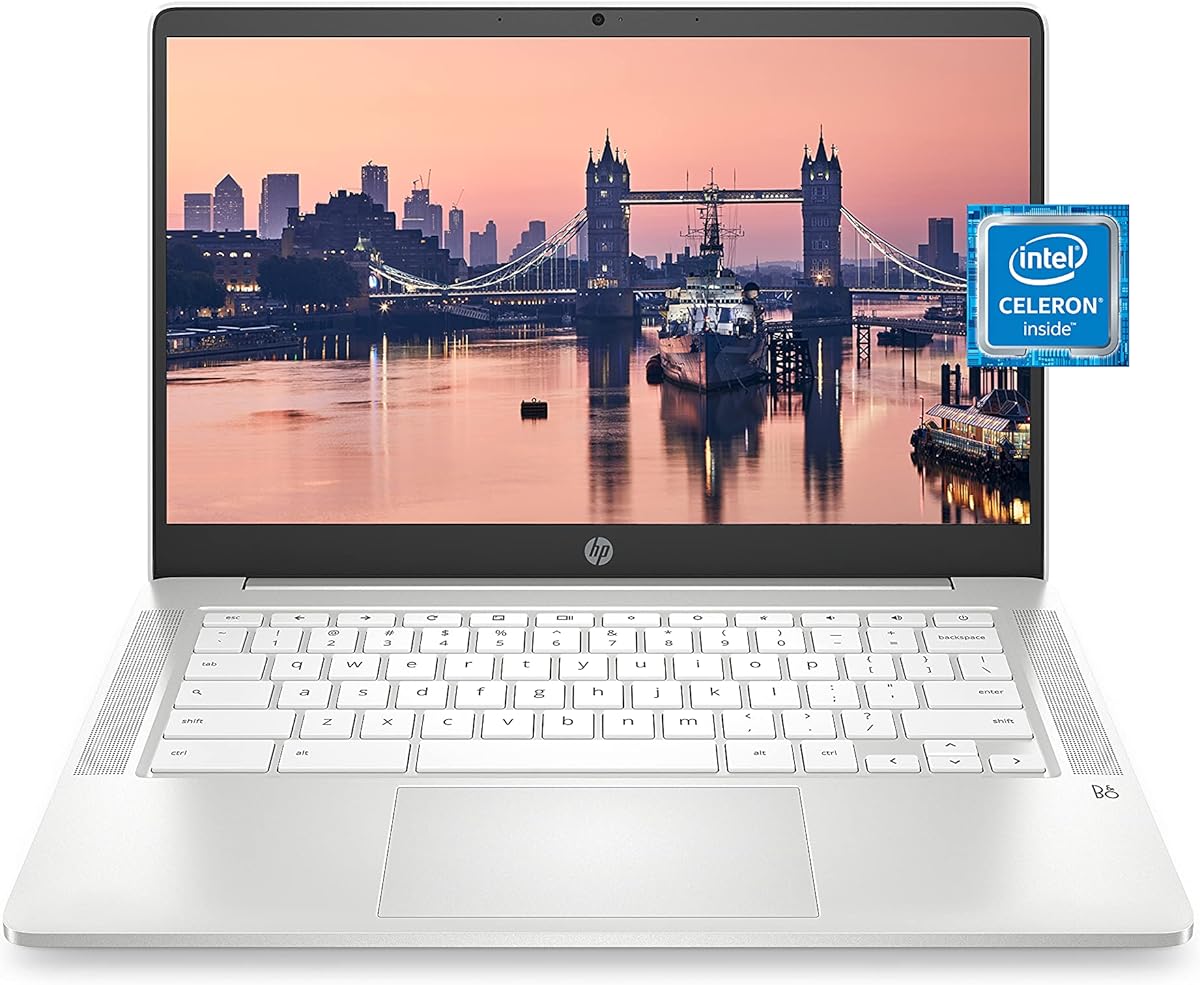
HP Chromebook 14
4.3Editor score
64GB flash-based storage
Up to 14-hour battery
14-inch anti-glare display
ChromeOS app support
A laptop for a 13-year-old should balance schoolwork, creativity, communication, and entertainment without becoming intimidating to use. Screen quality, battery life, portability, and easy access to learning applications matter more than processor jargon. The right device should support homework, video calls, research, games, and creative projects while remaining comfortable to carry each day.
We compared all ten featured laptops by examining their processors, memory, storage, displays, connectivity, operating systems, portability, and stated battery capabilities. The list includes ChromeOS models for web-based learning and Windows options for broader software compatibility, with configurations ranging from basic everyday machines to more capable multitasking setups.
Each review explains the strongest reasons to consider the laptop, along with limitations that families should understand before buying. Product features and availability can change over time, and current prices vary by seller and configuration. The rankings reflect the supplied specifications and ratings rather than personal hands-on testing.
4.3Editor score

4.7Editor score

4.4Editor score
As an Amazon Associate we earn from qualifying purchases.
The table below compares all ten laptops by operating system, performance, memory, storage, display, and portability, helping families identify the model that best matches a student's school software, creative interests, and daily routine.




The Lenovo Flagship Chromebook is a strong choice for a 13-year-old who prefers a large, responsive display and a simple web-centered computing experience. It has a 4.2 rating, an octa-core MediaTek Kompanio 520 processor, 4GB of RAM, and 64GB of eMMC storage. Its 14-inch Full HD touchscreen is the feature that most immediately separates it from many similarly positioned Chromebooks.
We may earn a commission when you buy through this link, at no additional cost to you.
The 1920 by 1080 panel offers more useful detail than a standard 1366 by 768 screen, while IPS technology supports wide viewing angles. That makes the laptop practical for shared study sessions, video calls, research, and watching educational content. The integrated 720p webcam includes a privacy shutter, a thoughtful feature for a student who may use the device in shared spaces.
Its limitations are the same ones that matter most in this product category. Four gigabytes of memory can become restrictive when many browser tabs and applications are open, and 64GB of eMMC leaves limited room for offline files. A full-size USB-A port, USB-C port, microSD reader, and 3.5mm audio jack help compensate for the modest internal storage by making peripherals and external drives easier to use.
This Chromebook is best for a student whose schoolwork centers on web applications, Google Workspace, research, and communication. It may be less suitable for intensive video editing, demanding games, or large software projects. For the intended classroom role, however, the sharp touchscreen, modern connectivity, privacy shutter, and portable 2.86-pound design make it an engaging and practical choice.
The Full HD touchscreen makes navigation intuitive for younger students and is useful for drawing, reviewing diagrams, or interacting with educational apps. Its wide viewing angles also make it easier to collaborate with classmates around a desk.
ChromeOS provides automatic updates, cloud-focused workflows, and built-in online protection. Wi-Fi 6, Bluetooth 5.1, and the webcam privacy shutter create a well-rounded setup for school, video calls, and everyday use.
We may earn a commission when you buy through this link, at no additional cost to you.
The Samsung Galaxy Chromebook Go is designed around portability, simplicity, and integration with an Android phone or other Google-powered devices. It carries a 4.3 rating, an Intel Celeron N4500 processor, 4GB of memory, and 64GB of storage. For online lessons, Google-based assignments, and communication, it offers a clean and approachable ChromeOS experience.
We may earn a commission when you buy through this link, at no additional cost to you.
Samsung emphasizes its slim design, durability, and stated 12-hour battery life. The listed three-times-faster Wi-Fi claim also positions the device well for schools and homes where a fast, stable connection is important. Features such as easy file transfer and the ability to control a phone from the Chromebook are especially useful for a young student who may already rely on an Android device.
This is not a high-performance computer, and the Celeron N4500 is better suited to browsing, documents, streaming, and lightweight Android applications than demanding software. Four gigabytes of memory and 64GB of storage also require regular attention to open tabs and downloaded files. Its value lies in portability, battery convenience, and ecosystem integration rather than intensive computing power.
Choose the Galaxy Chromebook Go for a student who attends classes on the move, wants a computer that lasts through a full school day, and prefers working primarily with Google applications. It is a particularly natural match for a teen who already uses an Android phone and wants files, messages, and device controls to feel closely connected.
A stated 12-hour battery life offers flexibility across a full schedule of classes, homework sessions, and travel. The lightweight form also makes the Chromebook easier to carry between classrooms, libraries, and study spaces.
The Chromebook includes access to core Google tools and offers straightforward file transfer and phone control. This creates a helpful bridge between mobile and desktop study workflows without requiring a complicated setup.
We may earn a commission when you buy through this link, at no additional cost to you.
The HP Chromebook 14 is a straightforward school and entertainment laptop with a 4.4 rating. Its Intel Celeron N4000 processor, 4GB of RAM, and 32GB of eMMC storage are modest, but the combination is well matched to browsing, school portals, video calls, media, and light Google applications. It weighs 3.24 pounds, making it manageable for a student who regularly carries a computer.
We may earn a commission when you buy through this link, at no additional cost to you.
The anti-glare 1366 by 768 display reduces reflections during lessons and is large enough for shared viewing. A Wide Vision HD camera and integrated dual-array microphones support remote learning and online conversations. The stated battery life of up to 13 hours and 30 minutes during wireless streaming is especially notable for a device intended to move between classes and study locations.
Storage is the clearest compromise. At 32GB, the Chromebook offers less room for downloaded media or offline documents than the 64GB models in the guide. The screen resolution is also lower than the Full HD Lenovo display, and the N4000 is not intended for demanding software. A lightweight design and long battery use compensate for those limitations in an education-focused context.
This model is a sensible recommendation for a 13-year-old who primarily uses web-based school tools, listens to music, watches videos, and joins remote classes. Parents seeking simple operation and long unplugged use will also appreciate it. It is less appropriate for a student who expects to install substantial desktop applications or keep a large offline media library.
The anti-glare coating can make text and video more comfortable to view under classroom lighting. It is particularly useful for long reading sessions and lessons watched in a bright room.
The integrated HD webcam and dual array microphones cover the basics of video conferencing. Paired with ChromeOS and Google Classroom-oriented workflows, they help the laptop function as a dependable remote-learning device.
We may earn a commission when you buy through this link, at no additional cost to you.
The 2022 HP Chromebook 14 is a balanced, budget-conscious option for a student who needs a dependable computer for online classes and everyday ChromeOS tasks. Its 4.3 rating, quad-core Intel Celeron N4120, 4GB of RAM, and 64GB of eMMC storage place it above basic browsing-only devices without moving into full Windows laptop territory.
We may earn a commission when you buy through this link, at no additional cost to you.
Its major advantage is endurance. HP states up to 14 hours of battery life, and Fast Charge can bring the battery from zero to 50 percent in approximately 45 minutes. The 14-inch anti-glare display reduces visual distractions, while custom-tuned stereo speakers add value for music and educational media. A full-size keyboard and multi-touch touchpad make extended typing and navigation comfortable.
The 4GB of memory and N4120 processor are the main limitations. Heavy multitasking, demanding games, and advanced creative software may slow down, while the 64GB storage eventually requires cleanup or cloud use. The screen's 1366 by 768 resolution is adequate for standard school work but less detailed than the Full HD options elsewhere in the list. Intel UHD Graphics 600 is suitable for everyday visuals and supported streaming rather than advanced 3D work.
This is a strong pick when the goal is to keep costs under control without giving up essential Chromebook features. A 13-year-old using Google Workspace, educational websites, Zoom-style classes, and Android apps will get the most from it. It is especially attractive to families who prioritize long battery life and fast charging over high-resolution displays or heavyweight performance.
The stated 14-hour runtime gives students flexibility for a full day of classes and homework. Fast Charge also makes short top-ups practical between classes or before a study session.
Compared with many entry-level Chromebooks, 64GB of eMMC provides useful room for school documents, images, and offline media. It does not eliminate the need for cloud storage, but it reduces everyday pressure on limited internal space.
We may earn a commission when you buy through this link, at no additional cost to you.
The acer Aspire 3 is the most conventional full Windows laptop in the guide, offering broader software compatibility for students whose school requires programs beyond the web. It has a 4.2 rating, an AMD Ryzen 3 7320U quad-core processor, Radeon Graphics, 8GB of LPDDR5 memory, and a 128GB NVMe solid-state drive. The specification mix is well suited to homework and general productivity.
We may earn a commission when you buy through this link, at no additional cost to you.
Its 15.6-inch Full HD IPS display is the main attraction. The larger canvas gives students more room to keep a document, video call, reference page, and note-taking application visible at once. Narrow bezels support a modern appearance, while the 16:9 aspect ratio is familiar for school work and entertainment. Acer's TNR camera technology and PurifiedVoice noise reduction are useful additions for online meetings.
The 128GB SSD can fill quickly with applications, downloaded videos, and game files, although the NVMe drive should provide faster storage performance than eMMC. Eight gigabytes of LPDDR5 is a more comfortable multitasking allowance than the 4GB found in many Chromebooks. The Ryzen processor also provides a useful foundation for Windows applications, coding tools, and moderate creative projects.
This laptop suits a teen who needs standard Windows software, prefers a large screen, or expects to use a mix of educational applications and entertainment. Its larger footprint may be less convenient for a small backpack, and 128GB is likely to require an external drive. For students who want flexibility without moving into a more expensive performance class, the Aspire 3 is an effective middle ground.
The 15.6-inch Full HD IPS panel gives documents and lessons a comfortable amount of visible space. It is especially useful for students who split their screen between a browser, video call, and notes.
Windows 11 supports the broad application compatibility that many schools expect. The NVMe SSD and 8GB of LPDDR5 also make this configuration more flexible than most entry-level Chromebooks in the list.
We may earn a commission when you buy through this link, at no additional cost to you.
The HP 14 Inch Student Laptop is the most balanced choice in the guide for a 13-year-old who needs a capable everyday Windows computer. It holds a 4.7 rating and combines 16GB of RAM with a 512GB PCIe NVMe SSD. That memory and storage headroom separates it from most models here, while the 14-inch format preserves school-day portability.
We may earn a commission when you buy through this link, at no additional cost to you.
Its Intel Pentium Silver N5030 processor is not intended for intensive gaming or professional creative work, but it can support everyday productivity, browsing, learning applications, document editing, and multiple simultaneous tasks. The 16GB of RAM is especially helpful when a student moves among browser tabs, Microsoft Office applications, and video calls. The 512GB SSD also offers ample room for school files and installed software.
HP states up to 11.5 hours of video playback and nine hours of wireless streaming. Fast Charge can take the battery from zero to 50 percent in 45 minutes, making the laptop convenient for a long school day. The trade-offs are a 1366 by 768-class HD display and modest graphics performance. A student who works with detailed visual design may prefer a sharper or more powerful machine.
This is our strongest general recommendation for a teen because it combines a capable memory configuration, useful storage, modern Windows security, Microsoft 365, and portable dimensions. It works well for mainstream schoolwork, family communication, browsing, organization, and light creative tasks. It may not satisfy a serious gaming enthusiast, but it offers more practical headroom than the typical Chromebook configuration.
Sixteen gigabytes gives a young learner more room to keep educational tools and browser sessions open. It is particularly valuable over a multi-year ownership period as assignments and applications become more demanding.
The 512GB NVMe drive comfortably accommodates a larger selection of applications, presentations, videos, and offline course materials. Fast storage also supports quicker file access and system startup.
We may earn a commission when you buy through this link, at no additional cost to you.
The HP 14-inch N150 Laptop combines a sharp display, 8GB of memory, and one year of Microsoft 365 in a portable Windows package. Its 4.4 rating reflects a configuration that is well matched to study and creative productivity. The Intel N150 processor reaches up to 3.6GHz across four cores, giving it enough capability for everyday office work, research, and communication.
We may earn a commission when you buy through this link, at no additional cost to you.
The 14-inch Full HD screen is a meaningful advantage over the HD panels used by many competing models. Its 720p camera, Wi-Fi 6, Bluetooth, USB-C, and HDMI 1.4 make the laptop well prepared for classes, video calls, and presentations. A 3.24-pound frame supports easy movement between classrooms, while the stated 11-hour battery provides a full-school-day target.
Storage is the main limitation. The 128GB UFS drive leaves less room for downloaded media and installed applications, and 8GB is adequate rather than exceptional for heavy multitasking. The N150 is also an efficient processor designed for productivity rather than demanding games. However, none of those limitations undermines the laptop's value for a student who prioritizes a clear display, modern connectivity, and a complete productivity package.
Choose this model for a teen involved in documents, presentations, remote learning, and creative work that relies on widely available Windows applications. The bundled Microsoft 365 subscription is particularly useful during the school year. It is also a solid option for a family that wants a simple 3.24-pound Windows device without moving to a larger, heavier workstation.
A Full HD panel offers more room for text, images, and detailed editing than a standard HD screen. The 14-inch size balances that clarity with a manageable footprint for school bags.
The 720p camera, Wi-Fi 6, Bluetooth, USB-C, and HDMI provide a useful collection of modern connections. These features suit video calls, online classes, presentations, and external displays.
We may earn a commission when you buy through this link, at no additional cost to you.
The HP Stream 14-inch is a distinctive option because its storage bundle extends well beyond the laptop's internal 128GB UFS capacity. It has a 4.2 rating, an Intel Processor N150, 4GB of RAM, and a seven-in-one docking station with 1TB of storage. A one-year Microsoft 365 subscription and AI Copilot support are also included according to the supplied product information.
We may earn a commission when you buy through this link, at no additional cost to you.
The 14-inch anti-glare display is practical for schoolwork and online learning, while the N150 processor provides efficient performance for browsing, documents, and communication. The included docking set provides 1TB of storage, a 32GB microSD card, a Type-C data cable, a three-in-one charging cable, and a cleaning cloth. This package could be useful for a student who needs to back up files or connect several peripherals.
The important distinction is that the advertised 1.12TB is not all internal laptop storage. The computer itself has 128GB of UFS storage, while 1TB belongs to the docking-station bundle. The 4GB of system memory is also modest and may slow down heavy multitasking. New users may need guidance on setting up the dock and deciding which files to keep in each location.
This laptop makes sense for a teen who values a large accessible storage bundle, wants a one-cable desk setup, and primarily performs typical school and home tasks. It is less attractive for intensive editing or gaming and may be unnecessary for a student whose work is fully cloud-based. The added flexibility can still make it a compelling choice for file-heavy study routines.
The docking station and 1TB of included storage provide room for project files, media, and backups. It can serve as a useful home-desk companion, though it is not equivalent to 1.12TB of internal laptop storage.
The seven-in-one dock, card reader, and included cables can simplify connections at a study desk. Users can keep frequently used accessories together and connect the laptop with less cable clutter.
We may earn a commission when you buy through this link, at no additional cost to you.
The Pink 15.6-inch FHD Laptop is aimed at students and everyday users who want a distinctive design, a large sharp screen, and more memory than most entry-level configurations. It has a 4.3 rating, 12GB of RAM, a 128GB SSD, and an Intel Pentium Gold processor. The 3.5-pound weight is convenient despite the large display.
We may earn a commission when you buy through this link, at no additional cost to you.
Its 15.6-inch Full HD screen provides comfortable room for classes, documents, streaming, and casual browsing. Memory is one of the configuration's strongest points: 12GB is higher than the 4GB found in many Chromebooks and should support several applications or browser tabs more comfortably. The SSD contributes quick startup and file access, although its capacity is modest for a large media library.
Connectivity is another strength. Multiple USB-A ports, USB-C, HDMI, a TF card slot, and a headphone jack give a student several ways to connect accessories, transfer files, use an external display, or attach headphones. A built-in webcam shutter supports privacy. Battery information is less detailed than on the competing HP models, so buyers should consider the actual duration of a school day.
This laptop is a good match for a 13-year-old who likes a personalized appearance and wants a large display without a heavy workstation. It is well suited to writing, browsing, streaming, school platforms, and general productivity. Families prioritizing a long guaranteed battery specification, more internal storage, or a specific premium processor may find a better fit elsewhere in the guide.
The pink finish gives a student a device that looks distinctive and less institutional than a standard school laptop. That personal touch can make a teenager more inclined to carry and use it regularly.
Twelve gigabytes of RAM provides a useful middle ground between basic Chromebooks and the 16GB HP student laptop. It is well suited to browser-based lessons, messaging, and document work.
We may earn a commission when you buy through this link, at no additional cost to you.
The HP Everyday Slim Laptop rounds out the guide as a portable Windows option for basic school, communication, and home tasks. It carries a 5.0 rating, which is the highest listed customer score, along with an Intel N150 processor, 4GB of RAM, and a 128GB SSD. Microsoft 365 and Windows 11 are included according to the supplied listing.
We may earn a commission when you buy through this link, at no additional cost to you.
The focus is communication and mobility. Its HP True Vision 720p HD camera uses temporal noise reduction, while dual-array microphones support clearer virtual meetings. A full-size keyboard with a dedicated Microsoft Copilot key provides quick access to AI-assisted features, and a multi-touch HP Imagepad supports familiar gestures. The slim form is designed to move easily between home, school, and study locations.
The 4GB of memory is the largest constraint because it offers less room for simultaneous applications. The 128GB SSD also offers limited capacity for downloaded media, game files, and offline coursework. The N150 is designed for efficient productivity, not advanced rendering or demanding games. Students should therefore treat cloud storage and careful file management as important parts of the setup.
This model is most appropriate for a teen whose work involves browsing, school websites, writing, video calling, and light document use. It may be a particularly good fit for a student who values a slim design, a familiar Windows interface, and useful camera features over maximum performance. Among the more constrained configurations here, it remains a clean and highly rated everyday choice.
The 720p camera's temporal noise reduction and dual-array microphones help a student look and sound clearer during online lessons. These details can make a noticeable difference in a crowded or dim home environment.
Windows 11, Microsoft 365, and a slim enclosure cover the essentials without a complicated learning curve. The dedicated Copilot key also offers convenient access to assisted writing and productivity features.
We may earn a commission when you buy through this link, at no additional cost to you.
The best laptop for a 13-year-old is the one that comfortably supports school requirements, communicates well, lasts through a typical day, and is simple enough to use independently. Comparing these priorities prevents a purchase from being driven by screen size, processor labels, or bundled software alone.
Short answer: choose ChromeOS for simple online learning and choose Windows when software compatibility is uncertain.
Short answer: match the processor to the workload, and avoid judging a Chromebook by Windows processor benchmarks.
Short answer: 4GB works for basic school tasks, while 8GB to 16GB is more comfortable and future-facing.
Short answer: favor more storage for large media, or plan to use cloud storage and an external drive.
Short answer: choose Full HD for detail, anti-glare for bright rooms, and 14 inches for the easiest balance of size and portability.
Short answer: prioritize all-day battery claims and fast charging, but expect real results to vary by use.
Short answer: favor a lightweight model with usable input hardware so the student can comfortably carry it all day.
Short answer: prioritize a clear camera, usable microphones, and a privacy shutter for a school device used at home.
Start with a simple organization system. Sign in with the student's own account, connect the device to the home network, update the operating system, and install only the school and creative applications the family expects to use. Create separate desktop or folder structures for classes, assignments, downloads, and personal projects. On a Chromebook, this may mean mastering Downloads, Drive, and the Files application; on a Windows machine, it means using folders consistently rather than saving every file to the desktop.
Build healthy study habits around the screen, battery, and data. A 14-inch display is best used at a desk or lap desk rather than held continuously, and breaks away from the screen help reduce eye strain. Lower brightness when possible, use headphones in shared spaces, and keep vents clear so the internal cooling system can work effectively. Families should maintain current backups, particularly if projects, photographs, or recordings cannot be recreated after loss.
Treat the device as a shared family resource while preserving the student's growing independence. Establish rules for updates, downloads, app installation, screen time, and device access without making every task feel micromanaged. The webcam privacy shutter and account security features can protect personal boundaries, while parental controls and ChromeOS or Windows account settings can provide structure. Periodically review installed applications, shared documents, browser permissions, and storage to keep the laptop useful and secure.
A Chromebook can be an excellent choice when schoolwork is primarily web-based or uses Google applications. ChromeOS is simple to manage, updates automatically, and supports Android apps, making it approachable for a younger student. For traditional desktop software, specialized design tools, or demanding games, a Windows laptop generally offers broader compatibility.
Four gigabytes is generally sufficient for focused web browsing, online classes, and basic document work. Eight gigabytes provides more comfortable multitasking, while 12GB or 16GB is preferable if several browser tabs, video calls, and applications will be open at once. Additional memory is also useful for extending the laptop's useful school life.
A 14-inch laptop is usually easier to carry and works well for most school tasks. A 15.6-inch model offers a larger canvas for documents, creative work, and shared viewing, but takes up more room in a backpack. Students who travel frequently should prioritize portability, while those working at a fixed desk may benefit from the larger display.
It can be enough for online learning when files are stored in the cloud and downloads are managed carefully. It becomes restrictive when installing games, saving large videos, or keeping multiple projects offline. Cloud storage, a microSD card, or an external SSD can add capacity, while the 512GB HP student laptop is the most spacious internal configuration in this guide.
Most school and home tasks do not require a dedicated gaming laptop. Entry-level processors and Intel UHD graphics can handle educational applications, communication, streaming, and light games. A more capable machine only becomes important if the student wants advanced games, intensive video editing, 3D work, or other demanding software.
They are very important for online classes, tutoring, and family communication. A 720p camera, dual microphones, and noise reduction can improve clarity in a typical home setting. A physical webcam shutter also gives students a simple way to control camera access when they do not need it.
Check the school's required applications before deciding. Chromebooks excel at affordable, secure, web-based learning, while Windows laptops provide more flexibility for specialized programs and software. A Chromebook is usually simpler for a first-time computer user, but a Windows model is the safer choice when the curriculum or student's interests are not yet settled.
Confirm that the laptop runs every required school application, meets the minimum processor and memory recommendations, and has enough storage for the student's projects. Also consider screen size, weight, battery needs, webcam quality, warranty, and the availability of repair or replacement parts. Checking the exact configuration and current seller listing helps prevent surprises.
The HP 14 Inch Student Laptop is the most complete overall recommendation because 16GB of memory, 512GB NVMe storage, Windows 11, and one year of Microsoft 365 create a flexible school setup. The HP Chromebook 14 is a strong budget choice for a student whose work centers on ChromeOS, while the HP 14-inch N150 Laptop stands out with a Full HD display, modern connectivity, and included productivity software.
For the best fit, prioritize required software first, followed by memory, portability, display quality, and battery life. A Chromebook can simplify the experience and reduce maintenance, while a Windows laptop offers broader compatibility and more room for specialized work. For a 13-year-old, a comfortable keyboard, manageable weight, reliable camera, and sufficient storage are often more valuable than a faster but less balanced configuration.
Ratings, availability, and prices can change, so confirm the current product details and seller information before purchasing. The featured laptops are valid starting points, but the right choice ultimately depends on the student's curriculum, the software already used at home, and how the device will fit into daily school life.