
TP-Link Tapo C500
4.5Editor score
360-degree horizontal coverage
1080p full HD video
Person detection and tracking
Night vision up to 98 feet
Physical privacy lens cover
Compare the best 360 degree security camera options for indoor and outdoor monitoring, featuring fisheye, PTZ, solar, PoE, and wireless designs.
A 360 degree security camera can cover an entire room, yard, or entry area from one installation point, reducing blind spots while simplifying monitoring. The best models combine broad views with useful resolution, dependable night performance, intelligent alerts, flexible recording options, and installation methods suited to the location.
This guide compares ten fisheye, pan-and-tilt, solar, PoE, wired, and wireless cameras using the supplied specifications. Coverage type, image quality, detection features, connectivity, storage, weather resistance, audio, and installation requirements are considered, covering options for homes, offices, stores, warehouses, and outdoor areas.
Each review explains the strongest reasons to choose a model, along with its limitations and ideal environment. Ratings and technical details reflect the supplied product information, while availability and pricing can change, so readers should confirm current specifications and costs before purchasing.
4.5Editor score
4.5Editor score

4.4Editor score
The comparison highlights meaningful differences in coverage, resolution, power, connectivity, detection intelligence, and storage, helping readers distinguish fixed fisheye views from motorized PTZ cameras and wireless consumer models from wired surveillance systems.


The REOLINK WiFi Security Fisheye Camera is a 4.1-rated indoor model built around a true 360-degree panoramic fisheye view. It produces a 180-degree field of view in all directions, allowing a single camera to cover a store, office, conference room, or warehouse without being repeatedly repositioned as activity moves.
We may earn a commission when you buy through this link, at no additional cost to you.
Its 6MP sensor records 2K+ video at 25fps, offering more detail than many lower-resolution fisheye options. Dual-band 2.4GHz and 5GHz Wi-Fi gives the installer flexibility: the 5GHz band can suit a less congested network, while 2.4GHz can provide better reach. Person detection can trigger recording, email alerts, push notifications, and an audible siren.
The principal limitation is that this is an indoor camera, so it should not be treated as an exposed outdoor unit. Storage also requires an additional purchase: either a supported microSD card or compatible Reolink NVR. Despite those caveats, the combination of unrestricted panoramic coverage, local storage, and wireless installation makes this a versatile choice for indoor spaces.
Choose this REOLINK when one device must observe a large room without blind corners and wireless placement is more important than a complete outdoor installation. It is particularly suitable for small businesses, offices, and multipurpose indoor rooms where broad awareness matters more than the ability to zoom into a distant object.
The fixed fisheye design continuously captures the entire surrounding area rather than following motion with a mechanical pan and tilt. This reduces the chance that a person or incident will move outside the camera's field during the time required to reposition it.
Supporting both 2.4GHz and 5GHz networks can simplify placement in homes and businesses with crowded wireless environments. The camera can use the longer-reaching 2.4GHz band or the potentially less congested 5GHz band according to local conditions.
We may earn a commission when you buy through this link, at no additional cost to you.
The REOLINK FE-P is a 4.4-rated 6MP fisheye camera designed for installations that value a permanent wired network connection. Its panoramic viewing extends well beyond ordinary rectilinear camera coverage, while dewarping gives users access to more natural-looking views of the monitored area.
We may earn a commission when you buy through this link, at no additional cost to you.
PoE is the standout installation feature because one Ethernet cable carries data, audio, and power. That can reduce cable clutter compared with separate power and network runs. The camera also supports customizable motion zones and alarm delays, helping users receive human-detection notifications while reducing repeated alerts caused by irrelevant movement.
Its trade-off is the need for compatible PoE infrastructure and a supported Reolink NVR when using that route. A DC power adapter is not included, and the stated night-detection range of up to 26 feet is more modest than the range advertised by some PTZ models. These constraints make setup planning essential.
The FE-P is a strong recommendation for installers seeking a fixed 360-degree view, reliable Ethernet connectivity, and detailed 6MP imagery without relying on Wi-Fi. It suits offices, shops, warehouses, and other areas where a structured network is preferable to a wireless installation.
Power-over-Ethernet can make a multi-camera installation cleaner and more dependable. Because power and data travel through the Ethernet connection, the camera is well suited to locations where cable routing is already available.
Customizable motion zones and alarm delays give administrators more control over when notifications should appear. Human detection, two-way talk, and infrared night illumination add useful monitoring functions beyond basic video capture.
We may earn a commission when you buy through this link, at no additional cost to you.
The Amcrest IP5M-F1180EW-V2 is a 4.2-rated 5MP fixed panoramic IP camera built for business and institutional monitoring. It combines a 1.4mm fisheye lens with a 360-degree field, a 180-degree viewing angle, and 30fps recording to provide broad scene coverage without mechanical pan or tilt movement.
We may earn a commission when you buy through this link, at no additional cost to you.
Its deeper IVS feature set distinguishes it from many simpler fisheye cameras. People counting can track activity across four areas and produce daily, monthly, and yearly reports when a compatible Smart NVR is used. Tripwire, intrusion, intelligent search, and event extraction are also listed among its supported analytical tools.
Recording flexibility is another strength. Depending on the setup, video can be stored on an Amcrest NVR, a microSD card up to 128GB, QNAP, NAS, FTP, Blue Iris, or Amcrest Cloud. However, the PoE injector or switch is not included, and the most advanced people-counting and event tools require separate compatible NVR equipment.
This camera is best for administrators who need broad scene coverage and business-oriented intelligence rather than only basic live viewing. Its fixed panoramic design, PoE connection, and extensive recording compatibility make it a practical candidate for stores, offices, warehouses, and other professionally managed spaces.
People counting and multi-zone reporting can help managers understand traffic patterns over daily, monthly, and yearly periods. Tripwire and intrusion analytics add another layer for locations where specific areas require closer attention.
Compatibility with local NVRs, NAS platforms, FTP, Blue Iris, microSD, and cloud storage gives installers considerable flexibility. The breadth of support is particularly helpful where footage must be routed into an existing recording infrastructure.
We may earn a commission when you buy through this link, at no additional cost to you.
The TP-Link Tapo C500 is a 4.5-rated outdoor pan-and-tilt camera offering 360-degree horizontal movement and 130-degree vertical movement. Its live view covers a broad area while retaining a familiar 1080p Full HD format, making it an accessible option for yards, driveways, porches, and general outdoor monitoring.
We may earn a commission when you buy through this link, at no additional cost to you.
Smart person detection and motion tracking can rotate the camera toward activity and issue notifications through the Tapo app. Night vision reaches up to 98 feet, while two-way audio and a customizable sound alarm extend the camera's usefulness for warnings and communication. A physical privacy mode blocks the lens when visual monitoring is not wanted.
Storage can be handled through a separately purchased microSD card of up to 512GB or the Tapo Care cloud service. The camera requires 2.4GHz Wi-Fi, and because it is designed for outdoor use, placement still deserves careful attention. Users should also consider whether the supplied wired power approach fits the intended location.
The Tapo C500 is a strong choice for buyers who want a capable 360-degree-style pan-and-tilt camera without moving into higher-resolution indoor or professional systems. It offers the broadest advertised night range in this list, useful tracking, and a physical privacy control at a restrained specification level.
The stated field of view is greater than the camera's mechanical pan-and-tilt range, allowing the lens to see beyond the direction in which it is pointed. That extra visual context can be helpful when identifying movement near the edge of the housing.
The physical privacy mode is more reassuring than a purely software-based lens control because the lens is physically blocked. Two-way talk, push-to-talk communication, and a custom alarm further improve its usefulness for entrances.
We may earn a commission when you buy through this link, at no additional cost to you.
The Hiseeu 3K 360° View PTZ Wired Security Camera System is a 4.1-rated four-camera package centered on local surveillance. Each included camera offers 355-degree pan and 90-degree tilt movement, allowing motorized control across a large area while avoiding the installation of four unrelated camera systems.
We may earn a commission when you buy through this link, at no additional cost to you.
The package includes a preinstalled 1TB surveillance-grade hard drive and a DVR for continuous or motion-based recording. Its event filters can organize footage by person and vehicle tags, while the advertised 256-times fast playback helps users move through extended recordings more efficiently.
AI filtering can separate people and vehicles from environmental movement, reducing false alerts from leaves or animals. Three night-vision modes include color, infrared black and white, and triggered color with a spotlight. A limitation is that several smart features are specified for a maximum of four cameras, matching the included quantity but limiting expansion flexibility.
This system is intended for buyers who want a complete wired installation rather than a single self-contained camera. It is particularly compelling for properties needing several viewpoints, local recording, and internet-free monitoring, provided the installation can accommodate a DVR, hard drive, and camera cabling.
The included DVR and 1TB hard drive allow footage to be recorded and accessed on a local monitor. This is valuable for users who want surveillance that can continue operating without a dependable internet connection.
Person and vehicle filters help focus alerts on more relevant events, while the spotlight-triggered color mode can provide a clearer view when a person is detected. The cameras also carry IP67 protection and a wide temperature rating for demanding outdoor installations.
We may earn a commission when you buy through this link, at no additional cost to you.
The eufy Security SoloCam S340 is a 4.2-rated 3K solar security camera designed to provide broad outdoor coverage with minimal cabling. When installed vertically, it uses 360-degree pan-and-tilt surveillance to monitor a porch, yard, driveway, or other area, while a removable solar panel helps keep it powered.
We may earn a commission when you buy through this link, at no additional cost to you.
The dual-lens configuration captures 3K video and supports up to eight-times digital zoom, giving users a way to examine distant details without adding another physical camera. The compact wire-free design is advertised as installable in seven minutes, and the removable panel allows more flexible positioning than an integrated solar surface.
The main limitation is environmental: meaningful solar performance depends on adequate direct sunlight, and the product is intended for outdoor-oriented coverage. The stated 360-degree monitoring behavior also depends on vertical installation. Users should account for these conditions before selecting it for shaded or poorly oriented locations.
The SoloCam S340 is a compelling match for homeowners who want flexible outdoor placement, 360-degree movement, and local storage without a recurring fee. It combines useful zoom, motorized coverage, and solar power in a compact package for sites where running a power cable is inconvenient.
Because the solar panel is removable, it can be positioned for better sunlight while the camera body sits where the viewing angle is most useful. This separation gives installers more control than a camera with a permanently attached panel.
The 3K dual-lens setup and eight-times zoom help users inspect distant activity while retaining a single-camera installation. Pan-and-tilt movement then allows the camera to redirect its view when attention shifts around the property.
We may earn a commission when you buy through this link, at no additional cost to you.
The aosu Security Cameras Wireless Outdoor is a 4.3-rated solar PTZ camera built for property monitoring without conventional power cabling. It records in upgraded 2K resolution and lets users tap around a 360-degree panorama to redirect the motorized view toward a selected area.
We may earn a commission when you buy through this link, at no additional cost to you.
Automatic human tracking is a notable convenience. Once motion is detected, the camera focuses on the moving person and records a more detailed event. Smart alerts include a quick preview image, while a motion-activated light and sound alarm can help discourage suspicious activity. Shortcut voice and voice-changing talk add further interaction options.
Solar power can keep the unit operating with regular direct sunlight, but that requirement also establishes its main limitation. The camera is restricted to 2.4GHz Wi-Fi, and a shaded wall, obstructed panel, or unfavorable orientation could reduce charging performance. These factors should be assessed before installation.
This aosu model is well suited to users who value flexible coverage and automatic tracking more than maximum image resolution. It is a practical option for walls, fences, and outdoor areas where a single solar unit can provide a much wider field than a fixed directional camera.
Tapping into the 360-degree panorama gives users a direct way to inspect different parts of the property. Quick preview images in notifications can help determine whether an event deserves immediate attention without opening every recording.
Automatic tracking keeps a detected person centered in the recording, while the light and sound alarm provides an immediate response. Together, these features turn the camera from a passive recorder into a more active monitoring tool.
We may earn a commission when you buy through this link, at no additional cost to you.
The aosu Solar Camera Outdoor Wireless is a 4.2-rated 2K security camera that combines a panoramic PTZ head with a fixed solar panel. The design is intended for simple, permanent installation, with app voice guidance and a detailed manual helping users complete setup and connection steps.
We may earn a commission when you buy through this link, at no additional cost to you.
Like the other aosu option in this guide, it supports 360-degree interactive rotation, 2K recording, and automatic human tracking. Smart alerts help users respond to people approaching, passing, or remaining in view. Compatibility with Alexa and Google Assistant, IP65 weather protection, color night vision, and two storage options broaden its everyday usability.
Its primary distinction is the fixed solar panel. The integrated arrangement makes the product look tidy and may simplify installation, but it gives the installer less freedom to separate the panel from the camera for ideal sun exposure. The 2.4GHz-only requirement can also be a consideration in dual-band or crowded home networks.
This camera is a sensible option for buyers who want a straightforward, unobtrusive solar solution with motorized coverage. It is especially appropriate for users comfortable with a single-band 2.4GHz network who want automatic tracking and voice-assistant compatibility without a complex wired installation.
Voice guidance through the app and detailed written instructions make connection less intimidating for first-time camera installers. The permanent solar format is intended for straightforward deployment after the initial setup.
IP65 weather protection supports outdoor use, while color night vision and human tracking improve visibility and event capture. The camera also works with major voice-assistant platforms for connected routines and control.
We may earn a commission when you buy through this link, at no additional cost to you.
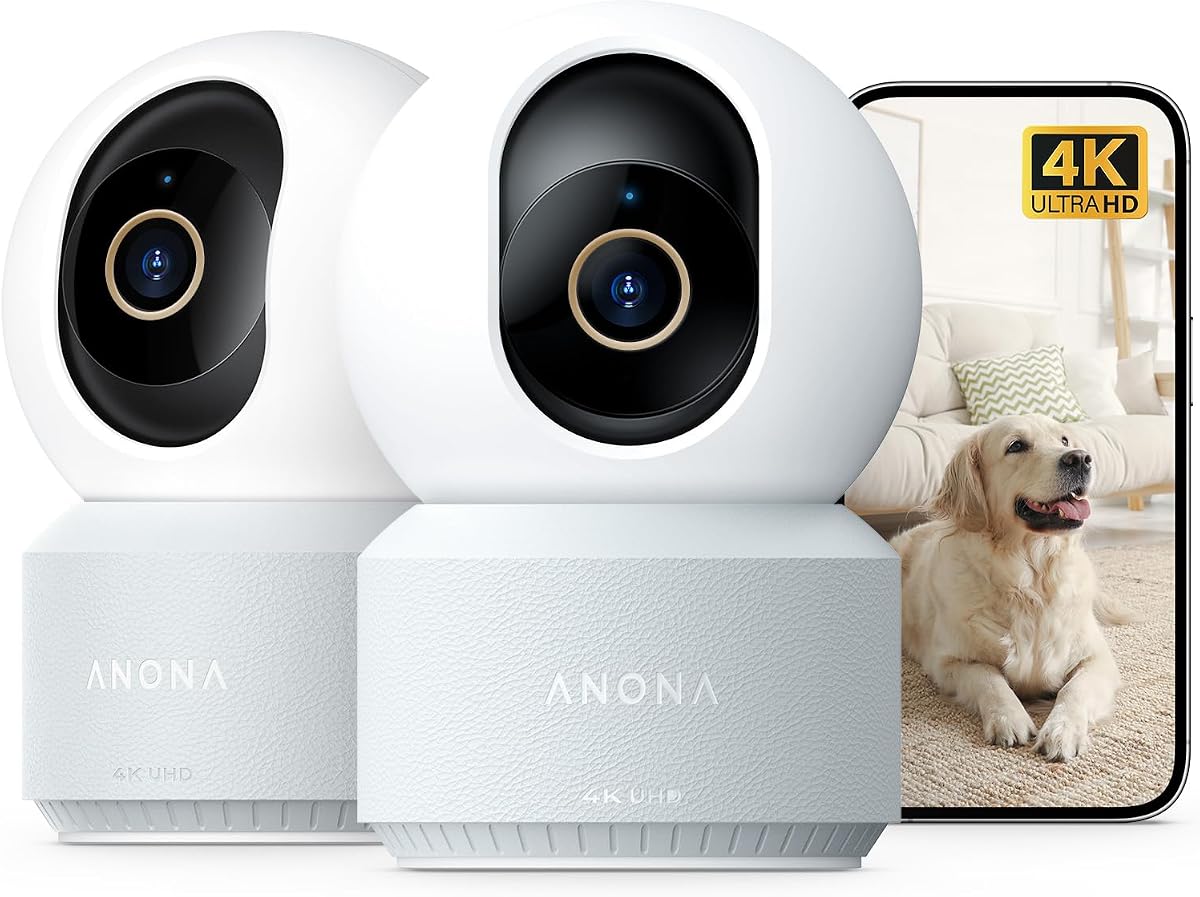
The Anona 4K UHD Indoor Camera is a 4.5-rated two-pack built for family monitoring, pet supervision, and baby-care use. It combines a 4K sensor and eight-times zoom with 360-degree pan, 110-degree tilt, and automatic tracking, allowing one compact unit to monitor a room and follow moving subjects.
We may earn a commission when you buy through this link, at no additional cost to you.
Its AI detection categories distinguish between people, pets, and baby crying. Each category can generate a phone-app notification, making the camera more useful than a generic motion alert system. Wi-Fi 6 and dual-band connectivity across 2.4GHz and 5GHz can provide faster, smoother, and more stable transmission than older wireless standards.
The cameras offer both encrypted AES-128 Anona Cloud storage and local microSD recording up to 512GB. The microSD card is not included. The product is also designed around indoor use, so buyers needing a weatherproof outdoor camera should choose a different model. The two-camera pack nevertheless offers a convenient way to monitor separate rooms.
The Anona is an excellent choice for homes where pets, babies, or elderly family members benefit from intelligent alerts and automatic subject tracking. It is also a strong fit for users who want 4K detail and modern dual-band networking without operating a complex PoE system.
Separate detection for people, pets, and crying reduces the need to interpret every generic movement alert. Users can focus on the events most relevant to their household rather than reacting to an undifferentiated stream of motion.
Wi-Fi 6 combined with selectable 2.4GHz and 5GHz bands supports smoother streaming and more stable connections. It also makes the pair adaptable to different signal conditions in a home where one band may be congested or inaccessible.
We may earn a commission when you buy through this link, at no additional cost to you.
The HD 1080P 4-in-1 Camera is a 3.7-rated analog fisheye option for installations centered on a wired BNC coax system. It provides 360-degree room monitoring with a 1.44mm fisheye lens, using a single camera to cover an area that might otherwise appear to require several conventional viewpoints.
We may earn a commission when you buy through this link, at no additional cost to you.
Compatibility is its main strength. The camera supports 1080p AHD, 1080p CVI, 1080p TVI, and CVBS 960H output, with CVBS 960H as the default mode. That range allows installers to connect it to compatible analog surveillance equipment rather than requiring a specific proprietary platform.
Image specifications are modest compared with the newer 4K, 3K, and 6MP models here. Fifteen infrared LEDs provide night vision up to 30 feet, and no intelligent detection, audio, cloud recording, or motorized tracking functions are listed. Its older compatibility approach may be ideal for an established analog system but less attractive for a new IP-based installation.
Choose this model when you already operate compatible TVI, AHD, CVI, or CVBS equipment and need a simple way to add a wide-angle analog view. It is less suitable for buyers seeking high-resolution imagery, smart alerts, wireless convenience, or advanced surveillance analytics.
Supporting four common analog video formats increases the chance of compatibility with an existing recorder. This makes the camera most useful as a targeted upgrade to a legacy or mixed surveillance installation.
The 360-degree fisheye view provides broad daytime coverage from one compact dome camera. At night, however, the listed 30-foot infrared range is shorter than several competing products, so supplementary lighting may be necessary in larger exterior areas.
We may earn a commission when you buy through this link, at no additional cost to you.
The most useful camera is the one whose coverage, power method, intelligence, and recording system fit the monitored space. Evaluate the physical environment before comparing resolution, because the best technical specifications cannot compensate for unsuitable placement or connectivity.
A true fisheye camera captures a simultaneous 360-degree panorama, making it useful for open rooms, retail floors, offices, warehouses, and other areas where continuous awareness matters. Its wide lens can produce distortion, although compatible software may offer dewarped views. A pan-and-tilt camera instead uses motors to turn and tilt, allowing it to follow selected subjects but requiring movement time and potentially leaving brief gaps in direction. Decide whether uninterrupted panoramic awareness or active subject tracking is more valuable.
Choose fisheye coverage for fixed, room-wide observation. Choose PTZ for flexible directional views and automatic tracking.
Resolution determines how much fine detail remains visible, but it should be considered alongside lens quality, lighting, compression, and viewing distance. The selection ranges from 1080p models to 3K, 4K, 5MP, and 6MP options. The Anona offers 4K with eight-times zoom for indoor family monitoring, while the eufy S340 combines 3K with a dual-lens design. The REOLINK fisheye models use 6MP sensors, and the Amcrest model provides 5MP. Higher resolution can help, but it does not replace adequate illumination.
Prioritize resolution for facial or fine-detail needs. Balance it against night lighting and storage capacity.
Power and connectivity determine whether a camera is convenient, reliable, and suitable for its location. Wireless models avoid Ethernet runs but depend on signal strength and compatible network bands. PoE cameras provide dependable wired data and power but require suitable switches, injectors, recorders, and cabling. Solar cameras reduce electrical wiring, though adequate direct sunlight remains essential. Wired indoor designs can be stable but less flexible than battery or solar alternatives.
Match the power method to the site. Favor PoE for structured networks and solar for remote sunlight-exposed locations.
Wireless specifications matter because a camera cannot deliver stable performance on an unsupported network. Many outdoor solar and pan-and-tilt products operate on 2.4GHz only, which usually offers better reach but may encounter interference. Dual-band cameras can connect to either 2.4GHz or 5GHz, and Wi-Fi 6 models may provide smoother performance in compatible environments. Check the router, app requirements, and building distance before finalizing an installation.
Verify the supported band before buying. Use dual-band or Wi-Fi 6 for crowded networks and flexible placement.
Night performance is more than a headline infrared range. Look for the stated viewing distance, type of night vision, number and placement of illuminators, and whether color mode activates on detected motion. The Tapo C500 lists night vision up to 98 feet, while the REOLINK FE-P detects humans at up to 26 feet and the analog 4-in-1 camera offers 30 feet. Outdoor models also need appropriate weather protection; the Hiseeu cameras list IP67, while aosu specifies IP65.
Compare night range with actual scene size. Confirm weather protection before using any camera outdoors.
Motion detection alone can generate many irrelevant alerts, so targeted AI categories can be more useful. Available functions include person detection, vehicle filtering, pet recognition, baby-crying detection, automatic tracking, customizable motion zones, alarm delays, tripwires, and intrusion detection. Professional analytics may also require a separate Smart NVR, as with the Amcrest model. Consider how you want to be notified and whether the camera will be used in a busy, variable environment.
Prefer specific detection over generic motion alerts. Confirm that advanced analytics do not require extra equipment.
Storage choices affect ongoing cost, convenience, and offline access. Local microSD is simple for single cameras, while a multi-camera DVR or NVR is more practical for larger properties. The Hiseeu package includes a 1TB drive, and the REOLINK WiFi fisheye supports up to 512GB microSD or compatible NVRs. Cloud options are available from Tapo, Amcrest, and Anona. Compare capacity, event filters, remote access, and whether continuous recording is supported.
Choose local storage for direct control, or cloud storage for convenience. Match capacity to retention needs.
Audio and privacy features can improve usability but should match the environment. Two-way talk allows communication through the camera, while the Amcrest model includes a built-in microphone and RCA audio connections. The Tapo C500 includes a physical privacy mode, and the Anona also advertises a privacy mode. For professional installations, supported NVR models, firmware compatibility, and ongoing technical support can be as important as the camera itself.
Use two-way audio where communication helps. Consider physical privacy controls and vendor support before deployment.
Begin by mapping the area the camera must observe. For a fisheye model, place it centrally where the ceiling or wall permits an unobstructed panorama. For PTZ, position the unit where it can rotate toward likely approaches without being blocked. Outdoor solar cameras should face a direction that receives dependable sunlight, while wired PoE installations should be planned around safe cable routing and compatible network hardware.
Complete setup through the manufacturer's app, update the camera's firmware, connect it to the intended network, and set the correct time zone. Define motion zones, detection categories, alert schedules, and recording rules. Test daylight and night footage, verify that notifications arrive, and confirm the field of view does not include unnecessary private areas. Enable two-way audio or a siren only after checking local privacy rules and the sensitivity of nearby neighbors.
Clean the lens gently and keep the solar panel free of dust, leaves, snow, and direct obstruction. Check storage capacity and event filters regularly so important recordings are not overwritten. Review alerts, update firmware when prompted, and inspect cables, mounts, weather seals, and power connections. For battery-based solar units, monitor charging performance and replace the battery if runtime declines substantially.
A 360-degree camera can cover a room or outdoor area from one position, reducing installation work and eliminating the need for multiple conventional viewpoints. It is especially useful in open-plan rooms, stores, and warehouses. Several standard cameras may still provide better image detail, flexible zoom, and redundant coverage in complex properties.
Recording behavior depends on the camera, app, storage service, and user settings. Some models support continuous recording, while others emphasize motion or event-based clips. A DVR-based system can provide around-the-clock recording, and microSD or cloud plans may offer continuous, scheduled, or event-triggered options. Check the product's recording modes before installation.
A fisheye camera captures a broad panorama continuously, so there is no mechanical movement delay. A pan-and-tilt camera rotates and tilts to direct its lens, which helps it follow activity and zoom toward particular subjects. Fisheye models emphasize total awareness, while PTZ models emphasize directed attention and tracking.
Solar operation depends on sunlight, temperature, panel angle, and whether the panel remains clean and unobstructed. A model that performs well in a bright, open location may charge poorly under heavy shade or prolonged bad weather. Review the manufacturer's guidance, place the panel where it receives direct sun, and consider whether a wired alternative would be more dependable.
Some cameras can record directly to microSD, while others are designed to integrate with a compatible NVR or DVR. Advanced features on certain professional models, including detailed people-counting reports and intelligent event tools, may require compatible NVR hardware. Check the camera's storage and accessory requirements before choosing a recording system.
Only use a camera outdoors if its specifications explicitly support outdoor operation. Relevant indicators include a weather-resistance rating, sealed housing, suitable operating temperature range, and an outdoor-rated power connection. An indoor camera without weather protection may fail when exposed to moisture, dust, or temperature extremes.
Required capacity depends on resolution, frame rate, compression, camera count, and whether recording is continuous or event-based. Higher-resolution multi-camera systems generally consume more space, while motion-only recording can reduce storage demands. Review the listed card limits or bundled drive capacity, and confirm the recorder supports the intended retention period.
A stable connection is especially important for live viewing, high-resolution streams, cloud uploads, and remote access. Dual-band or Wi-Fi 6 support can improve flexibility, while 2.4GHz-only devices may perform better over longer distances. Test the signal at the intended camera location and avoid placing the unit behind thick walls or metal objects.
The strongest all-around wireless option here is the REOLINK WiFi Fisheye Camera because it combines a true 360-degree panorama, 6MP recording, dual-band Wi-Fi, person detection, and local storage. The Anona 4K Indoor Camera is especially compelling for families, pets, and baby monitoring, while the TP-Link Tapo C500 stands out as the most budget-conscious outdoor pan-and-tilt choice.
For professional or structured-network installations, the REOLINK FE-P and Amcrest IP5M-F1180EW-V2 offer sophisticated options. The former emphasizes clean PoE installation and dewarped fisheye views, while the latter provides extensive intelligent analytics and storage compatibility. The Hiseeu system is ideal when several locally recorded cameras are needed, and the solar aosu and eufy options suit outdoor sites where wiring is inconvenient.
Before buying, confirm the camera's coverage method, power requirements, night performance, storage plan, and compatibility with the existing network or recorder. Current specifications, availability, and pricing can change, so checking the latest product listing ensures that the selected 360 degree security camera remains suitable for the intended location.
