
LimeCare Starlink Mini Battery Adapter
4.0Editor score
Dual-battery hot swapping
Low-voltage cut-off protection
Works with 20V and 60V batteries
Our battery backup for Starlink guide compares runtime, power output, portability, safety features, and compatibility for home or off-grid use.
Battery backup for Starlink can keep internet access running during outages, remote work, travel, and extended camping trips. A useful backup must match the dish’s power requirements, provide stable output, recharge conveniently, and fit the way you use your system without creating unnecessary complexity.
We compared all ten products across power type, output method, runtime claims, outlet availability, portability, safety protections, display functions, and Starlink compatibility. The list includes dedicated Starlink Mini units, portable battery adapters, and conventional UPS systems intended for stationary networks and critical electronics.
Each review identifies the product’s strongest use case and relevant trade-offs, while the comparison table provides a quick reference. Ratings and specifications reflect the supplied listing information, and product availability, configurations, and prices may change over time.
4.0Editor score

5.0Editor score

4.5Editor score
The table below compares dedicated Mini power systems, tool-battery adapters, and general-purpose UPS units by their core power architecture, portability, monitoring features, and most relevant use case.




The Pilestone/Woyum Starlink Mini UPS is the most purpose-specific option in this guide, combining a 220Wh battery with a listed runtime of up to 10 hours. Its 5.0 rating reflects a strong listing response, while the 22V specification is directly aligned with the power needs of the Starlink Mini.
We may earn a commission when you buy through this link, at no additional cost to you.
This unit stands apart from conventional UPS systems because it was designed around a compact satellite dish rather than a rack of electronics. At three pounds, it is practical for mobile users who need backup at a campsite, temporary work site, or during a home outage. The 10Ah capacity and claimed 10-hour runtime make it especially relevant when uninterrupted connectivity matters more than serving several devices simultaneously.
The main limitation is specialization. It is intended for the Mini dish and does not offer the broad collection of AC outlets, USB charging ports, and network-oriented controls found on conventional UPS models. A buyer who needs to run a router, laptop, and phone simultaneously may find a general UPS or a larger portable power station more flexible.
This is the strongest recommendation for someone whose priority is dependable Starlink Mini operation away from an outlet. It combines the highest listed rating in the group, a generous runtime claim, low weight, and direct Mini compatibility without requiring separate batteries or a complex adapter.
At a listed three pounds, the Mini UPS is easier to transport than a traditional floor-standing UPS. It suits users who move between campsites, vehicles, or temporary workspaces and need the dish to retain internet access during short outages.
The 220Wh capacity and up-to-10-hour claim provide a useful runtime target for work, messaging, and routine browsing. Actual duration can vary with usage, so the listing’s claim should be treated as a product-specific figure rather than a guarantee for every scenario.
We may earn a commission when you buy through this link, at no additional cost to you.
The CyberPower CP1500PFCLCD is a premium conventional UPS for keeping a complete home-office network online. Its 1500VA/1000W rating, pure sine wave output, and 4.5 customer rating make it a strong choice when a Starlink system shares backup power with a router, computer, and other sensitive electronics.
We may earn a commission when you buy through this link, at no additional cost to you.
Twelve NEMA 5-15R outlets provide ample room for a network setup, with six offering battery backup and six offering surge protection. The two USB charging ports are useful for phones and tablets, while the color LCD reports battery and power conditions. Automatic voltage regulation corrects minor fluctuations without needlessly drawing from the battery.
Unlike the smaller dedicated Mini units, this model is stationary and weighs more because it includes a sizable battery bank, inverter, outlet array, and monitoring system. Pure sine wave output is the more refined choice for modern electronics, but buyers without a full network to support may be paying for capacity and flexibility they will not regularly use.
Choose this UPS for a fixed home or office installation where Starlink is one component of a broader communications setup. The combination of pure sine wave power, abundant protected outlets, clear diagnostics, a three-year warranty, and connected-equipment protection makes it the most complete premium option here.
A conventional UPS is more useful when connectivity depends on several devices. Six protected battery outlets can support a router, network switch, and other essential equipment without requiring separate surge protectors.
The tilting color LCD makes ongoing monitoring easier than a simple indicator light. Users can check battery and power status and receive alerts about conditions that could otherwise lead to unexpected downtime.
We may earn a commission when you buy through this link, at no additional cost to you.
The CyberPower CP1500AVRLCD3 is a well-equipped standard UPS aimed at workstations, networking equipment, and home entertainment systems. It has a 1500VA/900W rating, 12 NEMA outlets, USB charging, and a color LCD, all of which make it easy to build a dependable Starlink-supported network.
We may earn a commission when you buy through this link, at no additional cost to you.
Six outlets provide battery backup while another six protect against surges. Its 900W continuous capacity should accommodate the Starlink system and essential networking devices without approaching the upper limit during ordinary use. Automatic voltage regulation keeps minor input fluctuations from needlessly transferring the load to internal batteries.
The important distinction from the CP1500PFCLCD is its simulated sine wave output. That design may be entirely appropriate for a router, basic networking equipment, or a home office, but a user operating more demanding or sensitive electronics should investigate whether pure sine wave output is preferable. Its larger physical footprint also makes it a home installation rather than a camping accessory.
This model is a solid middle-ground option for buyers who want extensive outlets, convenient status information, and a standard desktop UPS format. It is especially compelling when the Starlink Mini needs to share backup protection with a computer, router, and charging devices in a fixed workspace.
Twelve outlets and 900W of listed capacity provide room for the dish, router, and several essential devices. This makes the CP1500AVRLCD3 more adaptable than a single-purpose Mini power pack.
The multifunction LCD presents immediate information about battery and power conditions. That visibility is particularly useful for users who cannot easily inspect a conventional UPS from another room.
We may earn a commission when you buy through this link, at no additional cost to you.
The XTAR X6 Swappable Battery Power Base is designed for Starlink Mini users who want a modular system for multi-day camping, RV travel, or emergency preparation. Its 4.3 rating, direct 18–25.2V DC output, and hot-swappable six-cell architecture offer a distinctive alternative to a conventional UPS.
We may earn a commission when you buy through this link, at no additional cost to you.
When a battery set is depleted, the listing says a fresh set of six cells can be swapped in under three minutes, allowing the system to resume without waiting for a full recharge. With six XTAR 4900mAh batteries, the stated runtime reaches up to 5.3 hours at a 20W load. Direct DC output also avoids the conversion losses associated with turning battery power into AC and then back into DC.
This is not a complete starter package because the X6 listing includes the power base and manual but no batteries. Buyers must source compatible six-cell batteries and should verify the charging and battery requirements before purchase. The product is also explicitly limited to the Starlink Mini rather than other Starlink models.
Choose the X6 when modularity and quick field changes matter more than carrying one sealed power unit. Its integrated foldable stand, 0.64-pound listed base weight, LED status indicator, and cell-level discharge protection make it especially appealing to organized off-grid users who already carry suitable battery sets.
The six-cell swappable design is the X6’s defining feature. Carrying multiple charged sets means a depleted group can be exchanged quickly rather than ending the Starlink session while the base recharges.
Powering the Mini through native DC output reduces conversion steps and can improve usable runtime. The result is particularly appealing for users who understand modular battery systems and want to avoid conversion-related waste.
We may earn a commission when you buy through this link, at no additional cost to you.
The CyberPower OR2200PFCRT2U is the highest-capacity conventional UPS in the group, aimed at offices and installations where Starlink supports a substantial collection of equipment. It combines 2200VA-class capacity with pure sine wave output, two NEMA 5-20R outlets, and six NEMA 5-15R outlets.
We may earn a commission when you buy through this link, at no additional cost to you.
Its rotatable multifunction LCD can display estimated runtime, battery capacity, and load capacity, giving users a clearer picture of how the system is performing. Automatic voltage regulation corrects small input fluctuations without switching to battery operation, helping preserve internal battery life during normal use.
The trade-off is size and weight. This is a floor or workstation UPS rather than a travel product, and the product data does not highlight USB charging ports for mobile devices. It also requires the Starlink Mini and its AC adapter to be configured appropriately with the UPS.
For a home office, small business, or communications room, the OR2200PFCRT2U makes sense when more headroom is important. Buyers should choose it over smaller units when the dish, router, computers, monitors, and other network equipment need a shared and relatively substantial reserve.
The 2200VA class provides meaningful headroom for a complete professional workspace. It is a better fit than a compact 900W UPS when multiple high-draw devices must remain connected during an outage.
The rotatable panel reports estimated runtime and load capacity. These figures help operators decide whether connected equipment should be reduced or shut down before the battery reserve becomes critical.
We may earn a commission when you buy through this link, at no additional cost to you.
The LimeCare Starlink Mini Battery Adapter is a compact, economical way to power a Starlink Mini from De.Walt-style batteries. It holds one or two 20V or 60V FlexVolt batteries, and its 4.0 rating reflects a functional product with a clear appeal for users who already own compatible packs.
We may earn a commission when you buy through this link, at no additional cost to you.
Dual-battery support is its strongest advantage. It can extend operating time and allows a depleted battery to be replaced without interrupting the Starlink Mini, according to the listed hot-swapping design. An integrated low-voltage protection system and one-touch power switch help guard batteries from over-discharge and simplify daily operation.
The adapter itself is not a battery bundle, and it does not provide a large internal energy reserve. Its appeal therefore depends on already owning compatible De.Walt 20V or 60V batteries or being willing to purchase them separately. It also lacks the LCD monitoring, multiple AC outlets, and multi-hour runtime information supplied for the larger systems.
This is a practical budget recommendation for mobile workers, campers, and van-life users who want the Starlink Mini to share the batteries they already carry. The simple slide-in connection, 18AWG DC lead, flame-retardant construction, and hot-swapping capability make it easy to add as a secondary field solution.
Using two compatible batteries at once can extend the working time available from a tool-battery collection. It also gives owners a way to repurpose packs that already support other portable equipment.
The listed hot-swap design is valuable during long work sessions. A fresh pack can take over without forcing the dish to reboot, provided the adapter and batteries are used within the stated conditions.
We may earn a commission when you buy through this link, at no additional cost to you.
The CyberPower BRG1500AVRLCD2 is a 1500VA/900W intelligent LCD UPS with the group’s highest conventional-UPS rating at 4.7. It combines a color status panel, 12 protected outlets, USB charging, automatic voltage regulation, and optional remote-management support.
We may earn a commission when you buy through this link, at no additional cost to you.
Six outlets provide battery backup and six provide surge-only protection, making the system suitable for a Starlink Mini, router, switch, computer, and other home-office devices. Its support for optional RMCARD205, RCCARD100, or RWCCARD100 cards adds appeal to users who need remote visibility or control, although the cards are not included.
The simulated sine wave output is the main technical compromise, particularly when compared with the pure sine wave CP1500PFCLCD. It remains a standard configuration for many network and home entertainment devices, but buyers with especially sensitive or demanding loads should review compatibility first. The unit is also a stationary installation rather than a field power pack.
Choose the BRG1500AVRLCD2 when remote management, warranty coverage, and an outlet-rich design matter most. Its five-year warranty includes the battery, and the accompanying connected-equipment guarantee adds reassurance for a home or office installation where Starlink is part of a larger system.
The UPS can work with optional CyberPower management cards, allowing compatible installations to add remote oversight. This makes the model attractive for managed networks or unattended offices where local status checks are inconvenient.
The five-year warranty includes the internal battery, which is valuable for a unit intended to sit continuously near a router or other critical equipment. The warranty period helps distinguish this model from shorter-coverage alternatives.
We may earn a commission when you buy through this link, at no additional cost to you.
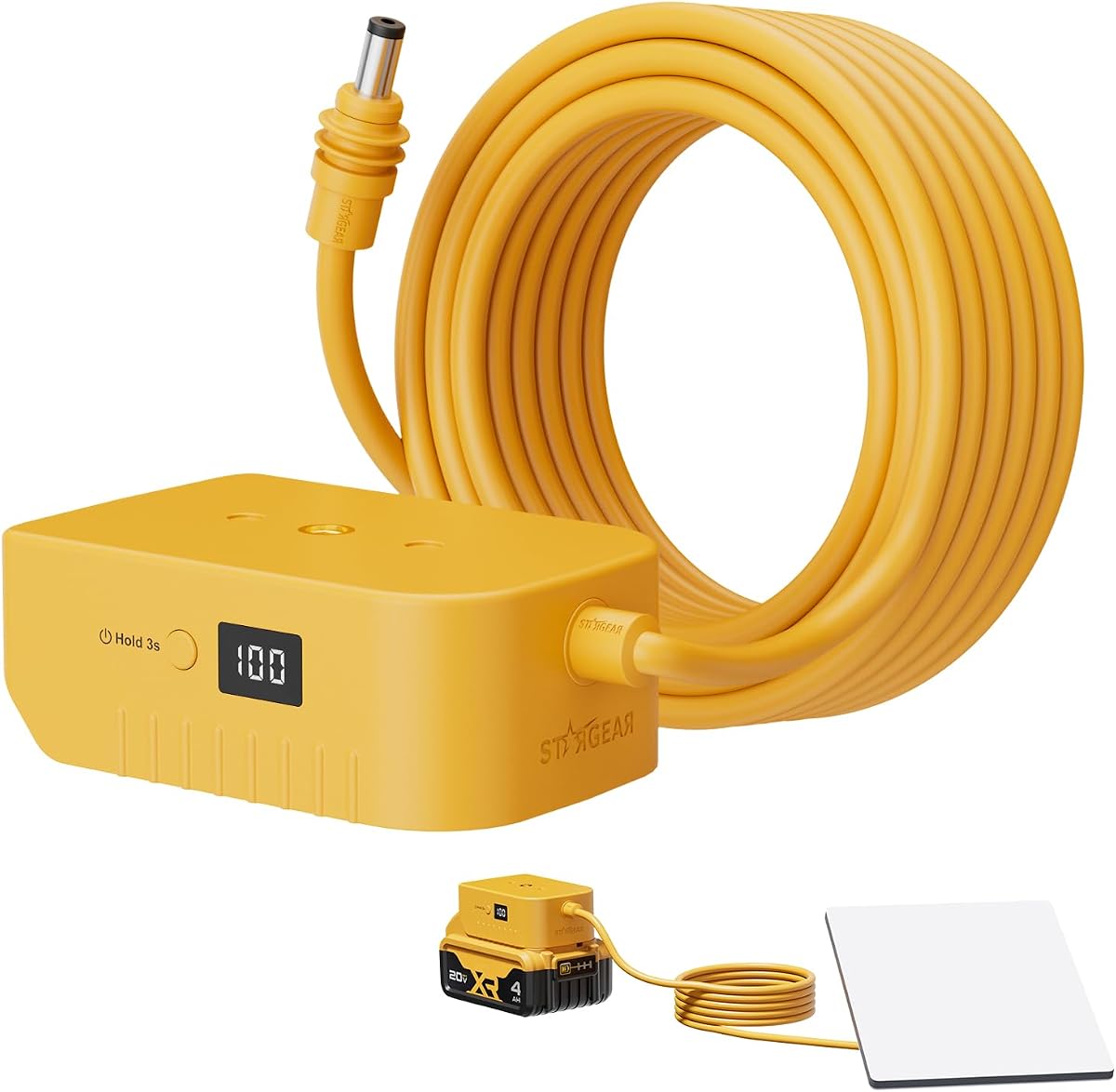
The STARGEAR Starlink Mini Battery Adapter with Over-Discharge Protection is a 4.6-rated adapter for users who want to power the Mini from De.Walt 20V MAX and 18V DCB batteries. Its compatibility list includes the DCB182, DCB183, DCB201, DCB203, DCB204, DCB206, DCB208, DCB230, and DCB240 packs.
We may earn a commission when you buy through this link, at no additional cost to you.
The included three-meter, 18AWG pure copper cable offers generous placement freedom and is intended to provide stable power with reduced voltage drop. A digital battery-level display makes it easier to determine when a pack should be swapped, while the independent on/off control avoids the need to disconnect the battery after every use.
This adapter requires a separate compatible battery and does not present a runtime figure. The long cable is useful for positioning a dish away from the battery, but it may be less tidy than a short integrated lead. Users must also ensure the adapter and cable are arranged safely in outdoor or high-movement settings.
This is a strong choice for travelers, campers, and boaters who already rely on De.Walt tool batteries. The combination of over-discharge protection, a readable level display, broad named battery compatibility, and a long copper cable makes it particularly useful for flexible off-grid placement.
A three-meter cable allows the battery to remain near a vehicle, work table, or protected campsite while the Mini is positioned for a clear view of the sky. That separation can be helpful when cable management and weather protection need careful attention.
The built-in digital display reduces guesswork when determining whether a pack needs recharging or replacement. Combined with the independent switch, it simplifies both monitoring and day-to-day operation.
We may earn a commission when you buy through this link, at no additional cost to you.
The STARGEAR Integrated Pipe-Mount Adapter offers a tidy all-in-one approach to powering and mounting the Starlink Mini. It carries a 5.0 rating and combines a De.Walt-compatible battery connection, a pipe mount, and a 0.3-meter DC cable in one integrated arrangement.
We may earn a commission when you buy through this link, at no additional cost to you.
Compatibility includes De.Walt 20V MAX and 18V DCB batteries, with the product data naming DCB182, DCB183, DCB201, DCB203, DCB204, DCB206, DCB208, DCB230, and DCB240 packs. Over-discharge protection supports battery care, while the digital level display and independent power control simplify operation.
Unlike the separate-cable STARGEAR model, this version is intended to consolidate the Mini, adapter, and battery into a unified system. That reduces cable clutter and is useful for mobile or frequently rearranged installations. The trade-off is the short 0.3-meter lead, which limits separation between the battery and dish.
Choose this model for a compact mobile setup where clean integration matters more than adjustable cable length. It is especially suitable for users who already have a compatible tool battery and want the Mini physically secured to the same support rather than managing a separate power lead.
The integrated design keeps the battery adapter, Mini mount, and short DC lead together. That makes the system easier to pack, reposition, and secure during travel.
The pipe-mount arrangement is listed as compatible with both new and older Starlink Mini pipe mounts. Existing Mini owners can therefore evaluate the system without assuming that their current mounting style is automatically supported.
We may earn a commission when you buy through this link, at no additional cost to you.
The Starlink Mini Battery Adapter Pack Compatible with De.Walt Battery is a straightforward 4.4-rated solution for powering a Mini with 20V and 18V DCB-series tool batteries. It focuses on simple insertion, a secure connection, and stable power transfer without a built-in battery.
We may earn a commission when you buy through this link, at no additional cost to you.
The adapter is described as lightweight and portable, which makes it convenient to carry between the home, campsite, and vehicle. Its plug-and-play process requires no complex installation, and integrated circuits are intended to protect against excessive power and improve transmission stability. A 20V or 18V battery already in a user’s toolkit can therefore become a dual-purpose power source.
The product does not provide a runtime estimate, detailed digital charge display, or a clear hot-swap procedure in the supplied information. It is also a third-party accessory and is not affiliated with De.Walt. Buyers should confirm the precise battery fit, cable arrangement, and power compatibility before purchasing.
This is a sensible lower-complexity option for a first-time Starlink Mini owner who already uses compatible tool batteries. It is less compelling for advanced users who require a cable-level battery display, integrated pipe mounting, or a stated hot-swapping design, but its simple approach remains easy to understand.
The straightforward connection process reduces the learning curve for new users. With the battery locked into place and the Mini connected, the system can move from storage to use with minimal setup.
Reusing a tool battery for connectivity reduces the number of separate power components a user must carry. The adapter also remains small enough to fit with a broader collection of portable work equipment.
We may earn a commission when you buy through this link, at no additional cost to you.
The right battery backup depends on the Starlink model, expected load, how often the system must run without grid power, and whether portability or a complete multi-device installation matters more.
The most important check is whether the backup unit supports the exact Starlink hardware you own. Several products in this guide are explicitly designed for the Starlink Mini, while the conventional CyberPower UPS systems support compatible equipment through standard household outlets and AC power supplies. A product that works perfectly with the Mini may not directly support another Starlink model, and an AC UPS still requires the correct Starlink power supply and appropriate wattage.
Runtime depends on battery capacity, the dish’s power draw, how aggressively the router is used, and the presence of other connected devices. The dedicated Pilestone/Woyum Mini UPS lists up to 10 hours, while the XTAR X6 lists up to 5.3 hours with six 4900mAh batteries at a 20W load. Adapter-based products do not offer a comparable standalone runtime because output depends on the capacity and condition of the tool batteries being used. For prolonged outages, estimate the total wattage and add a safety margin rather than relying only on a headline hour figure.
A backup must deliver stable power at an appropriate wattage. Pure sine wave models such as the CP1500PFCLCD and OR2200PFCRT2U are suitable when compatibility with sensitive or demanding electronics is important. Simulated sine wave units can work well with many routers, computers, and network devices, but they are a different technical proposition. Direct DC adapters avoid conversion stages, while conventional UPS models use AC outlets and are better suited to a complete network.
Portability varies dramatically across the list. The Pilestone/Woyum Mini UPS is listed at three pounds, the XTAR X6 base at 0.64 pounds before batteries, and the tool-battery adapters are designed to be carried with batteries already in hand. Traditional CyberPower UPS systems contain larger batteries and are better suited to a home, office, or communications cabinet. Consider not only the unit’s weight but also the weight of every battery needed to achieve the desired runtime.
Hot swapping can extend field use without waiting for a lengthy recharge. The XTAR X6 uses six-cell swappable sets, while the LimeCare adapter supports one or two batteries and a hot-swap process. This is valuable for all-day work, extended camping, or emergency use where a wall outlet is unavailable. A swappable system is only convenient if the user carries enough charged battery sets and can organize, protect, and recharge them safely.
Monitoring helps users judge how much operating time remains and whether a battery needs attention. CyberPower’s LCD systems show detailed power conditions, while the STARGEAR adapters include digital battery-level displays. The XTAR X6 uses a four-level LED indicator. Safety features also matter: look for low-voltage or over-discharge protection, automatic voltage regulation, surge protection, and power cutoffs that prevent a battery from being exhausted too aggressively.
A Starlink service may depend on a router, power supply, network switch, phone, or computer, and those devices can determine the true backup requirement. Conventional 1500VA or 2200VA UPS systems provide several protected outlets and USB charging, making them convenient for home offices. A compact dedicated Mini unit may better suit users who need only internet access. Tool-battery adapters are inexpensive and portable, but they usually do not power multiple household electronics at once.
Several highly portable products are adapters or bases rather than complete power systems. The XTAR X6 explicitly excludes batteries, and the LimeCare, STARGEAR, and De.Walt-compatible adapters require separate compatible packs. Before purchasing, verify whether batteries, cables, mounting hardware, and any required charger are included. Also review the manufacturer’s warranty, management software terms, and customer-support provisions so the long-term ownership experience matches your needs.
Begin by confirming the backup system supports your Starlink model and that the output, cable, and power-supply requirements are correct. For a dedicated Mini UPS, follow the manufacturer’s connection sequence and allow the unit to reach an appropriate charge level before relying on it during an outage. With a conventional UPS, connect the Starlink power supply and essential network equipment to battery-protected outlets rather than surge-only outlets, then use the display to confirm that the load is recognized.
Test the complete installation before you need it. Disconnect mains power, confirm that the Starlink system remains powered, check that the router and any other essential devices stay online, and note which status indicators change during battery operation. For adapter and hot-swap systems, practice changing the battery in a safe, dry environment and confirm that the replacement is fully charged and compatible. This rehearsal can reveal missing cables or adapter-fit issues before they become a problem.
Care for the system according to its battery chemistry and manufacturer’s instructions. Keep batteries away from extreme heat, direct cold, moisture, and physical damage, and do not use visibly swollen, leaking, or damaged packs. Recharge batteries regularly, keep ventilation openings clear, and use only approved chargers and power supplies. Periodic runtime checks are also useful: if the backup no longer delivers the expected duration, the battery or adapter may need inspection or replacement.
Yes, several dedicated adapters are designed to accept De.Walt 20V or 18V DCB-series batteries. Compatibility varies by exact battery model and adapter, so check the named DCB series before purchasing. The dish also needs its correct DC power connection and should only be connected through an adapter that meets the required voltage and safety specifications.
A normal UPS can support Starlink when the model, power supply, outlet, and wattage are compatible. It is especially useful in a home office because the router, computer, and other networking devices can share the same protected outlet bank. A compact dedicated Mini UPS may be easier to carry, while a conventional UPS generally offers more outlets and longer unattended operation.
The best choice depends on how the Mini will be powered. A dedicated portable Mini UPS offers a self-contained package, while tool-battery adapters and the modular XTAR X6 are useful for travelers who already carry compatible batteries. Battery weight, expected runtime, weather exposure, and access to charging should all influence the decision.
The Pilestone/Woyum product lists up to 10 hours of runtime with its 220Wh capacity. Actual duration can vary with the dish’s load, router activity, battery condition, and operating environment. Treat the listing’s figure as a maximum or stated configuration rather than a guaranteed duration for every use.
Starlink’s own power supply generally determines the waveform seen by the dish, so the more important question is whether the UPS is compatible with the AC power supply being used. Pure sine wave models are a conservative choice for a broad range of electronics, while simulated sine wave models may still suit many routers, computers, and networking devices. Check both the Starlink power requirements and every other device planned for backup.
A UPS converts stored battery energy into regulated AC power, usually with surge protection, voltage regulation, and outlet monitoring. A direct battery adapter converts the tool battery’s DC output into the voltage and connection needed by the Starlink Mini. Adapters are generally smaller and lighter, while UPS systems provide more outlets and a more complete stationary power-management solution.
The LimeCare adapter and XTAR X6 explicitly advertise hot-swapping features. The XTAR system uses a six-cell battery set, while the LimeCare model uses one or two tool batteries. Users should still follow the stated replacement procedure and confirm the incoming battery is charged and compatible before relying on uninterrupted operation.
No, the portable adapter products in this guide require a separate compatible battery. The XTAR X6 is explicitly a power base without batteries, and the tool-battery adapters are designed to use packs the user already owns. Check the product’s packing list carefully so you do not assume the complete operating system is included.
The Pilestone/Woyum Starlink Mini UPS is the leading choice for a self-contained portable setup, combining direct Mini compatibility, a listed 220Wh capacity, and up to 10 hours of runtime. The LimeCare adapter represents the budget-friendly route for users with compatible tool batteries, while the CyberPower CP1500PFCLCD is the premium pick for a fixed home or office network needing pure sine wave power and abundant protected outlets.
Prioritize the power architecture that matches your situation. Choose a dedicated Mini unit for portable simplicity, an adapter when you already own suitable batteries, a hot-swappable modular system for extended off-grid work, or a conventional UPS when the router, computer, and other essential devices need shared protection. Verify connectors, output, runtime, battery inclusions, and warranty terms before ordering.
Finally, check current product availability, configuration, and pricing at the time of purchase. Ratings, included accessories, and technical claims can change, and Starlink hardware revisions may affect compatibility. Confirm the latest listing details and manufacturer instructions to ensure the selected backup is ready for the way you plan to use it.