
Single Earbud Bluetooth Earpiece
4.0Editor score
Up to 10 hours per charge
Two-device multipoint connection
Lightweight left-or-right fit
Our expert guide compares the best cheap one ear Bluetooth headset options, focusing on comfort, battery life, call quality, connectivity, and features.
A cheap one ear Bluetooth headset can be a practical choice for drivers, office workers, online learners, and anyone who wants private calls while keeping one ear open. The best models balance a secure fit, clear microphone performance, dependable wireless connections, useful controls, and enough battery life to cover a full workday.
This guide compares ten single-ear headsets using the specifications and features listed for each product. It considers comfort, call clarity, battery and standby figures, device switching, charging options, environmental resistance, and practical extras such as mute buttons, voice assistants, LED displays, and adjustable ear hooks.
Each pick below highlights the product's strongest use case while also noting relevant limitations based on its supplied information. Ratings and specifications may reflect the manufacturer's or platform's reported data, and product prices change frequently, so readers should check the current listing before making a purchase.
4.0Editor score

4.7Editor score
4.2Editor score
The comparison below places all ten headsets side by side, focusing on the features that most affect everyday comfort, communication, power management, and device compatibility.


The New Bee V5.0 is a compact hands-free headset with a 4.1 rating and a feature set that makes it unusually versatile for the category. Its most immediately attractive qualities are the 12-gram weight, adjustable 360-degree earbud, and ability to connect to two devices simultaneously, making it practical for people who alternate between a phone and computer.
We may earn a commission when you buy through this link, at no additional cost to you.
Call handling centers on CVC 6.0 technology, which is intended to improve voice clarity and reduce distortion. Battery information is also generous for a compact earpiece, with 22 hours of music, 24 hours of talk time, and a stated 60-day standby figure. The included case improves portability, while S, M, and L ear tips allow the user to refine the fit.
Compatibility is broad across iPhone, Samsung, HTC, LG, Sony, PCs, laptops, iPads, iPod touch, Motorola, and other Bluetooth-enabled Android devices. The main caveat is that some phones may not automatically synchronize headset and phone volume; the supplied instructions direct users to find a volume-sync setting in the Bluetooth device menu.
This is a strong recommendation for drivers and mobile workers who want something light, portable, and able to handle two devices without a complicated setup. It is less suited to buyers who require a touch display or a USB dongle for a non-Bluetooth computer, but its general-purpose design makes it an easy first single-ear headset to consider.
At only 12 grams, the headset places little visual or physical weight on the ear. The rotating earbud, flexible left-or-right orientation, and three included tip sizes help distribute pressure more comfortably during extended calls or listening sessions.
The ability to hold connections to two devices is useful for people who take calls on a phone while listening to computer audio. This reduces the need to repeatedly disconnect and re-pair when moving between work and personal communication.
We may earn a commission when you buy through this link, at no additional cost to you.
The D2 Single-Ear Headset combines an earbud format with several features often associated with higher-end work headsets. It has a 4.1 rating, Bluetooth 5.3 connectivity, a visible digital battery display, dual-microphone noise cancellation, and a dedicated mute function for private conversations.
We may earn a commission when you buy through this link, at no additional cost to you.
Its physical construction is designed to adapt to different users. The in-ear section rotates 45 degrees, the ear hook turns 360 degrees, and the microphone arm swivels 180 degrees. Three ear-tip sizes are included, while the overall design can be worn on either the left or right ear.
The headset can connect to two devices at once, allowing a user to switch between a phone and computer. A quick double-click of the main button is listed as a way to activate Siri, and the LED display provides real-time battery information. USB-C and wireless charging are supported, although the wireless charger is not included.
This model is best for buyers who prioritize a visible battery gauge, flexible adjustment, and hands-free voice controls. The unspecified headset playback duration and missing wireless-charging accessory deserve consideration, but they do not outweigh the unusually broad feature set for a compact single-ear device.
The integrated digital display is a practical distinction for people who cannot easily see or hear headset prompts. It shows remaining battery status in real time, making it easier to recharge before a long drive or meeting.
Multiple adjustment points let the earpiece, hook, and microphone adapt to the chosen ear. This level of repositioning is useful for long workdays and for users who wear glasses or have different ear shapes.
We may earn a commission when you buy through this link, at no additional cost to you.
The 10-Hour Single Earbud is an understated option for shoppers who want a discreet headset without spending on a large over-ear design. Its 4.0 rating reflects a balanced feature set, while its 0.14-ounce weight and compact L-shaped body make it one of the lightest choices in this roundup.
We may earn a commission when you buy through this link, at no additional cost to you.
The integrated Bluetooth 5.4 chip supports multipoint connections to two devices, such as a phone and laptop. A multifunction button handles calls, music playback, track changes, redial, and voice-assistant activation. The stated operating range reaches 33 feet, and up to 10 hours of music or talk time are available after less than two hours of charging.
The ENC feature is designed to reduce background noise, and the integrated microphone supports calls, GPS guidance, and media. The lack of visible blinking lights during use is especially helpful in offices or other professional settings where a conspicuous earbud may be undesirable.
This is a strong budget recommendation for users who value low weight, understated appearance, and reliable phone-and-laptop switching. It does not offer a charging case or the longest runtime in the group, so buyers prioritizing uninterrupted all-day power may need to consider a higher-ranked alternative.
The small L-shaped body, optional ear tips, and no-blinking operation mode make the headset less conspicuous than a traditional boom-microphone headset. That makes it suitable for offices, reception areas, and other settings where visible earbuds may be distracting.
Multipoint pairing lets the headset remain associated with two Bluetooth sources. The physical multifunction button provides direct access to calls, playback, redial, and voice-assistant functions without requiring an app.
We may earn a commission when you buy through this link, at no additional cost to you.
The Xmenha is the most unusual entry in the group because it uses an open-ear, air-conduction design rather than placing an earbud inside the ear canal. It has a 3.8 rating, the lowest listed among these picks, but its distinct physical design serves a clear purpose: keeping the wearer aware of the surrounding environment.
We may earn a commission when you buy through this link, at no additional cost to you.
Made from skin-friendly ABS material, the headset includes adjustable earhooks intended to create a secure fit across different ear sizes. It provides up to 30 hours of listening or talking time and reaches a full charge in about one hour through USB-C. The product should be fully charged before its first use.
Call performance uses an ENC algorithm and two directional microphones to improve voice clarity in noisy surroundings. IPX5 protection helps resist sweat and rain during running, jogging, gym workouts, and other active activities. It is also compatible with Android, iOS, and Windows devices.
The Xmenha is a compelling recommendation for people who specifically want an earless, open design for exercise, outdoor awareness, or all-day comfort. Its lower rating and the possible sound limitations of an open architecture mean it may not satisfy users seeking the strongest bass or the most consistently clear calls.
Because the speaker rests outside the ear canal, the design avoids the sealed sensation associated with conventional earbuds. It can be particularly comfortable for users who dislike inserted tips or want to remain aware of traffic and surroundings.
IPX5 protection adds useful resilience against sweat and light rain. Combined with the adjustable hook and 30-hour stated runtime, it makes the headset more relevant to running and gym users than a basic office earpiece.
We may earn a commission when you buy through this link, at no additional cost to you.
The BlueFire uses a conventional on-ear headset format, distinguishing it from the smaller earbud and open-ear designs in this list. Its 3.2 rating is the lowest among the ten products, so buyers should weigh the straightforward work-focused design and comfort features carefully against that rating.
We may earn a commission when you buy through this link, at no additional cost to you.
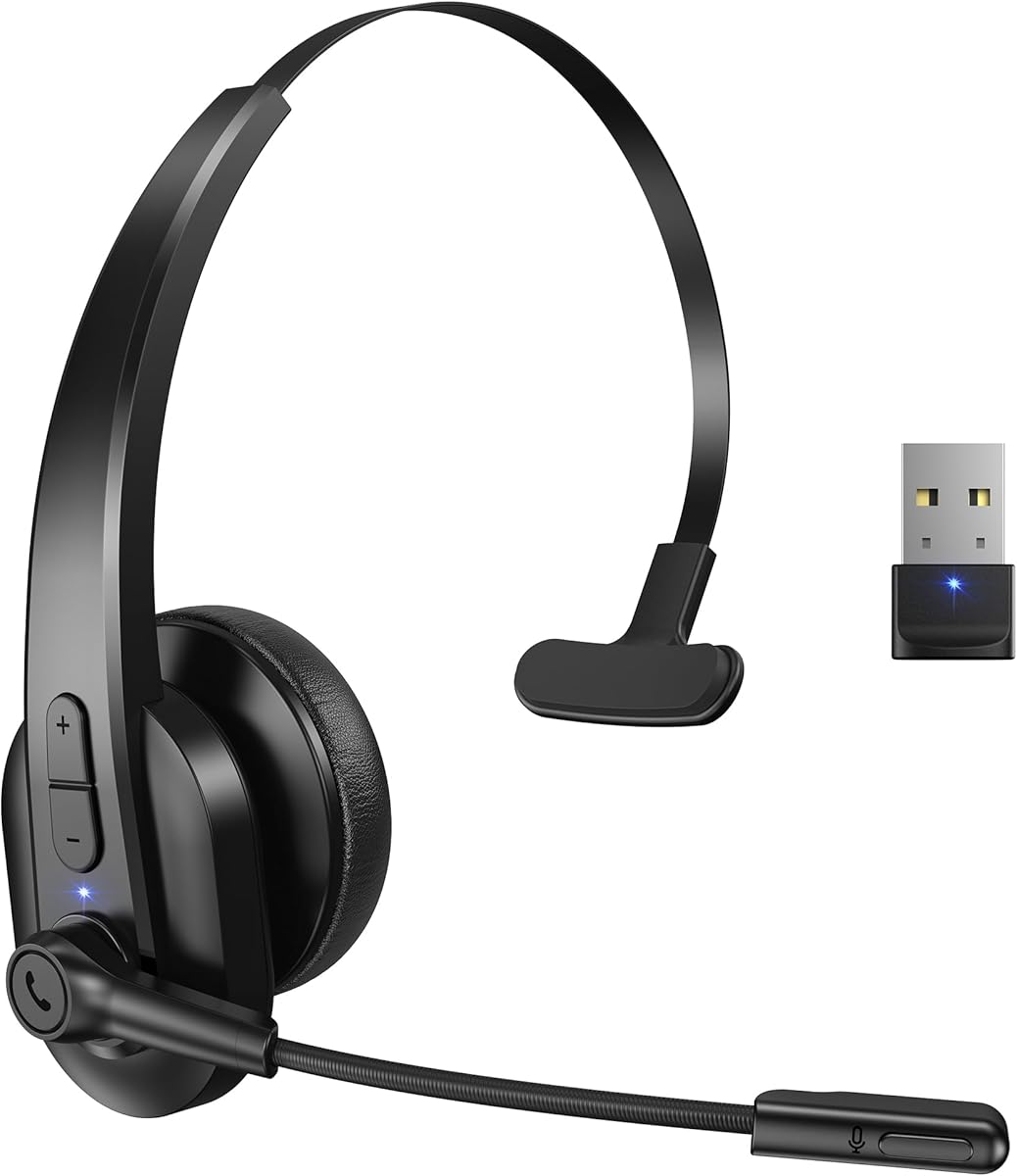
An adjustable headband accommodates different head sizes, while the soft leatherette ear cushion helps reduce pressure during long shifts. The microphone rotates 360 degrees, allowing left- or right-ear placement, and its unidirectional noise-reduction design is intended to limit background distractions.
The 250mAh battery supplies up to 18 hours of talk time and 160 hours of standby, with a full charge taking about two hours. Multipoint connection allows two devices to remain connected, which is useful for calls, online meetings, and music on a computer or phone.
This is most suitable for office workers, call-center employees, truck drivers, warehouse personnel, and delivery professionals who prefer a larger on-ear form. Its 3.2 rating and unspecified active-use runtime are important cautions, especially for people who place a high value on customer feedback.
The padded ear cushion and adjustable headband are designed for longer sessions than a bare in-ear earpiece. This makes the headset suitable for people who prefer the stability and visual profile of a traditional work headset.
Eighteen hours of stated talk time can cover a standard workday when recharged regularly. The 160-hour standby figure is also useful for users who keep the headset ready between calls rather than using it continuously.
We may earn a commission when you buy through this link, at no additional cost to you.
The HEIBAS combines a 4.3 rating with a substantial charging package, making it a balanced option for people who want a compact work earpiece without sacrificing battery planning. Its 500mAh case supports nearly 72 hours of combined music and talking time, while the headset itself offers 18 to 23 hours of talk time.
We may earn a commission when you buy through this link, at no additional cost to you.
A digital display on the case shows the remaining case power, helping users see when the headset needs recharging. The dedicated mute control is limited to phone calls, and Bluetooth 5.1 supports stable connections within the stated 10-meter range. Dual-device connectivity allows pairing with a phone and computer or another supported Bluetooth device.
The earpiece is designed to be small, stable, and comfortable. Five ear tips are listed in the package, spanning S, M, and L sizes, while the shape can be used on either side. A USB-C cable and welcome guide are included, but no AC adapter is supplied.
This is a worthwhile recommendation for drivers and office workers who want a long-running, portable package and appreciate a case display. Its Bluetooth 5.1 specification may be less advanced than newer alternatives, and buyers will need a suitable USB-C power source because an adapter is not included.
The numeric case display gives a clearer indication of stored power than a simple indicator light. It is particularly useful for travelers and shift workers who need to decide whether the earpiece will survive the day without an available charger.
The headset's 18 to 23 hours of talk time is suitable for extended daily use, and the case extends combined operation to nearly 72 hours. Its compact form preserves the portability associated with an earbud rather than a full on-ear headset.
We may earn a commission when you buy through this link, at no additional cost to you.
The Sarevble is the most focused computer-oriented headset in the roundup because it includes a USB dongle. Its 4.2 rating, 50-hour talk-time claim, ENC microphone, and 400mAh battery make it a strong choice for office and truck-driver use where reliable calls matter more than a minimal profile.
We may earn a commission when you buy through this link, at no additional cost to you.
The dongle provides a straightforward connection path for computers that lack Bluetooth. After plugging it in, the user is instructed to select M99+ as the computer's audio input and output. If direct Bluetooth use is preferred instead, the dongle must be unplugged, so it is helpful to think of the headset as offering two selectable connection modes.
The 270-degree boom microphone can be positioned on either side, and a one-touch mute button provides immediate call privacy. A lightweight frame, adjustable headband, and memory foam ear cushion are designed to reduce discomfort during long calls or drives. Battery life reaches 50 hours of talk time with 200 hours of standby.
The Sarevble is best for computer-based workers, online meeting participants, and drivers who need a non-Bluetooth route to their PC. The extra setup for the USB connection and the need to switch between dongle and Bluetooth modes are trade-offs that conventional Bluetooth-only headsets do not present.
The supplied USB dongle removes the need to purchase a separate adapter or upgrade an older computer. It is particularly useful for shared office PCs, warehouse terminals, and truck cab systems that do not offer convenient Bluetooth pairing.
A 50-hour stated talk time reduces charging interruptions during long shifts. The memory foam cushion and adjustable headband add comfort, while the flexible boom and one-touch mute support practical communication during calls.
We may earn a commission when you buy through this link, at no additional cost to you.
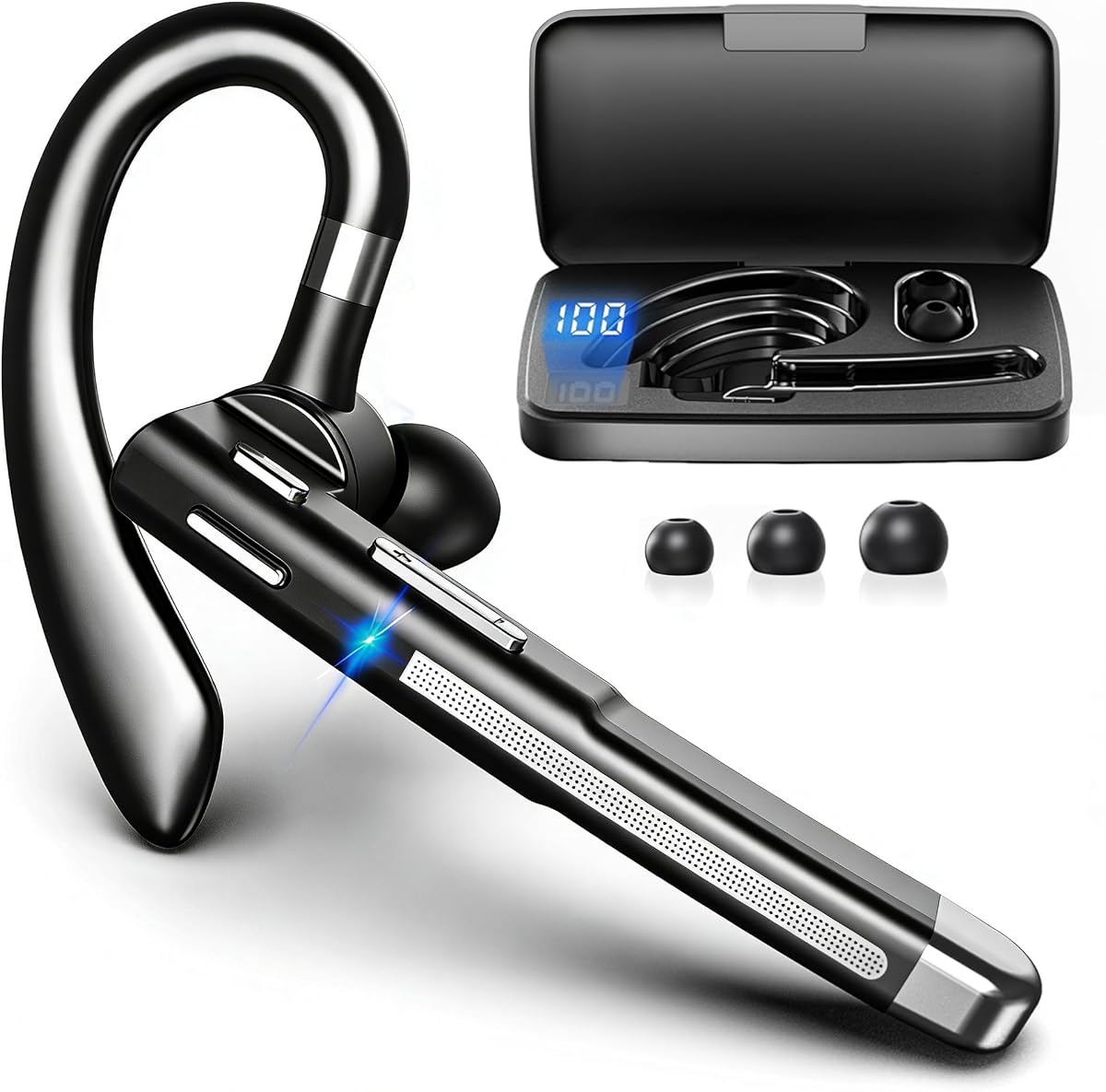
The Wireless Single Ear Bluetooth V6.1 Headset stands out with a 4.7 rating, the highest listed in this comparison. It combines modern Bluetooth 6.1 connectivity, dual-microphone environmental noise cancellation, a 100-hour charging case, physical controls, dual-device pairing, and IPX7 water resistance.
We may earn a commission when you buy through this link, at no additional cost to you.
Its ENC system is intended to reduce surrounding noise in locations such as highways, offices, warehouses, and busy streets. The portable case contributes up to 100 hours of total playback, and an intelligent LED display reports case power and headset charging status. That visibility helps prevent a headset from unexpectedly running out of power.
Physical buttons are a major usability strength. Users can answer calls, adjust volume, redial, activate Siri or Google Assistant, and use a dedicated mute control without relying on touch-sensitive surfaces that may trigger accidentally. The lightweight body, adjustable rotating hook, and multiple tip sizes support left- or right-ear use.
This is the strongest overall recommendation for people seeking a modern, feature-rich headset for work, driving, commuting, or field service. It is especially compelling for users who value call clarity, battery visibility, physical controls, and water resistance. The case adds carrying weight, and IPX7 should be understood as protection against sweat and water exposure rather than permission to submerge the device.
Bluetooth 6.1 is presented as providing faster pairing, stable connectivity, and low-latency audio. Those characteristics are valuable for users who move between calls, media, and notifications across a phone, tablet, or laptop.
Dedicated physical buttons are easier to operate blindly than many touch controls. They also reduce the chance of accidental activation while adjusting the headset or moving through a crowded commute.
We may earn a commission when you buy through this link, at no additional cost to you.
The G7 is built around endurance and visible power management. It has a 4.0 rating, a 500mAh charging case, 72 hours of stated music or talking time, 120 hours of standby, and a digital display that shows both headset and case charging status.
We may earn a commission when you buy through this link, at no additional cost to you.
Its call system uses a noise-canceling microphone, with the listing making a particularly strong claim about ambient-noise elimination. While that promise should be considered in the context of real environments, the dual-microphone and noise-reduction approach may be useful for truckers, office workers, and remote employees who regularly communicate in distracting settings.
The in-ear section rotates 45 degrees, the hook rotates 360 degrees, and the microphone arm rotates 180 degrees. A call-only mute button supports privacy, and multi-function controls enable voice-assisted calling. Three ear-tip sizes and a compact, lightweight build are intended to improve fit and reduce ear fatigue.
The G7 is a strong recommendation for buyers who want long combined runtime and can see the remaining charge at a glance. It supports two connected devices and works with iOS, Android, computers, PCs, and other Bluetooth-enabled equipment, making it versatile for mixed work setups.
The display reports charging status for both the headset and case, reducing the uncertainty that comes with indicator lights. This is valuable for people who carry the headset in a vehicle or bag and need to know whether it is ready for a full shift.
The rotating earpiece, hook, and microphone arm make it easier to find a secure and comfortable position. A dedicated call mute button and multi-function control offer direct access to essential communication functions.
We may earn a commission when you buy through this link, at no additional cost to you.
The Bluetooth 6.1 100-Hour Headset is one of the most technically detailed options in the guide. Its 4.4 rating is second highest in the group, and the product combines a 14.2-millimeter dynamic driver, 40-millisecond claimed latency, CVC8.0 noise reduction, dual-device connection, and a 500mAh case.
We may earn a commission when you buy through this link, at no additional cost to you.
Its standout media feature is the 40-millisecond latency claim, which is intended to keep sound and video closely synchronized. The single-ear format uses a 14.2-millimeter driver to provide bass, treble, and a stereo soundstage in one ear, making the headset suitable for music, gaming, calls, and video as well as voice communication.
Call handling is unusually comprehensive. The one-button multifunction design can answer, end, or reject calls, redial, and control media. A second-call function can put an active call on hold and swap between callers, while the mute button provides a quick way to silence the microphone.
The 12-gram body, three-point in-ear support, anti-slip grip, three tip sizes, retractable ear hook, and swiveling boom make the headset adaptable to either ear. A 500mAh case provides roughly 100 hours in total, and its digital gauge shows remaining power. This is an excellent recommendation for tech-oriented users who want more control than a basic one-button headset offers.
The stated 40-millisecond latency makes the headset relevant to users who alternate between calls, music, gaming, and video. A 14.2-millimeter driver adds fuller media performance than many small communication-oriented earpieces provide.
A dedicated mute control can manage a second incoming call, place the first on hold, swap between callers, reject a call, and end the second conversation. These functions are valuable for busy professionals who regularly handle overlapping calls.
We may earn a commission when you buy through this link, at no additional cost to you.
The most economical headset is not necessarily the most useful one. A sound purchase should match the intended environment, communication style, device setup, and physical preferences of the person who will wear it.
Single-ear headsets come in several physical formats. In-ear models are compact and use S, M, or L tips to create a seal, while open-ear models rest outside the ear canal and emphasize environmental awareness. Traditional on-ear headsets use a headband and padded cushion, which can feel stable during long shifts but usually adds more bulk. Consider whether the device will be used in an office, inside a vehicle, or during exercise, because an open design may be better for outdoor awareness while an in-ear or on-ear model may provide more conventional isolation.
In short, match the physical design to your environment and comfort preferences before comparing the remaining specifications.
A headset intended for calls should offer a clear microphone strategy. ENC, CVC, dual-microphone systems, and directional microphones are designed to reduce background noise, but none can guarantee perfect intelligibility in every environment. A dedicated mute button is useful for confidential or disruptive conversations, while a rotating boom microphone can make it easier to keep the microphone in a consistent position. Buyers who regularly talk from trucks, warehouses, streets, or busy offices should prioritize these call-focused features over maximum music playback.
In short, look for meaningful noise reduction, a well-positioned microphone, and easy mute access if calls are your primary use.
Battery specifications can be confusing because manufacturers may list headset runtime, case-assisted runtime, and standby time separately. For daily work, at least enough active power to cover a typical shift is desirable. A charging case extends the interval between wall-plug charges, while USB-C offers a widely used connection method. Pay attention to full-charge time as well, because a long runtime is less useful when the headset takes several hours to replenish. Digital battery displays are helpful because they let users judge readiness without relying on tone prompts or vague indicator lights.
In short, prioritize usable active runtime first, then consider case capacity, charging speed, and battery-status visibility.
Multipoint or dual-device pairing can connect the headset to two Bluetooth sources at the same time, such as a phone and laptop. This is especially useful for people who take calls while listening to computer audio or need to move between work and personal devices. However, the exact switching behavior can vary, so buyers should read the listing instructions and understand which controls are used to select a device. Some headsets also support voice assistants, allowing common actions to be performed without handling the phone.
In short, dual-device support is valuable for multitaskers, but verify the listed controls and compatibility before purchasing.
Comfort depends on weight, shape, ear-tip size, and adjustability. Lightweight earbud-style headsets can disappear during a call, while padded on-ear models distribute pressure differently over a long shift. Adjustable ear hooks and swiveling microphone arms help secure the device without forcing it into one position. Look for multiple tip sizes, left-or-right orientation, and skin-friendly materials. If glasses, hearing aids, or sensitive ears are part of your routine, the headset's dimensions and open or closed design become especially important.
In short, select a secure and adjustable fit, and favor lightweight materials for calls or workdays that extend beyond a few minutes.
Water-resistance ratings can make a headset better suited to commuting, exercise, delivery work, and outdoor calls. IPX5 indicates protection against water and sweat exposure, while IPX7 offers a higher level of water resistance. These labels do not mean every unit can be intentionally submerged, and they do not eliminate the need to dry the headset before charging. Users in wet environments should still avoid charging a wet device and should check the manufacturer's care guidance.
In short, use the IPX rating as an activity guide, not a guarantee against every form of water damage.
Compact earbud-style headsets are easy to carry and often include a small charging case, making them convenient for commuters and occasional office users. On-ear headsets generally look more like conventional business phones and may provide a more substantial cushion and headband. The larger format may be easier to position for extended conversations, but it is less discreet and takes up more room. Think about storage, clothing, vehicle space, and whether coworkers or customers are likely to see the headset during use.
In short, choose compactness for portability and discretion, or an on-ear frame for a more traditional and substantial work profile.
Physical buttons are easy to identify by touch and are less likely to activate accidentally than touch-sensitive surfaces. A headset may provide separate controls for calls, volume, playback, redial, voice assistance, and mute. Some models also add call-management functions for a second incoming call, which can be useful in busy offices. Buyers should avoid paying for a large number of controls if they will not remember the functions, so simplicity and placement matter as much as the count.
In short, favor clearly separated physical controls and the specific functions you actually use during calls and travel.
Begin by fully charging the headset and its case according to the supplied instructions. This helps establish a reliable baseline for battery performance and is particularly important for models that specifically recommend a full first charge. Remove the protective films from any case display, place the earpiece in the correct charging recess, and confirm that the charging indicator changes before the first use.
Pair the headset through the Bluetooth menu on the phone, tablet, or computer. Select the model name from the available-device list, then test the microphone, media controls, and volume synchronization. For a second device, complete the additional pairing procedure described in the manual. If computer audio is not recognized, check the input and output selection, and use a supplied USB dongle only when the instructions call for it.
For daily care, wipe the earpiece and silicone tips with a soft, dry or lightly dampened cloth, keeping moisture away from openings and charging contacts. Do not submerge the headset unless the manufacturer explicitly permits it, and let it dry fully before charging. Clean the ear tips regularly, store the device in its case, and avoid leaving it in extreme heat or moisture. Periodic checks of volume, mute behavior, microphone placement, and battery level can help identify issues before they interrupt an important call.
A single-ear headset is designed to leave one ear uncovered and usually includes one earpiece or one on-ear speaker. A true wireless headset generally has two independently wireless earbuds. The single-ear format is often preferred by drivers and office workers who need to hear their surroundings, while a true wireless set provides more conventional stereo listening. The right choice depends on whether situational awareness matters more to you than fully isolated two-ear audio.
Most Bluetooth headsets can connect to a computer that has Bluetooth capability, but the operating system must recognize the device as an audio input and output. Some models also include a USB dongle for computers without Bluetooth. With a dongle, the headset may need to be selected as M99+ in the computer's sound settings. Always check whether a product supports your operating system and whether the dongle is included.
For a typical office shift, a headset that provides at least a full workday of talk time is convenient. A charging case can extend total operation between wall-plug charges, sometimes to several dozen hours or more. Standby time is less useful for active calls because the headset is not consuming power in the same way. Consider both active runtime and charging speed, and look for a battery display if you dislike guessing when a recharge is needed.
Open-ear models can be better suited to activities where hearing the environment is important because they do not seal the ear canal. Their earhooks can also remain more stable during movement, and an IPX rating may add protection against sweat. They do not provide the same isolation as sealed earbuds, and users should remain alert to traffic and other surroundings even when audio is playing.
ENC and CVC refer to environmental or clear-voice processing intended to reduce background noise picked up by the microphone. Depending on the implementation, the system may use algorithms, multiple microphones, or directional pickup to make the user's voice more prominent. Results vary with traffic, wind, room echo, and speaking distance, so these features should be viewed as improvements rather than guarantees of perfect clarity.
A dedicated mute button can be valuable because it provides a quick, repeatable way to silence the microphone without navigating a phone menu. On several products in this guide, the mute function works only during a phone call. Users participating in computer-based meetings should verify whether the headset's mute control also applies to that application or whether the meeting software must be controlled separately.
A charging case is especially useful for people who use the headset throughout the workday but do not want to carry a cable and wall adapter. It can also provide a more secure place to store the small earpiece. Consider the case's size, battery gauge, and charging compatibility, and note that some products support wireless charging while others include only a cable or a USB-C connection.
Start by choosing the correct ear-tip size and positioning the earpiece so it sits securely without causing pressure. Rotate the hook or boom to place the headset according to its adjustable design, and use the included tips rather than forcing a loose fit onto the ear. Cleaning the tips and earpiece can also improve grip. If the headset repeatedly slips, consider a model with a more substantial on-ear cushion or an open-ear hook designed for active use.
The 10-Hour Single Earbud is the clearest budget-oriented choice for buyers who prioritize low weight, a discreet profile, and two-device connectivity. The Wireless Single Ear Bluetooth V6.1 Headset is the strongest all-around option, combining a high rating with modern wireless features, physical controls, ENC processing, a useful battery display, and IPX7 protection.
For people who work primarily on computers, the Sarevble USB Dongle Headset adds a valuable direct connection method and a 50-hour talk-time claim. Beyond those finalists, the D2 stands out for its digital display and extensive adjustability, the HEIBAS for its large charging case, and the Xmenha for its open-ear construction and exercise-oriented protection.
Before purchasing, confirm the physical fit, connection method, runtime, and controls against the intended use. Ratings and specifications can change over time, and prices vary between sellers, so check the current product listing and recent customer feedback before making the final decision.