
WEN DF475T Dual Fuel Generator
4.4Editor score
Gasoline and propane operation
120V and 240V outputs
Electric key start
Transfer switch compatible
Wheel kit included
Explore the best dual fuel generators, comparing wattage, runtime, outlets, fuel flexibility, safety features, and portability for home backup and travel.
Dual fuel generators offer practical flexibility by running on gasoline or propane, making them useful for home outages, jobsites, camping, and emergencies. The best model balances usable running power, clear controls, safe outlets, manageable size, fuel availability, and enough runtime to serve through an interruption rather than merely starting a short-lived power source.
This guide compares ten dual fuel generator listings on the specifications supplied by each manufacturer, including peak and running wattage, supported fuels, engine size, runtime, outlet configurations, starting methods, safety protections, and intended uses. The list includes compact inverter models, portable home-backup units, RV-oriented generators, and larger machines designed for transfer-switch applications.
Each numbered review identifies the strongest reason to consider a generator, along with its meaningful trade-offs. Ratings reflect the supplied customer feedback and are not based on personal testing. Specifications and availability can change, and marketplace prices fluctuate, so readers should confirm the current listing, manual, fuel requirements, and installation guidance before purchasing.
4.4Editor score

4.7Editor score

4.8Editor score
The table below compares the ten listed dual fuel generators by core power, fuel, connectivity, and practical-use characteristics, making the differences easier to evaluate before reading the detailed reviews.


The Westinghouse 12500-Watt Dual Fuel Home Backup Portable Generator earns the top position in this comparison because it combines substantial output, flexible fuel operation, remote starting, and a well-equipped outlet panel. Its supplied customer rating is 4.7, and the specifications position it as a capable backup machine for a home, RV, or job site without moving into the largest heavy-duty class.
We may earn a commission when you buy through this link, at no additional cost to you.
Power is substantial on gasoline, with 9,500 running watts and 12,500 peak watts. Propane output is 8,500 running watts and 11,200 peak watts, giving users a useful second fuel option while acknowledging the typical reduction in available power. The 457cc four-stroke OHV engine uses a cast-iron sleeve and includes automatic low-oil shutdown, while the digital VFT display provides voltage, frequency, and lifetime-hour information.
The outlet layout is especially practical for a home backup machine. It includes two 20-amp 120V GFCI household receptacles, a transfer-switch-ready 30A L14-30R outlet, and an RV-ready 50A 120/240V receptacle. The included remote key fob, 12V battery charger, oil, funnel, tool kit, and manual reduce setup friction, although minimal assembly is still required. A 6.6-gallon tank and fuel gauge support up to 12 hours of operation.
Its main trade-offs are size and weight compared with inverter or camping-oriented units. Buyers intending to move it frequently may find a smaller option easier to manage, while those needing abundant household power will appreciate the higher output and both 30A and 50A connections. It is best recommended for owners who want a capable, feature-rich dual fuel generator with remote starting and flexible home or RV use.
Westinghouse also states that its portable generators are functionally tested in the factory and may contain residual oil or fuel odor. EPA compliance and a three-year limited service, labor, and parts warranty add confidence. Because warranty terms and installation requirements can change, owners should verify the latest manual and coverage conditions before use.
The gasoline configuration provides enough running power for a meaningful mix of household essentials, while propane gives owners a convenient alternative when gasoline is unavailable or stored fuel is less convenient. The lower propane output should be considered when selecting appliances.
Remote electric starting reduces the need to return to the machine in poor weather, and the digital display gives users visible information about operating conditions. These features are especially helpful when the generator is positioned away from occupied areas or near a transfer-switch installation.
We may earn a commission when you buy through this link, at no additional cost to you.
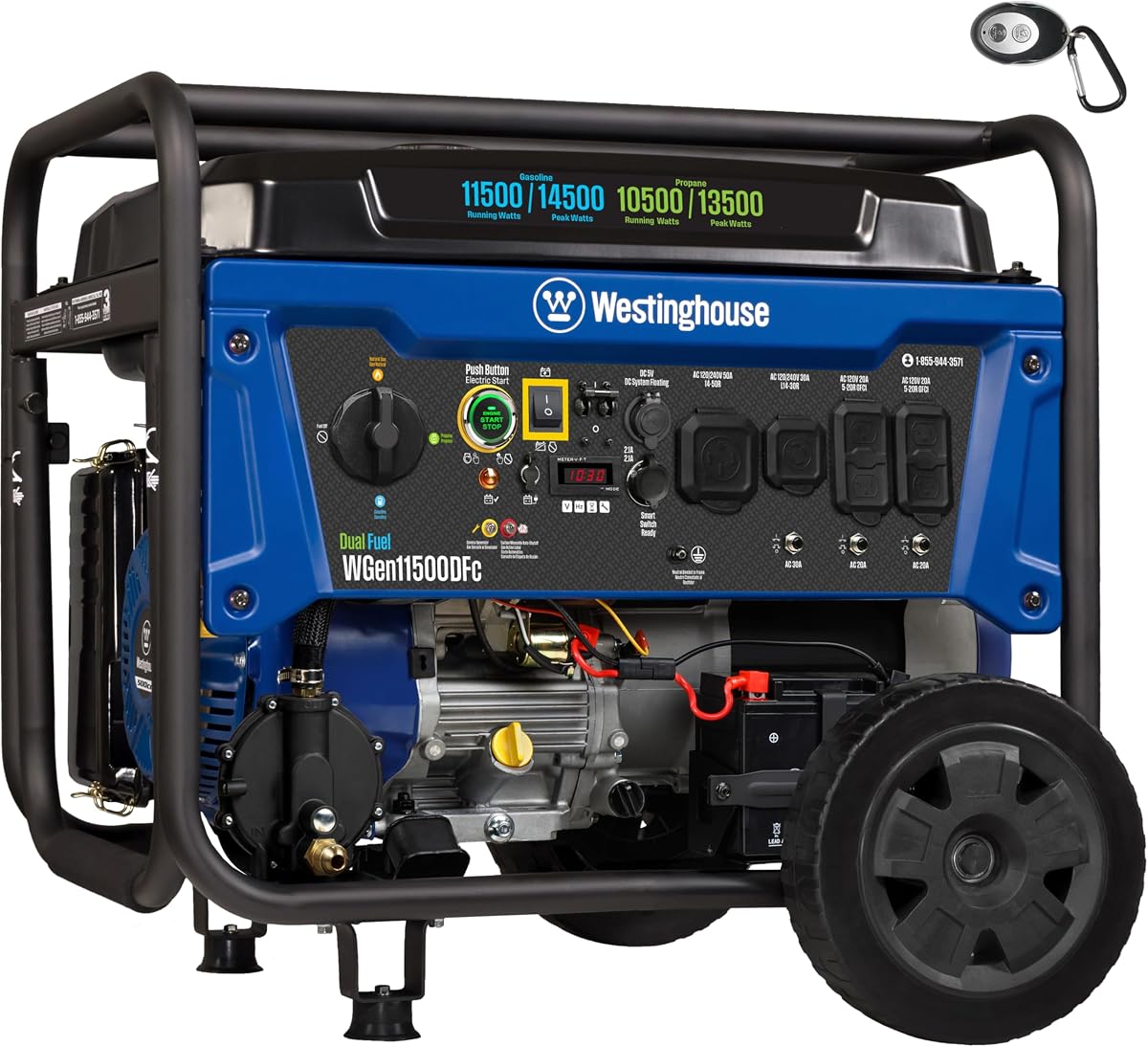
The Westinghouse 14500 Peak Watt Dual Fuel generator is the strongest high-capacity choice in this roundup, with 11,500 running watts on gasoline and 10,500 on propane. Its 4.6 rating reflects a favorable customer reception, while its output separates it from compact camping models and makes it more appropriate for larger homes or demanding portable applications.
We may earn a commission when you buy through this link, at no additional cost to you.
The 550cc four-stroke OHV engine is built around a durable cast-iron sleeve. Low total harmonic distortion is highlighted for use with sensitive electronics, allowing it to support phones, computers, televisions, and other household or job-site devices. Durable copper windings are also specified to help the generator produce cleaner power, operate more coolly, and withstand extended use.
Runtime is a major strength. The generator can run for up to 19 hours on its 9.5-gallon gasoline tank, which has a built-in fuel gauge, or up to seven hours on a 20-pound propane tank. Those figures make it better suited to extended outages than a small portable inverter, although actual duration depends on load, fuel, altitude, and operating conditions.
The trade-off is physical size. A 550cc engine, large tank, and home-backup output make this a substantial portable unit rather than a lightweight camping choice. Users must also select the correct electrical connection and meet local requirements for any transfer-switch installation. Installation should be performed according to the manual and applicable electrical codes by a qualified professional.
This model is recommended for buyers who prioritize capacity, long runtime, and clean output over portability. It offers a compelling step above the Westinghouse 12500-Watt model when the extra power and runtime justify the larger footprint, particularly for owners preparing a home for extended outages or needing portable power for equipment-intensive work.
A large fuel tank and claimed 19-hour gasoline runtime reduce the need for frequent refueling. Users should still maintain reserve fuel, rotate stored fuel appropriately, and monitor the gauge, especially during high-load operation or when the unit operates in changing weather.
The stated low-THD design and copper windings make this model more appropriate than a basic open-frame generator for computers, communications equipment, and household electronics. Users should still connect loads through properly grounded equipment and use surge protection where appropriate.
We may earn a commission when you buy through this link, at no additional cost to you.
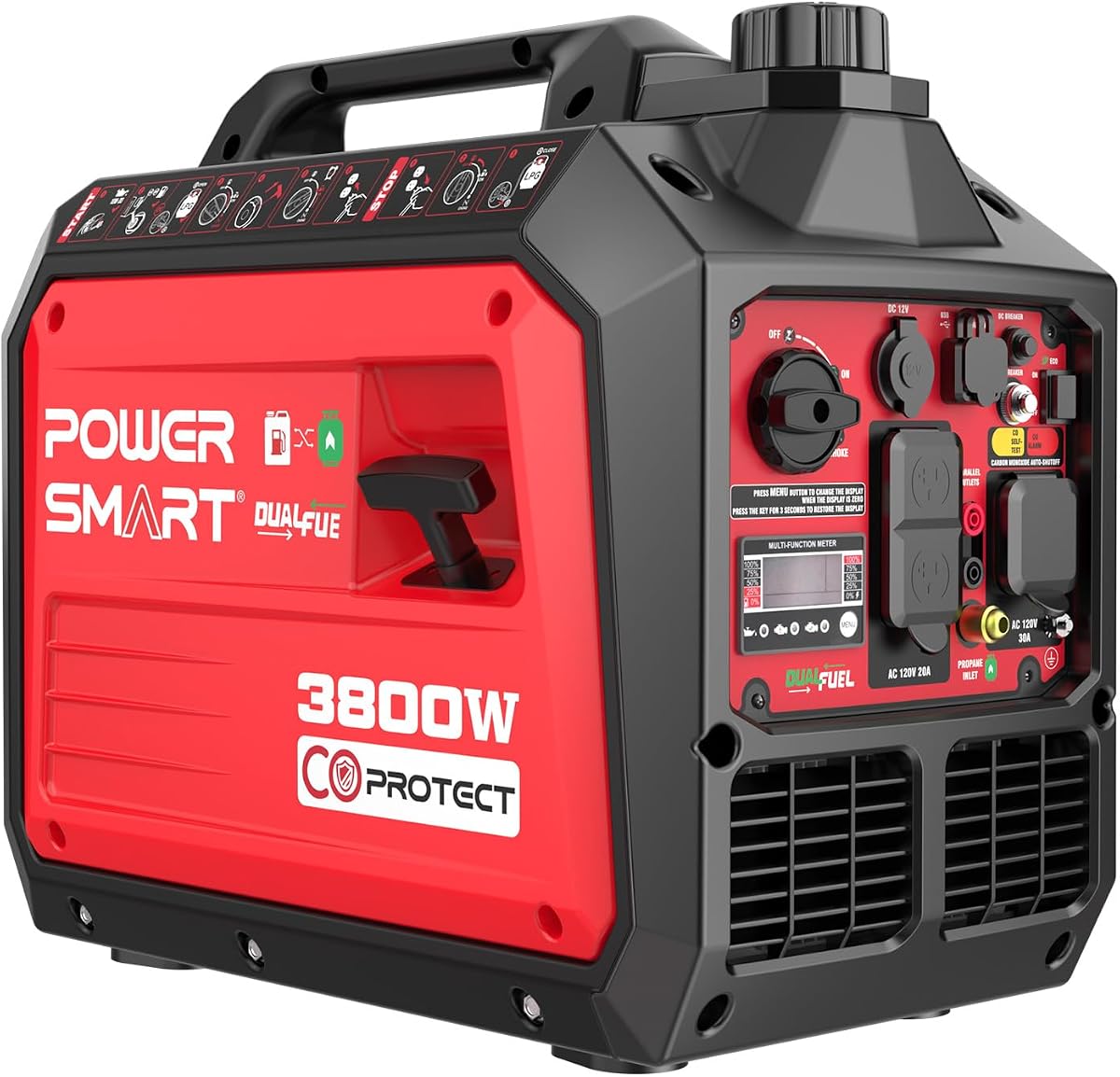
The PowerSmart 3800-Watt Dual Fuel Inverter Generator is the budget-conscious pick for buyers who prioritize portability, quiet operation, and useful low-load efficiency. Its supplied rating is 4.5, and the claimed 59 dBA operation at 25% load in Eco Mode makes it especially relevant to campsites, tailgates, small apartments, and neighborhoods where conventional generators may be intrusive.
We may earn a commission when you buy through this link, at no additional cost to you.
On gasoline, the unit delivers 3,300 running watts and 3,800 starting watts. On propane, it produces 3,100 running watts and 3,500 starting watts. That capacity is suitable for a selection of essential appliances, tools, and electronics rather than an entire large household. The inverter configuration also makes the model a better fit for sensitive devices than a typical high-output open-frame generator.
Fuel and runtime options are versatile. The 1.3-gallon gasoline tank can provide up to eight hours at 25% load, while a standard 20-pound propane tank can support up to 24 hours, with Eco Mode extending runtime further. Real-world results will depend on the connected load, ambient temperature, and fuel condition, so published figures should be treated as best-case operating claims.
Safety features include overload and short-circuit protection, a carbon monoxide sensor, and low-oil shutdown. The generator is certified to ANSI/PGMA G300, ANSI/UL2201, and EPA standards. Its control panel includes an L5-30R twist-lock outlet, a 120V 20A duplex outlet, a 12V 8A DC port, and two 5V 2.1A USB ports.
The limitation is straightforward: this is not a whole-home generator. Its lower output, relatively small gasoline tank, and limited high-load headroom make it best for portable use or a compact emergency-power plan. It is a strong recommendation for travelers and budget-conscious buyers who want dual fuel flexibility, low noise, and clean power without the size of a full-size backup unit.
The stated 59 dBA at 25% load shows that Eco Mode is designed for lower-demand use near occupied spaces. Sound levels rise with engine speed and output, so users should still place the generator outdoors at the distance recommended by the manual.
Household, twist-lock, DC, and USB outlets cover common portable-power needs. The inverter design is particularly useful for charging electronics directly, while the L5-30R connection adds flexibility for suitable 30A equipment.
We may earn a commission when you buy through this link, at no additional cost to you.
The DuroStar DS13000MX is a full-size dual fuel generator aimed at home backup, RV use, emergency preparation, and jobsites. Its supplied rating is 4.4, and the combination of 13,000 peak watts, 500cc engine, remote electric starting, and a 50-amp outlet gives it the broad utility expected from a larger portable generator.
We may earn a commission when you buy through this link, at no additional cost to you.
Dual fuel technology lets users choose gasoline for maximum output or propane for extended running and cleaner emissions. A front-facing fuel selector simplifies changing fuel sources, while push-button electric starting removes the need to pull a recoil cord. Those details matter when the machine is being operated in darkness, cold, rain, or after moving it into position.
Safety and readiness are emphasized through the CO Alert system, which automatically shuts the generator down if dangerous carbon monoxide levels are detected. The durable steel frame and reinforced power panel are designed to withstand heavy use and severe weather. Transfer-switch readiness and the 50A outlet allow the unit to serve as the power source for an appropriately installed home backup system.
As with any open-frame, high-output generator, noise, fuel consumption, and size are meaningful trade-offs. The listed 13,000 watts is a peak figure, and users should size actual loads against the generator's running and surge capability. The supplied information does not provide a full running-wattage figure, so the manual should be checked before planning a load schedule.
The DS13000MX is best for owners who want a flexible 50-amp generator with easy fuel switching and electric starting. It may be less attractive for quiet camping because its construction and engine size are oriented toward higher output rather than minimized sound. For emergency readiness, a transfer switch and suitable fuel storage should be planned at the same time as the generator purchase.
Electric starting and a front-facing fuel selector improve usability when a user needs to begin operation quickly. Keeping the machine accessible and operating it from a safe, ventilated outdoor location makes those convenience features more valuable.
The 50-amp outlet and transfer-switch-ready design provide a path to supplying selected household circuits. A qualified electrician should install any transfer equipment, and the generator must remain outside the home with exhaust directed away from doors, windows, and vents.
We may earn a commission when you buy through this link, at no additional cost to you.
The WEN DF475T stands out as a compact dual fuel generator that still supports 240-volt loads. It has a supplied rating of 4.4 and combines gasoline or propane operation with key electric starting, a 30A twist-lock connection, household GFCI outlets, and a wheel-and-handle kit.
We may earn a commission when you buy through this link, at no additional cost to you.
Gasoline operation provides 3,800 running watts and 4,750 surge watts. Propane lowers those figures to 3,500 running and 4,350 surge watts. A simple selection dial changes the fuel, while a voltage selector allows users to choose 120V or 240V output. That flexibility makes the unit useful for selected household backup needs, RV equipment, and larger tools that require 240V.
The 224cc four-stroke OHV engine starts electrically, avoiding the effort of a recoil pull on a frequent-use machine. Its 4-gallon tank is rated for up to 11 hours at half load, giving it a more conventional portable-generator runtime than many small inverter units. Actual runtime will fall when operating near maximum capacity or under difficult conditions.
Connectivity includes two 120V GFCI 5-20R outlets, a 120V/240V NEMA 30A L14-30R twist lock, and a 12V DC cigarette-lighter-style plug. The package also includes oil, a wheel and handle kit, a 47-inch LPG connection hose, and a two-year warranty. These included accessories make the initial setup more straightforward.
The chief limitation is output relative to full-size backup units. Buyers should add starting surges when calculating the loads they intend to connect, especially if motors, compressors, or power tools start simultaneously. The DF475T is a strong fit for buyers who want more voltage flexibility than a compact inverter generator without carrying a large home-backup machine.
The voltage selector and L14-30R connection allow the generator to serve both ordinary household devices and suitable 240V loads. Users should verify that each appliance's voltage, amperage, and surge requirements match the selected output.
The wheel kit and handle improve movement, while electric starting is convenient for repeated use. The included LPG hose and oil reduce the chance that essential setup items are missing on arrival, though users should still inspect and prepare the generator before operation.
We may earn a commission when you buy through this link, at no additional cost to you.
The DuroMax XP13000EH is a rugged, high-output dual fuel generator intended for whole-home backup, RV use, emergency preparation, and mobile jobsite power. Its supplied customer rating is 4.5, and the 13,000-watt peak classification places it alongside the largest portable options reviewed here.
We may earn a commission when you buy through this link, at no additional cost to you.
The model is designed around a heavy-duty DuroMax engine and a heavy-duty all-metal frame and power panel, with no plastic parts in the stated construction. Copper windings are used to provide better heat conduction and support longer service life. These are meaningful attributes for buyers who view a generator as long-term emergency equipment rather than occasional recreational gear.
A push-button start and front-facing interface allow operation and fuel changes without complicated procedures. The outlet selection includes a transfer-switch-ready 50A connection, giving users the option of connecting the unit to a professionally installed transfer switch. The generator is also designed for RV and jobsite versatility, where mobility and multiple connection types are useful.
No-flat tires are intended to make the heavy machine easier to roll across varied ground. That feature does not change the substantial effort involved in moving a 13,000-watt-class generator, however. The open-frame design also leaves the engine and components exposed, and it should never be operated in an enclosed space.
The XP13000EH is recommended for buyers who need rugged construction, a 50A connection, and dual fuel flexibility more than quiet inverter operation. Prospective owners should confirm running-wattage requirements, noise expectations, and local transfer-switch rules. As with all high-output machines, careful load management and safe outdoor placement are essential.
The all-metal frame, reinforced panel, copper windings, and no-flat tires are aimed at repeated use and mobility. These construction details are especially relevant for buyers storing a generator for emergencies and moving it between a garage, campsite, or jobsite.
The 50A outlet supports transfer-switch-oriented installations, while additional outlets serve RV and jobsite equipment. Users should match connector ratings and switch positions to each load and never depend on an outlet the generator is not rated to support.
We may earn a commission when you buy through this link, at no additional cost to you.
The Westinghouse 14500 Peak Watt Tri-Fuel generator is the most flexible fuel choice in the roundup because it operates on gasoline, propane, and natural gas. Its supplied 4.8 rating is the highest among the products with usable rating data, while its 14,500-watt peak capacity places it firmly in the home-backup class.
We may earn a commission when you buy through this link, at no additional cost to you.
Running power varies by fuel. Gasoline delivers 11,500 watts, propane delivers 10,500 watts, and natural gas delivers 9,500 watts. Peak outputs are 14,500, 13,500, and 12,000 watts, respectively. This tiered approach lets owners prioritize maximum power, storage convenience, or access to household natural-gas supply according to the circumstances.
The 550cc four-stroke OHV engine includes a durable cast-iron sleeve. The generator can run for up to 19 hours from its 9.5-gallon gasoline tank and up to seven hours on a 20-pound propane tank. Low total harmonic distortion is specified for sensitive electronics, and copper windings are intended to support clean output, cooler operation, and durability.
The extra natural-gas option creates a distinct trade-off. Users need suitable natural-gas supply equipment and a compatible connection arrangement, and the listed runtime information does not include a natural-gas figure. The machine is also large and intended for a home-backup setting rather than handheld portability. Transfer-switch readiness should be handled by a qualified installer.
This model is a strong recommendation for homeowners who want the widest fuel choices in a high-output unit. It is particularly relevant where natural gas remains available during an outage and gasoline or propane storage is inconvenient. Buyers should compare it with the dual-fuel Westinghouse 14500 model and consider whether the added natural-gas capability justifies the extra setup.
Gasoline, propane, and natural gas give owners multiple fallback paths when one fuel source is inconvenient or unavailable. Each fuel changes the available output, so appliance planning should use the running wattage of the fuel that will actually be used.
Remote electric start, low-THD output, a fuel gauge, and transfer-switch readiness support a more convenient backup installation. Westinghouse also states that the generator is EPA compliant and backed by a three-year limited service, labor, and parts warranty.
We may earn a commission when you buy through this link, at no additional cost to you.
The WEN DF680iX is a dual fuel inverter generator designed for RV use, emergency power, and electric-vehicle backup. Its supplied rating is 4.4, and it combines 6,800 surge watts on gasoline with a bonded-neutral 240V configuration that provides low-power Level 2 charging for compatible battery and hybrid electric vehicles.
We may earn a commission when you buy through this link, at no additional cost to you.
Gasoline operation provides 5,100 rated watts and 6,800 surge watts. Propane reduces those figures to 4,500 rated and 6,000 surge watts. Because EV charging draws substantial current, buyers must verify their vehicle's supported charging method, power requirements, and whether the generator's 240V configuration meets the vehicle's requirements.
RV users benefit from a TT-30R RV receptacle along with an L14-30R 120V/240V receptacle and two 120V three-prong receptacles. A 12V DC receptacle and two 5V USB ports add options for accessories and electronics. The tool-free LPG quick connector, six-foot regulator hose, onboard wheels, and telescoping pull handle improve setup and mobility.
Safety and maintenance features distinguish the unit. The WEN Watchdog carbon monoxide sensor automatically shuts off the generator when dangerous levels are detected. Fuel shutoff uses remaining fuel in the carburetor before shutdown, which is intended to reduce maintenance and help protect the engine.
The main limitation is that EV backup capability is not universal. A generator supplying a vehicle must also provide appropriate grounding and connection methods, and users should consult both manuals. The DF680iX is recommended for RV owners, compatible EV owners, and households seeking a portable inverter with both gasoline and propane flexibility.
The bonded-neutral 240V setup makes low-power Level 2 charging possible for supported battery and hybrid electric vehicles. It is not a substitute for every public charging solution, and compatibility should be confirmed before relying on the generator during an outage.
The TT-30R outlet, L14-30R connection, wheels, and telescoping handle align with common RV and portable-power needs. The tool-free propane quick connector simplifies hookup, while the separate regulator hose and fuel shutoff system support practical field use.
We may earn a commission when you buy through this link, at no additional cost to you.
ASIN B099KS71QX appears in the supplied dual fuel generator list, but the source data provides no product title, description, rating, image, wattage, runtime, engine details, outlet configuration, or safety features. That makes a confident feature-level assessment impossible from the information available for this guide.
We may earn a commission when you buy through this link, at no additional cost to you.
The listing should be treated as a research lead rather than a recommended purchase. Before considering it, a buyer would need to open the Amazon product page and verify the exact model, manufacturer, starting method, running and surge output, supported fuels, outlet ratings, runtime, warranty, and intended applications. It would also be necessary to compare those details against the better-documented products in this roundup.
A dual fuel label alone does not establish suitability. A compact inverter, RV-ready model, and 13,000-watt home-backup generator can all fit the broad category while offering dramatically different capabilities. Without supplied specifications, it is impossible to determine whether this ASIN offers a 30A connection, quiet operation, remote starting, carbon monoxide protection, or enough runtime for an outage.
There is also no basis for assigning a customer rating or making claims about reliability, noise, build quality, or ownership experience. The linked page should be checked for current availability and manufacturer information, and buyers should review the product manual and any applicable safety certifications directly.
Our recommendation is therefore cautious: do not choose this listing based on the rank or category placement alone. Confirm that it meets your required running watts, surge capacity, fuel connection, noise, and placement requirements, and favor an option with clearly documented specifications if any essential information remains unavailable.
Check running and surge wattage on both fuels, available outlet types, engine starting method, and rated runtime. These details determine whether the unit can support the intended equipment and how often it will need refueling.
A product with clear specifications is easier to assess and support than an otherwise comparable listing with missing data. Use the documented picks as a benchmark for the features and specifications expected in a competitive dual fuel generator.
We may earn a commission when you buy through this link, at no additional cost to you.
ASIN B0D3WW1CSQ is included as the tenth dual fuel generator listing, but the supplied record contains no title, rating, image, description, or specifications. As a result, this review cannot responsibly characterize its capacity, runtime, outlets, engine, safety equipment, or suitability for any specific use.
We may earn a commission when you buy through this link, at no additional cost to you.
The most useful next step is to open the linked Amazon page and identify the current product. Buyers should locate the manufacturer and model number, then verify peak and running output on each supported fuel. They should also check whether the unit is a conventional generator or an inverter, because that distinction affects noise, load response, and compatibility with sensitive electronics.
Installation considerations are equally important. A unit intended for home backup should be evaluated for transfer-switch readiness, connector types, grounding, and the availability of qualified local installation. A camping or RV model should be checked for wheel and handle design, low-load sound ratings, ventilation clearance, and propane connection hardware.
The absence of a supplied rating also prevents any meaningful customer-feedback comparison with the other nine entries. Reliability claims, fuel economy, and user experience should not be inferred from an ASIN alone. A complete product page, manufacturer manual, warranty statement, and verified customer feedback are needed before making an informed decision.
This entry is not a strong recommendation on the available evidence. It may become a suitable option once its specifications are confirmed, but the safer buying path is to compare it with a model whose power, runtime, safety systems, and outlet selection are clearly documented. Verify the live listing rather than assuming it offers the same capability as higher-ranked models.
Begin with the live product page and manufacturer documentation because the supplied record contains no model identity. Confirm the engine type, fuel system, starting method, and whether any included accessories or certifications are explicitly documented.
List the essential devices, their running watts, and their starting surges before comparing this listing with the documented options. A larger peak number does not guarantee better performance if running output, connectors, or runtime are insufficient for the planned load.
We may earn a commission when you buy through this link, at no additional cost to you.
The right dual fuel generator depends on the loads you need to support, where it will operate, how you will move it, and which fuels you can reliably store. Comparing the following factors helps prevent an expensive mismatch between a large home-backup machine and a compact camping unit.
Choose a generator with comfortable continuous headroom, not merely enough peak capacity for a single large appliance. In a home, prioritize the essential circuits you intend to back up and calculate the connected load in watts or amps. A unit running near its maximum for long periods may run hotter, consume more fuel, and have less margin for another device.
Choose based on fuel access and storage as well as headline power. Gasoline generally offers the highest output and can be replenished readily, while propane is often easier to store and can support longer operation on a standard cylinder. Confirm the fuel tank capacity, propane-cylinder compatibility, hose or connector type, and the manufacturer's fuel-switching procedure before buying.
For short outages, essential-appliance use, or camping, the rated runtime may be adequate. For overnight or multi-day backup, prioritize a large tank, easy refueling, and access to additional fuel. Never store fuel in an unapproved container or near ignition sources, and follow local storage and safety rules.
Home buyers should distinguish ordinary extension cords from a professionally installed transfer switch. Transfer-switch readiness means the generator provides the correct connection, not that the entire installation is included. A qualified electrician should handle any transfer equipment, grounding, and panel connections, while the generator remains outdoors.
Choose an inverter unit for quiet, electronic loads and a conventional high-output unit for tools, pumps, or whole-home circuit support. Even with clean power, surge protection and properly grounded equipment remain sensible. Check the generator's continuous and surge ratings before adding several sensitive devices.
Consider the noise environment and required safety clearance together. Open-frame models need more airflow and offer less weather protection than enclosed inverter units. Check the manual for the manufacturer's placement guidance, and never run a generator in a garage, basement, enclosed porch, or vehicle interior, even with a door or window open.
Prioritize a model whose safety features are explicitly documented, and confirm whether a CO sensor shuts the unit down or merely indicates a warning. A fuel shutoff system can reduce carburetor residue, while low-oil protection helps prevent engine damage. Keep the generator level, inspect the air filter and spark plug as directed, and use only the fuel and oil specified by the manufacturer.
Check whether the package includes an LPG hose, wheel kit, oil, funnel, battery charger, tool kit, and remote control. These items improve the first-use experience, but ownership also requires safe fuel storage, regular exercise, and a service kit. A model that is too heavy for the user to reposition safely is a poor choice regardless of its output.
Before first use, read the complete manual, identify the fuel and oil specifications, inspect the generator for shipping damage, and confirm that the air filter, fuel system, and exhaust are unobstructed. Place the machine outdoors on a stable, level surface at the clearance distance required by the manufacturer. Connect loads before starting, and make sure the selected voltage, fuel, and switch positions agree with the equipment being powered.
Start the generator according to its instructions, allow it to stabilize, and confirm that the output indicators and connected devices are operating normally. Add loads gradually rather than connecting several high-surge appliances at once. For a transfer-switch installation, operate the generator through the transfer equipment in the sequence specified by the electrician and manufacturer. Never connect the generator directly to household wiring without proper transfer equipment and qualified installation.
For ongoing care, shut down connected loads, follow the prescribed shutdown sequence, and let the engine cool before maintenance. Rotate or replace stored fuel according to the manual, inspect the air filter, clean the generator, check the oil level, and exercise the unit periodically as directed. Carbon monoxide alarms, smoke detectors, fire extinguishers, and properly stored fuel improve emergency readiness, but they do not make indoor generator operation safe.
Dual fuel generators add operating flexibility because they can use gasoline or propane, which can provide a useful backup when one fuel is unavailable. Gasoline usually offers higher output, while propane is convenient to store and can provide longer operation on a standard cylinder. The right choice depends on fuel access, storage space, runtime needs, and the generator's ratings on each fuel.
The correct size depends on which loads you want to operate and their starting surges, not simply the number of bedrooms in a house. List essential appliances and calculate their combined running watts, then add a reasonable margin for motor startup and future equipment. A transfer-switch-ready unit can support selected circuits, but the installation should be completed by a qualified electrician.
A dual fuel generator can run a refrigerator if its running and surge ratings cover the appliance and other connected loads. Refrigerators may require meaningful startup power even though their running draw is lower. Use the generator's lower fuel-specific rating for planning, and give loads room to start separately when practical.
Gasoline generally provides more power and can be replenished at many fuel stations, but it requires careful storage and can deteriorate. Propane is easier to store in approved cylinders and may run longer on a cylinder, though the generator usually produces less power. Availability during an emergency and the home's safe storage capacity should guide the choice.
Generators should operate outdoors with exhaust directed away from doors, windows, and vents, following the clearance requirements in the manual and advice from local authorities. Exact distance can depend on the model, wind, and local guidance, so the manufacturer's instructions take priority. Never rely on opening a door or window to make indoor use safe.
Inverter generators are generally better suited to sensitive electronics because they regulate output more precisely. Models with documented low total harmonic distortion offer additional reassurance. Surge protection, properly grounded equipment, and correct load sizing are still important, and no generator should be operated indoors.
Follow the manufacturer's schedule for oil changes, air-filter inspection, spark-plug service, fuel-system care, and operational checks. Periodic exercise can help identify starting or fuel problems, but maintenance should not be performed while the engine is hot. Store fuel and the generator in accordance with the manual and local fire and environmental rules.
No. Transfer-switch-ready indicates that the generator has a compatible connection for use with a transfer switch. It does not mean the switch, panel wiring, or installation is included. A qualified electrician should select and install the proper equipment according to local electrical codes, and the generator must still operate outdoors.
The Westinghouse 12500-Watt is the most balanced overall pick, combining 9,500 gasoline running watts, 8,500 propane running watts, remote starting, strong outlet options, and a 4.7 rating. The PowerSmart 3800-Watt is the budget and quiet-operation choice for portable use, while the Westinghouse 14500 Tri-Fuel offers the widest fuel flexibility and the highest supplied rating among fully documented models.
For larger homes, compare the high-output Westinghouse, DuroStar, DuroMax, and WEN 240V models by running output, connection type, transfer-switch readiness, and installation requirements. For camping, RV travel, or electronic devices, prioritize inverter design, low-load noise, manageable weight, and compatible outlets rather than headline peak wattage.
Before purchasing, verify the current Amazon listing, manufacturer manual, warranty, fuel-connection details, safety certifications, and available accessories. Marketplace prices and specifications can change, so compare current offers carefully. The right generator is the one that safely supports your planned loads, uses fuel you can obtain, and fits the places where it will be stored and operated.