
ASUS ROG Strix G16
4.4Editor score
RTX 5060 Blackwell GPU
165Hz FHD+ display
Advanced ROG cooling
Gaming laptops with RTX 40 Series graphics combine capable NVIDIA laptop GPUs with high-refresh displays, modern processors, and portable PC designs. The right model depends on more than GPU power: screen quality, cooling, memory, battery behavior, build quality, and keyboard feel can materially affect everyday gaming and productivity.
This guide compares ten RTX 40 Series systems from MSI, ASUS, HP, Acer, and Lenovo using the supplied specifications, including graphics capabilities, processor hardware, display measurements, memory, storage, networking, and design features. It covers everything from more affordable RTX 4050 laptops to higher-tier RTX 4060 and RTX 5060 configurations.
Each review explains the strongest reasons to consider the laptop, along with practical trade-offs visible in its specifications. The selections show how performance priorities, display preferences, and portability needs shape the best choice. Product listings and prices can change, so confirm the current configuration and listing details before purchasing.
4.4Editor score

4.6Editor score

4.2Editor score
As an Amazon Associate we earn from qualifying purchases.
The table below compares the ten laptops by graphics tier, processor, display, and core platform specifications, making it easier to identify the model that best matches your games, screen preferences, and productivity needs.




The MSI Thin 15.6 pairs an NVIDIA GeForce RTX 4060 laptop GPU with a Core i5-13420H processor, creating one of the more balanced configurations in this guide. Its 4.6 rating reflects a broadly appealing mix of discrete graphics, a 144Hz display, and a portable 15.6-inch form factor. It is particularly relevant to buyers who want an RTX 40 Series laptop without moving into a larger premium chassis.
We may earn a commission when you buy through this link, at no additional cost to you.
The RTX 4060 includes 8GB of dedicated laptop GPU memory, giving it more headroom than the 6GB RTX 4050 models for modern games, creative applications, and higher texture settings. The 144Hz FHD thin-bezel IPS panel is a particularly useful specification because it combines a familiar resolution with a refresh rate well suited to competitive shooters, action games, and general desktop use. The Core i5-13420H supplies enough multi-core capability for gaming, streaming, and routine content work.
Memory and storage represent the main compromises. The machine has 16GB of DDR4 rather than DDR5, and its 512GB NVMe SSD may become crowded once major games, updates, creative files, and applications are installed. These are real limitations for a system bought for several years, but they do not undermine its central appeal: a capable RTX 4060 in a relatively restrained chassis. Users needing more room can consider a model with a larger supplied SSD, while the DDR4 platform remains adequate for the core target audience.
This laptop suits players who want stronger graphics than an RTX 4050 system provides but do not need the highest-tier display, elaborate lighting, or more advanced cooling found in premium gaming notebooks. It is also a sensible choice for students or professionals who need one capable machine for gaming and productivity. For those priorities, the MSI Thin is a compelling all-round recommendation, especially when a 144Hz panel and RTX 4060 capability matter more than maximum storage.
The 8GB RTX 4060 is the central reason to consider this MSI over an RTX 4050 alternative. It offers a stronger graphics tier while retaining a conventional 15.6-inch format, making the configuration accessible without requiring the bulk of a large enthusiast gaming laptop.
The 144Hz FHD IPS screen offers a useful balance for competitive and cooperative play. Full HD keeps the GPU focused on frame delivery, while 144Hz provides a smoother experience than a conventional 60Hz panel.
We may earn a commission when you buy through this link, at no additional cost to you.
The 2025 ASUS ROG Strix G16 is the most advanced configuration in this roundup, combining the RTX 5060 laptop GPU with a Core i7-14650HX and a 16-inch 165Hz display. Its 4.4 rating reflects a premium package built around NVIDIA Blackwell architecture, DLSS 4, Max-Q technologies, and an extensive cooling system. It targets buyers who want the strongest graphics specification available among the supplied RTX 40 Series selections.
We may earn a commission when you buy through this link, at no additional cost to you.
The RTX 5060 is the centerpiece, supported by a high-end mobile processor and 16GB of DDR5-5600MHz memory. The supplied 1TB PCIe Gen 4 SSD gives the system more room for a modern game library than many competing configurations. Visuals are handled by a 16:10 FHD+ panel with a 165Hz refresh rate and 3ms response, while an ACR film is intended to enhance contrast and reduce glare. Wi-Fi 7 adds another current-generation feature for compatible networks and peripherals.
Thermal engineering is unusually thorough for this class. ASUS describes an end-to-end vapor chamber, three fans, and Conductonaut Extreme liquid metal on the chipset, all intended to support sustained performance and manageable noise. The trade-off is that a premium ROG chassis is larger and more elaborate than a conventional entry-level gaming notebook. Buyers must also accept only 16GB of initial memory, even though 1TB of storage and powerful graphics create a platform that can be upgraded further depending on the exact configuration.
The Strix G16 is ideal for enthusiast players who want the newest available RTX graphics in this comparison and value display response, cooling, connectivity, and customizable lighting. It is less compelling for someone seeking a small, understated laptop or a strict entry-level configuration. Subject to your preference for a large, feature-rich gaming notebook, it is the premium recommendation of the group.
RTX 5060 support brings the newest NVIDIA generation represented in the guide. DLSS 4 and Max-Q technologies can improve performance efficiency, while the Blackwell platform offers a clear step up from the RTX 4050 and RTX 4060 models included here.
The combination of a vapor chamber, tri-fan arrangement, and liquid-metal compound supports ASUS's goal of sustained gaming performance. These details are especially relevant for a high-power system expected to run demanding games for extended periods.
We may earn a commission when you buy through this link, at no additional cost to you.
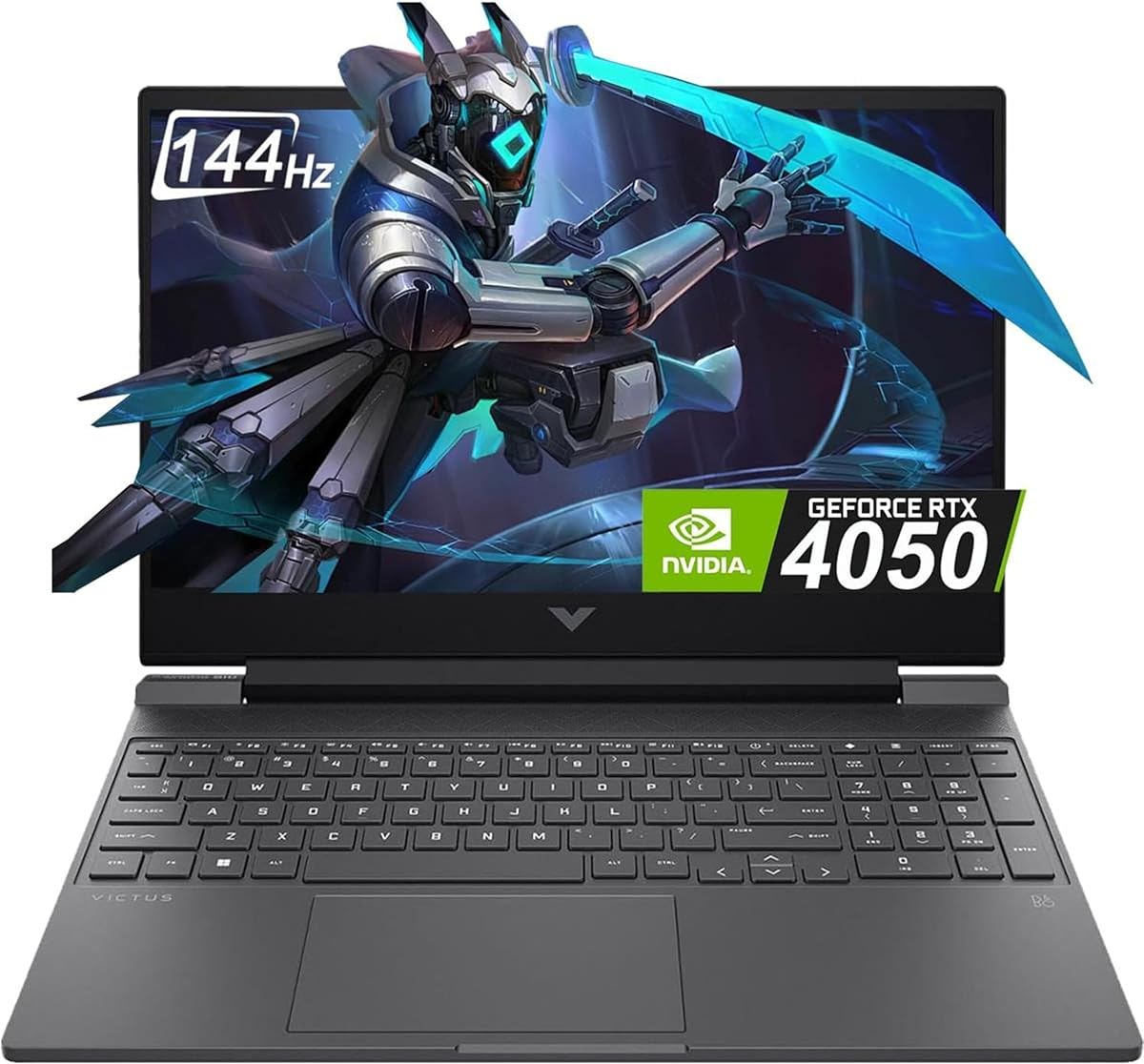
This HP Victus stands out through its unusually generous 32GB of DDR5 memory, 1TB SSD, Ryzen 7 7445HS processor, and RTX 4050 graphics. It carries the highest listed rating in the group at 5.0, although ratings should not be treated as a substitute for judging fit, thermals, and display quality. On specifications alone, it is one of the most complete conventional configurations for gaming and everyday productivity.
We may earn a commission when you buy through this link, at no additional cost to you.
The Ryzen 7 7445HS provides six cores and 12 threads with speeds up to 4.7GHz, while the RTX 4050 supplies 6GB of dedicated GDDR6 memory and technologies such as DLSS 3 frame generation. The 15.6-inch FHD IPS display runs at 144Hz and includes AMD FreeSync Premium, a solid combination for fast-paced games. The 32GB memory configuration gives it an advantage over most rivals when multitasking many applications or working with larger projects.
Connectivity is another strength. The specifications include Wi-Fi 6E, Bluetooth 5.3, Gigabit Ethernet, two USB-A ports, USB-C with DisplayPort and Power Delivery, HDMI 2.1, and an audio jack. A backlit keyboard, DTS:X Ultra spatial audio, 720p camera, dual-array microphones, and OMEN Gaming Hub broaden its appeal. The trade-offs are a 300-nit display that may be less vivid outdoors, and an RTX 4050 limited to 6GB of graphics memory.
Choose this Victus if memory capacity, storage, processor performance, and connectivity matter more than having the latest GPU. It is a strong fit for gamers who also study, stream, edit, or work, and it avoids the 8GB memory and 512GB storage limitations found on some lower configurations. The included Ryzen platform and 32GB RAM make it particularly attractive as an all-purpose system, although the display brightness deserves consideration in bright environments.
Thirty-two gigabytes of DDR5 RAM gives this Victus considerable headroom for gaming, browser use, streaming applications, and creative software running together. It is a meaningful advantage over the standard 16GB configuration offered by most competitors.
Wi-Fi 6E, Bluetooth 5.3, Gigabit Ethernet, HDMI 2.1, and a USB-C port with DisplayPort and Power Delivery provide useful options for gaming, peripherals, and external displays.
We may earn a commission when you buy through this link, at no additional cost to you.
This Victus 15 combines the Ryzen 7 7445HS and RTX 4050 with a 15.6-inch 144Hz FHD display, placing it among the more straightforward high-refresh gaming configurations. Its 4.4 rating indicates a generally well-received platform, while the supplied details emphasize performance, cooling, and productivity features. The six-core processor reaches up to 4.7GHz and works with 16GB of DDR5 memory and a 512GB SSD.
We may earn a commission when you buy through this link, at no additional cost to you.
The RTX 4050 uses the Ada Lovelace architecture and supports DLSS 3 frame generation, ray tracing, AV1 encoding, and NVENC acceleration. Those features make it suitable for modern games as well as streaming and content creation. A 144Hz FHD panel, micro-edge bezels, anti-glare treatment, and 300-nit brightness give the screen a sensible competitive-gaming focus, while support for two external monitors expands workspace options.
The main limitations are familiar: 512GB of storage can fill quickly, and 16GB is less generous than the 32GB configuration offered by another Victus in this guide. The listing also states that the computer was resealed to upgrade its memory and SSD, with warranty terms provided for the upgraded components and remaining parts. That disclosure should be considered when comparing the system with factory-configured alternatives.
This model is a sensible target for players who value a capable processor, a high-refresh FHD display, and a 6GB RTX GPU without moving to a larger 16-inch chassis. It also suits creators who appreciate hardware encoding and accelerated applications. Buyers seeking greater storage should plan accordingly, but for gaming, streaming, and general use, the core specification is balanced and appealing.
The RTX 4050's 6GB of dedicated GDDR6 memory is sufficient for many mainstream titles when texture quality and ray-tracing settings are managed sensibly. DLSS 3 frame generation and Ada Lovelace features add flexibility for both play and creation.
The Ryzen 7 7445HS, 16GB of DDR5, Windows 11 Home, a 720p webcam, and a backlit keyboard make this more than a dedicated gaming device. OMEN features and fast charging support a mixed gaming-and-work routine.
We may earn a commission when you buy through this link, at no additional cost to you.
The earlier ASUS ROG Strix G16 configuration pairs an RTX 4060 with a Core i7-13650HX, a 165Hz FHD display, and 1TB PCIe Gen 4 SSD. With a 4.4 rating, it offers a strong premium-gaming proposition for buyers who want 8GB of graphics memory without moving to the newer RTX 5060. The ROG platform emphasizes both sustained performance and display quality.
We may earn a commission when you buy through this link, at no additional cost to you.
ASUS specifies up to 140W maximum total graphics power for the RTX 4060, a useful detail for a performance-oriented laptop. The system also includes Thermal Grizzly Conductonaut Extreme liquid metal on the CPU and a third intake fan, supporting its goal of stable performance during long sessions. The 165Hz panel is listed with 100% sRGB coverage and Pantone Validation, making it appealing for games and color-sensitive work.
The 16GB of DDR5-4800MHz memory is modest beside the 1TB storage and powerful processor, particularly for buyers who want to retain the laptop for many years. The 16-inch display and ROG chassis also occupy more space than a conventional 15.6-inch notebook. Nevertheless, these are trade-offs associated with a premium gaming design rather than flaws in its core gaming proposition.
This Strix G16 is best for players who want a high-refresh 16-inch screen, a powerful Core i7, and an RTX 4060 configured for strong sustained performance. It is also suitable for game streaming, video creation, and other graphics-accelerated work. Choose it when display quality and chassis capability matter more than a smaller footprint or more than 16GB of initial memory.
A 140W maximum GPU power target and advanced thermal materials indicate that this notebook is designed to run its RTX 4060 at a comparatively high sustained power level. That can be valuable when frame rates or consistency matter.
The 165Hz refresh rate, 100% sRGB coverage, and Pantone Validation make the panel suitable for more than gaming. The specification set is particularly appealing for players who also edit images or video.
We may earn a commission when you buy through this link, at no additional cost to you.
The Acer Predator Helios 16 is defined by its 16-inch WQXGA panel, RTX 4060, and full 140W GPU power target. Its 4.2 rating is the lowest among this group, but the underlying specification is compelling for buyers who prioritize display resolution, high refresh rate, and a large gaming canvas. The Core i7-13700HX provides strong multi-core performance for gaming, recording, streaming, and editing.
We may earn a commission when you buy through this link, at no additional cost to you.
The display combines a 2560-by-1600 resolution with 165Hz refresh rate, 3ms Overdrive response, G-SYNC, and Advanced Optimus. That combination is especially attractive for visually detailed games and mixed creative work, although a higher resolution places greater demand on the GPU. The RTX 4060 and Intel processor are configured for up to 140W maximum GPU power, helping the system aim for stronger sustained performance than a low-power implementation.
The trade-offs include a 16GB memory limit and the physical demands of a large gaming laptop. High-resolution gaming can also reduce the frame-rate advantage normally associated with a 165Hz screen, depending on the game and settings. Buyers who prioritize competitive performance at 1080p may prefer an FHD 144Hz or 165Hz model, while those who value image detail will find the Helios panel more satisfying.
This is a compelling option for a buyer who wants an RTX 4060 laptop with a premium-quality high-resolution screen, Thunderbolt 4, advanced graphics switching, and a strong processor. It is well suited to gaming and creative work in equal measure, provided portability is not the primary concern. The recommendation is strongest for display-focused users who understand the greater performance demand of WQXGA resolution.
The 2560-by-1600 panel provides substantially more working space than Full HD and more detail for games, creative applications, and multitasking. The 16:10 aspect ratio also offers a useful middle ground between a standard widescreen laptop and a very tall display.
NVIDIA Advanced Optimus can dynamically switch between integrated and discrete graphics without requiring a reboot. This can make daily use more convenient while preserving access to the RTX 4060 when a game or accelerated workload needs it.
We may earn a commission when you buy through this link, at no additional cost to you.
The HP Victus 15.6 RTX 4050 is a direct entry point into dedicated RTX 40 Series gaming. It combines a Core i5-13420H, RTX 4050 with 6GB of GDDR6 memory, 16GB of DDR4, and a 512GB PCIe Gen 4 NVMe SSD. Its 4.3 rating reflects a conventional package that prioritizes the essentials without the storage, resolution, or cooling extras found on more expensive alternatives.
We may earn a commission when you buy through this link, at no additional cost to you.
Its 15.6-inch FHD IPS micro-edge anti-glare display runs at 144Hz, which is a sensible foundation for competitive and action-oriented games. Full HD resolution allows the RTX 4050 to focus more directly on frame delivery than it would with a high-resolution panel. The Core i5 is a familiar 13th-generation mobile processor with enough capability for mainstream gaming, schoolwork, and general creative applications.
The main compromises are the use of DDR4 memory, a comparatively limited 512GB drive, and the 6GB graphics memory of the RTX 4050. Modern releases can demand substantial storage, and some newer titles can test the limits of 6GB VRAM when detailed texture packs are enabled. These limitations make the laptop more appropriate for a defined gaming library and standard-quality settings than for preserving every extra bit of future headroom.
The Victus is best for first-time RTX 40 Series buyers, students, or anyone who wants a familiar 15.6-inch gaming format with a high-refresh display. It is less compelling than the 32GB Victus for heavy multitasking and less attractive than RTX 4060 models for demanding new releases. Within the entry RTX 4050 category, however, it provides a clear and balanced core specification.
Pairing a 144Hz Full HD panel with an RTX 4050 creates a practical setup for players who want fast refresh rates without asking the GPU to render a higher-resolution image. It is a common approach in portable gaming laptops.
Sixteen gigabytes handles a normal mix of games, browser tabs, and communication applications. DDR4 is the older memory standard in this group, but it remains adequate for the core use of an entry gaming laptop.
We may earn a commission when you buy through this link, at no additional cost to you.
The Acer Nitro V i7 is an attractive entry gaming laptop because it combines three high-refresh fundamentals: an RTX 4050, a Core i7-13620H, and a 165Hz FHD IPS display. The 4.6 rating supports its reputation as a well-received configuration, while 16GB of DDR5 and a 1TB PCIe Gen 4 SSD make it more balanced than many lower-cost alternatives.
We may earn a commission when you buy through this link, at no additional cost to you.
The 165Hz refresh rate provides a strong advantage over the 144Hz models in this guide, especially in fast competitive games. Its 15.6-inch Full HD panel keeps rendering demands relatively manageable for an RTX 4050. The supplied data also highlights DLSS 3.5, 194 AI TOPS for the graphics solution, and a Thunderbolt 4 port that supports charging, data transfer, and display output through one connection.
As with every RTX 4050 model here, 6GB of dedicated graphics memory is the main constraint. Newer demanding games may require texture adjustments, and the GPU will not deliver the higher ceiling of the RTX 4060 options. The 16GB memory capacity is standard rather than exceptional, although Acer lists two slots with support for up to 32GB. Storage is one of the system's clearest advantages because the supplied 1TB drive leaves room for a substantial game library.
This Nitro V is a strong fit for competitive players who want 165Hz without moving to an RTX 4060, as well as students and creators who value a Core i7 and fast storage. It also makes sense for users who prefer a conventional 15.6-inch footprint. For high-settings play in demanding new releases, the 6GB GPU is the limitation to weigh, but for a balanced RTX 4050 laptop, the specification is compelling.
The high-refresh 15.6-inch display is the model's most immediately attractive feature. It can make aiming, camera movement, and menu navigation feel more responsive, provided the game and settings can produce enough frames to take advantage of it.
A 1TB PCIe Gen 4 SSD provides a generous starting point for modern titles, while Thunderbolt 4 expands the laptop's compatibility with docks, fast storage, and external displays.
We may earn a commission when you buy through this link, at no additional cost to you.
The Acer Nitro V i5 is the most basic platform configuration in this guide, pairing a Core i5-13420H and RTX 4050 with a 15.6-inch 165Hz IPS display. Its 4.5 rating suggests broad appeal, particularly among buyers focused on a high-refresh screen and a conventional gaming-laptop size. However, the supplied 8GB of DDR5 memory is the specification that deserves the most attention.
We may earn a commission when you buy through this link, at no additional cost to you.
Eight gigabytes can become restrictive when a game, streaming application, browser, and voice chat are all active. Acer lists two DDR5 slots with a maximum of 32GB, so this model can be expanded, but a buyer relying on the supplied configuration may encounter stutter or reduced multitasking performance sooner than on a 16GB model. The 512GB Gen 4 SSD also offers less room than the 1TB version of the same series, requiring more selective game management.
The graphics and display are still capable of an enjoyable entry-level experience. The RTX 4050 includes 194 AI TOPS and DLSS 3.5 support, while the 165Hz FHD panel can provide smooth motion when the game and settings are capable of generating suitable frame rates. A backlit keyboard, Wi-Fi 6, Killer Ethernet, and Thunderbolt 4 provide a well-rounded foundation for gaming and general use.
This Nitro V is best for a buyer whose budget is directed primarily toward a high-refresh display and discrete GPU, and who is comfortable upgrading RAM. It is less suitable for anyone who wants a turnkey system for intensive multitasking, large creative projects, or a large installed game library. If memory can be upgraded, the Core i5, RTX 4050, and 165Hz display still form a useful entry platform.
The 165Hz IPS display is the model's strongest visual feature and gives it an advantage over many 144Hz alternatives. It is particularly well matched to fast-paced games where a high frame rate and responsive presentation are priorities.
The 8GB starting point is the primary concern. Checking whether the exact submodel offers accessible memory slots and arranging compatible RAM is advisable before treating it as a long-term multitasking machine.
We may earn a commission when you buy through this link, at no additional cost to you.
The Lenovo LOQ is an RTX 4050 gaming laptop built around the Ryzen 5 7235HS, a 15.6-inch 144Hz FHD IPS display, and extensive configuration flexibility. Its 4.2 rating reflects a practical approach in which buyers can tailor memory and storage rather than relying on one fixed specification. The supplied listing lists support for up to 64GB of DDR5 RAM and up to 8TB of PCIe M.2 storage.
We may earn a commission when you buy through this link, at no additional cost to you.
The Ryzen 5 7235HS has four cores and eight threads, with a 3.2GHz base frequency and boost capability up to 4.2GHz. That is a less substantial CPU platform than the Core i7 and Ryzen 7 options elsewhere in the guide, but it should remain capable of mainstream gaming and regular productivity tasks. The RTX 4050's 6GB of GDDR6 memory and G-SYNC-equipped 144Hz screen form the core gaming platform.
Storage details for the exact configuration are not specified in the supplied data, so buyers should verify the included capacity before purchasing. The generous memory ceiling is useful, but the 6GB GPU remains the likely performance limit in demanding games. Its port selection—three USB-A ports, USB-C, HDMI, Ethernet, an audio jack, Wi-Fi 6, and Bluetooth 5.2—is nevertheless versatile for a wide range of peripherals.
The LOQ is most appropriate for a buyer who values Lenovo's gaming design, wants a 144Hz display, and may need substantial storage or memory. It is less compelling for heavy editing, high-end simulation titles, or users who want a stronger processor without paying for a higher tier. With careful attention to the selected memory and SSD, it remains a flexible and potentially long-lived RTX 4050 platform.
The listed maximums of 64GB DDR5 memory and 8TB of PCIe M.2 storage make the LOQ appealing to buyers who may add games, work files, and applications over time. Verify the included configuration because the supplied information does not identify the starting SSD capacity.
The 144Hz IPS panel includes G-SYNC support and anti-glare treatment. Together with the RTX 4050, it creates a familiar platform for competitive shooters, action games, and general high-refresh use.
We may earn a commission when you buy through this link, at no additional cost to you.
A useful RTX 40 Series gaming laptop balances GPU performance, high-refresh visuals, processor capability, memory, storage, cooling, and portability. Comparing those factors against the games and applications you actually use will produce a more satisfying result than focusing on one specification alone.
Choose 6GB RTX 4050 for esports titles, lighter games, and controlled graphics settings. Choose 8GB RTX 4060 for newer games, richer textures, and higher settings.
Prioritize 144Hz or 165Hz for competitive play, and consider WQXGA when detail and multitasking matter more than maximum frame rates.
Choose a six-core or higher Core i7 or Ryzen 7 for a broader workload mix. An entry Core i5 or Ryzen 5 is better suited to gaming-first use.
Treat 16GB as the practical minimum and prefer 32GB for heavy multitasking. Confirm upgradeability when choosing an 8GB model.
Choose 1TB when possible for fewer storage interruptions. With 512GB, monitor installed titles and keep less frequently used games on compatible external storage.
Look for substantial cooling, multiple fans, and clearly stated power limits. Adjust performance modes carefully when balancing sustained speed and noise.
Choose 15.6 inches for a balance of portability and gaming, or a 16-inch model for a larger canvas, more cooling space, and richer displays.
Match ports to your monitors and peripherals, and check wireless compatibility. Backlit keyboards and capable audio improve daily use.
Start by choosing the appropriate power and graphics mode for the task. Use the balanced or efficiency setting for browsing, documents, and lighter applications, then switch to a high-performance or gaming mode when launching demanding games. On systems with Advanced Optimus or similar switching technology, allow the laptop to manage the discrete GPU automatically so it can return to integrated graphics for routine work. Keeping vents clear and using a hard, level surface helps the cooling system maintain its intended performance.
Update the operating system, graphics driver, BIOS, and firmware, and confirm that games are running on the dedicated NVIDIA GPU. Store new titles on the NVMe drive with enough free capacity for patches and shader compilation. For a first-time setup, use the laptop's performance tools to select a suitable mode, adjust the display refresh rate in system settings, and test the keyboard, trackpad, speakers, webcam, and network connection before relying on the system for an important event.
Care for the machine by cleaning vents gently, keeping liquids away from the keyboard, and avoiding prolonged use on soft surfaces that block airflow. Back up important files, especially if the storage will be upgraded or replaced. When the laptop is used for long gaming sessions, allow space around the rear and side vents, and let the system cool naturally before packing it away. Periodic cleaning, careful storage, and sensible thermal habits will help preserve performance and extend the practical life of the machine.
The RTX 4060 generally offers more performance and comes with 8GB of graphics memory rather than the RTX 4050's 6GB. That extra memory can be useful in demanding games with detailed textures, while the higher graphics tier can support higher settings or more demanding workloads. Both remain capable gaming options, but the RTX 4060 is the stronger choice when the budget allows it.
A 165Hz panel can look smoother and show more detail in motion than a 144Hz panel when the game and GPU can produce enough frames. The difference is often modest, and neither refresh rate will improve performance in a game already limited by the GPU. Match the panel to competitive play, visual preferences, and resolution rather than choosing refresh rate alone.
Sixteen gigabytes is the practical minimum for modern gaming, especially when a browser, game launcher, and communication applications are all open. Thirty-two gigabytes provides more comfortable multitasking and is valuable for video editing, streaming, and other demanding applications. The 8GB model in this guide is best upgraded if its memory slots are accessible.
It can be enough for a modest library, but modern games and updates quickly consume space. A 1TB SSD gives you more room for simultaneous titles, creative files, and system requirements. If you choose 512GB, uninstall inactive games periodically and consider compatible external storage for less frequently played titles.
A higher-resolution panel such as the Predator Helios 16's 2560-by-1600 screen provides finer image detail and more room for windows, editing timelines, and documents. The trade-off is greater GPU demand, which can reduce frame rates compared with a Full HD display. It is most compelling for users who value clarity and productivity alongside gaming.
Both platforms in this guide can handle mainstream gaming and productivity, so the better choice depends on the exact processor, cooling, display, and price. The Core i7 options provide a strong premium platform, while the Ryzen 7 7445HS is a capable six-core alternative. The Ryzen 5 configuration is the least substantial and is best treated as a gaming-first option.
Yes. Laptop GPUs use power and thermal limits determined by the manufacturer, so their performance can differ from desktop cards with the same general GPU family. Specifications such as the ROG Strix's 140W target and the Predator's full 140W configuration indicate how much power the system is designed to provide. Actual frame rates also depend on the processor, cooling, display resolution, and selected settings.
For a large and frequently changing game library, 1TB is the more comfortable starting point. Larger, high-resolution texture packs can make storage requirements increase faster than expected, and operating systems and creative applications need space as well. A 512GB machine remains viable if you manage installations carefully, but it offers less flexibility over the laptop's life.
The MSI Thin 15.6 is the most balanced overall option for buyers who want an RTX 4060, a 144Hz FHD IPS display, and a conventional portable footprint. The ASUS ROG Strix G16 with RTX 5060 leads the group in graphics architecture, cooling, connectivity, and premium display response, while the Acer Predator Helios 16 stands out for its WQXGA 165Hz panel and high GPU power target.
Among RTX 4050 alternatives, prioritize the hardware that affects daily use. The HP Victus with 32GB RAM and 1TB storage is unusually generous, the Acer Nitro V i7 combines 165Hz with a Core i7 and 1TB storage, and the Lenovo LOQ offers broad memory and storage configuration flexibility. Avoid choosing purely by refresh rate or GPU tier without considering VRAM, processor capability, screen resolution, and upgradability.
Before buying, verify the exact model, memory, storage, display, and operating system included in the current listing, and read recent customer feedback for details that specifications cannot convey. Prices and configurations change frequently, so compare the complete package at the time of purchase rather than relying on an earlier deal or a different submodel's specifications.