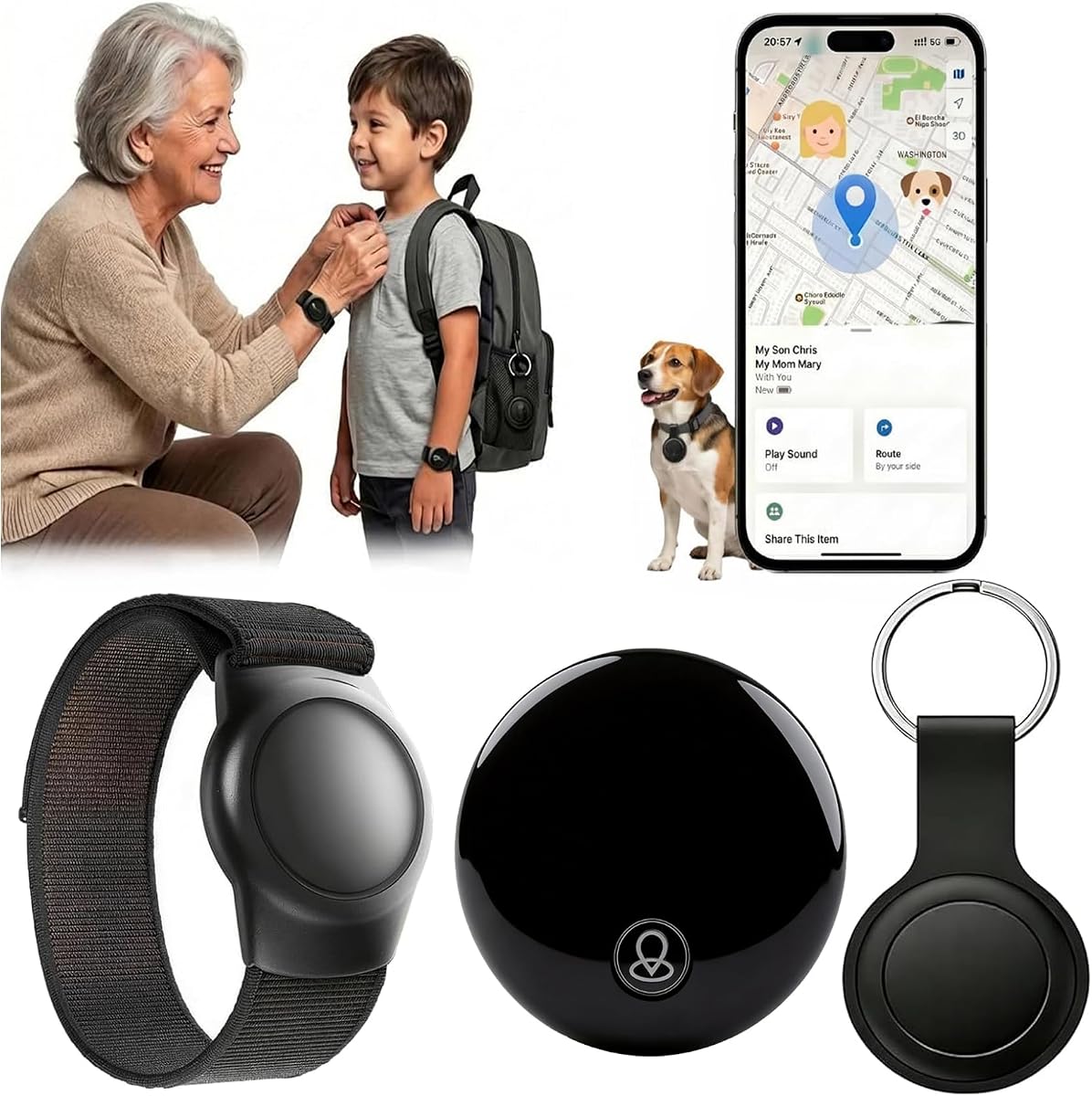
Find My Wristband GPS Tracker
4.6Editor score
Apple Find My network
No SIM card required
One-year stated battery life
GPS trackers for elderly vary in privacy, battery life, alerts, and wearability; this expert guide compares ten leading options for safer independent living.
GPS trackers for elderly can provide an important layer of reassurance without requiring a person to remain dependent on a caregiver. The best device depends on location accuracy, battery life, emergency features, comfort, privacy, and how easily a family member can interpret alerts. A useful tracker should be dependable, simple to wear, and unobtrusive in daily life.
This guide compares ten trackers designed for elderly adults, seniors, and people with dementia, autism, or other special needs. The products include compact tags, wristbands, pendants, watches, vehicle trackers, and dedicated medical alert systems. We compared their stated tracking methods, alert capabilities, wearing options, battery claims, subscription requirements, and caregiver-facing features.
Each pick reveals what kind of protection it is best suited to provide, from simple Find My network tracking to fall detection and two-way calling. Some products require a paid service for core features, while others emphasize freedom from recurring charges. Product features, availability, and prices can change, so confirm the current listing and service terms before purchasing.
4.6Editor score

4.1Editor score

3.8Editor score
The table below compares all ten options by their tracking approach, wearable format, emergency communication, and ongoing service model. It is designed to make the differences clear before you consider how closely each tracker matches an elderly person's routines and support needs.


The Universal Mini GPS Tracker combines broad compatibility with a no-subscription operating model. Its 5.0 rating is the highest among the products in this guide, although ratings alone do not reveal how the device performs under every real-world condition. Its strongest attraction is the combination of a compact form, Find My network support, real-time positioning claims, and a battery stated to last up to 720 days.
We may earn a commission when you buy through this link, at no additional cost to you.
This tracker needs neither a SIM card nor a paid application, which can simplify setup for families that do not want another cellular plan. It pairs through the built-in Find My or Works features on compatible iOS and Android devices, and the listing describes real-time location updates. Its upgraded magnet allows placement beneath a car, inside a bumper area, near a gas cap, or in other concealed locations, making it especially useful for monitoring an elderly person's vehicle.
The trade-offs are important. It is primarily designed around vehicle and asset tracking rather than being a wrist-worn medical alert device, and it does not offer the dedicated fall detection, direct caregiver calling, or geofence-focused routine monitoring found in the SecuLife products. The very long battery figure is also a stated maximum rather than a guarantee, and actual life will depend on use, signal conditions, and settings.
This is a compelling choice for a caregiver who wants to monitor a senior's car, travels frequently, or needs an inexpensive backup tag for a bag or vehicle. It is less suitable as the sole safety device for someone who cannot comfortably wear accessories or needs immediate voice communication after a fall. For those needs, the AngelSense or SecuLife options provide a more purpose-built experience.
For households tired of recurring tracker subscriptions, this model is unusually straightforward. Its no-SIM design removes one common source of setup complexity and supports a wider range of phones through the Find My and Works ecosystems.
The magnetic case and small dimensions make the tracker easy to place in concealed vehicle locations. That makes it useful when a senior continues driving and family members want an additional layer of location awareness.
We may earn a commission when you buy through this link, at no additional cost to you.
AngelSense is the most purpose-driven tracker in this group for an older adult with dementia, cognitive impairment, autism, or another condition that makes wandering more likely. It carries a 4.1 rating and emphasizes continuous supervision rather than only helping someone recover a lost item. The product combines live positioning, daily route review, location history, automated alerts, and direct communication in a caregiver-oriented system.
We may earn a commission when you buy through this link, at no additional cost to you.
Its strongest feature is the way it watches normal behavior and flags departures, unfamiliar places, or late arrivals. That makes the tracker more useful when a senior follows a predictable schedule but may become disoriented outside it. The built-in speakerphone can auto-answer a caregiver's call, allowing a family member to check in, calm the wearer, or offer directions without requiring the wearer to operate a small button.
The security sleeve is another meaningful advantage. It is designed to resist removal by a person with sensory sensitivities or cognitive challenges and can be detached with a caregiver key. This is a considerable benefit when a conventional watch or pendant is likely to be pulled off. The cost of that protection is a required subscription for the tracking and premium features, which should be considered as an ongoing service commitment rather than a one-time accessory.
AngelSense is best for families that need active oversight, detailed travel history, and intervention when behavior changes. It is less suitable for someone who merely wants an inexpensive tag with infrequent network-based location updates. If the goal is continuous supervision with a caregiver-controlled design, it is the strongest dedicated choice in this roundup.
AI-powered monitoring can identify unusual departures or unfamiliar locations based on a person's patterns. This gives caregivers more context than a basic tracker that merely reports the latest position.
The caregiver-key sleeve and sensory-sensitive attachments address a common problem: willing wearers may still remove ordinary trackers. That security-oriented design makes AngelSense particularly useful for people prone to wandering.
We may earn a commission when you buy through this link, at no additional cost to you.
The Find My Wristband Tracker is an appealing balance of affordability, comfort, and simple family monitoring. Its 4.6 rating is the second-highest in the group, and the product avoids subscription fees by using Apple's Find My network. The wristband format also gives it a more natural appearance for an elderly person than a boxy medical alert device.
We may earn a commission when you buy through this link, at no additional cost to you.
The tracker can be viewed through the Find My app on an iPhone, while a keychain-style use is also possible. A useful Play Sound function helps locate the device within approximately 60 meters, or 200 feet, which is valuable when a senior misplaces a wristband or attached item. Anti-loss notifications provide an additional prompt when the tracker separates from the paired phone, and Lost Mode can update its position through nearby Apple devices.
Its limitations center on the kind of service it provides. It is a network-based locator rather than a cellular medical alert system, so it does not include fall detection, emergency calling, or guaranteed continuous live tracking. The stated battery life of up to one year is impressive, though battery status can be checked in Find My. The silicone band is skin-friendly and adjustable, while the IP68 rating offers protection from dust, sweat, rain, and splashes.
This is one of the best choices for an independent, tech-comfortable senior who mainly needs reassurance that a bag, key pouch, or wristband has not been left behind. It also works well for families already invested in Apple devices. It should not be treated as a substitute for a dedicated fall-response system, but it provides capable low-maintenance location awareness without a recurring fee.
The Apple Find My network gives the tracker useful location capabilities without a separate cellular account. Families already familiar with Find My can start monitoring without learning an entirely new app or service.
The soft, adjustable silicone wristband is designed for unobtrusive daily use. Its water resistance also makes it practical for showers, rainy walks, exercise, and other routine activities.
We may earn a commission when you buy through this link, at no additional cost to you.
The Mini Locator Watch Band offers a simple, low-maintenance way for a family to view an elderly person's location. It has a 3.4 rating and no monthly subscription, which are the two most immediately useful points for budget-conscious caregivers. The product works through the native Find My app on an iOS device, avoiding the need to learn a separate tracking platform.
We may earn a commission when you buy through this link, at no additional cost to you.
Its watch-band format is more familiar and less conspicuous than a medical pendant. The listing describes real-time location monitoring and a waterproof band, both of which make it suitable for continuous daily wear. A family can use it for a senior who tends to leave home unexpectedly, visit a regular location, or simply wants a visible reminder that a location tool is being worn.
Compared with the Find My Wristband Tracker, the published feature information is less detailed. It does not provide a clear battery-duration claim, a specific water-resistance rating, anti-loss notification details, or an independently stated sound-alert function. Its 3.4 rating also suggests that some buyers may have found aspects of its experience less satisfactory. Position accuracy and update speed can vary with the Find My network and nearby devices.
This tracker makes sense for an iPhone household seeking a simple wearable with no recurring charge. It is a reasonable alternative to the third-ranked model when a more conventional watch appearance is preferred. However, caregivers who require a specific water-resistance standard, confirmed battery life, fall detection, or direct emergency communication should choose a product that explicitly documents those capabilities.
Using the native Find My app reduces setup friction and makes location checks familiar for many family members. It is particularly convenient for households that do not want another dedicated caregiver application.
The watch-style format provides a visible, familiar wearable, while the no-subscription model controls ongoing cost. It fills the gap between a simple item finder and a cellular medical alert system.
We may earn a commission when you buy through this link, at no additional cost to you.
Optimus 2.0 is a flexible vehicle and asset tracker with a 4.4 rating. It is particularly relevant to elderly adults who continue to drive or whose routines can be monitored through a vehicle. Unlike a pendant or wristband, it is designed to be placed in a car and protected by a powerful magnetic case, giving caregivers a way to receive useful event-based alerts.
We may earn a commission when you buy through this link, at no additional cost to you.
The tracker supports email and text alerts for movement, speeding, entering or leaving areas, low battery, and SOS activation. Position updates can be customized as frequently as every 10 seconds, and the listing states a battery life of up to two weeks when reporting every minute. These details make it more suitable than a basic item finder for users who want active oversight of a moving vehicle.
It does have clear boundaries. The device is not designed as something an elderly person wears or operates, and its real-time capabilities depend on cellular connectivity and a service arrangement that is not described in the supplied product information. GPS reception may also be impaired inside fully enclosed metal environments such as a cargo container, trailer, or metal box truck. The magnetic case addresses concealment but cannot remove the need for an unobstructed view of the sky.
Optimus 2.0 is a strong secondary tracker for a senior who travels independently by car. It can provide useful context about sudden movement, route changes, speeding, or arrival at an unexpected place. It should complement rather than replace a wearable medical alert system when the person needs a personal SOS button, fall detection, or direct communication.
Movement, speeding, boundary, and low-battery notifications can turn a raw location into actionable information. Caregivers are more likely to understand an unexpected alert when the tracker explains what kind of event occurred.
Vehicle-based monitoring can assist families following a senior's trips without asking the driver to operate a phone. The discreet magnetic case also makes the tracker easier to conceal in a suitable mounting area.
We may earn a commission when you buy through this link, at no additional cost to you.
Trak-4 is built for vehicles, equipment, and other assets rather than direct wear by an elderly person. Its 4.1 rating reflects a durable device with an unusually long stated operating period of 12 to 18 months when reporting daily. That longevity and rugged construction make it especially useful for tracking a senior's vehicle, travel equipment, or another asset that may be difficult to recharge frequently.
We may earn a commission when you buy through this link, at no additional cost to you.
The waterproof USB-rechargeable tracker combines GPS with Wi-Fi-based location. The Wi-Fi fallback is an important practical feature because GPS signals can be weak or unavailable inside buildings. International coverage through 4G LTE, with fallback to 2G networks, expands its usefulness for assets that move beyond a local area, although coverage quality and network support vary by location.
A subscription is required, so this is not the natural selection for someone who wants a completely service-free locator. It also lacks the family-facing, elderly-specific features of the AngelSense and SecuLife products: there is no stated fall detection, auto-answer speakerphone, or caregiver-controlled anti-removal wearable in the supplied information. Its value lies in dependable, low-maintenance asset tracking rather than personal emergency response.
Trak-4 is a good option for families managing a vehicle, motorcycle, boat, or valuable equipment used by a senior. The long battery and durable housing reduce routine maintenance. If the priority is a wearable monitor with immediate caregiver contact, choose a personal alert device instead; if the priority is tracking a mobile asset, Trak-4 offers a proven and practical feature set.
A stated 12–18 months of operation at daily reporting intervals is particularly useful for assets that are not accessed frequently. It reduces the likelihood that important tracking will stop because a battery was neglected.
GPS provides outdoor position data, while Wi-Fi-assisted location can help when a tracker is inside a building. This combination makes the device more versatile across garages, warehouses, and other common asset locations.
We may earn a commission when you buy through this link, at no additional cost to you.
The SecuLife SOS Wristband combines location monitoring with emergency communication in a screen-free wearable. Its 3.4 rating gives buyers less confidence than the higher-rated alternatives, but the product's stated feature set is well aligned with seniors who want simple access to help without having to navigate a smartphone.
We may earn a commission when you buy through this link, at no additional cost to you.
A wearer can call preset emergency contacts with a button press, and automatic fall detection can initiate the same type of alert. The wristband supports hands-free auto-answer for two-way communication, allowing a caregiver to speak with the wearer directly. The absence of a screen reduces distraction and may be easier for someone with limited vision, dexterity, or technology experience to use.
The caregiver app provides live tracking, geofence controls, and a year of location history. Geofencing can notify a family member when the wearer enters or leaves a familiar area, which is particularly relevant to a senior living independently. The IP67 rating protects against rain, splashes, and handwashing, while the lightweight design supports comfortable wear. A subscription is required for the listed service features.
This wristband is best for a senior who is comfortable wearing something on the wrist and wants direct contact with family after a fall or movement outside a safe zone. Its lower rating warrants checking recent customer feedback and confirming cellular service availability. It is also more complex and service-dependent than a simple Find My tag, so the additional emergency functionality should justify that difference for the intended user.
The screen-free interface and one-button calling reduce the learning burden. A senior does not need to unlock a phone, open an app, or find a contact before seeking help.
Geofence alerts can highlight departures from familiar areas such as home, a relative's house, or a regular activity center. Combined with live tracking and call history, they provide a broader view of daily safety.
We may earn a commission when you buy through this link, at no additional cost to you.
The SecuLife Medical Alert Pendant is the most complete personal medical alert device in this group. It has a 3.8 rating, but its feature set directly addresses the needs of an elderly person who may be unable to reach a phone after falling. Automatic fall detection, a large SOS control, GPS, geofences, and two-way calling work together as a personal response system.
We may earn a commission when you buy through this link, at no additional cost to you.
When a fall is detected, the pendant can automatically call and send an SOS notification to selected emergency contacts. The wearer can also initiate a call manually and use hands-free auto-answer when a caregiver calls. Approved-contact controls block unknown callers, reducing unwanted contact while ensuring family members can communicate. The app provides live location, custom safe zones, alerts, and one year of location history.
The display shows time, battery, and signal status, which helps a caregiver diagnose basic setup issues. A large SOS button and straightforward interface suit users who may have reduced vision or dexterity. Its stated battery life reaches up to six days under 24-hour interval tracking, while the IP67 housing is fully waterproof for showering and daily wear. A recurring service is required for the listed tracking, calling, and support features.
This pendant is the strongest option for a senior who wants a dedicated wearable emergency device rather than a passive locator. It is particularly suitable for independent adults concerned about falls. Caregivers should practice use with the wearer, confirm cellular coverage at home and outdoors, and agree in advance on which contacts should receive alerts. No tracker can guarantee that every fall will be detected, so normal emergency planning should remain in place.
Alerts travel directly to selected family members without requiring a call center, and two-way calling allows a caregiver to assess the situation. The wearer can also make an emergency call manually if automatic fall detection is not needed or does not trigger.
The pendant's time, battery, and signal display helps the user understand whether the device is ready. A large button and automatic speakerphone behavior reduce the physical effort required during an emergency.
We may earn a commission when you buy through this link, at no additional cost to you.
Utag offers a four-pack of discreet, anti-removal tags for families that need several monitored items or users. Its 4.0 rating is supported by a clear set of features: Apple Find My network operation, no subscription, shared access for as many as six trusted family members, and a design intended to resist removal by the wearer.
We may earn a commission when you buy through this link, at no additional cost to you.
Each tag can attach to clothing or a jacket using a non-removable pin locker that opens with an included magnetic unlocker. That approach may be less noticeable and less likely to be rejected than a visible wristband, which can help with a senior who has sensory sensitivities. The same four-pack can also support luggage, bags, bicycles, strollers, or other valuable equipment.
The product is explicit that it is not designed for real-time vehicle tracking. Location updates occur about every 15 minutes under Apple's privacy approach, and the device depends on nearby Apple devices and network participation. It requires a compatible iPhone or iPad and the latest iOS or macOS, so it is unsuitable for Android-only households. The CR2032 battery is stated to last a year, with additional batteries included.
Utag is a strong option for a family already using Apple devices and seeking discreet, low-maintenance tracking across multiple people or belongings. The four-pack improves flexibility because tags can be assigned to different relatives or essential items. It is not suitable as an emergency communication device or a continuous GPS monitor, but it is a practical choice for passive location awareness and wandering prevention.
The anti-removal attachment can keep a tag in place while avoiding the appearance of a conventional watch. Caregiver-controlled removal helps preserve location coverage without relying on the wearer to maintain the device.
A four-device pack and free sharing for trusted relatives make it practical to monitor more than one family member. The same system can extend to travel luggage and other important belongings without separate recurring service fees.
We may earn a commission when you buy through this link, at no additional cost to you.
The Seculife Senior GPS Necklace is a flexible emergency alert device for older adults. No customer rating is available in the supplied listing information, so it is impossible to compare its customer satisfaction with the rated products. Its stated features are still relevant: automatic fall detection, a hold-to-activate SOS button, two-way calling, geofencing, caregiver-app management, and several ways to wear the device.
We may earn a commission when you buy through this link, at no additional cost to you.
The device can be worn as a necklace, clipped to a belt, or attached to a keychain. That flexibility may be valuable for someone who dislikes a wristband or pendant but still needs rapid access to emergency controls. Holding the SOS control for three seconds calls selected contacts, and the automatic fall-detection function can initiate an emergency call without the wearer needing to find the device.
Caregivers can view live location, set safe zones, receive emergency alerts, manage contacts, and check battery and signal status through the app. Approved-contact controls block unknown callers, helping protect the wearer from unwanted contact and potential scams. The IP67 rating handles dust, rain, and everyday spills. A subscription is required, with the listing emphasizing coverage in the United States and a stated battery life of three to five days under continuous personal-safety use.
This necklace is a strong option for a senior who values flexible placement and wants both automatic and manual emergency response. Because no rating is available, buyers should examine current customer feedback, cellular coverage, activation terms, and service features before ordering. It is more suitable for emergency response than passive Find My tags, while offering greater wearing flexibility than a fixed wristband.
The necklace, belt clip, and keychain configurations let the user choose a comfortable and accessible arrangement. A belt or keychain placement may be easier to reach quickly than a necklace worn under clothing.
The caregiver app combines location history, safe zones, contact management, and status checks. Two-way calling and blocked unknown callers add practical communication controls around a vulnerable user.
We may earn a commission when you buy through this link, at no additional cost to you.
The most suitable tracker depends on the person's mobility, cognitive condition, tech comfort, and the kinds of help caregivers expect it to provide. Compare tracking method, emergency communication, wearability, battery claims, subscription terms, and network coverage before choosing.
GPS trackers use different networks to determine position. Dedicated cellular trackers can provide frequent live updates and send alerts independently of nearby phones, while Find My network tags depend on compatible Apple devices appearing in the area. These network-based tags are valuable for passive reassurance, but they are not equivalent to continuous real-time GPS monitoring and may update less often.
Choose a dedicated live tracker when a caregiver must know a senior's position promptly or investigate an unexpected departure. Choose a Find My device when the main goal is finding a person or item without a recurring service. Check the product's stated update interval, coverage requirements, and indoor location limitations.
A location tracker can show where someone is, but a medical alert system can also detect a fall, notify contacts, and provide voice communication. These capabilities matter most for seniors living alone, people with balance concerns, and anyone who may be unable to reach a phone after a fall. Automatic fall detection should be tested and adjusted in the app, since sensitivity can vary.
Look for a large, easy-to-activate SOS control as well as automatic detection. Two-way calling is especially useful because a caregiver can assess whether the situation requires urgent assistance. Confirm that alerts reach the intended family members and document a backup plan for events the device cannot detect.
A tracker is only useful if the wearer keeps it on. Wristbands must be comfortable and adjustable, pendants should not feel restrictive, and tags attached to clothing need to be secure without damaging garments. For people with dementia, autism, sensory sensitivities, or a habit of removing unfamiliar objects, caregiver-controlled anti-removal features may be more important than a fashionable appearance.
Try wearing the chosen form during normal activities. The user should be able to reach a button, understand its purpose, and remain comfortable. A device that is too tight, conspicuous, confusing, or difficult to operate can reduce both compliance and the quality of the safety response.
Subscription-based trackers usually bundle cellular service, live location, alerts, and support. Their ongoing cost can be justified for continuous monitoring and emergency calling, but the terms should be reviewed carefully. No-fee Find My devices lower ongoing expenses, yet they depend on a compatible phone ecosystem, nearby devices, and Apple's update practices.
Check whether the service includes the SIM or cellular connection, how alerts are delivered, whether sharing is limited, and what happens if the subscription lapses. For cellular medical alert products, verify service coverage at home, at regular destinations, and in the area where the senior spends time outdoors.
Battery life claims are often based on a particular reporting interval and can change with signal quality, feature use, and connectivity. A long claim does not mean a device will remain continuously live for the same duration. Medical alert wearables need dependable routines because an uncharged tracker cannot provide protection, but frequent charging can also be forgotten.
Choose a battery duration that matches the household's ability to check and charge the device. Look for visible battery or signal status, consider a spare battery where the product supports it, and record a charging schedule. For travel or memory-support situations, a simple audible reminder can help the wearer plug in the device.
A geofence is a virtual boundary around a home, relative's address, pharmacy, or other important place. When the wearer enters or leaves the area, the caregiver can receive an alert. This is particularly helpful for seniors with dementia, but it can also produce false alarms if boundaries are poorly chosen or if normal travel falls outside them.
Start with one or two clearly relevant areas and allow for realistic movement around them. Alerts should be assigned to someone who can investigate rather than to the entire family. A tracker that reports routes and unusual locations can provide context that a single alert does not.
Location data can be sensitive, and a tracker should not create an open monitoring system that anyone in the household can access. Caregivers should use a protected Apple or caregiver account, strong device credentials, and the minimum number of people who genuinely need access. Shared Find My items can be limited to trusted relatives, while dedicated systems offer more formal caregiver roles.
Discuss location monitoring with the senior whenever possible and document who may view routes, historical locations, and call records. A transparent arrangement is more likely to preserve trust than hidden monitoring, particularly when the wearer has privacy concerns or cognitive changes that affect consent.
Seniors may wear trackers while showering, exercising, walking in rain, or doing ordinary household work. An IP67 rating indicates protection against dust and temporary immersion, while lower or unspecified ratings may be less suitable for wet environments. The stated standard is more informative than a general claim of being waterproof, because the exact rating defines the tested conditions.
Check the listed water-resistance rating and charging instructions before exposing the device to water. A waterproof tracker is not necessarily safe under hot water, high-pressure spray, or prolonged submersion. Preserve the seal and inspect the casing if the device is exposed to moisture or impact.
Begin by charging the tracker fully and creating or signing into the appropriate Apple, Android, or caregiver account. Pair the device, test its location while both the wearable and phone are in different rooms, and confirm that the account receives location, left-behind, and emergency notifications. Invite only the family members or caregivers who need access, and assign primary and backup contacts for urgent alerts.
Have the elderly person practice the essential actions: checking location, pressing or holding the SOS control, answering an incoming caregiver call, and explaining what a sound or vibration means. If the tracker uses a wristband, necklace, or clothing tag, adjust it for comfort and demonstrate how to remove or conceal it discreetly. Record the device's daily charging routine and teach the caregiver how to check battery and signal status.
For ongoing care, review the first several days of routes and alerts to learn normal behavior before refining geofences. Test a non-emergency call between family members, and check cellular coverage in important locations. Clean the device according to its instructions, keep charging contacts dry, and inspect straps, clips, seals, and clasps for damage. Replace a tracker if the app no longer pairs, the battery swells, or location reports become unreliable.
GPS trackers can provide useful location information, but no device is perfect in every environment. Tall buildings, basements, metal vehicles, and weak cellular coverage can reduce accuracy or delay updates. For an active senior who may wander, combine location monitoring with a wearable or medical alert service and establish a response plan with the household.
AngelSense is designed specifically around people prone to wandering, using route history, pattern-based alerts, direct communication, and a caregiver-controlled sleeve. The SecuLife options also provide GPS, geofences, fall detection, and two-way calling. The right choice depends on whether wandering prevention, emergency response, or both are the primary concern.
Several medical alert products in this guide include automatic fall detection. AngelSense emphasizes behavior alerts, while the SecuLife wristband, pendant, and necklace include fall detection features. Automatic detection should still be treated as a helpful layer rather than a guarantee, and the wearer should keep a phone or another emergency method available when possible.
It depends on the product. The Find My-based wristband, watch, and compact trackers operate without a recurring tracking fee, while AngelSense, Trak-4, and the SecuLife services require subscriptions for their listed real-time or cellular features. Review service terms, included features, and activation requirements before deciding.
The Universal Mini GPS Tracker is described as supporting both iOS and Android through Find My or Works features. The Find My Wristband Tracker and Utag tags depend on Apple's Find My network, while the Mini Locator Watch Band is described as working with iOS. Always check the current compatibility requirements on the product listing.
A wearable is generally more dependable for personal safety because it stays with the person and may include an accessible SOS button. A vehicle tracker is useful for monitoring a car but cannot replace a wearable device. Many families use both when a senior continues driving and also needs protection while walking or living alone.
Check frequency should match the person's mobility, medical risk, and daily routine. Continuous live monitoring is useful for someone recently diagnosed with dementia or recovering from a fall, while occasional checks may be enough for a highly independent senior. Automatic alerts and geofences can reduce the need for constant manual checking without removing caregiver oversight.
Start by explaining what the device does and involving the senior in choosing the format, whether that is a wristband, necklace, clip, or concealed tag. If a medical condition requires monitoring, involve the person's healthcare professionals and trusted relatives in a respectful discussion. For higher-support users, caregiver-controlled anti-removal designs may help, but they should be used with clear consent and privacy practices whenever possible.
The strongest general-purpose choice in this guide is AngelSense because it combines live location, route history, behavior-based alerts, direct communication, and caregiver-controlled security. The Find My Wristband Tracker is the leading no-fee wearable, while the SecuLife Medical Alert Pendant is the most comprehensive premium device for fall detection, geofencing, and two-way caregiver calls.
The right priorities depend on the situation. A senior who continues driving may need a compact vehicle tracker alongside a wearable; someone living alone may need automatic fall detection and voice calling; a person prone to removing devices may need secure attachment; and a family seeking simple reassurance may prefer a no-subscription Find My product. Confirm that the wearer can comfortably operate and charge the chosen device.
Before purchasing, review the current listing, service terms, compatibility, cellular coverage, and available accessories. Prices, promotions, battery claims, and app features can change, and the most suitable device is one that the elderly person will wear consistently and the family can monitor confidently. Continue to use reasonable emergency precautions alongside any tracker rather than depending on a single product for every situation.