
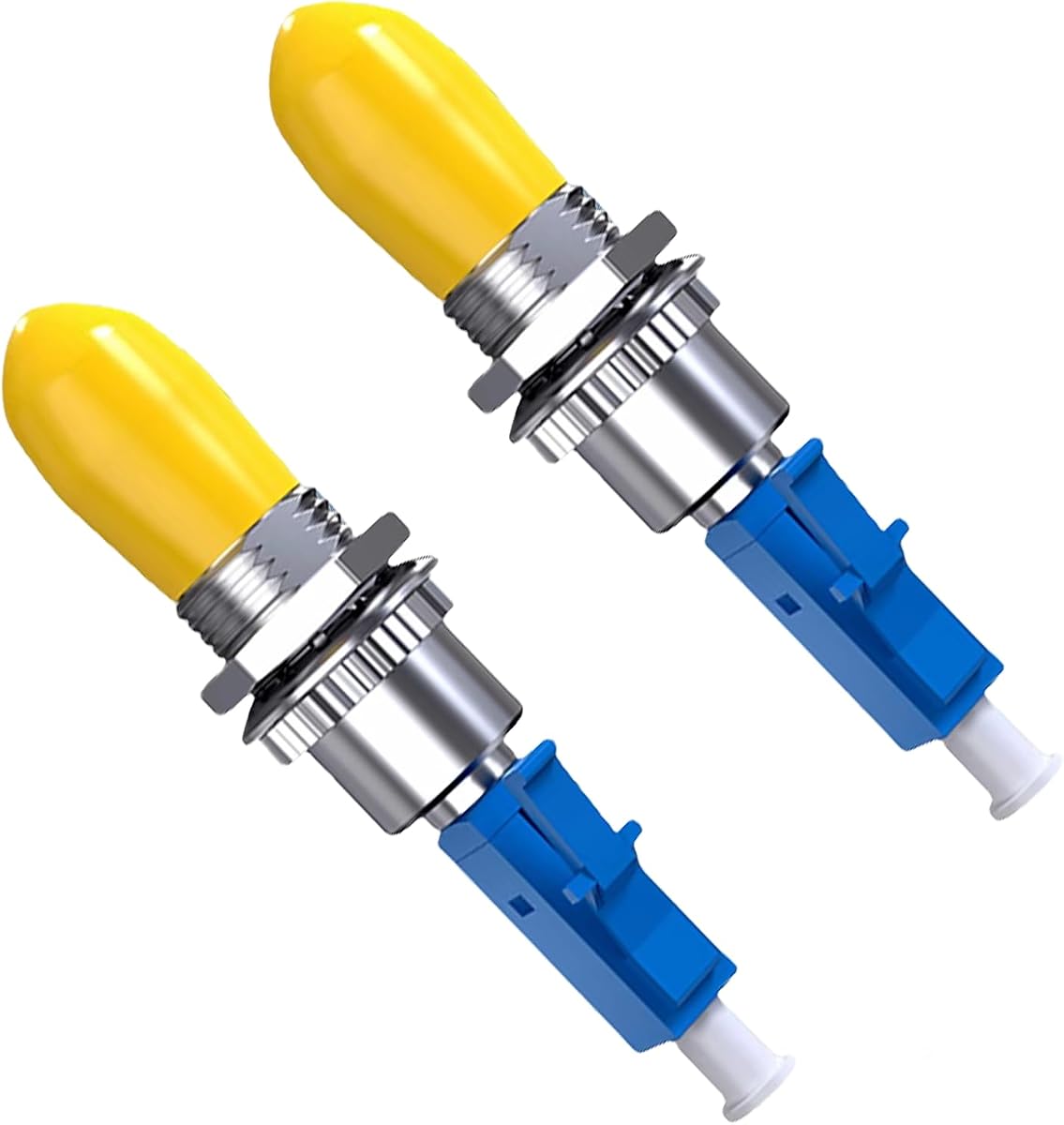
ST to LCU Fiber Optic Adapter
5.0Editor score
Two-piece adapter set
Single-mode UPC design
Ceramic sleeves and metal housing
Tool-free push-pull connection
Compact panel-friendly format
This Lc to St Fiber Optic Adapter guide compares connector direction, fiber type, wavelength, construction, and testing compatibility.
An Lc to St Fiber Optic Adapter bridges two different connector interfaces so technicians can connect equipment, patch cables, or test instruments without replacing an entire cable. The right adapter depends on connector direction, fiber type, wavelength, housing, and the specific LC or ST connection required.
The products in this guide range from compact inline hybrid adapters to short duplex adapter cables and a versatile interchangeable connector set. We compared their published connector genders, single-mode or multimode support, operating wavelengths, construction, use cases, and suitability for optical power meters, visual fault locators, OTDRs, and network maintenance.
Each review explains where that option fits, highlights practical benefits, and identifies trade-offs visible in the available specifications. Ratings and product details reflect the supplied listings, while prices and availability can change, so readers should confirm the current listing and exact connector configuration before purchasing.
5.0Editor score

4.8Editor score

5.0Editor score
The comparison below covers standalone hybrid adapters, duplex adapter cables, and a multi-connector testing kit, with particular attention to connector direction, fiber mode, wavelength, and the equipment each product is designed to support.


This Poyiccot set is a strong all-around choice for technicians who need to connect an ST/UPC male connection to an LC/UPC female connection. It carries a 4.8 rating and includes three single-mode 9/125um simplex adapters. Its most appealing feature is the clearly stated performance envelope: insertion loss of no more than 0.2dB at 1310nm and 1550nm, with return loss of at least 50dB at both wavelengths.
We may earn a commission when you buy through this link, at no additional cost to you.
The adapter uses ceramic and metal sleeve materials and is designed to withstand more than 1,000 plug insertion cycles. That makes it a practical bridge between ST and LC patch cables, especially when an optical power meter or visual fault locator has an interface that does not match the installed cable.
There are some limitations in the supplied specifications. The package contains only simplex adapters, so a technician needing two simultaneous paths should look for a duplex alternative. It is also intended for single-mode 9/125um fiber rather than 62.5/125um multimode.
Despite those boundaries, this is the strongest general-purpose pick in the group. The three-piece count, detailed optical figures, broad wavelength support, and instrument compatibility make it well suited to telecom maintenance, CATV engineering, optical measurement, and mixed-interface test setups.
The stated insertion and return loss figures give a technician more than a generic compatibility claim. The adapter is specified for 1310nm and 1550nm single-mode transmissions, covering two widely used optical measurement bands.
The ceramic-and-metal sleeve construction and stated resistance to more than 1,000 insertions suit maintenance work where connectors are connected and disconnected regularly. Its compact form also avoids the bulk of a full adapter cable.
We may earn a commission when you buy through this link, at no additional cost to you.
This two-pack reverses the direction of the first Poyiccot option by providing an LC/UPC male to ST/UPC female interface. It has a perfect 5.0 rating in the supplied data and is aimed at technicians who need to connect LC patch cables to ST equipment or test interfaces. The pair is built for 9/125um single-mode fiber and operation at 1310nm and 1550nm.
We may earn a commission when you buy through this link, at no additional cost to you.
Its optical specification is a major strength. The listing states insertion loss of no more than 0.2dB and return loss of at least 50dB at both supported wavelengths. Ceramic-and-metal sleeve materials contribute to a compact assembly that is also described as resistant to more than 1,000 insertion cycles.
The main trade-off is that the package contains two simplex adapters rather than duplex assemblies. It also does not cover multimode 62.5/125 fiber. Although the broader description mentions that single-mode, multimode, and PC options exist, the specific product supplied here is the UPC single-mode 9/125um version.
For a technician who needs two copies of the LC-to-ST direction, this is a particularly attractive choice. The 5.0 rating, two-adapter quantity, instrument compatibility, and stated performance specifications make it an economical pick for optical power meters, visual fault locators, local area networks, and routine fiber maintenance.
Two adapters provide a spare while one remains in service. That is useful for technicians who want to minimize downtime during testing or keep a matching connector on hand for another installation.
The LC male and ST female orientation is especially important when matching test equipment. Because the opposite configuration also appears in this category, checking the port gender before ordering prevents an otherwise straightforward adapter from being unusable.
We may earn a commission when you buy through this link, at no additional cost to you.
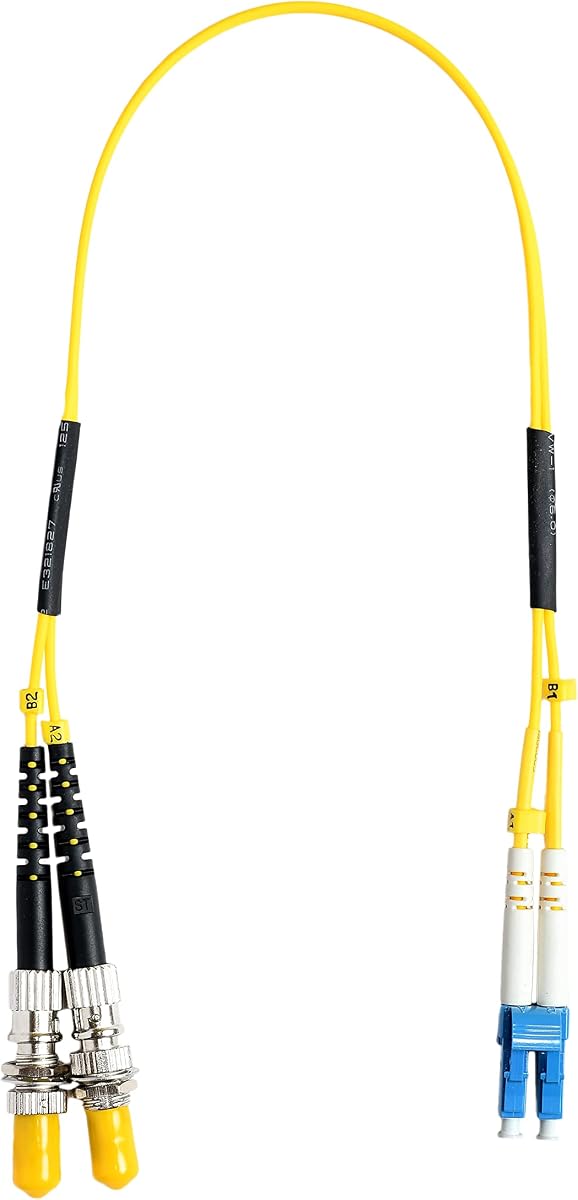
The OpZonik product is a ready-to-use, one-foot duplex cable rather than a small inline adapter. It converts LC male to ST female connections, uses 9/125um single-mode fiber, and is intended for 1310nm transmission. Although the supplied listing does not show a customer rating, it provides useful manufacturing information that distinguishes it from a simple connector coupler.
We may earn a commission when you buy through this link, at no additional cost to you.
The cable uses tight-buffered duplex zip cord with a 2.0mm outer diameter and an LSZH, or low-smoke zero-halogen, jacket. It is factory terminated, and the listing states that every unit is tested for link loss and return loss. That combination can appeal to technicians who want a complete matched assembly instead of assembling a separate adapter and patch leads.
Its main trade-offs are visible in the product format. A one-foot lead is convenient for close-range transitions but may not reach between distant devices, and the fixed single-mode, 1310nm configuration is narrower than the mixed-wavelength options in the guide. The lack of a supplied rating also makes it harder to compare customer feedback.
This is a good choice for a bench, cabinet, or nearby test setup that needs a short duplex LC-to-ST transition. Its factory termination and testing are meaningful advantages, but installers should confirm that a one-foot length and the 1310nm single-mode specification match the network and equipment involved.
A completed duplex cable removes the need to pair separate connectors and jumpers for a short connection. The stated factory testing for link loss and return loss adds assurance that the terminated assembly was checked before shipment.
The LSZH jacket is designed as a low-smoke, zero-halogen alternative for installation environments where ordinary jacket materials may be less desirable. It remains important to follow applicable local cabling requirements.
We may earn a commission when you buy through this link, at no additional cost to you.
This Ultra Spec Cables adapter cable is designed for the older 62.5/125 micrometer multimode fiber commonly encountered in legacy short-reach installations. It connects an LC male port to an ST female port, provides two strands in a duplex zip-cord jacket, and operates at 850nm. The listed customer rating is 4.8.
We may earn a commission when you buy through this link, at no additional cost to you.
Its primary benefit is straightforward compatibility with existing 62.5/125 multimode infrastructure. The one-foot length makes it easy to manage inside a rack, cabinet, patch panel, or test bench, while the duplex construction supports paired fiber routes. It is particularly relevant where an LC-equipped modern device must connect to an ST-equipped legacy component.
The trade-off is specialization. This cable is not described for 9/125 single-mode fiber, so it would be unsuitable for a long-haul or modern single-mode link operating at 1310nm. Its one-foot length also limits the physical separation between devices, and the 850nm specification confines it to the intended multimode application.
For technicians maintaining older multimode systems, this is a clear-fit option. The strong 4.8 rating, familiar 850nm wavelength, and duplex LC-to-ST configuration make it a solid bridge when the existing infrastructure is 62.5/125 rather than newer 9/125 single-mode fiber.
Many repair and migration tasks involve one newer LC port and one older ST port on 62.5/125 multimode fiber. This adapter provides that transition without requiring the surrounding equipment or cabling to be replaced.
At one foot, the duplex lead is compact enough to organize within a cabinet or workbench. Its standard zip-cord jacket is familiar to technicians accustomed with conventional multimode patch leads.
We may earn a commission when you buy through this link, at no additional cost to you.
The Sabary kit is the most versatile product in this guide because it includes six interchangeable fiber optic connectors rather than a single fixed LC-to-ST interface. It has a 5.0 rating and supports both single-mode and multimode fibers. Listed components include LC, SC, ST, FC, an FC-male-to-LC-female adapter, and an SC/UPC-male-to-SC/APC-female adapter.
We may earn a commission when you buy through this link, at no additional cost to you.
Metal housings provide the stated structural and corrosion-resistant foundation, while the kit is described as having insertion loss below 0.2dB and return loss above 45dB. Its plug-and-play design requires no tools, which is useful when field engineers need to adapt an OTDR, optical power meter, or visual fault locator to several connector combinations.
The tradeoff is that a multi-connector kit is more complex than a purpose-built single adapter. A technician who only needs one ST-to-LC transition may find the broader assortment unnecessary. The interchangeability also means care is required to select and handle the correct configuration, especially when several UPC and APC interfaces are included.
For mobile technicians, installation crews, and test laboratories that encounter LC, SC, ST, and FC interfaces, this kit offers the broadest utility. Its five-star rating, multimode and single-mode compatibility, and range of testing applications justify choosing it when adaptability matters more than a single dedicated coupler.
The six included interfaces reduce the need to carry separate adapters for every legacy and modern connector. This is particularly helpful for field service teams working across telecom, FTTX, and network-maintenance environments.
The stated plug-and-play format allows a tester to move between compatible interfaces without complex setup. This can simplify work involving OTDR launches, optical power measurements, visual fault location, and cable production.
We may earn a commission when you buy through this link, at no additional cost to you.
This two-pack is a compact choice for joining ST/UPC and LC/UPC connections in a single-mode network. It holds a 5.0 rating and emphasizes installation convenience through a threaded ST coupling on one side and a push-pull LC interface on the other. The design is particularly relevant to wall outlets and high-density patch panels where space is limited.
We may earn a commission when you buy through this link, at no additional cost to you.
Precision ceramic sleeves and a robust metal housing support stable signal transmission and mechanical durability. The listing also describes the adapter as compliant with standard ST/UPC and LC/UPC connectors, which is useful when connecting legacy ST equipment to modern LC infrastructure in telecom or enterprise backbone environments.
The principal limitation is its narrowly defined configuration. It is intended for UPC single-mode connections rather than APC interfaces or 62.5/125 multimode fiber. A technician with a different connector polish, fiber type, or port arrangement must confirm compatibility before ordering.
For standard ST/UPC-to-LC/UPC work, though, the product offers a strong combination of compactness, secure coupling, and straightforward installation. The two-pack provides a spare, while the stated design is particularly helpful for panel and outlet applications that benefit from a smaller inline form factor.
The compact adapter is intended to fit standard adapter panels, wall outlets, and other high-density spaces. Its small footprint is more suitable for those locations than a short pre-terminated cable that must loop between ports.
The threaded ST side provides a secure, vibration-resistant hold, while the LC side uses a familiar push-pull action. Together they allow quick installation without requiring separate tools.
We may earn a commission when you buy through this link, at no additional cost to you.
This Ultra Spec Cables model is the opposite-direction counterpart to the company's LC-male-to-ST-female multimode cable. It provides an LC female to ST male interface, carries two 62.5/125 micrometer multimode strands, and is specified for 850nm. The listing has a 4.9 rating, making it one of the better-reviewed options in the group.
We may earn a commission when you buy through this link, at no additional cost to you.
The female LC and male ST configuration is useful when the cable needs to plug an LC connection into a device or patch lead equipped with an ST male interface. Its duplex format mirrors conventional paired fiber leads, and the one-foot length is practical for cabinet-level transitions or temporary test arrangements.
As with other fixed adapter cables, the main limitation is flexibility. A one-foot assembly cannot accommodate large distances, and the 62.5/125 multimode, 850nm configuration does not cover modern 9/125 single-mode networks. It also does not accommodate APC polishing requirements.
The 4.9 rating, correct connector direction, and established multimode format make this a strong choice for legacy installations where an LC female port must connect to an ST male port. It is particularly useful for users who need the reverse gender arrangement and already work with 850nm multimode systems.
This cable solves the reverse connection problem encountered by many LC-to-ST adapter leads. Technicians should always compare both the connector type and male or female designation with the ports they intend to join.
The one-foot duplex lead is easy to route inside a rack and supports paired 62.5/125 connections at 850nm. It is best suited to short, cabinet-adjacent legacy links rather than remote field locations.
We may earn a commission when you buy through this link, at no additional cost to you.
This Ultra Spec Cables lead provides a duplex single-mode transition from an LC male connection to an ST female connection. It uses 9/125 micrometer fiber, a 1310nm wavelength, and a one-foot standard zip-cord jacket. Its 4.3 rating is the lowest numerical customer rating among the reviewed products, although it still reflects a substantial level of satisfaction.
We may earn a commission when you buy through this link, at no additional cost to you.
The ready-made duplex format is the main practical advantage. A technician can connect paired single-mode paths without sourcing a separate hybrid adapter and additional patch cords. The LC male and ST female direction is widely useful when modern LC equipment has to be adapted to legacy ST infrastructure.
The one-foot length limits where the lead can be used, and the supplied specifications mention only 1310nm rather than both common single-mode transmission bands. Its 4.3 rating is also less compelling than the ratings shown for the other Ultra Spec cables and the hybrid adapter options.
For a close-range, 1310nm single-mode transition, this remains a functional and convenient choice. It is most attractive to technicians who value a complete duplex lead over a standalone adapter and who have confirmed that the connector direction, wavelength, and short physical reach fit the installation.
Because both ends are factory configured, the lead can serve as a complete short adapter cable. This reduces the number of separate pieces that need to be carried, connected, and organized.
The product is specifically listed for 1310nm. While single-mode equipment may support several wavelengths, a 1550nm requirement should not be assumed from the connector type and should be confirmed before deployment.
We may earn a commission when you buy through this link, at no additional cost to you.
The QIANRENON converter is a simplex hybrid adapter that joins an ST/UPC male interface to an LC/UPC female interface. It supports 9/125 micrometer single-mode fiber at both 1310nm and 1550nm. Its 4.8 rating and unusually specific loss figures make it appealing for users who want more than a broad compatibility statement.
We may earn a commission when you buy through this link, at no additional cost to you.
The listed insertion loss is 0.12dB at 1310nm and 0.04dB at 1550nm, while return loss is 53.3dB and 52.3dB respectively. It is intended to work with ST/UPC and LC/UPC patch cords, pigtails, red light pens, optical power meters, and other fiber optic instruments.
The main restriction is that it is a simplex UPC adapter. It does not provide two paired strands, and it is not designed for APC connector polishing or 62.5/125 multimode fiber. Any application requiring duplex routing would need a second unit or a duplex alternative.
For a single optical path where precise wavelength performance is important, this is an excellent specialist option. Its compatibility with meters and pigtails, broad single-mode band support, and transparent specifications make it particularly suitable for bench testing and network maintenance.
Separate insertion and return-loss figures for 1310nm and 1550nm let users assess the converter against their measurement requirements. The values are among the most detailed specifications available in this product group.
The product is explicitly positioned for red light pens, optical power meters, patch cords, and pigtails. That makes it a natural bridge between a single-mode test interface and cabling that uses the opposite connector family.
We may earn a commission when you buy through this link, at no additional cost to you.
The final option is Ultra Spec Cables' one-foot duplex lead with an LC female end and an ST male end. It is intended for 9/125 micrometer single-mode fiber at 1310nm and uses a standard zip-cord jacket. Its listed rating is 4.6, placing it between the stronger-rated Ultra Spec multimode cable and the lower-rated single-mode LC-male version.
We may earn a commission when you buy through this link, at no additional cost to you.
This product fills a specific role: it allows an ST male cable or interface to connect to an LC female port without forcing a change to the surrounding single-mode setup. The duplex format handles two strands, while the short length makes it convenient for panel, rack, or bench transitions.
Its limitations are the fixed 1310nm specification, the restricted one-foot reach, and the absence of detailed insertion-loss information in the supplied description. It also remains limited to the UPC-style connector arrangement described by the listing, so users should confirm polish and gender before installation.
For a compact reverse-direction transition in a 1310nm single-mode network, this cable is a practical choice. Its duplex construction and established 4.6 rating make it a reasonable alternative when an LC female port must mate with an ST male lead.
The 9/125 construction suits modern single-mode infrastructure at 1310nm. It is a better match for those networks than the 62.5/125 multimode Ultra Spec leads in the same family.
The one-foot lead is easy to manage where equipment ports are close together. It also provides a ready-terminated alternative to assembling a separate inline adapter and two patch cords.
We may earn a commission when you buy through this link, at no additional cost to you.
The most important step is matching the adapter to the exact fiber type, connector gender, and test equipment involved. After those mandatory compatibility checks, consider wavelength, physical format, optical specifications, and whether a single adapter or a broader testing kit will be more useful.
An LC-to-ST adapter must physically match the port at each end, including male or female designation. Available products include ST male to LC female, LC male to ST female, LC female to ST male, and more specialized combinations. Connector names alone do not tell you which way the adapter plugs into the equipment, so inspect both ends and write down the required configuration before ordering.
The safe approach is to compare the adapter directly with the two interfaces it will bridge. A product with the right connector families but the wrong gender can leave a technician with a connector that looks correct yet cannot mate with the intended port.
The core and cladding sizes must correspond to the installed fiber. Most single-mode products in this guide use 9/125 micrometer fiber, while the Ultra Spec multimode cables use 62.5/125 micrometer fiber. These are not interchangeable simply because they terminate in similar LC and ST connectors.
Choose single-mode for 9/125 networks and 1310nm or 1550nm transmission, and choose 62.5/125 multimode for the 850nm legacy systems represented here. If the fiber type is unknown, inspect existing patch cables and documentation before purchasing rather than relying on the color or connector shape alone.
The listed wavelength indicates the transmission band for which the adapter or cable is specified. The standalone Poyiccot and QIANRENON adapters support both 1310nm and 1550nm, while several one-foot adapter cables are listed only for 1310nm or only for 850nm. The Sabary kit is described broadly as compatible with single-mode and multimode systems.
Match the wavelength to the service, meter, and fiber route. A connector that physically fits can still be the wrong choice if the supported band does not align with the test equipment or transmission system in use.
A simplex adapter provides one optical path, while a duplex assembly provides two paired strands. The Poyiccot, ST to LCU, and QIANRENON hybrid adapters are simplex. The short Ultra Spec and OpZonik adapter cables are duplex, which is important for systems that transmit and receive over two fibers.
Count the number of required paths before choosing. Use simplex for a single test point or individual link, and choose duplex for paired communication, bi-directional links, or continuity checks that need both strands. Purchasing two simplex units can work, but a purpose-built duplex cable is neater for permanent installation.
Standalone hybrid adapters are compact and work with existing patch leads, making them useful in test bags and patch panels. Short adapter cables arrive terminated and ready to connect, reducing assembly time but adding a fixed cable length and potential routing loops. A broad interchangeable kit is more useful when many connector types are encountered.
Consider how the product will be carried and used. Choose an inline adapter for flexibility with existing jumpers, a short pre-terminated cable for a nearby permanent transition, or a multi-connector set for a technician who supports varied networks and instruments.
Insertion loss describes how much optical signal is lost as it passes through an adapter, while return loss reflects how much light is returned toward the source. Lower insertion loss and higher return loss generally indicate a better-matched optical transition. Several products provide explicit figures, including a maximum of 0.2dB insertion loss and at least 50dB return loss across 1310nm and 1550nm.
Detailed figures are particularly helpful when configuring high-precision measurement setups. Where only general performance language is provided, do not assume the same level of transparency. Compare specifications only when wavelength and test conditions are equivalent, and validate the completed connection with the appropriate optical test equipment.
Construction influences durability, repeatability, and resistance to the conditions encountered in service. Several hybrid adapters use precision ceramic sleeves with metal housings. The Sabary kit uses metal connector housings, while the OpZonik cable uses an LSZH jacket on a 2.0mm tight-buffered duplex cord.
For equipment that will be moved repeatedly, pay close attention to stated insertion cycles and connector construction. For a cable installed in a constrained or occupied space, jacket requirements may be equally important. Choose the design that matches both the mechanical demands and any local installation standards.
The intended use should guide the selection more than the adapter's broad description. The hybrid adapters are positioned for optical power meters, visual fault locators, and patch-cord connections. The Sabary kit goes further by including interfaces for OTDR connections and explicitly supporting fiber testing, FTTX, network construction, maintenance, and cable production measurement.
Check the port type on the instrument, the connector type on the patch cord, and the direction of the adapter as three separate details. A useful product for a visual fault locator may not be the right interface for an OTDR, and a meter with an APC port requires a different polish than a UPC adapter.
Before installation, identify the fiber type, wavelength, connector family, and male or female orientation on both sides of the connection. Inspect the adapter and mating ports for dust, scratches, bent pins, and contamination. Clean all connector end faces with an approved fiber-optic cleaning method and confirm that the adapter fits the equipment or panel before applying mechanical retention.
Install the adapter in the required direction and avoid twisting the ferrule or connector body. For threaded ST connections, seat the coupling carefully without forcing it. For LC connections, align the push-pull connector squarely and engage the latch without excessive force. Once installed, inspect the junction in good lighting and run a suitable continuity, loss, or power test to verify the completed path.
Store unused adapters in a clean, dry protective container and keep connector caps on to prevent contamination. Do not force a mismatched connector, modify the housing, or use the adapter as a strain-relief point for a heavy cable. For adapter cables, support the cable without creating sharp bends, and periodically recheck the connection if it is exposed to movement, vibration, or repeated servicing.
It is a connector transition that allows an LC interface and an ST interface to be joined without replacing the connected patch cords. Depending on the model, one side may be male and the other female. The correct gender must match the ports being connected, and the adapter's fiber type and wavelength should also match the system.
Only if the adapter or cable is specifically rated for the multimode fiber in use. The 62.5/125 micrometer, 850nm Ultra Spec cables in this guide are designed for that multimode configuration, while most of the other products are specified for 9/125 micrometer single-mode fiber. Connector compatibility alone does not guarantee fiber-mode compatibility.
Yes. An ST male to LC female adapter will not be interchangeable with an LC male to ST female adapter even though both bridge the same two connector families. Check the gender of both equipment ports and the ends of the patch cords before ordering. This is the most common detail to overlook when comparing otherwise similar products.
The best choice depends on the meter's connector and the cable connected to the fiber under test. Several standalone adapters in this guide are specifically described for optical power meters, while the Sabary interchangeable kit supports optical power meters and other testing instruments. Verify the port gender, fiber mode, wavelength, and connector polish before connecting the meter.
A simplex adapter provides one fiber path, while a duplex adapter provides two paired strands. A duplex model is generally needed for a standard two-fiber communication link or a paired test, while a simplex model is sufficient for one-way testing or a single optical path. This guide includes simplex hybrid adapters and duplex short adapter cables.
Some can, but not all. The Poyiccot hybrid adapters and the QIANRENON converter explicitly support both 1310nm and 1550nm, while several one-foot adapter cables list only one operating wavelength. Check the product specifications and ensure that the wavelength matches both the fiber route and the test equipment being used.
A standalone adapter is usually more flexible because it can join existing patch cords and is easy to carry in a tool bag. A short adapter cable arrives terminated and ready to connect, but its length and routing are fixed. Choose based on portability, available patch cords, cabinet space, and how often the connection will move.
Keep the mating end faces clean and use an approved fiber-optic cleaning procedure before each connection. Store unused adapters in a clean protective container, and avoid touching or scratching the ferrule and end face. If a connector will not mate easily, inspect and clean it rather than applying extra force, which can damage the port or adapter.
The Poyiccot three-pack is the best overall choice for a flexible single-mode kit because it combines three ST-male-to-LC-female adapters with clear insertion-loss, return-loss, and wavelength specifications. The two-pack LC-to-ST Poyiccot and the ST-to-LCU set are also strong buys when the required connector direction, number of adapters, or panel footprint favors those configurations.
For mixed connector fleets, the Sabary interchangeable kit provides the broadest coverage, while the short duplex cables are convenient when a pre-terminated transition is more useful than a standalone coupler. Before buying any option, prioritize exact connector direction, fiber mode, and wavelength. These physical requirements matter more than packaging quantity, and a wrong match cannot be corrected by an adapter itself.
Ratings, product configurations, and prices can change over time, so check the current listing before ordering. Confirm the required LC and ST genders, compare the fiber and wavelength with the installed network, and make sure the adapter also fits the equipment and panel where it will be used.