
AudioControl Epicenter Micro PRO
4.8Editor score
Flexible input configuration
Maximum output above ten volts
Dual-knob dash remote support
Compare the best Line Driver Car Audio Options for factory systems, including high-voltage outputs, bass restoration, crossovers, remotes, and installation
A line driver car audio option can transform the sound available from a factory head unit or integrated amplifier by converting, strengthening, and conditioning the signal sent to aftermarket equipment. The right model can reduce distortion, restore weak bass, and provide clean preamp-level RCA outputs for amplifiers, subwoofers, processors, and crossovers.
This guide compares ten line drivers and closely related signal processors based on their stated channel capacity, input and output configurations, voltage, signal-to-noise performance, bass features, remote-control support, and physical design. It covers dedicated line drivers, line output converters, active crossovers, equalizers, and bass restoration processors for different installation needs.
Each review explains the product's most useful capabilities, practical limitations, and ideal system role. Ratings and technical details reflect the supplied product information, while product availability and pricing can change. Readers should verify current specifications, fit, and compatibility before making a final purchase decision.
4.8Editor score
4.8Editor score

4.6Editor score
The comparison below highlights each product's core signal-processing role, output capability, system features, and physical format to make it easier to identify the right unit for a factory or aftermarket car audio installation.




The AudioControl Matrix Plus 6-Channel High Voltage Car Audio Line Driver is a substantial signal-management device for installers who need more than a simple speaker-level-to-RCA conversion. It carries a 4.5 rating and stands out for its three balanced differential line-level input sets, three low-impedance line-level outputs, and ability to boost weak factory radio signals to as much as 13V peak. That combination makes it a strong candidate for elaborate factory-system upgrades.
We may earn a commission when you buy through this link, at no additional cost to you.
Signal purity is a major strength. AudioControl specifies total harmonic distortion below 0.005%, a frequency response extending from 10Hz to 100kHz, and a signal-to-noise ratio of -110dB. The device also includes a selectable subsonic filter, adjustable output gain up to +24dB, LED output-voltage indications, and common, ISO, or 200-ohm ground configurations. These features allow an installer to tailor both the signal level and system behavior rather than simply passing audio through unchanged.
The trade-offs are primarily about complexity and the need for a planned installation. The Matrix Plus is larger and more capable than a basic two-channel line output converter, and the optional ACR-1 remote is not included. Its six-channel architecture also demands more careful source and amplifier mapping than a compact converter. For a system with several powered components, however, that additional control can justify the extra setup effort.
Choose the Matrix Plus when the goal is a centralized, high-voltage signal hub for a factory radio, multiple amplifiers, processors, and subwoofers. It is especially compelling for serious builds that need balanced input, low distortion, adjustable output, and selectable ground handling in one unit. It is the most versatile dedicated line driver in this guide, even though it is not the strongest choice for a very simple single-subwoofer installation.
Three balanced differential input sets and three low-impedance outputs provide a practical foundation for multi-amplifier systems. An installer can distribute clean preamp-level signals without relying on a larger number of independent converters.
The combination of high output voltage, low harmonic distortion, selectable ground isolation, and a 33Hz subsonic filter gives installers several ways to protect downstream components and control unwanted energy.
We may earn a commission when you buy through this link, at no additional cost to you.
The AudioControl LC1i 2-Channel Car Audio Line Output Converter & Line Driver is a compact solution for adding an amplifier or subwoofer to a factory system. Its 4.7 rating reflects a strong balance of useful features, and its core purpose is straightforward: accept speaker-level audio and provide high-quality preamp-level RCA signals to aftermarket equipment.
We may earn a commission when you buy through this link, at no additional cost to you.
The LC1i can handle speaker-level input up to 400W, or 40V, per channel. Its onboard load selection switches offer 20-ohm, 60-ohm, and 20k-ohm settings so modern factory amplifiers can continue detecting speaker loads and passing audio. A built-in line driver improves the signal sent to downstream amplifiers, while selectable ground isolation can help remove ground buzz or alternator whine.
The main limitation is its two-channel focus, which makes it more appropriate for a subwoofer, a compact two-channel amplifier, or a straightforward factory integration than a large multi-zone system. The optional ACR-1 remote and its 20-foot cable are also sold separately, so the product does not include a dash control out of the box. Great Turn On signal sensing and a Remote Out connection simplify startup and downstream triggering.
The LC1i is an attractive choice for installers who want a more capable alternative to a basic converter without taking up substantial space. Its 4.8-by-3-by-1-inch chassis is easy to mount behind a trim panel, and its line-driver, load-detection, and ground-isolation features make it well suited to factory-radio upgrades.
Three selectable load positions help the LC1i cooperate with factory amplifiers that monitor speaker loads. This is especially useful when the original wiring must remain in service while an aftermarket amplifier is added.
The slim chassis simplifies placement, while GTO sensing, a remote output, ground isolation, and optional dash level control make the unit practical for a clean factory integration.
We may earn a commission when you buy through this link, at no additional cost to you.
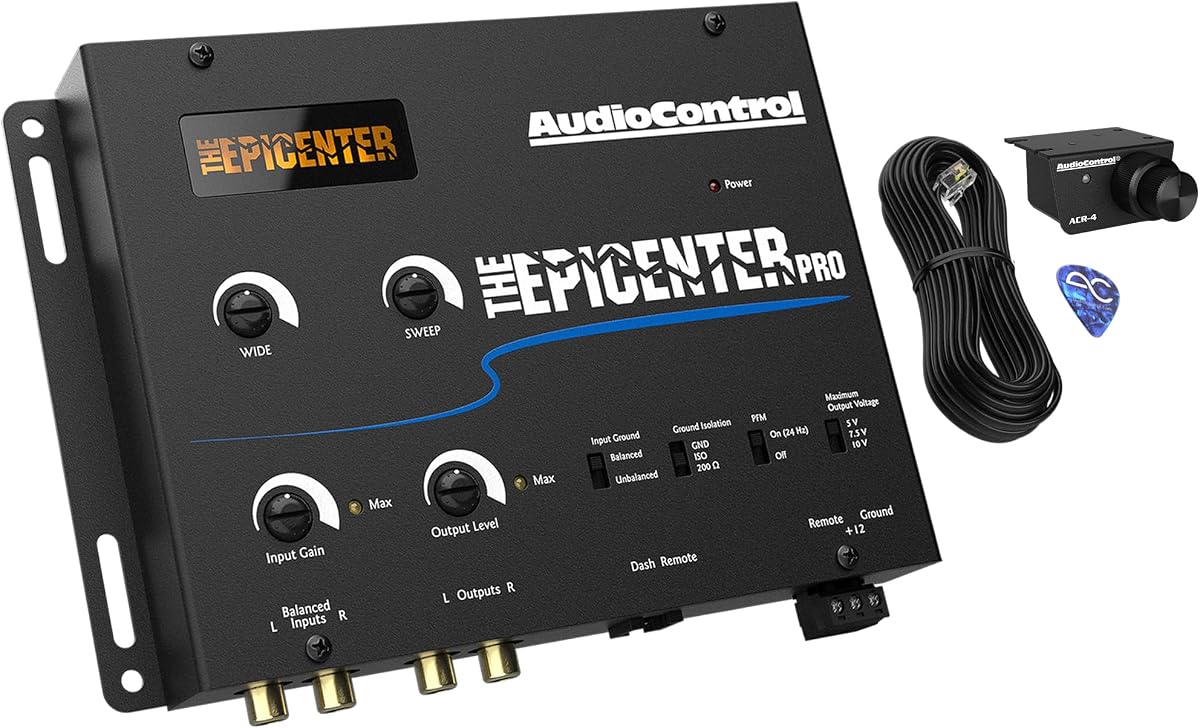
The AudioControl The EPICENTER PRO Bass Restoration Processor & Line Driver combines a high-voltage line driver with a dedicated bass-restoration circuit. Its 4.8 rating and broad feature set make it the most complete option for a factory system whose low-frequency response sounds compressed, shallow, or inconsistent at higher volume settings.
We may earn a commission when you buy through this link, at no additional cost to you.
The patented restoration circuit detects upper-range harmonics and synthesizes a low-frequency foundation, allowing the processor to rebuild impact in recordings that lack natural bass. Controls let users sweep the center frequency from 27 to 63Hz and adjust the bandwidth of the added signal. An optional ACR-4 dual-knob dash remote provides convenient control over the effect and bass level from the driver's seat.
AudioControl specifies a signal-to-noise ratio above 105dB and total harmonic distortion of 0.03%, while the balanced line-level input and output provide a clean path to equalizers, crossovers, and amplifiers. Selectable 20-ohm, 60-ohm, and 20k-ohm loads support modern factory systems, and the programmable frequency-match subsonic filter can eliminate wasted amplifier power. These are extensive capabilities, but their number also means the unit benefits from deliberate setup rather than a quick plug-and-play installation.
The EPICENTER PRO is best for listeners who want more than signal conversion and are specifically trying to recover low-end impact from factory sources. It also suits systems that already have enough amplification but lack control over the shape of bass. For a simpler installation, the LC1i or LC2i may be easier; for deeper control and richer bass tools, this is the most compelling dedicated processor here.
Rather than merely boosting existing bass, the restoration circuit identifies harmonic content and adds a low-frequency foundation. The adjustable sweep and width controls make that intervention more precise than a simple bass knob.
Balanced connections, selectable load positions, a subsonic filter, and a remote-output connection provide a flexible foundation for factory head units and downstream audio equipment.
We may earn a commission when you buy through this link, at no additional cost to you.
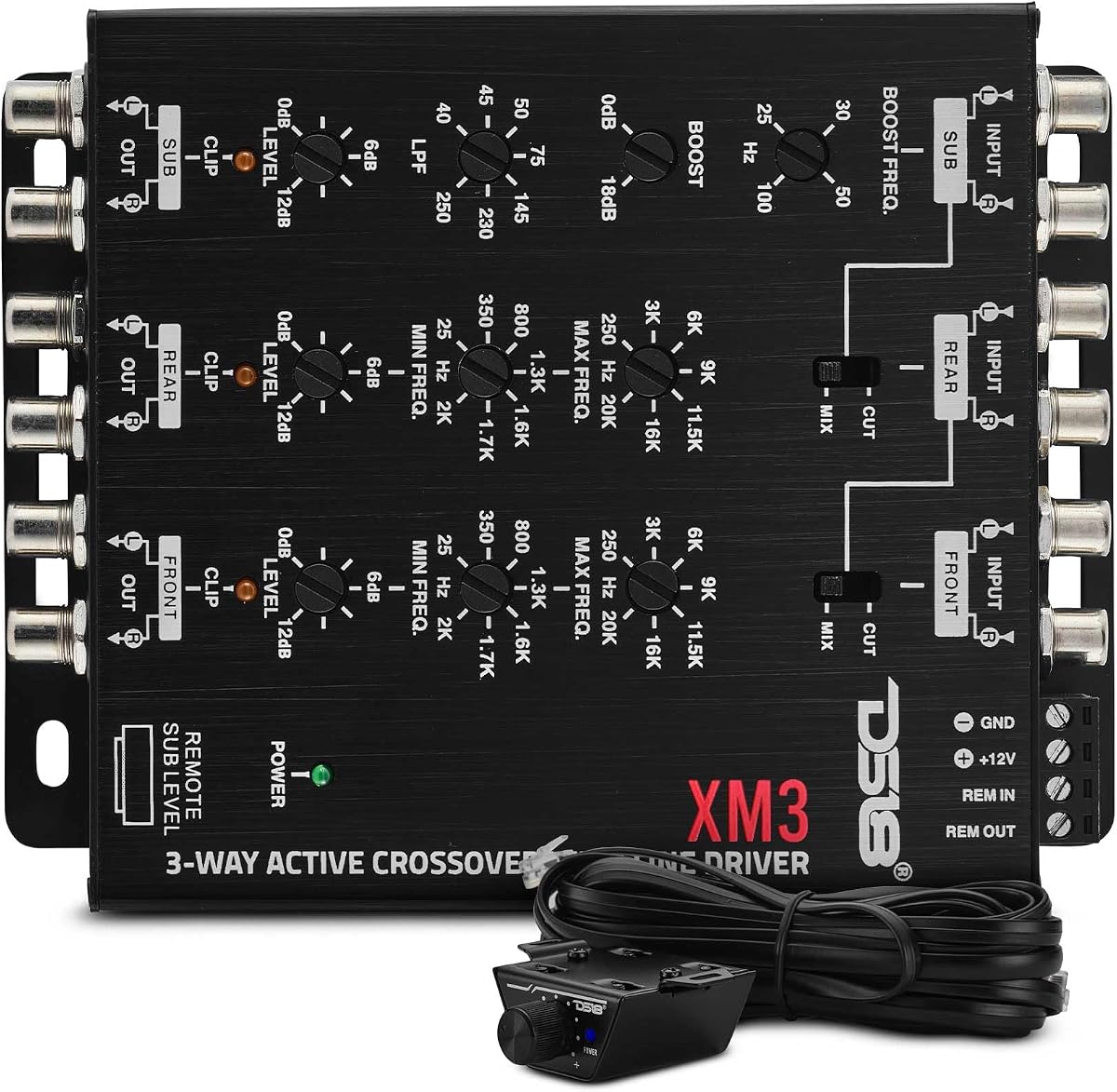
The DS18 XM3 is a 3-way active crossover with an integrated 11V line driver, making it a different kind of solution from the dedicated converters and signal processors in this list. It is intended for installers who need frequency division as well as strong preamp-level output. Its 4.1 rating is lower than the ratings of the other products, but its crossover functionality is difficult to duplicate with a basic line driver.
We may earn a commission when you buy through this link, at no additional cost to you.
The XM3 provides independent front, rear, and subwoofer tuning. Its high-voltage output can reach 11V and is specified at 0.01% total harmonic distortion, giving downstream amplifiers a strong, clean input. The included remote subwoofer level controller includes a clip indicator, allowing bass adjustments to be monitored while the vehicle is being driven rather than only while the system is parked.
Installation requires attention to crossover settings, amplifier compatibility, remote wiring, and the included Tiffany RCA connectors. The unit operates from 9 to 15V and supports three-, two-, or one-way systems. Adjustable high-pass filters span 25Hz to 2kHz, while low-pass filters cover 250Hz to 20kHz. Those broad ranges offer useful flexibility, although correct configuration matters for phase and tonal consistency.
The XM3 is a good choice for a complete front-and-rear system with separate subwoofer control, especially when the installer wants a crossover and line driver in one enclosure. It is less attractive for someone who only needs a small two-channel conversion. Its 6.25-by-5-by-1.2-inch size remains compact, and the delayed remote output supports a more organized installation.
Independent front, rear, and subwoofer adjustments allow the XM3 to manage multiple amplified zones. That makes it more suitable for a full system than a compact single-subwoofer converter.
The remote's clip indicator provides a practical warning when subwoofer level adjustments approach distortion. Combined with 0–18dB of bass boost, it supports deliberate low-end tuning.
We may earn a commission when you buy through this link, at no additional cost to you.
The Timpano 7 Band Equalizer TPT-EQ7 is an unusually broad product for the category because it combines a seven-band graphic equalizer, high-level input conversion, a 10V line driver, a crossover, subwoofer control, and six RCA outputs. Its 4.6 rating and feature density make it the most practical budget-oriented option for an installer who wants several functions in one compact unit.
We may earn a commission when you buy through this link, at no additional cost to you.
The equalizer provides seven adjustable bands at 50Hz, 125Hz, 320Hz, 750Hz, 2.2kHz, 6kHz, and 16kHz, with plus or minus 12dB available on each. Its high-voltage RCA output is designed to maintain a low-noise signal even over longer cable runs. A built-in speaker-wire-to-RCA converter allows the TPT-EQ7 to accept audio from a factory radio, while adjustable subwoofer level and crossover controls provide essential system management.
The primary compromise is the fixed-band design. Users cannot choose arbitrary center frequencies the way they can with a parametric equalizer, so the TPT-EQ7 is less precise for correcting a narrow acoustic problem. Its one-inch mounting depth is also excellent for hidden installation, but the number of connections still requires adequate space behind the trim or equipment. It is better viewed as a compact system hub than a dedicated high-end line driver.
This model makes sense for a factory-radio upgrade involving a subwoofer and one or more amplifiers, particularly when avoiding a stack of separate boxes is important. It is the strongest budget choice in the guide because it performs several common integration tasks at once. Buyers who require precise frequency selection or the lowest stated distortion figures may prefer a more specialized unit.
The built-in high-level converter, crossover, equalizer, and subwoofer level control reduce the number of separate devices required for a basic factory integration.
Seven standard bands offer straightforward tonal correction across the audible spectrum. They are useful for general vehicle acoustics, although they cannot be narrowed or repositioned like parametric controls.
We may earn a commission when you buy through this link, at no additional cost to you.
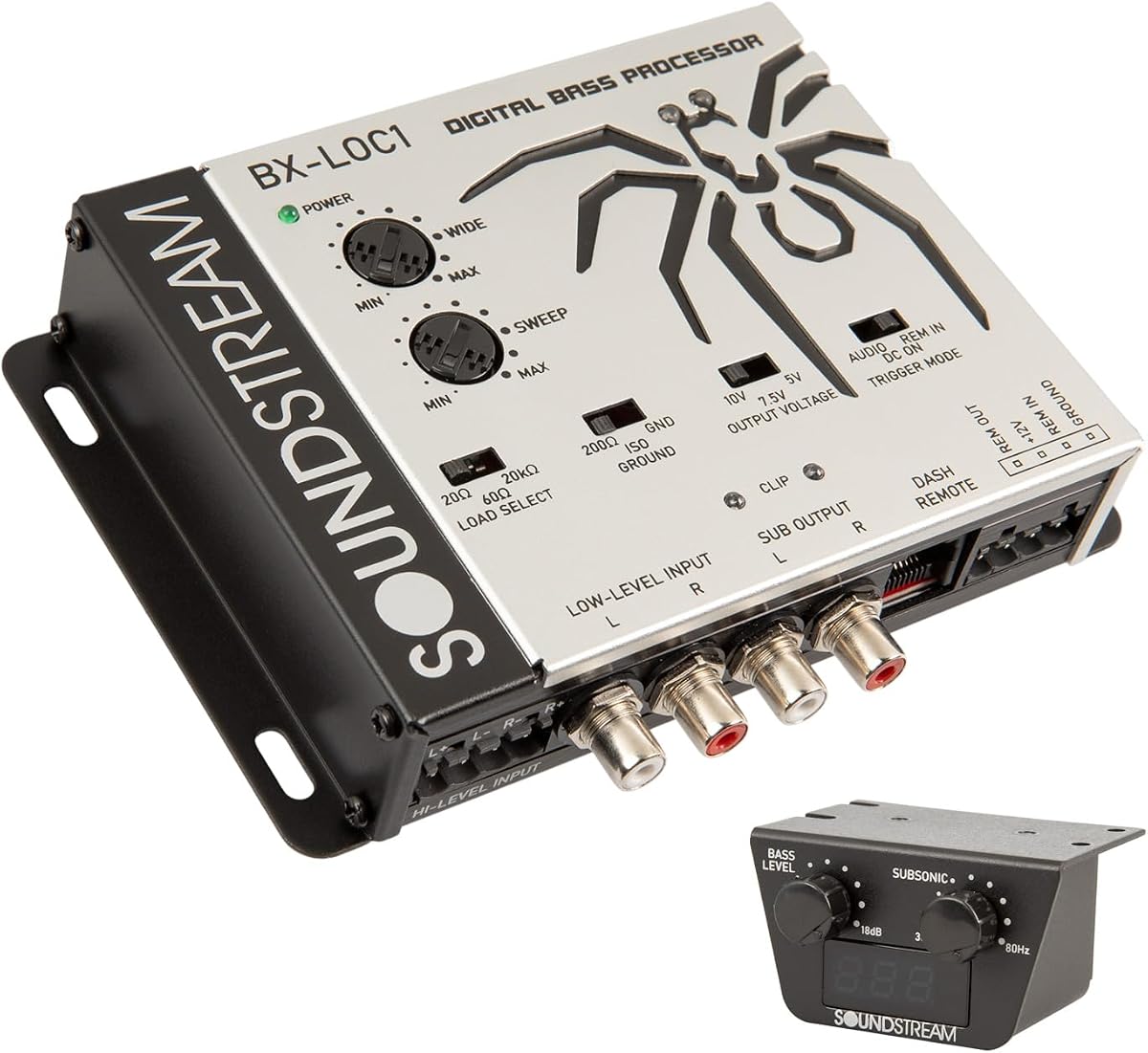
The Soundstream Premium Bass Processor BX-LOC1 combines line output conversion, a high-voltage line driver, and digital bass reconstruction in a compact package. Its 4.2 rating places it near the middle of the group, but its versatility gives it potential in both factory and aftermarket systems. The primary objective is to turn weak or compressed source signals into a cleaner, more forceful feed for amplifiers and subwoofers.
We may earn a commission when you buy through this link, at no additional cost to you.
The BX-LOC1 accepts both speaker-level and RCA inputs, making it suitable for factory head units as well as aftermarket sources. Its adjustable line driver can produce up to 9V, while shielding, ground isolation, and impedance matching are intended to reduce hiss, hum, and engine noise. A selectable turn-on method and onboard LED clipping indicator help simplify integration and gain setting.
Bass reconstruction is the distinguishing feature, restoring low-end impact to compressed or factory audio without requiring a completely separate bass processor. The limitation is that the product is built as a compact single-processor solution rather than a multi-channel control hub. There is no included dash remote, and the supplied feature description does not identify multi-channel routing comparable to the AudioControl Matrix Plus models.
The BX-LOC1 is a sensible option for adding a powered subwoofer or compact amplifier without replacing a factory stereo. Its clearly labeled RCA connections and small footprint simplify installation, while clipping feedback and selectable activation methods support a cleaner setup. It is best suited to a straightforward signal upgrade rather than a fully active multi-zone system.
Supporting both speaker-level and RCA inputs means the BX-LOC1 can follow an existing aftermarket signal chain or take over directly from a factory head unit.
The clipping indicator provides visible feedback during setup, helping installers avoid overdriving the processor before setting downstream amplifier gain.
We may earn a commission when you buy through this link, at no additional cost to you.
The AudioControl LC2i 2-Channel Line Output Converter with AccuBASS is built for a familiar factory-audio problem: bass that becomes progressively weaker as the original head-unit volume rises. Its 4.6 rating reflects a well-established feature set, and AccuBASS is the central reason to choose it over a plain line output converter.
We may earn a commission when you buy through this link, at no additional cost to you.
The LC2i converts speaker-level signals up to 400W per channel into preamp-level RCA signals for aftermarket subwoofers, amplifiers, and processors. AccuBASS processing is designed to correct the bass roll-off created when the factory radio is turned up. The unit offers fixed and variable outputs with onboard level controls, and the Remote Out can trigger downstream amplifiers, line drivers, crossovers, and other compatible devices.
Installation benefits from selectable Great Turn On sensing, optional ACR-1 dash remote input, and integrated mounting brackets. The stated dimensions are 5.4 by 3.25 by 1.5 inches, extending to 6.5 inches with the brackets. A meaningful limitation is that the unit does not retain fader control when multiple amplifiers are used; AudioControl points users toward the LC5i PRO, LC6i, or LC7i PRO for that type of arrangement.
The LC2i is an excellent fit for a single subwoofer or one aftermarket amplifier added to a factory system, particularly when the listener wants bass compensation. It is less appropriate for a large system requiring fader retention or many independently controlled zones. Confirming the vehicle's fader behavior and amplifier arrangement before installation is essential.
AccuBASS targets the low-frequency reduction commonly heard when a factory radio's volume rises. That makes the LC2i more than a passive signal adapter.
The converter can trigger downstream equipment and supports multiple output arrangements, but it does not retain fader control when multiple amplifiers are operating. Larger systems should account for that limitation.
We may earn a commission when you buy through this link, at no additional cost to you.
The Wavtech linkDQ combines the functions of the Wavtech linkD, linkQ, and bassFREQ products into a two-channel line output converter and line driver with parametric equalization. Its 4.7 rating makes it one of the strongest-rated products in the guide, and its defining feature is the ability to correct low-frequency deficiencies with either narrow or wide adjustment bands.
We may earn a commission when you buy through this link, at no additional cost to you.
The adjustable PEQ is especially useful when a vehicle has a specific bass problem rather than a general need for louder low end. A narrow setting can address a concentrated frequency issue, while a wide range can influence a broader portion of the low-frequency spectrum. The unit also supports automatic turn-on through DC-offset detection or audio signal detection, and its RJ45 port provides a straightforward path to adding a compatible remote level control.
OEM load detect compatibility is valuable in factory installations where the original amplifier checks connected speaker loads. As with many modern integration devices, correct load selection and power wiring remain important. The product's feature set is focused on the input and bass-correction side of the signal chain, so an installer will still need compatible outputs, amplifiers, crossovers, and a remote if one is desired.
The linkDQ is best for a factory-radio upgrade where the installer wants more targeted bass control than a fixed low-frequency boost. It can correct a narrow cabin resonance or shape a wider bass region, making it versatile for different vehicles. Buyers prioritizing a broader full-spectrum equalizer may find a seven-band unit more familiar, but the linkDQ offers a more focused and adaptable solution.
Parametric equalization lets the installer focus on a defined frequency region instead of applying a broad boost. The narrow and wide bandwidth options accommodate both focused corrections and more expansive shaping.
The RJ45 port is intended for a compatible remote level control sold separately. It offers a cleaner upgrade path than adding a separate wired controller to the signal chain.
We may earn a commission when you buy through this link, at no additional cost to you.
The AudioControl Epicenter Micro PRO Bass Restoration Processor with LOC is the most feature-rich premium option in the guide. It carries a 4.8 rating and combines high-output line driving, flexible source connections, patented bass restoration, precise harmonic controls, programmable subsonic filtering, and support for a dual-knob dashboard remote.
We may earn a commission when you buy through this link, at no additional cost to you.
Both speaker-level and balanced line-level inputs and outputs are supported, offering more flexibility than converters with a single input type. The Micro PRO can exceed 10V maximum output, while its specified signal-to-noise ratio is above 105dB and total harmonic distortion is 0.03%. The bass-restoration circuit detects upper-range harmonics and synthesizes low-frequency content for sources that lack impact.
The processor gives detailed control over the restoration effect. Its center frequency can be swept from 27 to 63Hz, and the bandwidth can be adjusted to suit the vehicle. A programmable frequency-match filter can reduce wasted amplifier power but may be bypassed for maximum output. Great Turn On sensing simplifies activation, while a conformal-coated circuit board provides protection against moisture, dust, and temperature changes.
The Micro PRO is ideal for a premium factory integration where the listener wants extensive bass control and clean high-voltage signals. The 1-by-8-by-3-inch chassis is compact enough for hidden installation, and the optional ACR-4 remote puts effect and bass-level adjustment within reach. The tradeoff is complexity: users should expect more setup and should select filter values and output levels carefully to avoid overprocessing.
Output above 10V gives downstream amplifiers a strong, low-noise signal while leaving substantial headroom. The processor's balanced connections further improve its suitability for complex installations.
The 27–63Hz sweep and adjustable bandwidth make it possible to align the synthesized fundamental with the vehicle's response. Bypassing the subsonic filter also allows the unit to operate at its maximum output.
We may earn a commission when you buy through this link, at no additional cost to you.
The AudioControl Matrix Plus 6-Channel Line Driver is a focused high-voltage signal driver for multi-channel car audio systems. Its 3.6 rating is the lowest among the products reviewed, so buyers should pay particular attention to compatibility and current product details. The supplied information is concise, but it identifies a capable output stage with generous gain control.
We may earn a commission when you buy through this link, at no additional cost to you.
The unit can provide up to 24dB of gain and a maximum of 9.5V RMS output. Top-mounted controls make the adjustments accessible during installation, and indicator lights show when output reaches 1V, 2V, or 5V, along with a separate Maximized indicator. These visual references can help an installer reduce unnecessary gain and maintain a cleaner gain structure.
Compared with the more extensively specified Matrix Plus model, this unit's documentation does not list detailed distortion, frequency-response, grounding, or remote-control specifications. It therefore appeals to buyers seeking a direct six-channel line driver with prominent controls rather than a complete set of conversion, filtering, and bass-restoration features. The available information does not indicate a remote or advanced source-management functions.
This Matrix Plus is most appropriate for an established system that already has compatible source components and needs a central high-output driver. It may suit installers who prefer top-accessible gain controls and clear output indications. Prospective buyers should verify connection types, grounding, remote behavior, and dimensional requirements against their installation because those details are not provided in the product summary.
The combination of up to 24dB of gain and 1V, 2V, 5V, and Maximized indicators gives installers useful visual references during signal calibration.
This model centers on boosting and distributing line-level audio rather than adding conversion, equalization, or bass-restoration functions. It works best as part of a system whose other components are already selected.
We may earn a commission when you buy through this link, at no additional cost to you.
The right line driver depends on the source, number of channels, downstream equipment, bass goals, remote-control requirements, and installation space. These factors help separate a simple signal converter from a full-featured system processor.
Start by identifying where the audio will enter the product. A factory radio or integrated amplifier normally provides speaker-level output, while an aftermarket head unit or processor may already offer RCA preamp connections. A dedicated line output converter handles the former, whereas a line driver is generally used to boost an existing line-level signal. Some models, including the AudioControl LC1i, EPICENTER PRO, Epicenter Micro PRO, and Soundstream BX-LOC1, support factory-style inputs, but their downstream capabilities differ substantially.
Choose a source configuration that matches the existing system without requiring unnecessary adapters. Also check whether balanced inputs and outputs are needed, because only some products support balanced connections. The correct input path reduces installation complexity and makes signal routing easier to understand.
A two-channel converter is sufficient for a single subwoofer, a compact two-channel amplifier, or a simple front/rear signal path. A six-channel line driver is more appropriate when one central unit must feed several amplifiers, processors, or subwoofers. Products such as the DS18 XM3 add an active crossover and route output by frequency, while the AudioControl Matrix Plus models are centered on multi-channel distribution.
Match channel capacity to the number of downstream zones instead of paying for unused controls. For a full system with independently processed front, rear, and subwoofer channels, choose a device that clearly labels each output and provides the required filtering. Simplicity remains valuable when the system only has one amplifier and one subwoofer.
A high-voltage line driver can improve compatibility with downstream amplifier inputs, especially in longer cable runs or more demanding installations. Available maximum outputs range from the Soundstream BX-LOC1's 9V to 13V peak from the fully specified AudioControl Matrix Plus. The Epicenter Micro PRO can exceed 10V, while the Timpano TPT-EQ7 and DS18 XM3 are specified at 10V and 11V respectively.
Higher voltage is not automatically better for every system, but it can provide useful headroom and reduce sensitivity to noise when gain is set appropriately. Match the output to the downstream amplifier and avoid using excessive gain that forces the amplifier to work harder. Confirm the input tolerance and preferred signal level of every component in the chain.
Low distortion and a strong signal-to-noise ratio are especially important when the system operates in a quiet cabin, where hiss can be more distracting than it would be at higher volume. Among the products with published figures, the fully specified AudioControl Matrix Plus lists less than 0.005% total harmonic distortion and a -110dB signal-to-noise ratio. The DS18 XM3 specifies 0.01% distortion, while both EPICENTER PRO variants state 0.03% and a signal-to-noise ratio above 105dB.
Treating these figures as comparative guidance is more useful than treating them as guarantees of perceived performance. Actual results depend on wiring, grounding, power quality, gain structure, and the connected components. A clean installation and correct gain calibration matter just as much as the headline specification.
A line driver and a bass processor are not always the same thing. The EPICENTER PRO and Epicenter Micro PRO use a patented restoration circuit to detect upper-range harmonics and synthesize low-frequency content. The Timpano TPT-EQ7 offers seven fixed bands, while the Wavtech linkDQ provides adjustable parametric low-frequency correction with narrow or wide bandwidth. The DS18 XM3 includes bass boost and an active crossover rather than harmonic reconstruction.
Choose harmonic restoration for compressed or bass-light source material, a parametric EQ for targeted vehicle corrections, and a graphic equalizer for broad tonal shaping. Extra bass processing is not always necessary if the source already has strong low-frequency information. Set restoration or boost conservatively to avoid overwhelming the cabin, distorting the subwoofer, or wasting amplifier power.
A dash-mounted remote gives the driver convenient control over bass or overall level without reaching into the trunk. AudioControl offers optional ACR-1 or ACR-4 compatibility across several products, the DS18 XM3 includes a remote subwoofer controller, and the Wavtech linkDQ has an RJ45 port for a compatible remote sold separately. Check whether the desired control is included, because many optional remotes must be purchased separately.
Remote capability is most valuable in factory systems where the original head unit may not provide convenient bass adjustment. A dual-knob controller can separately manage an effect level and bass output, while a single level control may be enough for a conventional subwoofer installation. Confirm that the remote is compatible with the selected processor and that its cable can reach the intended dashboard location.
The unit must turn on at the correct time and avoid introducing hum. Great Turn On signal sensing, DC-offset activation, audio signal detection, remote inputs, and remote outputs are all available in different combinations across the list. Ground isolation is especially useful when a factory or aftermarket installation produces ground buzz or alternator whine. The AudioControl LC1i includes a selectable isolation switch, and the Soundstream BX-LOC1 also provides ground isolation.
Choose a turn-on method that suits the source and vehicle rather than adding a manual switch when automatic operation is available. For ground-related noise, test the system, verify all connections, and use isolation only when needed. Correct power sourcing, appropriate fuse protection, and secure ground points remain essential regardless of the automatic features.
A line driver does not automatically perform frequency division. The DS18 XM3 is an active crossover with front, rear, and subwoofer controls, while the Timpano TPT-EQ7 also includes crossover functionality. The EPICENTER PRO and Epicenter Micro PRO use programmable subsonic filters to reduce unwanted energy and wasted amplifier power, and the AudioControl Matrix Plus includes a 33Hz, 18dB-per-octave subsonic filter.
A dedicated crossover is useful when multiple speakers cover different frequency ranges, but it is not necessary for every installation. Subsonic filtering is useful when controlling a subwoofer's excursion and protecting a monoblock amplifier. Adjust crossover points and filter slopes to match the speakers, enclosure, head unit, and amplifier rather than using generic values.
A technically capable processor is only useful if it can be mounted securely. The AudioControl LC1i measures 4.8 by 3 by 1 inch, the Timpano TPT-EQ7 has a seven-and-three-quarter-by-two-and-one-quarter-inch face with a one-inch mounting depth, and the Epicenter Micro PRO uses a low, elongated 8-by-3-inch chassis. The fully specified AudioControl Matrix Plus measures 8.7 by 6.7 by 1.15 inches.
Check the available space behind panels, under seats, or near amplifiers before buying. Leave room for cables and service loops, and ensure connectors can be removed without removing the entire unit. Physical clearance is also important for heat dissipation, especially in tightly enclosed installation areas.
Begin by disconnecting the battery before working with the vehicle's wiring, then map the source, processor, amplifier, crossover, and remote connections. Identify whether the input is speaker-level or RCA, confirm the number of channels, and select the appropriate load or ground configuration before powering the system. Route signal cables away from high-current power wiring whenever practical.
Install the unit in a dry, secure location with enough clearance for connectors and airflow. Use the supplied or compatible remote where appropriate, connect remote turn-on and ground leads according to the instructions, and check the output-voltage indicators before setting amplifier gain. Make small adjustments with the vehicle in a safe, stationary location, then listen across different source levels and music types.
Care for the device by keeping connectors clean and dry, avoiding repeated unplugging of power terminals, and checking that all fasteners remain secure. If hiss, hum, clipping, or unstable output appears, inspect grounding, RCA connections, turn-on settings, and gain before changing filters. Do not bypass protective grounding or subsonic features simply to obtain more output, and verify the manufacturer's guidance for the specific installation.
A line driver boosts and conditions a line-level audio signal before it reaches downstream amplifiers or processors. It can improve signal headroom, reduce the need for very high amplifier gain, and help maintain clean sound over longer cable runs. A line output converter is different because it specifically converts speaker-level factory output into RCA preamp-level signals.
Not always. If an aftermarket head unit already provides clean RCA outputs and the connected amplifier has suitable input sensitivity, a separate line driver may add little. It becomes more useful with factory systems, long signal runs, multiple downstream components, or amplifiers that benefit from a higher-voltage input. A crossover or dedicated signal processor may be more appropriate if frequency control is the main goal.
A line output converter accepts high-power speaker-level audio, usually from a factory radio, and produces RCA line-level outputs. A line driver usually accepts an existing line-level signal and boosts it. Some products combine both functions, as the AudioControl LC1i, EPICENTER PRO, and Soundstream BX-LOC1 do, so the input labels and supported sources should be checked before installation.
The appropriate voltage depends on the downstream amplifier, cable length, and system design. Products in this guide provide outputs ranging up to 9V, 10V, 11V, or more than 13V peak. More voltage can improve headroom, but the driver should not be used to force unnecessary gain into an amplifier. A clean signal at the correct level is more important than maximizing the meter reading.
No. A converter with ground isolation may reduce ground buzz or alternator whine, but noise can also come from improper grounds, RCA cables routed near power wiring, inadequate power connections, alternator interference, or an unstable signal source. Correct installation remains essential. If noise persists, check the source, ground points, turn-on behavior, and cable routing before replacing the processor.
It depends on the source. A bass-restoration processor can add low-frequency information that is missing or heavily compressed in factory audio, but the result should be adjusted carefully. Too much restoration can exaggerate distortion, reduce clarity, or drive the subwoofer beyond its intended limits. A fixed or parametric EQ may be preferable when the problem is a specific cabin frequency rather than generally weak bass.
Some modern factory amplifiers inspect connected speaker loads and may stop passing audio if they detect an unexpected impedance. Products with selectable 20-ohm, 60-ohm, and 20k-ohm loads can present an appropriate load to the factory system while still allowing the converter to obtain an audio signal. The correct setting should follow the product instructions and the vehicle's amplifier requirements.
It is optional, but useful in factory systems where the original radio offers limited bass control. A remote lets the driver adjust bass or output level without accessing an amplifier or processor in the trunk. Some products include a remote, while others offer a port for a separately sold controller. Check the package contents before budgeting for remote control.
The AudioControl EPICENTER PRO stands out as the most complete all-around option, combining high-voltage line driving with detailed bass restoration and flexible integration features. The Epicenter Micro PRO offers similar bass-focused capability with maximum output above 10V, while the Timpano TPT-EQ7 delivers the most useful budget combination of conversion, equalization, crossover, and subwoofer control in a slim enclosure.
For a straightforward factory subwoofer upgrade, the LC1i or LC2i may be easier to integrate, with the latter adding AccuBASS compensation. The DS18 XM3 is the natural choice when active frequency division is required, while the Wavtech linkDQ suits installers who want targeted parametric correction. Prioritize source compatibility, channel count, signal quality, remote support, and physical space over the number of advertised features.
Before ordering, verify current specifications, connector types, required accessories, and fitment directly on the product listing. Product availability and pricing can change, so checking the latest listing details is important. A carefully matched processor and clean installation can provide a stronger foundation than adding more equipment without a clear system purpose.