
SEMIER Small Digital FM Radio Bluetooth Speaker
4.4Editor score
Compact multi-function design
Bluetooth and file playback
Rechargeable 2000mAh battery
A portable radio with Bluetooth combines traditional broadcast listening with wireless music streaming, giving it more flexibility than a standard AM/FM receiver. The most useful models balance dependable reception, clear speakers, intuitive controls, and flexible power options for home, travel, camping, and emergency preparation.
This guide compares ten portable radios with Bluetooth across reception bands, speaker performance, battery and wired power arrangements, station storage, weather functions, alarms, headphone support, and file playback. It also considers practical differences such as size, display type, controls, and whether the model is intended for personal listening or fuller-room audio.
The rankings reveal where each radio excels and where compromises remain. The top three recommendations cover an approachable overall choice, a feature-rich budget model, and a higher-output premium option. Product configurations and availability can change, so confirm current specifications and prices on the linked listing before purchasing.
4.4Editor score

4.8Editor score

4.5Editor score
As an Amazon Associate we earn from qualifying purchases.
The comparison highlights the most important differences among these portable radios, including supported broadcast bands, audio output, playback flexibility, power options, and user-friendly features. It is designed to help readers identify the right combination of reception, portability, and convenience for their own listening habits.


The YOWGULF Portable AM FM Radio with Bluetooth, Battery Operated or AC Power stands out as the most balanced choice in this guide. It carries a 4.8 rating, the highest listed rating among these products, and combines AM and FM reception with Bluetooth streaming. Its intuitive knobs and flexible power options make it approachable for everyday listeners rather than only technically minded users.
We may earn a commission when you buy through this link, at no additional cost to you.
The strongest feature is the straightforward control layout. Instead of asking buyers to navigate a complicated digital menu, the radio provides clear tuning and volume knobs with visible dial marks. Bluetooth mode can stream music and audiobooks from compatible smartphones or tablets, while the radio bands cover FM 87–108MHz and AM 520–1710KHz. That makes the device useful for local news, talk radio, music, and streamed entertainment.
Its home-oriented design is not merely decorative. A large speaker is included for comfortable listening, and the product supports AC power or four AA batteries, allowing it to move from a bedroom, kitchen, or study to a walk, picnic, or camping trip. The absence of shortwave, NOAA, alarms, a digital screen, and card-based music playback means it is not the most feature-dense option. It is also strictly an AM/FM and Bluetooth device rather than a weather-alert receiver.
This is the strongest general recommendation for readers who want straightforward operation, attractive retro styling, both AM and FM, and meaningful flexibility between plugged-in and battery-powered use. It is particularly suitable for older adults, casual listeners, and anyone who prefers physical controls over touchscreens. For people seeking emergency weather broadcasts, programmable alarms, or stored-file playback, one of the feature-focused alternatives will be a better match.
Large tuning and volume knobs reduce the learning curve and make the radio practical for older listeners or anyone who dislikes navigating small digital menus. Clear dial markings also help users find broadcast stations with less guesswork.
The choice of AC power and four-AA battery operation lets the radio serve as a bedroom clock-style companion or a genuinely portable outdoor radio. Bluetooth adds a third source of audio without turning the device into a complex all-purpose media unit.
We may earn a commission when you buy through this link, at no additional cost to you.
The SEMIER Small Digital FM Radio Bluetooth Speaker, Support USB/SD Card is an unusually capable budget-oriented model. Its 4.4 rating reflects a favorable balance of reception, flexible file playback, portability, and charging convenience. Rather than limiting itself to radio and Bluetooth, it combines a digital tuner, USB player, microSD player, and Bluetooth speaker in a compact housing.
We may earn a commission when you buy through this link, at no additional cost to you.
The antenna is designed to improve FM reception across 88–108MHz, and the radio offers automatic and manual station searching, station deletion, and automatic storage. A clean LCD and numbered keys make selections accessible. Its dual four-watt speakers are more substantial than those of many miniature radios, while six sound-effect presets can add variety for different music styles.
Media playback is one of its major strengths. It supports MP3, WAV, FLAC, and APE files from USB drives or microSD cards, and it can record voice content to those same storage types. Bluetooth pairs with phones and tablets, automatic memory supports reconnection, USB-C charging uses the included rechargeable 2000mAh battery, and a 3.5mm earphone jack supports quieter listening. The trade-off is that it receives FM only, with no AM or NOAA weather band.
Buyers who want a small travel speaker, a portable digital radio, and a way to carry their own playlists should give this model strong consideration. It is especially useful when stored music matters more than access to talk stations. It is less appropriate for households that specifically require AM reception, emergency weather broadcasts, bedside alarms, or a larger stereo sound field.
Support for several common audio formats, USB drives, microSD cards, and voice recording gives the SEMIER flexibility beyond live broadcasts. It is a practical choice for users who want a compact personal media player with radio reception.
At 6.3 by 1.2 by 3.1 inches and 0.55 pounds, the radio is easy to place in a bag or carry with its lanyard. USB-C charging and a rechargeable battery further reduce dependence on disposable cells.
We may earn a commission when you buy through this link, at no additional cost to you.
The Avantree BoomByte is the premium selection for anyone who regards a portable radio with Bluetooth as a portable stereo speaker first. Its 4.5 rating and pair of seven-watt drivers distinguish it from the smaller personal-listening models. The two-driver arrangement produces left-right separation, making the radio better suited to a room, patio, garden, or other shared environment where one compact speaker would feel undersized.
We may earn a commission when you buy through this link, at no additional cost to you.
It accepts four kinds of content: FM radio, Bluetooth audio, USB-drive music, and SD-card music. That makes it easy to move from a live local broadcast to a stored playlist without changing devices. Enhanced FM reception is designed to improve signal clarity, while the portable form factor lets the unit move between the bathroom, garden, and park without becoming a stationary speaker.
The main limitation is its tuner scope. The listed specifications provide FM reception but do not include AM, NOAA weather broadcasts, shortwave, or dual alarms. Its Type-C charging port and advertised battery life of up to 18 hours help offset the larger speaker configuration, although actual runtime will vary with volume, Bluetooth use, and the selected source.
This is the strongest choice for listeners who prioritize stronger, more dimensional audio over access to every broadcast band. It is a natural fit for patios, picnics, small gatherings, and rooms where a single tiny speaker would be insufficient. Those who need AM talk radio, weather readiness, or alarm-clock functions should look toward the NOAA, shortwave, or bedside-oriented models instead.
Two seven-watt drivers create genuine left-right separation and more output than the miniature radio category typically provides. The result is a device that can function as the primary speaker for a casual gathering rather than only a personal headphone companion.
FM, Bluetooth, USB, and SD playback let users mix live radio with personal media. Automatic reconnection and long battery life reduce friction during travel or extended listening away from an outlet.
We may earn a commission when you buy through this link, at no additional cost to you.
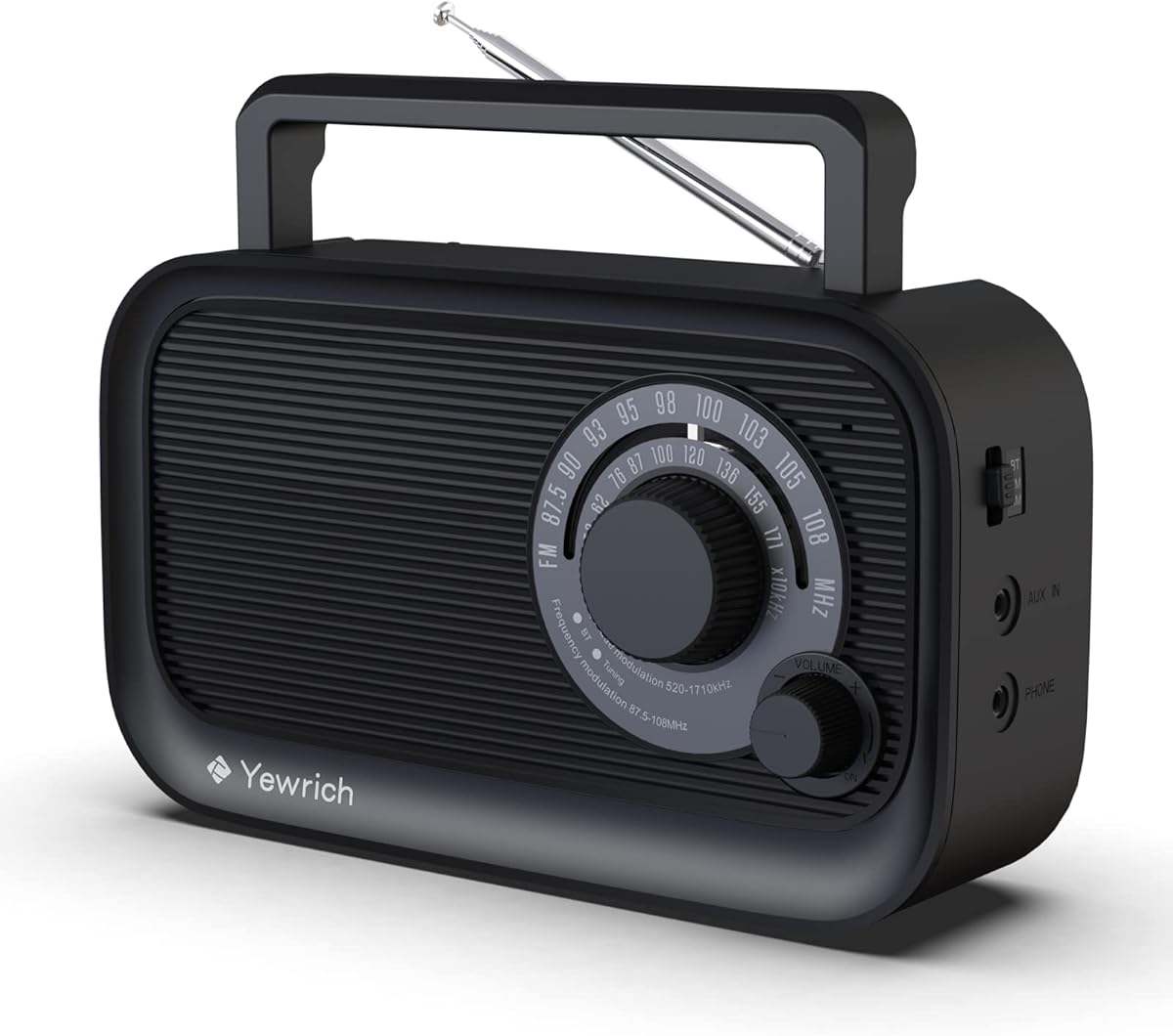
The Yewrich AM FM Radio with Bluetooth AC/DC Power with 3.5mm Headphone Jack is a direct, functional option for traditional radio listeners who also want phone music. Its 4.3 rating reflects a solid core feature set, and the product centers on clear AM/FM reception, Bluetooth speaker operation, and uncomplicated controls rather than an elaborate digital interface.
We may earn a commission when you buy through this link, at no additional cost to you.
A DSP chip and retractable antenna support stable reception, while the frequency coverage includes FM 87.5–108MHz and AM 520–1710kHz. The radio connects to a phone in less than a second according to the listed product information, and its built-in speaker is intended to deliver clear sound across a room. A large tuning knob and integrated handle contribute to an easy-to-use, easy-to-carry design.
Power flexibility is the defining practical feature. The supplied charging cable supports AC 110V operation for extended indoor listening, while a compartment accepts four AA cells for outdoor use. The headphone jack offers private listening without Bluetooth. However, there is no NOAA support, digital display, alarm, SD card, USB player, or station memory documented in the supplied information.
This radio makes sense for users who want a modest speaker, straightforward AM/FM tuning, and dependable Bluetooth without paying for a feature-heavy design. It can be a good bedside, kitchen, workshop, or picnic companion, particularly for older listeners who value a large dial. It is less suitable for people who require formal weather alerts or want to carry their own digital music library.
The radio maintains familiar AM and FM tuning while adding fast wireless access to phone-based music. That combination makes it useful for users who want one uncomplicated device rather than a separate speaker for streaming.
AC charging supports continuous home listening, and four-AA operation keeps the radio available during outages or outdoor activities. The carry handle and manageable control layout further support mobility.
We may earn a commission when you buy through this link, at no additional cost to you.
The Avantree SP850 is designed for personal listening rather than filling a room. It carries a 4.4 rating and combines FM radio, Bluetooth streaming, and standard SD-card MP3 playback in a compact body. Its clear voice-focused speaker and rechargeable design make it a sensible choice for commuters, travelers, and listeners who often use headphones.
We may earn a commission when you buy through this link, at no additional cost to you.
Bluetooth can stream music, podcasts, or news from a phone, tablet, or computer. The SD-card function supports MP3 playback without a paired device, while auto-scan and numeric keys accelerate station access. Holding a number key from one through nine stores a favorite, reducing the need to repeat a manual search each time the radio is switched on.
The built-in rechargeable battery and USB charging support portable use, and the small housing should be easy to carry. As a compact three-in-one unit, it avoids the complexity of larger models with color screens, weather bands, or multiple alarm settings. The trade-off is that it receives FM only and the product information does not list AM, NOAA, dual alarms, or weather-alert functions.
The SP850 is a strong pick for anyone who wants a small personal audio system with radio, phone streaming, and offline playlists. It works especially well for podcasts, spoken-word content, and close-range listening where a larger speaker is unnecessary. Buyers who need AM talk stations, emergency broadcasts, or a bedside clock should consider the more specialized options in this guide.
Auto-scan, numeric entry, and one-to-nine favorite shortcuts streamline FM tuning. Bluetooth adds podcasts and phone libraries, while SD playback remains available when a paired device is not.
USB charging removes the need for disposable batteries, and the compact enclosure suits a bag or desk. The emphasis on clear, balanced sound is particularly appropriate for close-range personal listening.
We may earn a commission when you buy through this link, at no additional cost to you.
The black JEUJUG Portable AM FM Radio is a flexible power solution with a 4.4 rating. It supports AM and FM, a five-watt speaker, Bluetooth 5.0, and three distinct ways of powering the device: a built-in rechargeable battery, four D-cell batteries, and an AC power cord. That combination is especially appealing to people who want a radio ready for travel, outages, and extended daily use.
We may earn a commission when you buy through this link, at no additional cost to you.
The built-in battery provides more than 10 hours of stated AM/FM playback and can recharge through the AC cable. Four D cells create a backup for outdoor use, while the rechargeable unit can also be used away from an outlet. Bluetooth 5.0 is designed for quick pairing, stable connections, and automatic reconnection to the last used device.
Reception is supported by an 18-inch telescopic antenna and an enhanced magnetic rod antenna. The radio measures 6 inches high and 4.8 inches in diameter, weighs 1.45 pounds without additional batteries, and includes a handle. These numbers reveal a larger, more substantial design than the miniature digital models. It lacks documented NOAA reception, alarms, storage-card playback, and a color display.
This JEUJUG version is a practical choice for listeners who prioritize speaker volume, antenna adjustment, and the ability to continue operating under different power conditions. It works well in a workshop, kitchen, garage, or campsite. Those seeking a smaller travel unit or a radio with formal weather alerts should consider a compact digital model or the dedicated NOAA options.
The internal rechargeable battery handles regular portable use, the AC cable supports stationary listening and recharging, and four D cells provide a practical backup. This is one of the broadest power arrangements in the guide.
A five-watt speaker and long telescopic antenna provide the fundamentals for louder listening and station adjustment away from home. The substantial size is less pocket-friendly, but it remains manageable for picnics and campsites.
We may earn a commission when you buy through this link, at no additional cost to you.
The FM Radio with Bluetooth, NOAA Weather Band, 2.4" Color Screen, Rechargeable Portable Radio, Dual Alarms, microSD Playback, USB-C Charging, Headphone Jack for Home, Bedroom, Office & Travel is the clearest bedside-oriented option. Its 4.5 rating reflects a well-rounded combination of weather access, clock features, Bluetooth, personal media playback, and a readable color screen.
We may earn a commission when you buy through this link, at no additional cost to you.
The 2.4-inch display shows stations, battery status, settings, and a real-time clock in standby mode. Dual alarms make the radio useful for waking, while NOAA reception provides weather broadcasts and updates. An SOS alarm offers an additional attention function. Bluetooth streams music, podcasts, and audiobooks, while a microSD card supports stored playlists without relying on a phone.
The built-in 3000mAh battery is stated to deliver up to 10 hours of microSD playback at maximum volume or up to 18 hours at 50 percent volume. USB-C charging simplifies replenishment, and six EQ modes adjust the sound for different content. A single multi-function control knob handles volume, station browsing, menus, and fine adjustments, while English, Spanish, and French menu support broadens accessibility.
The important limitation is explicit: this model supports FM and NOAA reception only, not AM. Buyers who need AM talk radio should choose a dual-band model, while those who prioritize a color bedside display, alarms, and weather awareness will find this one especially relevant. It also suits an office, kitchen, or travel setup where a clock and information display are more valuable than a compact retro appearance.
The color screen presents a live clock, battery information, and station details more clearly than a basic monochrome display. Dual alarms turn the radio into a practical bedside clock without requiring a separate device.
Bluetooth and microSD playback cover both streaming and offline listening, while six EQ modes and a headphone jack support different listening preferences. The stated battery estimates provide useful guidance for travel and everyday use.
We may earn a commission when you buy through this link, at no additional cost to you.
The Bluetooth AM FM Shortwave Radio with NOAA Weather Alert is the most comprehensive emergency-oriented model in the guide. It has a 4.3 rating and supports AM, FM, shortwave, and NOAA weather bands, offering a much wider selection of broadcast options than conventional AM/FM radios. A DSP chip, digital tuner, bright display, and clear button-based interface support practical station selection.
We may earn a commission when you buy through this link, at no additional cost to you.
NOAA reception provides real-time weather alerts and updates, while the built-in flashlight adds a useful emergency function. The 1250mAh rechargeable battery is stated to last up to 10–12 hours for music and news and charges through USB-C. A five-watt speaker delivers the main audio output, and a 3.5mm headphone jack allows private listening. Six EQ settings offer some tonal flexibility.
The radio also supports Bluetooth 5.4 and TF-card playback, making it useful for both live broadcasts and stored music. A back clip and wrist strap make it easier to attach to a bag or belt. Compared with simpler models, however, its digital controls, multiple bands, card slot, flashlight, and EQ options create a steeper learning curve. Its stated battery duration is also below the maximum playback figure claimed by several competitors.
This model is best for campers, travelers, weather-conscious households, and listeners interested in shortwave. It gives the broadest mix of broadcast and emergency functions in a portable form. If AM, FM, and Bluetooth are all that matter, a simpler dual-band radio will be easier to operate. For anyone building an emergency kit, however, NOAA reception and the flashlight materially improve its usefulness.
AM, FM, shortwave, and NOAA coverage create more options than a standard home radio. The NOAA band is particularly valuable for local weather broadcasts, alerts, and updates when conditions change rapidly.
The rechargeable battery, flashlight, headphone jack, back clip, and wrist strap support travel and emergency-kit use. USB-C charging and TF playback help keep the device useful between broadcast intervals.
We may earn a commission when you buy through this link, at no additional cost to you.
The retro JEUJUG Portable AM FM Radio combines a classic visual treatment with the same capable core found in the black version. It carries a 4.4 rating, supports AM and FM, and includes a five-watt speaker and Bluetooth 5.0. Its appeal lies in combining traditional radio styling with contemporary wireless connectivity and unusually flexible power support.
We may earn a commission when you buy through this link, at no additional cost to you.
The Bluetooth radio mode connects quickly to compatible devices and can automatically reconnect to the last device used. A built-in rechargeable battery supplies more than 10 hours of stated AM/FM playback, while four D cells offer another portable power option. The AC power cord recharges the internal battery and supports plugged-in use at home or in an office.
Reception is assisted by an 18-inch telescopic antenna and an enhanced magnetic rod antenna. A large, clear dial is intended to make tuning easier for older listeners. The radio is 6 inches high, 4.8 inches in diameter, weighs 1.45 pounds without extra batteries, and includes a handle. Missing features include NOAA reception, alarms, a digital screen, and USB or memory-card playback.
This is a good match for buyers who want the appearance and large controls of a classic radio but still want to stream phone music. It works well in a kitchen, study, workshop, garage, or campsite. The main reason to choose the black JEUJUG version would be appearance preference, while those wanting weather information or a screen should select a more specialized model.
The retro enclosure and large tuning dial create a familiar feel, while Bluetooth 5.0 adds quick access to music and other phone audio. It offers visual charm without sacrificing wireless flexibility.
AC, rechargeable-battery, and four-D-cell options let the radio operate around the home or away from an outlet. The antenna arrangement and five-watt speaker are useful for outdoor listening.
We may earn a commission when you buy through this link, at no additional cost to you.
The LEOTEC AM FM Bluetooth Radio AC/Battery Powered White Noise Headphone Jack is distinguished by its relaxation and sleep functions. With a 4.4 rating, it combines AM/FM reception, Bluetooth audio, a visible LCD, white noise and nature sounds, a programmable sleep timer, and both AC and four-AA battery power in a portable format.
We may earn a commission when you buy through this link, at no additional cost to you.
Its sound library includes ocean waves, rain, birds, and other ambient options intended to create a soothing environment for babies or adults. The sleep function can be adjusted from 5 to 90 minutes in 10-minute intervals, then powers the radio off when the selected period ends. This makes the model more than a conventional radio for nighttime, study, or relaxation use.
A scalable antenna supports reception across AM and FM bands, while the large dial makes station navigation easy. The LCD provides clearer status information than a display-free analog radio, and the 3.5mm headphone jack supports private, immersive listening. A portable handle supports use during picnics, hiking, office work, or household activities. The radio can run from a plug or four AA batteries for outage and outdoor flexibility.
The omissions are important for some shoppers. There is no documented NOAA reception, dual alarm function, shortwave support, or stored-file playback. This model is therefore most appropriate for users who actively value ambient sound and a sleep timer. It is less compelling for someone primarily seeking a powerful Bluetooth speaker, a full emergency-radio kit, or an alarm clock.
Ocean, rain, bird, and other nature sounds make the radio useful for winding down, studying, or creating a calming background. Bluetooth adds user-selected audio when radio and built-in ambient sounds are not enough.
The selectable 5-to-90-minute timer is a meaningful convenience for bedtime listening. LCD visibility, headphone support, and dual power options add flexibility without overwhelming the controls.
We may earn a commission when you buy through this link, at no additional cost to you.
The right portable radio with Bluetooth depends on where it will be used, which broadcast bands matter, how much audio output is needed, and whether standby battery life, weather alerts, alarms, or stored-file playback are worth additional complexity. Comparing these needs before shopping prevents an oversized or overly complicated device from being chosen by accident.
Start by identifying the stations you expect to listen to. AM remains useful for talk radio, news, sports, and local programming, while FM generally provides a wider selection of music and regional stations. NOAA weather-band reception adds official weather broadcasts and alerts but is distinct from ordinary AM and FM. Shortwave expands access to international and distance-based broadcasting, though it is more specialized. Several compact models are deliberately FM-only, so checking the supported bands is essential before purchasing.
Choose dual-band AM/FM for the broadest conventional station access, FM-only for a smaller and simpler design, and a NOAA-equipped model for emergency weather awareness. Shortwave is worth prioritizing only when you have a clear reason to use it.
Bluetooth turns the radio into a speaker for music, podcasts, audiobooks, and other compatible audio. Basic pairing is easy on every model in this guide, but some provide automatic reconnection to the last paired device, quick physical mode buttons, or Bluetooth 5.0 and 5.4 support. Consider whether you will stream mainly from a phone or also from a tablet or computer, and whether a dedicated source button is easier to identify than a nested digital menu.
Look for simple pairing, stable reconnection, and controls that do not require repeatedly opening settings. Bluetooth should complement the radio experience rather than turn basic station tuning into a complicated process.
A portable radio can be designed for private headphone listening, near-field listening at a desk, or shared listening in a room or outdoors. Larger speakers generally provide greater volume and more pronounced stereo separation, while compact products are easier to carry and often better for one person. The Avantree BoomByte uses two seven-watt drivers, the SEMIER has dual four-watt speakers, and several traditional models use a single five-watt speaker.
Match output to the environment. Choose a compact single speaker for travel and personal listening, dual drivers for patios and small gatherings, and a headphone jack when private audio matters more than room-filling volume.
Power options determine how far a radio can travel and how it will function during an outage. Rechargeable models with USB or USB-C charging reduce ongoing battery expense and are convenient for daily use. Models that also accept AA or D cells provide useful backup, while AC-only radios are best suited to fixed indoor positions. Some radios can recharge an internal battery from AC power, allowing the same unit to serve both stationary and portable needs.
Prioritize a rechargeable battery for frequent travel and removable cells for emergencies. If the radio will remain near an outlet, simpler AC operation may be sufficient. Check stated playback times, but treat them as guidance because volume and source choice can affect results.
Displays range from clear analog dials to bright color screens with clocks, battery status, and menu information. A digital screen helps when stations are numerous or weather details need to be read, while physical knobs are often easier for quick tuning. Alarms are especially valuable for bedside radios, and numeric station shortcuts can preserve favorites without repeating a search. Evaluate these extras according to how the radio will be used rather than assuming more screen functionality is always better.
For a bedside unit, prioritize a readable clock, dual alarms, and intuitive controls. For outdoor or emergency use, quick station access, backlighting, memory, and a clear display may matter more than alarm features.
NOAA reception is the most important distinction for emergency readiness because it provides direct access to weather broadcasts and alerts. A built-in flashlight adds another useful emergency function, while shortwave can expand access to distant stations. Sleep timers and white-noise sounds serve a different purpose, helping a radio double as a sleep aid or calming background device. A headphone output can also improve privacy during a power outage when announcements need to be heard without disturbing others.
Choose NOAA reception and a flashlight for emergency kits, a sleep timer for bedrooms, and standard AM/FM plus backup battery support for general household resilience. Verify that emergency features are built in rather than relying on a phone app.
Bluetooth streaming depends on a phone, but USB and memory-card playback allows a radio to operate independently. SD or microSD slots are common, and one model also accepts USB drives. Supported file formats vary, with MP3 broadly familiar while WAV, FLAC, and APE appear on some models. Voice recording to removable media can be useful for notes or saving broadcasts. A built-in file library is especially attractive for travel, work, and locations where cellular coverage is unreliable.
Prioritize the formats and storage type you already use, and check whether automatic station memory, repeat modes, and Bluetooth reconnection are included. A radio with both removable media and Bluetooth gives users more independence than a streaming-only device.
The smallest radios in this guide are easier to place in a pocket, bag, or suitcase, while larger five-watt models remain better suited to picnics and campsites where output takes priority. Handles, back clips, lanyards, and wrist straps all affect practical portability. The control design matters just as much: large knobs, high-contrast markings, simple mode buttons, and multilingual menus can make a device easier for children, older adults, or anyone using it in poor light.
Choose the smallest model that still provides the bands, features, and volume you need. If frequent sharing or outdoor listening is the goal, modest extra size can be justified. Test the interface conceptually by asking whether essential functions are visible and reachable without navigating deep menus.
Begin by reading the included instructions, charging the internal battery if the radio has one, and installing any required AA or D cells in the correct polarity. Position the telescopic antenna fully for FM and shortwave use, and adjust it slowly while listening. If the radio supports AM, rotating the body or repositioning a magnetic rod antenna can improve reception, especially indoors.
To use Bluetooth, put the radio and phone into pairing mode, select the radio from the device's Bluetooth menu, and wait for confirmation. Reconnect before playing audio to avoid sound unexpectedly coming from the phone. Use the radio's mode controls to distinguish FM, AM, Bluetooth, NOAA, USB, or memory-card sources. Preset stations or favorites after finding a clear signal, and use the headphone connection for private listening.
For storage, remove disposable batteries if the radio will sit unused for an extended period, especially in humid or warm conditions. Keep charging ports and battery compartments clean, avoid moisture and direct heat, and wipe the exterior with a soft dry cloth. Recharge before important trips or emergencies, test different stations periodically, and keep required cables and backup cells with the radio.
A portable radio with Bluetooth can receive live AM, FM, NOAA, or shortwave broadcasts and can also play audio from a paired device. A Bluetooth speaker usually focuses on wireless streaming and may not include a sensitive radio tuner. The best choice depends on whether live local broadcasting, emergency information, and offline radio access matter to you.
It can for radio listening because broadcasts are received directly by the radio. Bluetooth streaming normally requires a paired phone, tablet, or computer, although several models also support USB drives, SD cards, or microSD cards. A model with removable-media playback can therefore serve as a standalone personal music player.
Yes. NOAA weather-band radios can receive official weather broadcasts and alerts, providing useful information without relying on cellular data or an internet connection. They are particularly valuable in emergency kits, remote cabins, and areas with severe weather. A radio with NOAA support may still need a clear signal and appropriate positioning for the strongest reception.
A rechargeable battery is convenient for regular travel and reduces recurring disposable-battery use. Replaceable AA or D cells provide valuable backup during outages and when the internal battery cannot be recharged. The most resilient setup combines an internal rechargeable battery with a compartment for standard cells, provided the unit is compatible with them.
One person listening near the device generally needs less power than a group sharing music in a patio, park, or workshop. Models with a single speaker and roughly five watts suit close-range and moderate use, while dual drivers can provide greater volume and stereo separation. Headphone listening can make a smaller radio feel more powerful and private.
It depends on the stations you use. AM is especially useful for talk radio, sports, and local news that may not appear on FM. A dual-band AM/FM radio offers broader programming, while an FM-only model can be simpler and smaller. Verify the exact bands because NOAA weather frequencies are separate and should not be mistaken for AM.
Analog knobs are often faster for finding a known station and can be easier for older users, particularly at night or outdoors. A digital display provides station details, clock information, battery status, memory functions, and often easier access to NOAA broadcasts. The best radio is frequently one whose controls match the listener's habits and environment.
Charge the internal battery fully, pack the correct charging cable, and include compatible spare cells if the model accepts them. Extend the antenna, test AM, FM, and NOAA reception, save important stations, and verify the battery compartment and flashlight if included. Store the radio where it is accessible, and check the charge and reception periodically rather than only before an emergency.
The YOWGULF Retro Bluetooth Radio is the strongest all-around pick because it combines both AM and FM bands, uncomplicated knobs, attractive styling, Bluetooth, and AC or battery power. The SEMIER Digital FM Radio offers the best budget path into a compact multi-function device, while the Avantree BoomByte takes the premium position with dual seven-watt drivers and broader playback options.
Prioritize the features that match your environment. Choose NOAA and a flashlight for emergency readiness, dual alarms and a color screen for a bedroom, shortwave for international listening, removable media for offline music, or a larger stereo system for shared outdoor audio. Battery options, reception bands, headphone support, and interface simplicity can matter more than the number of functions printed on the box.
Finally, check the current listing for the exact configuration, included accessories, availability, and price, because product details and offers can change. Confirm supported bands and power requirements before ordering, and compare the radio's physical size and intended listening environment with the needs of everyone who will use it.