
RFID 125KHz Reader Writer
3.2Editor score
Standalone 125kHz operation
Twelve writable blanks included
Two-button handheld controls
Supports T5577 and EM4305
Compare the best Rfid Key Fob Card Copier options for supported frequencies, card formats, copying features, displays, portability, and included accessories.
An Rfid Key Fob Card Copier is a specialized device for reading access credentials and transferring their data to compatible rewritable cards or key fobs. A useful copier depends on correct frequency support, accurate chip compatibility, clear controls, dependable writing performance, and whether it suits standalone or computer-assisted work.
This guide compares ten handheld and multi-frequency copiers across supported frequencies, card families, read-and-write functions, displays, connectivity, included blanks, and portability. It distinguishes dedicated 125kHz devices from broader multi-frequency models and highlights the practical differences between basic button-operated tools and screen-equipped systems.
Each review explains the strongest reason to consider the model, along with its limitations and ideal use case. The top recommendations cover a budget starter kit, a well-supported general-purpose copier, and a premium multi-frequency platform. Product availability and pricing can change, so confirm current listings and compatibility before ordering.
3.2Editor score

4.3Editor score

5.0Editor score
The comparison highlights the key differences among ten RFID copiers, from simple 125kHz handheld units to multi-frequency systems with color displays, app connectivity, and NFC simulation. Compatibility with the credential you already own is the most important distinction.




This handheld reader and writer carries a 3.5 rating and stands out as a straightforward starting point for 125kHz work. It combines basic read and write controls with ten matching T5577 cards and key fobs, giving a new user usable media rather than a reader-only package. Its main appeal is ease of use rather than advanced device management.
We may earn a commission when you buy through this link, at no additional cost to you.
The unit supports T5577, EM4305, CE5200, and other unencrypted 125kHz chip types. Built-in LEDs and a buzzer provide feedback during operation, while a continuously flashing yellow busy light can indicate an incompatible card rather than a failed device. The ergonomic ABS body is designed for comfortable handling, and two AAA batteries power the copier without a computer connection.
Its limitations are substantial. It cannot handle NFC, 13.56MHz, 960MHz, encrypted, or other high-frequency credentials. Batteries are not included, and compatibility with every AWID or HID credential should not be assumed merely because those formats appear in the product title. A failed read can indicate an unsupported format rather than a defective copier.
Choose this model if your existing credentials use common unencrypted 125kHz chips and you want a self-contained kit with plenty of writable media. It is well suited to authorized testing, replacing a legitimately issued credential, or learning a basic read-and-copy workflow. Confirm the frequency and chip type of your card before purchasing, and keep the tool limited to credentials you are authorized to copy.
Five T5577 cards and five writable T5577 key fobs are included, making it possible to test both form factors immediately. The matching media is particularly helpful for users who want to compare card-style and key-fob workflows without ordering each type separately.
Two dedicated buttons keep the interface manageable, while the LED indicators and buzzer communicate device status. The flashing busy light deserves attention because it can reflect card incompatibility rather than an actual hardware failure.
We may earn a commission when you buy through this link, at no additional cost to you.
This compact blue copier has a 3.2 rating and prioritizes portability for on-site duplication. At a listed weight of 56g, it is among the lightest options in the guide, while the included set of six T5577 key fobs and cards gives users media for practical testing. It is designed around low-frequency 125kHz access credentials rather than a broad NFC workflow.
We may earn a commission when you buy through this link, at no additional cost to you.
The listed chip support includes EM4100, TK4100, T5577, EM4305, CE5200, and other unencrypted 125kHz types. The distinction between readable and writable chips is important: EM4100 and TK4100 credentials can be read, but those blank formats cannot necessarily serve as copy targets. T5577, EM4305, and CE5207-formatted writable media are the more appropriate choices for duplication.
This is not a universal copier. It cannot read or write NFC, 13.56MHz, 960MHz, or encrypted cards. The instructions also recommend a professional reader or a tool such as Proxmark3 for accurately identifying an unknown card, which is sensible when the chip type and protocol are uncertain. Its product information contains awkward wording, so users should not treat every claimed use as a guaranteed capability.
The copier is most appropriate for technicians who need a lightweight standalone tool for common unencrypted 125kHz credentials. Its small size supports mobile work, and it can handle parking, access, switch, and small button-shaped cards. Before buying, verify the original credential with a proper reader, use only authorized access credentials, and select T5577, EM4305, or CE5200 writable media when a copy target is required.
The 56g housing is easy to carry between locations and comfortable for repeated on-site tasks. Since the device works without a computer, technicians can perform basic workflows wherever the original credential and compatible blank are available.
Being able to read a card does not guarantee that a blank can receive its data. The product information specifically distinguishes readable EM4100 and TK4100 formats from writable T5577, EM4305, and CE5200 targets, so media selection should follow the source credential format.
We may earn a commission when you buy through this link, at no additional cost to you.
The X100 holds a 5.0 rating and is the most capable premium model in this comparison. Unlike the basic 125kHz copiers, it combines support for several low-frequency bands with 13.56MHz compatibility, a 2.8-inch color TFT screen, Type-C communication, and an independent NFC simulation function. It is aimed at users who need to inspect and manage more than one credential family.
We may earn a commission when you buy through this link, at no additional cost to you.
The listed card library includes S50, S70, TK4100, EM4100, EM4200, T5577, TK4100-D, TK4168, HID, and AWID formats. Its app can operate or decode through a computer or mobile phone, while the included drive carries installation files and a manual. The color display presents card information more clearly than LED-only feedback, which is valuable when checking a result before writing a new credential.
There are important operating constraints. The supplied file is designed for Windows rather than Mac, and the product information advises exiting protection software if the computer identifies the software as malware. That warning deserves careful attention: users should understand the software's behavior, keep backups, and follow the manufacturer's guidance rather than indiscriminately disabling security controls.
This is the strongest recommendation for an authorized access-control technician who regularly encounters mixed card formats. Its screen, app connectivity, frequency breadth, and simulation tools make it more versatile than the dedicated 125kHz models. It is less convenient for a simple one-format key-fob replacement, however, and the Windows-only software requirement may rule it out for Mac-based workflows.
The 2.8-inch TFT screen changes the experience compared with basic LED-only units. It provides a more intuitive view of detected card information and reduces ambiguity when moving through read, decode, and write tasks.
Support for seven listed frequency bands makes the X100 appropriate for organizations using several generations of access technology. Its support for common HID, AWID, EM, TK, S50, and S70 formats is broader than that of the dedicated 125kHz copiers.
We may earn a commission when you buy through this link, at no additional cost to you.
This pocket-friendly 125kHz copier earns a place as a compact starter kit. Its 3.2 rating reflects the same basic positioning found in other entry-level readers, but the generous package distinguishes it: six blank white cards and six blue T5577 writable key fobs accompany the device. Users can work with both common physical formats right away.
We may earn a commission when you buy through this link, at no additional cost to you.
The copier uses a straightforward READ and WRITE interface and runs independently without a computer. It is designed for T5577 and EM4305 tags and explicitly excludes 13.56MHz cards, so compatibility must be checked before ordering. Two AAA batteries are required but sold separately. The integrated component is described as managing the core read and write functions for consistent operation.
Its simplicity is both its main attraction and its boundary. There is no screen, app, or computer interface for inspecting detailed card data, and it does not address encrypted cards or multiple frequency bands. For many low-frequency tasks, however, that minimal design is preferable because it reduces setup and can be used quickly in communities, offices, homes, and other access-control environments.
This is a sensible option for a first copier when the user already knows that the credential is an unencrypted 125kHz T5577 or EM4305 format. It is especially attractive for the quantity of included writable media. It is not appropriate for NFC, high-frequency, or encrypted access systems, and users should purchase compatible batteries before expecting the copier to be ready for use.
The six cards and six key fobs provide more writable targets than most entry-level bundles. That makes the package useful for repeat testing, multiple authorized devices, or familiarizing yourself with both form factors.
Its pocket-friendly body and two-button control scheme make it easy to carry and operate without a computer. A focused 125kHz tool can be simpler for users who do not need multi-frequency analysis or screen-based card inspection.
We may earn a commission when you buy through this link, at no additional cost to you.
This handheld 125KHz reader and duplicator has a 3.7 rating, placing it somewhat above the average rating of the basic copiers in the guide. It is a portable rewriter that includes three writable key fobs, three writable cards, and a user manual. The package is designed for technicians who need to move between locations and duplicate common unencrypted low-frequency credentials.
We may earn a commission when you buy through this link, at no additional cost to you.
The listed writing formats include T5577, EM4205/4305, and EL8265/8268. It can handle parking, access, switch, and small button-shaped cards, and it operates without a computer for on-site work. Two AAA batteries are required and not included. As with the other entry-level units, the included cards and key fobs begin blank, so their data must first be read from an authorized source and written to them.
The central tradeoff is compatibility uncertainty. Even when two cards use the same 125kHz frequency, their chip types and protocols may differ. The product information recommends checking the card before purchase. A copier that cannot read a credential may be encountering an unsupported chip or protocol rather than suffering a hardware fault.
This model is best for mobile work involving common 125kHz access, parking, or switch credentials that the seller confirms are supported. It provides a more balanced rating and a practical mix of cards and key fobs, but it remains a focused low-frequency tool rather than a broad credential platform. Use it only for credentials you own or are explicitly authorized to duplicate.
Three writable key fobs and three matching cards provide enough material for several authorized test cycles. Including a user manual also makes the package more self-contained for users who are learning the process.
The blank cards are not ready to open a lock immediately. Their data must first be copied from a compatible source credential and written into the target, a point worth remembering before comparing the kit with a device that includes preconfigured media.
We may earn a commission when you buy through this link, at no additional cost to you.
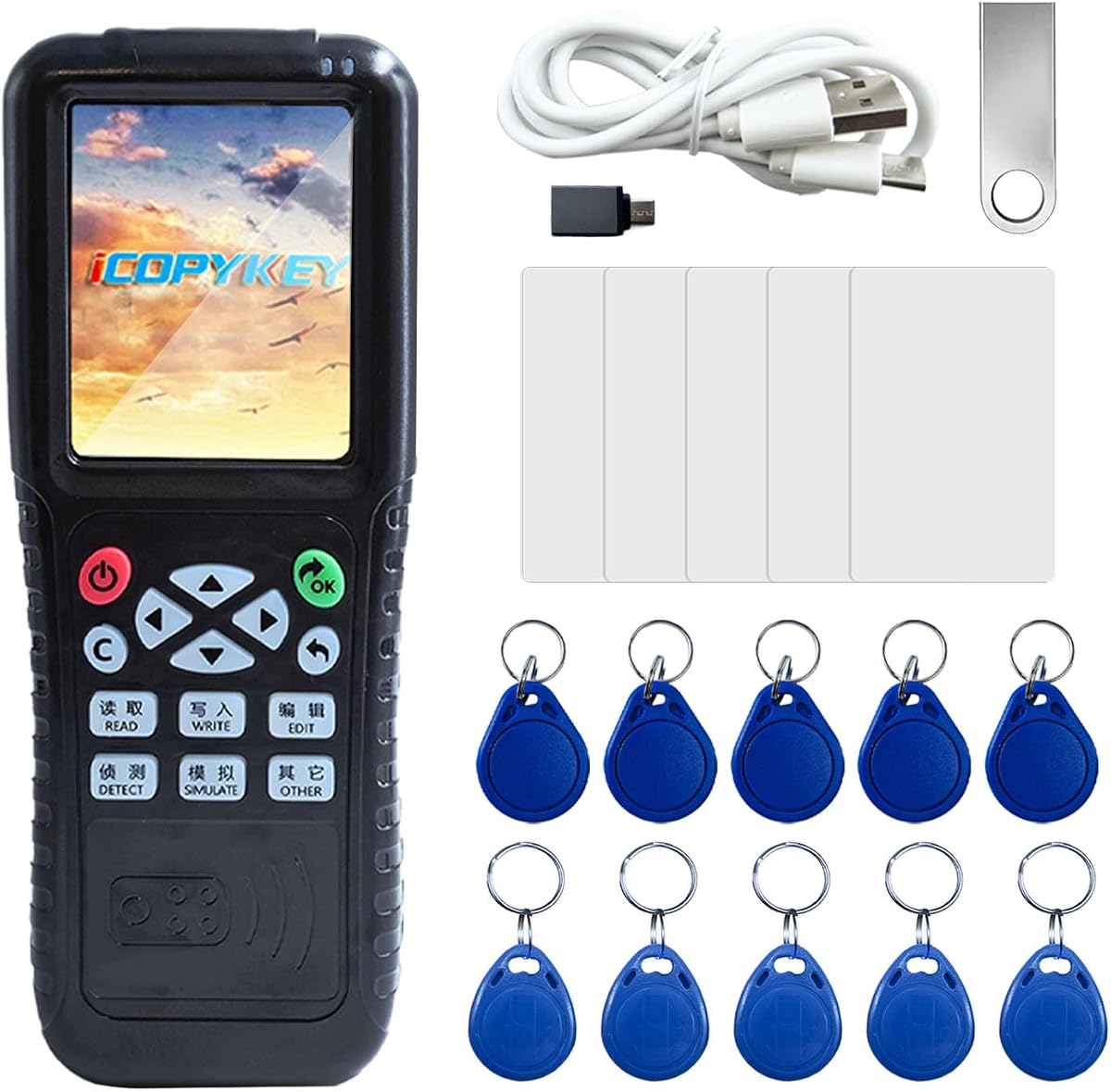
The X7 combines a 3.6 rating with one of the broadest compatibility lists in the guide. It supports 125kHz, 175kHz, 250kHz, 300kHz, 375kHz, 500kHz, 13.56MHz, and other listed frequencies. A 2.8-inch color TFT screen, Type-C communication, and one-button NFC simulation make it more sophisticated than the dedicated low-frequency readers.
We may earn a commission when you buy through this link, at no additional cost to you.
Its recognized card families include T5577, S50, S70, TK4100, EM4100, EM4200, TK4100-D, TK4168, HID ProxCard II, AWID, and Paradox. Users can directly enter a card number for writing, while the screen displays information more intuitively than an LED array. The package includes five T5577 key chains, five T5577 cards, and five CUID key chains, along with a USB cable.
Compared with the X100, the X7's product information does not describe a bundled computer application or mobile operating package. It may therefore be better suited to users who want a broad standalone device with a display and direct entry. The supplied compatibility list should still be treated as a guide, because real-world credentials can employ proprietary formats or security features beyond generic reader support.
The X7 appeals to access-control installers and support technicians who encounter varied systems and want a large assortment of writable targets. Its combination of frequency coverage, color display, simulation, and direct number entry makes it a strong all-around option. Users should position the card carefully over the rear sensing area and verify the original credential format before attempting a write.
The long frequency list reduces the need to carry separate readers for different low-frequency installations. Its support for 13.56MHz credentials adds another layer, making it useful where both older and newer systems appear in the same environment.
Five T5577 key chains, five T5577 cards, and five CUID key chains provide a generous selection of media. This supports repeated workflows and lets users choose a target form that suits the reader and access system being tested.
We may earn a commission when you buy through this link, at no additional cost to you.
The Keysy RFID Duplicator has a 4.3 rating, making it the strongest-rated model in the group. It takes a different approach from generic handheld writers by functioning as a compact credential manager. It can read up to four 125kHz key fobs or key cards and then emulate those credentials in front of a compatible door reader.
We may earn a commission when you buy through this link, at no additional cost to you.
Its listed format coverage includes HID Prox, AWID, Indala, ioProx, Rosslare, XceedID, Paradox, and CDVI. One rewritable Keysy fob or card is included, and additional compatible targets are sold separately. Because the device writes only to Keysy branded media, it avoids a loose interpretation of supported blank formats while giving users a controlled system for storing and replaying authorized credentials.
The four-credential limit is the clearest functional constraint. Users who need to carry many more credentials or expect unlimited storage should look elsewhere. Not every door reader supports credential emulation, and the manufacturer advises contacting Tiny Labs if compatibility is uncertain. Despite those boundaries, the one-year warranty and California-based customer support add confidence for a specialized product.
This is the best fit for an authorized technician who wants a compact, well-supported way to hold several common 125kHz credentials. It is less flexible than the X100 or X7 because it cannot write generic blanks or manage multi-frequency cards, but it is arguably more coherent for its intended job. Confirm reader support, use only authorized credentials, and verify that Keysy media suits your replacement process.
The device can store up to four previously read 125kHz credentials and emulate them near a compatible reader. That makes it a focused alternative to carrying a separate physical fob for every door in a small set of locations.
Writing exclusively to Keysy branded rewritable media creates a defined workflow, while the included one-year warranty provides manufacturer backing. The product's security-oriented positioning also allows local handling of credential data rather than sending it to a third-party copying service.
We may earn a commission when you buy through this link, at no additional cost to you.
This X100 version carries a 3.9 rating and delivers a capable mix of multi-frequency reading, writing, display, app connectivity, and simulation. It is closely related in function to the other X100 model, but the higher listed rating makes it worth considering for Windows or Android users who want a color interface and broader credential coverage.
We may earn a commission when you buy through this link, at no additional cost to you.
The device supports 125kHz, 175kHz, 250kHz, 300kHz, 375kHz, 500kHz, and 13.56MHz. Listed readable cards include S50, S70, TK4100, EM4100, EM4200, T5577, TK4100-D, TK4168, HID, and AWID. The 2.8-inch TFT screen displays card information, Type-C connectivity supports data transfer, and the app can operate or decode through a computer or Android phone.
The software requirement is the major caveat. The included files fit Windows, not Mac, and the description instructs users to exit protection software if it identifies the file as malware. A cautious approach is warranted: verify the package, follow the manufacturer's guidance, and use appropriate operating-system protections. The independent NFC simulation function can also reproduce encrypted IC cards with one button, subject to the normal security and authorization boundaries.
This model makes the most sense for an authorized technician whose computer runs Windows or whose workflow includes Android. It offers a better information display and broader format coverage than the simple 125kHz units. It is less attractive for Mac users, casual beginners, or anyone who needs a tightly defined four-slot remote rather than a general-purpose reader and writer.
The color TFT panel makes detected details easier to examine than a row of basic status lights. It is especially helpful when checking card identification before performing a write or simulation task.
App control and the included drive extend the device beyond standalone button operation. Users can decode and output data through Windows or Android systems, which is useful for technicians who need more structured interaction with credentials.
We may earn a commission when you buy through this link, at no additional cost to you.
The ZHAOYU handheld copier has a 3.6 rating and is distinguished by unusually clear compatibility guidance. The package includes the reader and ten blue T5577 key fobs, while the mini housing makes the device easy to carry. It is a dedicated 125kHz solution for users who have confirmed that their source credential uses a supported unencrypted format.
We may earn a commission when you buy through this link, at no additional cost to you.
T5577, EM4305, CE5200, EM4100, and related low-frequency protocols are listed, with a stated reading and writing distance of 2.5 to 6cm. It can be used with thin cards, thick cards, and key-fob credentials in authorized parking or access-control workflows. Two AAA batteries are needed and are not included, so they should be obtained before use.
The product description directly explains why some HID and AWID credentials will fail. Many use proprietary encodings, longer bit lengths, or advanced security such as Corporate 1000, which generic low-cost writers cannot copy. That honesty is valuable: a failed read is more likely a format limitation than proof that the unit is broken. NFC, 13.56MHz, encrypted, and other-frequency cards are also outside its scope.
This is a good fit for someone who mainly handles EM4100 and simple 26-bit open-format HID or AWID credentials and wants ten writable T5577 key fobs. It is less suitable for modern contactless systems or security-conscious corporate credentials. Check the source card's protocol, keep the device for authorized duplication only, and avoid purchasing based solely on a broad brand name.
Ten included T5577 key fobs offer substantial media for repeated authorized tasks. They allow the user to work across several devices or practice the read-and-write process without ordering each writable target separately.
The stated limitations help distinguish a format problem from device failure. Open 26-bit credentials may work, while proprietary, long-bit, or encrypted systems need specialized equipment, so compatibility should always be verified first.
We may earn a commission when you buy through this link, at no additional cost to you.
This handheld 125KHz RFID writer and copier has a 3.6 rating and offers a balanced package for basic low-frequency duplication. It includes five writable key fobs and five writable cards, making it a useful option for users who need both target shapes. The compact, lightweight body supports mobile use, and no computer connection is required.
We may earn a commission when you buy through this link, at no additional cost to you.
Supported writing formats include T5577, EM4205/4305, EL8265/8268, and SIC7888. The product is marketed for parking, access, switch, and small button-shaped cards. Two AAA batteries are required but not included. The included targets arrive blank, meaning they cannot replace an existing credential until their data has been read from a compatible source and written to them.
As with the other dedicated 125kHz devices, the absence of a display, app, or multi-frequency analysis limits troubleshooting. Users should confirm the chip family and protocol before purchase rather than assuming that all cards operating at 125kHz use the same protocol. The product information also notes that a reusable target must first be programmed with low-frequency data from the original device.
This model is most suitable for an authorized technician who routinely works with the listed 125kHz formats and values simple, portable equipment. The ten included targets make it convenient for several tasks, while the standalone design avoids computer setup. It is not the right choice for encrypted cards, NFC systems, or users who need detailed card inspection and multi-frequency support.
The package includes five writable key fobs and five writable cards, giving users flexibility in physical target format. This is useful where different readers or installed systems accommodate different credential shapes.
The small housing and no-computer design keep the workflow direct. Once the correct chip type and batteries are in place, basic read-and-write tasks can be performed on site without setting up additional software.
We may earn a commission when you buy through this link, at no additional cost to you.
The right copier depends first on the exact credential being duplicated, followed by the size of the job, desired media, and need for analysis or storage. These factors narrow the field before comparing convenience features or construction.
Always identify the actual chip and protocol before purchasing. Prefer sellers that can confirm compatibility from the card model or a clear photograph of its markings.
Choose a copier that explicitly covers both your source format and your required target format.
Prioritize standalone simplicity for straightforward duplication and connected tools for broader credential management.
Choose LEDs for simplicity, or a color display when detailed card information improves troubleshooting.
Consider remote storage only when your workflow involves a small number of frequently used authorized credentials.
Count the target formats and quantities you need, but prioritize chip compatibility over bundle size.
Favor a compact model for mobile work and include the required batteries in your initial setup plan.
Confirm both credential brands and writable media availability before deciding which copier to buy.
Begin by identifying the original credential with a known reader or a compatible diagnostic tool. Record the frequency, chip family, and apparent security format rather than assuming that every card sharing the same frequency is interchangeable. This step prevents wasted writes and helps distinguish an unsupported credential from a copier malfunction. For sensitive or proprietary systems, use only an approved credential-management process.
Install the batteries required by the model and power the copier according to its instructions. For a basic unit, place the authorized source card near the sensing area, initiate READ, and verify the success indication before writing. Insert a compatible writable card or key fob, initiate WRITE, and confirm completion. On a screen-equipped device, review the displayed card details and any warnings before proceeding. Copy one credential at a time and test the new target with the intended reader.
Store the copier in a dry, protected place and keep the sensing area free of dirt, moisture, and metal. Remove batteries during long periods of storage, particularly for models that are not designed for deep discharge. Keep spare media organized by chip type, protect sensitive credentials from unauthorized use, and update any connected software only through a trusted source. If a card will not read, move it slightly, check the battery level, and recheck compatibility before treating the unit as defective.
A 125kHz copier operates in the low-frequency band, while an NFC copier works with the 13.56MHz band used by many modern contactless cards. The dedicated models in this guide generally support only unencrypted 125kHz credentials, while the X100 and X7 list 13.56MHz compatibility. A device must explicitly support the frequency and protocol of the credential you want to copy.
No. Copying depends on frequency, chip family, protocol, bit format, and security features. Simple open 26-bit credentials may work with compatible low-frequency devices, but proprietary encodings, longer bit lengths, and encrypted systems may require specialized equipment. Confirm the source card's exact format and ask the seller to verify compatibility before buying.
Most included targets contain blank, writable chips rather than programmed access credentials. You must first read data from an authorized source credential and then write that data to the target. A card being readable does not also guarantee that a particular blank can receive the copied information, so both formats must be checked.
The dedicated 125kHz models are designed to operate independently with read and write buttons. The X100 adds app-based operation through Windows or Android, and the X7 provides Type-C communication and direct number entry. A computer is most useful when you want detailed decoding, output, or more controlled card inspection.
The most likely explanations are an unsupported frequency, an incompatible chip type, a proprietary encoding, or encrypted security. Positioning and low batteries can also interfere. Check the card markings and test the original credential with a known-good reader before concluding that the copier is faulty.
T5577 is a writable chip commonly used on blank low-frequency key fobs and cards, making it a typical copy target. EM4100 is frequently encountered as a read-only identification format, so it can often be read without being reproduced onto another EM4100 blank. The copier must support both the source format and the writable target you intend to use.
No. A copier can recognize a card and still be unable to reproduce it at a particular reader because of proprietary formats, security controls, or reader configuration. The Keysy also notes that not every door reader supports its credential-emulation function. Confirm both credential compatibility and reader support before relying on a device for access.
You should only copy credentials that you own or have explicit authorization to duplicate. Copying access credentials without permission can violate building rules, contracts, workplace policies, and applicable laws. Administrators should use approved procedures, while property owners or tenants should confirm that a replacement process is permitted before proceeding.
The strongest overall choices reflect three different needs. The RFID 125KHz Reader Writer is a compact budget starter with twelve writable blanks, the Keysy offers focused credential management with strong brand support, and the X100 provides the most advanced multi-frequency, screen-based feature set in the guide. Each serves a different workflow rather than competing for exactly the same buyer.
Compatibility should remain the decisive factor. Verify frequency, chip family, protocol, writable target format, and any security features before purchasing, and consider whether standalone controls or app-based inspection suit the job. Also account for batteries, included media, reader placement, and manufacturer support, since these small details determine whether the copier will be practical in regular use.
Product listings and prices can change, so check current availability, included accessories, software requirements, and warranty coverage at the time of purchase. Most importantly, use these devices only for legitimate testing, replacement, or administration of credentials that you own or are explicitly authorized to manage.