
Workman A28
4.5Editor score
PL-259 inline connector pair
Side grounding screw
Designed for CB and ham
Our Antenna Lightning Arrestor guide compares 10 leading options for radio, cellular, Wi-Fi, satellite, and outdoor coax systems by range, fit, grounding, and
An antenna lightning arrester is an inline surge-protection device that helps divert lightning-induced energy away from radios, amplifiers, routers, and other connected equipment. A good model must match the coax impedance, connector type, operating frequency, and grounding arrangement of the antenna system it will protect.
The products in this guide were compared using the supplied specifications, including connector configuration, frequency range, insertion loss, voltage rating, surge capacity, environmental construction, and intended applications. The list covers SO-239, N-type, PL-259, and F-type options for amateur radio, CB, cellular, Wi-Fi, satellite, IoT, and broader RF installations.
Each review explains the strongest reason to consider the product while also identifying installation constraints or compatibility issues that shoppers should verify. Ratings reflect the supplied marketplace feedback, while pricing, availability, and product details can change, so readers should confirm current information before purchasing.
4.5Editor score
4.6Editor score

4.8Editor score
This side-by-side comparison highlights connector compatibility, frequency coverage, impedance, construction, and surge-protection details so readers can select an antenna lightning arrester suited to their radio, cellular, Wi-Fi, satellite, or other RF coax system.


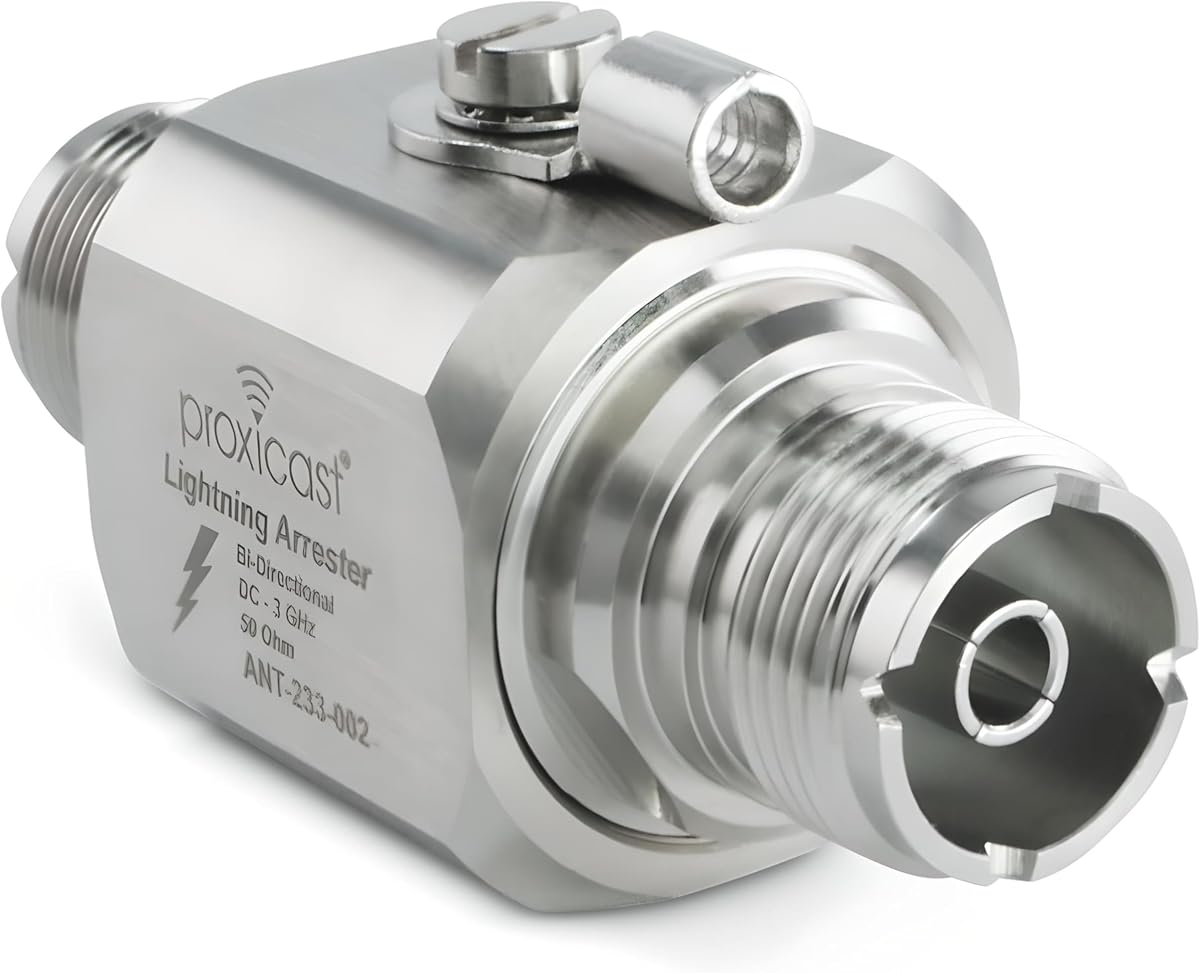
The Proxicast ProGrade 230V SO-239 arrester combines a purpose-built 50-ohm inline design with a 230V gas discharge tube. Its supplied rating of 4.6 reflects generally favorable customer feedback, while its strongest technical attraction is the clear compatibility with VHF, UHF, amateur, ham, CB, and two-way radio systems using SO-239 connectors.
We may earn a commission when you buy through this link, at no additional cost to you.
Both ends use female SO-239 connectors, making the physical arrangement straightforward for an inline installation. The arrester offers bi-directional protection, DC pass-through, and very low RF insertion loss. Its multi-strike discharge tube is intended to shunt damaging surges, transients, and lightning energy to ground rather than allowing it to continue toward sensitive equipment.
The main limitation is obvious connector specialization. It will not directly fit an N-type, PL-259, or F-type coax installation without suitable adapters and careful consideration of impedance. It also cannot provide complete protection unless the required grounding connection is installed correctly, so buyers must treat the ground lead as an essential part of the system.
This is a strong general recommendation for a 50-ohm SO-239 radio installation that needs outdoor-rated inline protection. Ham and CB operators with matching connectors can appreciate the low-loss, bidirectional configuration, while anyone considering adapters should first confirm that the complete signal path remains appropriate for the antenna and transmitter system.
The dual SO-239 arrangement targets common VHF and UHF radio installations without changing the cable standard. It is particularly relevant where a transceiver, amplifier, or other valuable component sits behind an outdoor antenna feedline.
The discharge tube can divert surge energy toward ground, but that pathway must be provided with a suitable earth-ground connection. Correct grounding is as important as selecting the correct connector and impedance.
We may earn a commission when you buy through this link, at no additional cost to you.
The Diamond SP1000 is a SP-Series coaxial surge protector intended for mobile and base-station antennas. With a 4.6 rating, it stands out in this roundup for its stated 6000-amp impulse-wave discharge capacity, extremely low loss, replaceable surge element, and durable outdoor construction.
We may earn a commission when you buy through this link, at no additional cost to you.
Its listed insertion loss of less than 0.3dB is especially useful for installations where preserving signal integrity matters. The product is described as compatible with Diamond SP-Series antennas and coaxial lines, and it is suitable for radios, transceivers, towers, vehicles, and portable setups that could be affected by lightning-induced surges.
One important buying caveat is that the supplied information does not clearly identify the connector configuration. A prospective buyer should therefore confirm the physical interfaces rather than assume they will fit a particular feedline. As with every antenna arrester in this guide, a dependable ground connection remains necessary for the protection path to work as intended.
The SP1000 is a compelling option for operators who value surge capacity and replaceable protection elements over a generic inline adapter. It is particularly well suited to professional-looking base-station or mobile installations, provided the connector configuration matches the antenna system and the grounding plan is engineered properly.
The stated insertion loss below 0.3dB makes the SP1000 attractive for wideband RF systems where preserving the signal is a priority. It is a meaningful specification for users comparing protection devices that sit directly in the coax path.
A replaceable surge-arrester element can make long-term ownership more practical than treating the entire inline unit as a disposable component. It also supports the product's positioning for base-station and mobile antenna applications.
We may earn a commission when you buy through this link, at no additional cost to you.
The Proxicast ProGrade 230V N-Type arrester is a 50-ohm inline protector covering DC through 6GHz. Its 4.4 rating is among the lower scores in the list, but the broad frequency coverage and combination of N-male and N-female connectors make it a versatile candidate for modern cellular and wideband RF installations.
We may earn a commission when you buy through this link, at no additional cost to you.
The listed uses include 4G and 5G cellular modems, routers, signal boosters, amplifiers, 2.4GHz and 5GHz Wi-Fi access points, 900MHz radios, and helium miners. Bi-directional protection, DC pass-through, and very low insertion loss help it fit neatly into an existing coax path where system behavior must remain stable.
Its performance rating is lower than the highest-rated models here, so buyers should not treat it as a universal endorsement without considering their application and connector requirements. The unit also needs a proper earth-ground attachment. Using adapter chains unnecessarily could introduce unwanted reflections or complicate the installation.
This arrester is best for installers with a known 50-ohm N-type system operating within the stated frequency range. It gives a single inline unit broad application potential, but careful cable matching and high-quality grounding remain essential to obtaining dependable protection.
The DC-to-6GHz range allows the same inline design to serve cellular, Wi-Fi, radio, and other supported RF uses. That versatility can simplify spare-part planning for technicians maintaining several similar installations.
The N-male and N-female ends make the device easy to place between an antenna and its connected equipment. This is a practical alternative to selecting a different arrestor for each N-equipped device in the same system.
We may earn a commission when you buy through this link, at no additional cost to you.
The N-Type 90V Arrester combines a 4.7 rating with wideband DC-to-6GHz coverage, making it one of the strongest all-around N-type options in this guide. It is designed for 50-ohm systems and provides bi-directional protection through N-male and N-female connectors.
We may earn a commission when you buy through this link, at no additional cost to you.
The listed applications include ham-radio equipment, GPS receivers, 900MHz systems, 2.4GHz outdoor antennas, and 3G, 4G, or LTE cellular boosters and amplifiers. Low insertion loss, 50-ohm impedance, and DC pass-through help preserve expected signal behavior while the unit is installed inline.
The use of a replaceable 90V gas discharge tube is a useful serviceability feature. Nevertheless, the device needs a proper ground connection, and the supplied description does not mention whether a ground cable is included. Buyers should plan that item separately or verify the package contents before installation.
This is an excellent choice for a mixed collection of 50-ohm N-type antenna equipment, especially where cellular, Wi-Fi, GPS, and radio applications may coexist. It balances strong customer feedback with broad supported frequencies, provided the installer handles grounding correctly and avoids unnecessary impedance changes.
Supporting GPS, cellular, Wi-Fi, 900MHz, and amateur-radio use gives this arrestor wide relevance. It is particularly appealing to users who want a common protector across several N-type coax devices.
The replaceable 90V gas discharge tube gives the unit a serviceable component. That can be useful in installations where long-term maintenance and replacement planning are important.
We may earn a commission when you buy through this link, at no additional cost to you.
The XRDS-RF PL-259 arrester is a 50-ohm UHF protector designed for CB, ham, two-way radio, and lower-frequency antenna systems. Its 4.6 rating is supported by a low-loss design, a stated VSWR below 1.2, and a DC-to-500MHz operating range.
We may earn a commission when you buy through this link, at no additional cost to you.
The connector arrangement uses UHF female connectors on both sides, requiring PL-259-equipped coax or suitable terminated assemblies. Construction details include a nickel-plated brass outer body, brass inner conductor, PTFE insulation, and nickel electroplating, all of which suggest attention to durability and stable RF connections.
The product data explicitly states that an additional ground cable is required. That is not a minor accessory: without a proper ground path, the protective function cannot be considered complete. The stated frequency ceiling also makes this more suitable for lower-frequency UHF applications than for modern multi-gigahertz Wi-Fi systems.
This arrester is a good fit for a CB or ham installation using PL-259 connections where low loss and straightforward inline placement matter. It should appeal to operators who prefer a mechanically substantial component, provided the connector ends and grounding arrangement match the actual feedline.
Low insertion loss and a stated VSWR below 1.2 help minimize disruption in the antenna path. These figures make the device particularly relevant to amateur and commercial two-way radio installations sensitive to signal quality.
Brass construction, PTFE insulation, and nickel plating support resistance to wear and environmental exposure. The robust connector design also suits repeated installation and service work.
We may earn a commission when you buy through this link, at no additional cost to you.
This UHF Female-to-Female SO-239 arrester is a 4.6-rated inline protector with a construction-focused design. Its nickel-plated brass outer conductor, brass-plated inner pin, and PTFE insulation are intended to support stable connections, resistance to abrasion and corrosion, and a longer service life.
We may earn a commission when you buy through this link, at no additional cost to you.
The product uses gas-discharge technology to divert surge voltage when external interference or a lightning event creates an abnormal condition on a communication line. It is advertised for a broad collection of applications, including GSM base stations, satellite reception, RF transceivers, GPS, walkie-talkie base stations, and other communication equipment.
The supplied specifications are less quantitative than those for several competitors: no exact frequency ceiling, insertion-loss figure, or discharge-tube voltage is stated. Buyers who require documented numerical performance may prefer an option with a clearly specified range and loss. The ground wire also must be added and connected.
Despite those uncertainties, this is a practical option for an SO-239 coax system that needs a straightforward inline protector. Its recommended placement near the equipment or building cable entry, paired with a solid ground connection, makes it especially relevant to installations where the arrester is intended to form part of the building's protection strategy.
The brass body, nickel plating, and PTFE insulation are practical features for a device installed outdoors. They address connector durability, environmental resistance, and the need for a stable center connection.
The recommendation to install the arrester close to protected equipment or near the building entry limits the amount of unprotected cable connected to that equipment. It also helps create a more organized surge-protection layout.
We may earn a commission when you buy through this link, at no additional cost to you.
The Workman A28 is a straightforward coaxial surge protector for CB, ham, and two-way radio base antennas. Its 4.5 rating reflects a practical design centered on simple installation: PL-259 male and female connectors sit on opposite ends, while a side grounding screw provides a convenient attachment point.
We may earn a commission when you buy through this link, at no additional cost to you.
Installing the device between the radio and antenna creates an inline interruption in the coax path. That arrangement places the protector at a logical transition point while preserving a familiar PL-259 signal standard. It is especially relevant to users who want basic surge diversion without moving to a more complex N-type system.
The product data provides fewer quantitative details than many alternatives, including no stated frequency range, insertion loss, or discharge voltage. For an experienced radio installer, that may be acceptable, but buyers with specialized high-frequency requirements may want more complete documentation before choosing.
The A28 is best recommended as a budget-oriented option for a compatible PL-259 radio installation. Its simple construction and accessible grounding screw are useful, but the grounding system still needs to be installed correctly and the entire feedline impedance and connector arrangement should be verified.
The side-mounted grounding screw is a straightforward way to attach the required earth path. Its placement should make the connection easier to inspect, terminate, and maintain during routine antenna work.
Opposing PL-259 connectors allow the arrester to sit inline in a compatible radio feedline. This avoids unnecessary adapters that could complicate installation or affect the performance of the coax path.
We may earn a commission when you buy through this link, at no additional cost to you.
The RAIGEN N-Type arrester has the highest supplied rating in this roundup at 4.8. It also has a broad technical profile: 50-ohm impedance, DC-to-6GHz coverage, less than 0.1dB insertion loss, a replaceable 90V gas discharge tube, and a weatherproof design for permanent outdoor mounting.
We may earn a commission when you buy through this link, at no additional cost to you.
Its listed device coverage is extensive, including LoRaWAN gateways, LoRa equipment, outdoor Wi-Fi access points, 4G and 5G LTE antennas, GPS receivers, cellular signal boosters, ham radio gear, and solar-based off-grid nodes. A brass-plated inner needle, Teflon insulation, and a heavy-duty nickel-plated brass body support outdoor reliability.
The grounding limitation is explicit: a grounding cable is not included, and surge protection is incomplete without attaching one. The product data also states that the protected device should be near the arrestor, often where the cable enters the building. Those details require careful layout planning rather than simply inserting the unit wherever space is available.
This is an excellent recommendation for a 50-ohm N-type system that needs broad frequency coverage and minimal added loss. It is especially relevant to installers supporting cellular, IoT, LoRa, Wi-Fi, or mixed RF deployments, provided the grounding connection is treated as a required part of the installation.
The stated insertion loss below 0.1dB is one of the lowest figures in the guide. It makes the arrester attractive for wideband systems where an inline protector should introduce as little disruption as possible.
Support for LoRaWAN, 915MHz LoRa, 2.4GHz and 5GHz Wi-Fi, LTE, GPS, cellular boosters, and other connected devices gives the unit broad relevance. It suits installers who need one protector for several N-type antenna systems.
We may earn a commission when you buy through this link, at no additional cost to you.
The Proxicast ProGrade 230V F-Type arrester is designed around 75-ohm consumer coax rather than 50-ohm radio systems. With a 4.5 rating, it offers a practical protection option for television, satellite, AM, FM, cable internet, and compatible outdoor cellular booster installations.
We may earn a commission when you buy through this link, at no additional cost to you.
Its F-male and F-female connectors accommodate the coax types commonly identified in the product data, including RG6, RG59, RG8X, and RG11. The 75-ohm impedance, low insertion loss, DC pass-through, and bidirectional 230V gas discharge tube make it a natural match for those applications.
It would be a mistake to select this unit solely because the physical connector looks similar. A 75-ohm F-type arrester is not a substitute for a correctly impedance-matched 50-ohm N-type or SO-239 radio protector. The entire coax system, including any adapters and cables, should be checked for consistency.
For a home or office receiving antenna, satellite system, or 75-ohm outdoor booster arrangement, this model offers a specialized solution with straightforward inline placement. It is best for buyers who know their system uses the matching 75-ohm F-type standard and can provide the required earth-ground path.
Matching the impedance of the existing coax reduces the risk of introducing an avoidable mismatch. This makes the F-Type model better suited to receiving and cable systems than to conventional 50-ohm radio equipment.
Television, satellite, AM, FM, cable internet, and 75-ohm outdoor booster antennas all appear in the product's stated use cases. The F connector interface is familiar in these environments and simplifies inline placement.
We may earn a commission when you buy through this link, at no additional cost to you.
The Diamond SP3000 is a premium-oriented coaxial lightning arrester for ham-radio antennas, with a 4.8 rating. Its headline specifications are easy to appreciate: 200-watt power handling, DC-to-3000MHz coverage, N-type female connectors, and a stated 1000V impulse-wave discharge rating.
We may earn a commission when you buy through this link, at no additional cost to you.
The 3000MHz ceiling comfortably covers many conventional amateur-radio bands and a range of lower-frequency wireless services. Its N female-to-female configuration suits installations already using N-terminated coax, and the explicit power rating provides useful information for operators comparing it with general-purpose inline devices.
The main limitation is frequency reach. It does not cover the full range of the modern 5GHz Wi-Fi environment, so it is not the universal choice for every wireless installation. As with other products here, the grounding arrangement is a required part of a complete surge-protection system and should follow sound bonding practice.
The SP3000 is an excellent choice for ham-radio operators with a compatible N-type antenna and equipment within the stated power and frequency limits. It combines a high rating, recognizable specialist branding, and clear published specifications, making it particularly convincing for a dedicated radio installation.
The explicit 200-watt and 3000MHz ratings help installers determine whether the device belongs in a given station. Users operating beyond either limit should choose a protector whose specifications cover the actual equipment.
The Diamond name and clearly defined radio-oriented specifications make the SP3000 a natural choice for a dedicated station. It offers focused protection rather than trying to serve every connector and frequency standard equally.
We may earn a commission when you buy through this link, at no additional cost to you.
The right antenna lightning arrester depends on matching the connector, impedance, frequency, antenna power, surge pathway, and installation environment. A visually similar device is not automatically compatible, and grounding quality is just as important as the arrestor itself.
Begin by identifying the exact connectors at both ends of the feedline. The options in this guide include SO-239 female-to-female, N male-to-female, N female-to-female, PL-259 female-to-female, PL-259 male-to-female, and F male-to-female configurations. Connector gender matters because a device with two female ends needs matching male-ended cable or appropriate terminated pigtails.
Adapters can make incompatible parts appear usable, but they add connection points and should not be used to bridge a significant impedance or frequency mismatch. Confirm that the arrester's connector type corresponds with the antenna, cable, radio, booster, and any existing bulkhead hardware.
Choose the exact connector pair your installation can use cleanly. A direct, well-terminated connection is generally preferable to an adapter-heavy arrangement.
The arrester should match the impedance of the coax system. Most amateur-radio, CB, cellular booster, LoRa, and many Wi-Fi installations use 50-ohm components, while television, satellite, and cable internet systems commonly use 75-ohm hardware. The Proxicast F-Type model, for example, is explicitly a 75-ohm option.
An impedance mismatch can introduce reflection, unwanted loss, and inconsistent RF behavior even if the surge device itself functions. Review the specifications for the complete line, including any pigtails, adapters, couplers, and powered devices between the antenna and protected equipment.
Match the arrester to the installed system rather than judging impedance only by connector shape. A 75-ohm F connector does not automatically mean every attached device is 75 ohms.
The useful frequency range must include the actual operating band of the antenna system. Many radio applications are covered by the SP3000's DC-to-3000MHz specification, while the N-Type 90V and RAIGEN options extend to 6GHz. The XRDS-RF PL-259 is listed for DC-to-500MHz, making it better aligned with lower-frequency UHF radio use.
A unit that covers the required frequency is only useful if its rated voltage and surge behavior also suit the installation. Pay particular attention to cellular sub-6GHz, 2.4GHz Wi-Fi, 5GHz Wi-Fi, 900MHz radio, LoRa, GPS, and conventional amateur-radio requirements when comparing otherwise similar products.
Select a protector whose published range comfortably includes every signal in the system. Using a wideband device can simplify future maintenance, but only when its connector and impedance are also correct.
A 230V or 90V gas discharge tube, 6000-amp impulse capacity, and 1000V impulse discharge are among the supplied surge-related figures. These numbers help distinguish products, but they should not be treated as interchangeable measures unless their test definitions are the same. A broader explanation of protection is still useful when comparing designs.
Look for multi-strike capability, a clearly described discharge mechanism, and information about whether the element is replaceable. The Diamond SP1000 and RAIGEN model are described as having replaceable elements, which may be useful for long-term maintenance planning.
Understand the device as one component of a coordinated protection system. The arrester, grounding conductor, bonding point, and equipment layout all influence the result.
An inline protector should not materially alter the antenna path. The supplied products list insertion loss below 0.1dB, below 0.3dB, below 0.4dB, or simply describe the loss as very low. These are useful indicators, although the measurement conditions and operating frequencies may differ between products.
The XRDS-RF PL-259 also states a VSWR below 1.2, while the UHF SO-239 model is described as having small VSWR. For long coax runs, high-gain antennas, sensitive receivers, or demanding multi-band stations, preserving low loss and good return loss deserves close attention.
Choose the lowest-loss option that still satisfies the required connector, impedance, frequency, and surge specifications. The lowest published figure alone does not settle the decision if another product better matches the installation.
Every product discussed needs a proper route for diverted surge energy. Several descriptions explicitly call for an earth ground, and the RAIGEN model notes that a grounding cable is not included. A ground wire or ground lug is therefore not an optional luxury; it is an essential component of the protection strategy.
The grounding connection should be short, robust, appropriately bonded, and installed according to applicable electrical and local requirements. Placement near the building entry or close to protected equipment can reduce the length of unprotected line, but the complete installation design should determine the final position.
Plan the ground path before ordering the arrester. Confirm whether a cable, lug, bonding strap, or other hardware must be purchased separately and how the selected connector will be attached.
The arrester will often be installed on a tower, mast, pole, or exterior wall, where moisture, temperature changes, and weather exposure affect long-term reliability. Weather-resistant housings, nickel-plated brass bodies, brass conductors, and PTFE insulation are positive indicators for outdoor use.
Construction should also be considered alongside connector durability. Repeated servicing, cable movement, and weather can loosen joints, so a robust body and secure termination are valuable. Mounting stability matters just as much as the arrester's internal protection component.
Choose a unit built for outdoor exposure when it will not be inside a protected enclosure. Confirm the mounting position and strain relief so the coax and ground connections are not carrying mechanical loads.
The best device is the one that fits the actual equipment without compromising the signal path. A radio operator with N-type coax may favor the Diamond SP3000 or an N-Type model, while a TV or satellite installer may need the Proxicast F-Type. Mixed cellular and IoT deployments can benefit from a 6GHz N-type unit such as the RAIGEN.
Consider whether the antenna system may change in the future. Wider frequency coverage can be useful if the same connector and impedance will be retained, but future planning should never justify compromising today's grounding or protection requirements.
Match first, then compare. Connector, impedance, frequency, and grounding come before brand preference, decorative construction, or small differences in secondary specifications.
Install the arrester inline in the coax path between the outdoor antenna and the equipment being protected. The most useful placement is near the building entry or close to the protected device, as indicated by the product guidance, because this limits the length of cable that remains exposed to surge energy. Disconnect power from connected equipment before changing the antenna system.
Terminate the connectors carefully and verify the cable type, connector gender, system impedance, and operating frequency before assembly. Attach the arrester's grounding lead to a properly bonded earth-ground or grounding system, keeping that path as short and direct as practical. Do not leave the ground terminal disconnected, and do not rely on a loose pigtail as a complete grounding solution.
After installation, inspect for secure fittings, correct polarity where applicable, good weather sealing, and strain relief that keeps the coax from pulling against the connector. Periodically check for corrosion, damaged insulation, loose ground connections, or signs of a failed protection element. If a surge occurs, disconnect the system and inspect the arrester, connectors, cable, and protected equipment before returning the installation to service.
The correct type depends primarily on your coax connector, system impedance, frequency, and antenna power. SO-239 models suit many VHF and UHF radio systems, N-type models cover numerous radio, cellular, Wi-Fi, GPS, and IoT applications, PL-259 devices fit compatible CB and ham installations, and F-type arrestors are intended for 75-ohm consumer coax. Confirm all four factors before buying.
Yes, a proper grounding connection is fundamental to the protection path. The arrester diverts surge energy toward ground, so an inadequate or missing connection can leave the system unprotected. Use a short, robust, properly bonded grounding conductor and follow applicable electrical codes and local grounding requirements.
It is not advisable. A 75-ohm arrester is intended for a 75-ohm signal path, while many radio systems use 50-ohm components. Mixing impedances and connector standards can introduce loss and reflections. Select a unit that natively matches the installed coax and equipment.
Place it inline between the antenna feedline and the protected equipment, ideally near the building cable entry or close to the device. This shortens the unprotected portion of the system. If the arrester has a separate ground connection, complete and bond that connection before energizing the equipment.
No arrester should be treated as a guarantee against every lightning event. A nearby or direct strike can produce energy beyond a protector's ratings, and damage may still travel through power, control, or communication lines. Surge protection reduces the chance of equipment damage but should be part of a broader bonding and lightning-safety plan.
It can, when the entire downstream network uses a compatible impedance, connector system, and frequency range, and the arrester is properly grounded. A branched distribution network may introduce different voltages, losses, or surge paths, so each protected feedline should be evaluated. The 6GHz N-type options in this guide are especially versatile for supported radio, cellular, Wi-Fi, LoRa, and GPS devices.
Low insertion loss means the arrester adds little attenuation to the RF signal as it passes through. This is important because every connector and inline component adds some loss, which can become significant over long cable runs or at high operating frequencies. Compare loss figures together with frequency range, impedance, and VSWR.
Inspect it during routine antenna-system maintenance and after any severe thunderstorm or known surge event. Look for loose connectors, corrosion, damaged cable jackets, water intrusion, discoloration, and secure grounding. If the protection element is replaceable, also review the manufacturer's guidance for service and replacement procedures.
The Proxicast ProGrade SO-239 is the most versatile overall choice for a 50-ohm VHF or UHF radio feedline, combining a 230V multi-strike tube, low loss, DC pass-through, and outdoor-rated construction. The Workman A28 offers a simpler and economical solution for compatible PL-259 CB or ham systems, while the Diamond SP3000 stands out as the premium radio-focused option with clear 200-watt and DC-to-3000MHz specifications.
For cellular, Wi-Fi, GPS, LoRa, or mixed RF systems, prioritize native N-type or F-type connectivity, the correct impedance, adequate frequency range, and a clear grounding plan. The RAIGEN and N-Type 90V models are especially relevant when a 50-ohm system needs broad support, while the Diamond SP1000 appeals to users seeking high stated impulse capacity and a replaceable element.
Finally, confirm current product details, package contents, availability, and pricing before purchasing. Prices and configurations can change, and a ground cable may need to be added separately. The most effective antenna lightning arrester is the one that matches the complete system, is installed in the right location, and is connected to a proper ground.