
Four-in-One Household Adapter
4.7Editor score
Four outlet configurations
12 AWG heavy-duty cable
SJTW wire construction
One-foot adapter length
20 Amp to 15 Amp Adapter Plug guide compares ten options for NEMA compatibility, wire gauge, safety features, voltage, and everyday usability.
A 20 Amp to 15 Amp adapter plug can make it easier to connect compatible equipment with a NEMA 5-20 plug to a standard household receptacle. The right adapter should match the connector format, carry suitable current, and include credible safety protection without suggesting that it can increase the capacity of a wall circuit.
This guide compares ten adapters and short adapter cords using the information supplied for each product. We considered NEMA configurations, conductor size, voltage coverage, safety listings, construction, cable length, protective features, and the number of outlet formats each design supports.
Each review explains the strongest reasons to consider a particular model, along with its limitations and ideal use. Ratings and product details reflect the supplied listing information, while prices and availability can change, so compare the current listing before making a purchase.
4.7Editor score

4.9Editor score

4.7Editor score
The comparison below covers direct plug-in adapters and short adapter cords, with particular attention to connector types, current capacity, conductor gauge, and safety-related construction.




This 4-in-1 adapter cable receives a 4.7 rating and stands out for combining a 12 AWG SJTW cable with four supported receptacle configurations. It is built for 15-amp household male and female connections as well as 6-series 15- and 20-amp female options, giving it unusual flexibility for a compact adapter.
We may earn a commission when you buy through this link, at no additional cost to you.
The most useful feature is the combination female end. Based on the supplied configuration details, it can accept NEMA 5-15R, 5-20R, 6-15R, and 6-20R equipment while presenting a NEMA 5-15P male plug to the wall. The 12 AWG SJTW construction also makes it more appropriate for demanding equipment than a thin, lightweight adapter.
There are some trade-offs. The listed voltage range is described as 110 to 220 volts, and the product does not include an overload circuit breaker. Users must also verify that their equipment is designed for the relevant voltage and connector format; physical compatibility alone does not guarantee electrical compatibility.
This is a strong choice for workshops, garages, temporary equipment connections, and users who want one adapter to cover several NEMA patterns. It is particularly appealing when avoiding a dedicated 20-amp outlet is a practical concern. Confirm the circuit and device requirements before use.
The supported NEMA 5 and 6 configurations make this cable useful for more than one type of equipment connection. That versatility can reduce the need to carry separate adapters when working across household and industrial-style receptacles.
A 12 AWG SJTW cable offers a more robust starting point than a compact adapter built with lighter wire. It is still important to use the adapter only within the limits of the connected equipment and the upstream circuit.
We may earn a commission when you buy through this link, at no additional cost to you.
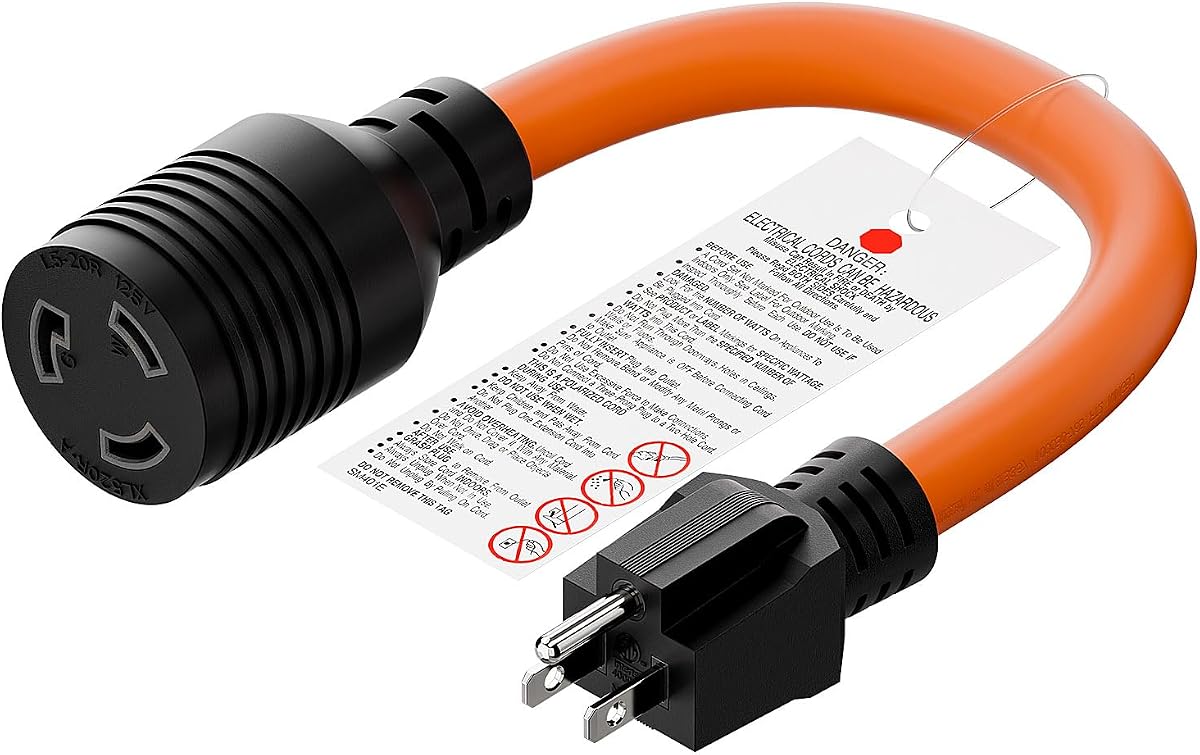
This adapter has a 4.6 rating and fills a specific gap: connecting a standard NEMA 5-15P male plug to a NEMA L5-20R locking female socket. It uses 12 AWG STW heavy-duty cord, measures approximately one foot, and is described as supporting up to 1875 watts.
We may earn a commission when you buy through this link, at no additional cost to you.
The NEMA L5-20R connection is the defining feature. Equipment with a locking 20-amp-style plug can be connected to a 15-amp household receptacle, while the short heavy-duty cord adds a little positioning flexibility. The stated maximum support of 1875 watts is useful information when checking whether a device fits within the adapter and circuit limits.
The limitation is specificity. Unlike the four-in-one products in this guide, this adapter supports only the L5-20R connection. It is also listed for 125 volts, so it should not be treated as a universal solution for 250-volt equipment or for NEMA 5-20R, 6-15R, or 6-20R connections.
Buy this option when the equipment plug is genuinely L5-20R and a locking-style connection is important. It is a focused solution for workshops or equipment setups that use industrial-style locking connectors and need a short adapter run rather than a permanent outlet change.
The L5-20R female end is valuable when the attached equipment uses a locking industrial-style plug. It is not a universal 20-amp receptacle, so confirm the exact connector before ordering.
The 12 AWG STW cord and one-foot length provide practical positioning flexibility for temporary setups. Keep the connection visible, dry, and free from mechanical strain.
We may earn a commission when you buy through this link, at no additional cost to you.
The Lightning Bug adapter carries a 4.7 rating and offers the simplest approach in the guide: a direct, three-prong adapter that converts a 15-amp male household plug to a 20-amp female T-blade connection. Its UL-listed designation and 120-volt household orientation make the intended use especially clear.
We may earn a commission when you buy through this link, at no additional cost to you.
Because it has no intermediate cable, there is no cord to bend, snag, or position awkwardly. That makes the adapter attractive for portable tools, garage equipment, exercise machines, and other compatible 120-volt products that use the expected NEMA 5-20 plug. The gray housing also gives it a recognizable, compact form.
The trade-off is that it handles only one connection pattern. It does not accommodate NEMA 6-series outlets, 250-volt equipment, or a locking L5-20R connector. It also lacks the overload switch found in a dedicated circuit-breaker model, so the user remains responsible for matching the equipment to the circuit.
This is the premium pick for a straightforward, recognizable adapter with a clean UL-listed specification. It is best for owners who already know their equipment uses a standard three-prong T-blade plug and need a compact adapter without a short extension cable.
The direct body is useful where cable length would be unnecessary or could create a snag hazard. It also travels easily in a toolbox, drawer, or equipment bag.
The 120-volt rating and three-prong format communicate a clear use case. Verify the device plug, voltage, and current draw before connecting it to a 15-amp receptacle.
We may earn a commission when you buy through this link, at no additional cost to you.
This three-pack earns a 4.7 rating by combining a familiar NEMA 5-15P-to-5-20R adapter with three units per package. The adapters are ETL listed and are presented as a convenient solution for connecting compatible 20-amp T-blade equipment to a standard 125-volt, 15-amp outlet.
We may earn a commission when you buy through this link, at no additional cost to you.
The multi-pack format is the central advantage. Users can keep one in a garage, one in a workshop, and another in a vehicle or tool bag instead of repeatedly moving a single accessory. The listing also identifies exercise equipment, UPS systems, and electric saws as possible applications, provided they meet the stated 1875-watt ceiling.
Its capabilities are narrower than those of the four-in-one cable adapters. It supports the NEMA 5-20R pattern rather than 6-series or locking receptacles, and it has no integrated overload breaker. The upstream receptacle and connected device must remain within the limits of a 15-amp household circuit.
This is a practical choice for buyers who want several identical adapters at a glance. It is especially useful for shared workshops or multi-room equipment, provided all connected products use the correct three-prong T-blade format and stay below the stated power limit.
Having three matching units makes it easier to keep an adapter wherever compatible equipment is used. This is more useful than a single loose adapter for anyone managing several temporary connections.
The stated support of up to 1875 watts provides a clear reference at 125 volts. Do not use the adapter with equipment that exceeds that figure or with a circuit that cannot supply the required load.
We may earn a commission when you buy through this link, at no additional cost to you.
This CRST adapter has a 4.6 rating and is the only product in the list with a clearly described built-in overload protection switch. That feature distinguishes it from passive adapters: if connected 20-amp equipment draws more than 15 amps, the switch is intended to trip and interrupt power.
We may earn a commission when you buy through this link, at no additional cost to you.
The adapter converts a NEMA 5-15P wall connection to a NEMA 5-20R equipment connection. It is ETL listed, uses high-temperature-resistant and flame-retardant materials, and includes an accessible reset switch. Its compact profile is also described as avoiding obstruction of a second wall outlet, which is valuable in busy work areas.
The circuit breaker is a safety improvement, not a way to run 20-amp equipment continuously at full draw. The listing specifically notes a continuous limit of 15 amps and 1875 watts, so high-demand devices may trip it. This adapter also supports only the standard NEMA 5-20R format and does not cover 6-series or locking connectors.
Choose it when overload protection and a space-conscious profile matter more than broad connector compatibility. It is a sensible temporary adapter for compatible 120-volt tools and appliances, provided the equipment can remain within the protected limit.
The integrated breaker is designed to interrupt the connection when demand exceeds the 15-amp threshold. It adds protection but cannot improve or upgrade the capacity of the wall circuit feeding the adapter.
The compact body is intended to leave an adjacent outlet usable. That makes the adapter more practical in a garage, shop, or laundry area where a bulky block would consume valuable outlet space.
We may earn a commission when you buy through this link, at no additional cost to you.
This molded adapter receives a 4.7 rating and offers a compact direct-plug design with a combination NEMA 5-15R and 5-20R female outlet. The listing identifies the internal wiring as 14 AWG, rated for 15 amps at 125 volts for the American market, and states that it is ETL certified.
We may earn a commission when you buy through this link, at no additional cost to you.
Its molded body is useful because it creates a compact adapter without a cable extending from the wall. The combination outlet makes it more accommodating than a one-pattern adapter, while the plug-and-play format requires no tools or complicated installation.
The 14 AWG conductor is lighter than the 12 AWG construction used by several cable-based competitors, and the adapter has no overload protection. It is therefore best suited to ordinary household equipment rather than situations where a heavier-duty cable or automatic cutoff is needed.
This adapter suits people seeking a simple 125-volt solution for compatible three-prong T-blade equipment. Check the device current, plug pattern, and outlet conditions before use, and avoid treating the adapter as a substitute for a dedicated 20-amp circuit.
The female side supports both 5-15R and 5-20R plug formats. This makes it easier to use with a mixed set of compatible household equipment without carrying separate outlet adapters.
The all-in-one body keeps the adapter compact and free of exposed cable joints. It is easy to store, though it does not provide the positioning freedom of a one-foot cord.
We may earn a commission when you buy through this link, at no additional cost to you.
This adapter cord has the highest listed rating in the group at 4.9. It combines a NEMA 5-15P male plug with a female end that supports NEMA 5-15R and 5-20R equipment, while its UL and CUL certification and clearly stated 14 AWG, 15-amp, 125-volt rating create a well-defined operating profile.
We may earn a commission when you buy through this link, at no additional cost to you.
The short cable provides a practical middle ground between a direct block and a long extension cord. It can move a plug slightly away from a crowded wall receptacle, reducing strain on the connection without creating excess cable to manage. The combination outlet also gives it more flexibility than a single-pattern adapter.
Its limitations are narrow but important. The supplied information identifies support for the 5-series household format rather than 6-series or L5-20R connections, and there is no overload protection switch. The 14 AWG cable is also lighter than the 12 AWG options, so users should compare it with the demands of the equipment.
This is the editor's choice for a buyer who values clear certification, a strong listed rating, and useful cord length. It is a good general-purpose adapter for compatible household 125-volt equipment, especially where a rigid plug-to-plug block is inconvenient.
UL and CUL certification provide a documented safety framework for the listed configuration. Buyers can compare those markings with local requirements and the equipment they intend to connect.
The one-foot length offers modest movement without behaving like a full extension cord. It can improve plug positioning around a receptacle while remaining compact enough for a toolbox or storage drawer.
We may earn a commission when you buy through this link, at no additional cost to you.
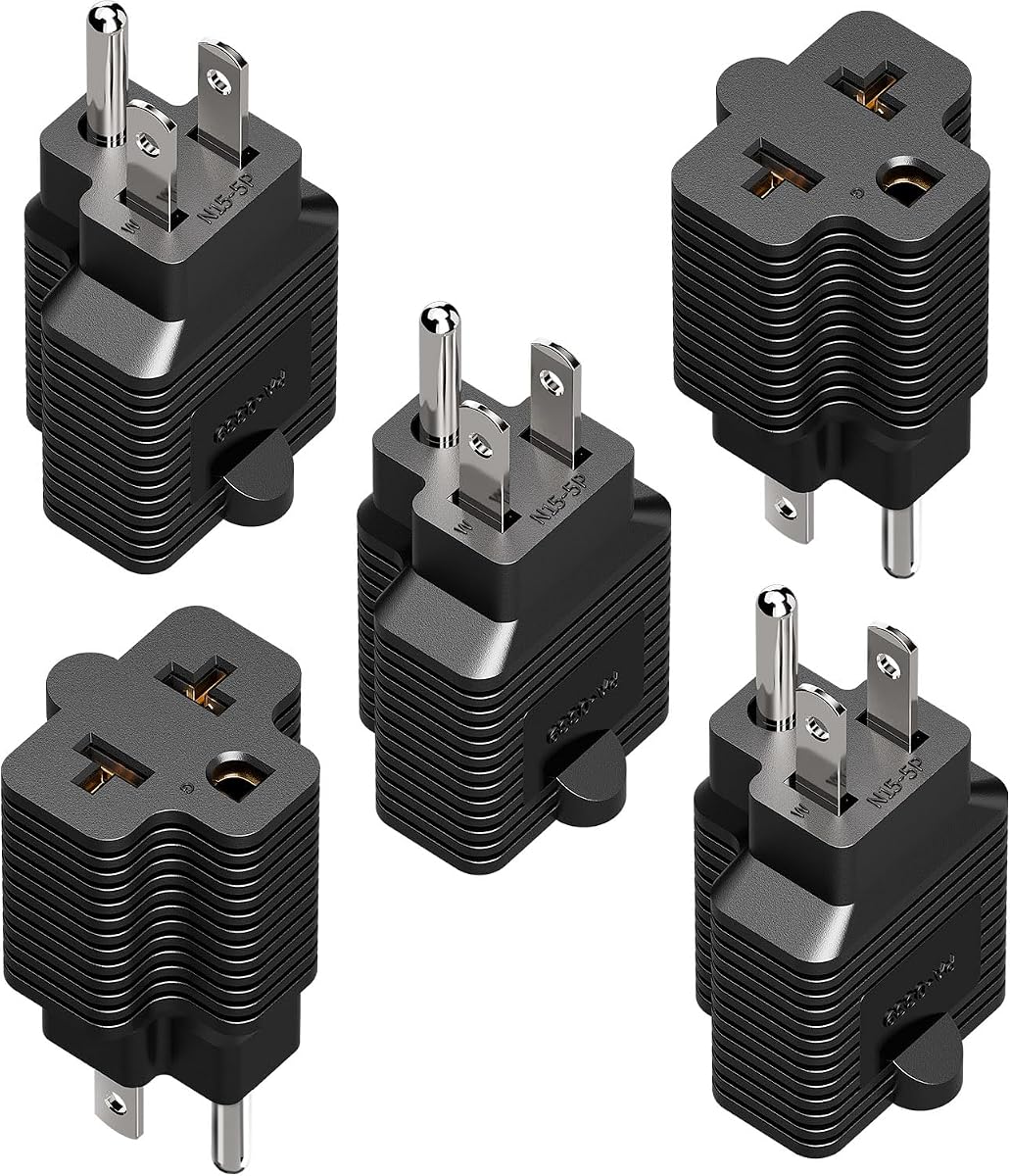
This five-pack has a 4.6 rating and combines a four-in-one NEMA design with five individual adapters. Each uses a NEMA 5-15P male side and can support 5-15R, 5-20R, 6-15R, or 6-20R female connections, making the set unusually broad for a collection of plug adapters.
We may earn a commission when you buy through this link, at no additional cost to you.
The quantity is useful for users who work across several locations or want spares available. The listing also describes 14 AWG heavy-duty copper wire, PVC molded construction, and support for 110 to 250 volts when the connected device can accept the relevant voltage. The multi-format design can be particularly handy around household, camper, and workshop equipment.
The adapters do not provide an overload circuit breaker, and their 14 AWG wire is lighter than the 12 AWG cables in several alternatives. The broad voltage statement must not be interpreted as permission to use a 250-volt connection with equipment that only supports 125 volts; the adapter's male plug is the limiting household-side connection.
This set is a strong choice for technicians, workshop operators, and homeowners who need multiple flexible adapters. Confirm each device's connector and voltage first, and keep one in each frequently used equipment area.
The five-pack reduces the need to retrieve one adapter from a central storage point. Keeping units in a garage, workshop, RV, or tool bag can make temporary setups faster.
Four supported female formats simplify matching, but the connected device must still be right for the voltage and current involved. The broad range is useful only when the equipment itself is properly rated.
We may earn a commission when you buy through this link, at no additional cost to you.
This 4-in-1 cable has a 4.5 rating and takes a different approach from most adapters in the guide. Its male end is a NEMA 5-20P right-angle plug, while the female end can support NEMA 5-20R, 5-15R, 6-20R, and 6-15R connections through a one-foot, 12 AWG SJTW cable.
We may earn a commission when you buy through this link, at no additional cost to you.
The 12 AWG SJTW construction and stated pure-copper conductor make this a heavy-duty option for temporary connections. The right-angle male plug can reduce sideways pressure at the wall receptacle, and the compact cable length gives the equipment a little positioning freedom without becoming a long extension cord.
The main physical limitation is that the right-angle shape may not work with every receptacle or tight installation. The adapter also has no overload switch, and its lower 4.5 rating is the lowest in this comparison. Those points do not cancel its useful construction, but they are worth comparing with the breaker-equipped option.
Choose this cable for heavy-duty compatible equipment, crowded receptacles, and mobile work setups where right-angle strain relief is valuable. Confirm that the receptacle can accept the plug orientation and that the device voltage and current fall within the stated range.
The angled plug can reduce the sideways pull that a straight plug may place on a receptacle. That can be useful in busy work areas where cords are moved frequently.
The 12 AWG cable and four supported female outlets cover several common equipment standards. That makes the adapter useful when a workshop contains a mixture of 5-series and 6-series plugs.
We may earn a commission when you buy through this link, at no additional cost to you.
This four-in-one heavy-duty cable carries a 4.7 rating and combines a NEMA 5-15P right-angle plug with a one-foot 12 AWG SJTW cable. Its female end supports NEMA 5-15R, 5-20R, 6-15R, and 6-20R equipment, giving buyers several options from a single adapter.
We may earn a commission when you buy through this link, at no additional cost to you.
The 12 AWG pure-copper conductor and PVC rubber protection are the main construction details. The product is described as reducing heat and supporting stable power transmission, while the short length makes it easy to carry. Its multi-format end is useful for a mixed collection of household and 250-volt-rated equipment plugs.
The voltage caveat is significant. The listing states that devices connected through NEMA 6-15P or 6-20P must support 110 to 220 volts, and the adapter itself has no overload circuit breaker. It also lacks a locking L5-20R connection, so it is not the right choice for every industrial-style plug.
This adapter is a versatile pick for compatible tools, appliances, and workshop equipment, especially when a right-angle plug improves wall clearance. Users should confirm both the physical outlet and the device's electrical rating before connecting it.
Supporting both 5-series and 6-series female outlets makes this a practical solution for mixed equipment. It reduces the need to carry a separate adapter whenever a device has an unusual but compatible plug.
The one-foot cable and right-angle plug balance bulk with positioning control. The larger 12 AWG conductor also gives it a more substantial feel than compact adapters built with lighter wire.
We may earn a commission when you buy through this link, at no additional cost to you.
The right choice depends on the exact equipment plug, the receptacle, voltage, current draw, and whether you value a direct adapter, short cord, multi-format outlet, or automatic overload cutoff.
A 20 Amp to 15 Amp adapter plug does not represent one universal outlet shape. The relevant distinctions include NEMA 5-15P, 5-15R, 5-20R, 6-15R, 6-20R, and L5-20R configurations. A standard three-prong household plug and a T-blade plug can look similar, while a locking industrial-style outlet is mechanically different and cannot be treated as interchangeable.
Match both ends rather than focusing on the advertised amperage. The wall side should fit the receptacle you intend to use, and the female side must match the plug attached to your tool, appliance, or extension cord. A product title that only says 15-to-20 amp may not reveal whether it supports a standard 5-20 blade, a 6-20 blade, a locking connector, or a combination of these formats.
Most household 5-series connections in this guide are listed around 125 or 130 volts, while some multi-format products also identify 250-volt receptacles. The connected device must support the voltage actually present at the outlet. A physical plug match does not compensate for incompatible voltage requirements, and a broad advertised voltage range on the adapter does not change the voltage of the attached device.
Check the equipment nameplate, manual, or power supply label for input voltage and current. If it requires 120 or 125 volts, use the corresponding household connection. If it is designed for 250 volts, use only a properly rated 6-series or 250-volt connection and ensure the power supply or equipment can also accept the lower household-side voltage when connected through this type of adapter.
A 15-amp household circuit is the upper boundary in this product category. At 125 volts, 15 amps corresponds to 1875 watts, a figure cited by several products in the guide. Equipment approaching that limit can still cause problems if the circuit is shared or if the connection is not maintained properly. A nominal 20-amp plug on the equipment side does not create additional current in the upstream receptacle.
For motors, compressors, heaters, treadmills, and other high-startup or continuous-load equipment, calculate the device's current rather than relying only on its plug shape. Stay below the adapter and circuit limits, and avoid daisy-chaining power strips or extension cords through the adapter. If a device needs sustained 20-amp service, using a properly wired 20-amp circuit is more appropriate than seeking a higher output from a 15-amp adapter.
Wire gauge influences how safely an adapter handles heat and sustained current. Products in this guide use either 12 AWG or 14 AWG conductors, with the 12 AWG models generally presenting a more substantial construction. SJTW and STW are also identified for several heavy-duty cords, while molded adapters emphasize compactness and fewer exposed joints.
Consider conductor size alongside the length of the adapter and the load involved. A short cable limits additional resistance, but a larger conductor still offers more margin. Look for intact insulation, molded strain relief, secure prongs, and a female outlet that fits the equipment plug without forcing or wobbling. Do not use an adapter with visible cracking, discoloration, bent pins, heat damage, or a loose connection.
A direct block adapter is compact and leaves no cable to manage, but it can place the equipment plug directly against the wall receptacle. A short adapter cord, generally about one foot or 32 centimeters in this guide, provides slight positioning flexibility. It may reduce strain on the wall connection and make it easier to plug in a bulky equipment connector without crowding the receptacle.
Think about where the equipment will be used. A direct adapter is convenient for a drawer or toolbox, while a short cable may be better in a workshop, garage, or behind equipment. Avoid choosing a longer adapter cord than necessary, since extra cable introduces more handling and another connection surface. The shortest design that provides the required reach and strain relief is usually the easiest to manage.
Several listings identify UL, CUL, or ETL certification, while one product adds a separate circuit breaker. Certification can provide useful evidence that a product was evaluated under an applicable safety standard, although buyers should verify the certification information on the actual product and ensure that the configuration being used matches the listing. Certification does not authorize unsafe operation, incorrect voltage, or exceeding the circuit's capacity.
An integrated overload switch offers a different kind of protection. The CRST model in this guide is described as tripping when connected equipment draws more than 15 amps. That can interrupt power in an overload condition, but the device may not operate at full 20-amp demand, and the upstream circuit still remains a 15-amp circuit. Treat the breaker as added protection rather than a performance upgrade.
A four-in-one adapter can save space by supporting several 5- and 6-series female connectors, but a dedicated single-pattern adapter may be simpler and less ambiguous. Multi-format products are especially useful for workshops with mixed equipment, whereas a direct 5-20R adapter is easier to explain, store, and deploy when every relevant device uses the same connection.
Consider the quantity as well. A three-pack can place adapters in multiple work areas, and a five-pack may suit technicians or users who want spares. More adapters are not automatically better if the extra units use a pattern you do not need. Choose the quantity and configuration that match actual usage rather than simply the largest package.
In a duplex receptacle, a bulky adapter can block the second outlet. A compact direct model may therefore be more useful than a cable that projects outward, while a right-angle plug can reduce sideways strain and improve clearance. Check the physical dimensions and orientation against the outlet, wall plate, surrounding equipment, and plug body before purchasing.
For portable equipment, add the adapter's storage size to the decision. A one-foot cord is easy to coil and place in a bag, while a molded block occupies less space. The best choice is the one that fits the intended outlet without forcing the connected plug upward, and that can be carried without tangling or creating a trip hazard.
Begin by disconnecting the equipment and confirming that the adapter, wall receptacle, and equipment plug are dry, clean, and undamaged. Read the device's electrical label and verify its voltage, current, and connector requirements. Inspect the adapter for bent prongs, loose outlets, cracked insulation, discoloration, or signs of previous overheating. If any problem is visible, do not use the adapter.
Plug the adapter into the correct grounded receptacle without forcing it. Make sure it sits securely and does not block another outlet when that could be avoided. Connect the equipment with the power switch off, then route the cord so it does not become pinched, wrapped around hot equipment, placed under furniture, or exposed to moisture. If a right-angle connector is used, confirm that the adjacent outlet and plug body have adequate clearance.
Turn the equipment on and monitor the connection during operation, especially for a new setup. Stop using the adapter if it becomes unusually hot, smells burnt, buzzes, trips a protected breaker, causes a plug to loosen, or produces visible discoloration. Unplug the equipment before inspecting anything. Store the adapter loosely in a dry location, and replace it if the housing cracks, the cable is cut, the grounding path is damaged, or a connection becomes loose.
No. The adapter changes the connector arrangement, but it cannot increase the current capacity of the wall receptacle or its wiring. A standard 15-amp household circuit remains limited to 15 amps at 125 volts, or 1875 watts. Equipment that requires sustained 20-amp service should be connected to a properly wired 20-amp circuit.
No. There are several 20-amp plug patterns, including NEMA 5-20R and 6-20R, as well as locking L5-20R connections. The female end must match the equipment exactly, and the male end must fit the wall receptacle. Never force a blade, locking plug, or three-prong configuration into a receptacle that appears similar but has a different geometry.
It may be appropriate only if the equipment's voltage, plug, amperage, and startup requirements are compatible with the 15-amp circuit and the adapter. Motors and compressors can draw substantial current, so a device designed for a 20-amp circuit may trip a protected adapter or overload the household circuit. Check the manufacturer guidance before using one.
A NEMA 5-20 connection is the common 125-volt household and commercial T-blade format, while a NEMA 6-20 connection is associated with 250-volt equipment. The physical blade and grounding arrangements also differ. A multi-format adapter can support both, but the connected equipment must be designed for the voltage present at the wall.
Not when the device draws more than the breaker's 15-amp threshold. The CRST model in this guide is intended to trip when a connected 20-amp device draws more than 15 amps. It adds protection against overload, but it does not upgrade the wall circuit or guarantee uninterrupted full-current operation.
A 12 AWG adapter generally offers a heavier-duty construction and greater current-carrying margin than a 14 AWG model. It is a sensible choice for demanding tools, appliances, or longer-term frequent use. A 14 AWG adapter can still suit suitable household equipment, provided the load, length, and circuit remain within its listed rating.
Only when the extension cord, adapter, equipment, and wall receptacle are all compatible and properly rated. The extension cord must support the equipment's current draw without adding unsafe resistance or heat buildup. Avoid daisy-chaining power strips and never use a lighter-duty extension cord to extend a heavy load through the adapter.
Replace the adapter if you notice cracked insulation, a loose or wobbly plug, bent prongs, damaged strain relief, discoloration, a burning odor, buzzing, or unusual heat. If a protected adapter trips repeatedly, investigate the connected equipment and circuit instead of repeatedly resetting it. Electrical damage is not a condition to work around with tape.
The NEMA Combination Adapter Cord is the editor's choice because it combines a 4.9 rating, UL and CUL certification, a useful combination outlet, and a short one-foot cable. The Four-in-One Household Adapter stands out for heavy-duty 12 AWG construction and broader connector support, while the direct Lightning Bug adapter is a compact, UL-listed option for standard three-prong T-blade equipment.
Prioritize the exact NEMA pattern, voltage, and current before considering packaging or convenience. A breaker is useful when overload protection is important, multiple formats help in mixed workspaces, and heavier 12 AWG cable may suit demanding equipment better than a compact 14 AWG design. For sustained high-current loads, a dedicated 20-amp circuit is safer and more appropriate than a temporary adapter.
Finally, review the current product listing, certification markings, compatibility information, and availability before purchasing. Ratings, designs, and prices can change over time, and the correct adapter for one device may not be right for another. Always verify that the equipment, adapter, extension cord, and wall circuit form a compatible and properly rated system.