
Hioazo Outdoor 6-Zone
4.8Editor score
Six independently scheduled zones
Automatic weather skip functions
Standard and soak irrigation modes
Our Smart WiFi Irrigation Sprinkler Controller guide compares ten app-based options for zone control, weather skips, scheduling, installation, and ease of use.
A smart WiFi irrigation sprinkler controller replaces a mechanical timer with app-based scheduling, remote control, and weather-aware watering decisions. The right model can simplify landscape care, reduce unnecessary irrigation, and give homeowners better visibility into how each watering zone operates over time.
We compared ten controllers based on zone capacity, indoor or outdoor placement, app-based scheduling, automatic rain, freeze, and wind skipping, installation requirements, and the degree of control offered to users. The list includes established eight-zone models, flexible options for smaller or larger properties, and weatherproof units intended for outdoor installation.
Each review identifies the controller's strongest use case, practical trade-offs, and most suitable landscape. Ratings and product details reflect the supplied listings, while current prices and availability can change, so shoppers should verify the latest offer and confirm compatibility with their existing irrigation equipment before buying.
4.8Editor score
4.5Editor score

4.5Editor score
The comparison below highlights controller capacity, installation environment, weather intelligence, and app functionality across ten models designed for connected irrigation control.


The Rachio 3 8-Zone earns a 4.5 rating and stands out as the most balanced choice in this guide. It combines flexible scheduling with weather intelligence, remote control, and an approachable eight-zone configuration suited to many established residential irrigation systems. Its key advantage is not merely connecting a timer to WiFi, but giving users meaningful control over when, where, and why the landscape is watered.
We may earn a commission when you buy through this link, at no additional cost to you.
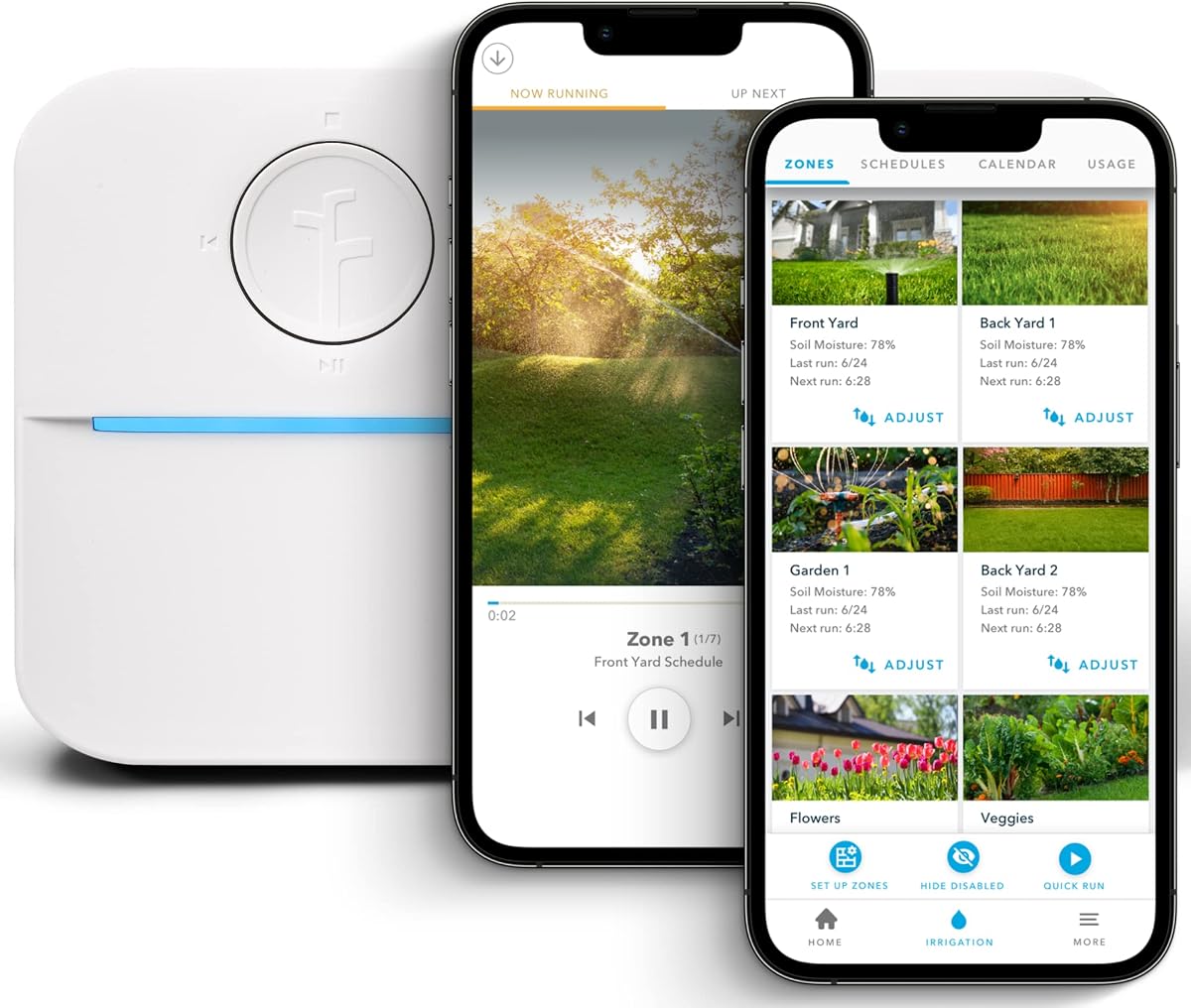
Its patented Weather Intelligence can skip watering for rain, wind, freeze, and other unfavorable conditions, while adaptive schedules help account for seasonal changes. Users can also create their own schedules, enable grow-in options, operate individual zones, review upcoming watering, and track estimated usage through the Rachio app. Those features make the controller practical for homeowners who want automation without giving up manual control.
The main trade-off is that this is an indoor model, so it needs a suitable protected location, and its advanced feature set places it above basic WiFi timers. Installation is advertised as taking 30 minutes or less with compatibility for 99% of existing sprinkler systems, but actual timing depends on the property, wiring, and old controller. Buyers should still check connection type and zone requirements before ordering.
It is a strong recommendation for an eight-zone home that values weather responsiveness, detailed scheduling, and remote visibility. Rachio is especially attractive for users who want a clear dashboard, manual zone runs, and estimated usage information rather than a bare-bones timer with WiFi connectivity. Confirm protected placement and compatibility before installation.
Automatic rain, wind, and freeze skips can prevent unnecessary irrigation without requiring constant schedule changes. Adaptive scheduling also helps balance seasonal conditions, although users should still consider plant needs and local rainfall patterns.
The app allows users to run zones, inspect schedules, and monitor estimated water use from anywhere. This is particularly useful for travelers, landscapers, and households with separate lawn, garden, and drip-irrigation needs.
We may earn a commission when you buy through this link, at no additional cost to you.
The Orbit B-hyve 8-Zone model 57925 has a 4.4 rating and offers a practical middle ground between a basic timer and a premium weather-aware system. It supports up to eight zones, multiple irrigation methods, custom watering programs, and mobile management. For buyers who want a connected controller without paying for every advanced feature found in premium models, it remains a credible option.
We may earn a commission when you buy through this link, at no additional cost to you.
Its combination of WiFi and Bluetooth connectivity supports convenient setup and ongoing sprinkler management. Independent zone scheduling allows different parts of a landscape to operate on different programs, which is important where lawns, flower beds, shrubs, and drip lines have different moisture requirements. The straightforward setup and two-year limited warranty also make the model approachable for first-time smart-controller users.
Unlike the Rachio models and Hioazo options in this list, the supplied product information does not advertise automatic skipping for rain, wind, or freeze. That means weather responsiveness may depend more heavily on manual adjustments or features not described in the listing. Its indoor-only design also requires a protected location such as a garage, utility room, or similar space.
This controller is best for a typical eight-zone property that prioritizes independent programming and app control over advanced automatic weather intelligence. It may be especially attractive to users already familiar with the B-hyve platform. Confirm the number of active zones, connection requirements, and available placement before purchasing.
Separate programs make it easier to irrigate turf, planting beds, and drip systems according to their different needs. Users can also start and monitor the system through convenient mobile management rather than adjusting a physical dial.
WiFi and Bluetooth connectivity reduce the learning curve associated with setup. The user-friendly interface and custom programs give the controller useful flexibility without requiring a premium-tier feature set.
We may earn a commission when you buy through this link, at no additional cost to you.
The Orbit B-hyve 6-Zone model 57946 carries a 4.5 rating and offers a flexible middle ground for medium-sized landscapes. It supports six zones, custom irrigation schedules, and remote management while allowing installation in a garage, shed, or on an outdoor wall when protected by its weatherproof case.
We may earn a commission when you buy through this link, at no additional cost to you.
The defining advantage is placement flexibility. Unlike an indoor-only controller, the protective case permits use in more than one type of environment. App controls let users adjust programs, monitor individual zones, and coordinate lawn sprinklers with drip systems, which is valuable when different portions of the yard need separate run times.
The supplied information does not identify automatic rain, freeze, or wind skipping, so buyers should not assume that this model offers the same weather intelligence as the Rachio 3 or Hioazo controllers. Six zones can also constrain a property that has more valves or anticipates expansion, and careful attention should be paid to the outdoor mounting environment.
It is a good recommendation for a six-zone property that wants multi-zone app control and installation flexibility. Choose it over the indoor-only Orbit model if an outdoor wall or shed location is necessary, and over larger controllers if six zones fully cover the intended layout. Verify wiring, valve count, and weather exposure before installation.
A protective weatherproof case gives users more placement options than a strictly indoor model. This flexibility can simplify access to power and wiring while supporting a smart, remotely managed system.
Custom app schedules make it possible to coordinate turf and drip irrigation with different requirements. Remote adjustments also help accommodate seasonal plant needs and routine schedule changes.
We may earn a commission when you buy through this link, at no additional cost to you.
The Hioazo 4-Zone controller earns a 4.2 rating and is a strong fit for smaller landscapes seeking more scheduling depth than a simple app timer. It supports four zones, up to 16 plans, automatic rain, freeze, and wind skipping, and two irrigation modes through the Hioazo app.
We may earn a commission when you buy through this link, at no additional cost to you.
Its two modes are particularly useful for different watering strategies. Standard irrigation provides continuous watering, while soak irrigation allows time for soil to absorb water between cycles or application periods. Sixteen plans across four zones offer considerable flexibility for daily drenching, intermittent hydration, weekly soaking, and other recurring requirements.
The main limitation is four-zone capacity. Homes with more than four watering valves will need a larger controller or another way to manage expansion. The unit also requires a 2.4GHz WiFi network, so users should check their router before installation. It is intended for indoor use and is advertised as compatible with 99% of existing sprinkler controllers.
This is a compelling option for a four-zone system where automatic weather skips and detailed programming matter. It may suit new plantings that need different frequencies from an established lawn, as well as homeowners who want multiple plans ready to activate. Its claimed 10-minute setup should be treated as a goal rather than a guarantee, since wiring and site conditions vary.
Automatic rain, frost, and wind skipping helps prevent scheduled watering during poor conditions. The feature makes the controller more useful than a fixed remote timer, particularly in climates with rapidly changing forecasts.
Multiple plans make it easier to maintain different frequencies for lawns, flowers, shrubs, and drip zones. Soak mode adds another layer of control for soils and plants that benefit from gradual absorption.
We may earn a commission when you buy through this link, at no additional cost to you.
The Orbit B-hyve 12-Zone model 57950 has a 4.4 rating and is designed for properties that need more zone capacity than standard residential controllers. It combines twelve independently managed zones with custom schedules, remote app controls, and a protective weatherproof case for indoor or outdoor placement.
We may earn a commission when you buy through this link, at no additional cost to you.
Twelve zones provide room for complex landscapes containing multiple lawn sections, planting beds, shrub lines, and drip irrigation. Users can create and adjust custom programs, monitor zones, and coordinate different watering methods from the app. Installation in a garage, shed, or on an outdoor wall gives flexibility when selecting a practical controller location.
Its trade-offs include a larger footprint than four- or six-zone models and the absence of explicitly stated automatic weather skipping in the supplied information. A property with only a few simple valves may not need twelve zones, and buyers should avoid paying for unnecessary capacity. Like other controllers, its installation time depends on existing wiring and site conditions.
This model is best for a medium-to-large residential landscape with many distinct watering areas and a need for flexible placement. It is a solid choice for users invested in the B-hyve app who want remote multi-zone management but do not require the named weather-skip features of the Rachio 3. Count active valves and choose an appropriate protected location before buying.
Twelve zones offer useful separation for large properties with varied turf, beds, and drip areas. This allows each area to follow a more appropriate watering pattern without forcing every valve onto one schedule.
The protective case supports installation in garages, sheds, or on outdoor walls. That flexibility can make wiring, power access, and network coverage easier to optimize.
We may earn a commission when you buy through this link, at no additional cost to you.
The Hioazo Outdoor 6-Zone controller holds the highest supplied rating at 4.8 and stands out for combining six-zone capacity, outdoor installation, and automatic weather skipping. It also provides up to 16 watering plans and both standard and soak irrigation modes, making it a feature-rich option for medium-sized landscapes.
We may earn a commission when you buy through this link, at no additional cost to you.
The Hioazo app gives users remote access to schedules and real-time monitoring. Rain, frost, and wind skips can suspend watering when conditions are unfavorable, while customizable plans support daily drenching, intermittent hydration, and weekly soaking. The two irrigation modes are useful for balancing continuous watering with periods that allow soil to absorb moisture.
The controller requires a 2.4GHz WiFi network, which is an important compatibility consideration. Six zones may also be limiting for a property with many separate valves, and outdoor installation should be completed with attention to the manufacturer's environmental and wiring requirements. Although installation is advertised as taking 10 minutes and working with most existing systems, the claim depends on the existing setup.
It is our leading value pick because it gives buyers a high rating, substantial zone capacity, outdoor placement, and weather-aware operation without moving to the premium Rachio tier. It is a good match for six-zone properties that want soak cycles and multiple plans. Verify WiFi frequency, valve count, and mounting location before purchasing.
Six independently scheduled zones provide enough capacity for many suburban lawns and gardens while remaining simpler than larger premium controllers. Each area can follow a program suited to its plant type and soil conditions.
Automatic skips help conserve water during rain, frost, or wind, while soak mode supports controlled absorption. Together, these features make fixed schedules more responsive to changing outdoor conditions.
We may earn a commission when you buy through this link, at no additional cost to you.
The Rachio 3 16-Zone earns a 4.5 rating and is the premium choice for large, complex irrigation systems. Its sixteen-zone capacity is the highest in this guide, while its weather intelligence and adaptive scheduling provide a sophisticated way to manage extensive landscapes without constant manual intervention.
We may earn a commission when you buy through this link, at no additional cost to you.
Rachio's app allows users to create schedules, let Weather Intelligence adjust automatically, operate individual zones, review upcoming runs, and track estimated usage. The controller skips watering for rain, wind, freeze, and other conditions, reducing the likelihood of unnecessary irrigation. Grow-in options can also support new planting areas that require more frequent attention than mature landscaping.
The trade-off is cost and the need for a suitable indoor location. A sixteen-zone controller can add complexity and expense when a property has only a few zones, so counting valves is essential. It also remains an indoor model, which means a garage, utility area, or other protected space must be available and suitable for power and network access.
For expansive properties with many independently controlled sections, this model offers the most capacity in the list. Choose it when weather-aware automation, adaptive schedules, and remote water-use visibility justify the premium positioning. It is less compelling for a small yard, but excellent for users managing numerous turf and planting zones.
The broad zone capacity suits large estates and sophisticated irrigation layouts. Independent control helps reduce the need to group dissimilar planting areas under one schedule.
Weather Intelligence can adjust or skip runs, while estimated usage tracking gives users a clearer view of consumption. These capabilities are particularly useful when conserving water is an ongoing goal.
We may earn a commission when you buy through this link, at no additional cost to you.
The Orbit 57915 B-hyve 4-Zone has a 4.5 rating and is a streamlined smart option for smaller properties. It combines four-zone control, custom watering programs, and mobile management in an indoor controller, making it potentially easier to use than a more complex multi-zone system.
We may earn a commission when you buy through this link, at no additional cost to you.
Users can configure independent schedules for separate landscape areas and support different irrigation methods through the B-hyve platform. WiFi and Bluetooth connectivity assist with setup and operation, while the straightforward interface reduces the learning curve. A two-year limited warranty provides basic coverage for private-use applications.
The limitations are relatively clear. Four zones are best suited to compact irrigation systems, and larger landscapes may outgrow the unit. The supplied information does not advertise automatic rain, wind, or freeze skipping, so owners who want automatic weather responses may need to adjust schedules manually or consider another controller.
This is a good choice for a four-zone home that wants remote control without a large zone count or complex programming. It also works well for users already comfortable with the B-hyve ecosystem. Confirm that the existing system has no more than four active zones and that a protected indoor location is available.
A smaller zone count keeps programming more approachable for basic residential systems. It is a sensible format when each zone can represent a meaningful and distinct part of the landscape.
Custom programs and mobile zone management provide the core benefits of a smart timer. WiFi and Bluetooth connectivity support convenient configuration while retaining manual control.
We may earn a commission when you buy through this link, at no additional cost to you.
The Rain Bird ARC8 has a 3.8 rating and distinguishes itself through eight-station capacity, indoor or outdoor installation, EPA WaterSense certification, and compatibility with popular voice assistants. It is an appealing option for buyers who want their irrigation controller integrated into a broader smart-home setup.
We may earn a commission when you buy through this link, at no additional cost to you.
The Rain Bird mobile app supports schedule setup, monitoring, manual watering, delays, upcoming schedule viewing, and local forecast checks. Users can share control with family members or landscaping and maintenance professionals. Automatic skips or daily adjustments use the postal code, local forecast, and historic averages, with the listing estimating up to 30% water savings.
Its lower rating among this group suggests buyers should examine current owner feedback carefully, even though the stated features remain useful. The percentage of possible savings is not guaranteed for every property, and actual results depend on weather, landscape, schedules, and irrigation efficiency. Voice assistant and mobile operating-system compatibility should also be confirmed before purchase.
The ARC8 is best for an eight-station property seeking water-efficiency features, flexible placement, and smart-home integration. It is particularly relevant to households already using Alexa or Google Assistant. Prospective buyers should compare current app experience and compatibility details, then verify the controller against their valve count and installation conditions.
Postal-code-based forecasts and historical averages allow the controller to skip or adjust daily watering automatically. The approach can support more efficient irrigation, though actual savings depend on local conditions and user settings.
Users can grant access to family members and service professionals, reducing the need to hand over physical keys. Alexa and Google Assistant compatibility also connects irrigation control with broader smart-home routines.
We may earn a commission when you buy through this link, at no additional cost to you.
The Rain Bird ARC6 carries a 4.0 rating and offers a six-station smart controller with mobile management, forecast-based adjustments, and voice-assistant compatibility. It is aimed at medium-sized properties that need more capability than a mechanical timer but may not require the highest zone capacities in this comparison.
We may earn a commission when you buy through this link, at no additional cost to you.
Through the Rain Bird app, users can set, monitor, and adjust schedules, activate individual programs, delay watering, initiate manual runs, and review upcoming schedules. The controller can automatically skip or modify daily watering using a postal code, forecast information, and historical averages. Family members or maintenance professionals can also be given access to help manage the system.
The ARC6 is designed for indoor installation, so buyers need a protected location near the controller wiring. Its six stations may also be insufficient for a property with more than six watering points, and the up-to-30% savings claim is an estimate rather than a guarantee. The 4.0 rating reinforces the importance of checking recent user feedback and app preferences.
It is a sensible recommendation for a six-station home that values Rain Bird's app, flexible access sharing, and voice-control integration. It may be especially attractive to users already invested in Alexa or Google Assistant. Verify operating-system support, station requirements, and network coverage before making the final choice.
The controller can use local forecast information and historic averages to skip or modify daily watering. This automation can make a fixed irrigation plan more responsive to seasonal conditions.
Remote schedule management, manual watering, and shareable access help households coordinate irrigation with contractors or family. Voice-assistant support adds another option for routine monitoring and commands.
We may earn a commission when you buy through this link, at no additional cost to you.
Choose a smart irrigation controller by matching zone capacity, installation environment, scheduling features, and connectivity to your landscape and household routine.
A watering zone is an independently controlled group of sprinklers or drip lines, so the controller must have enough outputs for every valve in the system. Count current valves and consider future beds, turf sections, or drip irrigation. Eight-zone units suit many homes, while four- and six-zone models are better for compact landscapes; twelve and sixteen zones support more complex layouts.
Buy for today's valves plus realistic expansion, not for an arbitrary maximum. Also check whether accessories or modules are required, and avoid paying for many unused outputs if a smaller controller can cover the property cleanly.
Indoor controllers need a dry, protected location near power and the irrigation wiring, such as a garage or utility space. Models with weatherproof protective cases can support indoor or outdoor placement, while outdoor-only versions should be installed according to their environmental requirements.
Choose placement around safe access, signal strength, and nearby wiring rather than convenience alone. An outdoor unit still needs protection from damaging weather and easy access for future service.
Rain, wind, and freeze skipping can prevent scheduled runs during conditions that make irrigation wasteful or risky. Forecast-based adjustment may also change daily duration or frequency. These features are most useful in climates with unpredictable rainfall, seasonal freezes, or windy weather.
If automatic weather response is a major goal, prioritize controllers that explicitly advertise it. Otherwise, budget for occasional manual schedule adjustments and monitor local forecasts through the app.
Basic controllers may offer only a small set of programs, while advanced models support multiple plans, soak cycles, grow-in schedules, and individual zone controls. Separate programs are valuable when lawn, shrubs, flowers, and drip irrigation need different frequencies or run durations.
Look for enough plan flexibility to represent the landscape without making the interface confusing. A model with 16 plans across four or six zones can be highly adaptable, but usability matters as much as raw plan count.
Most smart controllers need a reliable home network, and some products work only with 2.4GHz WiFi. Modern dual-band routers may still provide a compatible 2.4GHz network, but users should confirm the requirement before purchase. Placement near a weak signal can also interfere with setup or remote access.
Check the app's account, device, and operating-system requirements as well. A controller that supports voice assistants should be verified against the user's existing smart-home platform.
A controller advertised as quick to install may still require identifying wires, removing an old timer, connecting valves correctly, and establishing network access. Check the existing system's voltage, transformer, wiring layout, valve type, and number of zones. Some listings claim compatibility with most existing systems, but that does not replace site verification.
For complex retrofits, professional installation can prevent miswiring and unnecessary valve damage. For straightforward replacements, follow the included instructions carefully and test each zone after connection.
A useful app should make schedules understandable, provide manual run controls, display upcoming watering, and show which zones are active. Shared access can help families, tenants, and landscapers coordinate without sharing one account. Weather status, estimated usage, and delayed-run visibility are valuable additions when supported.
Choose a platform that feels manageable for the person who will maintain it. The largest feature set is not automatically the most convenient, so consider interface simplicity and whether family members need full access.
A limited warranty can provide some protection against defects, but terms vary by model and use. Orbit listings in this comparison specifically state a two-year limited warranty for private use, while warranty details for other controllers should be checked on their current product pages. Manufacturer support, replacement parts, and documentation also influence long-term ownership.
Review warranty exclusions and keep proof of purchase. Reliable documentation and accessible support are valuable, but they should complement rather than replace sound installation and regular maintenance.
Begin by identifying every valve and labeling the corresponding wires before disconnecting the existing controller. Photograph the wiring, confirm that the new controller supports the system's voltage and valve setup, and install the unit in a dry, accessible location with reliable WiFi coverage. Follow the manufacturer's diagrams rather than relying solely on wire colors.
After the physical installation, connect to the app, create the account, join the controller to the 2.4GHz network if required, and configure the date, time, location, and watering schedules. Program each zone according to plant type, emitter or sprinkler output, soil, and season. Run every zone briefly and confirm that water reaches the intended area before relying on a complete schedule.
Maintain the controller by keeping the enclosure dry and unobstructed, cleaning filters as recommended, checking emitters and spray heads for damage, and inspecting valves for leaks. Review weather adjustments and estimated use periodically, update schedules for seasonal growth, and test manual runs after major plumbing or landscaping changes. Treat app access as a convenience rather than a substitute for routine irrigation inspection.
Most models need internet access during setup and for remote app control and weather-based features. If the network drops after setup, behavior varies by product and configuration, so check whether essential scheduling continues locally. The Hioazo models in this guide specifically require 2.4GHz WiFi, while the other products may have different network requirements.
The number indicates how many valves the controller can operate independently. More zones allow separate schedules for different lawns, flower beds, shrubs, and drip systems. Choose enough capacity for present and planned valves, but avoid paying for unused zones if a smaller model will cover the landscape adequately.
Yes, most multi-zone controllers can operate different valve types, provided each zone is wired and programmed correctly. The Orbit models specifically describe coordination between lawn sprinklers and drip systems. Runtime should be adjusted because drip emitters usually deliver water at a much lower flow rate than spray heads or rotor sprinklers.
A straightforward replacement may be manageable for a confident DIY homeowner, especially when the new controller matches the existing wiring and valve setup. Complex systems, unclear wiring, unusual transformers, or extensive landscaping are better handled by an irrigation professional. Incorrect connections can damage valves or lead to persistent watering problems.
Savings depend on climate, schedules, plant health, irrigation efficiency, and how often unfavorable conditions trigger a skip. The Rain Bird listing estimates up to 30% savings using forecasts and historic averages, but that is not guaranteed for every property. Controllers with automatic rain, freeze, and wind skipping can also prevent individual unnecessary watering events.
Indoor models are usually simpler to protect and may be the better choice when a garage or utility area is close to the valves. Weatherproof models offer more installation flexibility but still require appropriate mounting and protection. Consider power access, wiring distance, WiFi signal, maintenance access, and local weather exposure.
Several platforms support shared access, and the Rain Bird ARC8 and ARC6 explicitly allow users to share control with family members and landscaping or maintenance professionals. Rachio and Orbit apps also provide remote management, although the exact sharing options should be confirmed in the current app before relying on them.
Start with the type of emitter or sprinkler, soil, plant needs, sun exposure, and season. Run each zone and measure actual output, then adjust duration to avoid runoff or dry areas. Seasonal changes, plant growth, rainfall, and restrictions should be reflected in the schedule, while weather skips provide an additional layer of automation.
The Rachio 3 8-Zone is the strongest all-around option for buyers who value weather intelligence, flexible scheduling, remote control, and estimated water-use visibility. The Hioazo Outdoor 6-Zone is the best value-oriented choice, combining six zones, outdoor placement, 16 plans, and weather skips. For a large and complex landscape, the Rachio 3 16-Zone offers the highest zone capacity and the most premium-oriented control experience.
Before choosing, count the valves, identify a protected installation site, confirm WiFi and app requirements, and decide whether automatic weather response is important enough to influence the selection. Smaller properties may be better served by the Orbit B-hyve 4-Zone or 6-Zone, while users seeking smart-home integration should examine the Rain Bird ARC options.
Current prices, availability, ratings, and product details can change, so verify the current listing before buying. Also review the manufacturer's compatibility chart, warranty, and installation instructions for the exact model. Those checks reduce the chance of discovering a zone, wiring, or network limitation only after delivery.