
Battery Tender Junior 12V
4.8Editor score
Compact 750mA output
Four-step charging cycle
Ideal for powersports
Our Agm Battery Tender guide compares ten smart chargers, covering compatibility, power, safety, displays, and multi-battery support for confident maintenance.
An AGM battery tender is more than a simple trickle charger: it is designed to charge, monitor, and maintain a battery without supplying excess power. A useful model should match your battery chemistry, suit the vehicle or equipment, and provide dependable protection during long storage periods.
We compared ten smart battery chargers using the specifications and features supplied for each product. The guide considers charging output, battery compatibility, safety protections, display clarity, cable design, multi-battery capability, and the practical needs of cars, motorcycles, boats, and recreational equipment.
Each review identifies the strongest use case and any meaningful trade-offs, helping you choose according to your battery setup rather than output alone. Product ratings and availability can change over time, and current prices should always be confirmed before purchasing.
4.8Editor score

4.7Editor score

4.5Editor score
The comparison below highlights charging output, supported battery systems, safety provisions, and the scenarios best suited to each charger and maintainer.


The Battery Tender 4 AMP is a well-rounded automatic charger and maintainer for people who need one dependable unit to handle several common battery types. Its 4.7 rating reflects a favorable balance of charging performance, useful compatibility, and straightforward operation. It supports 6V and 12V batteries, making it more versatile than many single-voltage competitors.
We may earn a commission when you buy through this link, at no additional cost to you.
The charger is compatible with lithium LiFePO4, lead-acid, flooded, sealed maintenance-free, AGM, and gel-cell batteries. It begins by bringing the battery to a full charge and then moves automatically into float mode. An ISM adaptive system can restore full output if voltage falls too far under load, while the two-color LED keeps the charging state visible. Spark-proof connection behavior and automatic reverse-polarity detection add practical protection.
Its main limitation is the modest 4-amp output. It is intended primarily to charge and maintain rather than rapidly recover a severely depleted automotive battery. The simple LED also offers less information than the LCD-equipped 15 AMP model. Even so, the 6V/12V switch, broad chemistry support, and automatic monitoring provide more flexibility than many basic trickle chargers.
This is the strongest all-around choice for owners of mixed equipment or for someone who wants one charger to serve AGM and other supported battery types. It is especially attractive for long-term storage because the automatic float and adaptive charging behavior reduce the need for frequent supervision. For larger vehicles requiring a faster recovery, however, the 5 AMP or 15 AMP alternatives may be more appropriate.
The ability to handle 6V and 12V systems across AGM, gel, flooded lead-acid, sealed, and LiFePO4 batteries makes this model useful beyond a single vehicle class. Matching the correct voltage and chemistry is essential for safe, effective charging.
Automatic float mode and adaptive charging allow the unit to remain connected during storage. The two-color LED gives a simple indication of status without requiring frequent menu navigation or manual adjustment.
We may earn a commission when you buy through this link, at no additional cost to you.
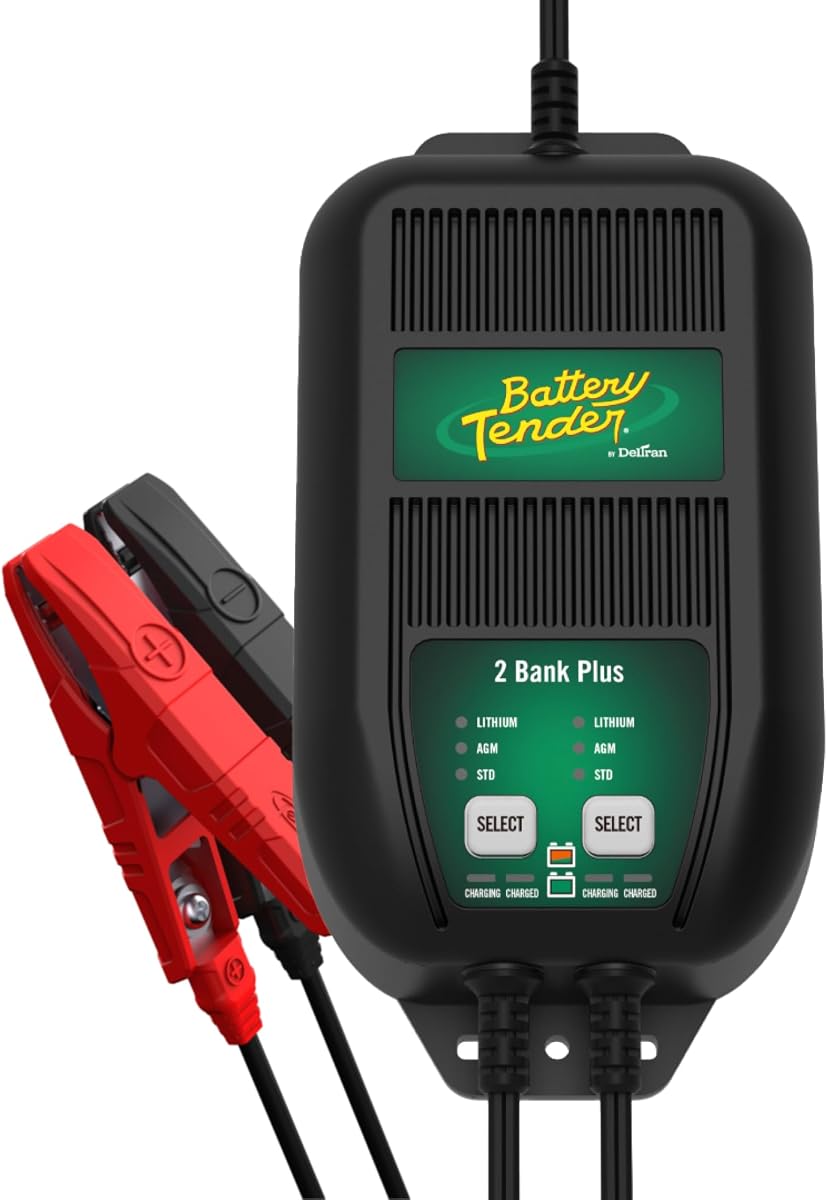
The Battery Tender Plus Two Bank is an intelligent choice when two 12V batteries need maintenance at the same time. Its 4.8 rating is among the strongest in this group, reflecting a well-liked balance of independent charging, temperature compensation, and broad compatibility. Each bank delivers 1.25 amps for a combined maximum of 2.5 amps.
We may earn a commission when you buy through this link, at no additional cost to you.
Two independent charging stations allow separate batteries to be maintained without combining them as one large bank. The three-step program progresses through initialization, bulk charging, and float mode. Temperature compensation adjusts the charging voltage to ambient conditions, while a solid-state two-color LED displays the charging stage. Standard, AGM, sealed maintenance-free, and flooded batteries are supported.
The compromises are predictable. The unit is limited to 12V systems, and each bank delivers only 1.25 amps, making it better for routine maintenance than aggressive battery recovery. It also offers no detailed display beyond the LED status system. Those limitations matter less when the primary goal is keeping two stored vehicles, motorcycles, or pieces of equipment healthy.
Choose this model if you regularly maintain two batteries and prefer separate, temperature-aware charging over a single higher-output connection. It is particularly suitable for owners of multiple motorcycles, seasonal vehicles, or paired 12V batteries that need independent float maintenance. Buyers needing more current or 6V flexibility should look to one of the single-bank switchable chargers.
Each charging station manages its battery separately, providing 1.25 amps per bank. This arrangement is useful when batteries have different sizes, ages, or maintenance schedules.
Temperature compensation helps optimize charge voltage as ambient conditions change. That is especially useful in cold storage areas or unheated garages where batteries experience seasonal temperature swings.
We may earn a commission when you buy through this link, at no additional cost to you.
The Battery Tender 15 AMP is the most feature-rich model in this roundup, offering selectable 15, 8, and 2-amp output alongside an interactive LCD. Its 4.5 rating remains strong despite being a more specialized and potentially more complex unit. It is aimed at 12V users who want meaningful control over charging speed and battery type.
We may earn a commission when you buy through this link, at no additional cost to you.
Users can select the amperage and battery chemistry, while the LCD reports the chosen rate, battery type, estimated charge percentage, and error messages. Standard, AGM, gel, and LiFePO4 batteries are supported. The 15-amp setting can handle larger automotive batteries more effectively than the 2-, 2.5-, 4.3-, or 5-amp alternatives, while lower settings support controlled maintenance.
Its limitations are its 12V-only design and the additional decision-making involved with an electronic interface. The model does not offer the 6V flexibility of the 4 AMP or 2 AMP chargers, and the LCD provides more information but may be unnecessary for a basic storage application. Battery chemistry selection must also be made correctly for the unit to operate as intended.
This charger makes the most sense for owners of several 12V vehicles or batteries who appreciate fine-grained settings and clearer status information. It also serves as a capable general-purpose charger when a battery needs more than a slow maintenance current. For a small powersports battery or a collection of 6V systems, one of the more compact options would be a better fit.
Switching among 15, 8, and 2 amps lets the owner match the charging rate to the battery and task. Higher output suits larger automotive batteries, while lower settings favor controlled maintenance.
The LCD displays the selected current, battery chemistry, approximate charge level, and error messages. This information makes setup verification and ongoing monitoring easier than a simple LED alone.
We may earn a commission when you buy through this link, at no additional cost to you.
The Battery Tender 5 AMP offers a conventional middle ground between compact powersports maintainers and more powerful automotive chargers. Its 4.7 rating indicates a well-regarded product, and the 5-amp output is suitable for routine charging and maintenance of typical 12V vehicle batteries.
We may earn a commission when you buy through this link, at no additional cost to you.
The model offers a full charge followed by automatic float operation, preventing continued overcharging when the battery reaches the appropriate level. ISM adaptive charging can resume full output if voltage falls too far under load. Compatibility covers lead-acid, AGM, gel, and lithium batteries. Spark-proof connection behavior, reverse-polarity detection, and stated safety approvals add confidence for regular use.
Compared with the 4 AMP model, the additional current offers modest improvement in charging flexibility. Compared with the 15 AMP model, however, it is less flexible because it offers only one output level and no 6V switch. Its two-color LED communicates status but provides less detail than a full LCD, which may be a drawback for users who want battery percentage or error information.
For someone with one standard 12V car, SUV, or truck battery, this is a practical and uncomplicated selection. It provides enough power for routine maintenance without the controls and bulk of a high-output charger. The included ring-terminal and alligator-clip combination cable and 11-foot total reach also make it convenient for reaching a battery in a crowded engine bay.
A 5-amp rate is a sensible general-purpose level for common 12V vehicle batteries. It offers more charging capability than compact powersports units while remaining focused on automatic maintenance.
ISM adaptive charging monitors the battery and restores full output if voltage drops excessively under load. This makes the maintainer more responsive than a fixed trickle-only design.
We may earn a commission when you buy through this link, at no additional cost to you.
The Battery Tender Plus is a long-standing style of general-purpose maintainer suited to cars, motorcycles, lawn equipment, and ATVs. Its 4.7 rating reflects consistent customer appeal, while the 1.25-amp output keeps it focused on controlled charging rather than rapid recovery.
We may earn a commission when you buy through this link, at no additional cost to you.
A four-step program adapts to the battery's needs, and the two-color LED reports charge status. If voltage falls too far under load, charging resumes at full output. The quick-disconnect harness allows the attached lead to be removed without separating an inconvenient wiring connection each time the equipment is used.
The low current is the most important constraint. It is well suited to keeping a healthy battery maintained, but it is not the first choice for a deeply discharged large automotive battery. The unit also charges only one battery and lacks 6V selection, a detailed screen, and the more sophisticated reconditioning features found elsewhere in the roundup.
This model is a good fit for a mixed household with several 12V batteries used at different times. Its simplicity, quick-disconnect system, and broad equipment compatibility make it convenient for recurring seasonal maintenance. If maintaining two batteries simultaneously is the priority, choose the two-bank or four-bank version instead.
The quick-disconnect harness improves the experience of moving between maintenance and use. It avoids making the user repeatedly detach wiring or reposition a permanently fixed lead.
The multi-stage program provides controlled charging and maintenance rather than a single constant trickle. Its two-color status light and automatic restart under load keep the unit responsive.
We may earn a commission when you buy through this link, at no additional cost to you.
The Battery Tender Junior delivers focused battery maintenance for motorcycles, ATVs, and other 12V powersports equipment. Its 4.8 rating makes it one of the strongest-rated products here, and the compact 750mA design is particularly appealing when charging speed is less important than inexpensive seasonal upkeep.
We may earn a commission when you buy through this link, at no additional cost to you.
The four-step charging cycle moves through initialization, bulk charge, absorption, and float mode. It supports 12V flooded, AGM, and gel-cell lead-acid batteries. A two-color LED communicates the charging state, and adaptive charging resumes output if the battery voltage falls too far under load. The charger itself measures just 3.3 by 1.3 by 2.4 inches and weighs one pound.
Its limitations are straightforward. The 750mA rate is slow for larger or deeply discharged batteries, and the product information does not list lithium compatibility. Spark-proof circuitry and automatic reversed hook-up detection improve safety, but the device still cannot compensate for an undersized battery or a severely depleted starting battery.
The Junior is best for owners of small 12V powersports batteries who want a compact, dedicated maintainer. It is less appropriate for a large car battery that needs a meaningful top-up, or for a collection requiring multiple-bank charging. The 12-foot output cable and included fused ring-terminal harness make placement in tight motorcycle or ATV compartments manageable.
The small enclosure can be easier to accommodate than a full-size automotive charger. That is valuable in motorcycle garages, equipment bays, and storage areas where space is limited.
The four-step program handles charging, absorption, and float maintenance in one sequence. Automatic transition to float mode makes long-term connection more convenient for seasonal storage.
We may earn a commission when you buy through this link, at no additional cost to you.
The NOCO GENIUS2D stands apart because it is designed to mount directly near a battery. Its 4.6 rating reflects a capable smart charger with recovery features and a permanent-installation format. Rather than serving only as a temporary maintainer, it can become a fixed component of a vehicle or equipment system.
We may earn a commission when you buy through this link, at no additional cost to you.
A durable snap-fit bracket and included truss-head screws create a relatively straightforward mounting setup near the battery. The integrated thermal sensor adjusts charging to ambient temperature, while smart monitoring supports extended maintenance. Force Mode can attempt to charge a battery reduced to zero volts, and the charger can operate from a very low starting voltage.
The product information says it supports 12V lead-acid AGM, gel, SLA, VRLA, flooded, maintenance-free, deep-cycle, marine, and RV batteries. Its pulse-charging function is intended to address sulfation and acid stratification. It is not a 6V charger, and onboard use requires a secure installation with suitable cables and attention to the vehicle's electrical layout.
Choose the GENIUS2D when a permanently installed system is the goal, especially for a classic vehicle, boat, RV, or rarely used machine. Its 2-amp output is modest but appropriate for a 2A onboard maintainer. People seeking a simple plug-in travel charger or needing 6V support should choose one of the portable alternatives instead.
The mounting bracket allows the charger to sit securely near the battery. This is valuable for vehicles that remain stored for long periods or need consistent maintenance between trips.
Force Mode is designed for batteries that have fallen to extremely low voltage. The pulse-charging approach is also intended to counter common forms of battery degradation in compatible systems.
We may earn a commission when you buy through this link, at no additional cost to you.
The Battery Tender 2 AMP is a versatile middle ground between the very small Junior and higher-output automotive chargers. Its 4.7 rating indicates a well-received product, and selectable 6V or 12V operation is unusual among compact smart chargers. It is a good fit for maintaining a mixed collection of smaller batteries.
We may earn a commission when you buy through this link, at no additional cost to you.
Compatibility covers 12V lead-acid, flooded, AGM, and gel-cell batteries. A multi-step program handles the initial charge before moving into float mode, while adaptive charging restores output if voltage falls excessively under load. The two-color LED keeps the status visible, and the listed ETL, CSA, FCC, ICES, and BC certifications support confidence in its electrical design.
The 2-amp rate is not intended to revive a large deeply discharged automotive battery quickly. Although the title refers to selectable lead-acid and lithium operation, the supplied feature details specifically enumerate 12V lead-acid, flooded, AGM, and gel types, so buyers should verify exact lithium compatibility for their battery before relying on that function.
This model is a strong pick for small powersports batteries, 6V equipment, and users who want a compact unit without giving up smart monitoring. It also offers a useful compromise between the Junior's 750mA output and the stronger 4-amp model. For several batteries or a full-size vehicle battery needing rapid recovery, however, a multi-bank or higher-output charger is preferable.
The 6V and 12V selection allows one charger to cover two common battery classes. This is particularly helpful for mixed collections of vintage equipment, motorcycles, and modern vehicles.
Automatic float operation and adaptive restart make the unit suitable for extended storage. A visible status LED provides reassurance without the complexity of a full digital display.
We may earn a commission when you buy through this link, at no additional cost to you.
The CTEK MXS 5.0 distinguishes itself with an eight-step charging process and a reconditioning function. Its 4.7 rating reflects a strong general-purpose product suitable for cars, bikes, marine equipment, RVs, and tractors. The 4.3-amp output sits neatly between compact maintainers and larger automotive units.
We may earn a commission when you buy through this link, at no additional cost to you.
Its principal advantage is the staged charging program, which is designed to optimize charging in varying conditions. The reconditioning mode can improve the lifespan and usable capacity of healthy or underperforming batteries. CTEK's patented float and pulse charging approach is designed for extended connection, and the supplied information says users can leave it connected for months.
Safety features include splash, dust, spark, and shock resistance, along with short-circuit and reverse-polarity protection. The limitation is that the listed compatibility focuses on 12V lead-acid and AGM batteries. Buyers with lithium batteries should verify compatibility rather than assuming it from the broader category. The unit is also more substantial than a small motorcycle maintainer.
Choose the MXS 5.0 when you want an intelligent charger that can do more than hold a battery at a fixed float level. Its reconditioning behavior may be particularly attractive for seasonal lead-acid batteries that lose capacity during storage. For a small powersports battery or a simple one-button maintenance setup, a lower-output compact model may be easier to live with.
The multi-stage process gives the charger more opportunities to assess and optimize battery condition. It is a more structured approach than simple constant-current trickle maintenance.
The reconditioning function is intended to bring some underperforming lead-acid batteries back toward useful health. It can be valuable for batteries that spend substantial time unused in seasonal equipment.
We may earn a commission when you buy through this link, at no additional cost to you.
The Battery Tender Four Bank is designed for users who need to maintain several batteries around one central unit. Its 4.7 rating reflects a practical four-station design with broad compatibility and weather resistance. It can service up to four 12V batteries simultaneously at 1.25 amps per bank.
We may earn a commission when you buy through this link, at no additional cost to you.
Each bank moves independently from full charging into float mode, and a four-step algorithm is designed to optimize battery life while avoiding overcharging or excessive discharge. Standard, AGM, lithium LiFePO4, flooded lead-acid, and gel-cell batteries are supported. Four separate alligator-ring-terminal combination clips are included for connecting the stations.
The per-bank current is modest, so this is primarily a coordinated maintenance hub rather than a rapid recovery solution for four large depleted batteries. It is also limited to 12V systems. Those constraints are offset by an IP65 weather-resistant enclosure, reverse-polarity protection, a 25-hour safety timer, and spark-proof operation.
Choose this model if you maintain a collector, several motorcycles, a fleet of small 12V machines, or multiple vehicles stored for extended periods. Centralizing maintenance can simplify cable management and make it easier to inspect all charging states. If you only have one battery, a higher-output single charger will be a more direct investment.
Four independent stations provide a convenient way to maintain multiple 12V batteries. The included combination leads support straightforward connections to different battery locations.
The IP65 enclosure adds protection against dust and water intrusion. That makes the unit more practical in garages, sheds, and other storage environments than an entirely open design.
We may earn a commission when you buy through this link, at no additional cost to you.
The right AGM battery tender depends on battery voltage, chemistry, capacity, charging priorities, and the number of batteries you need to maintain. These factors help narrow the field before comparing convenience features.
Start by confirming whether the battery is 6V or 12V. A 12V charger is not automatically appropriate for every lead-acid system, and using the wrong voltage setting can damage a battery or charger. Models with a 6V/12V switch offer useful flexibility if your collection includes vintage vehicles, motorcycles, or other 6V equipment.
The most versatile models in this guide combine 6V and 12V operation with automatic float charging. If every battery you own is a modern 12V unit, a fixed-voltage charger may be simpler, but the added switch can still prevent a costly mismatch later.
Charging output should reflect both battery capacity and your goal. Compact 750mA and 1.25-amp models are appropriate for maintaining smaller powersports batteries, while 4- to 5-amp units suit routine work on common vehicle batteries. A 15-amp model offers more recovery capability for larger batteries but does not make it suitable for every chemistry or voltage.
Output is not the sole measure of quality. The charging algorithm, temperature behavior, float transition, and ability to handle a deeply discharged battery also influence results. Choose the lowest appropriate output for a small battery and the highest safe option for a large battery that needs meaningful recovery.
AGM compatibility is essential, but you should also confirm whether the charger supports flooded, sealed maintenance-free, gel-cell, and LiFePO4 batteries. The supplied specifications differ among products, so do not assume that a charger labeled for AGM will automatically handle lithium or every lead-acid format.
Matching the chemistry lets the charger select an appropriate voltage and absorption strategy. It also prevents an unsuitable charging program from reducing performance or damaging the battery. Always follow the battery manufacturer's guidance when it provides specific charging requirements.
Single-bank chargers maintain one battery at a time. A two-bank unit serves paired vehicles or equipment, while a four-bank hub supports larger collections without requiring several separate power supplies. Independent stations are helpful when batteries have different capacities, ages, or usage patterns.
Multi-bank products are not simply faster chargers. In the examples here, each bank receives a relatively modest 1.25 amps. If your main priority is recovering one deeply discharged large battery quickly, select a higher-output single charger instead.
A two-color LED is sufficient for basic charge-status awareness, while an LCD can show selected output, battery type, estimated charge percentage, and error messages. More information is helpful during setup, but it also introduces another interface that users must understand.
Automatic float mode is the more important long-term feature. It reduces the need for constant supervision by stopping the bulk stage when the battery reaches its target and maintaining voltage afterward. Adaptive restart, if present, lets the charger respond when voltage falls under load.
Look for reverse-polarity protection, spark-proof connection behavior, overcharge prevention, and short-circuit resistance. These safeguards matter because charger leads are frequently connected in dark garages, where a reversed or loose connection may go unnoticed.
A safety timer can add another layer of protection in multi-bank units. Weather resistance is also relevant if the charger will live in a damp shed or exposed storage area rather than a climate-controlled room. Safety features do not excuse poor installation, so the supplied instructions should still be followed carefully.
A portable maintainer is convenient for occasional use and easy to move between vehicles. A permanently mounted onboard charger is better when a vehicle or machine remains stationary for long periods and needs continuous maintenance without repeatedly connecting a lead.
Permanent systems require secure placement, correct cable routing, and attention to electrical compatibility. Portable models usually include ring terminals and alligator clips, with quick-disconnect harnesses offering a convenient middle ground for equipment used intermittently.
Temperature affects battery performance and charging behavior. Chargers with temperature compensation or integrated thermal sensors can adjust their output as conditions change, which is useful in cold climates and unheated garages. This is particularly relevant when maintaining batteries through winter.
Also consider dust, moisture, and cable reach. A weather-resistant enclosure helps in rough storage areas, while a longer combined cord can make it easier to reach a battery in a crowded engine bay. Choose the physical design that you can actually position safely.
Before connecting the charger, identify the battery's voltage and chemistry, then select the corresponding settings on the model. Read the battery and charger instructions, inspect the leads for damage, and work in a ventilated area. Clean around the battery terminals and make sure the charger is not connected to mains power until the connections are secure.
Attach the positive lead to the positive terminal and the negative lead to the negative terminal. If the charger provides a ring-terminal lead, install it firmly; if it includes an alligator clip, ensure a solid metal connection. Connect the AC cord only after checking polarity. The charger's protection circuitry can detect common errors, but careful setup remains the primary safeguard.
Allow the battery to complete its charging cycle, then confirm that the unit has entered float or maintenance mode. Recheck the connection periodically, particularly after moving the charger or vehicle. Disconnect mains power before removing leads, and keep the charger dry, vents unobstructed, and away from combustible materials. If the indicator shows an error or the battery swells, leaks, or becomes unusually hot, stop charging and consult the relevant instructions.
Yes, if the charger is designed for long-term maintenance and is correctly matched to the battery's voltage and chemistry. A smart charger moves into float mode after charging and monitors the battery, often restarting a charge if voltage falls too far under load. Periodic connection checks are still advisable, especially in damp or changing environments.
A basic trickle charger supplies a small, relatively constant current, while a smart maintainer uses multiple charging stages and automatic voltage monitoring. The maintainer can deliver appropriate bulk charging, transition to float mode, and respond to changes in battery condition. That makes it better suited to unattended seasonal storage when used as intended.
No. A high-current charger is not automatically suitable for every battery. Small powersports batteries can be overwhelmed by excessive output, while large deeply discharged batteries benefit from more current. Always check the battery manufacturer's charging guidance, use a selectable charger where available, and choose the lowest effective level for routine maintenance.
Some models support AGM, conventional lead-acid, gel, and LiFePO4 batteries, but compatibility varies by model. A lithium battery must also use the correct chemistry setting and a charger approved for that battery type. Verify the complete specification rather than relying on a broad product description or the word tender alone.
For routine maintenance, many owners find that a charger in the 2- to 5-amp range is practical for common vehicle batteries. A higher-output model may be useful for recovery, especially when the battery is deeply discharged, but the output should still remain appropriate for the battery. Battery capacity, chemistry, and manufacturer instructions should guide the decision.
Cable length depends on the distance between a safe power outlet and the battery. The 4 AMP and 5 AMP models provide 11 feet of combined reach, while the Junior includes a 12-foot output cord. Longer reaches improve placement flexibility, but the lead should still be routed without sharp bends, exposed damage, or interference with hot and moving vehicle components.
A multi-bank charger is convenient when several batteries need simultaneous maintenance, because it centralizes the power supply and connections. However, each bank usually has a modest current rating. If you maintain only one battery or need faster recovery for one large battery, a higher-output single charger may be more useful.
Disconnect mains power before touching the leads, then verify that positive is connected to positive and negative to negative. Inspect the battery terminals and clips for corrosion, looseness, or damage. Restore power only after the connection is corrected, and consult the charger's manual if the error persists.
The Battery Tender 4 AMP is the most balanced overall choice because it combines 6V and 12V flexibility with support for AGM and several other battery types. The Battery Tender Junior is a compact, economical option for small 12V powersports batteries, while the 15 AMP model stands out for selectable output, battery chemistry controls, and a detailed LCD.
Prioritize correct voltage and chemistry before comparing output or convenience features. Then consider how many batteries you maintain, whether a permanent installation is useful, how much recovery power you need, and which charging information you want to see. For collectors and multi-vehicle households, the two-bank and four-bank models can simplify maintenance without requiring several separate chargers.
Ratings, specifications, product availability, and prices may change, so confirm the current listing and manufacturer instructions before buying. Check the battery's required charging method, select the appropriate settings, and install the charger where it can operate safely and remain dry.