
Zoom R4
4.5Editor score
Four-track recording capability
32-bit float capture
Two XLR/TRS inputs
Built-in stereo microphone
Stereo bouncing feature
Our Portable Digital Multi Track Recorder guide compares 10 top models for track counts, inputs, portability, recording features, and creator needs for
A portable digital multi track recorder puts multitrack recording, effects, and playback into a device that can move from a rehearsal room to a remote shoot. The best models make capturing separated performances convenient while remaining approachable enough for songwriters, podcasters, filmmakers, and musicians working away from a full studio.
We compared the ten products in this guide by examining their supplied track capacities, input configurations, built-in microphones, editing tools, effects, monitoring options, storage support, power methods, and portability. The list includes tabletop recorders, handheld field units, podcast-focused recorders, and compact mixers that can serve as multitrack recorders.
Each numbered review explains where the product stands out and where its feature set may not align with every workflow. The top selections reflect the supplied ratings and capabilities rather than personal testing, and specifications, availability, and prices can change, so readers should confirm current details before buying.
4.5Editor score
4.1Editor score

4.4Editor score
This side-by-side comparison highlights each recorder's channel count, input options, built-in features, and intended creator environment, helping narrow the field before a detailed review.



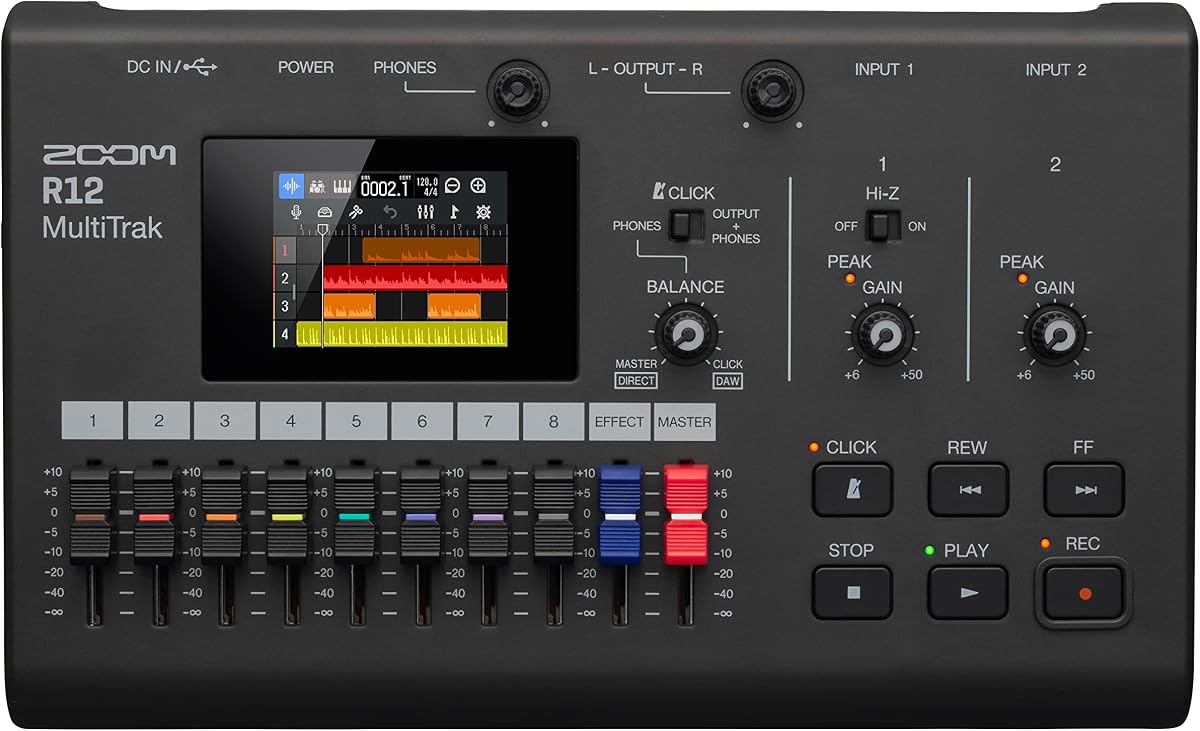
The Zoom R12 is an eight-track portable recorder aimed at musicians who want to sketch, arrange, and polish songs without relying on a computer. Its supplied rating of 4.1 makes it less universally favored than the highest-rated products in this list, but its combination of a color touchscreen, DAW-style editing, rhythm tools, and flexible USB integration gives it a distinctive creative package.
We may earn a commission when you buy through this link, at no additional cost to you.
Its main strengths are visible in the hardware and software combination. It records up to eight tracks through two XLR/TRS inputs, supports 48V phantom power on both, and includes a Hi-Z switch on input 1 for direct guitar or bass connection. The touchscreen supports cutting, copying, looping, and mixing, while 150 drum loops and 18 FM synth instruments help users build material before a complete band is available.
The trade-offs are most noticeable for users who need to record several live sources at once or who expect the highest possible customer rating. Only two physical inputs are listed, so larger ensembles will need another approach. Its USB-C audio-interface and DAW-control functions are useful, but they do not transform the two-input limit into a larger standalone channel count.
It is best suited to singer-songwriters, home-studio users, producers building demonstrations, and musicians who value portability and creative tools over a large input count. For those needs, the R12 is an effective one-device studio: a recorder, arranger, drum-machine source, and computer companion. Buyers should verify storage requirements and exact workflow details, but the supplied feature set makes it the strongest fit for mobile music creation.
The 150 preloaded drum loops and 18 FM instruments give the R12 more than a conventional audio-capture function. A musician can create a beat, add a synth part, record over it, and arrange the result directly on the touchscreen, reducing the need to build every starting point in separate software.
USB-C operation turns the recorder into a stereo audio interface and DAW control surface. That makes it useful for creators who want to begin on the portable device and later move into a more detailed computer-based production workflow.
We may earn a commission when you buy through this link, at no additional cost to you.
The Zoom R4 is a four-track recorder for musicians who want a focused, portable way to capture ideas without building a full desktop studio. Its 4.5 rating is among the strongest in this roundup, and the supplied highlights—32-bit float recording, two XLR/TRS combo inputs, a built-in stereo microphone, effects, rhythms, and USB audio-interface operation—make it versatile for small ensembles and mobile recording.
We may earn a commission when you buy through this link, at no additional cost to you.
The built-in microphone is especially useful for capturing ambient sounds, a quick reference performance, or a stereo source without carrying extra equipment. Two external inputs provide room for microphones or instruments, while the 32-bit float format is intended to preserve detail across wide dynamic ranges. Stereo bouncing lets users combine tracks into a finished stereo file for sharing or later work.
Its limitations are straightforward: it is a four-track device with only two physical input connectors, and it does not offer the large touchscreen project environment described for the R12 or R20. Musicians recording a full drum kit and several amplified instruments at once will need a higher-channel alternative. Even so, a focused four-track workflow can be a practical limit that encourages better performances and cleaner decisions.
The R4 is best for singer-songwriters, podcasters capturing more than one source, bands testing arrangements, and anyone who wants a battery-powered recorder that can also connect to a computer. It may be the most balanced choice for users who prioritize the supplied 4.5 rating and essential recording features over a large channel count.
The 32-bit float format is a standout for a compact recorder because it is designed to retain a broad range of signal levels. Creators can capture quieter sources or changing performances with less concern for immediate clipping, although good microphone placement and gain control remain important.
Stereo bouncing helps turn a four-track session into a shareable final mix. It is a practical way to produce a song, rehearsal record, or demo without keeping every take as a separate track throughout playback.
We may earn a commission when you buy through this link, at no additional cost to you.
The Zoom R20 is a tabletop multitrack recorder for musicians who want to record, edit, and mix substantial projects directly on the device. It carries a 4.4 rating and stands apart from compact four-track units with support for up to 16 tracks, six XLR inputs, and eight simultaneous tracks. A DAW-style touchscreen becomes the central control surface for arrangement and mixing.
We may earn a commission when you buy through this link, at no additional cost to you.
The supplied feature list emphasizes a complete standalone workflow. Users can drag, drop, swipe, and pinch to arrange audio, then apply EQ, compression, and other built-in effects. A library of 150 rhythm patterns and an onboard synth with 18 sounds helps with song development, while the six XLR inputs give a small band or multi-instrument session considerably more capture flexibility than a two-input recorder.
The primary compromise is portability in the strictest sense. Although portable compared with a large studio console, the R20 is described as a tabletop unit and will demand more space than a handheld field recorder. Its editing environment also introduces more complexity, which may not suit someone who only wants a simple dictation or location-recording device.
This recorder is best for home-studio musicians, project-based songwriters, and groups that want multitrack capture without a computer. It is the top choice in this guide for a larger standalone touchscreen workflow, particularly when the number of tracks and inputs matters more than ultra-compact handling.
With capacity for up to 16 tracks and eight simultaneous recordings, the R20 provides room to layer guitars, vocals, percussion, and other parts. The greater project size can reduce the need to consolidate parts prematurely and gives musicians a broader canvas for arrangement.
Direct manipulation makes the R20 attractive to creators who dislike button-heavy editing. Audio can be arranged with drag, drop, swipe, and pinch gestures, while built-in EQ and compression help improve the source recordings before export.
We may earn a commission when you buy through this link, at no additional cost to you.
The Roland BR-80 is a portable digital recorder built around three operating modes: MTR for multitrack recording, eBand for practice, and Live Recorder for direct capture. Its 4.4 rating reflects a well-rounded feature set, including 64 V-Tracks, eight simultaneous playback tracks, a built-in stereo condenser microphone, and a substantial collection of backing and rhythm patterns.
We may earn a commission when you buy through this link, at no additional cost to you.
Practice is a central part of the BR-80's identity. The eBand mode supports phrase training and play-along material, making it particularly useful for instrumentalists who want to isolate passages, practice with accompaniment, or revisit a performance. For faster captures, Live Recorder provides a more direct path to recording, while the MTR mode supports organized multitrack work.
Some listed specifications may feel dated compared with newer devices. Recording is specified to SD or SDHC media with a maximum listed capacity of 32GB, and the product name does not suggest a recent-generation touchscreen platform. The included SONAR X1 LE software also reflects a different software ecosystem from the current computer-centered workflows offered by some competitors.
Despite those considerations, the BR-80 is compelling for musicians who want one portable device that combines recording with structured practice. Its built-in condenser microphone, effects, backing library, and USB interface broaden the use case, making it more than a basic field capture unit. Confirm current storage and accessory requirements before purchasing.
The eBand function gives the BR-80 a clear advantage for instrumental practice. Phrase training and play-along tracks can help users rehearse difficult passages repeatedly, turning the recorder into a practice companion rather than only a capture device.
The 64 V-Tracks and eight simultaneous playback tracks provide room to organize a rehearsal or learning session. Roland's COSM amps and effects add a familiar layer of sound shaping that can make practice and playback more engaging.
We may earn a commission when you buy through this link, at no additional cost to you.
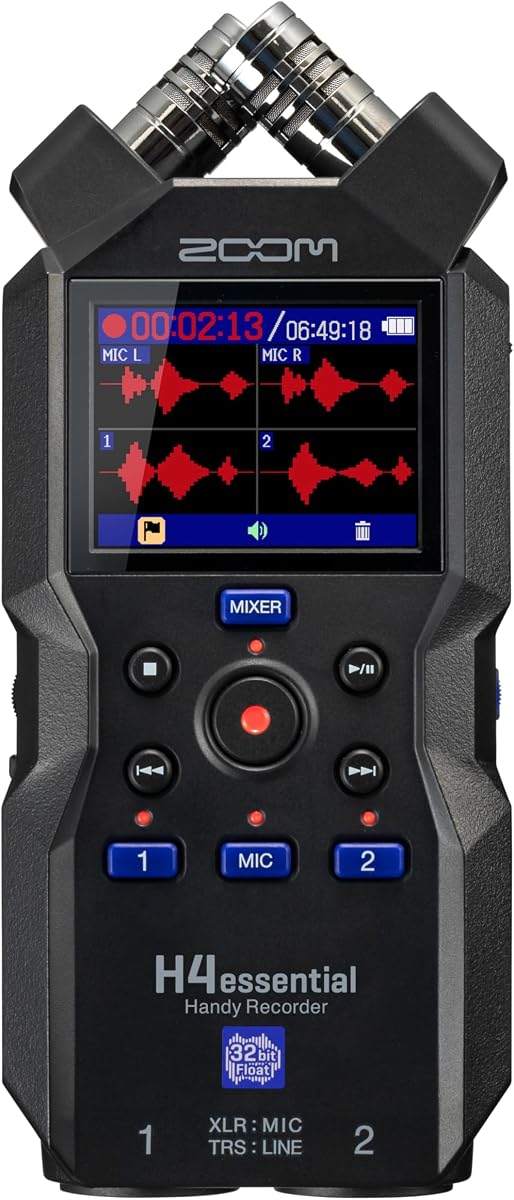
The Zoom H4 Essential is a four-track handheld recorder designed to serve musicians, podcasters, filmmakers, and field recordists. Its 4.4 rating and broad range of supported sources make it a practical all-purpose recorder. The built-in stereo microphones can capture environmental sound, while two XLR/TRS inputs accept external microphones, instruments, mixers, or soundboards.
We may earn a commission when you buy through this link, at no additional cost to you.
The supplied features emphasize dependable capture and easy navigation. The device records to an SD card for local backup and connects through USB-C to a phone, tablet, or computer for recording or streaming. Spoken menu guidance is a thoughtful accessibility feature, particularly for visually impaired users, and may also make the interface less intimidating to new recordists.
Its core compromise is capacity. Four tracks are enough for a musician layering a few parts, a two-person interview, or a small location setup, but not for a large ensemble recording many sources simultaneously. It is also not primarily a touchscreen song-arranging system, so complex editing will likely require a computer or another production device.
The H4 Essential is best for creators who value a single recorder that can move between an interview, a rehearsal, a video shoot, and a spontaneous musical idea. It is especially attractive when the goal is flexible source capture, solid handheld portability, and the ability to save locally while also working with a computer.
The H4 Essential can handle songs, conversations, video audio, and field recordings. That broad compatibility makes it useful for creators whose projects vary and who would rather own one portable unit than separate recorders for each task.
Recording directly to an SD card creates a useful local record, while USB-C provides a route to a phone, tablet, or computer. This flexibility helps users balance standalone reliability with connected editing or streaming.
We may earn a commission when you buy through this link, at no additional cost to you.
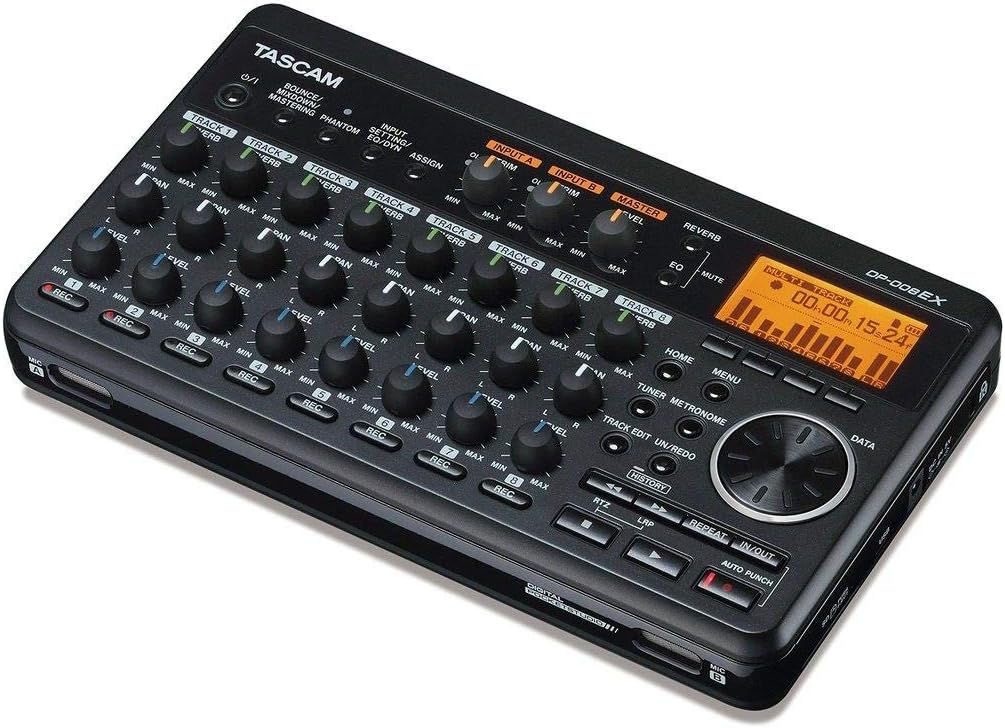
The TASCAM DP-008EX is an eight-track Pocketstudio recorder built for songwriters who want to create away from a fixed studio. It has the highest supplied rating in the list at 4.6, and its defining features—built-in microphones, songwriting tools, and battery operation—position it as a self-contained device for drafting ideas and layering parts.
We may earn a commission when you buy through this link, at no additional cost to you.
Having microphones built in removes the first barrier to recording. A songwriter can capture a vocal, an acoustic instrument, or a room idea immediately and then use the multitrack capacity to build a fuller arrangement. The battery-powered format supports rehearsals, living-room sessions, and other locations where access to mains power would be inconvenient.
The available product data does not detail the exact input connectors, preamp specifications, storage format, or effects, so it would be inappropriate to infer those details. The listing also includes package dimensions, weight, quantity, and product-type information rather than a rich technical description. Buyers should therefore consult the current product documentation to confirm that its physical connections meet their recording plan.
The DP-008EX is best for songwriters, educators, and mobile musicians who want an eight-track creative surface with integrated microphones. Its strong 4.6 rating and clearly stated songwriting focus make it a compelling selection, provided the user does not require numerous external inputs or a fully specified computer-connected workflow.
Built-in microphones make the DP-008EX approachable for immediate idea capture. A creator can record vocals, acoustic instruments, or environmental sound before investing time in external microphones and cabling.
Eight tracks give songwriters room to develop an arrangement across multiple passes. Combined with dedicated songwriting features and battery operation, the format is well suited to portable drafting and rehearsal.
We may earn a commission when you buy through this link, at no additional cost to you.
The Zoom LiveTrak L-8 combines an eight-channel mixer with a multitrack recorder capable of capturing 12 tracks simultaneously at 24-bit/96kHz. Its 4.5 rating reflects a capable hybrid design for bands, podcasters, streamers, and studio sessions. The supplied information also highlights six preamps, a -121dBu noise floor, up to +54dB gain, and per-channel effects.
We may earn a commission when you buy through this link, at no additional cost to you.
Monitoring is a major strength. Four headphone outputs and three independent monitor mixes let performers hear different combinations of the mix, which is valuable during a rehearsal, remote podcast, or live performance. The recorder can write directly to an SD card and a connected computer at the same time, creating a local backup while also supporting a computer workflow.
Its limitations come from the compact mixer design. The L-8 records 12 simultaneous tracks, but it has fewer channels than the L6max in this guide. A larger session may also demand careful gain staging and channel allocation, since the physical input count is below the 12-channel total used for the complete mix.
This is a strong choice for a small band that wants to control its own monitor mix, as well as for podcasters who need more channels than a basic four-track recorder. It combines transport, mixing, recording, and monitoring in one portable unit, making it especially useful for rehearsals and sessions where reducing equipment is valuable.
Four independently controlled headphone outputs give each musician or speaker a personal monitor level. Three custom mixes make it possible to offer different blends to different people without requiring separate headphone amplifiers.
Simultaneous SD-card and USB recording provides both standalone capture and a connected-computer record. That redundancy is useful for rehearsals, podcasts, and sessions where preserving every take matters.
We may earn a commission when you buy through this link, at no additional cost to you.
The TASCAM DR-70D is a compact four-channel recorder designed around production sound for filmmakers, television producers, advertisers, and documentarians. Its 4.5 rating and four balanced XLR inputs make it a natural fit for crews recording dialogue and other location audio with multiple wired sources.
We may earn a commission when you buy through this link, at no additional cost to you.
The supplied specifications show careful attention to location reliability. HDDA microphone preamps provide 64dB of gain for quiet performances, each of the four inputs has individual gain control, and a limiter and high-pass filter help keep levels under control. Dual Recording mode creates a safety copy at a lower level, reducing the risk that an unexpected spike will ruin a take.
Physical placement is another strength. The compact unit can be mounted above or below a camera, while two internal microphones offer a stereo capture option. SD, SDHC, and SDXC media are supported, with cards up to 128GB listed as compatible, offering more headroom for extended production days.
The DR-70D is best for video crews, documentary teams, and location sound professionals who need more inputs than a stereo field recorder. It is less focused on built-in music mixing or instrument effects, but for its target work it provides a specialized and practical four-channel capture solution.
Dual Recording captures a second copy at a lower level while the primary track continues. The safety track is there to protect the session if the main recording encounters a sudden high level.
The ability to mount the DR-70D above or below a camera keeps production sound close to the camera position. Two internal microphones add a quick stereo option when external microphones are not required.
We may earn a commission when you buy through this link, at no additional cost to you.
The Zoom PodTrak P4 is a purpose-built podcast and interview recorder with four XLR microphone inputs, four headphone outputs, sound pads, and remote-call support. It has the highest supplied rating at 4.7, and its feature set addresses common production demands more directly than a general-purpose music recorder.
We may earn a commission when you buy through this link, at no additional cost to you.
Automatic Mix-Minus is particularly important for remote interviews. It allows a call participant to hear the program feed without hearing their own voice returned through the connection, preventing an echo loop. A TRRS jack and USB Audio Interface mode expand the ways a phone or computer guest can join, while the four sound pads can trigger music, jingles, or effects during a program.
The tradeoff is specialization. Four XLR inputs are ample for a typical panel discussion, but the device is not designed to replace a larger multichannel music console. Its supplied features also emphasize podcast production rather than a broad set of channel-strip effects or instrument-oriented tools.
The P4 is best for podcasters, remote interviewers, small panels, and producers who want dedicated monitoring and call-handling features. It also suits creators who want multitrack capture of microphones and sound pads in a portable, battery-powered package.
Automatic Mix-Minus manages the feedback path when a caller is connected by phone. This focused podcast feature prevents a guest from hearing their own voice echoed through the program output.
Four programmable pads give producers immediate access to samples, music beds, or effects. Recording the pads as multitrack alongside microphone inputs preserves performance elements for later mixing.
We may earn a commission when you buy through this link, at no additional cost to you.
The Zoom LiveTrak L6max is a feature-rich portable mixer and recorder for musicians and podcasters. Its 4.5 rating, 12-channel mixer layout, and capacity to capture 14 tracks simultaneously place it among the most capable units in this guide. Four combo inputs with Hi-Z support and eight line inputs cover a broad range of instruments, microphones, and playback sources.
We may earn a commission when you buy through this link, at no additional cost to you.
The standout technology is dual AD conversion on channels 1 through 4, which is designed to capture clip-free audio across extreme dynamics. Real-time AI reduction can remove hum, hiss, and background noise while preserving voice and instrument detail. For live electronic work, sound pads can trigger samples, jingles, and effects while staying synchronized to a MIDI clock.
Its complexity is the main consideration. More channels and signal paths can make gain staging and device setup more demanding, particularly for first-time recordists. Users must also provide suitable storage because the device records to SD cards, and the supplied 2TB support is a capacity statement rather than an included accessory.
The L6max is best for mobile musicians, podcasters, and live performers who need more than a basic recorder but prefer one portable mixer/recorder rather than a separate console and capture unit. Flexible power through AA batteries, USB bus power, or a mobile battery pack also makes it suitable for locations without dependable mains electricity.
Dual AD converters on the first four channels are designed to preserve detail when levels vary widely. That makes the L6max attractive to users recording quiet acoustic sources and louder amplified instruments in the same session.
AA batteries, USB bus power, and mobile battery-pack support create several ways to operate away from a wall outlet. The result is a portable mixer/recorder that can support rehearsals, field podcasts, and mobile performances.
We may earn a commission when you buy through this link, at no additional cost to you.
A useful purchase decision depends on the number of sources you need to record, how you will monitor them, and whether the device must support music, interviews, video sound, or live performance. Use the following factors to match the recorder to the actual job rather than choosing only by track count.
Track capacity and simultaneous input count are related but not identical. A recorder may offer many virtual or project tracks while accepting only two or four sources at once. Songwriters layering one instrument at a time may need only a few tracks, whereas a band, panel discussion, or film scene can benefit from four to eight simultaneous recordings. The Zoom R20 supports up to 16 tracks and eight simultaneous tracks, while the L6max can capture 14 tracks and the LiveTrak L-8 supports 12.
Choose enough simultaneous inputs to cover the performers present, then consider whether you need extra room for overdubs. A larger project capacity is useful for arrangement, but it cannot compensate for a device that lacks enough physical inputs for the initial session.
XLR, TRS, Hi-Z, and line connections determine which microphones and instruments can be used. XLR/TRS combo inputs are versatile for microphones and line-level equipment, while Hi-Z support allows a guitar or bass to be connected directly. The R12 includes Hi-Z on input 1, and the L6max lists Hi-Z across its four combo inputs. USB and phone connections add another layer of flexibility for podcasts and computer-based production.
Match connectors to the equipment already owned. Count microphones, instruments, adapters, cables, and monitoring needs before choosing, and verify whether a separate interface or DI box will be required.
Integrated microphones make a recorder useful the moment it leaves the box. The R4, H4 Essential, BR-80, and DP-008EX all include built-in microphones for reference recordings, interviews, rehearsals, or environmental sound. They are particularly useful for creators who record ideas spontaneously and may not always have an external microphone available.
Built-in microphones are a convenience, not a substitute for a carefully chosen external microphone in demanding production work. Treat them as a fast-start feature and evaluate connector flexibility for polished results.
A portable recorder becomes more valuable when it can shape a session without a computer. Touchscreen models such as the R12 and R20 provide visual editing, track arrangement, looping, EQ, compression, and mixing controls directly on the device. That can be valuable in locations where carrying a laptop is inconvenient or impractical.
Standalone editing is not equally deep across the category. If detailed arrangement and mixing are priorities, favor a device with a large project interface. If the main goal is accurate capture, a simpler recorder with strong preamps and dependable storage may serve better.
Recording and monitoring are separate requirements, particularly for bands and podcasts. The PodTrak P4 provides four individually controlled headphone outputs, and the L-8 adds three custom monitor mixes. The L6max includes a broad mixer layout and MIDI-synchronized pads for live electronic use. These features help performers hear the sources they need without relying on separate monitor equipment.
Look for the number of headphone outputs, independent level controls, and custom mix buses. A single shared headphone output may be adequate for solo recording, but it is rarely enough for a group rehearsal or multi-person interview.
The storage system determines how long a session can last and where files can be transferred. The BR-80 records to SD or SDHC media, the DR-70D supports SD, SDHC, and SDXC cards, and the L6max lists SD card support up to 2TB. The H4 Essential can save directly to an SD card while also connecting through USB-C, and the L-8 can record to an SD card and a computer simultaneously.
Check card format, maximum capacity, and whether the package includes media. For important sessions, maintain a separate backup and confirm the device's file organization before the first take.
Portable power matters when the recorder leaves the studio. The R12 is specified to run for up to five hours on four AA batteries, the PodTrak P4 for up to 3.5 hours on two AA batteries, and the L6max can use AA batteries, USB bus power, or a mobile battery pack. Other products emphasize battery operation without supplying a runtime in the available data.
Consider battery type, expected session length, charging logistics, and access to outlets. A compact body also matters, but a tabletop mixer with many channels may be more portable in practice than a smaller unit that the user must operate awkwardly in the field.
Specialized features can be more valuable than a higher general track count. The PodTrak P4 offers automatic Mix-Minus for remote interviews, the DR-70D includes dual recording and camera-friendly mounting, and the BR-80 provides phrase-training tools. The R12 and R20 emphasize music creation with drum loops and synth sounds, while the LiveTrak models focus on live mixing and monitoring.
Prioritize the features that remove friction from your normal work. A feature that supports your most common session is more valuable than a larger specification that will remain unused, so identify the creator type before finalizing the purchase.
Before the first important session, format a compatible storage card, confirm the intended file type and sample rate, and test every microphone or instrument connection. Set gain conservatively, listen with headphones, and leave adequate headroom. A short test recording is the safest way to verify channel routing, storage behavior, monitoring levels, and backup procedures before musicians or speakers begin.
During recording, place microphones according to the sound rather than simply as close to the source as possible, watch individual channel levels, and avoid repeated gain changes within a take. For interview work, test Mix-Minus and remote-call routing in advance. For music and live sessions, use custom monitor mixes to give each performer an appropriate blend without compromising the main recording level.
After the session, save files in an organized folder structure, copy the originals to a second storage location, and do not format the card until the important files have been verified. Keep the recorder away from moisture, excessive heat, and impact, use compatible batteries or power supplies, and clean connectors gently. For touchscreen models, a protective case can reduce accidental damage during transport.
Track count refers to how many recorded or project tracks a device can organize, while simultaneous recording describes how many sources can be captured at the same moment. A recorder might hold many tracks but have only two physical inputs, making it better for overdubbing than for recording a full band in one pass. Check both figures against the way you intend to work.
It can replace a computer for many focused capture and editing tasks, especially when the device offers touchscreen arrangement, effects, and mixing. The R12 and R20 are designed for substantial standalone music work, while simpler recorders may only capture tracks and require a computer for detailed editing. The best choice depends on how much post-production control you need away from the device.
The LiveTrak L-8 and L6max are the strongest fits in this list because they combine multitrack recording with a larger mixer layout and multi-person headphone monitoring. The R20 is another option when touchscreen editing and six XLR inputs matter more than live mixing. Choose based on the number of performers, required inputs, and whether the session will be mixed live.
Prioritize XLR microphone inputs, independent headphone outputs, clean preamps, and simple routing. The PodTrak P4 stands out for four XLR inputs, four headphone outputs, sound pads, and automatic Mix-Minus for phone interviews. Make sure the number of outputs matches the number of speakers and confirm how remote participants will connect before recording.
Built-in microphones are useful for reference, ambient sound, and fast location capture, but external microphones usually provide better isolation and control. The DR-70D combines two internal microphones with four balanced XLR inputs and a compact camera-mountable design, allowing a crew to use dedicated microphones while retaining a quick stereo option.
Hi-Z inputs are designed to handle instrument-level signals directly and can avoid needing a separate DI box. The R12 lists a Hi-Z switch on input 1, while the L6max provides Hi-Z across four combo inputs. If your sessions rely on electric instruments, verify this feature or confirm that you already own an appropriate DI.
The required capacity depends on track count, sample rate, bit depth, and session length. Check the recorder's supported card format and maximum capacity, then estimate storage for the full planned session rather than only the final mix. Bringing an additional compatible card and a separate backup drive is wise for important recordings.
The H4 Essential is explicitly handheld and supports four-track capture with built-in microphones, external inputs, SD recording, and USB-C connectivity. Smaller control surfaces may also be easier to carry, but the H4 Essential is the clearest field-oriented option among the listed products. Actual comfort depends on the accessories and monitoring setup used.
The Zoom R12 is the most versatile pick for mobile song creation, combining eight tracks, touchscreen editing, rhythm instruments, USB control, and battery operation. The Zoom R4 offers a focused four-track approach with 32-bit float recording and a strong 4.5 rating, while the Zoom R20 leads the list for larger standalone projects with 16 tracks, six XLR inputs, and touchscreen mixing.
Other needs point toward specialized models. Choose the PodTrak P4 for remote interviews and podcast production, the DR-70D for camera-based production sound, the LiveTrak models for live mixing and personal monitoring, and a built-in-microphone recorder for rapid idea capture. The most important priorities are simultaneous input count, monitor flexibility, standalone editing, storage, and power method.
Ratings and specifications provide a useful starting point, but they do not replace checking the current listing, included accessories, and manual. Features, storage support, and prices can change, so confirm that the final model matches your microphones, instruments, software, and planned recording environment before purchasing.