
PRV AUDIO DSP 2.4X
4.7Editor score
Four independent outputs
Built-in display controls
Remote-trigger sequencer
Explore the best digital signal processor DSP for car audio, comparing Bluetooth control, crossover flexibility, channel capacity, EQ depth, and integration
A digital signal processor gives a car audio system the control needed for accurate crossovers, detailed equalization, time alignment, phase adjustment, and protection from unwanted distortion. The right DSP can transform an ordinary factory stereo or elevate a carefully planned multi-amplifier build, making the difference between simply loud music and precisely balanced sound.
This guide compares ten DSP processors according to their channel capacity, input options, crossover controls, equalizer depth, tuning interfaces, and integration features. It covers products suitable for factory-system upgrades, conventional four-channel builds, sophisticated eight-channel installations, and projects requiring remote app control or expanded signal routing.
Each review highlights the strongest use case for its featured processor, along with practical limitations to consider before installation. The top selections include versatile app-controlled models, an approachable four-channel option, and a premium processor for elaborate systems; as with all car electronics, prices and availability can change over time.
4.7Editor score
4.6Editor score

4.6Editor score
The table below compares all ten processors by their most important architecture and tuning features, making it easier to identify the right model for a factory upgrade, active-speaker build, or complex multi-amplifier installation.





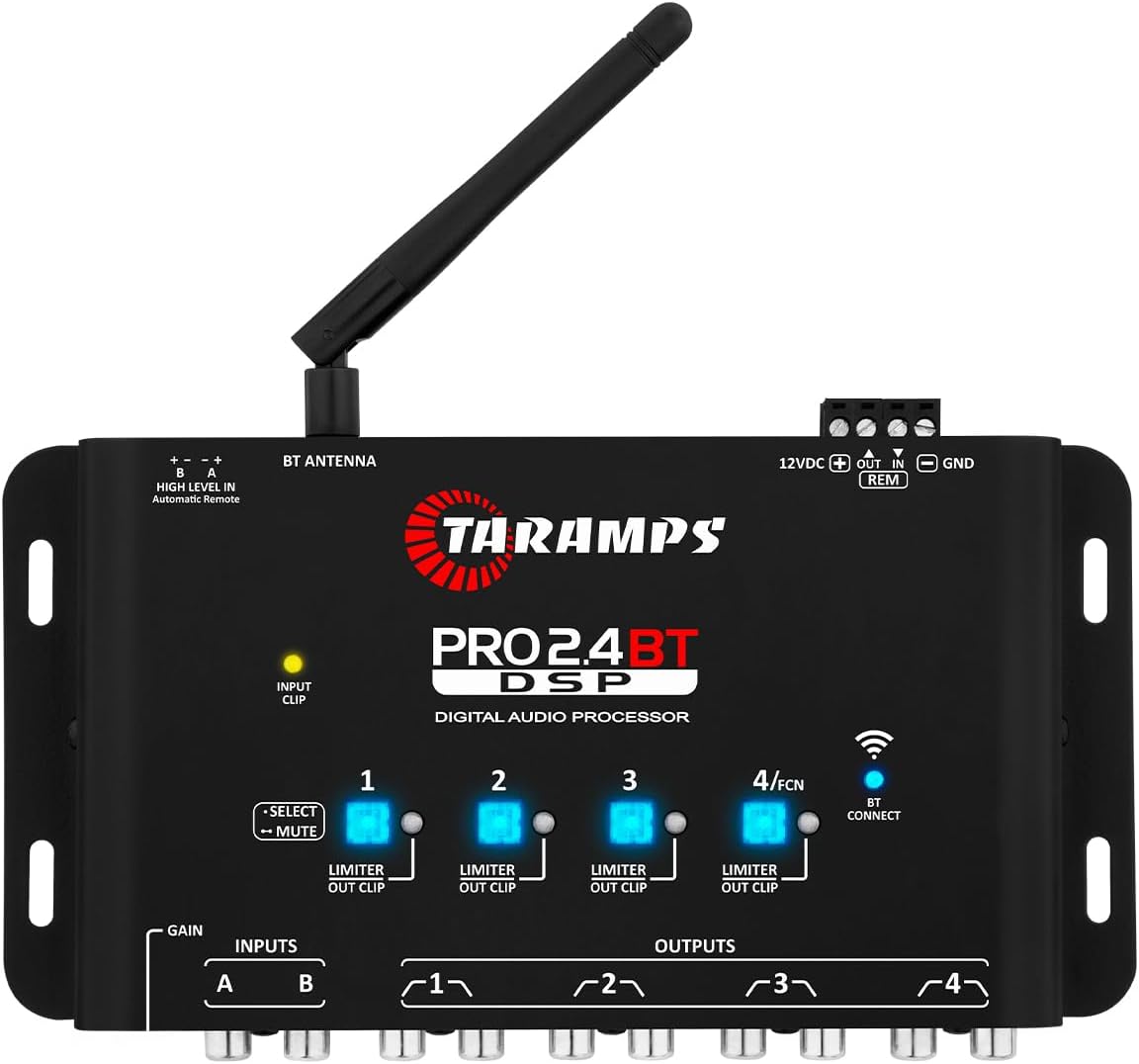
The Taramps PRO 2.4 BT is a strong all-around choice for drivers who want extensive tuning control without relying on a menu-driven front-panel display. Its 4.6 rating reflects a well-rounded feature set, and the standout combination of Bluetooth 5.4 BLE control, 24-bit/48kHz processing, four outputs, and flexible equalization makes it suitable for both factory upgrades and custom installations.
We may earn a commission when you buy through this link, at no additional cost to you.
The processor offers two inputs and four independently controlled outputs, along with a 15-band graphic EQ, parametric EQ, high-pass and low-pass filters, per-channel delay, phase inversion, and an adjustable limiter. RCA inputs can accept signals up to 9V RMS, while high-level input and automatic turn-on simplify connections to factory head units. The external Bluetooth antenna is also useful for maintaining a stable connection in a crowded installation.
Preset management is another practical strength. Taramps supports import and export of custom configurations through services such as WhatsApp, email, or AirDrop, with encryption applied to shared settings. That makes the processor easier to duplicate across multiple vehicles or request remote assistance without casually exposing a tuning file. The rugged housing and support for as many as four processors in the app further improve its appeal for multi-vehicle or multi-zone users.
The main constraint is its four-channel architecture. A system with front and rear doors, multiple subwoofers, tweeters, and additional amplifiers may eventually require more outputs or a larger DSP. Even so, the PRO 2.4 BT is an excellent recommendation for a typical enthusiast who values wireless tuning, factory compatibility, and a broad collection of professional correction tools in one accessible unit.
High-level input, automatic turn-on, and RCA options allow the DSP to serve both factory stereos and aftermarket head units. This flexibility reduces the likelihood that the processor will be limited by the source equipment, although careful grounding and signal-level checks remain essential.
Bluetooth app control allows equalizer, crossover, gain, delay, and limiter changes without repeatedly reaching the unit. Encrypted preset export and import also make it easier to save a proven tune, replicate it, or obtain assistance from an experienced installer.
We may earn a commission when you buy through this link, at no additional cost to you.
The PRV AUDIO DSP 2.4X delivers the highest customer rating in this collection at 4.7, combining a useful four-channel architecture with direct front-panel operation. It is a compelling value for anyone who wants meaningful crossover and equalization control but does not need a large output count or extensive wireless preset management.
We may earn a commission when you buy through this link, at no additional cost to you.
The processor accepts two audio inputs, labeled A and B, and provides four independent crossover outputs. Each output can draw from input A, input B, or both, offering more routing flexibility than a basic fixed processor. The 15-band graphic equalizer can be adjusted manually or selected from 12 presets, including Flat, Loudness, Bass Boost, Mid Bass, Treble Boost, Powerful, Electronic, Rock, Hip Hop, Pop, Vocal, and Pancadão.
For detailed correction, the description also identifies a one-input, one-output parametric equalizer with gain, frequency, and bandwidth adjustment. A 16-by-2-character LCD and intuitive interface allow real-time changes without a phone. The remote-trigger connection and sequencer function can operate other compatible products in sequence, which is particularly useful when an amplifier, accessory, or related system needs an automatic startup and shutdown order.
This DSP is best suited to a conventional four-speaker or simple multi-amplifier build where local control is preferable to app-based tuning. Its lack of stated Bluetooth connectivity is a drawback compared with several newer competitors, and installers should confirm signal-level and output-routing requirements before purchase. Even so, its strong rating, broad EQ choice, and flexible source selection make it a well-rounded budget pick.
A dedicated LCD and straightforward physical interface make the DSP approachable in the car, even when a phone is unavailable. Users can make real-time changes, while the 12 presets provide a convenient starting point for common listening preferences.
Choosing input A, input B, or a combined A-plus-B signal independently for each output supports different system arrangements. This is useful when one processor serves front and rear zones or when multiple sources need to be blended.
We may earn a commission when you buy through this link, at no additional cost to you.
The PRV AUDIO DSP 2.8X is the eight-channel counterpart to the highly rated 2.4X, carrying a 4.6 rating and the same direct-control approach. It makes sense for installers who need more outputs than a standard four-channel processor can provide, particularly when every speaker or amplifier section requires its own crossover and gain settings.
We may earn a commission when you buy through this link, at no additional cost to you.
Two inputs labeled A and B feed up to eight independently controlled outputs. As on the smaller PRV model, each output can select source A, source B, or both. The 15-band graphic equalizer supports manual adjustment and 12 built-in presets, while a parametric equalizer adds control over gain, target frequency, and bandwidth for more precise tonal and problem-solving work.
The 16-by-2-character LCD provides immediate feedback while the system is being tuned, which can be advantageous in a fixed installation where a phone or computer is not part of the setup. A remote trigger through the REM connection allows compatible products to be triggered sequentially, helping organize automatic startup and shutdown behavior across a larger system.
The DSP is not intended for minimal installations because eight outputs may be more than a simple door-speaker upgrade needs. Its physical size, cable requirements, and tuning complexity also call for more installation planning. Nevertheless, for an active system with separate front components, rear speakers, and dedicated subwoofer channels, the 2.8X offers a useful combination of output capacity, equalization, and source flexibility.
Eight independent outputs let separate amplifier sections receive different crossover, gain, and equalization settings. That is valuable in a multi-way front stage or when a subwoofer, rear speakers, and tweeters each need tailored control.
The 12 quick-select presets offer a convenient starting point, while manual and parametric equalization provide the control needed to refine the result. A sensible workflow is to establish the basic crossover first and then address tonal issues.
We may earn a commission when you buy through this link, at no additional cost to you.
The PRV AUDIO DSP 2.4X BT focuses on upgrading a vehicle that already has an OEM infotainment system. Its high-level input and built-in speaker-wire converter are especially relevant when the goal is to add external processing or amplifiers without replacing the factory head unit. The 3.7 rating is the lowest in this group, so buyers should pay particular attention to compatibility and app requirements.
We may earn a commission when you buy through this link, at no additional cost to you.
Two inputs, identified as A and B, feed four outputs with independent gain, crossover, and parametric equalization settings. The processor offers 21 high-pass and low-pass filter choices across Butterworth, Linkwitz-Riley, and Bessel responses. Per-output limiter, phase, and delay controls provide the tools needed to align a multi-speaker system and manage the transition between different frequency ranges.
One distinctive feature is the inclusion of crossover presets associated with PRV speakers, drivers, and tweeters. Those presets can simplify initial setup when the installation uses compatible PRV components, although crossover values should still be checked against the actual speaker specifications. A 16-by-2-character LCD supports local adjustment, and the product description also directs users to a smartphone app.
This model is a practical option for a factory-radio upgrade that needs high-level integration and detailed four-channel correction. Its lower rating should prompt buyers to check recent customer feedback, firmware or app compatibility, and the availability of functions they intend to use. If those details align with the installation, the extensive crossover choices and dedicated OEM path are meaningful advantages.
The high-level input and built-in speaker-wire converter create a direct path between factory audio and aftermarket processing or amplification. This makes it possible to modernize an OEM system while retaining its original controls and appearance.
With 21 filter configurations spread across three response families, the processor offers more crossover flexibility than many basic models. That control is valuable when matching different speaker types, but accurate speaker measurements and patient setup are more important than simply selecting the most aggressive filter.
We may earn a commission when you buy through this link, at no additional cost to you.
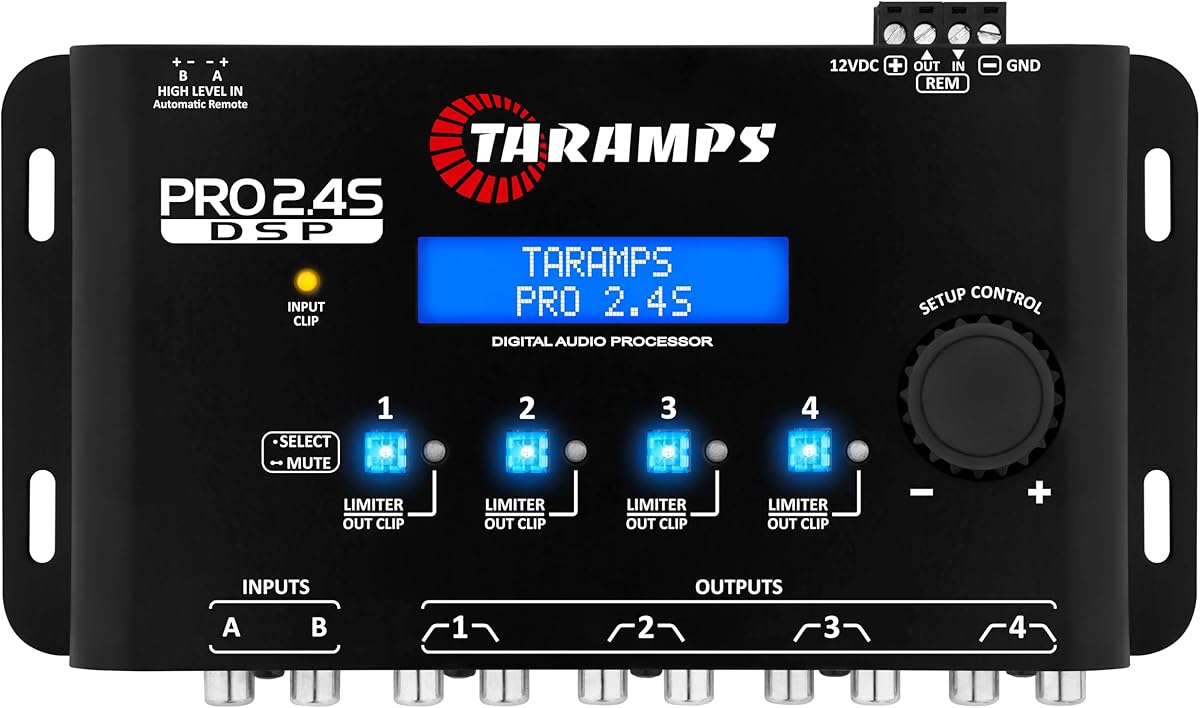
The Taramps PRO 2.4S is a compact four-channel processor built around the core functions most car audio installers need: crossover control, equalization, gain adjustment, delay, and limiting. Its 4.6 rating places it among the stronger models here, and its compatibility with both RCA and high-level inputs gives it broad relevance for factory upgrades and aftermarket builds.
We may earn a commission when you buy through this link, at no additional cost to you.
A 15-band graphic EQ is joined by parametric EQ and an active crossover, allowing different frequency ranges to be assigned to different speakers. HPF and LPF filters, multiple crossover slopes, and routing options provide the essential tools for separating bass, mids, and highs. Delay alignment is also included, helping improve imaging when speakers are mounted at different distances from the listening position.
System protection and usability receive attention through an integrated Anti-Pop System, clip indicators, and a limiter. The anti-pop feature can reduce unwanted turn-on or turn-off noise, while clip indicators help identify signal-level problems during setup. RCA and high-level inputs make it possible to integrate the unit with OEM stereos or aftermarket head units without changing the overall source architecture.
The principal limitation is the absence of stated Bluetooth app control, so tuning may require the processor's own interface or another supported control method. Its four-channel output count also makes it less suitable for an eight-way system without additional equipment. For a focused front-and-rear or compact active build, however, it provides an attractive balance of essential processing features and integration support.
Graphic EQ, parametric EQ, crossover filters, and delay provide a solid foundation for accurate system correction. These tools are enough to establish speaker boundaries, correct tonal imbalances, and improve the soundstage in a conventional four-channel installation.
The anti-pop system and clip indicators address two common installation concerns: distracting transients and signal saturation. They do not replace correct gain staging, but they make troubleshooting more transparent and help protect the amplifier and speakers.
We may earn a commission when you buy through this link, at no additional cost to you.
The Banda Audiopart X8AiR is the most specification-dense processor in this guide, combining 32-bit/96kHz processing, four inputs, eight outputs, a 79-band equalizer, Bluetooth, and app control. Its 4.6 rating indicates a well-regarded feature set, while the channel capacity makes it especially attractive to installers working on multi-amplifier, component-speaker, or dedicated-subwoofer systems.
We may earn a commission when you buy through this link, at no additional cost to you.
Each output channel receives 79 EQ bands, offering a far more granular approach to tonal shaping than a conventional 15-band graphic equalizer. The processor also includes adjustable crossovers, time alignment, phase control, and a peak limiter. This combination allows a builder to map out each part of the frequency spectrum, align speakers separated by different physical distances, and control the transition into bass-producing channels.
Bluetooth control through a dedicated mobile app covers EQ curves, crossover points, limiter settings, and channel gains in real time. That convenience is valuable during initial tuning because every change can be made without navigating a small built-in menu. With four inputs and eight outputs, the X8AiR can also serve systems involving multiple amplifiers, separate tweeters and midrange drivers, and subwoofers requiring different filtering or limiting.
This is not a processor for a simple four-speaker installation where basic tone control would be sufficient. Its extensive control surface creates more opportunities for error if the installer does not understand measurement, gain staging, and system design. For an enthusiast who intends to use the full eight-channel architecture, though, the X8AiR provides one of the most complete tuning packages in the comparison.
A 79-band equalizer gives each channel far finer control than a standard 15-band model. That resolution can help correct narrower spectral problems and shape each driver's contribution, provided the settings are supported by reliable measurements rather than repeated guesswork.
Four inputs and eight outputs create ample routing capacity for advanced installations. The processor is particularly relevant when tweeters, midrange drivers, rear channels, and subwoofers require separate gain, filtering, delay, or limiting treatment.
We may earn a commission when you buy through this link, at no additional cost to you.
The Taramps PRO 2.8S Black expands the brand's processing range to eight channels, making it suited to larger and more segmented car audio systems. Its 4.4 rating is slightly below the leading models, but the combination of independent outputs, RMS and peak limiters, precise timing tools, and broad filter range remains compelling for serious builds.
We may earn a commission when you buy through this link, at no additional cost to you.
Each of the eight outputs can be tuned independently, while the crossover filters cover 10Hz to 22kHz. A 15-band graphic equalizer, parametric adjustment, and 12 presets provide several levels of tonal control. Precise delay and phase settings help align speakers for improved imaging, clarity, and soundstage, a valuable capability in installations where drivers sit at very different distances from the listener.
The dynamic DSP mode provides adjustable RMS and peak limiters, allowing different limiting strategies to suit different sections of the system. RCA and high-level inputs with automatic turn-on support factory and aftermarket integration. This makes the processor useful both for adding external amplification to an OEM system and for routing a conventional aftermarket source into an advanced multi-channel architecture.
The product is best for installers who need more control channels than a four-output model but do not require the X8AiR's especially deep 79-band EQ or stated Bluetooth app control. As with any high-channel-count DSP, wiring complexity and setup time increase substantially. For the right system design, however, the PRO 2.8S provides precise control over every output and a strong selection of timing, filtering, and protection tools.
Separate RMS and peak limiter settings can be more appropriate for different kinds of signals and speaker loads. This flexibility helps the processor serve multiple zones while allowing each output to be protected according to its intended behavior.
Delay and phase controls are critical when different drivers are physically separated. Using them correctly can bring the apparent source position closer to the listening position and improve the coherence of the reproduced soundstage.
We may earn a commission when you buy through this link, at no additional cost to you.
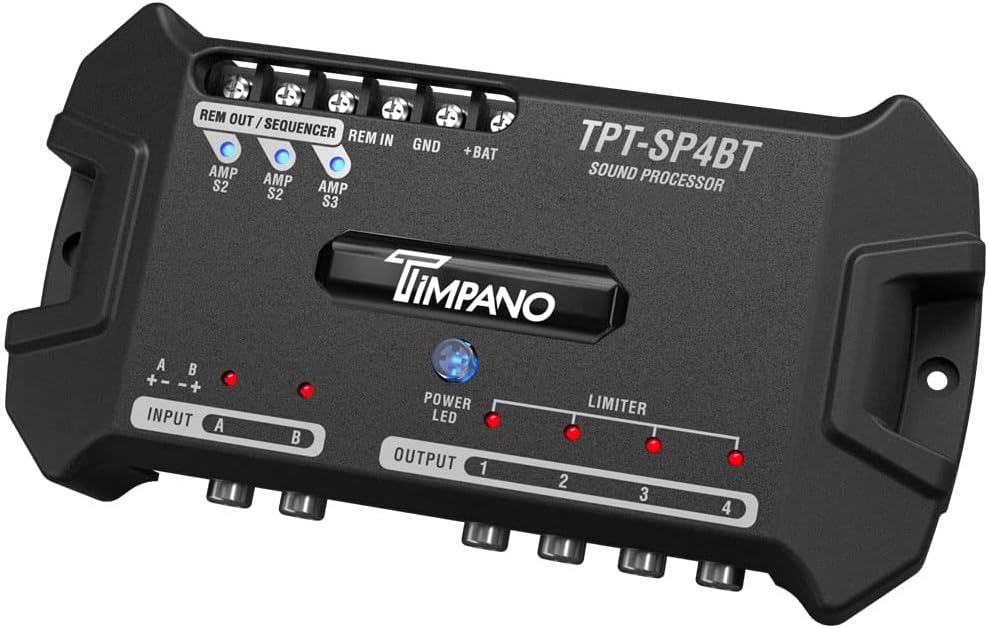
The Timpano TPT-SP4BT combines a compact four-output DSP with Bluetooth control and useful diagnostic features. Its 4.5 rating indicates a solid overall reception, and the built-in battery voltmeter, frequency generator, frequency sweep, and pink-noise tools distinguish it from processors focused primarily on equalization and crossover settings.
We may earn a commission when you buy through this link, at no additional cost to you.
The unit is configured remotely from a phone or tablet through the TIMPANO TPT-SP4BT app, which the product listing says is available through the Play Store and Apple Store. Users can modify equalization, crossover filters, alignment, gain, phase inversion, limiter behavior, and input/output routing in real time. This gives a compact processor a control interface that does not require navigating a crowded front panel in a difficult-to-reach installation location.
Its sequencer can control the programmed startup and shutdown of up to three products through S1, S2, and S3 remote-start connections. That is useful for coordinating amplifiers and other compatible equipment in a defined order. The built-in voltmeter gives a quick view of the vehicle's electrical state, while the test signals can assist with identifying resonances and evaluating a system's response during setup.
The TPT-SP4BT is most appropriate for a compact custom system that benefits from wireless tuning and diagnostics. Users should confirm current app compatibility and the availability of the desired control functions before installation. Its four outputs are sufficient for many conventional builds but not for a large eight-channel architecture. Within that scope, it offers a notably practical combination of remote operation, sequencing, and test tools.
A built-in voltmeter, frequency generator, sweep, and pink-noise source can simplify installation checks and tonal exploration. These tools help identify electrical changes, reveal problem frequencies, and evaluate corrections, although the results should still be interpreted carefully.
The three-device sequencer can organize remote-triggered equipment into a programmed startup and shutdown order. That automation creates a cleaner operating routine and reduces the need to control compatible components separately.
We may earn a commission when you buy through this link, at no additional cost to you.
The Dayton Audio DSP-408 is a highly flexible eight-output processor with four inputs, per-output parametric EQ, integrated crossover functions, time alignment, and input/output mixing. Its 4.0 rating is the second lowest in the featured group, so it may appeal most to buyers who prioritize broad routing and the ability to use the same processor in car or home installations.
We may earn a commission when you buy through this link, at no additional cost to you.
All eight output channels have a fully adjustable 10-band parametric equalizer, giving each driver or zone its own tonal correction. Built-in crossovers, time alignment, and mixing functions cover the central tasks required for multi-speaker installations. Real-time signal processing and a graphical user interface support system-specific configuration, while four inputs offer more source flexibility than a simple two-input model.
Remote control is less integrated than on several competitors. The processor supports an optional Bluetooth dongle for streaming and app control and also works with a wired remote. That modular approach may suit someone who does not want to pay for built-in wireless hardware, but it also requires an additional compatible accessory and careful compatibility checking.
The DSP-408 is most compelling for multi-room home audio, elaborate car builds, or installations that need many outputs and source combinations. Its relatively modest rating should encourage buyers to read current customer feedback and confirm that the software, remote accessories, and required control methods are supported for their platform. It remains a technically expansive choice with several functions that simpler four-channel processors do not provide.
Four inputs create opportunities for source mixing and more complex signal distribution. They can be particularly useful in a home theater or multi-zone car system where more than one source must remain available.
The stated support for both home and car audio makes the DSP-408 relevant to experimenters and installers who move between projects. Its eight outputs and ten-band parametric EQ per channel also suit installations that need more granular channel control.
We may earn a commission when you buy through this link, at no additional cost to you.
The Stetsom STX2448 FLOATING PRO is a feature-rich processor designed for installers who want extensive control and specialized operating modes. Its 4.4 rating reflects a capable overall package, while the floating mode, dual input-level adjustment, remote sequencer, subharmonic bass, and separate peak and RMS limiters distinguish it from more conventional DSPs.
We may earn a commission when you buy through this link, at no additional cost to you.
Floating mode allows the processor to be loaded with different audio streams and resources, expanding how the unit can be configured for various systems. It operates alongside a standard mode, giving the installer a choice between a familiar workflow and a more flexible architecture. The supplied remote sequencer, 15-band graphic equalizer, crossover functions, and subharmonic bass tool make it a broad platform for tuning and system control.
RCA and high-level inputs share input A and B, allowing the DSP to work with aftermarket head units and factory car stereos. Input level adjustment is available for both channels, and dedicated CLIP LEDs show when the incoming signal saturates. The improved encoder supports both rotation and click actions, providing a more tactile way to navigate device settings and make selections.
The processor is best suited to an installer who understands professional DSP workflows and can take advantage of its different modes. Buyers should verify how the floating architecture fits their planned system and whether every desired function is available in the required operating mode. With that caveat, the STX2448 is a compelling choice for projects that value flexible processing, diagnostics, and system automation.
Floating mode changes how streams and resources can be loaded, offering more possibilities than the standard workflow. It is most valuable when a complex installation needs a processing approach that cannot be handled as a simple fixed signal path.
Independent input-level adjustment helps integrate sources with different signal characteristics, while CLIP indicators show when saturation is occurring. The included remote sequencer, peak and RMS limiters, and tactile encoder add useful control and diagnostic features.
We may earn a commission when you buy through this link, at no additional cost to you.
A DSP should be selected around the design of the vehicle's audio system, not merely by the number of functions printed on the box. Channel count, signal type, crossover requirements, tuning method, and installation constraints will usually matter more than small differences in specifications.
Count the number of amplifier channels that need independent processing, not just the number of speakers visible in the vehicle. A four-channel DSP is often sufficient for front and rear door systems, while an eight-channel model is useful when separate tweeter, midrange, rear, and subwoofer channels each require their own gain, delay, filtering, or limiting. Extra outputs also provide room to grow, but they also add wiring, configuration, and tuning complexity.
Choose the lowest channel count that meets the completed design, unless future expansion is an explicit priority. More outputs are not automatically better if they create unused channels or tempt an installer to overcomplicate the signal path.
Factory systems usually require high-level speaker-wire input, while aftermarket head units normally offer low-level RCA connections. A processor with both can accommodate a broader range of vehicles, but installers should also check automatic turn-on behavior, input impedance, maximum signal level, grounding requirements, and whether a speaker-wire converter is built in. Correct input compatibility is essential for a clean, noise-free installation.
For a factory upgrade, verify that the processor can accept the head unit's output without requiring an additional converter. For an aftermarket build, confirm that the number of RCA inputs matches the available sources and that analog-to-digital conversion is unnecessary.
A useful crossover offers high-pass and low-pass filters with selectable slopes and at least one adjustable target frequency per output. The ability to set time alignment and phase alongside each filter is equally important because crossover transitions depend on how the drivers are mounted. Models offering multiple filter families, such as Butterworth, Linkwitz-Riley, and Bessel, provide more options, but they also demand a disciplined setup method.
Prioritize independent crossover settings for every output and make sure the manufacturer provides enough control to match the frequency range of the connected speakers. A large filter menu is less valuable without clear documentation and a repeatable tuning process.
A 15-band graphic EQ is common in car DSPs and provides a useful balance of broad tonal control and manageable setup. More bands, such as the 79-band option in the X8AiR, offer finer resolution but are best supported by accurate measurements. Parametric equalization is valuable when a specific frequency range needs targeted gain and bandwidth control. A collection of presets can accelerate initial setup, although presets should be treated as starting points rather than final corrections.
Choose deeper control when a complex system needs precise correction. For a straightforward upgrade, a 15-band graphic EQ with standard crossover functions may be easier to operate and less likely to encourage excessive correction.
Local controls with a readable LCD are convenient for permanent installations, while Bluetooth app control makes iterative tuning faster and allows settings to be managed remotely. Some processors include wireless functionality, some support an optional dongle, and others rely entirely on a wired connection. Check whether the relevant app supports the buyer's phone or tablet and whether essential functions are available in that app. A large feature list is less useful if the control software is difficult to access or maintain.
An encoder-and-display design can be ideal for a fixed installation, whereas app control is often more convenient in a temporary tuning environment. The best choice depends on where the DSP is mounted and who will operate it after installation.
Time alignment can compensate for speakers placed at different distances from the listener, while phase controls help maintain a coherent transition between drivers. Delay and phase should be adjusted together with crossover points, not as isolated tone controls. A limiter is also important because it can reduce overload and protect downstream components when the system is driven hard. Models offering both peak and RMS limiting provide more choices for different signal and speaker characteristics.
Do not select a DSP merely because it has a limiter; prioritize the adjustment range, monitoring indicators, and how the limiter integrates with each output. Correct gain staging remains the first defense against distortion.
Remote-trigger and sequencer functions can control compatible amplifiers and accessories in a defined startup or shutdown order. This is valuable for complex installations, particularly when a subwoofer amplifier should power on only after the source unit is active. A built-in battery voltmeter can also provide a quick electrical diagnostic, while CLIP indicators help reveal saturation. These features do not replace sound-quality analysis, but they simplify installation management and troubleshooting.
Confirm the number of remote outputs, trigger behavior, and compatibility with the equipment in the build. Extra automation is useful only if every connected component supports the intended control method.
A processor with dozens of filters, routing options, and operating modes can be impressive on paper while being difficult to configure correctly. More features increase the potential for a better result only when the installer understands signal flow, speaker behavior, and measurement. Simpler four-channel units are often more appropriate for standard door-speaker upgrades, while high-channel processors are justified for active systems, multi-amplifier layouts, and complex source routing.
Choose the most capable model that matches the design rather than the largest model available. A focused system with correctly set crossover points and sensible gain staging will usually outperform an overcomplicated installation with poorly coordinated settings.
Before installation, map the complete signal path from the head unit to each amplifier input. Identify every speaker, crossover point, gain target, delay requirement, and wiring connection. Mount the DSP in a protected, ventilated location where cables can reach it without being pinched, and keep it away from moisture, excessive heat, and moving parts. Confirm that the processor's input type matches the source before connecting anything.
Start with input gain, output gain, and basic routing, then set crossover points appropriate for each driver. Do not attempt aggressive equalization while signal levels are clipping or the amplifier gains are mismatched. After setting crossover boundaries, apply delay and phase in small, measured steps, followed by modest equalizer corrections. Save a baseline preset before making major changes so it can be restored if a later adjustment makes the result worse.
Use the available clip indicators, battery voltmeter, test tones, frequency sweeps, or pink noise only as part of a careful diagnostic process. Recheck the system at different listening positions and volumes, ensure all channels remain stable during bass-heavy playback, and confirm that limiters are not engaging constantly. Keep a written or digital record of the final settings, secure remote-control app access, and periodically inspect connections for corrosion, strain, or heat-related damage.
A DSP handles audio signals in software, allowing precise adjustment of crossover frequencies, equalization, gain, delay, phase, routing, and protection. It can separate frequency ranges for different speakers and correct system imbalances that a conventional amplifier or head-unit EQ cannot address as precisely. A DSP can therefore improve both the tonal balance and spatial coherence of a properly designed installation.
A DSP is not mandatory for every basic upgrade, but it becomes valuable as soon as the installation includes an amplifier, separate tweeters, a subwoofer, or more than one speaker type. It gives those components properly matched frequency ranges and a way to manage gain and protection. Even a straightforward four-channel processor can make an OEM-based system easier to tune and improve.
A four-channel DSP is usually better for a conventional front-and-rear system where each pair of speakers shares processing. An eight-channel DSP is more useful for active or multi-amplifier systems because every driver or amplifier section can have independent crossover, gain, delay, and limiter settings. The correct choice is determined by the number of independently controlled outputs in the finished design.
Many DSPs support high-level speaker-wire input specifically for factory systems, while RCA inputs are intended for low-level aftermarket sources. Check the processor specifications and make sure the connection method is appropriate for the vehicle. Power, grounding, remote turn-on behavior, and signal quality must also be handled correctly to avoid noise or unreliable operation.
A compatible DSP can improve a factory system by adding better crossover control, equalization, time alignment, and protection than the original head unit may provide. Results depend on the speakers, integration, and tuning quality; a processor cannot overcome severely compromised components or an unsuitable system design. It is most effective when the factory audio is retained but carefully augmented with processing and, when appropriate, external amplification.
Measurements provide the most reliable starting point because they reveal frequency response, alignment, and crossover behavior that may be difficult to judge consistently. You can then use listening to refine the result after correcting the objective problems. A process that combines measurements, proper gain staging, and careful listening is more dependable than relying on repeated equalizer adjustments by ear alone.
Bluetooth control is convenient but not essential to the underlying processing capability. A model with a readable local display may be easier to operate in a fixed installation, while an app-controlled unit can be tuned more quickly from a phone or tablet. Confirm app compatibility, available controls, and whether wireless features are built in or require an optional adapter.
Crossover filters separate the audio spectrum so each speaker receives the range it can reproduce efficiently. High-pass filters reduce low-frequency loading on midrange and tweeter drivers, while low-pass filters limit higher frequencies reaching subwoofers. Available responses may include Butterworth, Linkwitz-Riley, and Bessel, and the appropriate choice depends on the design goals, measurement approach, and system behavior.
The Taramps PRO 2.4 BT is the strongest all-around recommendation because it combines flexible four-channel processing, app-based control, high-level input, detailed crossover tools, and portable encrypted presets. The PRV AUDIO DSP 2.4X stands out as a value-focused four-channel model with direct controls and a 4.7 rating, while the Banda Audiopart X8AiR takes the premium position for its 32-bit/96kHz processing, 79-band equalization, and eight outputs.
Before buying, prioritize the processor that matches the finished system rather than the model with the largest feature list. Count independently controlled amplifier channels, confirm factory or aftermarket input compatibility, and ensure the crossover and equalization tools support the design. Delay, phase, limiting, routing, and remote sequencing should be considered alongside basic sound-shaping functions.
Prices and product availability can change, so compare current listings, warranty terms, included accessories, and software support before making a final purchase. Installation quality will influence the final result as much as the processor itself; correct grounding, signal routing, gain staging, crossover design, and patient tuning are what turn a capable digital signal processor into a better-sounding car audio system.