
Klipsch CDT-5650-C II
4.8Editor score
One-inch titanium tweeter
Controlled dispersion design
Single-speaker configuration
In-wall and ceiling speakers can deliver immersive sound without filling the room with visible equipment. A good model balances accurate sound, wide dispersion, attractive grilles, simple installation, and enough power handling for the intended room or system. The right choice depends heavily on whether it serves music, movies, or both.
This guide compares ten in-wall and ceiling speaker options using their published specifications, driver configurations, installation features, intended applications, and customer ratings. It covers single speakers, pairs, four-packs, and a complete five-speaker theater system, with particular attention to placement flexibility, grille design, and system compatibility.
The recommendations show how each option fits different priorities, from compact whole-home audio to full-range home cinema. Ratings and specifications can help narrow the field, but room dimensions, amplifier capability, wiring, and placement remain decisive. Product prices change frequently, so check current listings before purchasing.
4.8Editor score

4.7Editor score

4.7Editor score
As an Amazon Associate we earn from qualifying purchases.
The comparison below highlights each model's driver layout, scale, installation approach, and intended use, making it easier to match a speaker to a room, amplifier, and home-audio goal.



The Polk Audio RC80i is a versatile two-way in-ceiling speaker offered as a round white pair. It carries a 4.7 customer rating and stands out for its eight-inch Dynamic Balance woofer, aimable one-inch tweeter, and mineral-filled polymer cone. Those elements position it as a strong all-around option for music, movies, and distributed home audio.
We may earn a commission when you buy through this link, at no additional cost to you.
Its larger woofer is designed to provide depth and full-bodied output, while the pivoting tweeter can be aimed toward the main listening area. The supplied description highlights improved damping for both music and movies. A rubber seal helps prevent moisture from entering the speaker, making the RC80i suitable for bathrooms, kitchens, and covered porches as well as conventional indoor rooms.
Installation is presented as a three-step process, and the paintable aluminum grilles help the speakers blend into an existing ceiling. The main compromise is that it is a two-way design rather than a three-way model, so the woofer handles more of the frequency range than a dedicated midrange driver would. It is also a pair, which means buyers who need only one additional zone may have an unused speaker.
The RC80i is a strong recommendation for buyers who want one flexible model for several rooms or for a central home-theater installation. Its eight-inch driver, aimable high frequencies, moisture protection, and understated appearance make it especially versatile. Choose it when room-filling sound and flexible placement matter more than a three-driver array.
The eight-inch woofer supplies more cone area than smaller architectural speakers, while the aimable tweeter helps direct high frequencies toward listeners. This combination is particularly useful in living rooms, dining areas, and open-plan spaces where fixed ceiling positions are not directly in front of every seat.
A rubber seal helps keep moisture from leaking into the enclosure, giving the RC80i broader placement options than a basic indoor speaker. It remains important to follow the stated indoor/outdoor and covered-area guidance rather than exposing the unit to uncontrolled weather.
We may earn a commission when you buy through this link, at no additional cost to you.
The Micca M-8C is a single eight-inch two-way in-ceiling speaker with a 4.7 rating. It is designed for a wide range of home-audio uses, from background music to high-impact home theater. Its high-excursion poly woofer, pivoting one-inch silk dome tweeter, and 90 dB sensitivity make it a practical choice for many amplifier configurations.
We may earn a commission when you buy through this link, at no additional cost to you.
A six-decibel crossover network is used to integrate the woofer and tweeter through the upper midrange. Published specifications include a 40 Hz to 20 kHz frequency response, eight-ohm impedance, and 100 watts of power handling per speaker. The mounting tabs are designed to grip drywall or wood panels without additional brackets or boxes, simplifying the installation process.
The grille uses a rimed design that protrudes only slightly from the ceiling, and it can be painted to match the surrounding finish. That makes the M-8C appealing where visual discretion matters. Its principal limitation is that it is sold as one speaker; users expanding a home-theater or multi-room system will need to purchase multiple units.
This model works well for buyers building a system one zone or channel at a time. It also suits anyone who values a pivoting tweeter, straightforward mounting tabs, and a low-profile grille without needing a three-way design. For balanced music, background listening, and conventional surround-sound duties, the M-8C is an adaptable recommendation.
The published 90 dB sensitivity and eight-ohm impedance provide useful information when matching the speaker to an amplifier or receiver. A receiver with adequate power and clean speaker-wire connections should give the M-8C a practical foundation for either music or home theater.
The rimed grille stands only slightly proud of the ceiling and can be painted for a more integrated look. Integrated mounting tabs reduce the need for separate brackets, which can be valuable in retrofit projects where structural framing access is limited.
We may earn a commission when you buy through this link, at no additional cost to you.
The Polk Audio 70-RT is a three-way in-ceiling speaker built around a 7-inch subwoofer, a 2.5-inch midrange driver, and a 0.75-inch dome tweeter. Its 4.7 rating reflects a strong overall reception, while the published 34 Hz to 27,000 Hz frequency response indicates an ambitious full-range design for a ceiling-mounted loudspeaker.
We may earn a commission when you buy through this link, at no additional cost to you.
The separate driver bands can improve the division of labor within the speaker. A dedicated subwoofer handles low frequencies, the midrange driver supports voices and instruments, and the tweeter covers high frequencies. Polk's Dynamic Balance and Power Port technology are also cited as tools for broad coverage, deep bass, and reduced distortion around reflective ceiling surfaces.
Installation is a major strength. The speaker uses precision fit templates, a precision flange, an optional pre-construction bracket, and a patented rotating-camera system intended to secure the enclosure against vibration. The sheer grille is wafer thin and paintable, allowing the unit to disappear into the ceiling. The deeper, multi-driver enclosure may require more clearance than a compact coaxial model.
The 70-RT is an excellent candidate for home theater, especially for a ceiling-mounted center channel or for users who want full-range ceiling sound rather than an underspecified surround. It is also a credible high-performance music speaker when properly amplified. The main consideration is physical space and the effort required to integrate it cleanly during construction or renovation.
The three-way layout assigns distinct jobs to the subwoofer, midrange, and tweeter. That architecture is attractive when the ceiling speaker must carry music, dialogue, and effects without relying on a small woofer to reproduce the entire spectrum.
A rotating-camera mounting mechanism is intended to hold the speaker firmly against the ceiling and reduce vibration. The thin paintable grille improves the finished appearance, particularly when the speaker color is matched to the ceiling or trim.
We may earn a commission when you buy through this link, at no additional cost to you.
The Klipsch CDT-5650-C II is a single white in-ceiling speaker with a 4.8 customer rating, the highest listed rating in this group. Its defining published feature is a one-inch titanium tweeter, while its broader design centers on controlled dispersion technology suited to whole-house and integrated home-audio installations.
We may earn a commission when you buy through this link, at no additional cost to you.
Controlled dispersion is especially relevant when a speaker is mounted in a ceiling rather than directly in front of a listener. A more focused output pattern can reduce unwanted reflections and help direct sound into the room's listening area. This makes the model a logical candidate for a kitchen, family room, hallway, or other area where a conventional freestanding speaker would be inconvenient.
The available product information does not provide a complete driver list, impedance, sensitivity, cutout dimensions, or power-handling figures. That limits the depth of technical comparison with models that publish extensive specifications. Still, the titanium tweeter and controlled-dispersion focus identify the intended performance priorities clearly.
For buyers seeking a single premium architectural speaker with a particularly strong customer rating, the CDT-5650-C II is a persuasive choice. Confirm cutout dimensions, wiring requirements, and amplifier compatibility with the current manufacturer or listing before cutting a ceiling. Once those details are confirmed, it is a strong option for distributed audio and flexible placement.
Ceiling speakers often sit above and outside the ideal listening position. Controlled dispersion helps focus the output toward the room instead of allowing energy to spread indiscriminately, which can improve clarity and reduce the influence of nearby reflective surfaces.
The single-speaker format makes the model convenient for expanding a multi-room system one zone at a time. Its one-inch titanium tweeter also suggests an emphasis on clear high-frequency reproduction for music and intelligible dialogue.
We may earn a commission when you buy through this link, at no additional cost to you.
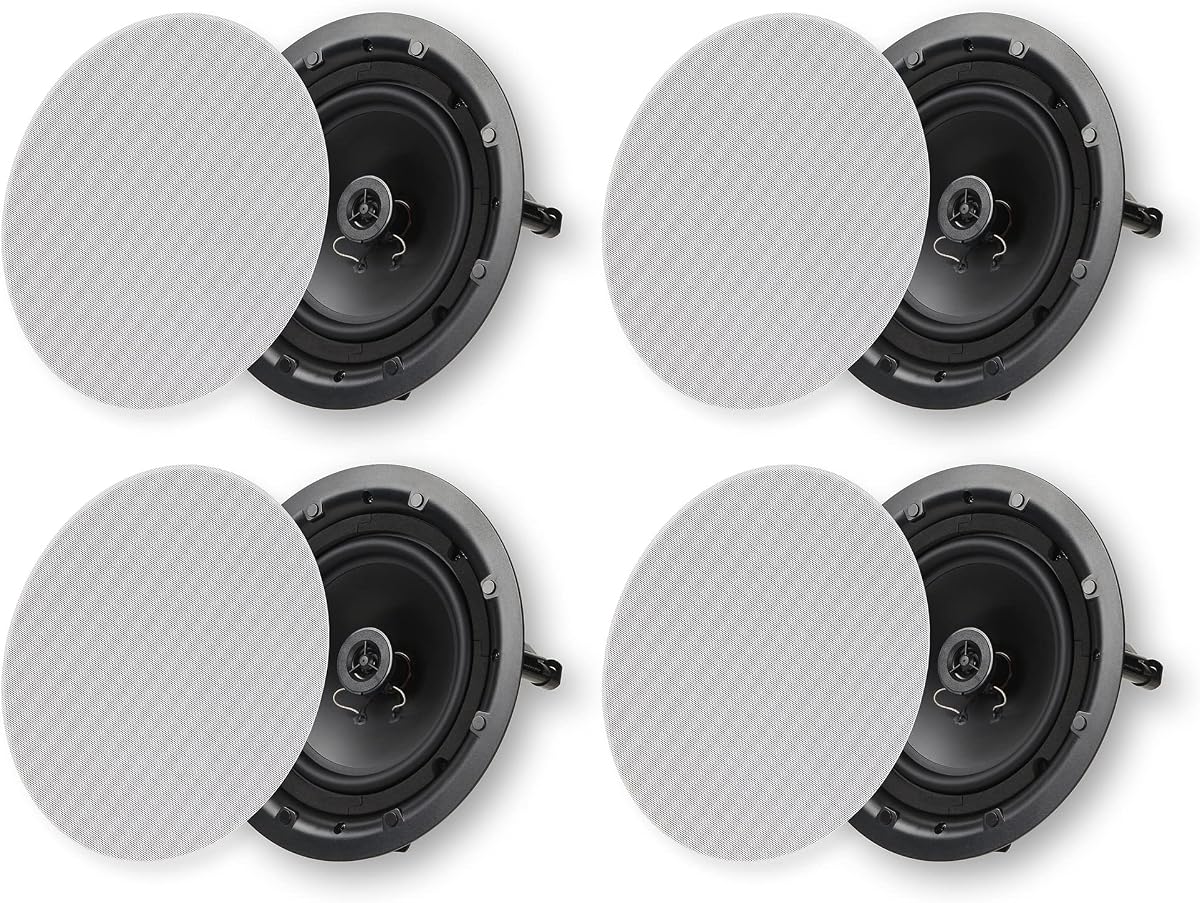
The Micca Architecture Series package includes four eight-inch two-way speakers designed for either in-ceiling or in-wall use. Its 4.5 rating is slightly lower than the leading products in the list, but the coordinated four-pack format offers a practical way to establish a consistent multi-room or surround-sound installation.
We may earn a commission when you buy through this link, at no additional cost to you.
Each speaker uses a polypropylene cone woofer with a rubber surround and a one-half-inch PEI dome tweeter. Published specifications include a 50 Hz to 20 kHz frequency response, six-ohm impedance, 87 dB sensitivity, and 80 watts of power handling per speaker. The stated vocal accuracy and wide dispersion are intended to create a large sweet spot and improve imaging.
One of the package's most useful design details is the rimless grille, which protrudes less than three-eighths of an inch from the wall. Built-in mounting tabs are designed to grip drywall or wood without separate brackets or backing boxes, and the instruction sheet includes installation and speaker-wire recommendations.
This four-pack is best suited to buyers who need several matching speakers rather than a single room unit. It can serve a four-speaker home theater, separate zones in a family room and kitchen, or a broader whole-home audio plan. If only one location needs coverage, the package offers less flexibility than buying individual speakers.
A four-pack simplifies the logistics of installing a surround system or several matching ceiling zones. Using the same model throughout can produce more consistent tonal character and take the guesswork out of matching separate grilles and driver combinations.
The rimless design sits almost flush with the ceiling or wall, reducing the visible projection created by conventional grilles. Paintability allows the remaining trim to be finished to match the surrounding surface for an integrated appearance.
We may earn a commission when you buy through this link, at no additional cost to you.
The Acoustic Audio by Goldwood CS-IC83 is a five-speaker home-theater system rated at 4.7. It includes five white three-way in-ceiling speakers, offering a more complete starting point than a single unit or pair and making it particularly relevant to dedicated theater construction.
We may earn a commission when you buy through this link, at no additional cost to you.
Each speaker combines an eight-inch high-rigidity poly cone woofer, a Poly Mica midrange, and a 13 mm soft-dome tweeter. Passive three-way crossovers are used to improve fidelity, with a stated frequency response of 40 Hz to 20 kHz and 95 dB sensitivity at eight ohms. The driver separation provides dedicated bandwidth for lows, mids, and highs across the system.
A pressure-lock mounting system is designed to clamp tightly to drywall, while spring-loaded raw-wire connections simplify wiring. The package includes five speakers, removable grilles, cutout templates, and an instruction manual. It is intended for passive operation from a home receiver or amplifier, and the guidance calls for CL3-rated in-wall wire.
The CS-IC83 appeals to home builders and theater enthusiasts who want a coordinated set without selecting each speaker separately. Its key trade-off is size: five units require five suitable ceiling locations, proper wiring, and sufficient amplifier output. It is a strong recommendation when the goal is a dedicated surround system rather than a single-room background audio installation.
The five matched speakers remove the need to assemble front, surround, and additional channels from separate product lines. That convenience is especially valuable during new construction, when cutouts, wiring, and grille selection are being planned as one project.
Because the speakers are passive, the receiver or amplifier must provide appropriate power and compatible raw-wire outputs. The stated guidance recommends no less than 10 and no more than 350 watts per channel, along with properly rated CL3 in-wall cable.
We may earn a commission when you buy through this link, at no additional cost to you.
The Klipsch R-1650-C four-pack includes four compact white in-ceiling speakers and carries a 4.6 rating. Each unit uses a 6.5-inch polymer-cone woofer and a coaxially mounted one-inch polymer-dome tweeter, combining multiple drivers in a package designed for straightforward installation.
We may earn a commission when you buy through this link, at no additional cost to you.
The coaxial tweeter distributes high frequencies over a wide area, which is useful in rooms where listeners move around or sit in different positions. A large motor structure and high sensitivity are cited as supporting strong acoustic performance. The mounting system is designed to make installation straightforward, while the paintable aluminum grille adds rust protection in moisture-prone spaces.
Published dimensions are 9.5 inches for the overall speaker and 8.3 inches for the cutout, making this a more compact option than many eight-inch models. The trade-off is reduced physical cone area, which can limit deep-bass output compared with larger woofers. It may also be less effective as a dedicated home-theater center channel when maximum low-frequency capability is the priority.
The four-pack is well suited to home and commercial distributed audio, as well as a surround system needing four matching units. Buyers should verify the compact dimensions against framing and ceiling-placement plans. For rooms where broad dispersion, modest visual impact, and a matched multi-speaker package are the central needs, the R-1650-C is a balanced recommendation.
The smaller enclosure can be easier to position around joists, recessed lights, ducts, and other ceiling obstacles. It may also be a better visual fit in smaller rooms where a large architectural speaker would draw more attention.
Mounting the tweeter at the center of the woofer produces a coherent point source. Its wide dispersion helps maintain useful output across listening positions, which is desirable for casual music listening and whole-room audio.
We may earn a commission when you buy through this link, at no additional cost to you.
The Klipsch R-5800-W II is a single white in-wall speaker with a 4.8 rating, tying for the highest rating in the group. Its driver system pairs an eight-inch Cerametallic cone woofer with a one-inch titanium dome compression driver mounted in a pivoting 90-by-60-degree Tractrix horn.
We may earn a commission when you buy through this link, at no additional cost to you.
Horn-loaded technology is intended to increase acoustic output while reducing distortion. The pivoting horn allows the high-frequency section to be directed toward the listening area, a particularly useful feature for in-wall speakers installed to the sides of a television or within an angled wall. The tweeter can be adjusted after the grille is removed and reinstalled.
Treble and midbass attenuation switches add further control over tonal balance. These can help a buyer account for reflective walls, nearby furnishings, or installation variables. The same eight-inch woofer and horn architecture also suggest substantial output potential, although detailed sensitivity, impedance, and power-handling data are not included in the supplied listing.
This model is a strong pick for a serious home theater or dedicated two-channel wall-mounted system where precise control matters. The principal challenge is planning: an in-wall speaker with an eight-inch driver and horn needs adequate cavity depth and space for wiring. Confirm current cutout and mounting specifications before beginning installation.
A conventional in-wall speaker is often installed within a wall plane and may fire past the primary seating area. The pivoting Tractrix horn corrects that geometry by directing treble toward the audience without relocating the enclosure itself.
Treble and midbass attenuation switches give installers a way to manage reflections and wall-induced tonal changes. The controls are most useful when the speaker must share space with windows, doors, cabinetry, or other surfaces that alter its perceived output.
We may earn a commission when you buy through this link, at no additional cost to you.
The Klipsch CDT-5800-C II is a single white in-ceiling speaker designed for outdoor or surround-sound use. It carries a 4.7 rating and shares important design themes with the CDT-5650-C II, including Controlled Dispersion Technology, horn-loaded construction, and switches for treble and midbass attenuation.
We may earn a commission when you buy through this link, at no additional cost to you.
Controlled dispersion gives the installer more influence over where sound travels, an important advantage in covered patios, exterior living spaces, and rooms with irregular seating. Horn loading can increase acoustic output while controlling distortion, while attenuation switches allow the output to be adjusted to the surrounding environment. These controls can make the speaker more adaptable than a basic fixed-response in-ceiling model.
The listing calls attention to outdoor use, but that should not be interpreted as permission for every exposed installation. Buyers should confirm the model's exact environmental rating, placement requirements, and recommended cover before installing it where rain, direct sunlight, or persistent moisture may reach the enclosure.
The CDT-5800-C II is a compelling recommendation for a covered outdoor audio zone or a flexible home-theater ceiling position. The primary reason to choose it over a conventional two-way model is its controlled, adjustable approach to high and mid frequencies. Verify cutout, depth, wiring, and weather-protection details before ordering.
Outdoor speakers face fewer nearby boundaries but often have widely dispersed audiences and substantial background noise. Controlled dispersion can focus output toward a patio seating area while limiting spill into adjacent spaces.
Treble and midbass attenuation lets an installer respond to hard surfaces, open-air acoustics, and nearby reflective materials. Fine-tuning these controls can be more useful in outdoor installations than relying on the same setting used for a conventional indoor room.
We may earn a commission when you buy through this link, at no additional cost to you.
The Yamaha NS-IW480C is a pair of eight-inch three-way in-wall speakers with a 4.6 rating. It combines an eight-inch polypropylene mica cone woofer with dual three-quarter-inch dome tweeters using Sound Max technology, creating a distinct three-way architecture within a wall-mounted enclosure.
We may earn a commission when you buy through this link, at no additional cost to you.
The high-frequency array can swivel to direct sound toward the listening position. Two small dome tweeters provide the top-frequency output while the main woofer handles lower frequencies, and the stated maximum input capability is 120 watts. Published mounting-depth information is provided, which is valuable because wall cavities must have adequate room behind the grille.
Because the NS-IW480C is a pair, it is particularly convenient for front left and right stereo channels, a two-channel listening system, or a pair of ceiling-height surrounds. A matching wall pair should provide a more consistent stereo image than unrelated speakers selected independently. Its disadvantage is the larger cavity and more complex three-way arrangement compared with compact coaxial designs.
The Yamaha is a strong recommendation for buyers prioritizing a dedicated three-way driver layout, a matched factory pair, and adjustable high-frequency direction. Confirm the exact cutout size, depth, and compatible receiver or amplifier before construction. With proper placement and adequate cavity space, it can provide a strong combination of dialogue clarity, music detail, and home-theater presence.
A factory-matched pair is convenient for installations requiring symmetric left and right channels. Using the same model also helps maintain a consistent tonal signature, which is especially valuable when the speakers form the front stage of a music or cinema system.
The swiveling dual-tweeter assembly can be aimed after the grille is installed. This is useful when wall placement forces the speakers away from the ideal axis of the main listening area.
We may earn a commission when you buy through this link, at no additional cost to you.
The best in-wall or ceiling speaker is one that fits the room, matches the amplifier, and suits the type of listening you want. Driver configuration, dispersion, installation requirements, and package format should be considered alongside aesthetics.
A two-way model divides the frequency range between a woofer and a tweeter, making it simpler and often easier to fit within a standard wall or ceiling cavity. A three-way speaker adds a dedicated midrange driver, which can improve vocal and instrumental clarity while giving the woofer and tweeter narrower jobs. The Polk Audio 70-RT, Acoustic Audio CS-IC83, and Yamaha NS-IW480C illustrate the three-way approach, while the other models generally use coaxial or two-driver arrangements.
A larger cone can move more air and generally offers greater low-frequency potential, but it also requires a deeper cavity and may be harder to position around structural framing. Eight-inch drivers are common in the models reviewed, while the Klipsch R-1650-C uses a more compact 6.5-inch woofer. Published low-frequency figures are not directly comparable across every listing, so consider the driver size alongside room size and the need for deep bass.
Architectural speakers must project sound from positions that are rarely ideal. A pivoting or swiveling tweeter can direct high frequencies toward the main seating area, while controlled dispersion can reduce unwanted spill. The Micca M-8C, Klipsch R-5800-W II, and Yamaha NS-IW480C provide explicit directional adjustment, while the Klipsch CDT models emphasize controlled dispersion for room integration.
Architectural speakers are generally passive and draw power from a receiver or amplifier. Compare impedance, sensitivity, and recommended power with the amplifier's capabilities. For example, the Micca M-8C is eight ohms with 100-watt handling, the Micca Architecture model is six ohms with 80-watt handling, and the Acoustic Audio system calls for an amplifier delivering no less than 10 and no more than 350 watts per channel.
The visible grille is only one part of the installation. The cutout must match the enclosure, and the cavity must provide sufficient depth for the driver, bass reflex port, wiring, and mounting hardware. Some listings provide exact figures, such as the Micca M-8C's 9.4-inch cutout and 3.5-inch mounting depth. For the Yamaha, whose enclosure appears deeper, checking all dimensional requirements is especially important.
Paintable grilles help a speaker blend into the room, but projection and grille design affect the finished appearance. The Micca Architecture series uses a rimless grille that protrudes less than three-eighths of an inch, while the Polk Audio 70-RT uses a sheer wafer-thin grille. The Micca M-8C and Klipsch R-1650-C use rimed or compact designs, and the Acoustic Audio grilles are removable and paintable.
Bathrooms, kitchens, covered porches, and sunrooms can expose speakers to elevated humidity. The Polk Audio RC80i includes a rubber moisture seal and is described as suitable for indoor or covered outdoor use. The Klipsch R-1650-C's aluminum grille adds rust protection in moisture-prone areas. No model should be assumed safe for direct rain exposure without checking its official environmental specifications.
Buying a pair, four-pack, or five-speaker package can simplify system design and ensure matching grilles. The Polk RC80i and Yamaha NS-IW480C are pairs, the Micca Architecture and Klipsch R-1650-C are four-packs, and the Acoustic Audio CS-IC83 includes five speakers. Single-speaker options provide more incremental flexibility but require multiple purchases for a theater or multi-zone system.
Plan speaker placement before cutting any holes. Identify joists, wiring, pipes, ducts, recessed lighting, and other obstructions, then use the supplied template to confirm the cutout. Keep speakers away from corners when possible, and account for room acoustics, seating, listening height, and the direction in which the tweeter should face.
Connect each speaker to the intended amplifier channel using appropriately rated in-wall or in-ceiling cable. Maintain the correct polarity, secure the mounting mechanism, and test every speaker before applying trim or paint. Grilles can usually be painted after removal, but follow the manufacturer's instructions regarding coating type, thickness, and curing time.
For ongoing care, dust the grille gently with a soft, dry cloth and keep the speaker opening unobstructed. Do not push objects into the drivers or use damp cleaning liquids. Inspect the mounting stability and wiring connections periodically, especially in homes where temperature or humidity changes are pronounced.
They can be better when the goal is uncluttered décor, broad room coverage, or immersive home theater. Their performance still depends on placement, enclosure design, amplifier quality, and room acoustics. Freestanding speakers are easier to move and audition, while installed speakers disappear more completely into the room.
Only models that are specifically rated for the intended environment should be used outside. A covered porch may be suitable for certain moisture-resistant models, but direct rain, standing water, and severe temperature exposure require verified outdoor ratings. Check the manufacturer specifications and use an appropriate weatherproof installation method.
Many architectural speakers are passive and can be powered by a compatible home-theater receiver or multi-zone amplifier. Other systems may require external amplification or carefully chosen impedance-matching devices. Confirm the speaker impedance, power handling, sensitivity, and the amplifier's supported load before connecting anything.
No. A three-way design can provide more precise frequency division, but overall sound also depends on driver quality, enclosure design, room placement, and system matching. A well-positioned two-way model may sound more satisfying than a poorly placed three-way speaker.
A conventional home theater may use five speakers for front left, center, front right, and two surrounds, with additional channels for a larger layout. The Acoustic Audio CS-IC83 directly provides a five-speaker package. Actual channel count and layout should follow your receiver, room geometry, and viewing experience.
Many grilles in this roundup are described as paintable, including those on the Polk Audio, Micca, Klipsch, and Acoustic Audio models. Remove the grille carefully, use a compatible paint, and apply thin, even coats without blocking grille openings. Always follow the specific painting instructions for the model.
Yes, when the speaker provides a pivoting, swiveling, or aimable tweeter. Directing the high frequencies toward the main seats can improve clarity and reduce reflections from walls and furniture. In a multi-zone system, a broader controlled-dispersion model may be more suitable than manually aiming every speaker at one location.
Check the cutout dimensions, mounting depth, cavity clearance, grille projection, and room for wiring or plumbing. Identify the location of joists and electrical cables, and make sure the speaker can be supported securely. If the existing finish is already in place, patching and grille alignment are easier to plan before drilling.
The Polk Audio RC80i is the most versatile all-around recommendation, pairing an eight-inch woofer with an aimable tweeter, moisture seal, and paintable grilles. The Klipsch CDT-5650-C II stands out for controlled dispersion and a one-inch titanium tweeter, while the Micca M-8C offers a practical single-speaker format for flexible system building.
For larger projects, prioritize the driver architecture and installation constraints before choosing a package. The Acoustic Audio CS-IC83 supports a five-speaker theater build, the Micca and Klipsch four-packs simplify multi-room or surround installations, and the Yamaha pair fits a dedicated three-way stereo arrangement. Verify cutout dimensions, cavity depth, impedance, and amplifier requirements in every case.
Ratings provide a useful sense of customer reception, but they cannot reveal how a model will interact with your room. Review placement options, grille design, environmental suitability, and full electrical specifications before buying. Since prices and product availability can change, check the current listing and manufacturer guidance at the time of purchase.
