
Chessnut Air
4.4Editor score
Handcrafted wooden-look board
Full piece recognition
Online platform compatibility
Twenty-game onboard storage
Compare 10 electronic chess boards for learning, coaching, online play, portability, and family use, with expert buying guidance and recommendations for every
Electronic chess boards combine familiar physical pieces with computer coaching, move recognition, and guided practice. The best models make it easier for beginners to understand legal moves, give experienced players a credible AI opponent, and support regular human games at home. Useful features include LEDs, spoken guidance, puzzles, and online connectivity.
The products in this guide were compared using their stated engine strength, learning tools, coaching systems, piece recognition, connectivity, display, portability, and physical design. The list covers traditional talking computers, app-connected boards, a themed display set, and a compact model, giving shoppers a broad view without overlooking important differences.
Each review explains what distinguishes its board, who will benefit most, and where its feature set falls short. Ratings and specifications reflect the supplied product information, while practical trade-offs help clarify which board fits a child, beginner, traveling player, club member, or committed enthusiast. Market details can change.
4.4Editor score

4.4Editor score

4.3Editor score
The comparison below highlights the strongest differences among these electronic chess boards, including coaching, engine capability, online connectivity, display design, recognition, and portability.



The P6 Electronic Chess Board receives a 4.3 rating and offers one of the most approachable combinations of computer opponent, training mode, and physical move guidance in this guide. Its sensor board recognizes pieces on the squares, while colorful lights and voice announcements help a new player understand what the engine expects next.
We may earn a commission when you buy through this link, at no additional cost to you.
Three modes give the board flexibility. Training mode is designed for beginners and children, Match mode supports focused practice against the built-in engine, and Human mode lets two people play without the computer taking a side. The engine offers 18 levels and support up to 1700 ELO, making it suitable for developing players rather than only complete beginners.
The included 200 puzzles are one of its strongest learning features, while the question button provides hints and the voice system announces moves. Strong magnetic pieces are less likely to topple during energetic play, and the compact 12.6-by-12.13-inch footprint makes the set easier to move than a large tournament board. The limitation is that online connectivity is not listed among its features.
This is a strong choice for families wanting a self-contained chess tutor that does not require an account or companion device. The 1700 ELO ceiling and puzzle-led approach make it better for learning and recreational matches than for demanding training against very strong engines. For those priorities, it is a capable and approachable all-around board.
Training prompts, hints, spoken announcements, and 200 puzzles give learners several ways to engage with a position. The system is especially useful because it supports gradual practice instead of limiting the board to a single computer-versus-player function.
The stated dimensions, magnetic pieces, and included drawstring storage bags make the P6 practical for home, school, camping, or travel. It offers a smaller playing surface than some full-size electronic sets without giving up its training and two-player functions.
We may earn a commission when you buy through this link, at no additional cost to you.
ChessUp 2 holds a 4.4 rating and is the most connected product in this roundup. Built-in WiFi allows it to join online games on Chess.com and Lichess without requiring a phone or laptop during play, while the TouchSense pieces add another way to interact with the board and receive information about possible moves, mistakes, and blunders.
We may earn a commission when you buy through this link, at no additional cost to you.
Its defining advantage is adjustable AI assistance. A beginner can use illuminated squares for guidance, while an experienced player can turn hints off for a more serious contest. The companion app adds game review, progress tracking, and expert-led lessons whose material is shown simultaneously on the physical board, creating a coherent learning loop.
Study tools extend well beyond a standard computer opponent. Users can set up positions, test strategies, recreate famous games, examine openings, and work through tactical or endgame ideas. That flexibility gives ChessUp 2 considerable value for self-learners, families, and players who want one board to handle instruction, analysis, live online matches, and traditional chess.
The trade-off is a greater dependence on a modern connected ecosystem and companion-app workflow. A buyer who wants a simple talking computer may find the broader feature set unnecessary. Even so, ChessUp 2 is the clear choice for anyone who values wireless online play, adaptive coaching, and integrated lessons in a single physical set.
The board's built-in WiFi is a major convenience because opponents can receive their moves without a nearby phone or laptop. Support for both Chess.com and Lichess expands the available online community while retaining the tactile experience of real pieces.
Per-player assistance settings allow stronger participants to play without hints while beginners continue to receive guidance. This makes family matches more useful for mixed levels and gives teachers a way to adjust support during instruction.
We may earn a commission when you buy through this link, at no additional cost to you.
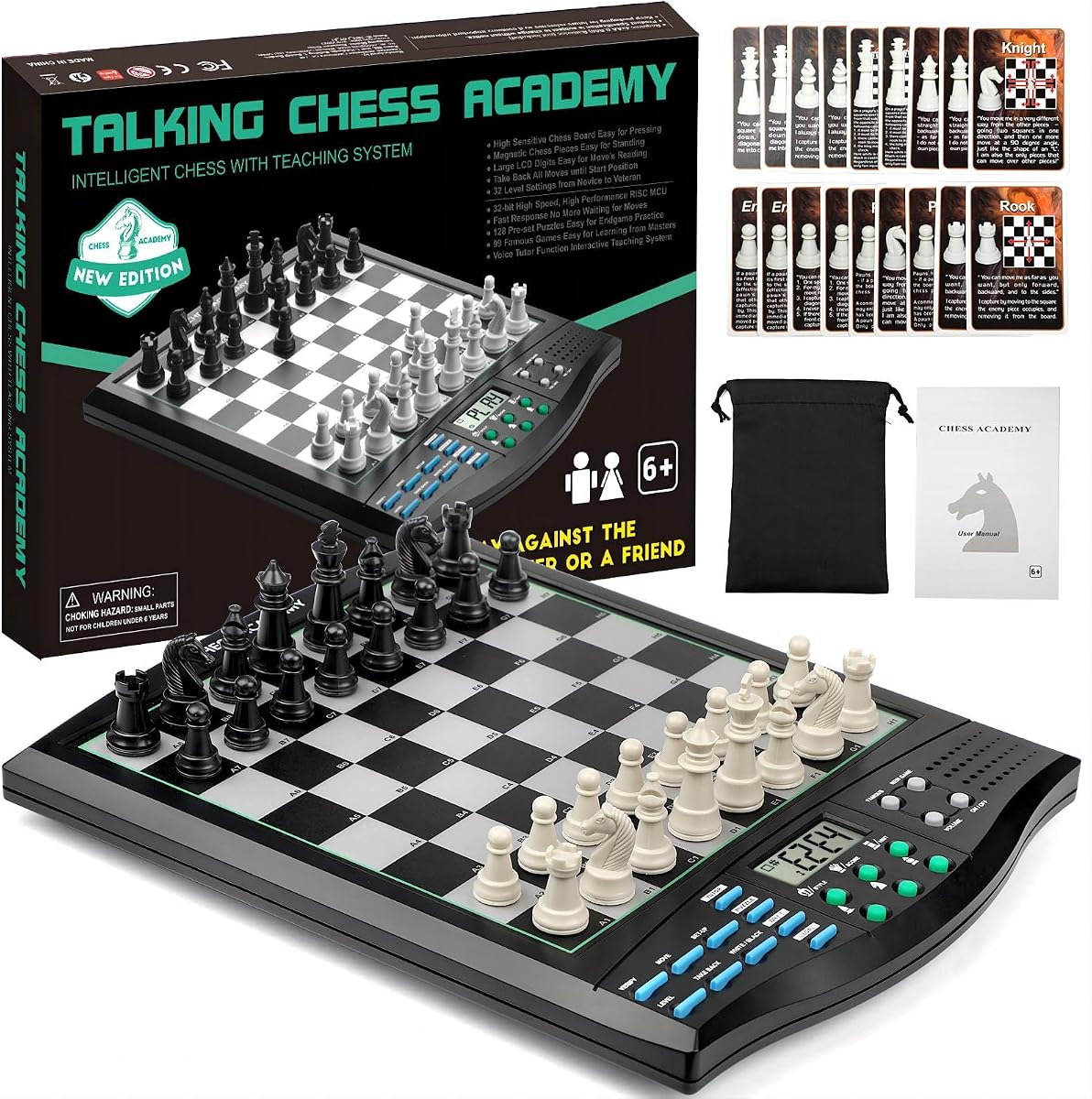
The Talking Chess Academy earns a 4.3 rating and emphasizes spoken instruction over app-based study. Its 32-bit processor delivers responsive computer play, while the interactive voice tutor identifies weak moves, mistakes, and threats. It also announces legal or illegal moves and can guide players through setup and position verification.
We may earn a commission when you buy through this link, at no additional cost to you.
The learning library is unusually broad for a straightforward electronic set. It includes 128 puzzles for endgames, 99 famous games, five mini-chess games for novices, and five fun difficulty levels. A hint function recommends a move, and the simple controls let players take back moves, swap sides, chase the computer's move, and adjust the sound volume.
Operation is refreshingly direct. Players register moves by pressing lightly on the sensitive squares, and large LCD digits make move coordinates easier to read. Magnetic pieces remain stable, while auto power-off and game-saving functions are useful for longer sessions. The simple and portable design also makes the set less intimidating for a child or an adult returning to chess.
There is no listed online connectivity, so buyers seeking live matches and cloud lessons would need another device or a different board. Even so, for a shopper focused on a complete offline tutor, the combination of voice coaching, puzzles, classic games, and an approachable interface is compelling. It is a particularly strong value for beginners and families.
The tutor goes beyond simply announcing a move. It can warn about poor choices, mistakes, and threats, giving learners immediate context for why a decision may be weak. That makes it useful during supervised practice as well as solo study.
A lightweight press on each square registers a move, and the large display reduces the need to interpret tiny characters. Takeback, side-swap, hint, and volume controls give young or inexperienced players the tools they need to recover from mistakes.
We may earn a commission when you buy through this link, at no additional cost to you.
This Advanced Electronic Chess Board has a 4.4 rating and stands out for its combination of a 2200-plus ELO engine, real-time voice coaching, large playing area, and particularly stable magnetic pieces. It is designed to serve beginners, improving players, and adults who want a computer opponent that can present a meaningful challenge.
We may earn a commission when you buy through this link, at no additional cost to you.
The voice coach provides immediate analysis of moves, identifies weaknesses, and suggests strategic ideas. A collection of 128 tactical puzzles and 256 classic game scores supports deeper study, while unlimited takebacks make it practical to examine mistakes or revisit lines without the usual move-limit restriction.
Physical design is unusually well considered. The board measures 14.6 inches diagonally, uses 1.22-by-1.22-inch squares, and includes a 2.36-inch king for easier visibility. The magnets are strong enough to keep pieces secure even when the board is inverted, and a four-digit black-and-white LCD shows coordinates and key information.
It is also designed for longer use and travel. EVA foam storage protects the set, AA battery power supports extended sessions, and auto-shutoff reduces unnecessary drain. The lack of stated online support is the principal compromise, but for offline training, classic study, voice analysis, and a challenging engine, this board is among the strongest choices here.
Larger squares and a taller king improve visual clarity, particularly for adults or anyone who finds standard small pieces uncomfortable. The expanded board also creates a more traditional playing feel without requiring a separate piece-detection surface.
Unlimited takebacks let a learner reconstruct earlier positions and investigate alternative decisions. Combined with tactical puzzles and classic scores, that flexibility makes the board useful for deliberate study rather than only quick matches.
We may earn a commission when you buy through this link, at no additional cost to you.
Chessnut Air receives a 4.4 rating and brings together full piece recognition, LED guidance, online play, game analysis, and a classic wooden-look appearance. Its 13-by-13-inch board is designed to look at home on a desk while remaining small enough for club rooms and travel.
We may earn a commission when you buy through this link, at no additional cost to you.
The board recognizes pieces across the position, and embedded LEDs show moves and game status without a separate screen. That physical feedback is especially useful during online play, where compatible apps and integrations transmit an opponent's move to the board so it can be replicated with real pieces.
Training features include adjustable AI difficulty, position review, and completed-game analysis through the Chessnut app. The over-the-board recording function stores up to 20 games for later review or export, adding value for players who want to study club matches, lessons, or games played against friends.
The visual design is one of its defining strengths. A durable plastic-and-wood board combines a classic appearance with hidden electronics, while the 2.7-inch king provides a comfortable sense of scale. The pieces are plastic sensor-chip pieces rather than wood, but the compromise produces a cohesive, portable set. For buyers who value appearance, recognition, and app-assisted analysis together, Chessnut Air is an excellent choice.
The wooden-look finish and concealed LEDs make the board more suitable for display in a living room or club than a conspicuously electronic design. It preserves the look and feel of conventional chess while still adding automatic recognition and computer support.
Compatible integrations allow supported online moves to appear on the physical board through the embedded indicators. This bridges online play and over-the-board practice, making it easier to copy an opponent's move accurately and study the resulting position.
We may earn a commission when you buy through this link, at no additional cost to you.
The Harry Potter Chess Set Smart Electronic Board Game has the highest supplied rating in the roundup at 4.6. Its defining appeal is the display-worthy Wizard's Chess design, inspired by the giant chess scene and intended to bring a dramatic fantasy look into a home.
We may earn a commission when you buy through this link, at no additional cost to you.
Despite the theatrical presentation, the set includes substantive chess features. Real-time colored light indications provide coaching for each move, and an advanced chess bot offers 32 difficulty levels. Assistance can be selected for players of different abilities, making mixed-level games more approachable without removing competition entirely.
The board also supports online games through GoChess on Lichess and Chess.com. Players can find friends or opponents around the world while continuing to use physical pieces. This combines the accessibility of online matchmaking with a themed set that feels more like a collector's display than a standard tournament accessory.
A crucial expectation-setting point is that the pieces do not move themselves. The lighting and app provide guidance, but the players still make the moves. Some buyers may also prioritize the franchise aesthetic over deeper study libraries or extensive onboard game storage. Even so, the 4.6 rating, light coaching, broad AI range, and distinctive design make it a standout gift for a Harry Potter fan.
The themed board and sculpted wizard-inspired pieces are the main visual attraction, but the underlying system supports serious computer matches and online play. It works best for someone who wants themed equipment to remain central to regular chess practice.
Selectable assistance means a child, casual relative, and stronger player can share the same game without every participant receiving the same amount of guidance. Colorful indicators make the supported move visible directly on the board.
We may earn a commission when you buy through this link, at no additional cost to you.
This P6 Electronic Chess Set has a 4.6 rating and combines a sensor board, colorful move lights, voice guidance, an engine rated above 1700 ELO, and a built-in battery. Its three modes cover training, match play, and a two-player Human mode, making it suitable for both instruction and shared family competition.
We may earn a commission when you buy through this link, at no additional cost to you.
The beginner side is particularly well developed. LEDs prompt the player toward a move, the talking function can provide assistance, and a question-mark button offers help when a learner is unsure. Two hundred teaching exercises and 18 levels from passive to aggressive create a progression that can be adjusted as confidence and skill improve.
Its portability makes it easier to use than a stationary home board. The built-in battery, magnetic pieces, and three modes support use at home, school, outdoors, during travel, or in a picnic setting. A family can use Training for instruction, Match for individual practice, and Human mode for a traditional game without the computer participating.
The board does not list online platform support, and its teaching strength and engine ceiling are not exceptional beside the strongest competitors. Its main appeal is the combination of a high rating, rechargeable portability, and clearly separated training and social modes. For a child learning chess or a family seeking an approachable all-purpose set, it is an attractive recommendation.
The question-mark control, LED prompts, and voice guidance provide several ways to resolve uncertainty without immediately abandoning a position. This can be particularly helpful for younger players who may not yet know which piece should move.
Training, Match, and Human modes divide solo development from computer practice and social play. That structure helps a household use one set for education, individual challenge, and regular games with friends or relatives.
We may earn a commission when you buy through this link, at no additional cost to you.
The Vonset L6 has a 4.3 rating and combines an engine stated at up to 2300 ELO with an HD e-ink display, LED move prompts, a rechargeable battery, and an integrated storage compartment. It is especially interesting for players who want a demanding opponent and a traditional-looking board rather than a heavily screen-based system.
We may earn a commission when you buy through this link, at no additional cost to you.
The e-ink screen is designed to remain easy to read under different light sources, and the engine's stated strength places it in a high-performance bracket. Training and Match modes use adjustable levels, while Human mode provides a two-player option for family or friends. The level setting applies to both training and match play, which simplifies practice transitions.
Beginners receive LED prompts, talking guidance, an easy hint control, two fun introductory levels, and 1,000 built-in stalemate puzzles. This approach makes the board more focused on direct instruction than on the extensive app ecosystems offered by some connected competitors.
The L6 is designed for convenient storage and transport. Its rechargeable battery can support up to eight hours of use, and the internal compartment keeps pieces from being lost when the board is not in play. The lack of stated online connectivity limits it for connected competition, but for a durable offline computer, readable display, and strong engine, it is a well-rounded choice.
The e-ink display is intended to remain legible under varied lighting, making it useful in a bright room, classroom, or travel setting. Combined with coordinate prompts, it reduces the need to infer the computer's move from the pieces alone.
An integrated compartment keeps the magnetic pieces organized when play ends. That design reduces loose-piece clutter and makes the complete set easier to carry, unpack, and put away.
We may earn a commission when you buy through this link, at no additional cost to you.
The Talking Chess Academy with Voice Teaching System has a 4.3 rating and is built around a 32-bit processor, a stated ELO 2000 engine, and 32 difficulty levels. It offers a notably detailed voice system intended to explain not only what occurred but also why a move may be weak or dangerous.
We may earn a commission when you buy through this link, at no additional cost to you.
The tutor announces poor moves, mistakes, threats, legal or illegal moves, special moves, the computer's response, and selected master-game moves when the teaching function is enabled. It also speaks during setup and position verification. This level of narration helps a learner build a clearer vocabulary for evaluating a position.
Study tools include 128 preset endgame puzzles, 99 famous games, five mini-chess games for beginners, five fun levels, and a move-hint feature. Takeback, side-swap, immediate computer move, sound adjustment, and a large LCD make the board accessible even though the operation relies on direct function keys rather than an app.
The board runs on four AA batteries, which are not included, and there is no stated online connectivity. It is also worth noting that it shares a similar teaching concept and some listed content with the other Talking Chess Academy model. Nevertheless, the ELO 2000 claim, 32 levels, strong magnetic pieces, and detailed warnings make it an appealing choice for offline instruction.
Rather than only marking an incorrect move, the tutor can identify threats and weaker choices. That explanatory layer helps a learner connect a specific decision with the position's tactical and strategic demands.
Five mini-chess variations give novices focused practice with individual pieces. The structure lowers the initial learning barrier and creates a gentler path toward full-game understanding.
We may earn a commission when you buy through this link, at no additional cost to you.
GoChess Mini receives a 4.4 rating and focuses on a compact connected experience. It uses real-time colored light indications for coaching, provides 32 AI difficulty levels, and supports online play through Lichess and Chess.com. Those features make it appealing to players who want modern connectivity in a portable board.
We may earn a commission when you buy through this link, at no additional cost to you.
The coaching system is designed to help users from beginner through advanced levels. Assistance can be selected for each participant, so a stronger player can compete without unnecessary prompts while a novice receives guidance. This is especially useful for offices, homes with mixed skill levels, and informal lessons.
Its main physical advantage is portability. The standard square size is described as 35 millimeters by 35 millimeters, and the compact design is intended for quick setup at home, work, or while traveling. The board preserves the essential strengths of larger connected systems without focusing on a large display or a more elaborate physical frame.
No screen is mentioned, so information is delivered primarily through the pieces and their lights. A buyer who values a full coordinate display or extensive onboard study content may prefer another option, but those seeking a small board with a capable engine and online access will find this model focused and practical.
The Mini form factor prioritizes easy carrying, yet the engine still offers 32 levels. That makes it suitable for beginners working upward as well as experienced players seeking a compact opponent away from a full-size board.
Lichess and Chess.com compatibility gives the board a broad pool of online opponents. Individual assistance settings help preserve a fair and approachable atmosphere when participants have different levels of chess knowledge.
We may earn a commission when you buy through this link, at no additional cost to you.
The most useful electronic chess board depends on the player's goals, available space, interest in online play, and appetite for guided instruction. Review the engine, teaching tools, connectivity, displays, storage, and physical design before making a choice.
An electronic board's stated playing strength provides a useful indication of how demanding its computer opponent may be. Options near 1700 ELO are well suited to beginners and intermediate development, while boards listed at 2000, 2200-plus, or 2300 ELO can provide a greater challenge. Difficulty range matters just as much as the headline figure because experienced players need enough room to increase the opposition gradually.
Choose an engine that matches the intended user rather than automatically selecting the highest number. A child learning piece movement benefits more from a gentle opening level, hints, and clear coaching than from a formidable opponent. A serious adult may want a broad range and a strong ceiling for meaningful long-term practice.
A board that explains its suggestions can shorten the learning curve. Look for LED prompts, spoken warnings about mistakes or threats, legal-move announcements, a hint button, and adjustable assistance for different players. These tools are especially valuable for children, returning adults, and households where skill levels vary. Voice systems should also be evaluated for clarity, volume control, and whether detailed instructions can be enabled or reduced.
Prioritize flexible guidance over constant help. The best learning setup lets a beginner receive prompts initially and gradually reduce assistance as skill develops. A coaching system that cannot be adjusted may become intrusive during stronger matches or when the owner wants a more competitive experience.
Connected boards expand a chess set beyond local computer play. The ChessUp 2, Chessnut Air, Harry Potter Smart Board, and GoChess Mini list support for online platforms, with the first two also offering clearly defined app-based analysis or lessons. Connectivity can provide live opponents, cloud review, progress tracking, and access to expert instruction, but it also creates a dependency on compatible software and services.
Check whether the board connects directly or requires a phone, laptop, or separate accessory. The ChessUp 2 is notable for built-in WiFi and no phone needed for supported online matches. Buyers who mainly want offline practice may prefer a simpler talking set and avoid the extra complexity of an app ecosystem.
Electronic boards use sensors, light patterns, or piece recognition to determine what has been played. Full recognition can identify the overall position rather than merely noticing that a square changed, which makes automatic setup and analysis more reliable. LED indicators can then show legal destinations, the computer's reply, online moves, or coaching suggestions directly on the playing surface.
For beginners, visible feedback is often more useful than a hidden sensor function. For experienced users, accurate position recognition becomes important when recording games, recreating studies, or transferring online moves to physical pieces. Look for a clear indication of how the system communicates and whether the pieces are specifically designed for the board.
The amount of built-in material varies substantially. The P6 boards list 200 puzzles or teaching positions, the Talking Chess Academy products include 128 puzzles and 99 famous games, and the Vonset L6 provides 1,000 stalemate puzzles. Connected products may offer lessons, game review, position study, and analysis through companion apps. The right mix depends on whether the owner wants short guided exercises or long-form study.
Look for content that matches the learning stage. Mini-chess games and easy levels help novices understand pieces, while classic games, tactical puzzles, arbitrary position setup, and game export support more advanced study. A large library is less useful if the navigation is confusing, so simplicity and access to hints remain important.
Boards present information in several formats. The Vonset L6 uses an HD e-ink display for coordinates and status, the Advanced Electronic Chess Board uses a four-digit black-and-white LCD, and several products rely on LEDs and voice prompts instead. Larger or more readable displays can reduce errors, while lights and spoken cues are helpful for young players who are still learning algebraic notation.
Consider the playing environment before choosing an interface. A coordinate display is useful for serious analysis, a screen-free board is convenient for travel, and voice-heavy systems may be noisy in shared spaces. Adjustable volume, a question-mark help control, and simple function keys can make a difference during regular use.
Electronic boards range from compact travel designs to substantial home or club sets. The GoChess Mini is explicitly built for easy transport, while the Vonset L6 incorporates a storage compartment for its pieces. Some larger boards also include foam storage, and portable traditional-style sets may use charging cables and drawstring bags. The physical footprint should fit the intended table without making move recognition or piece handling awkward.
For frequent travel, prioritize a compact board, secure piece storage, rechargeable operation, and manageable charging requirements. The Talking Chess Academy ELO 2000 uses four AA batteries, which are not included, so buyers should consider ongoing battery convenience. For permanent home use, screen visibility, board stability, and comfortable piece size may matter more than portability.
An electronic board should remain useful when two people want to play each other. The P6 boards and Vonset L6 provide Human modes, while the GoChess platforms allow assistance to be selected for players with different abilities. These features let families practice or compete without one person always receiving unnecessary hints and the other receiving none.
Look for takeback, side-swap, and move-history functions if children or casual players are expected to use the set. These controls make it easier to correct a misidentified position, learn from an error, or continue a game under a different color. An electronic board with good two-player support can become a regular household game rather than a solitary teaching tool.
Begin by placing the board on a stable, level surface with enough room for the pieces and any required side panels or storage areas. Install the pieces in the starting position, confirm that each sensor is registering, and select the correct mode before moving anything. Beginners should use Training or the easiest engine level, while experienced players can select Match and adjust coaching to their preference.
For online play, connect the board to its specified network and complete the required app setup on a separate device where applicable. Verify that the application recognizes the current position, then use the board's lights or indicators to copy each incoming move. A voice coach, hint control, or status display can be used to confirm the board's understanding before making the next move.
Care for the set by removing the pieces before moving the board, keeping the surface free of dust and spills, and following the stated charging or battery guidance. Replace batteries consistently when needed, store magnetic pieces in their designated compartment or bag, and avoid pulling pieces directly upward if the board depends on a secure sensor grip. Regular careful handling will help preserve both the electronics and the playing surface.
Yes, and many models are specifically designed with beginners in mind. The P6, Talking Chess Academy, Vonset L6, and GoChess Mini provide hints, prompts, voice guidance, easy difficulty levels, or adjustable assistance. A beginner should start in Training mode and use the lowest practical engine level, gradually increasing difficulty as familiar patterns become easier to recognize.
ChessUp 2 is the clearest all-around choice because it has built-in WiFi, direct access to Chess.com and Lichess, and no need for a phone or laptop during supported online matches. Chessnut Air, the Harry Potter Smart Board, and GoChess Mini also list online platform support. The best connected option ultimately depends on which app ecosystem and physical design you prefer.
ELO strength describes the approximate competitive level of the computer engine, while practice modes control the nature and amount of guidance. A high ELO setting can present a hard opponent even when hints are disabled, while Training mode may prioritize puzzles, prompts, and teaching. Buyers should consider both factors rather than treating ELO as the only measure of learning value.
No. The product information explicitly states that the pieces do not move themselves. The board's colored lights and app provide move guidance, but the players physically reposition the pieces. This distinction is important for shoppers who may associate the product with the animated giant chess scene from the films.
It can support regular human games, and most models include a Human or two-player mode. However, a computer board adds electronics, controls, and learning features that a simple traditional set does not need. A buyer who only wants an inexpensive way to play with friends may prefer conventional chess, while a learner or traveling player may gain more from the electronic features.
Prioritize a compact footprint, lightweight construction, rechargeable operation or simple battery requirements, secure piece storage, and a board that can be set up quickly. The GoChess Mini is explicitly designed for portability, while the Vonset L6 offers an integrated storage compartment. Check the stated dimensions and included accessories before choosing.
No, but power methods vary. The P6 products include a charger cable, the Chessnut Air includes a USB-C charging cable, the Vonset L6 has a built-in rechargeable battery, and the Talking Chess Academy ELO 2000 uses four AA batteries that are not included. Confirm the power method because it affects travel, storage, and long-term convenience.
Voice coaching is convenient for direct, self-contained instruction and can be especially useful for children or beginners. App-based systems tend to offer broader online play, game review, progress tracking, lessons, and study tools. A shopper who values offline simplicity should favor spoken guidance, while a connected player who wants deeper analysis should prioritize a well-supported app ecosystem.
The strongest overall recommendation is ChessUp 2 because it combines a capable computer opponent, adjustable coaching, built-in WiFi, direct online platform access, and app-based lessons in one connected system. Chessnut Air is the most attractive premium option for buyers who prioritize full recognition, a traditional wooden-look design, LED-guided online play, and stored game analysis.
For a simpler route into electronic chess, the Talking Chess Academy offers a thorough voice tutor, puzzles, famous games, and beginner mini-games without requiring a connected service. Buyers focused on a highly portable design should consider GoChess Mini, while a classic themed gift may be best represented by the Harry Potter Smart Board.
Before buying, confirm the engine level, coaching system, online requirements, power method, display style, dimensions, and included storage. Product specifications and market conditions can change, so check the current listing and compatibility details carefully before making a final electronic chess board purchase.