
Ceptics Type A Travel Adapter
4.5Editor score
Dual grounded and ungrounded inputs
Ultra-compact 1.07-ounce body
Accepts polarized North American plugs
Three adapters included
This Japan to Usa Plug Adapter guide compares ten options for plug fit, voltage support, USB charging, portability, safety, and travel convenience.
A Japan to Usa Plug Adapter helps travelers connect familiar electronics to outlets in the United States, while universal and reverse-direction models can also bridge several international plug formats. The right choice depends on plug shape, voltage, grounding, device count, and how much suitcase space you want to preserve.
We compared the ten listed adapters by examining their supported plug types, AC outlets, USB ports, power ratings, voltage limitations, physical dimensions, and country compatibility. The guide covers both dedicated USA-to-Japan Type A adapters and broader universal designs that also accept plugs commonly found in Europe, Asia, Australia, and elsewhere.
Each review explains where the adapter fits best, what features distinguish it, and where its design may fall short. Ratings and specifications reflect the supplied product information, while prices and availability can change, so readers should verify current listings before purchasing.
4.5Editor score

4.6Editor score

4.7Editor score
The comparison covers dedicated Type A adapters, universal plug converters, and multi-port travel chargers. Key differences include supported plug directions, AC outlet count, USB availability, maximum ratings, grounding, portability, and whether the product converts voltage.




The HANYCONY US to Japan Plug Adapter combines a Type A travel plug with two North American AC outlets and three USB ports. Its 4.6 rating reflects a balanced approach to portability and charging capacity. Rather than acting as a simple one-device converter, it gives travelers a compact charging hub for a phone, tablet, power bank, and other compatible electronics.
We may earn a commission when you buy through this link, at no additional cost to you.
The adapter can accommodate two standard American outlets and charge up to five devices across its AC and USB connections. Its maximum AC capacity is 2,500 watts at 250 volts and 10 amps, while the USB system supplies up to 5 volts and 3.1 amps in total, with a maximum combined output of 15.5 watts. Individual USB-A output reaches 5 volts and 2.4 amps, while the USB-C connection can supply 5 volts and 3 amps.
Its body measures 2.2 by 1.1 by 1.5 inches and weighs just 2.4 ounces, making it substantially smaller than a conventional power strip. The lack of surge protection and the shared USB output are important trade-offs, particularly for travelers who might otherwise assume every travel adapter includes full surge suppression. It also remains a plug adapter rather than a transformer, so single-voltage appliances are not supported without separate voltage conversion.
This is a strong general recommendation for travelers who want one reasonably small unit to handle both outlet conversion and everyday USB charging. It works especially well for dual-voltage phones, tablets, laptops, cameras, and battery packs. Travelers carrying high-wattage single-voltage hair tools should choose a separate voltage converter or confirm that each appliance supports 100–250 volts before departure.
Combining two AC sockets with three USB ports reduces the number of separate accessories required. The adapter is particularly useful in hotels or offices where wall space is limited, although the shared USB output means connected devices may divide the available charging capacity.
At 2.4 ounces, the unit is easy to carry in a day bag or carry-on. Its compact form makes it more travel-friendly than a full-size extension cord, while the power indicator provides a simple way to confirm whether the adapter is active.
We may earn a commission when you buy through this link, at no additional cost to you.
The TESSAN 7-in-1 adapter is designed for travelers who need more connection points than a basic plug converter can offer. It includes four North American AC outlets, one USB-C port, and two USB-A ports, allowing as many as seven devices to connect at once. Its 4.6 rating and two-pack configuration make it appealing for couples, families, or anyone carrying several electronics at once.
We may earn a commission when you buy through this link, at no additional cost to you.
The AC section supports up to 1,875 watts, and the USB-C port can deliver up to 20 watts for compatible phones, earbuds, and other devices. USB-A ports provide up to 2.4 amps each. Unlike some competing multi-port products, the four-sided housing is designed so large wall-plug chargers can be fitted without blocking every neighboring outlet, which is useful in crowded hotel rooms.
The principal compromise is its 1,875-watt AC limit, which is lower than the 2,500-watt figure stated for two of the HANYCONY models. There is also no surge protection, so travelers should not treat it as a substitute for a surge protector. A separate voltage converter remains necessary for appliances designed only for 110 or 125 volts.
Choose this option when outlet quantity and USB-C charging speed matter more than minimum weight. It is a particularly capable choice for a family sharing a room or for digital nomads carrying a laptop, phone, headphones, tablet, camera, and power bank. The package includes two adapters, allowing one to be kept in each carry-on.
Four AC outlets and three USB ports provide more flexibility than a standard two-outlet adapter. The broad connection count is particularly helpful in hotels where travelers need to charge several devices without crowding a single wall socket.
The four-sided body gives bulky North American charger bricks room to occupy the adapter without preventing access to every outlet. This practical layout is a meaningful improvement for anyone traveling with larger power supplies.
We may earn a commission when you buy through this link, at no additional cost to you.
The Ceptics CT-6 is one of the simplest and lightest options in the guide. This three-pack converts North American three-prong and two-prong plugs for use with Type A outlets commonly found in Japan and the Philippines. It carries a 4.5 rating and is built around direct plug conversion rather than a multi-port charging hub.
We may earn a commission when you buy through this link, at no additional cost to you.
Each adapter offers two connection positions: one grounded three-prong North American input and one non-grounded two-prong input. The two-prong side also accepts polarized plugs, and the unit is rated for up to 10 amps and 250 volts. At 1.6 by 1.6 by 1.9 inches and just 1.07 ounces, it is among the easiest choices to distribute between bags.
What it gains in portability, it gives up in charging integration. There are no USB ports, so travelers must bring a separate wall charger for their phone, tablet, watch, or battery pack. The adapter is also not a voltage converter, and its compact body may be less useful for high-wattage appliances that require careful voltage conversion.
This is the most practical pick for travelers who want a simple, inexpensive, and highly portable way to connect chargers in Japan. The three-pack also offers useful redundancy and allows a traveler to keep one adapter in multiple bags. It is less suitable for someone who expects the adapter itself to serve as a multi-device charging station.
The separate three-prong and two-prong inputs give travelers flexibility with different North American charger shapes. The grounded position also provides a useful option for electronics whose chargers use the three-prong configuration.
Keeping an adapter in every bag prevents a single misplaced accessory from disrupting a trip. Its tiny 1.07-ounce weight is also easy to overlook during packing, although carrying separate USB chargers will add other items to the loadout.
We may earn a commission when you buy through this link, at no additional cost to you.
The BESTEK Japan Travel Plug Adapter is a compact three-pack centered on straightforward Type A conversion. Its 4.3 rating reflects a no-frills approach that works with common flat-pin plugs and a broad list of countries, including Japan, China, the Philippines, Canada, Mexico, and several other destinations.
We may earn a commission when you buy through this link, at no additional cost to you.
The three-in-one input accepts standard flat-pin plugs, and the product is rated for a maximum of 10 amps and 250 volts. Its body measures only 1.37 by 1.37 by 0.98 inches, making it smaller than most multi-outlet adapters in the comparison. A limited lifetime warranty also provides a form of long-term reassurance.
Travelers should not expect USB charging, surge suppression, or voltage transformation from this model. It is primarily useful for allowing a compatible North American charger to connect to a Type A outlet. High-wattage appliances with fixed 110-volt operation require separate attention, and the lack of a built-in USB hub means each device still needs its own charging block and cable.
The BESTEK is a good choice for minimalists who carry a limited number of electronics and want the smallest listed options. Its three-pack quantity is useful for distributing adapters among luggage, while the international compatibility list makes it relevant for trips beyond Japan. It is not the strongest match for group travel or anyone who wants one unit to charge a full device ecosystem.
The adapter's sub-1.4-inch width and 0.98-inch depth make it easy to place in a small organizer. This is valuable when luggage space is limited and a bulky power strip would be inconvenient.
Type A outlets are found in numerous destinations, not just Japan. The broad country list makes the three-pack more versatile for multi-country trips where different outlets may use the same two-flat-pin configuration.
We may earn a commission when you buy through this link, at no additional cost to you.
This two-pack of US to Japan plug adapters combines four North American outlets with two USB-A and two USB-C connections. Its 4.7 rating is among the highest in the guide, and the ability to connect as many as seven devices makes it appealing for travelers with phones, tablets, earbuds, watches, cameras, and power banks.
We may earn a commission when you buy through this link, at no additional cost to you.
The AC portion has a maximum capacity of 1,875 watts at 125 volts and 15 amps. The four USB ports share a total output of 5 volts and 3.1 amps. Smart charging is said to detect connected devices and provide up to 5 volts and 2.4 amps per suitable port, with USB-C reaching up to 3 amps. It is important to note that USB-C here does not support Quick Charge 3.0 or devices requiring 9–22 volts.
The housing uses a material described as fire-resistant, and the cord-free design is suitable for cruise-ship use. A blue indicator shows whether power is active. As with many travel adapters in this category, it does not provide surge protection, and its maximum AC rating should be respected when connecting several high-draw devices.
This model is well suited to domestic or international travelers who want a single charging hub for many low- and moderate-power devices. The two-pack offers good redundancy and can serve separate travelers or separate bags. It is less suitable for phones or accessories that depend on a high-voltage USB-C fast-charging standard, since compatibility—not connector shape alone—determines charging performance.
The combination of two USB-A and two USB-C connections is broad for a travel adapter. It lets travelers leave several proprietary charging bricks at home and consolidate routine charging into the wall-plug unit.
The absence of a trailing power cord keeps the setup compact and avoids snagging around cruise furniture. The visible indicator also offers a quick visual check of the adapter's operating status.
We may earn a commission when you buy through this link, at no additional cost to you.
The HANYCONY 8-in-1 adapter is one of the most connection-dense products in the comparison, offering four standard American outlets and four USB ports. Its 4.7 rating and two-pack format make it a strong choice for groups or travelers who want several independent units available without doubling their luggage footprint dramatically.
We may earn a commission when you buy through this link, at no additional cost to you.
The AC outlets support up to 2,500 watts at 250 volts and 10 amps. USB charging includes two USB-A connections rated up to 5 volts and 2.4 amps, plus two USB-C connections rated up to 5 volts and 3 amps. The full USB system has a combined maximum of 5 volts and 3.1 amps, or 15.5 watts. Smart charging is designed to detect connected devices and adjust output for suitable phones and tablets.
The adapter weighs 2.4 ounces and measures 2.75 by 2.2 by 1.5 inches, so its added capacity does not make it excessively large. Nevertheless, the four-outlet body is bulkier than the Ceptics or BESTEK alternatives. It also has no surge protection, and its 2,500-watt maximum should not be treated as a guarantee for every combination of high-power appliances.
This product is a good match for a family or a traveler carrying several low-wattage electronics. The two included units are useful for keeping one adapter in each suitcase, while the four AC outlets reduce dependence on scarce wall receptacles. It is not designed to transform voltage, so single-voltage hair dryers, straighteners, and similar appliances need separate consideration.
Four AC outlets and four USB ports offer a practical mix for hotel rooms and offices. This capacity is especially helpful when several travelers need to charge at the same time and only one convenient wall outlet is available.
The stated 2,500-watt maximum is the highest AC capacity among the dedicated multi-outlet products listed. Travelers should still check the requirements of connected appliances and avoid exceeding the adapter's stated limits.
We may earn a commission when you buy through this link, at no additional cost to you.
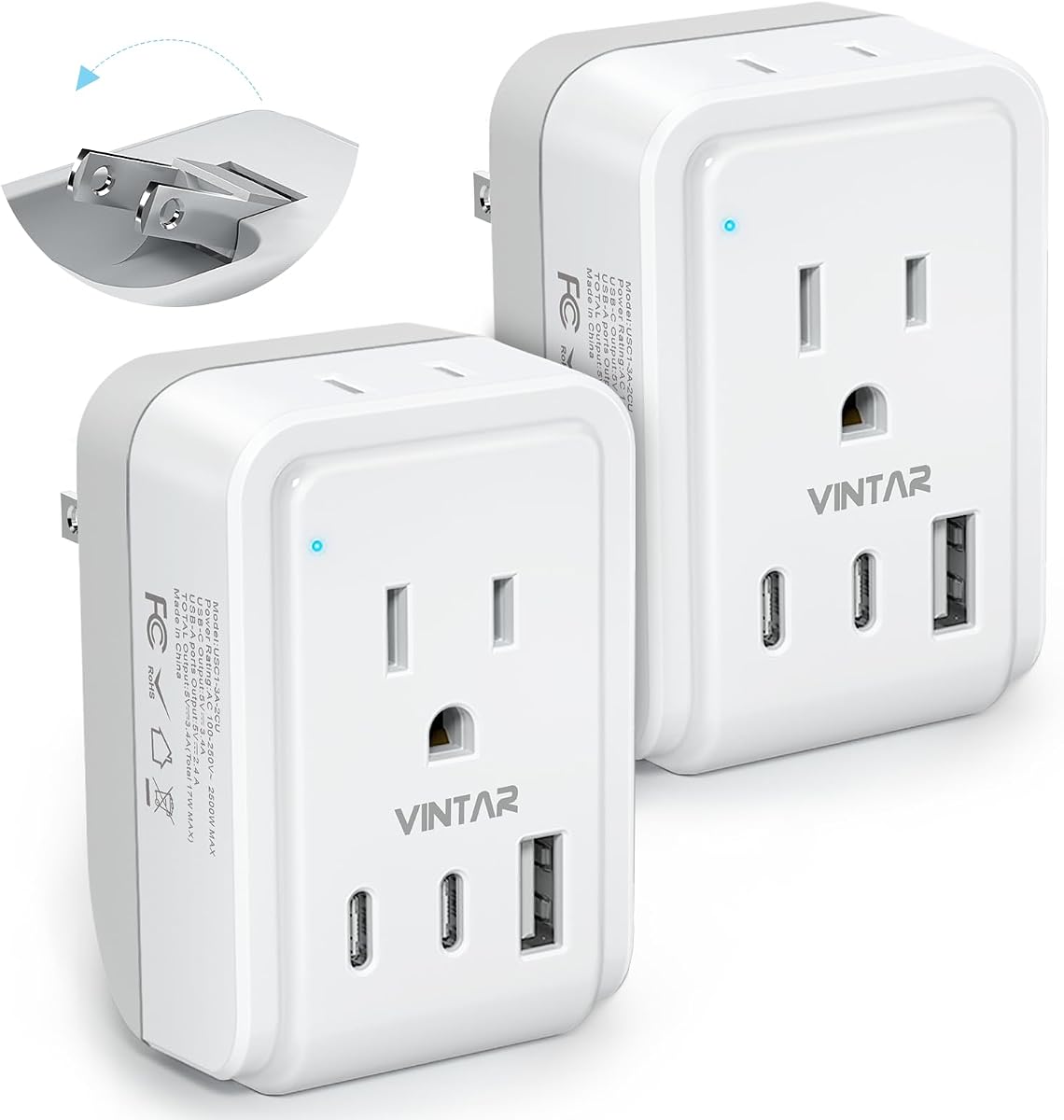
The VINTAR foldable adapter combines four North American outlets with two USB-C ports and one USB-A port. Its 4.7 rating reflects a strong balance of charging options and physical design, while the folding 90-degree plug mechanism gives it a clear advantage for travelers who want to protect the prongs during transit.
We may earn a commission when you buy through this link, at no additional cost to you.
Each USB-C port can deliver up to 5 volts and 3.4 amps, with a maximum of 17 watts, while the USB-A port supports conventional charging. The unit measures 2.9 by 1.9 by 1.7 inches, so it occupies more space than the simplest Type A adapters but remains manageable in carry-on luggage. CE and FCC certification and a 12-month warranty are also stated.
The USB-C output remains a 5-volt charging profile and does not support Quick Charge 3.0 or accessories requiring 9–22 volts. The adapter also has no surge protection. Although it can be used in both directions for many Type A-compatible destinations, it is not a voltage converter, so it cannot make a 110-volt-only appliance safe for Japanese use without additional equipment.
This is an appealing pick for travelers who frequently pack and unpack electronics. The folding prongs reduce the chance of accidental damage and make the adapter easier to place beside other chargers. It is also suitable for hotels, offices, and homes, although the stated 2,500-watt maximum should be observed when connecting several high-draw devices.
The 90-degree fold keeps the metal prongs closer to the housing while the adapter is stored. This reduces snagging and limits direct contact with other items in a densely packed bag.
Two USB-C ports support newer cable standards and reduce the need to carry separate phone-specific chargers. Their 17-watt maximum is useful for everyday charging, though it is not intended for high-voltage fast-charging protocols.
We may earn a commission when you buy through this link, at no additional cost to you.
The Cable Matters Universal Travel Adapter is designed specifically to convert international plugs into a US Type B connection. Its 4.9 rating is the highest in the guide. Rather than focusing on one travel corridor, it supports Type A, C, G, I, N, L, and J plugs, making it especially relevant for global travelers.
We may earn a commission when you buy through this link, at no additional cost to you.
Supported inputs include Type A plugs used in Japan, Mexico, and Canada; Type C plugs used in several European and Asian countries; Type G plugs used in the United Kingdom and Singapore; Type I plugs used in Australia, New Zealand, China, and Argentina; and Type J, L, and N formats. The adapter is rated for up to 10 amps and 100–250 volts, with a maximum capacity of 2,500 watts.
Its main limitation is that it does not support Type D, E, or F plugs, including the formats associated with India and some European countries. It also lacks USB charging ports and surge protection. Most importantly, it changes plug shape but does not convert voltage, so 220-volt-only hair dryers and other single-voltage appliances should not be used with it.
This is the strongest option for a traveler whose devices have varied international plugs, particularly when the trip is to the United States, Canada, or Mexico. The included storage bag adds convenience for keeping the adapter with the cords. Its strong rating and broad compatibility make it a versatile travel accessory, though travelers carrying several modern devices may prefer an adapter with integrated USB outputs.
Supporting seven plug families is valuable for international itineraries involving different countries. It reduces the need to carry a separate destination-specific adapter for every Type A, C, G, I, J, L, or N plug.
The adapter's 2,500-watt capacity sounds substantial, but capacity is not the same as voltage conversion. Single-voltage appliances still need a suitable transformer, and the excluded Type D, E, and F plug formats remain a meaningful limitation.
We may earn a commission when you buy through this link, at no additional cost to you.
The Cellet CNFPIN2 is a two-pack of universal travel adapters intended to let international plugs connect to North American outlets. With a 4.4 rating, it occupies a practical middle ground, offering broad input compatibility and a grounded three-prong output without adding USB charging hardware.
We may earn a commission when you buy through this link, at no additional cost to you.
The input side accepts two-prong polarized US plugs, three-prong grounded US plugs, and European, UK, Australian, and Indian plug standards. A grounded Type UK output is also included. Internal metal interfaces are designed to improve conductivity, while the product explicitly excludes the large South African plug. The two included units offer redundancy or the ability to keep one in each bag.
The adapter does not convert voltage, which is the most important limitation for anyone using it with hair dryers, straighteners, kitchen appliances, or other equipment designed for a single voltage. It also does not include USB ports, so a separate wall charger remains necessary for most phones and accessories. Its universal input design is less streamlined than a dedicated Type A adapter but more useful for multi-country travel.
The Cellet is best for a traveler carrying equipment with several different international plug shapes, particularly when moving between the United States, Canada, Mexico, Japan, and other listed regions. It is less suitable for a minimalist trip centered on Japan, where a dedicated Type A model would be easier to operate and generally smaller.
The universal input is useful for travelers carrying chargers from different countries. It allows familiar international equipment to work with a standard North American wall outlet without hunting for a new charger at each destination.
A grounded three-prong output provides a suitable path for compatible North American plugs. Travelers should confirm that the connected device and its regional plug can be used safely with this configuration.
We may earn a commission when you buy through this link, at no additional cost to you.
The UGREEN US Travel Plug Adapter combines a Type B US output with inputs for Type A, B, C, G, and I plugs. Its 4.6 rating reflects a security-focused design, particularly the TÜV certification, UL94 V-0 flame-retardant housing, and multiple electrical protections.
We may earn a commission when you buy through this link, at no additional cost to you.
Type A inputs cover plugs from China, the United States, and Japan, while the additional formats accommodate European Type C, UK Type G, and Type I plugs used in China and Australia. The listed destinations include the United States, Canada, Mexico, Japan, and the Philippines. At 2.58 by 2.44 by 2.56 inches and 3.65 ounces, the adapter is compact enough for a backpack, handbag, or carry-on.
Protection features include over-voltage, over-current, over-temperature, overload, short-circuit safeguards, and a built-in child safety shutter. Despite these protections, the product is not a voltage converter. Dual-voltage electronics from 100–250 volts are suitable, but travelers should check hair dryers, straighteners, and curling irons before use because many are designed for a single voltage.
The UGREEN is an excellent choice for travelers who value documented safety features and may carry chargers with several international plug shapes. It is less attractive for anyone wanting integrated USB charging, since the adapter provides no USB ports and relies on separate wall chargers. Its wider universal input also makes it more versatile than a dedicated Japan-to-US Type A unit.
Over-voltage, over-current, over-temperature, overload, and short-circuit protection provide multiple safeguards beyond basic plug compatibility. These features make the adapter appealing for routine travel use in hotels, airports, offices, and cafes.
The built-in child safety shutter helps make the outlet face less accessible when it is not in use. The flame-retardant housing and TÜV certification add further reassurance for frequent travelers.
We may earn a commission when you buy through this link, at no additional cost to you.
The most useful adapter depends on which direction you are traveling, which plugs your devices use, whether you need grounded connections, and whether you want to consolidate USB charging. Voltage compatibility and travel restrictions should be evaluated before outlet quantity.
A Japan-to-USA travel arrangement usually involves a Japanese Type A plug being used with a North American outlet or an American charger being adapted for a Japanese Type A outlet. Dedicated products in this guide are Type A converters and multi-outlet adapters, while the Cable Matters, Cellet, and UGREEN products focus on broad or international input with a US output. Always verify whether the product solves the direction you actually need rather than assuming the shopping keyword describes every included model.
Choose based on the physical plug you hold and the outlet you plan to use.
A plug adapter changes the shape of a connector; it does not normally change the electrical voltage. Most phones, tablets, laptops, cameras, and many modern chargers support a broad input range, but appliances such as hair dryers and straighteners are frequently limited to 110 or 125 volts. The products in this guide are explicitly described as non-converting unless otherwise stated, so a separate transformer may be necessary for high-draw, single-voltage equipment.
Use a dual-voltage device or carry a separate voltage converter when necessary.
A grounded three-prong connection is important for some laptops, kitchen appliances, and other equipment designed with a protective ground. Adapters that accept a North American three-prong plug can preserve that grounding path when converting to a Type A outlet. Two-prong-only designs may still work for ordinary chargers, but travelers should check the cable and device rather than relying on shape alone.
Choose a grounded path for equipment that requires a grounded plug.
A basic adapter may provide only one or two usable connection positions, while the multi-port models offer four AC outlets plus several USB connections. More ports can reduce clutter in a hotel room, but they also increase size, weight, and shared power demand. Evaluate the number of devices you will realistically charge together and whether one unit can safely accommodate their combined draw.
Count simultaneous devices rather than total device ownership.
USB-C connectors do not all provide the same charging power. The listed multi-port adapters range from a shared 15.5 watts to USB-C outputs of 17 or 20 watts, and some explicitly do not support Quick Charge 3.0 or higher-voltage protocols. Check the charging standard and voltage required by your phone, earbuds, tablet, or laptop rather than judging compatibility by connector shape alone.
Match the USB profile and power level to your devices.
Travel adapters range from very small Type A blocks to multi-outlet units with broad country support. A foldable design can protect exposed prongs, while a cord-free shape is convenient for ships. Several products omit surge protection, so travelers should keep that limitation in mind and choose a separate surge protector where appropriate.
Balance outlet count, physical size, and surge protection.
Type A outlets appear in Japan and many other countries, but compatibility varies by outlet layout. Some descriptions note that certain products fit only partial outlets in Thailand and Peru, where round-hole receptacles may not accept the flat pins. The universal options cover more plug formats, but they also exclude some standards, including Type D, E, or F plugs.
Check the exact country list and outlet style before departure.
Certification and warranty terms provide additional confidence, although they do not replace correct use. Listed features include CE, FCC, RoHS, TÜV, and UL94 V-0 claims, along with limited lifetime or 12-month warranties. These details can help distinguish established safety-oriented designs, but users should still follow electrical limits and avoid connecting unsupported appliances.
Consider documented safety standards alongside warranty coverage.
Before use, identify the outlet type in the destination and the plug on your device. Confirm that the adapter accepts the correct plug family, that the device supports the local voltage, and that the adapter's output can handle the combined power draw. Do not attempt to force a plug, alter the prongs, or use an adapter as a voltage transformer.
Insert the adapter fully into a compatible wall outlet and connect devices only after the adapter is seated. Keep the outlet uncovered, avoid water and damp surfaces, and do not exceed the stated wattage, amp, or USB output limits. When using several USB devices, recognize that the ports may share a total charging allowance and may charge more slowly when heavily loaded.
To pack the adapter, disconnect all cables first. Fold prongs where the design permits, place the unit in a protective compartment, and keep it away from hard objects that could bend connectors. Clean a dirty exterior with a dry cloth only, and do not immerse the unit, expose it to moisture, or open the housing. Replace the adapter if the shell cracks, prongs bend, heat becomes abnormal, or the power indicator behaves unexpectedly.
No. A plug adapter normally changes only the physical plug shape so a device can fit an outlet in another country. It does not transform 100–250 volts into the voltage required by a single-voltage appliance. Most listed products explicitly state that they are not voltage converters, so check the device label and use a suitable transformer for incompatible high-wattage equipment.
Japan commonly uses Type A outlets with two flat pins, including both polarized and non-polarized configurations. Some Japanese outlets also provide grounding through a separate ground pin. A North American three-prong plug normally needs an adapter that accepts that grounded configuration and provides a Type A output.
You can use it when the charger supports the voltage available in Japan and the adapter safely accommodates the plug and electrical load. Modern phone and laptop chargers commonly support a broad voltage range, but hair dryers, straighteners, and some kitchen appliances often do not. Check the charger's input label before use.
The TESSAN, HANYCONY 8-in-1, VINTAR, and two-pack multi-port models provide the most connection choices. They combine multiple AC outlets with USB-A or USB-C charging, allowing several low- and moderate-power devices to charge without separate wall plugs. Their shared output and maximum power limits should still be respected.
Most of the listed adapters do not provide surge protection. Their stated wattage and USB limits describe normal operating capacity, not protection from power surges. Travelers needing surge suppression should use a dedicated surge protector and confirm that the combined adapter and protector remain compatible with the destination outlet.
Only if the appliance explicitly supports Japanese voltage, commonly through a 100–250-volt or 100–120-volt dual-voltage rating. A plug adapter alone will not lower a 220-volt-only appliance to a safe operating range. Carry a suitable voltage converter when the appliance lacks universal voltage support and follow the converter's instructions.
The Ceptics CT-6 and BESTEK Type A adapters are among the smallest products in the guide. The Ceptics weighs 1.07 ounces, while the BESTEK has an especially shallow 1.37 by 1.37 by 0.98-inch body. These options work best for travelers who want a simple plug conversion and will carry separate USB wall chargers.
No universal adapter supports every plug standard. The Cable Matters model covers Type A, C, G, I, J, L, and N plugs but excludes Type D, E, and F. The Cellet also has exclusions, including the large South African plug. Check the exact plug type used at every destination and do not force an incompatible connector.
The HANYCONY 5-in-1 adapter is the strongest all-around choice for travelers who want a compact combination of Type A conversion, two AC outlets, and USB charging. The Ceptics CT-6 stands out for minimal weight, three included units, and a straightforward dual-input design, while the HANYCONY 8-in-1 provides the most extensive connection capacity for groups and device-heavy itineraries.
Prioritize the travel direction and plug format first, followed by grounding and voltage requirements. Once those essentials are confirmed, outlet count, USB charging profiles, size, certification, and included quantity can determine the final choice. A simple dedicated Type A adapter may be more useful than a universal model for a Japan-only trip, while a broad-input adapter is advantageous for international itineraries.
Current ratings, product details, and prices can change, so check the latest listing before buying. Review the exact outlet configuration in your destination, confirm that every device is dual-voltage when needed, and treat stated power limits as firm operating limits rather than suggestions.