
SureCall Five-Band RF Signal Meter
4.3Editor score
Five cellular frequency bands
Rechargeable AAA battery power
Backlit dark-environment display
A cellular signal meter for antenna aiming helps technicians evaluate signal conditions, identify stronger directions, and make more accurate antenna placements. The right instrument may report carrier metrics, display broad spectrum activity, measure antenna performance, or simply guide outdoor television antennas.
We compared the products by examining their stated frequency coverage, measurement functions, display features, portability, power options, and intended uses. The list includes dedicated cellular meters, general-purpose spectrum analyzers, antenna analyzers, RF power meters, and over-the-air television signal finders.
Each review explains where the tool fits in a practical antenna-alignment workflow and highlights relevant limitations. Ratings and availability can change over time, so readers should confirm current product details, accessories, and pricing before purchasing.
4.3Editor score

4.6Editor score

5.0Editor score
As an Amazon Associate we earn from qualifying purchases.
The comparison below covers ten distinct measurement tools, from dedicated cellular meters to broad-spectrum analyzers and television signal finders, showing the most relevant coverage and workflow features for each.


The SureCall Five-Band RF Signal Meter is a purpose-built instrument for cellular signal assessment and booster installation. Its stated 4.3 rating reflects a favorable user response, while the five-band design gives installers a more relevant tool than a generic power meter that cannot distinguish supported cellular frequencies.
We may earn a commission when you buy through this link, at no additional cost to you.
Coverage includes 1930-1995MHz PCS, 869-894MHz Cellular, 2110-2155MHz AWS, 746-757MHz LTE, and 728-746MHz LTE. The meter has a receiving sensitivity of -110dBm and can operate for approximately 2.5 to 3.5 hours using four rechargeable AAA NiMH batteries. A controllable backlight is especially useful when readings must be taken in dark rooms, equipment cabinets, or shaded outdoor locations.
The main limitation is specialization. This is not a full spectrum analyzer, so it does not offer the waterfall views, interference inspection, tracking generator, or wide-frequency context available from professional RF instruments. It also does not provide the detailed RSRP, RSRQ, and RSSI readings offered by the Berkeley Octopus. Buyers needing only cellular-band direction and strength comparisons will find that narrower scope beneficial rather than restrictive.
This is the strongest choice for a cellular installer or technically inclined homeowner who wants an uncomplicated way to compare signal in different directions. Its dedicated band coverage, rechargeable format, and backlit display make it more directly aligned with cellular antenna aiming than many general-purpose alternatives in this guide.
The five included cellular and LTE bands let users check the frequencies most relevant to common cellular installations. That focus can simplify antenna aiming without requiring broad-spectrum interpretation.
Rechargeable AAA batteries provide useful cordless operation, while the adjustable backlight makes the display easier to read in difficult lighting. The stated runtime comfortably supports a typical installation session.
We may earn a commission when you buy through this link, at no additional cost to you.
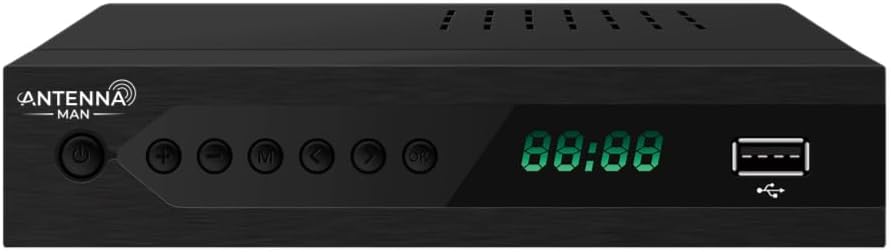
The Antenna Man Signal Meter is an ATSC digital converter box with a television tuner and recording function. Its 3.8 rating reflects a more mixed reception than the higher-rated dedicated cellular meters, but its straightforward real-time strength display makes it approachable for residential antenna positioning.
We may earn a commission when you buy through this link, at no additional cost to you.
Users can rotate an outdoor television antenna and observe which direction produces the strongest reading. The plug-and-play format minimizes configuration, while the TV tuner and recording capability provide practical value beyond measurement alone. These qualities make the device most suitable for installers or homeowners working with ATSC over-the-air television reception.
It should not be confused with a cellular signal meter. The supplied information does not identify cellular band support, carrier metrics, or wideband spectrum analysis. It is therefore not appropriate for aiming a cellular booster antenna, assessing LTE RSRP, or diagnosing crowded RF environments at cellular frequencies.
Choose this product when the immediate goal is aligning an ATSC television antenna and you value a simple interface. For cellular installations, choose a dedicated cellular meter or spectrum analyzer instead. Its focused television purpose remains clear, but it belongs in this roundup as a contrast rather than a cellular-specific solution.
The live signal-strength display gives users immediate feedback while turning or repositioning an antenna. This makes it practical for basic elevation and azimuth comparisons.
The integrated TV tuner and recording capability extend the device beyond a bare strength indicator. It can serve as a convenient digital converter when a compatible television is connected.
We may earn a commission when you buy through this link, at no additional cost to you.
The Berkeley Octopus 4G LTE Cellular Signal Meter combines a strong 4.6 rating with measurements that are especially useful for cellular antenna aiming. It reports true RSRP, RSRQ, and RSSI values rather than offering only a general indication of signal presence, giving installers more meaningful information when comparing antenna positions.
We may earn a commission when you buy through this link, at no additional cost to you.
The meter supports AT&T, Verizon, T-Mobile, and U.S. regional carriers. It requires no subscription, SIM card, phone, or app, which makes it straightforward to use at a remote installation site. Its stated applications include EV charging stations, utility telematics, alarm installations, wireless IoT equipment, and cellular boosters.
The tradeoff is that it is optimized around cellular measurements rather than full RF spectrum analysis. It will not provide the waterfall, frequency heatmap, tracking generator, or wideband inspection available from the RF Explorer and AirCheck products. Those additional capabilities matter when locating interference, diagnosing unfamiliar signals, or conducting detailed frequency coordination.
For cellular technicians who need trustworthy directional measurements rather than a general signal bar, the Octopus is a compelling pick. Its combination of true LTE metrics, broad carrier support, and no-recurring-requirement operation is especially attractive for booster installers and anyone maintaining cellular-connected commercial equipment.
RSRP, RSRQ, and RSSI describe different aspects of received radio conditions. Comparing all three while rotating an antenna can reveal whether a stronger reading also corresponds to a healthier connection.
The lack of a required SIM card, phone, app, or subscription reduces setup and connectivity dependencies. A technician can arrive at the site, power the instrument, and begin measuring immediately.
We may earn a commission when you buy through this link, at no additional cost to you.
The RF Explorer Pro is a broad RF measurement platform rather than a simple cellular meter. It combines spectrum analysis, power measurement, and a tracking generator in a portable enclosure, making it appropriate for advanced users who need to inspect the wider radio environment while aiming an antenna.
We may earn a commission when you buy through this link, at no additional cost to you.
Its stated spectrum analyzer coverage begins at 15MHz and extends through configuration-dependent limits up to 6.1GHz. The 8-inch 1280 by 800 capacitive touchscreen, Zero Span mode, 2D and 3D waterfalls, GPS Heatmap, and Frequency Coordination features offer much more context than a cellular-only meter. A fast 100 microsecond power-meter response and continuous sweep support dynamic monitoring.
This sophistication introduces a learning curve and a substantially higher acquisition commitment. Additional software licenses for cable testing, GPS Heatmap, and Frequency Coordination may be purchased separately, and the Ethernet adapter is not included. The modular frequency configuration also means buyers should confirm that the selected variant covers the bands needed for their work.
Despite those considerations, the RF Explorer Pro is the most flexible product here for diagnosing interference, checking cable behavior, and analyzing multiple wireless services. It suits RF professionals and advanced technicians who need the spectrum context that a dedicated LTE meter cannot provide.
Spectrum, power, and tracking-generator functions let users examine more than received signal level. That breadth helps separate an aiming problem from an interference, component, or cable problem.
The high-definition capacitive touchscreen provides room for real-time traces, waterfalls, menus, and measurement details. It is better suited to deliberate analysis than quick handheld signal comparisons.
We may earn a commission when you buy through this link, at no additional cost to you.
The NetAlly AirCheck G3 Pro Kit is the most complete professional site-survey package in the group and carries a 5 rating. It combines the AirCheck G3 Pro mainframe, an external directional antenna, and the NXT-2000 tri-band spectrum analyzer to support Wi-Fi, Bluetooth, and broader radio-frequency investigation.
We may earn a commission when you buy through this link, at no additional cost to you.
Physical location detection works across 2.4GHz, 5GHz, and 6GHz, while the optional NXT-2000 adapter enables spectrum analysis in those bands. Link-Live adds remote collaboration, reporting, centralized data management, and automatic network topology mapping. These features are particularly useful for organizations troubleshooting distributed wireless estates rather than performing a single household antenna adjustment.
The external directional antenna is an important advantage for aiming work because it can favor signals arriving from a selected direction and help users survey more efficiently. Nevertheless, the kit's Wi-Fi and Bluetooth orientation makes it less directly focused on cellular signal metrics than the SureCall or Berkeley meters. The NXT-2000 can provide radio context, but this is primarily a professional wireless site-survey ecosystem.
Buy the kit when the antenna is part of a larger enterprise network and you need documentation, collaboration, and topology mapping. For a compact booster antenna installation, the dedicated cellular instruments in this guide will usually offer a more straightforward path.
The included external directional antenna helps users identify and evaluate signals by approach direction. It supports faster surveys while also providing a direct tool for directional comparison.
Link-Live allows field technicians and remote engineers to examine site data together. Centralized analysis and topology mapping turn individual readings into a scalable troubleshooting process.
We may earn a commission when you buy through this link, at no additional cost to you.
The Extech 480836 is a high-frequency RF EMF strength meter designed for broad field-strength measurements. Its 4.3 rating indicates a well-regarded instrument, and its 50MHz to 3.5GHz range covers frequencies commonly associated with cellular systems, mobile phones, base stations, and microwave leakage.
We may earn a commission when you buy through this link, at no additional cost to you.
The defining feature is the three-channel triaxial probe. Because it is non-directional and isotropic, it measures total field strength without requiring the user to point a narrow receiving antenna toward a suspected transmitter. Up to 99 sets of measurements can be stored and recalled, helping users document conditions at multiple locations or compare repeated readings.
That same non-directional design makes it less useful for precise cellular antenna aiming. The meter cannot tell a user which direction produces the strongest signal in the way a directional cellular meter or spectrum analyzer can. It also does not report carrier-specific RSRP, RSRQ, or RSSI, nor does it identify which network occupies a measured frequency.
The Extech is best for safety-oriented RF surveys, broad signal presence checks, and comparing overall field levels. Use it alongside a directional tool when azimuth and elevation alignment are the objective. Its value lies in comprehensive field strength measurement rather than carrier diagnostics.
The triaxial probe captures RF energy from multiple directions. This is useful for general exposure and leakage surveys where identifying the source direction is not required.
Manual storage and recall of up to 99 measurement sets helps technicians retain baseline and comparison data. The feature is particularly useful across a multi-point survey.
We may earn a commission when you buy through this link, at no additional cost to you.
The MINI1300 Antenna Analyzer is a compact, dedicated RF tool for measuring antenna and feed-line behavior. It has a 4.4 rating and covers 0.1 to 1300MHz, spanning HF, VHF, and UHF. That makes it particularly relevant when the goal is to evaluate an antenna system itself rather than only observe a carrier's received signal.
We may earn a commission when you buy through this link, at no additional cost to you.
Single-point measurement, frequency sweep, and TDR modes provide different ways to inspect RF components. The listed SWR range is 1.0 to 1999 in single-point mode and 1.0 to 20.0 in scan mode. A 4.3-inch color touch display keeps controls accessible, while the portable housing is suitable for technicians who already understand impedance and reflection measurements.
It is not a cellular signal meter in the carrier-metric sense. The supplied information does not list RSRP, RSRQ, RSSI, or cellular band detection, and 1300MHz does not cover many of the higher frequencies used by modern cellular systems. It is better for evaluating a relevant antenna, cable, connector, or impedance-matching setup.
The non-updateable firmware is an important limitation and should not be altered, as the product information warns that doing so can damage its original functions. For technicians seeking a low-cost antenna analyzer, the MINI1300 offers a useful combination of sweep, SWR, and TDR functionality.
SWR, sweep, and TDR measurements help distinguish a poorly matched antenna from a damaged feed line or connector. These metrics focus on the installed RF system rather than only the signal arriving at a receiver.
The 4.3-inch touchscreen makes frequency selection and trace review easier than a cramped key-only display. The compact body remains practical for mobile work.
We may earn a commission when you buy through this link, at no additional cost to you.
The SA6 is a compact two-in-one RF instrument combining a spectrum analyzer with a built-in signal generator. Its stated range of 35 to 6200MHz encompasses Wi-Fi, LTE, 2G, 3G, GSM, CDMA, DCS, and GLONASS signals, giving it broad relevance for modern wireless troubleshooting.
We may earn a commission when you buy through this link, at no additional cost to you.
The spectrum display supports up to 75dB of dynamic range and stated accuracy of plus or minus 2dB. Its tracking generator adds frequency-response measurement for filters, amplifiers, and other components. Users receive a 3.2-inch color resistive touchscreen plus physical buttons, which is a useful combination when operating the device in a workshop or outdoors.
Its rechargeable battery is specified at 2500 to 5000mAh depending on batch, with approximately three to four hours of continuous operation. USB Type-C supports charging, data transfer, and PC connectivity for real-time logging and analysis. The 380g housing is easy to carry, although the small resistive screen is less refined for detailed work than the larger capacitive displays in the RF Explorer and AirCheck.
This is a versatile option for technicians who want more than a cellular-only meter but do not need the complexity of a professional enterprise kit. It suits field inspection, antenna tuning, device debugging, and broad spectrum monitoring, making it a practical all-purpose addition to an RF tool collection.
The integrated signal generator adds response testing beyond ordinary spectrum viewing. It can help characterize filters, amplifiers, and passive components without carrying a separate generator.
The 35 to 6200MHz span covers many Wi-Fi and cellular bands in a small enclosure. That combination is useful for quick surveys, tuning, and device troubleshooting across multiple wireless services.
We may earn a commission when you buy through this link, at no additional cost to you.
This SA6 handheld spectrum analyzer offers a compact way to inspect 35 to 6200MHz RF activity. It supports common wireless technologies including Wi-Fi, 4G, LTE, GSM, GPRS, and GLONASS, making it useful for rapid field evaluation of a mixed wireless environment.
We may earn a commission when you buy through this link, at no additional cost to you.
Its tracking generator produces output from -15 to 25dBm for characterizing filters, amplifiers, and passive components. With the optional directional coupler and calibration kit, it can also support SWR and return-loss measurements. The fixed 200kHz resolution bandwidth and fast scanning performance are designed for quickly assessing spectrum conditions and repeater-related activity.
The package includes a 2500mAh internal battery providing up to three hours of runtime, charging accessories, extension cables, a data cable, a stylus, and a KK connector. Its compact 5.9 by 3 by 0.9-inch housing is easy to carry, although the lack of a listed rating and the somewhat abbreviated product description mean buyers should carefully verify screen functions, included accessories, and performance before committing.
This product is most attractive to mobile technicians who need a broad, fast spectrum assessment and value the tracking generator in a compact package. It is less clearly suited to precise cellular carrier-metric comparison, so it works best as a diagnostic companion rather than a replacement for a dedicated LTE meter.
Rapid full-span sweeps help users understand changing RF conditions without dwelling on one narrow frequency. This is useful when comparing sectors, checking interference, or assessing a repeater installation.
The tracking generator and optional coupler-based measurements extend the device into component characterization. That makes it useful for technicians who need both spectrum observation and return-loss or SWR work.
We may earn a commission when you buy through this link, at no additional cost to you.
The Channel Master TV Antenna Signal Strength Meter is built specifically for precise over-the-air television antenna alignment. Its 3.9 rating reflects a generally positive reception, while its combination of signal level and signal-to-noise information gives users more context than a single strength bar.
We may earn a commission when you buy through this link, at no additional cost to you.
The meter supports ATSC television frequencies used in the United States and presents readings on a color touchscreen. A built-in rechargeable battery removes the need for disposable cells during an installation, while the included stylus and protective carrying case improve usability and transport.
The device is not designed for cellular antenna aiming. It does not list cellular band support, carrier-specific RSRP, RSRQ, or RSSI, or wideband spectrum analysis. It is therefore best suited to rooftop television antennas and related OTA installations rather than cellular booster or DAS work.
For TV antenna positioning, the dual-metric display is the key benefit: comparing signal level alongside SNR can produce a better final aim than watching strength alone. Users should select it when their objective is television reception. For cellular work, the SureCall and Berkeley meters are substantially more relevant choices.
Signal level shows received strength, while SNR helps describe signal quality relative to the surrounding noise floor. Viewing both can prevent an installer from settling on a position that looks strong but is not optimal.
The rechargeable battery, touchscreen, stylus, and protective case create a practical package for rooftop and attic installation work. U.S. ATSC coverage keeps the scope clear and appropriate for local television antennas.
We may earn a commission when you buy through this link, at no additional cost to you.
The best instrument depends on whether you need carrier-specific readings, full spectrum visibility, antenna-system measurements, or only a simple direction indicator. Match the tool's measurement capabilities, frequency coverage, display, and field ergonomics to the installation task.
A dedicated cellular meter reports received signal behavior for communication networks, while a spectrum analyzer shows RF energy across a range of frequencies. An antenna analyzer measures SWR, return loss, and other properties of the antenna and feed line. These categories answer different questions, so choosing the wrong type can leave the actual installation problem unanswered.
Choose a cellular meter for booster aiming, choose a spectrum analyzer for interference or crowded-spectrum work, and choose an antenna analyzer for cable, connector, or impedance diagnosis.
Cellular services operate across several lower, middle, and upper bands, and a meter must support the frequencies used in the target area. The SureCall covers PCS, Cellular, AWS, and two LTE ranges, while the Berkeley Octopus supports major U.S. carriers and regional carriers. Spectrum analyzers offer broader context but may require more interpretation than a dedicated cellular model.
Match coverage to the carrier and service bands at the installation site. Check the product's complete supported range rather than relying on a generic 4G or LTE label.
Signal bars and a single overall strength value can be enough for a rough comparison, but detailed cellular metrics provide a stronger basis for positioning. RSRP describes received power, RSRQ gives information about quality and interference, and RSSI provides a broader received-signal indicator. Values can vary with load and nearby transmitters, so compare readings taken close together under similar conditions.
Prioritize true RSRP, RSRQ, and RSSI when performing professional cellular work. For basic installations, the dedicated five-band meter may provide enough directional information at a lower complexity.
A spectrum analyzer reveals signals across a broad frequency range, allowing an installer to identify interference, compare nearby transmitters, and confirm whether a target band is occupied. Carrier-focused meters provide more direct cellular measurements but generally do not reveal the entire spectral neighborhood. Neither view is universally superior; the most useful setup often combines simple directional readings with broader diagnosis when something does not behave as expected.
Choose a spectrum analyzer for troubleshooting and RF research. Choose a cellular meter when the goal is a fast, carrier-relevant reading during antenna positioning.
A weak reading does not always mean the antenna is aimed incorrectly. Feed lines, connectors, adapters, and impedance matching can also reduce performance. The MINI1300 provides SWR, frequency-sweep, and TDR modes across 0.1 to 1300MHz, while the SA6 products can include tracking generators for component response measurements.
If you work with custom antennas, long coax runs, or questionable connectors, include an antenna analyzer in the toolset. It can verify whether the installed system is electrically sound before you spend time adjusting direction.
Field readability depends on display size, contrast, controls, and backlighting. The SureCall includes a controllable backlight for dark environments, the Channel Master and SA6 use color touchscreens, and the RF Explorer offers an 8-inch high-definition display for detailed traces. Larger screens help with complex analysis, while simpler displays can make quick directional comparisons more direct.
Choose based on the amount of information you need to interpret. A large screen helps with spectrum analysis; a compact backlit display may be better for rapid installation checks.
Antenna aiming often occurs on rooftops, towers, attics, or remote sites, so cordless operation matters. The SureCall runs for approximately 2.5 to 3.5 hours on rechargeable AAA batteries, the AirCheck G3 Pro lists up to five hours of internal operation, and the handheld SA6 models offer roughly three to four hours depending on configuration and batch. Actual runtime can vary with screen use and measurement load.
For extended jobs, carry a reliable charging method and verify connector availability. For short sessions, a compact rechargeable instrument may be more convenient than a larger unit with external power needs.
Professional tools provide deeper measurements, additional bands, waterfall views, documentation, and collaboration features, but they also demand more setup and interpretation. A dedicated cellular meter can provide a faster path from unpacking to comparing signal directions. A spectrum analyzer is more valuable when the installation includes mixed wireless systems, suspected interference, or complicated diagnostics.
Avoid paying for advanced analysis you will never use. Choose the simplest instrument that can verify the signal condition or system fault you need to diagnose.
Begin by defining the target signal and ensuring that the meter supports the relevant cellular carrier and band. Charge the instrument fully, update its software or calibration files when required, and confirm that the measurement display is functioning correctly before leaving the site. If the product supports a signal generator or calibration accessories, perform the recommended calibration procedure before making comparative readings.
Place the antenna in a stable initial position and take a baseline reading. Rotate the antenna in controlled increments, pausing briefly at each position, and record the cellular metrics or spectrum values. Move through a consistent arc, compare like-for-like readings, and avoid interpreting a single dramatic change until it has been confirmed with another pass. Once the strongest region is identified, refine elevation and azimuth in smaller adjustments while monitoring signal level and quality metrics together.
For a spectrum analyzer, keep the displayed span, resolution bandwidth, and detector settings consistent so the traces remain comparable. Watch for strong nearby signals that may change with system load, and use the waterfall or directional antenna to distinguish persistent activity from short-lived traffic. After installation, disconnect or secure the test lead, protect connectors from moisture and dust, recharge the battery, and store the unit in its case away from extreme heat, direct sunlight, and impact.
A cellular signal meter focuses on received cellular-network metrics such as RSRP, RSRQ, and RSSI, making it convenient for directly comparing antenna directions. A spectrum analyzer displays RF energy across many frequencies, which helps identify interference, other transmitters, and changing spectrum conditions. A spectrum analyzer provides broader diagnostic context, while a dedicated cellular meter usually provides a simpler installation workflow.
Yes, when the meter supports the cellular bands carried by the relevant carrier and the readings are taken under comparable conditions. Turn the antenna through several directions and record the readings before refining the best angle. If the result is weak or inconsistent, check the cable, connectors, antenna compatibility, and nearby interference before adjusting again.
A basic signal-strength reading can reveal the strongest direction, but RSRP, RSRQ, and RSSI provide more meaningful detail. RSRP helps characterize received power, RSRQ indicates signal quality and interference, and RSSI gives another received-signal perspective. Looking at all three can prevent a position with acceptable power from being mistaken for the best-performing location.
Usually not. Television meters such as the Antenna Man Signal Meter and Channel Master are designed for ATSC over-the-air television frequencies and do not provide cellular carrier metrics. They can accurately serve television antenna alignment tasks, but cellular antennas require a meter with suitable cellular band coverage or a broad-spectrum RF instrument.
A cellular meter shows what is being received, while an antenna analyzer evaluates the antenna, feed line, connectors, and impedance match. Weak results can result from damaged coax, poor connectors, an unsuitable antenna, or improper mounting rather than incorrect aiming. Using both types of tools can separate a system installation problem from a directional alignment problem.
Take a baseline reading and then sample several positions using small, consistent adjustments. Record the readings at each position and repeat the sweep to confirm that the strongest area is stable. Cellular signal levels can fluctuate with network traffic, so an average or repeated comparison is more reliable than relying on a single peak.
Measure at the intended antenna location when possible, because that shows the signal the antenna and feed line will actually encounter. Indoor readings are useful for evaluating the finished result but can be distorted by walls, wiring, and equipment placement. A sound workflow checks both the antenna position and the final coverage where service is needed.
Some dedicated models do. The Berkeley Octopus explicitly requires no subscription, SIM card, phone, or app, allowing direct measurements at the installation site. Other instruments may depend on a connected device or proprietary software, so verify the operating requirements before purchasing. Standalone operation is especially convenient on rooftops and remote installations.
The SureCall Five-Band RF Signal Meter is the most straightforward dedicated option for cellular-only aiming, with five relevant bands, a rechargeable design, and a backlit display. The Berkeley Octopus offers deeper cellular insight through true RSRP, RSRQ, and RSSI readings, making it a strong choice for professional booster work and cellular-connected equipment.
Prioritize the information your installation actually requires. Use broad-spectrum analysis when interference or mixed wireless activity complicates the diagnosis, an antenna analyzer when coax and RF components need verification, and a television meter only when aligning ATSC television antennas. Directional readings should be repeated under stable conditions, and both signal strength and quality should be considered before locking an antenna into place.
Product availability, configurations, accessories, and prices can change, so confirm the current listing and technical specifications before buying. Verify cellular band support, measurement mode, power requirements, and included directional accessories for the exact model you choose.