
Mik-Nana Food Scale
4.5Editor score
1g resolution
10kg maximum capacity
Six measurement units
304 steel platform
This scale for soap making guide compares capacity, precision, platforms, tare functions, displays, and power options for every formula.
A dependable scale for soap making must measure small additives accurately, accommodate larger batches, and make ingredient tracking straightforward. Resolution matters for trace ingredients, while capacity matters when combining oils, water, and sodium hydroxide. A useful platform also gives you room to stage bowls and tools without repeatedly transferring ingredients.
The ten products in this guide were compared using the specifications supplied for each scale, including maximum capacity, increment, platform size, tare capability, unit conversion, display design, and cleaning considerations. The list includes compact gram scales, larger kitchen scales, high-precision baking scales, and dual-platform models, with special attention to their usefulness in a soap-making workspace.
Each review explains the scale's strongest qualities, practical limitations, and the type of maker it is best suited for. Ratings reflect the available customer feedback supplied with each product, while products without a listed rating are not presented as reviewed favorites. Prices and availability can change, so confirm the current listing and complete your recipe calculations before purchasing.
4.5Editor score

4.7Editor score

4.6Editor score
The comparison below highlights the trade-offs among the ten scales, focusing on the capacity, precision, platform, and functions that matter most when accurately measuring soap ingredients.



The Etekcity Food Kitchen Scale is a straightforward kitchen scale rated 4.6 by customers. Its 11-pound capacity and one-gram increment make it a practical choice for general soap making, where oils and liquid ingredients are often measured in larger quantities. The included tare function helps isolate ingredient weight when using a bowl or measuring vessel.
We may earn a commission when you buy through this link, at no additional cost to you.
Its five supported units include ounces, pounds and ounces, fluid ounces, grams, and milliliters. That flexibility is useful when working from a recipe written in a different measurement system. The large-font LCD is backlit for easier reading, while the small body is described as space-efficient and easy to store. Cleaning is straightforward because the 304 food-grade stainless steel surfaces can simply be wiped down.
The main limitation is resolution. At one gram, the scale is less suitable for very small quantities of fragrance, colorant, preservative, or another additive that must be measured very precisely. It also lacks the percentage function found on some higher-resolution models. Those omissions matter for intricate formulas, but they do not undermine its usefulness for weighing bulk recipe ingredients.
Choose the Etekcity if you want a familiar, compact scale for standard batches and prefer simple controls over advanced functions. It is especially suitable for makers who measure oils, water, and other larger components separately and use a more precise tool only for additives. For most conventional cold-process or melt-and-pour workflows, its capacity and tare function provide a sound balance.
The small, sleek housing is easier to store than a broad commercial platform. That makes this scale practical for a home craft room where bench space may be limited and another bowl needs room beside it.
Multiple unit options help when following formulas expressed in grams, ounces, or pounds. Wipeable 304 stainless steel also simplifies routine cleanup after oils or other sticky ingredients.
We may earn a commission when you buy through this link, at no additional cost to you.
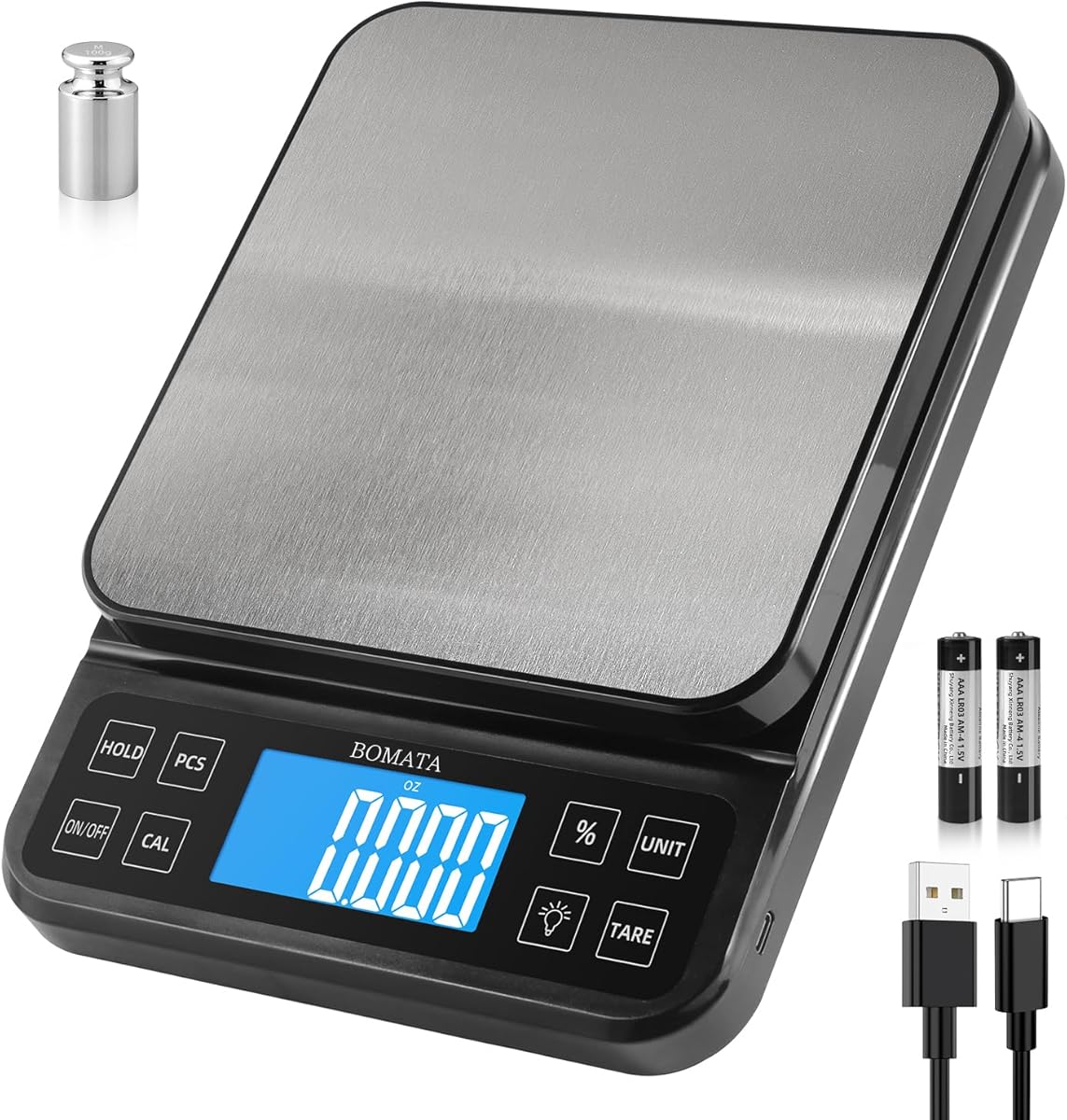
The BOMATA Large Kitchen Scale holds a 4.4 rating and combines a broad platform with 0.1-gram precision. That combination is especially relevant to soap makers who want to measure small additives accurately without giving up enough platform area for mixing bowls, cups, and ingredient staging. Its 11-pound maximum capacity covers many standard-sized batches.
We may earn a commission when you buy through this link, at no additional cost to you.
The 7.2-inch square weighing platform is one of the more useful features in a craft workspace. It can accommodate containers that would feel cramped on a compact scale. The hold function is helpful when a container extends beyond the pan, while percentage mode supports formulas based on ingredient ratios. Tare, counting, unit conversion, calibration, and a cancellable auto-off function round out the controls.
Power flexibility is another strength. The built-in lithium battery can be recharged by USB-C, while two external AAA batteries can be used when portability matters. The package includes a USB cable, a 100-gram calibration weight, a large transparent box, batteries, and an instruction manual. The removable stainless steel pan is durable and easy to clean.
The scale still requires sensible placement because a broad platform and a smaller vessel can affect stability. Its one-gram equivalent ounce marking is more useful for general baking than for individual drops of additives, although the 0.1-gram increment remains a meaningful improvement over one-gram models. It is a strong fit for makers who prioritize platform size, ratio tools, and flexible power.
The generous platform reduces the need to balance small containers on a scale that was not designed for them. That makes ingredient organization smoother during larger production runs.
Percentage mode helps maintain relationships between ingredients without converting every value to grams first. Tare and calibration options also support a controlled, repeatable workflow.
We may earn a commission when you buy through this link, at no additional cost to you.
The YONCON KF-H8U is a 22-pound commercial-style kitchen scale with a 4.2 customer rating. Its ratio function is particularly relevant to soap makers who work from percentage-based formulas, while its five-gram minimum measurement and 0.5-gram increment favor larger ingredient quantities. It also has tare and piece-counting functions.
We may earn a commission when you buy through this link, at no additional cost to you.
The 6.3-by-6.9-inch platform is positioned so the display remains visible while a container rests on top. A backlit LCD provides large, easy-to-read numbers. The smooth surfaces and detachable stainless steel cover are designed for straightforward cleaning, and the cover is dishwasher safe. This makes the scale practical for a dedicated production area where sanitation and repeat measurements are priorities.
For power, the scale can use three AA batteries or the included adapter. An automatic shutdown after ten minutes of inactivity helps conserve power, and the listed five-year maintenance term adds reassurance for repeated commercial-style use. The stated range of 5 grams to 10 kilograms and 0.5-gram increments also make it suitable for broad kitchen and craft tasks.
The limitation is resolution. Although called high precision in the product title, 0.5 grams is less refined than the 0.1-gram and 0.01-gram options in this guide. A maker measuring a tiny quantity of fragrance or additive should use a smaller precision scale. For large oils, water, milk, or other bulk formula components, however, the YONCON offers ample capacity, useful ratio tools, and an easy-to-clean design.
The percentage function lets makers follow ingredient relationships directly. That is useful when a formula emphasizes proportions rather than fixed gram quantities for every component.
The removable stainless steel cover can be washed separately, while smooth surfaces reduce the number of crevices that need attention. A backlit display keeps readings visible during longer work sessions.
We may earn a commission when you buy through this link, at no additional cost to you.
The Mik-Nana Food Scale has a 4.5 rating and offers a straightforward 22-pound capacity at a one-gram increment. It handles bulk soap ingredients well, including recipes where oils and water are weighed in cups, pounds, ounces, or grams. Six unit options—grams, kilograms, pounds, ounces, milliliters, and milk milliliters—make it adaptable to different formula formats.
We may earn a commission when you buy through this link, at no additional cost to you.
Its tare function excludes the weight of a container so that the displayed amount reflects only the ingredient added. The dimensions are listed as 7.4 by 5.5 by 0.6 inches, giving it a smaller footprint than many kitchen scales. A bright, large LCD is easy to read, and the scale automatically turns off after three minutes of inactivity.
The food-grade 304 stainless steel platform is easy to wipe clean and should withstand routine craft use. The 10-kilogram, 22-pound capacity is generous relative to the compact body, allowing the scale to cover many recipes without becoming a large countertop unit. However, it does not offer the finer resolution, percentage mode, calibration weight, or counting function seen on some competing models.
This is the best budget option in the list for makers who need a dependable scale for general ingredient weighing and want to keep the initial setup simple. Its one-gram resolution is adequate for oils, water, and larger additives, but it is not the right instrument for trace ingredients measured in hundredths of a gram. Keep a smaller precision scale on hand if your formula includes especially small quantities.
The 22-pound maximum is larger than the scale's countertop footprint suggests. It therefore offers useful batch capacity without requiring the wide platform associated with a commercial model.
Zeroing out a bowl or vessel lets the maker add ingredients without manually subtracting the container's weight. The same basic function is available on most modern digital kitchen scales.
We may earn a commission when you buy through this link, at no additional cost to you.
The Large Digital 40kg Scale is built for makers who routinely handle substantial batches. Its maximum capacity of 40 kilograms, or 88 pounds, exceeds every other model in the guide, and its one-gram increment remains useful for ordinary ingredient quantities. The scale carries a 4.5 customer rating.
We may earn a commission when you buy through this link, at no additional cost to you.
Five units—grams, kilograms, ounces, pounds, and milliliters—can be selected with the large green-backlit LCD. Pricing, counting, and tare functions extend its usefulness beyond basic kitchen weighing, and the specified 5-to-40-kilogram range supports large vessels. Battery and AC power modes provide flexibility for mobile use or a fixed production station.
The scale is explicitly intended for kitchen, retail, warehouse, and commercial applications rather than micro, laboratory, or jewelry precision. Its 5-gram minimum and one-gram increment reflect that design. It can handle large recipe quantities, but it should not be used to weigh a small amount of fragrance, dye, or another trace additive. The broad platform also requires more bench space than a compact kitchen scale.
Choose this model for large cold-process batches, bulk molding, inventory, or production work where a smaller scale would be repeatedly approaching its capacity. It is less appropriate as the only scale in a finely formulated soap studio, but it is a useful primary weighing station when paired with a compact precision scale. The 88-pound ceiling gives considerable room for growth.
The 40-kilogram limit provides substantial headroom for bulk oils, water, and other ingredients. This is a major advantage when the scale needs to support multiple recipes or larger production quantities.
Pricing and piece-counting modes extend the scale beyond personal craft use. They can be useful for tracking packaged soap, accessories, or other inventory in a small production operation.
We may earn a commission when you buy through this link, at no additional cost to you.
The Kitchen Scale 0.01g is designed around fine measurement rather than high-volume batches. It can weigh up to 2.2 pounds, or one kilogram, with a stated resolution of 0.01 grams. That makes it suitable for fragrance oils, colorants, preservatives, and other small additives that are difficult to measure accurately on a one-gram kitchen scale.
We may earn a commission when you buy through this link, at no additional cost to you.
Its backlit LCD supports unit conversion, percentage, tare, piece counting, and calibration. A 100-gram calibration weight is included, helping the user check or restore measurement consistency over time. The 4.9-inch stainless steel platform provides a stable, cleanable weighing surface, while adjustable feet and a level bubble support careful placement.
The rechargeable battery is included, and the scale can alternatively use two AAA batteries, although those batteries are not included. That gives the unit good portability for craft rooms, workshops, or other spaces where a permanent outlet is inconvenient. Its feature set is well suited to detailed formulation work and repeated precision tasks.
The tradeoff is a one-kilogram capacity, which cannot handle a full batch of most soap formulas. A maker would need to weigh bulk oils and water on a larger scale, then measure additives on this one. No customer rating was supplied for this product, so its comparison here rests on the stated specifications rather than a quantified customer feedback score. It is best viewed as a precision companion scale.
A 0.01-gram increment captures differences that a one-gram scale cannot display. This matters when a formula includes a small amount of an expensive or strongly scented additive.
The included 100-gram weight gives users a way to check the scale. Adjustable feet and a bubble level also help reduce setup errors that can affect fine measurements.
We may earn a commission when you buy through this link, at no additional cost to you.
The Large Kitchen Scale 0.1g is the strongest overall fit in this guide, combining a 4.7 customer rating with the features most soap makers need. Its five-kilogram capacity accommodates a broad range of recipe sizes, while 0.1-gram resolution is precise enough for many small additives without limiting the scale to tiny portions.
We may earn a commission when you buy through this link, at no additional cost to you.
The 5.9-inch square stainless steel platform offers enough room for a reasonably sized vessel and leaves the display easy to read. Supported functions include unit conversion, percentage mode, tare, piece counting, and calibration. Percentage mode is useful for ratio-based recipes, while tare prevents the weight of a bowl from being included in the ingredient reading.
Power is handled by an included rechargeable battery, with two AAA batteries serving as an optional alternative. The batteries are not included, so buyers who prefer disposable power should plan accordingly. The 5.9-inch platform and broad feature set make the scale more versatile than a pocket model, although it still does not reach the 0.01-gram resolution offered by the finest scale in the list.
This is the best overall choice for a maker who wants one scale to handle typical batches and moderately precise additives. It is less appropriate for very trace quantities, for which a 0.01-gram scale should be added. The combination of capacity, 0.1-gram increments, percentage tools, tare, and a roomy platform is unusually well suited to the practical demands of a home or small production soap workspace.
Five kilograms is enough for many normal batches, and 0.1 grams offers useful precision for small but not microscopic ingredients. That middle ground makes the scale adaptable without requiring a separate setup for most steps.
The included rechargeable battery avoids a routine disposable-battery dependency. Optional AAA power also allows continued operation away from a fixed charging location.
We may earn a commission when you buy through this link, at no additional cost to you.
The Mini 500g Gram Scale has a 4.3 customer rating and offers 0.01-gram resolution in a compact format. Its title specifically identifies soap making as a use case, making it relevant to makers who need to measure fragrance, essential oils, pigments, or other small quantities with more sensitivity than a standard kitchen scale provides.
We may earn a commission when you buy through this link, at no additional cost to you.
The 500-gram capacity is the main boundary. It is intended for additions and samples rather than full batches. Its stainless steel platform and ABS plastic frame are supported by two protective trays, which can serve as containers and make cleanup or transport easier. A tare button subtracts a bowl or tray, and piece counting is included for compatible small objects.
The M button toggles nine units: gn, ounces, ozt, dwt, carats, pounds, troy pounds, milliliters, and grams. Overload, low-battery, and unstable-status indications help the user understand when a reading is unreliable. An automatic shutdown after 180 seconds helps conserve the power source. The range of units is unusually broad for such a small device.
This scale is best purchased as a companion to a larger kitchen scale rather than as a replacement. It is ideal for additives, test batches, and spot checks, while a separate model should handle oils, water, and other bulk ingredients. Its small size also makes it easy to store and carry, which can be valuable for a traveling or space-conscious maker.
A dedicated precision scale lets the maker isolate small ingredients from the main batch workflow. The protective trays also provide a place to measure or transfer those additions cleanly.
Alerts for overload, low battery, and instability can help prevent the use of questionable readings. Automatic shutdown adds another layer of convenience for intermittent craft work.
We may earn a commission when you buy through this link, at no additional cost to you.
The Nicewell Food Scale shares the highest listed rating in the guide at 4.7. Its 22-pound capacity and large 9-by-6.3-inch platform make it a solid general-purpose scale for weighing large quantities of oils, water, and other batch ingredients. It uses four high-precision load sensors and responds in one-gram or 0.1-ounce increments.
We may earn a commission when you buy through this link, at no additional cost to you.
The measurement range begins at 3 grams, or 0.1 ounce, and extends to 10 kilograms, or 22 pounds. A large LCD supports grams, kilograms, pounds and ounces, fluid ounces, and milliliters. The platform combines tempered glass with a stainless steel top surface designed to resist fingerprints and simplify cleaning. An attached hook provides convenient storage.
Tare is the key workflow function: it subtracts a plate or container so that only the ingredient weight is shown. The scale is powered by two included AAA batteries. Its one-gram increment and lack of a stated calibration function make it less attractive for trace additives, but the large platform and strong rating remain meaningful advantages for general kitchen-scale tasks.
Choose the Nicewell when a broad platform, familiar display, and large capacity matter more than sub-gram measurement. It suits standard batch preparation and recipes with few tiny components. A maker with a detailed formula can pair it with one of the compact 0.01-gram models. On its own, it is most convincing as an easy, roomy scale for everyday ingredient weighing.
The broad platform can support larger bowls and staging containers. It also helps a maker avoid repeatedly transferring ingredients between incompatible vessels.
The large LCD makes values easy to check from a normal working position. A stainless steel top surface is easy to wipe clean and is designed to limit visible fingerprints.
We may earn a commission when you buy through this link, at no additional cost to you.
The KUAIVO Dual Platform Scale is the premium option because it combines two weighing ranges in one system. The large platform supports up to 33 pounds with 0.1-ounce accuracy, while the small platform supports 1.1 pounds with 0.001-ounce accuracy. That lets a maker move from bulk ingredients to trace additives without relying on a separate precision scale.
We may earn a commission when you buy through this link, at no additional cost to you.
Seven units are available: grams, kilograms, pounds, ounces, pounds and ounces, milliliters, and milk milliliters. Tare removes the container's weight, while the accumulation function can total weights from both platforms without repeated manual calculation. These features support an efficient workflow in which a main batch is measured on the large area and small additions are handled on the precision area.
The LCD remains readable in dim conditions, and the automatic shutoff occurs after 210 seconds of inactivity. The smooth, non-porous stainless steel surface is stain resistant and easy to wipe clean. Its stated dimensions are 10.8 by 7 inches, so it requires more counter space than a single-platform scale but less attention than maintaining two separate devices.
This model is best for a dedicated maker who values versatility and workflow consolidation. The dual setup can measure bulk ingredients and tiny additions in the same workspace, while accumulation reduces some manual arithmetic. Its main tradeoff is size and a more complex control layout. For a compact craft room, a 0.1-gram scale paired with a small precision scale may cost less space, but the KUAIVO offers the most integrated multi-range design here.
The small platform provides high resolution for additives, while the large platform handles recipe quantities. This dual approach can simplify a workspace that would otherwise need two separate scales.
The accumulation function adds weights from the two platforms, which is useful when a formula is divided between broad and precise measurements. Tare keeps each displayed value focused on the ingredient itself.
We may earn a commission when you buy through this link, at no additional cost to you.
The right soap-making scale balances the precision of your smallest ingredient with the capacity of your largest batch. These factors help narrow the options before you commit to a model.
Choose enough resolution for the smallest quantity in your formula, not simply the highest advertised number.
Match capacity to your batch size while leaving a reasonable margin above the expected total.
Use a broad, stable platform for full batches and a compact platform for trace ingredients.
Prioritize tare for everyday measuring and percentage mode for ratio-based or scaled formulas.
Choose the units your formulas actually use, and verify any conversion before starting a batch.
Look for large digits, strong backlighting, and an angle that remains readable during use.
Rechargeable power suits frequent use, while battery flexibility helps in mobile or shared workspaces.
Prioritize a smooth, cleanable platform and use calibration support when choosing a precision model.
Place the scale on a flat, stable surface before turning it on. Confirm that the display reads zero and that the platform is clean and dry. If the scale has adjustable feet or a leveling bubble, use them on an uneven worktop. For the most accurate results, weigh ingredients in the unit specified by your formula and avoid leaning on the platform or touching it while a reading settles.
For container-based measurements, place the empty bowl or vessel on the platform, wait for the display to stabilize, and activate tare. Add the ingredient slowly until the desired net weight is reached. Percentage mode can be used when a formula is based on ratios, while a precision scale is better reserved for very small additives. Keep separate vessels for oils, water, and lye solutions so one scale can be reused without introducing avoidable residue.
After the batch is complete, remove all vessels and wipe the platform with a suitable damp cloth, following the manufacturer's care instructions. Do not immerse the unit unless the product information specifically permits it. Store the scale dry, protect the platform from impacts, and replace or recharge its power source as directed. Periodically check a precision scale with the supplied calibration weight and recalibrate if required.
The appropriate precision depends on your smallest recipe ingredient. One-gram resolution is usually adequate for bulk oils, water, and larger additions, while 0.1 grams is better for small fragrance, color, or additive quantities. A 0.01-gram scale is useful for trace ingredients, but it normally has a lower maximum capacity and should complement rather than replace a larger batch scale.
A digital kitchen scale can measure the water and lye components, provided the scale is compatible with the materials and the capacity is appropriate. Many soap makers place a heat-resistant vessel on the platform, tare it, and add water before measuring the lye separately. Proper chemical handling and safety procedures remain essential, and the scale should never be exposed to corrosive spills.
Weight is generally more consistent because the density of oils and other liquids can vary with temperature, while mass does not. Volume measurements can be convenient for quick production, but a reliable scale allows more repeatable batches. For consistent results, use the same formula, units, and weighing method from batch to batch.
A waterproof scale is helpful if spills are likely, but it is not the only consideration. Choose one with a smooth, easy-to-clean platform, sufficient capacity, and suitable resolution. Even a non-waterproof scale can be protected through careful handling, use of suitable containers, and prompt removal of residue.
A larger platform is better for full batches because it gives you more room to position a bowl and reduces the chance of an unstable setup. It does not make the scale more precise by itself. Small precision scales still need a compact vessel and should be used for the trace ingredients a larger kitchen scale cannot measure reliably.
A 0.1-gram scale reports changes in tenths of a gram, while a 0.01-gram scale reports hundredths. The latter offers ten times finer displayed increments and is useful for tiny amounts, but it often has less capacity and may require more careful placement. Choose according to both the smallest quantity in your formula and the size of the batch.
Percentage mode is convenient but not essential. It is especially helpful when scaling a formula or comparing ingredient relationships. If your preferred recipe lists exact weights in grams or ounces, accurate weighing and tare functions may be enough. Percentage mode can still add value if you regularly alter batch size or work from ratio-based formulas.
Remove the weighing vessel and wipe the platform with a damp cloth according to the manufacturer's instructions. Avoid flooding the display, controls, and battery compartment, and never immerse a scale unless the product is explicitly designed for it. Store the unit dry and use the supplied calibration weight periodically if it offers calibration and fine-resolution measurement.
The Large Kitchen Scale 0.1g is the strongest all-around choice because it combines a 5-kilogram capacity, 0.1-gram resolution, a 5.9-inch platform, percentage mode, and rechargeable power. The Mik-Nana Food Scale offers the most budget-friendly way to cover standard batch ingredients, while the KUAIVO Dual Platform Scale provides the premium all-in-one approach for makers who want both broad capacity and a separate precision area.
Before buying, prioritize the smallest quantity in your formula, the largest amount you will weigh, and the amount of counter space available. A 0.01-gram companion scale is valuable for trace additives, while a large commercial-style model helps with bulk production. A platform that fits your usual vessel and a display you can read comfortably can matter just as much as the headline precision number.
Finally, check the current listing, package contents, power requirements, and warranty details before ordering, because product configurations and availability can change. Prices also fluctuate, so compare the complete feature set and current cost rather than relying on an old article or a temporary promotion. The right scale should support a safe, consistent, and efficient soap-making process.