
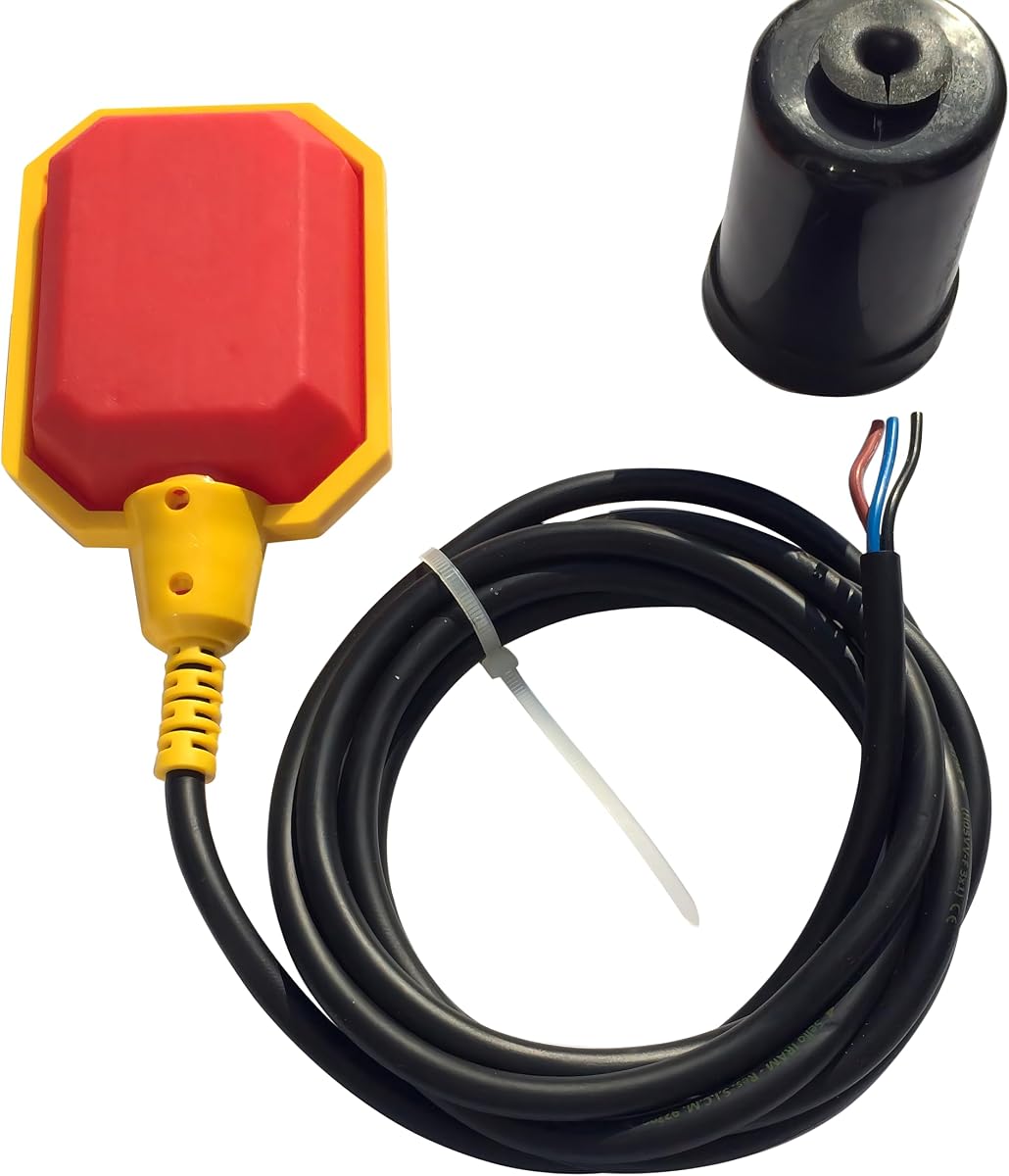
Float Switch with 10ft Cable
4.3Editor score
Ten-foot mechanical tether
IP68 waterproof housing
Sixteen-amp maximum current
Explore the best float switch for sump pump options, comparing cord length, pump ratings, waterproofing, installation, and automation features for basements.
A float switch for a sump pump is the small automatic control that starts a pump when water reaches a set level and stops it after the water falls. A dependable choice should match your pump’s electrical requirements, tolerate a damp sump pit, and provide enough cord or tether adjustment to fit your basin.
This guide compares ten mechanical float switches based on the information supplied for each product, including switch type, cord length, current rating, voltage, water resistance, installation hardware, and intended applications. It covers tethered and vertical designs for sump, sewage, effluent, utility, bilge, and water-tank systems.
The selections show where straightforward plug-in installation meets the needs of a typical basement, where a longer cord offers greater placement flexibility, and where added alarms or dual sensors justify a more specialized approach. Product ratings and availability can change, and current prices should be checked before purchasing.
4.3Editor score

4.7Editor score

4.7Editor score
The table below places all ten switches side by side, focusing on the characteristics that determine installation fit, pump compatibility, environmental resistance, and control range.




The PumpSpy 10ft Piggyback Tethered Float Switch is a mechanically operated replacement control for sump, sewage, and effluent pumps. It has a 4.6 rating and stands out for a straightforward universal design: a 10-foot cord, piggyback plug, adjustable cable grip, and stainless steel hose clamp are supplied for installation on a pump discharge line.
We may earn a commission when you buy through this link, at no additional cost to you.
The switch detects changes in water level and opens or closes its normally open electrical connection to control the pump automatically. Gold-plated electrical connections are intended to resist accelerated pitting and wear, while the modular construction and flexible cord make the unit easier to position than a permanently wired control. Its stated maximum is 10 amps at 120VAC, making electrical compatibility the most important qualification.
The tethered design also presents a tradeoff. The float must be able to move freely as water rises and falls, so obstructions, tangled debris, and nearby pipes can affect operation. It also carries a lower current allowance than several alternatives in this guide. Buyers whose pumps draw more current should not assume that universal physical connections make the switch electrically universal.
This is a strong choice for a homeowner replacing a failed tethered switch without running new wiring. It suits common 120V sump, sewage, and effluent pumps that operate within 10 amps. Confirm the pump nameplate, inspect the discharge pipe for room to clamp the switch, and verify the piggyback arrangement is appropriate before buying.
The supplied hose clamp and cable grip support quick installation without connecting the switch directly to household wiring. The pump cord plugs into the piggyback connection, which then connects to the appropriate outlet.
A sump pit is a damp environment, and the PumpSpy switch uses gold-plated connections to help limit pitting and wear. Its mechanical level-control approach also avoids the electronic circuitry found in some sensor-based controls.
We may earn a commission when you buy through this link, at no additional cost to you.
The PumpSpy 10 Foot Vertical Replacement Float Switch is our Editor's Choice because it combines an established vertical-switch format with a plug-in installation and broad sump-pump compatibility. Its 4.7 rating reflects a well-regarded option, while the stated cycle rating of up to one million cycles indicates a focus on long-term mechanical operation.
We may earn a commission when you buy through this link, at no additional cost to you.
This switch comes completely assembled and includes a 10-foot power cord with piggyback plug, mounting bracket, and stainless steel hose clamp. It can turn a compatible manual pump into an automatic system, starting it when water reaches the upper activation point and stopping it after the level drops to the lower point. Gold-plated contacts are designed to reduce buildup and pitting.
Its main limitation is the 10-amp maximum at 120VAC. That ceiling makes the nameplate information on the pump essential. Vertical placement also requires enough straight, unobstructed discharge pipe to permit the float to move through its operating range without striking the basin wall or a neighboring component.
This switch is an especially good general replacement for a 120V sump, sewage, or effluent pump that needs automatic operation without new electrical wiring. It is less appropriate for pumps with a higher running current or for installations with no room to mount the vertical float. With those conditions confirmed, it offers a balanced package of installation convenience, contact durability, and application flexibility.
A vertical float responds directly to rising and falling water while remaining compact along the discharge pipe. That makes the format especially familiar to sump-pump users and useful where a tethered cable cannot move freely.
Once correctly mounted, the switch can start the pump at the upper water level and stop it at the lower level. The result is hands-free drainage without installing a separate control panel or rewiring the pump.
We may earn a commission when you buy through this link, at no additional cost to you.
The WASSERMANN Vertical Float Switch offers a 10-foot cable, piggyback plug, and a stated maximum current of 16 amps at 125VAC. It has a 4.5 rating and is designed to start and stop compatible water pumps according to the water level, removing the need for manual operation during routine drainage.
We may earn a commission when you buy through this link, at no additional cost to you.
One of its most useful features is flexibility in mounting. The product information describes installation on either a pipe or the water pump using the included accessories, making it easier to adapt to different basin layouts. Its broader current allowance can also make it a more practical match than a 10-amp switch for certain higher-drawing 120V pumps.
Buyers should still verify every electrical specification against the pump nameplate. The product description refers to a rated voltage of AC 125V, while the title uses AC 115V, so the intended 120V-class application should be confirmed. The float can operate in water up to 125°C, but the surrounding system still must be suitable for that environment.
This switch is worth considering for a sump, sewage, effluent, or large water-tank system using a compatible 120V pump and a vertical mounting location. It is a good alternative for buyers who want more current headroom than common 10-amp replacements while retaining the convenience of a piggyback connection.
The ability to mount on a pipe or pump gives installers more options when the discharge-pipe layout is not ideal for a standard bracket. Included accessories support positioning the float where it can move freely.
The piggyback plug is described as compatible with most sump, sewage, and other water-pump connectors. Electrical current and voltage still determine whether the switch can safely control a particular pump.
We may earn a commission when you buy through this link, at no additional cost to you.
The FLUENTPOWER Vertical Float Switch is a complete, assembled replacement control with a 4.4 rating. It includes a 10-foot cord with piggyback plug, mounting bracket, stainless steel hose clamp, and four screws, giving buyers the principal hardware needed to add automatic operation to a compatible pump.
We may earn a commission when you buy through this link, at no additional cost to you.
Its stated applications include submersible sump, sewage, utility, sump-basin, and effluent pumps, and the product information specifically notes compatibility with the FLUENTPOWER FSP65035DWB sewage effluent pump. The pump plugs directly into the switch's piggyback plug, avoiding the need to wire the switch into a dedicated circuit.
The listed pumping range runs from 5.8 inches down to 0.75 inch, and the switch is limited to a 120V pump running current of 10 amps. Those details are especially important in a shallow basin. If the available vertical space is too short for the full range, the switch may not activate and deactivate at the appropriate levels.
This is a practical option for a DIY replacement where the pump operates within 10 amps, the discharge pipe has enough vertical travel, and the piggyback plug is physically compatible. It is less suitable for a higher-current pump, a pump with a nonstandard connector, or a basin too shallow to accommodate the stated operating range.
The bracket, clamp, screws, and long power cord allow the switch to be mounted and connected without a separate parts order. The pump cord plugs into the piggyback arrangement, simplifying the electrical side of the installation.
The listed compatibility extends beyond ordinary sump pumps to sewage, utility, effluent, and submersible applications. That makes the switch useful for homeowners with more than one compatible water-removal system.
We may earn a commission when you buy through this link, at no additional cost to you.
The HC6000v2 Sump Pump Float Switch is a more feature-oriented option for buyers who want warnings as well as automatic pump control. It has a 4.6 rating and uses a Hi-Lo dual-sensor arrangement intended to optimize pump cycles, reduce unnecessary wear, and improve the operating efficiency of the connected system.
We may earn a commission when you buy through this link, at no additional cost to you.
Its standout feature is the set of built-in alarms for high water levels or pump malfunctions. That makes it appealing in finished basements, pool installations, or other locations where early notification can help reduce damage. The compact design is intended to fit tight spaces and replace standard switches without complications, while the maintenance-free format removes moving parts that might otherwise need cleaning.
The listed longevity claim covers more than one million cycles, reinforcing the product's positioning as a long-term control rather than a disposable component. However, the supplied information gives fewer detailed electrical specifications than it does for several conventional tethered and vertical models. Buyers should therefore inspect the product, its installation instructions, and the pump nameplate rather than assuming compatibility from the general application description.
This switch is a strong candidate when built-in alarms are important or when conventional mechanical switches have not delivered the desired visibility into system failures. It may be less compelling for a simple replacement where the priority is the lowest-cost universally recognizable piggyback configuration. Its dual sensors and alarms justify closer attention in higher-consequence installations.
Built-in alarms can notify the user of high-water or pump-malfunction conditions, adding a monitoring layer that ordinary float switches do not provide. That visibility is especially useful in a finished basement.
The maintenance-free design avoids exposed moving parts that need cleaning. Its dual sensors are intended to improve pump-cycle efficiency, which can help reduce needless starts and stops.
We may earn a commission when you buy through this link, at no additional cost to you.
The Universal Sump Pump Float Switch is a tethered mechanical control with a 4.7 rating, a 10-foot cord, and a piggyback plug. It is intended to sense water levels and automatically switch compatible sump, sewage, septic, effluent, irrigation, lift, trash, and other pumps on and off.
We may earn a commission when you buy through this link, at no additional cost to you.
Its electrical specification is up to 13 amps at 125V/250VAC, 60Hz, and the product is described as safety certified by UL and CSA. Long-lasting silver snap contacts sit inside a heavy-duty, anti-corrosion, impact-proof ABS housing. The sealed IP68 float housing is designed to resist moisture, grime, abrasion, and pitting in demanding installations.
The 45°C, or 113°F, operating-environment limit deserves attention in hot outdoor tanks, warm wastewater systems, and sun-exposed pump pits. Despite the broad 250VAC wording, the plug arrangement is primarily presented as a 120V-class sump-pump replacement, so the pump and connected system should be checked carefully.
This is a strong choice for a household with multiple compatible water-handling applications or for a sewage or septic pump that requires a sealed float. It offers a generous 10-foot cord and straightforward installation between the pump cord and the power source. Confirm current draw, temperature, and physical connector compatibility before making the switch.
The IP68 housing is particularly relevant to damp, grimy sewage and septic environments. A fully sealed float can help protect the switching mechanism from contamination and moisture.
The unusually broad application list includes sump, sewage, septic, ejector, effluent, irrigation, lift, trash, condensate, tank, pond, and fountain systems. Buyers can use the same control style across several compatible water-removal installations.
We may earn a commission when you buy through this link, at no additional cost to you.
The Float Switch with 10ft Cable is the budget selection in this guide, offering a mechanical tethered control, a 10-foot cable, an IP68 waterproof enclosure, and a 16-amp maximum pump-running current. Its 4.3 rating is the lowest among the listed products, but the core specifications cover the needs of many common 120V sump-pump replacements.
We may earn a commission when you buy through this link, at no additional cost to you.
The water-contacting cable uses SJEOW standard and is described as UL certified, with a maximum service temperature of 140°F. The switch itself is built for underwater performance and operation in dirty sewage environments. Because it uses straightforward mechanical switching rather than complex electronic circuitry, the product is positioned as durable and comparatively resistant to electronic damage.
Installation is designed to be minimal. It connects through a piggyback plug and is secured with nylon ties, allowing the float to be positioned and adjusted as needed. The trade-off is that the included fastening method and general installation details are less elaborate than the hose clamp, cable grip, and bracket supplied with several competing models.
This switch suits a homeowner seeking a straightforward replacement for a compatible sump, water-tank, sewage, pool, or pond pump. The 16-amp allowance gives it useful electrical headroom, while the 10-foot cable helps accommodate a larger basin. Buyers should still check the pump's connector, operating current, and the product's complete installation guidance before use.
The switch provides the essentials of automatic pump control without adding an alarm system, complex electronics, or a broad bundle of mounting hardware. That simplicity supports its appeal as a budget replacement.
An IP68 rating and UL-certified water-contact cable give the switch credentials for wet sump and sewage locations. The mechanical design also has few components that can fail electronically.
We may earn a commission when you buy through this link, at no additional cost to you.
The Water Boss Float Switch combines an adjustable 10-foot tether with a Honeywell Microswitch and rugged polypropylene housing. Its 4.5 rating reflects a well-liked tethered option for sump, groundwater bilge, water-tank, and other water-level-control applications.
We may earn a commission when you buy through this link, at no additional cost to you.
The switch is rated for up to 13 amps or one-half horsepower and has CE and IEC approvals. Its IP68 housing is described as non-corrosive, while the PVC-jacketed tether has a listed temperature range from 32°F to 140°F. These details make it a credible option where moisture, mineral-laden water, or debris could shorten the life of a less robust control.
The most attractive feature is the adjustable tether, which allows the float to be shortened or positioned to suit the basin and desired water levels. A five-year manufacturer-defect warranty adds reassurance, although the warranty does not replace the need to match electrical ratings or maintain adequate float clearance.
This is a good selection for a groundwater or bilge application, a water tank, or a sump system with a half-horsepower-or-smaller pump. It may be less suitable for a higher-output pump. Confirm that the sump, tank, and liquid temperatures remain within the stated range and that the float can move without obstruction.
The IP68, non-corrosive housing is designed for wet locations where ordinary components may deteriorate. Its temperature range also makes it more broadly usable than a switch with a narrow environmental limit.
A Honeywell Microswitch provides the switching element and is noted for accuracy and repeatability. The five-year warranty against manufacturer defects gives the product a longer-term support commitment.
We may earn a commission when you buy through this link, at no additional cost to you.
The Little Giant RFSN-6 is our premium pick for a tethered float switch, combining a 10-foot cord, adjustable pump-down design, and 4.7 rating. It is intended for sump, sewage, effluent, pond, and utility pumps, allowing compatible equipment to start and stop automatically as water levels change.
We may earn a commission when you buy through this link, at no additional cost to you.
The stated pumping range is seven inches to 36 inches, offering more vertical adjustment than many basic tether switches. Maximum pump run current is 13 amps, maximum start current is 85 amps, and the pump should be no larger than one-half horsepower. The PVC housing and 16/2 SJOW cable are UL recognized and CSA certified, while the maximum liquid temperature is 140°F.
Those electrical and mechanical limits should be treated as firm requirements. A pump without integral thermal overload protection is not suitable, and a pump that exceeds the stated run or start current should use a different control. The RFSN-6 is best suited to water-resistant installations where the float has sufficient room to move across its range.
Despite those constraints, the RFSN-6 is an excellent choice for a homeowner who values certification, adjustable tethering, and a broad pumping range. It is particularly attractive for sump and utility systems with enough vertical clearance. Verify the pump's horsepower, starting characteristics, and overload protection before installation.
The tether can be adjusted to help establish the pump-on and pump-off levels within a seven-inch to 36-inch range. This makes the switch suitable for basins with more varied vertical dimensions.
UL recognition and CSA certification provide useful information about the listed switch and cable construction. Buyers should still observe the product's run-current, start-current, horsepower, and thermal-overload requirements.
We may earn a commission when you buy through this link, at no additional cost to you.
The Little Giant RFSN-9 shares the core operating characteristics of the RFSN-6 but adds a 15-foot cord. That extra length gives it an advantage in large basins, deep pits, elevated pump installations, or layouts where the outlet and float cannot be connected with a shorter lead.
We may earn a commission when you buy through this link, at no additional cost to you.
The switch is rated for a maximum one-half-horsepower pump, 13 amps of running current, and 85 amps of starting current. Its pumping range extends from seven inches to 36 inches, and the tether is adjustable. As with the RFSN-6, the pump must have integral thermal overload protection, and the maximum liquid temperature is 140°F.
The product information lists UL recognition and CSA certification in the United States and notes that it is made in USA. Those points distinguish it from several generic-looking alternatives in the list, although certification does not override the need to match the switch to the pump's electrical requirements.
Choose the RFSN-9 when a 15-foot cord is specifically needed and the pump is within the stated limits. It is less attractive when a 10-foot cord is already sufficient, but that extra length can eliminate awkward routing or make the float easier to position. Confirm the 115V rating, pump overload protection, and available tether space before installation.
The 15-foot cord provides additional installation reach compared with the RFSN-6 and most other selections. It can simplify connections where the power outlet is distant or the pump discharge pipe sits far from the basin edge.
The stated horsepower, run-current, start-current, temperature, and overload-protection requirements define the operating envelope. Adhering to all of them is essential for reliable and safe automatic operation.
We may earn a commission when you buy through this link, at no additional cost to you.
The most important factors are electrical compatibility, basin geometry, environmental resistance, and the type of automatic control needed. A switch that looks suitable can still fail if its current rating is too low, its float cannot move freely, or its connector does not match the pump.
Start with the pump nameplate rather than the motor horsepower alone. Run current is the amount the motor draws while pumping and must remain below the switch's stated maximum. The products in this guide range from 10 amps to 16 amps, so a high-drawing pump may require a higher-rated switch or a different control architecture. Starting current can be substantially higher than running current, making the RFSN-6 and RFSN-9's 85-amp start limit another important detail. A switch should never be selected solely because its plug physically fits the pump.
Most residential sump pumps in this category use 115V or 120V power, but the exact switch rating still matters. The WASSERMANN is described with 125VAC AC electrical specifications, while the Little Giant models are explicitly 115-volt products. Confirm the pump voltage, plug configuration, and whether the intended outlet and circuit are appropriate. The piggyback arrangement lets the pump cord connect to the float switch and the switch to the outlet, but it does not make incompatible electrical ratings interchangeable.
Vertical switches mount along the discharge pipe and use the float's vertical travel to actuate the control. Tethered switches use a weighted float connected by an adjustable cable. Vertical models can be compact and direct, but they need adequate pipe length and unobstructed movement. Tethered models offer a broader range of level adjustment, although debris and tight basin geometry can interfere with the float or cord. The right design follows the physical dimensions and layout of the actual sump basin.
Cord length determines how far the switch can reach from the pump or outlet. Most selections use a 10-foot cord, while the Little Giant RFSN-9 provides 15 feet. A longer cord is useful for a deep basin, a remote outlet, or a pump set deeper in the pit, but excessive slack can create routing problems. A shorter cord can be easier to manage. Measure the path from the power connection to the intended float position rather than relying only on the stated length.
A sump basin is permanently exposed to moisture, and sewage systems can add solids, grit, and corrosive residue. An IP68-rated housing offers a strong indication that the switch is sealed for immersion and dirty environments. The Water Boss and the universal 13-amp model emphasize corrosion-resistant construction, while several others specify waterproof housings. Temperature limits also matter: listed maxima range from 113°F in one product's environmental specification to 140°F for the Little Giant and Water Boss models. Compare both moisture resistance and expected liquid temperature.
The pumping range determines the vertical space between the switch-on and switch-off points. It must be compatible with the basin's depth and the level at which the pump should begin operating. Tethered products can often be adjusted more freely, while the FLUENTPOWER vertical switch is specified from 5.8 inches down to 0.75 inch. The Little Giant switches provide a seven-inch to 36-inch range. Account for the float's full physical size, not only the stated range, and make sure it cannot contact the basin wall.
Many switches use a piggyback plug, allowing installation without cutting into household wiring. That convenience does not remove the need to mount the float correctly. Some kits include a stainless steel hose clamp, bracket, screws, and cable grip, while others use nylon ties and provide fewer mounting components. Vertical switches generally attach to the pump discharge pipe; tethered switches can sometimes attach to the pipe or pump. Choose hardware that can withstand the sump environment and secure the float without restricting its travel.
Most mechanical float switches provide only on-and-off pump control, while the HC6000v2 adds Hi-Lo dual sensors and built-in alarms for high water or pump malfunction. Those features can add important warning in a finished basement, pool area, or other location where a failure would be difficult to discover. They are not necessary for every installation, and a more specialized controller may require more careful setup. Decide whether basic automatic operation is enough or whether early warning forms part of the flood-prevention strategy.
Before installation, disconnect the pump from its power source and identify the pump's voltage, running current, horsepower, plug type, and start-current requirements. Compare those values with the float switch specifications, inspect the discharge pipe, and confirm that the float will have unobstructed movement through the intended water-level range. For a tethered model, measure and adjust the cable so the float can rise and fall without striking the basin wall or becoming caught on debris.
Mount a vertical switch on a clean, straight section of discharge pipe using the supplied bracket and stainless steel hose clamp. Install a tethered switch on the pipe, pump, or another stable point according to its instructions, and use the included clamp or ties as intended. Connect the pump cord to the float switch's piggyback plug and plug the switch into the appropriate grounded outlet. Keep the pump, switch, connections, and electrical components above the expected splash zone and follow local electrical requirements.
Test the installation by briefly activating the pump and confirming that it starts normally, then fill enough water to raise the level to the switch's activation point. Verify that the pump starts, that it shuts off at the intended lower level, and that the float returns without sticking. After the first test, periodically remove debris, inspect the cord or mounting clamp, and listen for changes in pump operation. Replace the switch if contacts become erratic, the housing is damaged, or the float no longer moves freely.
Usually, yes, provided the replacement matches the pump's voltage, run current, plug configuration, and mounting needs. A physical piggyback connector does not guarantee electrical compatibility, so check the pump nameplate and compare it with the switch specifications. The switch type and available pipe or basin space must also be suitable.
A vertical float mounts directly on the discharge pipe and moves up and down to actuate the switch. A tethered float is connected by an adjustable cable and can often be positioned at a wider range of water levels. Vertical switches can be compact but need sufficient pipe travel, while tethered switches need room for the float and cable to move freely.
No. The switch must be compatible with the pump, and a higher rating does not compensate for incorrect voltage, a nonstandard connector, or an unsuitable installation. A switch with a rating above the pump's run current can provide useful headroom, but the product's other limits and the pump's start-current requirements still need to be checked.
Many switches in this guide are designed for sump, sewage, effluent, utility, and related water pumps. Compatibility still depends on electrical ratings, connector type, temperature, liquid conditions, and mounting space. The broad application lists on the universal 13-amp and FLUENTPOWER products make them especially versatile, subject to those requirements.
An IP68 rating indicates a high level of protection against dust and water, including the ability to withstand immersion under the conditions defined by the relevant standard. It is a useful indicator for damp, dirty, or flood-prone installations. The rating does not eliminate the need to secure the cord, maintain clearance, or inspect the housing for damage.
The required length depends on the outlet location, pump depth, discharge-pipe layout, and float position. Most choices provide 10 feet, while the Little Giant RFSN-9 provides 15 feet. Measure the actual route and avoid leaving so much slack that the cord becomes tangled or the float is pulled against an obstruction.
A continuously running pump may have a stuck or misaligned float, a damaged switch, an obstructed discharge, a clogged impeller, or a separate pump problem. Check whether the float moves freely and whether the switch changes state at the expected water level. Disconnect power before inspecting the mechanical components and test the switch separately if necessary.
Most of the listed models use a piggyback connection, so the pump cord plugs into the float switch and the switch plugs into the outlet. Installation then mainly involves securing the float to the discharge pipe or another suitable point. Local electrical codes, plug compatibility, and the manufacturer's instructions should always guide the installation.
The PumpSpy 10 Foot Vertical Replacement Float Switch is the strongest all-around recommendation for a compatible 120V sump, sewage, or effluent pump, offering a familiar vertical design, a piggyback connection, gold-plated contacts, and a stated one-million-cycle rating. The 10-foot Float Switch with 10ft Cable is the budget-friendly option, while the Little Giant RFSN-6 is the premium choice for buyers who prioritize certification, an adjustable tether, and a broad pumping range.
Begin with the pump's nameplate, then consider the basin. Match voltage and running current, choose vertical or tethered operation according to available space, and check temperature, waterproofing, cord length, and mounting hardware. If early warning is important, the HC6000v2 adds alarms and dual sensors; if a long route or deep basin makes cord length decisive, the Little Giant RFSN-9 offers 15 feet.
Ratings, product details, availability, and prices can change, so verify the current listing and manufacturer instructions before buying. Most importantly, do not select a switch based only on its plug, wattage impression, or broad application label. A reliable sump system begins with a control whose electrical ratings, float geometry, and environmental limits genuinely fit the pump and basin.