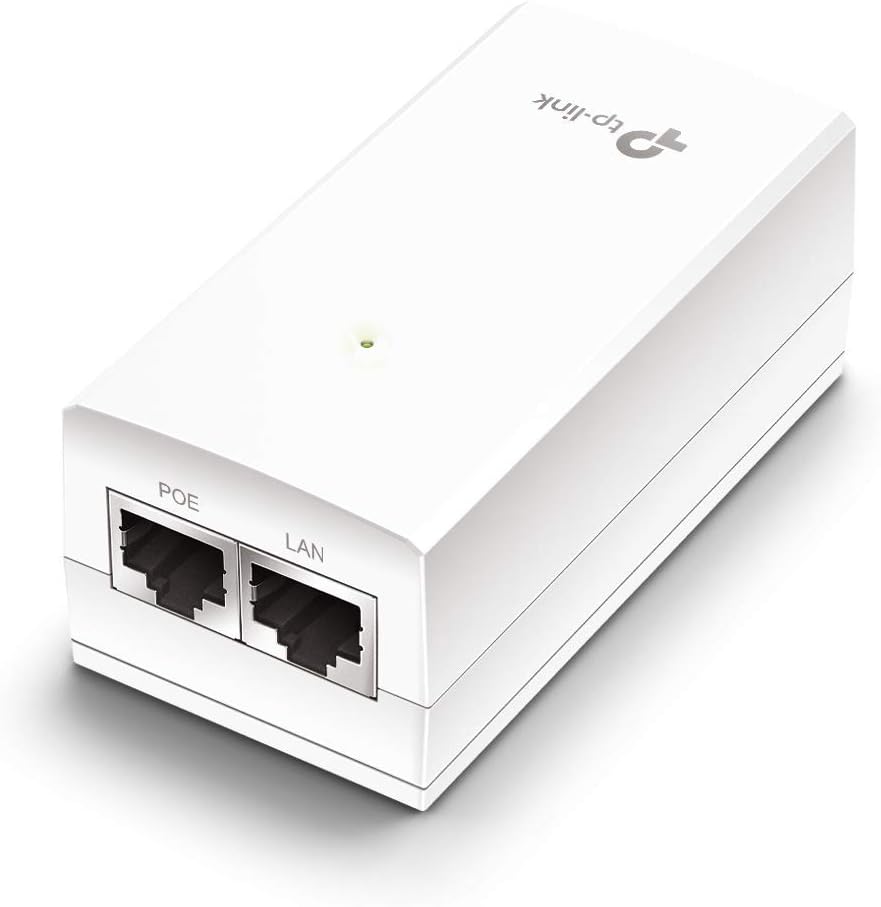
Omada POE2412G
4.4Editor score
24V passive PoE support
Automatic power detection
Convenient wall mounting
Our Gigabit POE Injector Adapters guide compares power standards, port speed, range, mounting, and compatibility to help you choose the right model with
Gigabit PoE injector adapters add both power and network connectivity to compatible devices through one Ethernet cable. They are especially useful for IP cameras, wireless access points, VoIP phones, and other equipment installed where a nearby outlet is inconvenient. A capable injector should match the device’s power standard while preserving full Gigabit data throughput.
The products in this guide were compared using their stated port configurations, supported PoE standards, maximum power output, transmission distance, installation features, and intended applications. The list covers standard 802.3af devices, 802.3at PoE+ equipment, passive PoE, and more demanding 802.3bt PoE++ installations, with attention given to features such as auto-sensing and wall mounting.
Each review explains where the injector stands out, identifies any practical limitations, and clarifies the kind of installer or device it best serves. The top selections represent the strongest all-around options, a capable budget model, and a premium choice for higher power demands. Product availability, features, and prices can change, so verify current specifications before purchasing.
4.4Editor score

4.7Editor score

4.5Editor score
The table below compares all ten injectors by their core capabilities, including supported power levels, Gigabit connectivity, transmission range, and practical installation features.


The Omada POE160S combines broad PoE+ compatibility, full Gigabit ports, and straightforward installation in a compact injector. Its 4.6 rating reflects a favorable balance of useful capacity and ease of use. The device accepts a non-PoE network input and delivers both power and data to an 802.3at or 802.3af endpoint through one Ethernet cable, making it a practical solution for common professional installations.
We may earn a commission when you buy through this link, at no additional cost to you.
Auto Detect is one of the product’s most valuable features. Rather than requiring manual power selection, the injector automatically supplies up to 30W to a compliant PoE+ device while maintaining backward compatibility with 802.3af equipment rated at 15.4W. The single Gigabit input and single Gigabit output preserve high-speed wired connectivity, and the stated 100-meter transmission distance allows cameras or access points to be placed well away from a power outlet.
The main limitation is that it serves the PoE+ tier rather than the newest PoE++ tier. Equipment requiring more than 30W would need a higher-output injector, and devices that specifically depend on passive PoE should confirm compatibility before installation. Even so, the POE160S covers the most widely used PoE and PoE+ categories without requiring complex configuration, making those trade-offs easy to accept for the intended applications.
This is the strongest general-purpose choice for installers adding power to a standard IP camera, wireless access point, VoIP phone, or other 802.3af/at device. Its auto-detection, Gigabit throughput, certification, and 100-meter reach cover the central requirements of a dependable PoE injector. Choose it when you need reliable 30W PoE+ performance without moving to a larger PoE++ system.
The auto-detection function reduces the chance of a mismatch between the injector and endpoint. It can deliver the higher 30W allocation to a compliant PoE+ device while recognizing lower-power 802.3af equipment, which is useful in mixed environments.
Combining data and power over one Ethernet run reduces cable clutter and removes the need for a local outlet. The stated 100-meter reach gives installers useful flexibility for cameras, access points, and other distributed network equipment.
We may earn a commission when you buy through this link, at no additional cost to you.
This generic Gigabit PoE+ injector offers a 4.6 rating and a useful combination of auto-sensing, integrated power, and IEEE 802.3af/at compliance. It converts a non-PoE switch or device into a PoE source, allowing a compatible camera, access point, or IP phone to receive power and network data over a single Ethernet connection. It is designed for straightforward deployment without software or configuration.
We may earn a commission when you buy through this link, at no additional cost to you.
The unit includes one Gigabit Ethernet input and one PoE+ Gigabit output, with automatic delivery of up to 30W. Backward compatibility with 802.3af devices makes it suitable for networks containing both older PoE hardware and newer PoE+ equipment. Its integrated power supply also keeps the installation more self-contained, while the listed 100-meter range provides ample distance between the network source and endpoint.
One important distinction is that this product is intended for PoE devices and PoE cameras, not cameras that accept data and power through separate connections. Equipment requiring more than 30W is also outside its stated capacity. The included status-light behavior should not be mistaken for a fault: a red load indicator can turn on during normal output, while the green light indicates that power is active.
The adapter is a good fit for home offices, small surveillance systems, and business networks with standard 802.3af or 802.3at endpoints. It delivers the essential combination of Gigabit data and automatic PoE power without adding installation complexity. Users should verify the endpoint’s connection method and power requirement before installation, but compatible devices will receive an efficient and convenient single-cable solution.
Support for both 802.3af and 802.3at allows the injector to serve a wider mix of network equipment. Its stated compatibility with IP cameras, VoIP phones, and wireless access points makes it relevant to several common installation categories.
The green power light and red load indication provide simple operational feedback. Since a red load light may appear during normal output, installers should understand the stated behavior before troubleshooting the installation.
We may earn a commission when you buy through this link, at no additional cost to you.
The TRENDnet TPE-115GI stands out with a 4.7 rating, a 30W PoE+ output, auto-sensing technology, and a wall-mountable form factor. It uses one Gigabit Ethernet input and one PoE+ Gigabit Ethernet output, giving installers a straightforward way to turn a non-PoE network port into a power source for a compatible endpoint. Full-duplex Gigabit operation helps it serve both network extension and device power delivery.
We may earn a commission when you buy through this link, at no additional cost to you.
The injector automatically recognizes 802.3at PoE+ equipment and remains backward compatible with 802.3af PoE devices at up to 15.4W. A 100-meter connection distance supports distributed equipment such as cameras and access points, while the integrated power supply and LED indicators simplify setup and monitoring. Its enclosure is designed to accommodate wall-mounted installations, where keeping the unit accessible but out of the way is important.
TRENDnet also lists NDAA and TAA compliance for government customers in the United States and Canada and backs the product with three years of manufacturer protection. These benefits matter in institutional or procurement-sensitive environments, although the stated compliance claim is geographically limited. Like most injectors in this category, it tops out at 30W and therefore does not serve high-power PoE++ equipment.
The TPE-115GI is a strong recommendation for professional installers who want more than basic PoE conversion. It combines a high user rating, automatic compatibility, Gigabit performance, flexible installation, and formal support terms. Choose it for standard PoE and PoE+ deployments, particularly when wall mounting or organizational purchasing requirements are part of the installation.
Wall mounting, integrated power, LED status confirmation, and three years of manufacturer protection make the injector suitable for managed deployments. These details are especially relevant in offices, schools, public facilities, and multi-site installations.
The injector can deliver up to 30W to 802.3at equipment and up to 15.4W to 802.3af equipment. That flexibility reduces configuration work when different endpoint types share the same installation plan.
We may earn a commission when you buy through this link, at no additional cost to you.
The Omada POE2412G is a compact, budget-oriented injector with a 4.4 rating and a maximum output of 12W. Unlike many standard 802.3at models, it emphasizes 24V passive PoE support and automatically determines the required power level. That makes it relevant for compatible lower-power devices that do not require the full 15.4W or 30W supplied by conventional PoE injectors.
We may earn a commission when you buy through this link, at no additional cost to you.
Gigabit speed support ensures the data path remains appropriate for modern network equipment even though the power budget is modest. The injector can be wall mounted, which is valuable in confined spaces or installations where the unit needs to remain secure. It also operates in a plug-and-play manner without software, configuration files, or complicated setup procedures.
The central trade-off is the 12W ceiling. It cannot power a high-demand 802.3at or 802.3bt endpoint, and its 24V passive approach may be incompatible with equipment designed specifically for standard 802.3af power negotiation. Passive PoE should therefore be matched carefully to the device’s voltage and polarity expectations rather than selected solely by connector shape.
The POE2412G is a sensible pick for installers with a known 24V passive PoE device or a compact deployment where only modest power is needed. It provides the core benefit of PoE—one cable for data and power—while retaining Gigabit connectivity. Verify the endpoint’s electrical requirements first; if they align, this is a focused and economical solution.
The 12W output distinguishes this model from broad 30W alternatives. It is best suited to devices explicitly designed for 24V passive PoE, including their voltage and polarity requirements.
The wall-mountable design and no-configuration operation keep deployment simple. It can sit close to the endpoint or network source without becoming a prominent part of the installation.
We may earn a commission when you buy through this link, at no additional cost to you.
The BV-Tech 30W Gigabit PoE+ Injector combines a 4.4 rating with a 30W output at 54V and a stated 100-meter range. It is designed for IEEE 802.3at and 802.3af devices, including PTZ IP cameras, wireless access points, and IP phones. Support for 10/100/1000Base-T environments keeps the data side appropriate for Gigabit connected equipment.
We may earn a commission when you buy through this link, at no additional cost to you.
Automatic detection and protection of non-standard Ethernet terminals is a notable feature. Instead of simply applying maximum power to every connected endpoint, the injector is designed to provide the power each device needs, helping reduce the risk of damaging equipment with incompatible connections. Its Level VI efficiency compliance also targets lower standby consumption and more responsible energy use.
The enclosure offers more unusual installation flexibility than many competing injectors. An interlocking feature is included for organized multi-unit installations, while integrated wall-mount slots allow individual units to be placed securely. The tradeoff is that the product’s 30W maximum still leaves genuinely high-power PoE++ devices outside its range, and passive PoE support is not stated in the available specifications.
This injector is a good match for standard PoE+ deployments where energy efficiency, endpoint protection, and flexible mounting are priorities. It works particularly well for 30W-capable cameras and access points, while 802.3af devices can also be used within the stated standards. Confirm endpoint requirements, then choose it for a secure, organized installation with efficient 30W delivery.
The injector detects connected Ethernet terminals and applies the appropriate power. This approach is preferable to assuming every device can safely accept the injector’s maximum output.
Interlocking features support tidy deployments with several injectors, while wall slots provide secure placement. These options are particularly helpful in equipment closets and structured cabling environments.
We may earn a commission when you buy through this link, at no additional cost to you.
This Gigabit PoE++ Injector earns a 4.6 rating by combining up to 60W of power with compatibility across 802.3af, 802.3at, and 802.3bt devices. It can supply the familiar 15.4W PoE level, 30W PoE+ level, and up to 60W for PoE++ equipment, while also offering backward compatibility for passive PoE devices. That range makes it a versatile middle ground between ordinary PoE+ and very high-output injectors.
We may earn a commission when you buy through this link, at no additional cost to you.
The injector uses one Gigabit input and one PoE++ Gigabit output, supporting full-duplex Ethernet speeds up to 2Gbps. Its internal AC/DC converter avoids the need for a separate external power brick, simplifying the physical installation. Automatic detection distinguishes PoE and non-PoE equipment, supplies compliant endpoints appropriately, and powers down for non-standard equipment to protect the system.
Its 60W limit means it cannot meet the needs of every 802.3bt device, particularly models designed for the full 95W class. Passive PoE support also requires the endpoint’s electrical requirements to be compatible rather than assuming universal behavior. Despite those qualifications, the injector is more versatile than a 30W model and includes helpful built-in power conversion.
This is a strong option for networks with mixed PoE generations or a specific device that needs more than 30W but does not require 95W. It is especially suitable for installers who want one unit to cover several endpoint categories. Verify the endpoint’s standard and power ceiling before connecting, and use quality Ethernet cabling to support the full installation distance.
Compatibility with 802.3af, 802.3at, and 802.3bt classes makes the unit adaptable to mixed equipment. Backward support for passive PoE broadens its potential uses when endpoint requirements are carefully matched.
The internal AC/DC converter removes the need for an external power brick. That simplifies placement around cabinets, walls, and other areas where additional adapters would be inconvenient.
We may earn a commission when you buy through this link, at no additional cost to you.
The TRENDnet TPE-119GI is the most capable premium option in the list, with a 4.5 rating and an output stated as high as 95W. It converts a non-PoE Gigabit port into a PoE++ Gigabit port and can deliver 15.4W PoE, 30W PoE+, or up to 95W PoE++ to the connected device. That broad range lets one injector handle both ordinary and demanding 802.3bt equipment.
We may earn a commission when you buy through this link, at no additional cost to you.
Auto-sensing technology automatically selects the appropriate wattage, reducing manual setup and helping installers use mixed device types. A Gigabit data input and Gigabit PoE++ output support high-speed communications over a stated distance of 100 meters. The unit uses a sturdy metal enclosure and a wall-mount design, giving it a more permanent installation profile than a lightweight plastic adapter.
TRENDnet lists three years of manufacturer protection and technical support, while the product is also described as NDAA and TAA compliant for government customers in the United States and Canada. The 95W capability is the main reason to choose this model over a 30W injector. However, it is unnecessary for ordinary cameras, phones, and access points that only require lower PoE power, so purchasing it purely for a basic endpoint could be excessive.
The TPE-119GI is ideal for high-end access points, advanced cameras, and other 802.3bt devices that need a substantial power budget. It is also a practical single-unit solution when the installation may include a mix of PoE, PoE+, and PoE++ endpoints. Choose it when power headroom, metal construction, and support coverage outweigh the value of a smaller standard PoE+ adapter.
An output of up to 95W supports the newest 802.3bt class while retaining compatibility with 15.4W and 30W devices. This makes the injector future-oriented for installations that may later add more demanding equipment.
The metal enclosure and wall-mount format suit permanent structured installations. It can be secured in a technical room or positioned near the cabling route more securely than a lightweight portable adapter.
We may earn a commission when you buy through this link, at no additional cost to you.
The Gigabit PoE+ Injector, 30W 48V, provides a 4.5 rating and a 30W power budget with full Gigabit data connectivity. It is compliant with IEEE 802.3af and 802.3at, uses one Gigabit Ethernet input and one PoE/PoE+ Gigabit Ethernet output, and is designed for straightforward setup without complex configuration.
We may earn a commission when you buy through this link, at no additional cost to you.
Auto-sensing technology delivers up to 30W to PoE+ devices while preserving backward compatibility with 802.3af equipment at 15.4W. The injector can transmit data and power for as long as 100 meters, making it useful for cameras and access points deployed away from outlets. Its flame-retardant plastic housing is compact and positioned for a broad range of common installation scenarios.
The product is described as compatible with CCTV cameras, IP phones, wireless access points, 802.11n/ac/ax routers, network attached storage, and smart TVs, subject to their individual power and PoE requirements. Its limitation is that it remains a 30W PoE+ unit. It does not provide the higher output of an 802.3bt PoE++ injector, and passive PoE is not listed as a supported mode.
This injector is a versatile option for homes, small offices, and compact commercial deployments that need a standard PoE+ source. Its broad device list, auto-detection, and long reach cover the most common networking needs without requiring software. Match the endpoint to the 802.3af or 802.3at class and stay within 30W for dependable results.
The stated device support spans surveillance, telephony, wireless networking, storage, and display equipment. That breadth makes the injector useful for mixed residential and office networks, provided each endpoint falls within the supported PoE class.
The small flame-retardant enclosure is easier to position than a large powered chassis. It can sit near the endpoint or within a structured cabling space without consuming excessive room.
We may earn a commission when you buy through this link, at no additional cost to you.
The REOLINK RLA-PI1 carries a 4.7 rating and is specifically designed to simplify camera installations using REOLINK equipment. It converts a non-PoE Gigabit port into a PoE+ Gigabit port, delivering 30W to compatible PoE+ devices and 15.4W to PoE equipment. Its recommended applications include REOLINK PoE IP cameras, video doorbells, and floodlight cameras.
We may earn a commission when you buy through this link, at no additional cost to you.
Power and data travel over one Ethernet cable for a stated distance of up to 100 meters. This makes the injector useful when a camera needs to be positioned where a local power outlet is unavailable. The plug-and-play approach requires no complicated setup, and users can avoid separate device power cords and adapters by sourcing both necessities through the network connection.
Its specialized positioning is the main limitation. While its stated specifications describe standard PoE and PoE+ behavior, the product information particularly emphasizes compatibility with REOLINK devices. It also cannot deliver the higher output required by demanding 802.3bt endpoints, making it less suitable as a universal high-power solution.
The RLA-PI1 is an excellent choice for a REOLINK-based security system that includes cameras or other compatible devices without convenient outlet access. Its high rating, 100-meter reach, and automatic selection between PoE and PoE+ power levels reduce installation friction. Choose it for a REOLINK-centered project, then confirm each endpoint’s power class before connecting.
The injector is especially relevant to REOLINK PoE cameras, video doorbells, and floodlight cameras. That ecosystem focus gives it a clear role in surveillance installations where equipment is intended to work together.
A 100-meter Ethernet run carries both connectivity and power, allowing security equipment to be placed away from wall outlets. This is especially useful around outdoor perimeters, entrances, and larger properties.
We may earn a commission when you buy through this link, at no additional cost to you.
The TP-Link TL-PI30G is a focused 30W Gigabit PoE+ injector with a 4.5 rating. It converts a non-PoE switch or device into a PoE source, allowing compatible equipment to receive both power and network data through one Ethernet cable. Its single Gigabit input and single Gigabit output provide a clear, uncomplicated path for standard PoE+ deployments.
We may earn a commission when you buy through this link, at no additional cost to you.
Automatic power detection supplies up to 30W to an 802.3at PoE+ device and maintains backward compatibility with 802.3af equipment rated at 15.4W. The injector can deliver power and data over a stated 100-meter distance, making it practical for IP cameras and access points located beyond convenient outlet reach. Installation requires no software or configuration.
The product does not offer the output of a PoE++ injector, so high-power 802.3bt devices are outside its intended range. Passive PoE is also not listed among its supported features. These are meaningful limitations when a project includes specialized equipment, but for standard PoE and PoE+ endpoints, the TL-PI30G covers the essential requirements without unnecessary complexity.
This is a practical pick for IT installers, small businesses, and home network builders who need to add PoE capability to an existing non-PoE port. Automatic detection, full Gigabit throughput, and 100-meter reach make it especially convenient for cameras and access points. Confirm that the endpoint uses standard 802.3af or 802.3at power and does not exceed 30W.
The TL-PI30G avoids the need to replace an existing non-PoE switch or device. That makes it a practical way to introduce PoE only where it is needed rather than rebuilding the entire network.
The injector identifies the power class of a compliant endpoint and supplies the appropriate level. It supports 30W PoE+ and 15.4W PoE without requiring manual selector changes.
We may earn a commission when you buy through this link, at no additional cost to you.
A suitable PoE injector must satisfy three connected requirements: the endpoint’s power class, the Ethernet distance, and the physical installation. The following factors help narrow the field before you purchase.
Start with the power standard supported by the device that will receive power. Standard 802.3af devices generally require up to 15.4W, while 802.3at PoE+ devices may need up to 30W. An 802.3bt PoE++ endpoint can demand still more, with the TRENDnet TPE-119GI reaching 95W and the Gigabit PoE++ Injector reaching 60W. A lower-output injector cannot safely substitute for a model that meets the endpoint’s actual requirement.
In short, choose an injector whose supported class and maximum output match the device rather than merely offering a similar-looking connector.
Active PoE performs negotiation and power detection, while passive PoE applies a specified voltage without the same negotiation process. The Omada POE2412G supports 24V passive PoE, making it appropriate for carefully matched devices, whereas the Gigabit PoE++ Injector also states backward compatibility for passive PoE. Never assume passive and active equipment are interchangeable because their voltage, polarity, and detection behavior may differ.
In short, check whether the endpoint requires standards-based negotiation or a specific passive voltage before choosing the injector.
A Gigabit injector should have a Gigabit input and output, not merely a label suggesting high speed. This distinction matters for IP cameras, wireless access points, NAS devices, and other systems that can move more data than 100Mbps. Several products explicitly support 10/100/1000Base-T, while others advertise Gigabit ports and full-duplex operation. Verify both the upstream source and endpoint also support Gigabit Ethernet, since the slowest component limits the available throughput.
In short, confirm that the input, output, switch, and endpoint are all Gigabit-capable for a genuine Gigabit path.
Most products in this guide support a stated maximum distance of 100 meters, or 328 feet, for combined power and data delivery. That is ample for most rooms and small buildings, but longer property runs may require Ethernet extenders, switches, or a different network design. Cable quality, bundling, environmental conditions, and installation workmanship can affect real-world performance even within the stated limit.
In short, measure the complete route and use suitable Ethernet cabling, especially when the run approaches 100 meters or passes through demanding environments.
An injector may live in a cabinet, on a wall, behind a monitor, or near an outdoor camera. Wall-mountable designs from TRENDnet and Omada, integrated status LEDs, and compact housings can make the hardware easier to position and maintain. The TRENDnet models also emphasize a metal enclosure, while the BV-Tech model offers interlocking features for organized multi-unit deployments. Think about access for indicators and connectors before selecting a form factor.
In short, select a housing and mounting style that keeps the injector secure, ventilated, and convenient to inspect.
Auto-sensing or auto-detect technology can identify the connected device’s requirements and apply the appropriate power level. It is especially valuable in mixed deployments where 15.4W and 30W endpoints may share the same installation plan. The Omada POE160S, TRENDnet injectors, and TP-Link TL-PI30G all highlight automatic power matching. The BV-Tech unit adds stated protection for non-standard terminals, while the 60W PoE++ model is described as powering down for non-standard equipment.
In short, automatic detection reduces setup work and helps protect connected hardware, making it a valuable feature in professional installations.
For business, institutional, or government work, manufacturer protection and documented support can matter as much as the technical specifications. TRENDnet lists three years of manufacturer protection for both TPE-115GI and TPE-119GI. Those models are also described as NDAA and TAA compliant for government customers in the United States and Canada, while the BV-Tech model is described as NDAA compliant. Confirm the exact procurement requirements for the intended market rather than assuming all compliance statements are interchangeable.
In short, review warranty terms and applicable procurement standards when the injector will support business or government infrastructure.
Begin by confirming that the endpoint supports the same PoE class and power level as the injector. Connect the non-PoE network source to the injector’s Gigabit input using suitable Ethernet cable, then connect the PoE endpoint to the injector’s PoE output. Once the power connection is established, allow the device to negotiate or detect the required power level. Do not connect a standard PoE injector directly to a non-PoE device merely to test it.
Position the injector where it will remain ventilated, dry, and mechanically secure. Wall mounting can help keep the unit away from foot traffic, moving cables, and accidental impact. Avoid placing it beneath rugs, inside tightly sealed cabinets without airflow, or where moisture may collect. Route Ethernet cables away from sharp edges and strong sources of interference, and avoid sharp bends or unsupported cable lengths.
Use the stated indicator lights to confirm that power and load are present, interpreting them according to the product’s guidance. If the endpoint does not start, check the cable connections, power source, device compatibility, and whether its power requirement exceeds the injector’s output. Do not repeatedly change electrical arrangements if the endpoint expects a different passive voltage. For outdoor or exposed installations, use equipment and enclosures rated for the actual environmental conditions.
A Gigabit PoE injector converts a non-PoE network connection into a PoE connection by adding power to Ethernet data. It typically has one Gigabit input for an existing switch and one Gigabit output for a compatible camera, access point, phone, or other device. This allows one Ethernet cable to carry both network data and power.
Yes, when the injector supports backward compatibility and the connected device uses standards-based PoE. Models with automatic detection can identify the lower requirement and deliver the appropriate level. The device must still use compatible 802.3af power negotiation, and passive PoE equipment requires separate voltage and polarity verification.
Most of the injectors listed here support a combined power-and-data distance of up to 100 meters, or 328 feet. Actual performance can vary with Ethernet cable quality and installation conditions. A run beyond that distance requires an extender, additional network equipment, or a redesigned topology.
No. An injector is intended to add PoE capability to a non-PoE switch or network source at one endpoint. A PoE switch is useful when several devices need centralized power delivery, but a single injector can be sufficient for one remote camera, access point, or phone reached through an existing Gigabit network.
A standards-compatible PoE++ injector is designed to support lower PoE and PoE+ classes as well as 802.3bt devices. The Gigabit PoE++ Injector lists support for 15.4W, 30W, and up to 60W, while the TRENDnet TPE-119GI adds up to 95W. Automatic sensing is important because it selects the correct power level for each endpoint.
No, not merely because the device also has an Ethernet connection. A PoE injector supplies power through the Ethernet cable according to a supported PoE standard or passive arrangement. Devices designed for a separate power adapter and non-PoE data connection generally cannot be powered directly by the injector.
Active PoE follows standards such as IEEE 802.3af, 802.3at, or 802.3bt and can negotiate or detect the device’s requirements. Passive PoE applies a specified power level without the same negotiation process. The Omada POE2412G supports 24V passive PoE, so the connected equipment’s voltage and polarity requirements must be confirmed.
First verify that the endpoint supports PoE and does not require more power than the injector provides. Check both Ethernet connections, confirm the injector has power, and review its status indicators according to the product instructions. If the equipment expects passive PoE, confirm its required voltage and polarity before connecting or troubleshooting further.
The TRENDnet TPE-115GI is the strongest all-around option for standard PoE and PoE+ installations, combining a 4.7 rating, 30W auto-sensing, Gigabit ports, wall mounting, and formal support. The Omada POE2412G is the budget-focused selection for compatible 24V passive PoE devices, while the TRENDnet TPE-119GI is the premium choice when an endpoint needs up to 95W of 802.3bt power.
Prioritize the power class of the endpoint before every other consideration, followed by genuine Gigabit port support, installation distance, and the type of network source. Active 802.3af and 802.3at equipment is broadly covered by the 30W models, passive PoE demands closer electrical verification, and high-power devices require a 60W or 95W injector. Physical placement and cable quality also influence whether a theoretically capable installation works as intended.
Before purchasing, confirm the current product specifications, compatibility notes, and connector arrangement for the exact device being powered. Product features, supported standards, availability, and prices can change, so current listings should be checked before ordering. With the correct power class and installation plan in place, one of these injectors can provide a clean single-cable solution for power and Gigabit connectivity.