
Grasside Level 2 EV Charger
4.9Editor score
48A hardwired 240V output
RFID and app access
IP65 weather protection
25-foot J1772 cable
This guide compares the best Hardwired 48 Amp Ev Chargers for speed, connector compatibility, safety, smart controls, cable reach, and installation needs.
A hardwired 48 amp EV charger delivers the highest output available from many residential Level 2 charging stations, giving compatible electric vehicles up to 11.5 kW of charging power. The right model can shorten charging times substantially, but connector type, electrical capacity, safety certifications, and installation requirements matter just as much as headline amperage.
We compared all ten chargers across charging output, vehicle compatibility, cable length, weather resistance, app functionality, access controls, safety certifications, warranty coverage, and installation considerations. The list includes dedicated hardwired models, dual-mode chargers, and plug-and-play designs that also support hardwiring, allowing you to compare practical differences rather than identical feature lists.
Each review explains what stands out, where compromises may arise, and who is most likely to benefit. Ratings reflect the supplied customer feedback, while specifications and compatibility claims come from the available product information. Retail prices and promotional terms can change, so confirm current listings and electrical requirements before purchasing.
4.9Editor score
4.7Editor score

4.7Editor score
The table below compares the ten chargers by output, connector, cable, installation type, and standout capabilities. It is a quick way to identify the right general category before reading the detailed reviews.




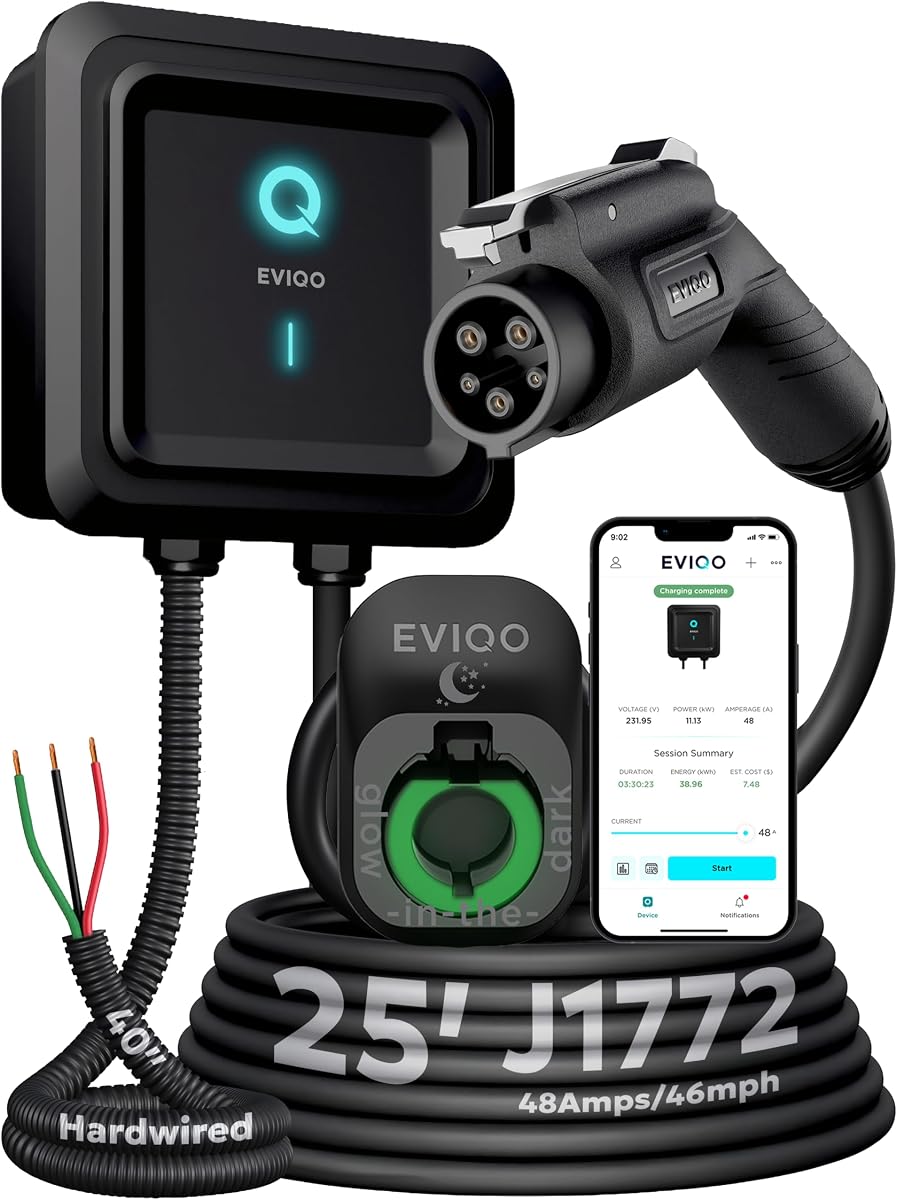
The EVIQO J1772 48A combines full 48 amp hardwired output with a long cable, strong app controls, and one of the more complete weather-protection specifications in this guide. Its supplied rating is 4.7, and its standout qualities include flexible charging-current settings, remote session management, and an included holster designed to remain visible in low-light conditions.
We may earn a commission when you buy through this link, at no additional cost to you.
This charger is designed around a dedicated 60 amp, 240-volt circuit, allowing it to deliver up to 48 amps of Level 2 power. The app can start and stop charging, adjust output from 6 to 48 amps, set reminders, and track energy use. The enhanced antenna is intended to preserve connectivity in garages and basements, although the unit requires a 2.4 GHz home network rather than 5 GHz WiFi.
The main compromise is connector compatibility for Tesla owners without a suitable J1772 adapter. It is also a permanently installed device, so an electrician and adequate panel capacity are essential. A DIP-switch configuration can unlock 50 amps on a dedicated 70 amp circuit, but that option should be selected only after professional electrical evaluation. Otherwise, the 48 amp configuration offers a balanced mix of power, connectivity, and outdoor-ready construction.
This is an especially strong choice for a J1772-equipped EV owner who wants fast overnight charging, app-based scheduling, and a generous 25-foot cable without giving up basic plug-and-charge convenience. It also suits installers looking for adjustable output, remote updates, and a glow-in-the-dark holster. Buyers should confirm their vehicle connector, panel capacity, and local electrical requirements before ordering.
The companion app provides unusually broad control for a home charger, including current adjustment, remote control, reminders, and session energy tracking. The charger also supports automatic over-the-air updates, helping keep its software and functions current without requiring the owner to open the unit.
A hardwired 48 amp installation requires careful electrical work, but the result removes plug wear and supports the highest output on the list. The 25-foot cable, IP66 and NEMA 4 enclosure, internal shielding, and glow-in-the-dark holster make it well suited to a garage, driveway, or exposed outdoor location.
We may earn a commission when you buy through this link, at no additional cost to you.
The Tesla NACS 48A is the clearest choice in this guide for owners of a vehicle with a native NACS port. It has a built-in Tesla-style plug, including a release button, and avoids the adapter required by most J1772 chargers. The supplied rating is 4.7, with full 48 amp hardwired performance as its defining feature.
We may earn a commission when you buy through this link, at no additional cost to you.
Beyond the connector, the charger closely matches the strengths of the leading J1772 model. It offers 6-to-48-amp app adjustment, remote start and stop, charging reminders, energy and cost tracking, scheduled off-peak charging, and automatic software updates. A stronger built-in antenna is designed to maintain a connection in garages and basements, while the app requires 2.4 GHz WiFi.
Its IP66 and NEMA 4 enclosure, internal steel shielding, and 25-foot cable make it suitable for either indoor or outdoor installation. The included high-visibility holster simplifies connector storage. The important limitation is that non-Tesla J1772 vehicles need a NACS-to-J1772 adapter, which is not included. Buyers must also provide a dedicated 60 amp circuit for 48 amp operation or the specified 70 amp setup for the selectable 50 amp output.
This charger is best for Tesla Model S, 3, X, or Y owners, as well as other vehicles using a native NACS connection, who prioritize a clean, adapter-free setup. It also makes sense for mixed-EV households willing to obtain the appropriate adapter for occasional J1772 charging. Confirm the actual port on your vehicle before ordering, and have a licensed electrician evaluate the installation.
The integrated NACS plug connects directly to compatible vehicles, and its opening button improves the physical connection routine. For owners who charge a Tesla most often, that convenience can outweigh the need to carry a separate J1772 adapter.
The app, over-the-air updates, adjustable output, strong antenna, and long cable support a polished daily charging setup. Weather resistance and the three-year warranty add further confidence for permanent garage or outdoor use.
We may earn a commission when you buy through this link, at no additional cost to you.
The Emporia Level 2 EV Charger stands out because it supports both a 40 amp NEMA plug-in configuration and a 48 amp hardwired configuration. Its supplied rating is 4.7, and it combines flexible installation with a 25-foot J1772 cable, WiFi energy management, and a substantial list of recognized safety certifications.
We may earn a commission when you buy through this link, at no additional cost to you.
When connected through the NEMA 14-50 configuration, the charger can deliver up to 40 amps. Converting it to a hardwired installation raises the maximum to 48 amps on a dedicated 60 amp circuit. That makes the unit useful for homeowners who may begin with a simpler installation or need the extra output later, although professional installation is recommended for safe, code-compliant hardwiring.
The app connects through 2.4 GHz WiFi and provides real-time energy data, session monitoring, and charging schedules. The charger is UL listed and ENERGY STAR certified, with the supplied information also identifying SAE J1772, UL 817, UL 991, UL 2231, UL 2251, UL 2594, and NEC 625 criteria. It uses a standard SAE J1772 connector for broad compatibility across North American EVs and plug-in hybrids.
Emporia is a strong fit for a J1772 owner who values installation flexibility and detailed energy management. Tesla owners can also use it with an appropriate adapter, although the adapter is not stated as included. Before buying, determine whether you want plug-in convenience now, permanent 48 amp performance, or the option to move between both installation methods.
The supplied NEMA 14-50 configuration supports up to 40 amps, while hardwiring unlocks the full 48 amp output. This flexibility can simplify early ownership, though the highest performance still requires a licensed electrician and a dedicated 60 amp circuit.
Real-time data and scheduled sessions help owners coordinate charging with their household energy use. The extensive certification list is another major strength for buyers who prioritize recognized electrical and connector standards.
We may earn a commission when you buy through this link, at no additional cost to you.
This upgraded 48 amp J1772 charger earns a supplied rating of 4.8 and offers one of the most granular control options in the guide. Current can be adjusted from 10 to 48 amps in one-amp increments, while the app adds scheduling, session history, energy and cost tracking, remote charging control, multiple-user management, and schedules that extend across midnight.
We may earn a commission when you buy through this link, at no additional cost to you.
The charger is designed specifically for hardwired 48 amp operation on 240 volts and 11.5 kW. Its stated charging-rate estimate reaches up to 46 miles of range per hour, though actual results depend on the vehicle's onboard charging capability, battery condition, ambient conditions, and selected current. A dedicated 60 amp circuit and installation by a licensed electrician are required.
Safety features include certifications to UL 2594 and CSA C22.2 No. 280, along with ETL, FCC, and CSA compliance. Multiple systems are intended to guard against overcurrent, overvoltage, overheating, overcharging, and other faults. The IP65 enclosure and 25-foot cable support indoor or outdoor use, and a three-year warranty is backed by a stated 24/7 support team.
This model is most appealing to drivers who want unusually precise current control and comprehensive app-based reporting. It is a strong alternative to the EVIQO for standard J1772 vehicles, particularly when fine adjustment, user management, or around-the-clock support are priorities. Tesla owners need a J1772-to-NACS adapter, and every buyer should confirm electrical capacity before ordering.
One-amp adjustment steps provide more control than preset-only models. Scheduling, remote start and stop, historical tracking, and multiple-user access make the app useful for both individual drivers and shared households.
The combination of hardwired 48 amp design, dedicated electrical requirements, recognized certifications, and multi-fault protection suits buyers building a permanent charging station. The IP65 enclosure extends the installation options beyond a protected garage.
We may earn a commission when you buy through this link, at no additional cost to you.
The Grasside 48 amp charger combines a supplied rating of 4.9 with a broad set of access controls. It supports plug-and-charge, RFID card authentication, and app-based unlocking, giving owners several ways to manage who can use a charger mounted in a shared garage, driveway, or other semi-accessible location.
We may earn a commission when you buy through this link, at no additional cost to you.
Its hardwired design is built for a dedicated 60 amp or higher breaker, and the charger includes built-in GFCI protection. The smart app provides stepless current adjustment from 10 to 48 amps, while the physical screen provides preset choices of 16, 24, 32, 40, and 48 amps. Scheduling and real-time status information help place charging around off-peak periods.
The unit is ETL listed to UL 2594 and CSA C22.2 No. 280, complies with FCC requirements, and carries an IP65 rating for indoor and outdoor installation. Its metal enclosure and rubberized charging handle emphasize durability. The 25-foot UL-listed cable adds reach, while the three-year Grasside care program and promised response within 12 hours provide support coverage.
This is a compelling choice for drivers who want high-power hardwired charging without giving up RFID security. It is less suitable for anyone with limited electrical-panel capacity, because the full output requires appropriate circuit infrastructure. Tesla drivers also need an adapter. For a J1772-equipped vehicle owner who values flexible access and unusually high customer ratings, it is a particularly balanced recommendation.
RFID cards, mobile-app unlocking, and ordinary plug-and-charge operation make the charger adaptable to different household access patterns. The security options are especially relevant when the wall box is visible or reachable by more people than the vehicle owner.
A metal case, rubberized handle, IP65 enclosure, and 25-foot cable support regular use. Fine-grained app control and scheduled charging add useful everyday management, while the three-year coverage rounds out the value proposition.
We may earn a commission when you buy through this link, at no additional cost to you.
The IYILO 48 amp charger differentiates itself with smart power management, utility-program support, connector temperature monitoring, and multiple-user control. Its supplied rating is 4.7, while its headline electrical performance is full 48 amp, 11.5 kW hardwired output using a dedicated 60 amp circuit.
We may earn a commission when you buy through this link, at no additional cost to you.
One notable feature is power sharing, which allows two chargers to operate safely on one circuit breaker without overloading it. When paired with the separately available Energy Meter bundle, dynamic load balancing can further optimize home energy use. These functions require app configuration and a correctly set circuit-breaker threshold, so they are most valuable to technically comfortable owners or installers.
The J1772 connector includes an NTC sensor that tracks temperature and displays it in the app. If the connector rises above 221 degrees Fahrenheit, the system automatically stops charging. The app also supports time-of-use rates, scheduled charging, RFID, remote upgrades, energy and cost tracking, and multiple accounts. Certification information includes UL 2594 test documentation, ETL, ENERGY STAR, and CSA.
IYILO is a strong option for a J1772 vehicle owner who anticipates adding a second charger or wants detailed utility-rate control. The charger also carries a three-year warranty and a NEMA 4 weather rating with a 25-foot cable. It is less ideal for users who want effortless setup, since advanced power functions require deliberate configuration and compatible infrastructure.
Power sharing can help households operate two EVSE units without exceeding a shared circuit's capacity. With the optional Energy Meter setup and proper app threshold, dynamic balancing further improves how available electrical capacity is allocated.
The connector's NTC sensor adds a layer of protection by monitoring heat and stopping charging when the specified threshold is exceeded. Time-of-use settings also help owners align charging sessions with periods when electricity rates are more favorable.
We may earn a commission when you buy through this link, at no additional cost to you.
The Lectron NEXUS focuses on the essentials of fast home charging: hardwired 48 amp output, a J1772 connector, an IP66 enclosure, and a 23-foot cable. It has a supplied rating of 4.7 and is ETL listed under UL 2594, with additional UL 2231 and UL 2251 certification, ENERGY STAR, and FCC credentials.
We may earn a commission when you buy through this link, at no additional cost to you.
At 240 volts and 11.5 kW, the charger can supply up to 48 amps continuously and is stated to add up to 46 miles of range per hour. The actual rate depends on the vehicle's accepted charging power and settings. Installation must be handled by a professional and requires the appropriate 240-volt hardwired circuit to realize the charger's full potential.
Built-in protection addresses overheating, overcurrent, voltage faults, and ground faults. The IP66 enclosure is designed for indoor and outdoor conditions, including rain, snow, heat, and dust. A 23-foot cable and included J1772 holster help with reach and connector storage. A three-year limited warranty provides coverage from the purchase date.
The Lectron is a good fit for owners who want a high-output, permanently installed charger without needing app-based scheduling or access control. It is also one of the cleaner choices for a J1772-centered installation. Tesla vehicles require a compatible adapter, and the 23-foot cable is slightly shorter than the 25-foot cables offered by several competitors.
The NEXUS is designed specifically for hardwired 48 amp charging, reducing the need to evaluate multiple operating modes. It prioritizes high power, recognized safety testing, and a weather-resistant enclosure for permanent home use.
The 23-foot lead is long enough for many garage and driveway arrangements, and the included holster gives the connector a dedicated resting place. Drivers needing a little more reach should measure their normal parking position before installation.
We may earn a commission when you buy through this link, at no additional cost to you.
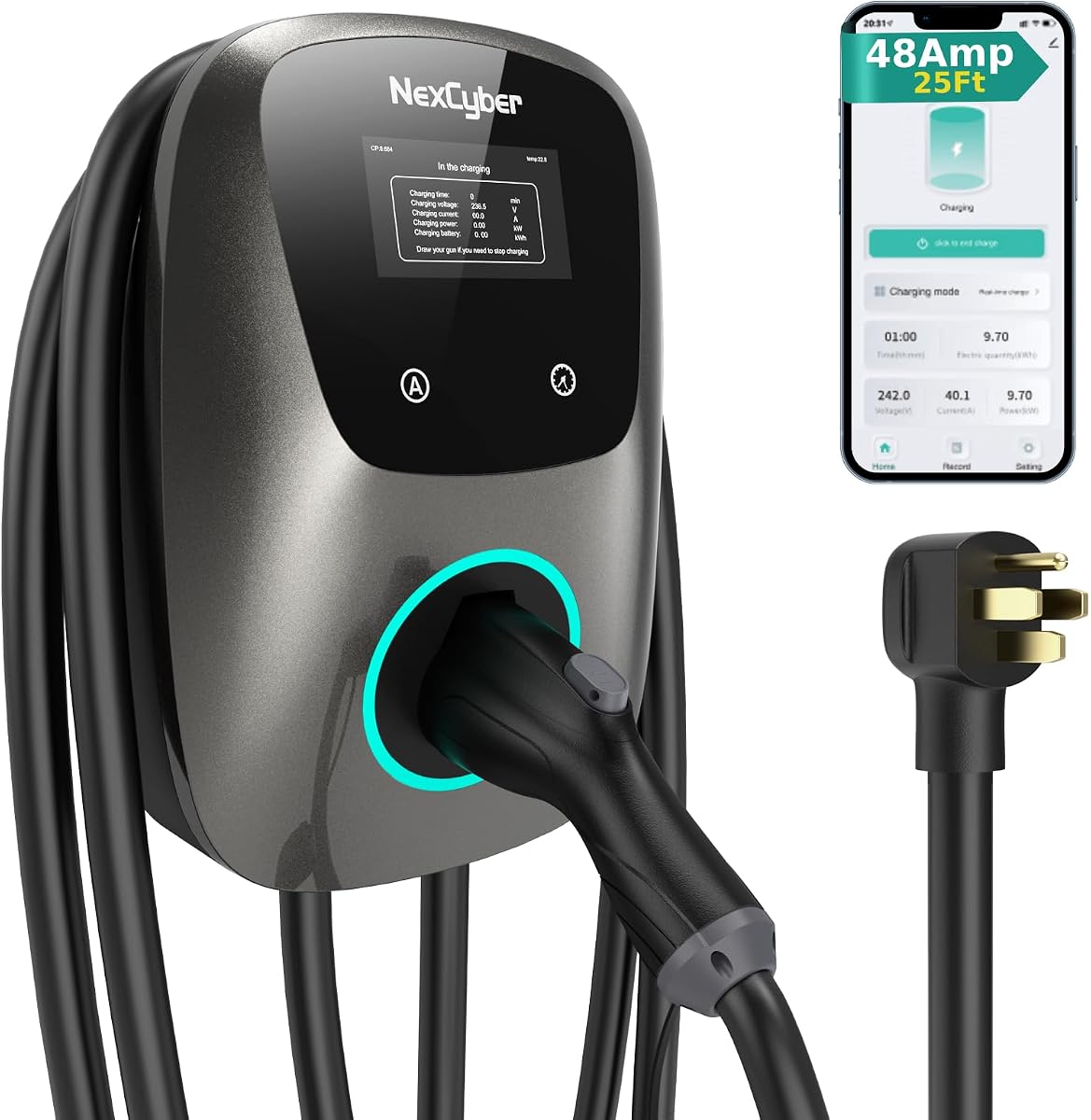
The NexCyber 48 amp charger is a hybrid option that can operate as a plug-and-play unit or be hardwired for maximum output. Its supplied rating is 4.5, and it stands out for offering both physical touchscreen controls and optional WiFi app functions without forcing users to depend on an app for basic operation.
We may earn a commission when you buy through this link, at no additional cost to you.
Through the NEMA 14-50 connection, it can deliver up to 40 amps. A hardwired installation supports 48 amps and requires appropriately sized wiring and electrical service. The product information distinguishes between input-side installation conductors, which fall under the electrician's scope, and the certified automotive charging cable. Buyers should provide these installation details to the electrician rather than attempting the work themselves.
The touchscreen can display current, charging speed, input voltage, and delay time while providing preset or adjustable amperage and delayed-start controls. The app adds cost and session history, completion notifications, charging status, and scheduling. Safety credentials include ETL, FCC, and ENERGY STAR, with listed standards covering J1772, UL 2231, UL 991, UL 2251, UL 1998, and UL 2594.
This charger is attractive to owners who want an easier initial setup, the ability to relocate the unit, or a fallback operating method if the network is unavailable. Its 25-foot cable is generous, while the three-year warranty adds support. Direct sun and rainy installation are discouraged, and owners should check their vehicle port carefully because some NACS-equipped models require an adapter.
The physical screen and buttons make local control practical, while the app adds remote scheduling, history, cost tracking, and status notifications. This dual approach is useful for households with uneven WiFi coverage or owners who do not want every charging task tied to a phone.
Starting with the plug-in configuration can be convenient, while hardwiring enables the full 48 amp output. An electrician should size the circuit and conductors correctly, and the installation should avoid the direct sunlight and exposed rain discouraged by the manufacturer.
We may earn a commission when you buy through this link, at no additional cost to you.
The Romaa 48 amp charger is defined by its large three-inch color touchscreen, which displays charging status, power, session time, energy delivered, and error codes without requiring an app. It has a supplied rating of 4.3 and delivers hardwired 240-volt, 11.5 kW output for compatible J1772 vehicles.
We may earn a commission when you buy through this link, at no additional cost to you.
Its app supports remote status checks, energy history, schedules, and completion notifications. The product information gives an example of a typical 65 kWh battery charging from 10 to 80 percent in about four hours, while appropriately noting that actual time depends on the vehicle's onboard charger, battery, and settings. The installation includes a 24-inch input cord, mounting plate, screws, tools, and a manual.
Safety protections include ground fault, temperature, overvoltage, undervoltage, overcurrent, and short-circuit monitoring. The enclosure is NEMA Type 4 and IP66 rated for indoor or outdoor use, and the charger carries a two-year manufacturer warranty. Its J1772 connector is listed for a broad range of North American EVs, including Chevrolet, Ford, Hyundai, Honda, BMW, Volkswagen, Nissan, Audi, Toyota, Subaru, Mercedes-Benz, Kia, Rivian, Acura, and Porsche models.
The Romaa is a practical choice for an owner who appreciates a large local display and wants charging information visible from the vehicle. It also offers a complete installation package and strong fault protection. Tesla and NACS vehicle owners need an adapter, and the shorter two-year warranty is less generous than the three-year coverage offered by several competitors.
The color display is the main differentiator, making power, timing, energy, and fault information easy to check at the wall. Owners who frequently review sessions or want charging status without opening an app will appreciate this approach.
The J1772 connector and long list of supported vehicles make the charger broadly practical. Multiple electrical protections and an IP66 enclosure support dependable use, while the included hardware simplifies the electrician's mounting process.
We may earn a commission when you buy through this link, at no additional cost to you.
The Universal J1772 48 amp charger combines hardwired 11.5 kW performance with scheduled app control and a particularly broad stated temperature range. It has a supplied rating of 4.6, a 25-foot cable, and an aluminum enclosure designed for indoor or outdoor deployment in demanding conditions.
We may earn a commission when you buy through this link, at no additional cost to you.
The charger can provide up to 44 miles of range per hour according to the supplied information, making it suitable for overnight replenishment and quick garage turnarounds. Current is not described as finely adjustable in the same way as several app-first competitors, so buyers focused on granular control should verify the settings available in the app before purchasing.
Its smart app allows owners to start, stop, and schedule charging while monitoring speed, consumption, and session history. The enclosure carries NEMA 4 and IP66 protection, and the stated operating range extends from minus 22 to 122 degrees Fahrenheit. A corrosion-resistant coating, ETL listing, and certifications to UL 2594, UL 2231-1, UL 2231-2, and FCC Part 15 support outdoor reliability.
This charger is well suited to J1772-equipped owners who want straightforward scheduling and a long cable. It is particularly relevant in climates with severe cold or heat because of its stated temperature range. However, buyers should check their vehicle's charging port because some newer models have moved from J1772 to native NACS. The unit uses a standard J1772 connector, and an appropriate adapter would be needed for NACS vehicles.
The wide stated temperature range, IP66 rating, NEMA 4 enclosure, and corrosion-resistant aluminum housing make the charger a credible choice for exposed outdoor installations. These specifications are particularly relevant in regions with severe seasonal temperature swings.
Start, stop, schedule, consumption, and session-history functions cover the core needs of most home charging routines. The 25-foot cable gives the installer flexibility in locating the unit relative to the vehicle's usual parking position.
We may earn a commission when you buy through this link, at no additional cost to you.
Choosing a 48 amp home EV charger requires balancing connector compatibility, electrical service, safety, smart features, and physical placement. The following factors help narrow the field before an electrician evaluates the installation.
Match the connector before considering any other feature. A 48 amp charger is only useful if it can physically and safely connect to the vehicle.
Ask a licensed electrician to evaluate the panel and loads before ordering. Maximum headline output is not useful if the home cannot safely support it.
Prioritize documented certifications and meaningful fault protection. These features matter more because hardwiring creates a long-term electrical connection.
Choose app features for real daily needs, and confirm the required network, accessories, and setup process. Useful control is better than a large number of superficial options.
Measure the actual route to the charge port. The longest listed cable is not automatically the best if it creates unsafe routing or excessive slack.
Choose a model explicitly approved for outdoor placement, or install a suitably protected unit indoors. Follow local code and the manufacturer's mounting instructions.
Use access controls when the charger is shared or exposed. For a private garage, local plug-and-charge operation may be simpler and more reliable.
Check the full warranty terms and support route before installing. A longer stated term is useful only if the process is clear and responsive.
Before installation, have a licensed electrician review the electrical panel, calculate the available load, select the proper breaker and conductors, and install the charger according to the National Electrical Code and the manufacturer's instructions. Confirm the charger's connector matches the vehicle and review the DIP switches or current settings before energizing it. If the unit is intended for outdoor use, select a location covered by its specified weather rating and route the cable so it cannot be pinched, driven over, or stretched across a walkway.
After installation, begin with the charging current recommended by the vehicle manufacturer and the charger instructions. Most vehicles and chargers negotiate the safe maximum internally, but the charger can also be limited through its app, physical controls, or display. Use scheduled charging when electricity rates vary, and use RFID, app locking, or plug-and-charge mode according to the level of shared access you need. Do not use a timer or remote command that interrupts a session in a way contrary to the vehicle or charger's instructions.
For routine care, inspect the connector and cable for visible damage, discoloration, kinks, or a damaged strain relief. Clean the connector according to the manufacturer's directions and keep the holster and mounting hardware secure. Preserve the charger's firmware through automatic updates or the specified app process, and use the external reset or emergency-stop control only as directed. If the charger displays a fault, stops unexpectedly, or shows a connector temperature warning, examine the connector, installation, circuit, and vehicle connection before repeating the session, and contact the manufacturer or electrician when the cause is unclear.
A 48 amp Level 2 charger generally requires a dedicated 240-volt circuit with a 60 amp breaker and correctly sized conductors. Some models in this guide can be configured for 50 amp output on a dedicated 70 amp circuit, but that setting should be used only after a licensed electrician evaluates the panel and connected loads. Your utility and local authority may impose additional requirements.
An EV can use a Level 2 charger only if its charge port and internal onboard charger support that connection and power level. Most models here use J1772, while one is designed around NACS. Even with a matching connector, many vehicles accept less than 48 amps and will negotiate a lower charging rate automatically.
It depends on the charger and the vehicle. The Tesla NACS charger connects directly to vehicles with a NACS port, while the J1772 models generally require a J1772-to-NACS adapter for Tesla vehicles. Most of the product information for those J1772 chargers states that the adapter is not included, so confirm the correct adapter before purchase.
A 48 amp, 240-volt Level 2 charger can deliver up to 11.5 kW and is commonly described as adding roughly 44 to 46 miles of range per hour under favorable conditions. A standard Level 1 outlet is much slower. Real charging time varies with battery size, vehicle acceptance rate, temperature, and the starting state of charge.
Although a plug-in charger may be straightforward for some owners, a hardwired 48 amp installation involves dedicated high-current wiring, panel considerations, and code compliance. The product information for all listed chargers recommends professional installation, and a licensed electrician is the appropriate person to assess and perform that work.
No. Several listed units provide physical controls, delay timers, status displays, and normal plug-and-charge operation even when the app is unavailable. Apps become more useful for remote start and stop, scheduling, historical energy data, cost tracking, user access, and power management. Check the local-control features as well as app functions before choosing.
The answer depends on the panel, service, existing loads, charger load-management features, and electrical code. Some products support power sharing or dynamic load balancing, but the supplied information for the IYILO model notes that dynamic balancing requires the app, an appropriate circuit-breaker threshold, and the optional Energy Meter bundle. Have an electrician perform a load calculation before installing two units.
It can be if the model has a suitable weather rating and the installation follows the manufacturer's requirements. Several products carry IP65 or IP66 protection, while one product advises against direct sun and exposed rain. A protected garage location is generally simpler, but an outdoor installation can provide more flexible vehicle access when properly designed and electrically installed.
The EVIQO J1772 model is the strongest all-around recommendation for most J1772 owners because it combines full 48 amp hardwired performance, detailed app controls, a 25-foot cable, and a weather-resistant enclosure. The Tesla NACS model is the more natural choice for native NACS drivers, while the Grasside charger stands out for access controls and its strong supplied customer rating.
Prioritize connector compatibility, safe electrical capacity, documented certifications, and the features you will use every week. Fine current adjustment, RFID cards, color screens, connector temperature monitoring, and power sharing can be meaningful, but they cannot compensate for an undersized circuit or the wrong connector. Measure the installation site and have a licensed electrician review the panel before committing to 48 amp output.
Finally, review the current product listing, availability, warranty terms, and installation requirements before ordering. Retail prices, promotions, product details, and vehicle connector arrangements can change, and local electrical requirements may differ. The information in this guide is intended to simplify comparison, but the final decision should reflect your vehicle, electrical service, and daily charging routine.