NIMO 15.6 AI Ready
4.8Editor score
8GB expandable system memory
256GB solid-state storage
Comprehensive USB-C connectivity
Two-year warranty included
A laptop for law school must balance concentrated research, extensive document review, professional writing, and hours of online classes. The right model also needs to be comfortable in lecture halls, libraries, dorm rooms, and remote meetings. Screen quality, keyboard comfort, battery life, storage, and dependable connectivity matter more than specialized graphics or unnecessary premium features.
This guide compares ten products using the supplied specifications, including processor performance, memory, storage, display quality, ports, portability, operating system, privacy features, and included accessories. The list covers affordable Windows laptops, a Chromebook option, a higher-powered Dell model, and a compact law-school-themed accessory for personalizing a study setup.
Each review identifies the strongest reasons to consider a particular model and the compromises that law students should understand. Ratings reflect the available customer feedback, while products without a published rating are evaluated from their listed specifications. Prices and promotional terms can change, so readers should verify the current listing and configuration before purchasing.
4.8Editor score

4.3Editor score

4.6Editor score
As an Amazon Associate we earn from qualifying purchases.
The comparison below places each product's processor, memory, storage, display, portability, connectivity, and operating system side by side, while noting the accessory-only option separately.





This HP 14-inch model carries a 4.6 rating and stands out for offering a remarkably complete first-year law school bundle. Its Intel N150 processor, 4GB LPDDR5 memory, Windows 11 Pro operating system, and 628GB combined storage configuration cover the central needs of research, word processing, legal outlining, and video calls without requiring an immediate accessory purchase.
We may earn a commission when you buy through this link, at no additional cost to you.
The 128GB UFS drive provides internal storage, while the bundled 500GB portable external drive creates room for case files, scanned documents, textbooks, and large software projects. The HubxcelAccessory bundle also includes wireless earbuds, a mouse, mouse pad, HDMI cable, and USB extension cord. Lifetime Microsoft Office support adds another useful layer for students who want a productive setup immediately after opening the box.
The main limitation is 4GB of installed memory, which is modest for keeping numerous browser tabs, a case-management platform, PDF software, cloud storage, and a video meeting open simultaneously. The 14-inch HD anti-glare display is suitable for ordinary reading and writing, although students who spend long periods comparing legal documents may appreciate a sharper panel. These are meaningful constraints, but the bundle offsets them with useful software and accessories.
This laptop is best for budget-conscious law students who value a ready-to-use package, ample file capacity, and a Pro edition of Windows. It is less suitable for students who intend to run intensive software, compile large databases locally, or keep dozens of applications open throughout the day. For ordinary case reading, outlining, research, and coursework, it is a practical and well-equipped choice.
The combination of 128GB internal UFS storage and a 500GB external drive is particularly useful when the first year of law school brings new electronic resources, reading lists, recorded lectures, and scanned materials. Students can keep active files accessible while moving larger course materials to the portable drive.
Office access, an external drive, wireless earbuds, a mouse, an HDMI cable, and a USB extension cord reduce the number of separate accessories a student must coordinate. The bundle is especially convenient for a new student setting up a dorm room, home office, or temporary study space.
We may earn a commission when you buy through this link, at no additional cost to you.
The ASUS Vivobook 14-inch Full HD model is a basic study computer built around portability, a sharp display, and access to 1TB of cloud storage. It does not yet have a published customer rating, so its evaluation depends on the supplied specifications rather than a visible history of owner feedback.
We may earn a commission when you buy through this link, at no additional cost to you.
Its Intel Celeron N4500 processor, 4GB DDR4 memory, and 64GB eMMC storage are designed for everyday tasks such as browsing, writing, streaming, and attending online classes. The 1920 by 1080 LED panel is a meaningful advantage for reading dense legal documents because it offers more usable detail than the HD displays found on several competing models. A USB-C port, USB-A port, HDMI, audio jack, Wi-Fi, Bluetooth, and 720p camera cover standard study needs.
The largest concern is storage. Sixty-four gigabytes is limited for a laptop that may need to store downloaded case files, application data, recordings, and large document collections. The included cloud storage can help with active files, but students who routinely work offline or keep large research libraries will need additional storage. The 4GB memory also limits heavy multitasking, and the Celeron processor is not designed for demanding legal databases, extensive spreadsheets, or virtual machines.
This Vivobook works best for students who do light writing, rely heavily on cloud-based documents, and value a sharp, portable screen. It is a sensible entry point for browsing, reviewing assignments, and joining seminars. Those who need more local capacity or routinely switch among demanding applications should favor a model with 8GB or more memory and a larger solid-state drive.
The 1920 by 1080 LED display provides a more detailed canvas than a standard HD screen, which can reduce strain when reading footnotes, statutes, or multiple pages of a brief. Its resolution remains a practical advantage even though the underlying processor and memory are entry-level components.
At 2.87 pounds and 0.71 inches thick, the Vivobook is easy to carry between classes, offices, and the library. The listed battery life of up to 10 hours also makes it reasonable for a full day of note-taking when the workload stays light and screen brightness is managed.
We may earn a commission when you buy through this link, at no additional cost to you.
The WIPEMIK P15 offers the strongest balance of screen size, memory, and everyday performance in this list. Its 4.6 rating, 16GB RAM, 256GB SSD, and 15.6-inch Full HD IPS display make it well suited to a student who regularly reads long documents, writes research papers, and keeps several browser-based legal resources open.
We may earn a commission when you buy through this link, at no additional cost to you.
The 6500Y processor can reach 3.4 GHz and is paired with enough memory to support relatively smooth multitasking for a law-school workload. A 1080p IPS panel with narrow bezels gives the laptop a roomy, sharp viewing area. Four stereo speakers support lectures and media, while a physical privacy slider provides straightforward control over the front-facing camera.
Storage is the principal limitation because 256GB fills quickly with large document repositories, synchronized folders, media, and software. The port selection is otherwise generous, including USB-C charging, two USB 3.0 ports, one USB 2.0 port, HDMI, a microSD slot, an audio jack, and a Kensington lock. Wi-Fi 5 is adequate for routine use but less forward-looking than the Wi-Fi 6 found on several other recommendations.
This is an excellent choice for students who value 16GB memory and a large, sharp display but do not need a heavier workstation. It is particularly suitable for outlining, document review, online classes, note-taking, and group study. Buyers who accumulate substantial local files should plan to add storage, while those who need advanced software performance should look toward the Dell model.
Sixteen gigabytes gives this laptop more headroom than the many 4GB competitors in the guide. That advantage is useful when a student has a case database, several PDF tabs, an outline document, cloud storage, and a video call open at the same time.
The 15.6-inch Full HD IPS display offers a generous work area and consistent viewing angles. Its narrow bezels preserve the useful screen size without turning the laptop into an oversized, difficult-to-carry device, while the anti-glare-style panel is less distracting in bright library environments.
We may earn a commission when you buy through this link, at no additional cost to you.
This HP Everyday Slim Laptop has a 5.0 rating, the highest published score among the products in the guide. Its core configuration centers on an Intel N150 processor, 4GB RAM, a 128GB SSD, Windows 11, and Microsoft 365, creating a straightforward platform for writing, browsing, research, and remote class attendance.
We may earn a commission when you buy through this link, at no additional cost to you.
The full-size keyboard, multi-touch HP ImagePad, 720p HD camera, temporal noise reduction, and dual array microphones are particularly relevant to online seminars and group meetings. Long battery life is another major strength for students moving through a campus day without constant access to an outlet. The thin design also supports use in a library or lecture hall where a bulky computer would be inconvenient.
Only 4GB of memory is provided, and many advanced browser-based legal applications can consume that capacity quickly. The 128GB SSD also places a firm ceiling on local case files, course software, and synced folders unless a student uses cloud storage or adds an external drive. The supplied information gives less detail about display resolution and port selection than some competing listings, so buyers should confirm those specifications on the product page.
The model is a strong option for students who want a simple, dependable machine with familiar HP features and useful software included. It is best for standard word processing, reading, outlining, and video participation. Power users who routinely keep many tabs open or work with large local document sets should consider increasing memory or selecting a configuration with more storage.
A full-size keyboard and multi-touch ImagePad create a familiar working setup for long outlines, briefs, and case summaries. These input features matter more than decorative design elements because law school places sustained emphasis on accurate, comfortable typing.
The 720p camera, temporal noise reduction, and dual array microphones support clearer video calls and virtual office hours. These features are valuable when a student attends lectures remotely or participates in study-group meetings from a shared living space.
We may earn a commission when you buy through this link, at no additional cost to you.
The 100-pack of law school stickers is the one product in this guide that is not a laptop. It is an accessory designed to personalize laptops, water bottles, luggage, phone cases, notebooks, helmets, and other smooth surfaces with legal-themed graphics. Its 4.7 rating reflects its appeal as a decorative gift for law students and legal professionals.
We may earn a commission when you buy through this link, at no additional cost to you.
The decals use vinyl PVC material described as waterproof and sun-resistant, helping the colors retain their appearance in ordinary daily use. Every sticker measures approximately 2 to 3 inches, a size that works for both small personal items and a laptop lid. The broad assortment makes it easy to coordinate a set rather than choosing a single design.
Application is straightforward: place each decal on a clean, dry, smooth surface and press it down carefully. The product description states that the stickers can be removed without leaving residue, although careful removal remains important to avoid lifting a surface finish. This purchase offers no computational performance, display quality, or study functionality.
The set is best viewed as a complementary law-school accessory rather than a computer recommendation. It works well as a graduation, orientation, holiday, or study-group gift and can make a plain laptop cover feel more personal. Students shopping for a complete study setup should select one of the actual computers in this guide instead.
The large assortment allows students to create a matching visual theme across a laptop, water bottle, notebook, and luggage. Because the decals are relatively small, they can also fill empty spaces without overwhelming a larger lid design.
The set works as an inexpensive add-on for orientation, graduation, birthdays, or exam-season encouragement. It is also a convenient way to mark a study device as belonging to its owner in a shared classroom or library.
We may earn a commission when you buy through this link, at no additional cost to you.
The HP Chromebook 14 is built around web-based research, long battery life, and a portable 14-inch design. It has a 4.3 rating and runs Chrome OS, making it a natural fit for students whose coursework primarily lives in web applications, Google Workspace, cloud document services, and browser-based legal research platforms.
We may earn a commission when you buy through this link, at no additional cost to you.
Its quad-core Intel Celeron N4120 processor, 4GB RAM, and Intel UHD Graphics 600 support everyday browsing, assignments, streaming, and cloud collaboration. The anti-glare 1366 by 768 display reduces reflections in bright spaces, while custom-tuned stereo speakers add value for recorded lectures. Up to 14 hours of stated battery life gives it a clear advantage when a student spends the day in class without easy access to charging.
The main limitation is 64GB of eMMC storage, which leaves little room for downloaded files or a large local application library. Its HD resolution is also less detailed than the Full HD panels offered by several other products. Most importantly, a Chromebook can be less suitable for students whose school requires Windows-specific legal software, advanced document formatting, specialized citation tools, or other desktop applications.
This Chromebook is best for a student committed to cloud-first study methods and browser-based tools. It offers excellent endurance and a low-maintenance operating system. Students whose curriculum depends on conventional desktop software should choose a Windows machine, while those comfortable working primarily through the web can get an effective and portable study device from this model.
The stated battery life of up to 14 hours gives the Chromebook an edge in long class days. HP Fast Charge can also bring the battery from zero to approximately 50 percent in about 45 minutes, which is useful when short gaps between lectures create brief charging opportunities.
Chrome OS emphasizes browser-based workflows, automatic system updates, and access to Google Play applications. That simplicity can benefit a first-year student who wants a secure, approachable device for online classes, shared documents, and research conducted through web services.
We may earn a commission when you buy through this link, at no additional cost to you.
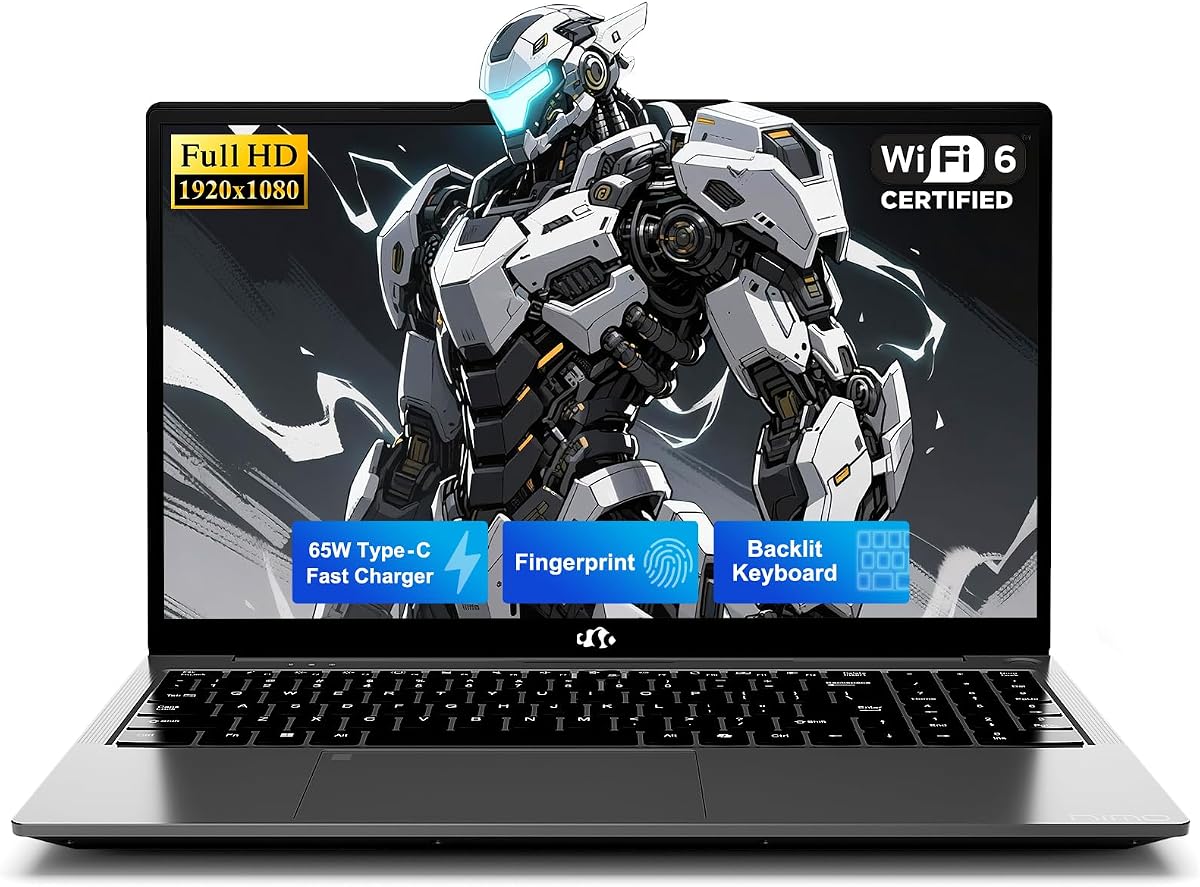
The NIMO 15.6-inch AI Ready laptop is the strongest overall value for a law student because it combines a 4.8 rating with 8GB of memory, a 256GB SSD, a Full HD display, extensive connectivity, and a two-year warranty. It is designed around the daily needs of a student rather than gaming or highly specialized professional workloads.
We may earn a commission when you buy through this link, at no additional cost to you.
The Intel N150 processor has four cores and is intended for efficient schoolwork, note organization, browsing, document review, and Copilot-assisted productivity. Eight gigabytes of memory offers more comfortable multitasking than 4GB configurations. Storage can be expanded through the M.2 slot or a microSD card, giving students a practical path for adding capacity as their case library grows.
Connectivity is a major strength. The laptop includes two full-function USB-C ports with power delivery and display support, three USB-A ports, HDMI, a microSD slot, Wi-Fi 6, and Bluetooth 5.3. That range reduces the need for a docking station during presentations. A physical webcam shutter, fingerprint reader, 180-degree hinge, backlit keyboard, and 65-watt fast charger further improve daily usability.
This model is best for students who need a capable Windows laptop without moving into the higher-cost tier. Its 15.6-inch screen is useful for document review, and its 3.7-pound weight remains manageable for campus use. It is not designed for intensive software or local video editing, but for legal research, outlining, video classes, and general productivity, it is exceptionally well equipped.
Two full-function USB-C ports, three USB-A connections, HDMI, and a microSD slot cover most law-school accessories. A student can connect a monitor, wired peripherals, and an external drive without carrying a large adapter, while the microSD slot offers another convenient transfer method.
The physical webcam shutter provides a direct way to block the camera, while the fingerprint reader supports convenient secure login. These features are particularly helpful in dorm rooms, libraries, study areas, and online meetings where a student may be surrounded by people they do not know.
We may earn a commission when you buy through this link, at no additional cost to you.
The HP 14-inch 2026 Notebook delivers a well-balanced portable Windows experience with a 4.4 rating. It combines an Intel N150 processor, 4GB LPDDR5 memory, 128GB storage, Wi-Fi 6, and Windows 11 Home in a chassis weighing 3.24 pounds and measuring 0.71 inches thick.
We may earn a commission when you buy through this link, at no additional cost to you.
Its stated endurance of up to 11 hours during video playback or 7.5 hours with mixed use makes it appropriate for a mobile school schedule. The 14-inch anti-glare display uses micro-edge bezels and offers 250 nits of brightness. A 720p camera with noise reduction, dual microphones, and stereo speakers support online classes and remote study sessions.
The port selection is one of the model's better attributes. It includes a 10Gbps USB-C port with DisplayPort 1.2, two 5Gbps USB-A ports, HDMI 1.4b, an audio jack, and a multi-format SD card reader. A one-year Microsoft 365 Personal subscription includes Word, Excel, PowerPoint, and cloud storage, which makes the package convenient for everyday assignments.
The limitations are the same ones associated with many entry-level models: 4GB of memory and 128GB of internal storage. A student doing light research and writing will find this model convenient and portable, while a heavy multitasker should seek additional memory. It is best for campus use where a full-size Windows experience, light weight, and balanced battery life matter most.
The combination of a 3.24-pound body, 0.71-inch profile, and stated all-day battery makes the notebook straightforward to carry. It is large enough for a conventional keyboard and screen but small enough to remain practical in a backpack between classes.
DisplayPort over USB-C makes it easier to connect an external monitor, while HDMI supports classroom presentation equipment. Wi-Fi 6 and Bluetooth 5.4 provide current wireless standards for cloud research, accessories, and collaboration with nearby devices.
We may earn a commission when you buy through this link, at no additional cost to you.
The HP Stream 14 HD is built around an unusual amount of bundled storage. Its internal 128GB UFS drive is paired with a 1TB docking station, creating 1.12TB of listed combined storage. A 4.2 rating reflects a mixed customer experience, but the package remains compelling for students who want substantial file capacity.
We may earn a commission when you buy through this link, at no additional cost to you.
The Intel N150 processor and 4GB DDR4 memory are intended for ordinary productivity, and Windows 11 provides the familiar desktop environment required by many legal applications. A one-year Microsoft 365 subscription includes core Office applications and cloud services. The supplied 7-in-1 docking station, 32GB microSD card with adapter, Type-C data cable, three-in-one charging cable, and cleaning cloth create a ready-to-use workstation.
Connectivity includes USB-C, two USB-A ports, HDMI 1.4b, a media card reader, and a headphone and microphone combination jack, along with Wi-Fi 6 and Bluetooth 5.4. At 3.24 pounds and 0.71 inches thick, the laptop remains convenient for class and library use. Its 14-inch HD anti-glare display is comfortable for reading, though the 1366 by 768 resolution gives it less detail than Full HD alternatives.
This configuration is best for students who want roomy storage without immediately adding a separate drive. The docking station is especially useful for a dorm room or home desk. The main compromise is 4GB of memory, which can limit heavy multitasking, and the lower rating suggests checking recent customer feedback for configuration-specific concerns before buying.
The seven-port docking station can serve as the central connection point for a monitor, keyboard, mouse, storage, and network accessories. That makes the included package particularly useful for students who study primarily from a fixed desk rather than carrying every peripheral between locations.
A terabyte docking-station drive can hold a substantial collection of case briefs, scanned readings, recordings, and course documents. Students should still maintain backups and use cloud synchronization for work that must remain accessible across devices.
We may earn a commission when you buy through this link, at no additional cost to you.
The Dell 15.6-inch Full HD model is the most performance-oriented conventional laptop in this guide. Its Intel Core 3 100U processor and 8GB of RAM give it more computing headroom than the N150 and Celeron models, making it the safest choice for demanding legal research, multiple browser-based applications, complex documents, and heavier multitasking.
We may earn a commission when you buy through this link, at no additional cost to you.
The 15.6-inch Full HD display offers a large and detailed canvas for reading statutes, case opinions, outlines, and exhibits. Windows 11 Home provides a familiar environment with Microsoft applications and broad desktop compatibility. Dell ComfortView software is included to reduce blue-light emissions, while energy-efficient batteries and Express Charge support the demands of a long study day.
The keyboard includes roomy keys, a separate numeric keypad, and a calculator hotkey. Although the numeric keypad is not essential for legal writing, it can be helpful for calculating damages, interest, damages multipliers, and other figures encountered in assignments. One-year onsite service adds meaningful reassurance because a qualifying hardware issue can be addressed at the student's home, office, or another chosen location.
This laptop is best for students who want stronger performance, a large sharp screen, and conventional Windows flexibility without moving into a specialized workstation. It is less compelling for someone whose priority is minimum weight or the lowest possible cost. Students should also verify the storage capacity and dimensions, because those details are not included in the supplied specifications. For computational headroom, the Dell is the clear leader.
The Intel Core 3 100U is the most capable listed processor and should handle heavier multitasking more comfortably than the entry-level N150 and Celeron alternatives. That advantage matters when legal research, spreadsheets, scanned PDFs, and several communication applications compete for system resources.
Full HD resolution on a 15.6-inch panel provides more detail and work area than the HD screens in several competing products. It is a better fit for prolonged document comparison, and the included numeric keypad adds useful calculation capability without changing the standard keyboard layout.
We may earn a commission when you buy through this link, at no additional cost to you.
A law-school laptop should be judged by the work it must handle, the environment in which it will be used, and how long it must remain dependable. The most important factors are processing power, memory, storage, display clarity, battery endurance, connectivity, and comfortable input.
The processor affects how smoothly a laptop handles research pages, PDFs, word-processing documents, virtual meetings, and multiple open applications. An Intel Core 3 100U provides the strongest performance in this group, while the N150 and N4500 options are designed for efficient everyday work. A law student should not need a gaming processor, but the device should be able to sustain several browser tabs, a video call, and a document editor without excessive delay.
Memory determines how many applications the system can keep active without leaning heavily on slower storage. The 4GB configurations are suitable for basic assignments, but 8GB is a more comfortable starting point for legal research, and 16GB provides the greatest headroom in this group. Students using case databases, several browser tabs, cloud storage, and video meeting software simultaneously should favor 8GB or more rather than relying on the supplied 4GB.
Legal study creates considerable demand for digital case files, textbooks, recordings, research exports, and course software. A 256GB SSD offers a reasonable balance of speed and capacity, while 64GB eMMC and 128GB configurations require regular cleanup, cloud synchronization, or an external drive. Solid-state storage is preferable to a traditional hard drive because it improves startup time and application responsiveness. Several bundles include external storage, which can be useful but should not replace routine backups.
A Full HD display makes dense legal text easier to read by providing more detail than a standard 1366 by 768 screen. A 14-inch panel is a common compromise between readability and portability, while 15.6 inches offers more room for comparing documents and taking notes. Anti-glare coatings are beneficial in libraries and lecture halls, and IPS panels can provide more comfortable viewing angles when working with classmates or watching recorded lectures.
A law student may carry a laptop through several classes, a study session, and a commute in one day. Stated battery figures provide a useful starting point, though actual runtime depends on screen brightness, wireless activity, video calls, and workload. Models around three pounds are easier to carry, while the HP Chromebook's claimed up-to-14-hour runtime stands out for endurance. Fast charging can be especially helpful when a student has only a short window to recharge between obligations.
A law student may need to connect a projector, external monitor, wired Ethernet adapter, headphones, mouse, or external storage. USB-C with DisplayPort is especially useful for modern displays, while HDMI remains common in classrooms. The NIMO provides the broadest listed port selection, including two full-function USB-C ports and three USB-A ports. The HP 14-inch 2026 model also offers a well-rounded mix of USB-C, USB-A, HDMI, and an SD reader.
Operating-system choice can determine whether a student can use required legal databases, word processors, citation tools, or school-specific software. Windows provides the broadest compatibility and appears in most of the recommended computers. Windows 11 Pro adds features described in the HP bundle that may be valuable for institutional work, while Home is sufficient for many students. Chrome OS is highly convenient for browser-based workflows but less suitable when desktop applications are mandatory. Privacy shutters, fingerprint readers, and hardware-backed protections deserve consideration in shared spaces.
A warranty can be especially valuable during an intensive academic program because it reduces the disruption caused by a hardware failure. The NIMO includes a two-year warranty, the Dell provides one year of onsite service, and the HP Chromebook includes a one-year limited hardware warranty. Bundled accessories may include an external drive, Office subscription, mouse, earbuds, cables, or a docking station, but buyers should check whether every included item is genuinely useful and whether software access is perpetual or time-limited.
Begin by organizing files into clearly named folders for each course, keeping active outlines synchronized with a cloud service or maintained on an external drive. Install required legal databases and school applications before classes begin, confirm that the browser used for coursework is updated, and test microphone, camera, headphones, and presentation connections. A short setup period prevents avoidable problems during the first seminar or online lecture.
For daily care, keep ventilation openings clear and avoid placing the computer on soft bedding or crowded surfaces. Clean the screen with a soft microfiber cloth, use a safe amount of liquid on a lint-free cloth, and do not spray cleaner directly onto the display. A padded sleeve and properly sized backpack protect the chassis during commutes. Students should also use a surge-protected outlet for extended charging and follow the manufacturer's guidance for battery temperature and charging.
Protect academic work by maintaining at least two forms of backup and enabling automatic cloud synchronization for active documents. Run system updates on a regular schedule, keep the operating system and legal applications current, and use strong, unique account credentials with multifactor authentication. Periodic storage checks, a clean startup list, and periodic review of downloads help preserve speed over the length of the academic year.
Eight gigabytes is a practical minimum for a typical law-school workflow involving a legal database, browser tabs, PDFs, cloud storage, and a video meeting. Sixteen gigabytes offers additional comfort when many applications remain open or research is computationally demanding. A 4GB laptop can handle basic writing and browsing, but it may feel constrained during a full research session, so students should consider whether the configuration can be expanded.
A Chromebook works well when coursework is primarily browser-based and all required applications are available through the web or Google Play. It can offer strong battery life, automatic updates, and an easy-to-manage environment. However, students should confirm that their school permits it and that no required legal database, citation tool, document application, or examination platform requires Windows or macOS.
A 16GB laptop is advisable for heavy multitasking, large local research collections, or advanced software, though it is not necessary for every student. The WIPEMIK P15 in this guide is the main 16GB option, pairing that memory with a large Full HD IPS display. Students using lighter browser-based workflows can often manage with 8GB, while 4GB configurations should be treated as budget-oriented and potentially expandable.
Full HD resolution is helpful because case opinions often contain dense footnotes, citations, and paragraphs. The extra detail compared with a 1366 by 768 display can make text more comfortable to read and help a student fit more information on screen. Resolution is only one part of readability, however, and screen size, brightness, anti-glare treatment, and comfortable viewing distance also influence the experience.
At least 256GB of solid-state storage is a sensible target because course software, case files, recordings, and research exports can accumulate quickly. A 512GB or larger drive offers more freedom, while 64GB and 128GB configurations work best with cloud storage and an external drive. Whichever capacity is selected, students should maintain backups and avoid treating one synchronized folder as the only copy of important work.
Most law-school tasks do not require a dedicated graphics card. Legal research, document review, word processing, web browsing, and video conferencing are primarily handled by integrated graphics, as seen across the models in this guide. A stronger processor and additional memory generally contribute more to practical productivity than a specialized graphics card unless the student also performs intensive video editing, 3D work, or advanced data analysis.
A numeric keypad is convenient for calculations involving damages, interest, percentages, and financial exhibits. It can also make entering large numeric sets faster. However, it occupies space that some students prefer to have within a more compact keyboard, and a separate calculator or spreadsheet software can serve the same function. The choice depends on personal typing habits and whether the law student expects frequent quantitative work.
A protective sleeve, headphones, a reliable USB-C or HDMI adapter, a mouse, and an external storage drive are useful starting points. Some recommended bundles already include several of these items, including storage, mice, cables, and wireless earbuds. Students should verify compatibility before buying additional accessories and should keep important coursework synchronized or backed up beyond the laptop itself.
The Dell 15.6-inch Full HD Core 3 is the strongest all-around choice for a student who prioritizes processor performance, 8GB of memory, a large detailed display, and conventional Windows compatibility. The NIMO 15.6-inch model is the best budget-focused pick because it combines 8GB of memory, extensive ports, useful privacy features, fast charging, and a two-year warranty. The WIPEMIK P15 is the premium value pick, offering 16GB of memory and a large Full HD IPS display.
Before buying, prioritize the features that directly affect coursework. Students with demanding software needs should favor the Dell's stronger processor, while those running many applications simultaneously should look for at least 8GB of memory. Full HD resolution improves long-form reading, adequate storage protects access to course materials, and USB-C, HDMI, and wireless standards simplify classroom and library work.
Finally, verify the exact configuration, included accessories, storage capacity, warranty terms, and current marketplace conditions before ordering. Promotions and prices can change, and the same product family may appear with different component combinations. A law-school laptop is a long study investment, so the best choice is the one that provides adequate performance, comfortable typing, dependable connectivity, and enough room for the growing digital case library.