
ASUS A31 ATX Mid-Tower PC Case
4.7Editor score
Dual tempered glass
Hidden cable support
80mm AIO clearance
Explore the best PC case with vertical motherboard options, comparing airflow, GPU clearance, cooling capacity, cable management, and display design.
A PC case with vertical motherboard layout is prized by builders who want a dramatic, space-efficient display that keeps major components prominently visible. The best designs pair vertical presentation with effective airflow, room for modern graphics cards, organized cables, and cooling options suited to powerful gaming or creator systems.
This guide compares ten ATX-oriented cases based on the information supplied for each model, including motherboard support, GPU positioning, fan and radiator capacity, tempered-glass presentation, cable-management features, front connectivity, storage provisions, and included lighting. It covers mainstream mid-towers, full-tower designs, and enthusiast-oriented airflow cases.
Each review identifies the configuration that stands out and the compromises worth considering, helping you match a chassis to your motherboard, cooler, graphics card, and preferred build style. Product listings and prices can change, so confirm the current specifications, accessories, dimensions, and retailer details before ordering.
4.7Editor score

4.7Editor score

4.4Editor score
The table below compares all ten cases by chassis format, display treatment, cooling provisions, and hardware compatibility, making it easier to identify the model that best matches your motherboard and preferred internal layout.


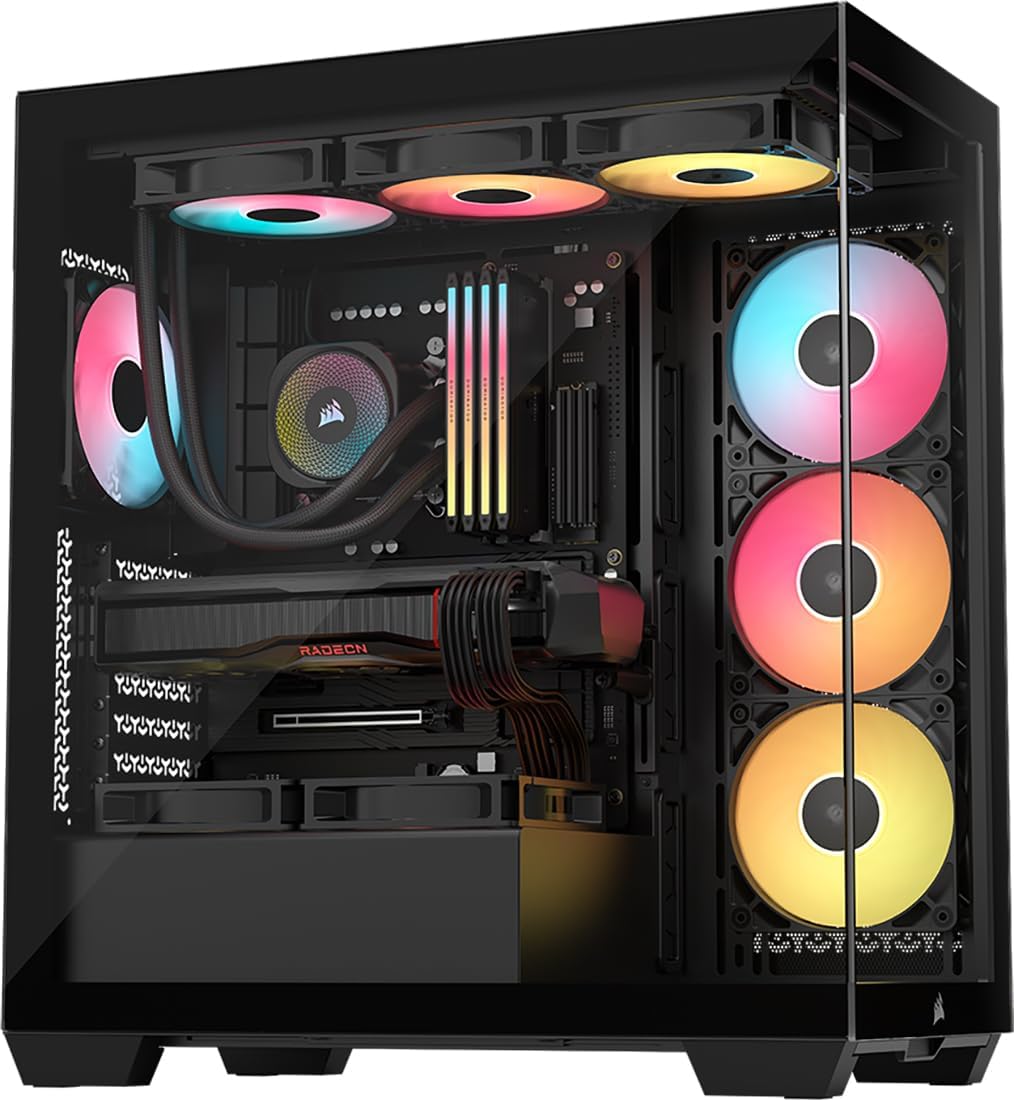


The CORSAIR 4000D RS ARGB Frame is a mid-tower built around airflow, configurability, and a clean view of the components. It carries a 4.7 rating in the supplied product data, while its three preinstalled RS ARGB PWM fans provide a strong foundation for a gaming or general-purpose enthusiast build. The case does not explicitly list a vertical motherboard mount, so it is better understood as a flexible display-oriented ATX chassis than a dedicated vertical-layout model.
We may earn a commission when you buy through this link, at no additional cost to you.
Its standout quality is the FRAME modular case system. The motherboard tray and front I/O panel can be changed as the builder's needs evolve, reducing the chance that an otherwise capable chassis becomes obsolete. The InfiniRail mounting system adds another layer of adaptability, allowing fans up to 200mm at the front and 140mm in the roof to be positioned for targeted airflow. That flexibility is particularly useful when a builder wants to balance intake, exhaust, radiator placement, and visible component layout.
The perforated 3D Y-pattern front panel is designed for a low-obstruction path of incoming air, while the removable internal side panel can either conceal cables or become another fan-mounting surface. These are meaningful advantages for builders who want both organized wiring and optional cooling expansion. The tradeoff is that this isn't primarily marketed around a vertically mounted motherboard or GPU, so buyers seeking a dramatic upright GPU presentation should confirm the available mounting options carefully.
This is a strong recommendation for a builder who prioritizes airflow, modular design, and a generous accessory ecosystem over a dedicated vertical component arrangement. It is particularly attractive when you want a polished ATX system that can evolve with component upgrades. Confirm case dimensions, motherboard form factors, and radiator positions against your planned hardware before purchasing.
The FRAME system lets builders replace the motherboard tray or front I/O panel instead of replacing the entire enclosure. That makes the 4000D RS ARGB a practical choice for creators and performance builders whose connectivity and hardware requirements may change over time.
Three daisy-chainable ARGB PWM fans are already installed, and InfiniRail mounting positions support larger fans at the front and roof. The Y-pattern steel panel further helps maintain airflow while preserving the case's distinctive exterior.
We may earn a commission when you buy through this link, at no additional cost to you.
The SSUPD Xhuttle Black combines a futuristic dual-chamber structure with a vertical GPU display, making it one of the most visually ambitious picks in this guide. It has a 4.7 rating and includes three 120mm ARGB reverse fans, an RGB strip, and an ARGB controller. The result is a coordinated display case designed to showcase the graphics card as a central visual element.
We may earn a commission when you buy through this link, at no additional cost to you.
Dual tempered glass provides broad visibility, while the upright GPU mounting and optimized vertical airflow make the chassis especially attractive to builders who want a dramatic centerpiece. The dual-chamber layout separates visible components from cable routing, helping the interior look cleaner even in a densely equipped system. The included lighting package also reduces the need to source matching fans immediately.
The main caveat is that the vertical arrangement is centered on the GPU rather than a vertically mounted motherboard. It supports ATX and hidden-connector motherboards, GPUs up to 370mm, power supplies up to 190mm, and CPU coolers up to 170mm. It can hold as many as ten 120mm fans and dual 360mm radiators, so cooling capacity is excellent despite the display-oriented layout.
Choose the Xhuttle if your goal is a visually dramatic gaming room centerpiece with an upright graphics card and clean, illuminated presentation. It suits builders using hidden-connector motherboards and comfortable with the specific clearance limits of the vertical GPU arrangement. Those who literally need the motherboard mounted vertically should treat this as a related display-style design rather than an exact motherboard-layout match.
The vertical GPU mount gives a large graphics card a prominent position beside the glass. This can create a cleaner, more deliberate appearance than a traditional horizontal layout, especially when reverse-blade fans and an RGB strip are used together.
A dual-chamber layout conceals wiring behind the component area, while the case can accommodate up to ten 120mm fans and two 360mm radiators. That creates useful flexibility for air-cooled and liquid-cooled enthusiast systems.
We may earn a commission when you buy through this link, at no additional cost to you.
The darkFlash DY470 Black is a full-tower ATX case aimed at builders who want a large, visually prominent system. It carries a 4.6 rating and uses an angled tempered-glass design to reveal internal components from an elevated viewing angle. The chassis supports a vertical GPU mount and a back-mounted ATX motherboard, creating a presentation-focused internal arrangement.
We may earn a commission when you buy through this link, at no additional cost to you.
Its spacious interior accommodates graphics cards up to 410mm and dual 360mm radiators, giving users room for substantial cooling and high-performance components. A dual-chamber structure improves organization, while the snap-on design and included velcro straps assist with cable management. The bottom dust filter also helps limit the accumulation of debris around the intake area.
The main drawback is the limited value of the included cooling package. Only one PWM ARGB fan is specified, and the RGB hub is not included. A buyer intending to use liquid cooling or a multi-fan air-cooling configuration should budget for additional fans, controllers, and compatible radiators rather than assuming the enclosure is supplied with a complete cooling setup.
The DY470 is most appropriate for a large gaming or creator desktop where space and presentation matter more than compactness. Its vertical GPU support and broad component clearance make it a strong candidate for a showpiece system, provided the builder is comfortable adding the desired fan hardware. Check the exact motherboard, power-supply, and cooler clearances before finalizing the build.
Support for 410mm graphics cards and dual 360mm radiators gives this full-tower substantial thermal and component capacity. The open interior is especially attractive for builders planning a heavily upgraded or visually elaborate system.
The angled glass and vertical GPU position improve the viewing experience, but only one ARGB PWM fan is listed. Buyers should treat the included fan as a starting point and purchase additional cooling to match their thermal plan.
We may earn a commission when you buy through this link, at no additional cost to you.
The SAMA V40 White is a bright, full-view ATX gaming case built for coordinated white builds and extensive lighting. Its supplied rating is 4.4, and the defining package includes six 120mm ARGB PWM fans with hub support. Dual glass panels, a vertical airflow layout, and white exterior surfaces make it a visually distinctive alternative to the many black mid-towers in this comparison.
We may earn a commission when you buy through this link, at no additional cost to you.
The included fans are one of the most complete lighting packages listed. Their hub support can simplify synchronization, while the dual-glass presentation lets the white components and RGB illumination remain visible from multiple angles. The case supports graphics cards up to 410mm, CPU coolers up to 181mm, and top-mounted liquid-cooling radiators, making it suitable for visually elaborate performance systems.
This isn't necessarily a literal vertical-motherboard chassis; the vertical airflow design is the more accurate description. Its premium case is better justified by the coordinated white finish, full-view panels, six lighting fans, and broad hardware support. The enclosure is also more elaborate than a basic build requires, so buyers should consider whether a simpler case would serve their components equally well.
The SAMA V40 is a compelling recommendation for a white-themed gaming system where lighting and presentation are priorities. It also appeals to builders who want a generous fan package instead of immediately adding several illuminated fans. Verify USB-C header requirements and the exact radiator placement, then confirm that the case's external dimensions fit the intended desk or entertainment unit.
Six preinstalled 120mm ARGB PWM fans and dual full-view glass panels reduce the work required to create a coordinated white build. The hub support is especially useful for keeping the lighting arrangement visually consistent.
The V40 supports large graphics cards, tall CPU coolers, and 360mm radiators. Back-connect motherboard support can also produce a cleaner interior because permanently attached cables move behind the motherboard tray.
We may earn a commission when you buy through this link, at no additional cost to you.
The ASUS A31 delivers a clean, frameless glass presentation for mainstream ATX builders. It has a 4.7 rating and focuses on a pillar-free view of the internal components rather than a specific vertical motherboard arrangement. Its understated design, dual tempered-glass panels, and eight-degree angled base give it a more architectural appearance than a conventional entry-level tower.
We may earn a commission when you buy through this link, at no additional cost to you.
The case is built for contemporary gaming hardware, including compatibility with RTX 5090 and RTX 4090-class graphics cards and 360mm AIO cooling. An 80mm AIO clearance supports liquid-cooling configurations, while the angled base is intended to improve both viewing angles and airflow. Back-Connect and hidden-connector support is another valuable feature for a tidy internal appearance.
One important consideration is that the supplied information does not list preinstalled fans. Builders should plan the cooling arrangement and verify whether an AIO, air cooler, and additional case fans are included elsewhere in the package. The A31 also should not be mistaken for a case with a literal vertical motherboard mount; its appeal comes from the open glass presentation and angled base design.
The A31 is a strong recommendation for someone who wants a polished showcase build without paying for a highly specialized vertical-layout chassis. It is particularly well suited to users with a modern GPU, a 360mm AIO, and a hidden-connector motherboard. Confirm fan provisions, cooler measurements, and motherboard form-factor support before ordering.
The frameless, pillar-free design makes the internal hardware the visual focus. Combined with the eight-degree base, it creates a more dramatic presentation without requiring an upright GPU or motherboard mount.
Compatibility with high-end graphics cards and 360mm AIO coolers makes the A31 relevant to current gaming systems. Hidden-connector support further improves the uncluttered appearance of the main component chamber.
We may earn a commission when you buy through this link, at no additional cost to you.
The CORSAIR 3500X RS ARGB is a panoramic mid-tower that balances a wraparound glass view with substantial fan capacity. It has a 4.6 rating and comes with three RS120-R ARGB fans. The supplied listing explicitly notes that other pictured components are not included, so the actual package should be judged by the three preinstalled fans rather than the appearance of promotional images.
We may earn a commission when you buy through this link, at no additional cost to you.
The case supports motherboard formats from Mini-ITX through EATX and provides mounting points for as many as ten 120mm fans at the side, roof, and power-supply area. Reverse-blade fans and the glass aesthetic work together to create a clean visual effect, while removable front and side glass panels make installation and later access more convenient.
The trade-off is that the 3500X RS ARGB is not listed with a vertical motherboard or vertical GPU feature. It is therefore a strong display case for conventional horizontal component layouts, not a literal answer to a vertical-motherboard search. The three included fans are useful, but a cooling-heavy system will require additional hardware and careful planning around radiators and mounting locations.
This case suits builders who want panoramic glass, coordinated reverse fans, and a familiar mid-tower format. It is a good option for a system using a hidden-connector motherboard, since the validated support can remove cable clutter from the main viewing area. Prospective buyers should confirm detailed dimensions, drive layout, and radiator compatibility against their chosen components.
The wraparound glass treatment and three reverse-blade ARGB fans create a smooth visual flow from the front toward the rear. This presentation works especially well for builders who want lighting visible without the clutter of standard fan blades.
Side, roof, and PSU mounting points can accommodate up to ten 120mm fans. The removable glass panels also improve access when routing cables, installing hardware, or adjusting the cooling configuration.
We may earn a commission when you buy through this link, at no additional cost to you.
The HYXN H2 2026 is built for builders who want maximum cooling and expansion rather than a compact or minimalist enclosure. It carries a 4.4 rating and includes eight non-ARGB fans: six 140mm reverse fans and two 120mm forward fans. That is one of the largest preinstalled cooling packages among the cases reviewed.
We may earn a commission when you buy through this link, at no additional cost to you.
Its dual-chamber layout separates the power supply and storage from the main hardware area, creating a more orderly interior and an extra-large cable compartment. The case supports E-ATX through ITX motherboards, GPUs up to 455mm, and power supplies up to 220mm. Cooling flexibility is exceptional, with support for either two 420mm or three 360mm radiators simultaneously.
The trade-offs are size and appearance. The stated dimensions are substantial, and the installed fans do not include ARGB lighting, so the case may feel less immediately dramatic than glass-focused alternatives with illuminated reverse fans. The large motherboard and graphics-card support is an advantage, but it also means the case should be measured against the available room and any nearby desk or shelf.
The H2 is an excellent recommendation for a high-airflow workstation, enthusiast gaming system, or build with unusually long graphics hardware. Its fan hub can be controlled through the motherboard without adding a separate controller, while velcro straps and mounting points assist with wiring. Buyers prioritizing RGB over cooling capacity may prefer one of the illuminated cases in this guide.
Six 140mm reverse fans and two 120mm forward fans create immediate airflow capacity. The mix of fan sizes also gives builders a useful foundation for tailoring intake and exhaust around a powerful CPU and GPU.
The H2 can hold up to three 360mm radiators or two 420mm radiators at the same time, while accommodating graphics cards up to 455mm. These generous limits are particularly relevant to builders with oversized liquid-cooling loops or long modern GPUs.
We may earn a commission when you buy through this link, at no additional cost to you.
The HYTE Y50 RGB is a panoramic ATX desktop chassis intended for horizontal placement beside or beneath a display. It has a 4.7 rating and combines a three-piece glass design with a dual-chamber structure. The supplied title identifies the finish as Snow White, making it a polished option for light-themed builds where a traditional black tower would feel visually heavy.
We may earn a commission when you buy through this link, at no additional cost to you.
The included cooling is unusual for this case category: one 120mm ARGB fan and one 360mm ARGB reverse-blade unibody fan. A 360mm unit can also serve as the basis for a 360mm liquid-cooling radiator, depending on the exact installation and included components. The reverse fan works well with the panoramic glass because it presents a cleaner face toward the viewer.
Unlike the most aggressively display-oriented alternatives, the Y50 supports horizontal graphics-card mounting rather than a vertical GPU arrangement. That can be advantageous for builders prioritizing a low-profile desktop presentation, full-size expansion slots, and additional drive space. The trade-off is that the case won't satisfy someone whose main goal is an upright tower-style GPU display.
The Y50 is best suited to a clean desk setup where the system will be displayed horizontally. Its rear-connect motherboard compatibility supports a tidy component chamber, and the included fans make it easier to begin an illuminated build. Verify the desktop chassis footprint, expansion-card clearance, and radiator arrangement before ordering.
The three-piece panoramic glass and desktop format are intended to keep the system visible from the front or side of a desk. Horizontal GPU mounting preserves the low-profile shape while retaining a full ATX-class expansion layout.
A 360mm reverse-blade ARGB fan and a separate 120mm ARGB fan provide coordinated lighting from the start. Both use standard ARGB and PWM connections, simplifying motherboard-based control.
We may earn a commission when you buy through this link, at no additional cost to you.
The HYXN H1 Black is a panoramic mid-tower whose defining feature is a 270-degree tempered-glass view. It has a 4.5 rating and includes seven PWM ARGB fans: three bottom-mounted reverse fans, three side-mounted reverse fans, and one rear forward fan. The extensive lighting package creates a strong visual identity without requiring a separate case fan purchase.
We may earn a commission when you buy through this link, at no additional cost to you.
Its vertical airflow concept uses bottom and side intake paths with top and rear exhaust. Dust filters at the top and bottom help maintain a cleaner internal environment. Although the marketing uses a vertical airflow design, the graphics card is installed conventionally, so this is not a literal vertical-motherboard or vertical-GPU case.
Cooling support is broad but not unlimited. The H1 can hold two 360mm radiators at the same time, either at the top and side, and accommodates CPU air coolers up to 170mm. Graphics cards may be up to 400mm, power supplies up to 200mm, and storage includes one HDD and two SSDs or three SSDs. The title mentions support for three 360mm radiators simultaneously, while the detailed description states two, so buyers should confirm the exact arrangement with the manufacturer.
The H1 is a strong recommendation for a colorful, visible gaming build where the case should be the centerpiece. Seven installed ARGB fans make it appealing for builders who want immediate lighting. Confirm radiator and power-supply clearances before ordering, especially if you plan an elaborate liquid-cooling loop.
Two transparent tempered-glass panels create a broad field of view across the chassis. Reverse fans at the bottom and side maintain a clean visual face while filling the interior with coordinated ARGB light.
The detailed description supports two simultaneous 360mm radiators, while the product title references three. The chassis also supports substantial air cooling, but confirming the intended radiator positions prevents an incompatible or crowded installation.
We may earn a commission when you buy through this link, at no additional cost to you.
The darkFlash DY470 White is the light-finish counterpart to the DY470 Black and provides the same full-tower emphasis on component capacity and visible design. It has a 4.6 rating, an angled tempered-glass panel, a vertical GPU mount, and a dual-chamber internal layout. The white finish broadens its appeal for coordinated gaming rooms and creator desks.
We may earn a commission when you buy through this link, at no additional cost to you.
The spacious interior supports graphics cards up to 410mm and dual 360mm radiators, making it suitable for large hardware and elaborate cooling arrangements. The back-mounted ATX motherboard position, velcro straps, and rear cable cover help maintain a clean build. A bottom dust filter adds a practical maintenance feature to an otherwise display-focused enclosure.
As with the black version, the supplied information lists only one PWM ARGB fan and no RGB hub. This is the main limitation for a buyer who expects a complete illuminated cooling package. Additional fans and any required lighting controller will need to be purchased separately, and their wiring should be planned around the dual-chamber structure.
The DY470 White is best for builders who want a large vertical-GPU showcase in a white or light-neutral system. It offers more physical space than the mid-towers in this guide and supports substantial cooling hardware. Verify the case's full external dimensions, power-supply clearance, and exact motherboard position before ordering.
The white exterior and upright GPU position create an eye-catching alternative to standard black tower cases. The angled glass improves visibility from above while the dual-chamber layout keeps wiring behind the presentation area.
Large GPU support and dual-radiator capacity make the enclosure suitable for ambitious components. Since only one ARGB fan is included and the hub is absent, the complete cooling and lighting setup will cost more than the case alone.
We may earn a commission when you buy through this link, at no additional cost to you.
The phrase vertical motherboard can describe two different ambitions: a literal upright motherboard installation or a visually vertical, component-focused layout that often places the graphics card upright. Use the following factors to distinguish a true motherboard rotation from a related showcase design before comparing dimensions and accessories.
First establish whether you require the motherboard itself to be mounted sideways or upright, or whether a vertical GPU and panoramic glass will satisfy your display preference. A literal vertical motherboard changes cable reach, cooler orientation, riser requirements, and possibly radiator placement, while a vertical GPU usually preserves a standard motherboard tray. Several highly rated cases in this guide provide vertical airflow or vertical GPU support without rotating the motherboard.
In short, do not equate vertical airflow with a vertical motherboard. Read the mounting description carefully and confirm that the chassis supports the precise rotation and orientation your build requires.
ATX support is common among the cases reviewed, but ATX, Micro-ATX, Mini-ITX, and E-ATX boards have different dimensions and mounting patterns. A case may support several formats while imposing a maximum CPU cooler height, GPU length, or power-supply length. Hidden-connector motherboards are another important category because their rear-facing connections prevent cable clutter from spoiling a glass-panel display.
Match the exact board size, socket area, rear-panel layout, and cooler clearance before purchasing. The motherboard's I/O position and standoff locations are decisive when orientation changes.
Graphics-card limits in this guide range from 370mm to 455mm, and CPU air-cooler limits include 170mm and 181mm. These dimensions matter because cases with upright GPUs often need extra clearance around the power connectors, side panel, and intake fans. A long GPU may also interfere with radiators, front fans, or the edge of a panoramic glass panel.
Compare the case limit with the exact dimensions of your GPU and cooler, including the power connector and any cooler overhang. Leaving a small margin is wiser than relying on the maximum as an exact fit.
Included fan counts vary from one to eight, while radiator support ranges from a single large unit to multiple 360mm or 420mm positions. More preinstalled fans can reduce initial cost and simplify planning, but reverse-blade orientation, RGB connectors, PWM daisy chaining, and radiator mounting still need to fit the case design. Look for intake and exhaust compatibility rather than judging only by the total fan count.
Choose enough exhaust for the heat generated by your CPU and GPU, and avoid blocking a front intake with a radiator or cable bundle. If a listing gives conflicting radiator figures, verify the physical mounting pattern with the manufacturer.
Display-oriented cases must balance glass visibility against unrestricted airflow. The SAMA V40 uses a vertical airflow layout, the HYXN H1 separates lower intake from upper exhaust, and the CORSAIR 4000D RS ARGB relies on a perforated front panel. Bottom dust filters and top or rear filtration can help maintain airflow over time, although removable filters are easier to clean than fixed mesh.
Prioritize a coherent intake-to-exhaust path and unobstructed intake areas. A visually restrained front panel can work well if its material is appropriately perforated, while a highly open front may sacrifice some dust protection.
Dual-chamber layouts, back-mounted motherboards, removable cable covers, and hidden-connector boards are the main tools for producing a clean interior. The HYXN H2 provides an extra-large rear compartment with velcro straps, while the SSUPD Xhuttle and darkFlash DY470 use dual-chamber designs. A vertical motherboard orientation can complicate cable paths, making dedicated routing space even more important.
Look for dedicated mounting space, reusable straps, and routing cutouts rather than relying on temporary adhesive ties. Confirm that the motherboard's power and data cables can reach their ports in the chosen orientation.
Storage capacity ranges from flexible multi-drive arrangements in the SAMA V40 to specific combinations such as one HDD and two SSDs in the HYXN H1. The HYXN H2 and H1 also support multiple SSDs, while the SSUPD Xhuttle lists room for two 2.5-inch SSDs or two 3.5-inch hard drives. Front-panel connections include USB-C on several models, but exact ports vary, so match the case header to your motherboard rather than assuming every connector is present.
Prioritize the drive format you already own or plan to use, along with the connectors you actually need. A case can look excellent while still requiring a separate hub or adapter for an unsupported device.
Product photography may show fans, controllers, or accessories that are not included. The CORSAIR 3500X RS ARGB listing specifically states that only three fans are included, and both darkFlash DY470 versions specify one fan with no RGB hub. Conversely, the SAMA V40 includes six ARGB PWM fans, and the HYXN H2 includes eight non-ARGB fans. Read the bullet points carefully and compare the actual package with your cooling plan.
Make a parts list before buying the chassis. Count the fans, identify any controller, note the cables and screws included, and determine what must still be purchased for balanced cooling and complete lighting.
Begin with a dry, well-lit work surface and lay out the case, manuals, screws, accessories, and components before installation. If the motherboard is genuinely rotated into a vertical position, install the CPU and cooler while access is still unrestricted, and confirm that the cooler will not conflict with the side panel, intake fans, or radiator. For a vertical GPU design, ensure the card has enough clearance around its power connectors and supports.
Build cable routes early. Use the dedicated channels, rear compartment, and velcro straps provided with the case, but keep power and data cables routed so they do not interfere with fans or restrict front intake. Connect ARGB and fan cables to the correct motherboard headers, checking that PWM and lighting connectors are not confused. With an RGB hub, connect the required power supply and synchronize the lighting through the hub or motherboard software.
After the build is complete, test the fans and lighting before closing every panel. Listen for unusual vibration, check that reverse fans spin in the intended direction, and confirm that no cable is touching a fan blade. Clean removable dust filters on a regular schedule, keep the intake mesh free of dust, and use gentle, dry cleaning methods on glass and other surfaces to preserve the finish.
Not necessarily. Vertical airflow describes how air travels through the chassis, often from lower intake positions toward upper exhaust positions. The motherboard may remain mounted conventionally, and in some cases the graphics card is mounted upright for presentation. Read the exact mounting details rather than relying on the airflow description.
The HYXN H2 2026 includes eight non-ARGB fans, comprising six 140mm reverse fans and two 120mm forward fans. The SAMA V40 includes six ARGB PWM fans, while the HYXN H1 includes seven ARGB PWM fans. Fan lighting and total cooling value should therefore be compared separately.
That depends on the model. The darkFlash DY470 Black and White versions each list only one PWM ARGB fan and do not include an RGB hub, so additional parts are likely. The SAMA V40, HYTE Y50 RGB, HYXN H1, and HYXN H2 offer much more substantial included fan packages, although a controller may still be useful for some lighting arrangements.
Confirm the case's supported motherboard formats and compare them with the exact board you plan to use. Most models support ATX, while some also support Micro-ATX, Mini-ITX, and E-ATX. Hidden-connector or rear-connect motherboards can also improve cable visibility, but they must be explicitly supported by the selected chassis.
Choose a case with a dual-chamber layout, back-mounted motherboard, and dedicated cable routes. Hidden-connector motherboards can prevent permanently attached cables from appearing behind the glass. Route leads away from the GPU face, use reusable straps, and avoid placing drive cages or power-supply cables in the primary viewing area.
Several can, depending on the model. The SSUPD Xhuttle and darkFlash DY470 support dual 360mm radiators, the HYXN H2 supports two 420mm or three 360mm radiators simultaneously, and the SAMA V40 supports a 360mm radiator. Always verify the exact mounting positions and compare them with the thickness of the radiator plus its fans.
The supplied descriptions focus on case fans, radiators, and liquid-cooling support rather than CPU coolers. A case's support for a 170mm or 181mm CPU cooler means the enclosure can accept that cooler, not that one is supplied. Treat the CPU cooling system as a separate component unless the retailer explicitly lists it in the package.
Yes. Full-tower cases such as the darkFlash DY470 are significantly larger than mid-towers, and the HYXN H2 also has a large stated footprint. Measure the available height, width, and depth, including the space required for side panels, cables, and airflow clearance. For a horizontal desktop presentation, also verify that the case's width and top surface fit the intended area.
The SSUPD Xhuttle Black is the strongest all-around display choice, combining a vertical GPU mount, panoramic glass, dual-chamber organization, three reverse ARGB fans, and generous cooling capacity. The ASUS A31 is a refined mainstream option for a conventional horizontal build, while the SAMA V40 White is the leading premium-lighting choice with six ARGB fans, a white finish, and broad component clearance.
Prioritize the meaning of vertical for your specific build. If you want an upright graphics card and dramatic glass presentation, the Xhuttle or darkFlash DY470 fits that goal. If you need maximum fan and radiator expansion, consider the HYXN H2; if you want a panoramic horizontal desktop, look to the HYTE Y50. A literal rotated motherboard requires much more careful verification than these showcase-oriented layouts.
Before placing an order, confirm motherboard form factor, GPU length, CPU cooler height, power-supply dimensions, radiator positions, storage needs, and included accessories. Listings and prices change frequently, and marketplace pages may be updated with revised component bundles. Checking the latest product details and retailer information will help ensure the selected case fits the complete system you intend to build.